
Evolution of a Glory
(On occasion of Moharram month)
Farairan Quarterly,Nos.5&6,Autumn2000-Winter 2001
Mohsen Sharifi
Upon the initiative of the Culture and Islamic Guidance Cultural Affairs Vice-ministry, the Eighth International Exhibition of the Holy Qor’an was held at the Cultural and Artistic Creations Center during the holy month of Ramazan 1421 AH (12 Azar to 6 Dey 1379 AS). The first of this series was held in Esfand 1372, but the existence of more elaborate sections and the presence of yet more superb works in this year’s exhibition made it an even more magnificent event. Sixteen sections, including a much more lavish artistic section, were included. The ever popular artistic section of this exhibition in fact embodies the Qor’anic Arts section of the Exhibition of the Holy Qor’an, dedicated each year to a different theme. This year, designated Year of Imam ‘Ali, seventy excellent works created in view of this occasion on such themes as the Qor’an in Imam ‘Ali’s statements, Qor’anic verses pertaining to Imam ‘Ali, and narratives from the Holy Prophet concerning Imam ‘Ali, were exhibited. Three winners were selected by a jury consisting of master calligraphers Gholamhossein Amirkhani, ‘Ali Shirazi, Mohammad Haydari, Kaykhosrow Sorush, Mohammad Salahshur, Amir-Ahmad Falsafi and Mohammad Ehsa’i, master painters and illuminators Mohammad-Baqer Aqa-Miri and Mohammad Tariqati, and master traditional artisans Majid Sharifzadeh and ‘Ali-Rez Mojtahed
Artistic Section
The Holy Qor’an, the main source of all authentic Islamic arts, embodies both the subject matter and the main themes of innumerable works in such varied fields as calligraphy, painting, illumination, the arts of the book (design, illumination, cover-making, binding…) and the production of traditional objects of metal, wood, etc.
The first manuscripts of the Holy Qor’an were written in a sort of naskh-e mayel script known as hejazi, or tanzil, then used in the Hejaz. This task was later assumed by kufi script. In its initial form, kufi had neither dots nor vocal marks, and this led to misinterpretations. The problem was resolved in the first century of the Islamic era by Ab-ol-As‘ad ad-Du’ali, a disciple of Imam ‘Ali (pbuh) who had already written a grammar of the Arabic language following his spiritual leader’s directives. Ab-ol-As‘ad laid the foundations of a notation system based on dots in Qor’anic texts whereby similarly-shaped letters were distinguished by a varying number of dots above or below them and dots inside or beside consonant letters indicated their sounds. The use of red and yellow dots, in contrast to black letters, not only guided the pronunciation but also added a chromatic dimension to the decoration of Qor’an manuscripts. Since then, for long centuries, Muslims have made innumerable copies of the Holy Book, bringing into being an important occupation that is still traditionally followed as a familial art in many countries._
In the Islamic world, the appearance of calligraphy, the emergence of different scripts and styles, and the development of the arts of the book, are all due to the efforts devoted to copying the Holy Qor’an. Early Qor’an manuscripts bore no separation marks, but gradually signs indicating the end of verses, surahs, parts and chapters appeared. In earlier copies, the beginning and end of verses, surahs and parts and the prostration points wereindicated by golden dots and simple geometric lines, whereas colorful medallions and decorative frames were later designed which eventually gave birth to the art of illumination.
Calligraphy and Calligraphic Painting
An examination of the history of calligraphy reveals that this art owes its origins and development to the task of copying the Holy Qor’an. This was initially done in a script known as hejazi, or tanzil. After the year 17 AH / AD 638, when Kufa was founded, its population wrote Arabic in a particular style that came to be known as kufi, which in turn originated several other scripts and also affected the arts of the book and architectural decoration.
With the appearance of naskh script in the fourth century and the institution of the Six Scripts, or Fundamental Scripts, namely sols, rayhan, naskh, mohaqqaq, towqi‘ and reqa‘, calligraphy made a great leap forward. The creation of these scripts has been attributed to Mohammad-‘Ali Bayzavi Shirazi, known as Ebn-e Moqleh. In the fifth century, these scripts, particularly naskh, were perfected and refined by ‘Ali ebn-e Helal, known as Ebn-e Bavvab. In the second half of the seventh century, Yaqut Mosta‘sami devoted his incomparable style to copying Qor’anic verses in sols, naskh and rayhan scripts. His advent marked the beginning of the golden era of Islamic calligraphy, during which various styles and forms flourished and distinguished scripts and fashions developed throughout the Islamic world.
Kufi reached such perfection at the hands of Iranian artists that it was emulated, under the appellation of kufi-e Irani, (Iranian Kufic) in other Islamic lands, and found its way as a decorative element into such other Islamic traditional fine arts as ceramic manufacture, metal work, stucco carving and tile-making. Iranian calligraphers invented a new type of naskh that paved the ground for the emergence of an independent Iranian school of calligraphy and the invention of nasta‘liq script in the ninth century AH (15th c. AD). Owing to the delicate tracing, strong configuration and fine proportions of its letters and words, brilliantly exhibited in Mir-‘Emad’s masterpieces, nasta‘liq began to be used in copying the Holy Qor’an and other venerable manuscripts and creating calligraphic tableaus. A century later, talented Iranian calligraphers created an exquisite variation of this script that was called shekasteh nasta‘liq. Darvish ‘Abd-ol-Majid Taleqani and Mir-‘Emad Qazvini played exemplary roles in perfecting shekasteh nasta‘liq and nasta‘liq, respectively.
During the past two decades, alongside the continued creation of lasting classical works of calligraphy, several talented artists seeking to bring diversity to this art have been experimenting with colored inks and painterly devices, combining painting and calligraphy into what is now known as “calligraphic painting.”Of course, the roots of this art lie in the magnificent tile epigraphs adorning mosques and other religious buildings.
The calligraphic works exhibited at the Eighth International Exhibition of the Holy Qor’an were selected from among the pieces written by calligraphers and artists many of whom had achieved mastery level. A total of seventy works were on show, including:
1. Mobaheleh (Al-e ‘Emran, verse 61), by master Mohammad Ehsa’i, illuminated by Mohammad Tariqati. Rayhan script;
2. Maveddat (Shura, verse 23), by master ‘Abd-os-Samad Haj-Samadi, illuminated by Mohammad Tariqati. Sols script;
3. Ze-l-Qorbi (Nesa’, verse 36), by master ‘Abbas Akhavein, illuminated by Mohammad Tariqati. Nasta‘liq script;
4. Velayat (Ma’edeh, verse 55), by master Gholam-Hossein Amirkhani, illuminated by Mohammad Tariqati. Nasta‘liq script;
5. Abrar (Abrar, verses 5 to 9), by master Mohammad Heidari, illuminated by Mohammad Tariqati. Shekasteh and ta‘liq scripts.
Also exhibited were works by masters Sedaqat Jabbari, ‘Ali Rajiri, Karam-‘Ali Shirazi, Amir-Ahmad
Falsafi, Mojtaba Malekzadeh, Mohammad-Reza Afshari, ‘Ali-Reza Bakhshi, Valiollah Parsa Niaki,
Mohammad Chizfahm, ‘Ali Reza’ian, Javad Sebti, Ahmad ‘Abd-or-Reza’i…
Painting and Illumination
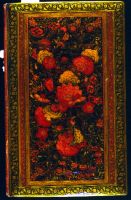
In the early years of the Islamic era, decorative elements were used in Qor’an manuscripts to mark the beginning and end of verses, surahs and parts, as well as the prostration points. The early decorative bands separating the surahs became elaborate panels in the third and fourth centuries AH, turning into richly refined frontispieces in the seventh and eighth, and eventually giving birth to illumination, a mature Islamic art in its own right, in the eleventh and twelfth. The arts of the book were also deeply affected by this development.
The term tazhib (literally ‘gilding’) refers to decorative compositions of various types of arabesques drawn in gold or black ink on indigo background. When other colors are conspicuously involved, the terms tarsi‘ (literally ‘bejeweling’), or tazhib-e morassa‘ (literally ‘bejeweled illumination’), are employed, and when the frames of the inscribed medallions surrounding the illuminated parts are drawn in brilliant colors, they are called jadval-e morassa‘ (literally ‘bejeweled margin’).
The decoration of Qor’an manuscripts and other precious books and poetic anthologies caused the arts of the book to develop immensely. The pages of Qor’an manuscripts and other precious books were adorned with delicate floral scrolls and harmonious geometric patterns executed on surfaces of gold and other colors. A magnificent, colorful world of refined patterns appeared in which the character of different periods can be retraced. The pages and frontispieces of the third and fourth centuries AH (9th c. AD) are modestly decorated. Those of the fifth and sixth centuries AH (11th & 12th c. AD), which coincide with the Seljuq period in Iran and Mamluk rule in Egypt, are austere and elegant, occupying a wider place and indicating a distinct progress; vegetal patterns have replaced simple geometric ones, and a type of scroll-like decoration has appeared. The illuminated panels of the seventh and eighth centuries AH (13th & 14th c. AD), i.e., the Il-Khhanid period, are majestic and powerful, including eight- and twelve-pointed stars, individually or in groups. Their relatively broad vegetal patterns combined with inscriptions in kufi script on indigo background are trikingly beautiful. Arabesques adorn the margins. Dark blue predominates in central parts and is surrounded by gold, blue, red, green and orange. Pages illuminated in the ninth, tenth and seleventh centuries AH (15th-17th c. AD), i.e., in Timurid and Safavid times, are sumptuous, refined and elaborate. Illumination reaches the peakof its perfection in the Timurid period, when the main colors are gold and indigo, and the main motifs are vegetal patterns, landscapes and occasionally birds.
The development of Iranian illumination is representative of the evolution of this country’s decorative arts. Today, the prosperity of the arts of the book, including illumination, has declined in the face of industrial printing technologies. However, the opening pages, margins and covers of printed Qor’ans, albums and
calligraphic collections continue to be illuminated, as a venerable tradition in full bloom.
In illuminated pages, indigo text appears on buff-colored pages. Sometimes the entire page is gilded and polished to serve as a background on which khata’i and eslimi patterns are drawn. The patterns are delineated with a fine ink pen and filled in with watercolor and indigo dye. The flowers’ edges are then highlighted and each petal is accentuated with a color deeper than its surrounding background.
Other elements involved in the decoration of Qor’an manuscripts, books and calligraphic pages are called tash‘ir, sar-lowh and shamseh.Tash‘ir refers to decorative monochrome—usually golden—drawings of rocs, dragons and other imaginary creatures, executed with a swift brush. Once these are drawn, the illuminator goes on decorating the floral and animal elements with golden dots.
Sar-lowh, or sar-lowheh, is a crown-like illuminated frontispiece—sometimes consisting of one or several symmetrical and scroll-like frames—that appeared at the top of the first page of the book. Under it, and sometimes connected to it, a decorative inscribed panel was added wherein the invocation Bismillah, the title of the book, and the names of its surahs, were written in kufi, sols, or reqa‘ script. These were called sar-lowh-e katibeh-dar. The frontispieces of Qor’ans copied during the first eight centuries of the Islamic era were mostly rectangular. In the Timurid period, these assumed the shapes of prayer niches, medallions, domes, multi-lobed figures and regular polygons. Safavid frontispieces were very varied in terms of design and coloring.
Shamseh refers to a star-like, or sun-like, figure inscribed in a circle. This motif, created from a combination of various decorative patterns, is visible in different types of decorative arts, such as tile-work, stucco carving, penmanship, etc. These roundels appeared at the beginning of most precious illuminated manuscripts.
Iranian painting, benefiting from its rich heritage, contributed to the decoration of vessels and influenced the design of carpets, tile-work, stucco carving and other arts. Following their acquaintance with Chinese art and the vogue of Song art in Iran, particularly after the Mongol invasion, Iranian painters briefly turned to merely copying them, but soon reverted to their own cultural heritage.
In the ninth century AH (15th c. AD), under the Timurid Shahrokh and his descendants, more than a hundred talented master painters working at the great library of Herat gave birth to the magnificent School of Herat, which contributed stupendous masterpieces to the history of art. Today Islamic painting is proud to have a master as Mahmood Farshchian, who has reached perfection in this field.
Traditional Arts with Qor’anic Themes
A multitude of exquisite handcrafts connected with architectural and utensil decoration were made of clay, wood, cloth, metal, etc. Superb Qor’an manuscripts, besides their artistic and calligraphic significance, have given birth to various styles of traditional book design, cover making and binding, which may therefore be considered arts related to the Holy Qor’an. Book covers underwent a long development from their initial form of two thin planks enfolding the text pages to the magnificent burnished or lacquered covers produced in later times.
were drawn, directly or by the intermediary of a page of paper, on the back of the leather. These were then cut out using a pointed knife and pasted elsewhere—inside or outside the cover. This technique was called sukht, or sukhteh, which means literally ‘burnt’, because dark brown leather was used to make this type of covers. Various arabesques, vegetal patterns and human or animal designs were used. The origins of this art date back to Timurid times. Superb sukht covers were also produced in the Safavid period.
·Sukht-e Mo‘arraq Book Covers
A type of sukht in which the patterns adorning the cover were made in the mo‘arraq manner, which gave it an even more precious appearance. This technique consisted of inlaying the cutout areas with replicas of the desired patterns usually made of darker leather. This was done so finely that the joint between the assembled surfaces was invisible. Book covers of this type were first made in the 9th century AH (15th c. AD) and they reached their peak of perfection in the Safavid period.
·Lacquered Book Covers
This type of book covers became popular in the second half of the 9th century AH (15th c. AD) and reached its peak of perfection in the 12th and 13th centuries AH (18th & 19th c. AD). Cardboard, paper paste, leather, thick cotton fabric and, rarely, thin boards were used in the manufacture of these covers. A layer of ab-e sorb was applied to the cardboard, leather, fabric or wood, and let to dry. The resulting surface was smoothed with a file and covered with a fine silk cloth on which the desired painting was executed. The finished work was covered with successive layers of lacquer (rowqan-e kaman), which gave it a glossy appearance. Various arabesques and ‘bird and flower’ patterns were used in this decoration.
·Hammered Book Covers
This was the most current type of book covers. The desired patterns were drawn in ink on a pair of complementary (‘male’ and ‘female’) pieces of hard leather, brass or wood, and their surrounding areas were hammered down to leave the patterns themselves in relief. The brass (‘female’) piece was chiseled so as to precisely reflect the relief of the entwined scrolls of the design. Once the brass matrices were ready, a press was used to transfer their patterns to the leather cover. These were sometimes gilded. Medallions and quarter medallions were also occasionally included.
·Pottery
One of the Iranians’ finest achievements is their pottery, which is as old as Iranian civilization. In the early centuries of the Islamic era, Nayshabur became the center of Iran’s pottery industry. Terra cotta wares left behind from the third and fourth centuries AH (9th & 10th c. AD) are brilliant examples of this art. The pottery of Kashan was unrivalled in the seventh and eighth centuries AH (13th & 14th c. AD).


