
Farairan’ Choice Reza Aramesh
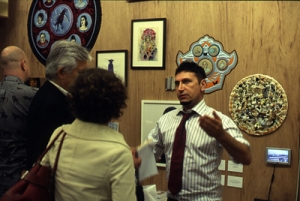
Born in 1970, AHWAZ, Iran
Works and lives in London, UK
EDUCATION:
Goldsmith College, London. 1997. MA Fine Art.
SOLO EXHIBITIONS AND PROJECTS:
2011 ‘Walking in the Darkness of a Promised Light’, Gallery Isabelle van den Eynde, Dubai, UAE
2009 Live Action 71, curated by The Diogenes Club, Late at Tate Britain, London, UK
‘Between the Eye and the Object falls a Shadow…’, B21 Gallery, Dubai, UAE
2008 Live Action 60, commissioned for Zoo Art Fair and CollectingLiveArt, London, UK
Best of Discoveries, Shcontemporary, Shanghai, China
2007 ‘You Were the Dead, Their’s Was the Future…’, Barbican Art Gallery, London, UK
‘Who is the Third that Walks Beside You?’, Matthew Bown gallery, London, UK
Reza Aramesh, Watermans Centre, London, UK
‘We’ve Lost the Hearts and Minds… E: vent gallery, London, UK
2006 Live Action ‘I am a Believer’, commissioned by ICA, Trafalgar Square, London, UK
2005 Live Action, ‘The Key of Dreams’, Gasworks Gallery, London, UK
Live Action ‘Of this Men Shall Know Nothing’, Thomas Goode Shop, London, UK
2003 ‘The Eternal Spring’, Laurence O’Hana Gallery, London, UK
2002 ‘Picture This..’, Platform Gallery, London, UK
GROUP EXHIBITIONS:
2011 ‘Light’ (part 1), Paradise Row, London, UK
2009 ‘Relaunch’, Sunbury House, London, UK
2008 ‘Los Vinilos’, Zoo Art fair, London, UK
Event Horizon, GSK Contemporary, Royal Academy of Art, London, UK
2007 Space Invasion, an International Offspace Project, various venues, Vienna, Austria
2007 ‘Los Vinilos’, Buenos Aires, Argentina
‘The Politics of Fear’, Albion gallery, London, UK
‘Temporary Measures’, Associate Gallery, London, UK
2006 ‘Making a Scene’, curated by Tal Yahas Haifa Museum of Art, Israel
‘Metropolis Rise: New Art from London’, CQL Design Centre, Shanghai and 798 Art District, Beijing, China
Culture Bound, East Wing Collection VII, Courtauld Institute of Art, Somerset House, London, UK
2005 ‘Defense’, University of California, Sweeney Art Gallery, USA
Contemporary Drawings, curated by Synthesis, Athens, Greece
‘We Have Met The Enemy and He is Us’, curated by Shezad Dawood, Redux Project Space, London, UK
2004 ‘So You’re Afraid of What?’, curated by Centrefold, Redux Project Space, London, UK
‘Copy-art.net’, curated by Irini Papadimitriou, ICA, London, UK
‘Gewalt’, curated by Suhall Malik, Laushy Art, Tel Aviv, Israel
Sir ® Eel: The Suit since ’68: The Politics of Revulsion, curated by Peter Lewis, Redux Project Space, London, UK
2001 ‘What if I Told the Truth?’, curated by Reza Aramesh, Cell Projects, London, UK
‘Trick Peaser’, curated by Luke Oxley, Mandarin Duck, London, UK
‘Teeth and Trousers’, curated by Richard Priestly, Cell Projects, London, UK
‘Forever Yours’, curated by Reza Aramesh, Victoria House, London, UK
‘Heart of Glass’, curated by Esther Windsor, London College of Printing, London, UK
AWARDS AND SCHOLARSHIP:
2007 Nominated for the Paul Hamlyn Award
2006 Nominated for the Paul Hamlyn Award
2006 Artsadmin Bursary
2006 Arts Council of England grant for the ‘I am a Believer’ show hosted by the ICA
2004 London Arts Research and Development grant, Arts Council
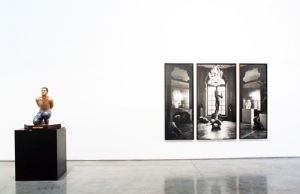
Action 97 (2010),Algerian civilians suspected of being terrorists are searched and put on trucks to be taken to the inter- rogation cells, Algiers 1956.
Born in 1970 in Ahwaz, Iran, Aramesh left his homelandwhen 16 and after completing his BA in Chemistry, changed his major and obtained his first class MA in Fine Arts at Goldsmith College, London. At first it was paintings and pieces of texts which attracted his attention, but since 2001 he is engaged in works he calls Actions. Launching shows or events which may or may not have any audience, nevertheless they remain in the form as photographs or videos where he explores his identity as a Middle Eastern man and all those clichés which can play a role in the relationship between East and West.
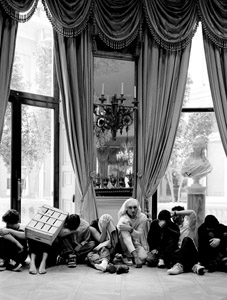
اکشن 42، پیروان فتح از منطقه حماس در شمال غزه به سوی کرانه باختری میگریزند. چاپ نقره، ژلاتین، 164 در 124.
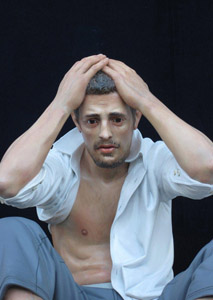
Action 105. An Israeli soldier points his gun at a Palestinian youth asked to strip down as he stands at a military checkpoint along the “separation barrier” at the entrance of Bethlehem. March 2006.
Aramesh, the imagery of the world in turmoil and war has become a focal point for his work. He meticulously recreates details found in images that are sourced from print, television and online media, all reporting on wars and international conflicts. The artist tends to focus on an individual or group of men, and endeavours to bring their character into his photographic or sculptural pieces.
In photography Aramesh finds a medium to connect social-politics of the modern world with his interests in art history, cinematography and literature.
In making his sculptures, Aramesh uses the exacting techniques employed by 17th Century European sculptors; the application of the varnish and paint are executed in the same way as the great ecclesiastical sculptures of the 17th Century. This is essential to understanding his work. Aramesh brings a contemporary dialogue to the traditions of sculpture and the long-standing debates of conflict and faith, and thus hope. He invites the viewer to question whether the victims of war which he portrays can be considered as modern day saints not in the disparaging relationship between East and West, but in terms of the absolute human realities of suffering.
Aramesh’s photographs represent a kind of stillness associating Still Life in painting. His scenarios go on stage, in slick modern apartments, stately British mansions, and art-filled museums. from majestic apartments to aristocratic houses in order to suggest that wealth and financial interests are fundamentally intertwined with war. He says: I think war reportage is presented in such a way as to make you see the horrible at the first glance. In this way, they focus on certain elements and exaggerate. Attention is drawn to horror and you stop reading the picture further. Aramesh wants to show all the layers of reality. “Life as it is lived is what theater and media lose in their search for horror. “The expression of tragedy turns to roar. I am interested in things which are completely left out; the things which are not captured by the camera, but are around it.”
Picture this. You are walking back from work down a pedestrian suburban street, and through the window of a terraced house you glimpse a group of Middle Eastern men lounging around in armchairs, wearing balaclavas. At a time when terrorist activity saturates popular visual culture, this simple tableau contains all the ingredients of tabloid sensationalism – the unexpected and dangerous combined with the neighbourly and familiar, peppered with a pinch of xenophobia. It is with such scenarios that Iranian artist Reza Aramesh adroitly explores his identity as a Middle Eastern man, as well as the complex relationship between East and West, in his recent show ‘Picture This’ (2002). His work, though political, has quite a humourous element running through it; an element that is highly important to him as he feels that humour creates a distance with which to critique culture. It is as though he uses humour as a tool rather than merely a means of making people laugh: humour often serves as a way of breaking down awkward situations, of making people feel at ease, perhaps even when they shouldn’t.
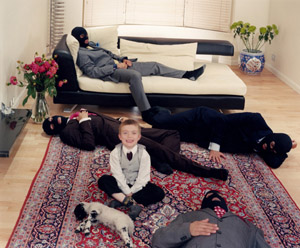
Like the Surrealists, Aramesh uses the masquerade to question the identity behind the mask. Drawing on his own experiences of living in both Iran and the UK, the artist explores how he himself is perceived, and the various fallacies on which such perceptions are founded.
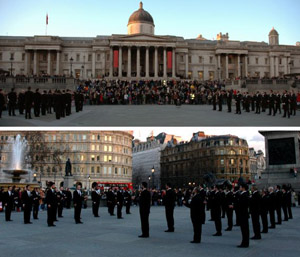
I am a believer (2005)
It’s interesting with Aramesh that as much as he wants to break down the constructs and structures of society, he avoids them. He states that he consciously avoids anything that could possibly dictate rules or impose bonds unto him, and one can see this obsessive aversion to authority in his work. He states that we can only define our identity within the very split-second that you do so, within moments that definitions changes, shifts according to your situation and beliefs. Such an attitude makes the theme of his I am a believer (2006 at Watermans) which takes the traditional Changing of the Guard ceremony and re-enacts it in Trafalgar Square. He first advertised, in various newspapers and publications, for males (of which roughly 99% were second-generation British) to perform the ceremony. In other words, by turning to the Past and glorifying traditions, and arguing that the I am a believer he is questioning the fact that identity could be fixed. He argues that this regression to the past, this citation of history as a form of psychological appeasement, is detrimental to contemporary society. Constructs, rituals, habits are what make the society and it is specifically these, which Aramesh finds so tiring, and burdensome.
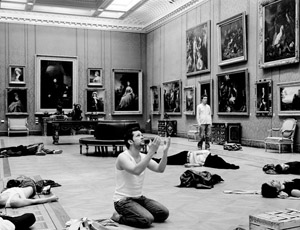
Between the Eye and the Object Falls a Shadow (2008)
The series Between the Eye and the Object Falls a Shadow (2008), a name borrowed from William Burroughs is an attempt to unlearn surrounding media images. He wants to overturn our perception of tragedy and in this way remind us of the reality of atrocities. The ever present coverage of atrocities rendered in words and images can desensitize us as much as bring about a kind of indifference through the knowledge we gain from tragedy. To confront such detrimental effect, he slows down the pace of the image to draw our attention to the essential humanity lost in momentous reading. In this way he breaks down the shape of the tragedy and with that suddenly nudity becomes vulnerability. The curiosity of viewer is left intact, but it seems naïve. Once again human tragedy becomes human. In his own words: Each one of us can be an oppressor and each one of us can be a victim.” That is why the oppressive figure is completely removed from this series and the camera intentionally keeps a distance and focuses on the detained groups of men.
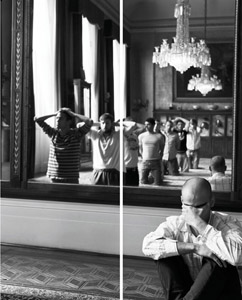
Walking in the darkness of a promised light (2011)
In the series called Walking in the darkness of a promised light (2011, Dubai), Aramesh puts himself centrally, amidst the swirling cross_currents of the global information flow and relentless supply and demand of media imagery from across the world. In this exhibition he presents photographs in the form of triptychs and diptychs in a Goya-like manner and five sculptures that employ traditional 17th century polychromatic, marquetry and wood-carving techniques. Their themes is the continuation of the previous series of conflict, war, martyrdom, sacrifice and most of all and more tangible, human suffering.
In his last show Them Who Dwell On Earth (2011, One Marylebone), the inaugural exhibition by Mottahedan Projects dedicated to developing, nurturing and creating platffoorms for emerging artists of our time, Aramesh displays seven sculptures and six photographs as his first solo exhibition in London.
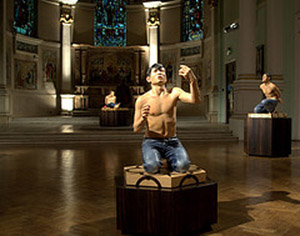
یکی از پیکرههای نمایشگاه ساکنین زمین 2011
در آخرین کارهایش، ساکنین زمین (2011، وان مریلبون) که یکی از پروژههای متحدان برای رشد خوراکرساندن و آفریدن سکوهایی برای هنرمندان در حال پیدایش روزگار ما از سوی محمد متحدان است، آرام هفت پیکره و شش عکس را در این نخستین نمایشگاه انفردی خود در لندن به نمایش میگذارد. پیکرهها از سبک تمثالهای کاتولیک پیروی می کنندف اما در اینجا به صورت رنج آدمی به نمایش گذاشته میشوند و بیشتر انگار دادخواهی میکنند تا گذشت الهی را به نمایش بگذارند. سپس با عکسها زمینه بیشتری به آنها داده میشود، نگارههایی عظیم و سیاه و سفید که نگاه خیره موضوع تنوعی از داوری یا بدفهمی را به نمایش میگذارد و احساس کلی ابهامی ژرف را. پیکرههایش برانگیزاننده، پرشورند و رویارویی نزدیک با افرادی که نقش قربانی را بازی میکنندف عواطف خود را برای ژرفاندیشی و مهر و شفقت به دنیا پیشکش میکنند.
امید است تلاشهای رضا آرامش در مقام هنرمندی ایرانی انگلیسی، همراه با دیگر هنرمندانی که دغدغههای او را دارند، درک گستردهتری میان باختر و خاور از راه رسانهی کارساز و تأثیرگذار هنر به وجود آورد.
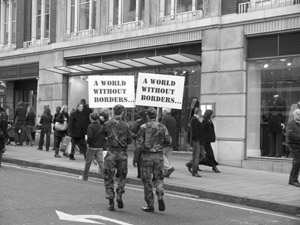
اکشن 58، دنیای بدون مرز
منابع:
کاتالوگ نمایشگاهها و بازبینیهای نمایشگاههایش از جمله در مجله فریز


