Farairan’ Choice Monir Farmanfarmaian
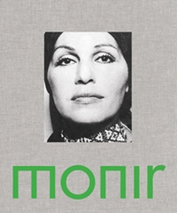
Edited by Hans Ulrich Obrist, Karen Marta. Text by Nader Ardalan, Media Farzin, Eleanor Sims. Conversation with Hans Ulrich Obrist. Published by Damiani
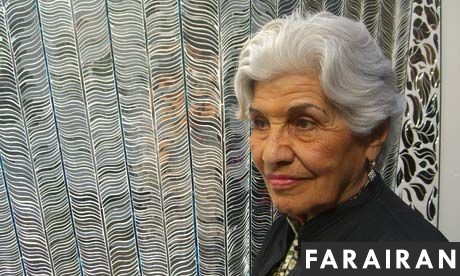
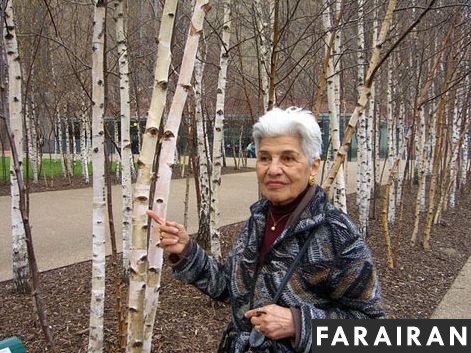
Monir Farmanfarmaian is one of those Iranian women of our time who brings to mind Ferdosi’s great epic Shahnameh and the verse: “That’s the way their women are, the Iranians.”
Born in 1923 in the city of Qazvin, and in one of those old and now nostalgic Persian house-gardens with rooms covered with gorgeous Persian carpets, and colored windows opening to orchards full of nightingales. During the WWII, she audaciously left the occupied Iran, because she had made up her mind to go to Paris to become an artist. The French consulate informed her that moving to occupied Paris was, unfortunately, impossible; as was her alternative plan of waiting out the war in Morocco, which was still under German attack. But Monir was undeterred: she resolved to move to America, and from there to Paris once peace was declared. She secured a place on an American battleship bound from Mumbai to California; from there, she travelled east to New York, arriving in 1945. She never made it to Paris, but she did become an artist.
Instead of Paris, she returned to Iran, entered Tehran University to study art (1944-46), went back to New York to further her studies at Parsons School of Design (1946-49) and Cornell University (1948-51) where she becomes close to many of the emerging contemporary artists of 1950s, like Louise Nevelson, Andy Warhol, Jackson Pollock and, later, Frank Stella, Willem de Konning and…, thus becoming a component product of Zeitgeist. She began her art career as a fashion illustrator for the department store Bonwit Teller, where “Andy would do the drawings and she would do the layouts.” The musician John Cage describes her as the “young beautiful Persian girl” while Monir describes Warhol as an ‘incredibly shy illustrator’ from whom she bought several sketches of shoes and in exchange gave him a small Mirror ball which he always kept on his desk. It is through her friendship with these people that her lifelong interest in modernism is instilled in her – the influence of which sits fascinatingly in her art. “It was amazing to know all these people,” she says. “I loved it. Even though I was just painting flowers and designing fashion, I loved these modern things.”
After a decade of life and studies in New York, she returned to Iran in 1957 which was a return to her rich Iranian inheritance. One day when taking some visiting western friends to Shah Cheraq’s Shrine in Shiraz, she sits in a corner for half an hour dumfounded by its unique majestic interior mirror work, crying like an innocent child by watching the reflection of people’s images – the faithful and beggars – in those tiny pieces of mirrors. This is how her lifelong experimentation with adapting and combining age old techniques of reverse-glass painting, mirror mosaics and Iranian Islamic designs with a modern abstract expressionism and minimalism begins.
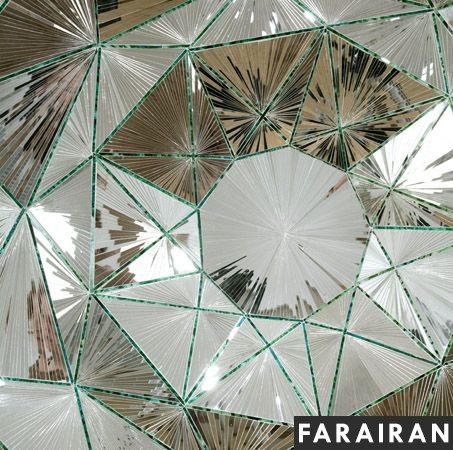
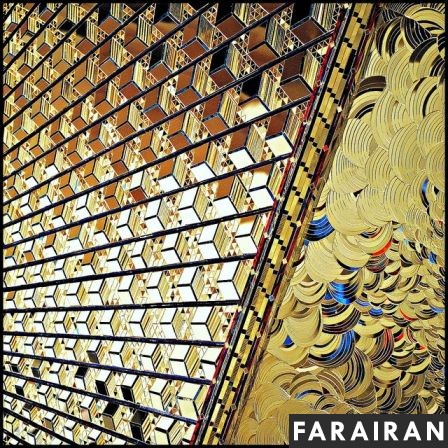
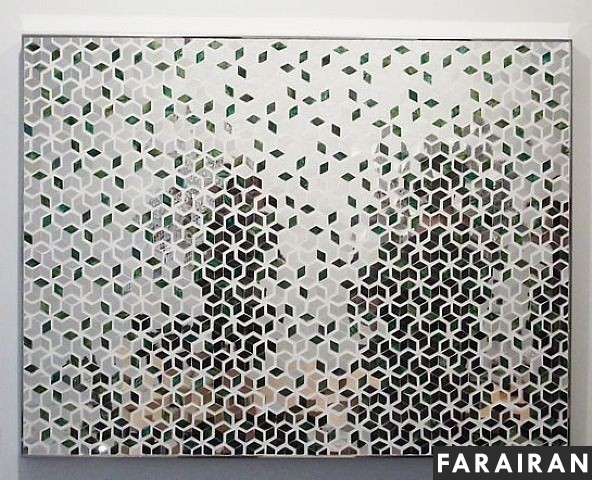
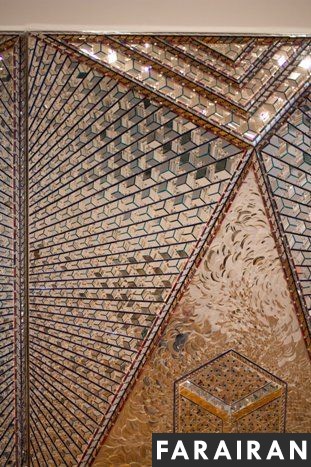
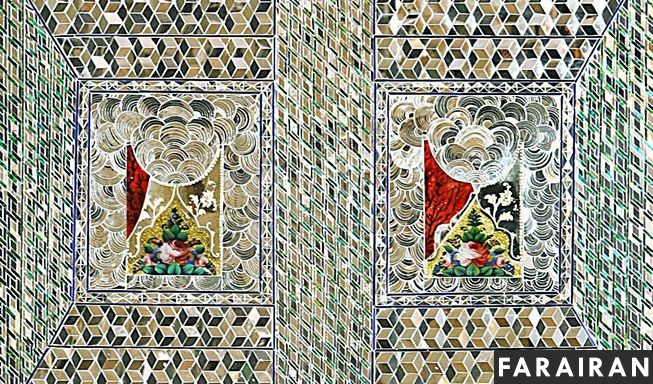
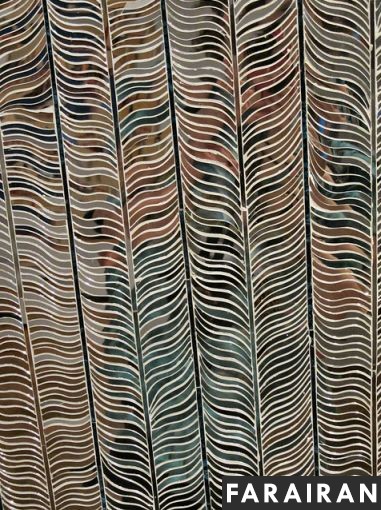
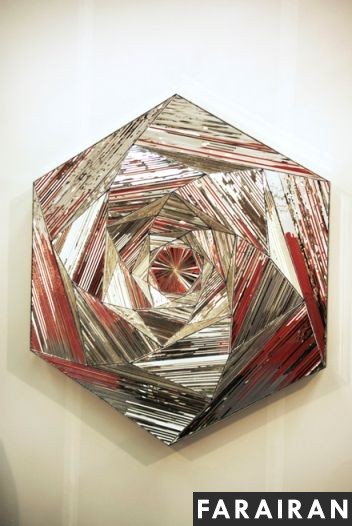
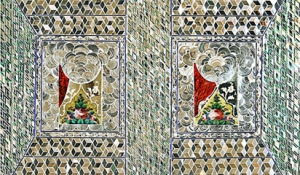
Farmanfarmaian’s art has encompassed many forms, from simple paintings of flowers and birds to unsettling “memory box” installations reminiscent of the oeuvre of Louise Bourgeois. But her largest, and most compelling, body of work combines two techniques from traditional Iranian design: mirror mosaic, and reverse glass painting, both having a flourishing existence in Iran before the advent of Islam (with Mirror Hall of Persepolis and the documentary Iran, Seven Faces of Civilization, as evidences)[1] and continuing to evolve as other art fields after Islam now not only in Royal Castles, but also Holy Shrines. These works are often large in scale and exquisitely beautiful, each sliver of glass catching and refracting the light like the teeming images inside a giant kaleidoscope, celebrating a culture which their creator adores.
Her distinctive aesthetic, thus rooted in a strong passion for her Iranian heritage was developed in the late 1960s and 1970s, with a knapsack of modern art she had brought home from US. It is during this period when Monir Farmanfarmain seriously begins to study the arts, crafts, customs and rituals of nomadic tribes in the Middle Eastern region, and toured ancient cities where she was impressed by their architectural forms and intricate ornamentation. Her work illustrates a commitment to these traditional Persian Oriental techniques and patterns, combining mirror mosaics, geometric patterns and reverse-glass paintings to create works that resonate both with traditional forms and a more modernist aesthetic.
Her reputation peaked in the 1970s, with major exhibitions in Tehran, Paris and New York. Hans Ulrich Obrist, the distinguished contemporary art director, curator, art critic and author becomes determined to see Farmanfarmain because during his trips to Cairo and Emirates at that time whenever he asked young artists: Who is your hero of the last generation? They always answered “Monir.” Obrist’s continued dialogue and friendship with Monir thereby becomes the basis of a monograph he edited about Monir (see above) and also his invitation to her to participate in his project Maps for 21st Century (2010) a series of lectures and discussions with the simple guideline: how artists perceive a map of 21st Century.[2]
Although Monir was brought up in affluence inherited from her grandfather (a merchant along the Silk Road), yet losing two sisters (one due to tuberculosis and the other to appendicitis), initiated her into pain and suffering quite early in life. After the Islamic Revolution of 1978, with the confiscation of her home and her art (some sold and others destroyed), she was forced to flee and take refugee in New York working on commissions, drawings, collages and models.
If in Iran her gender was her main hindrance as an artist (traditional craftsmen found it hard to take orders from a woman), in US it is her nationality which hinders her. In her own words: “After the revolution and the Gulf war, nobody wished to have anything to do with Iran and Iranians. None of the art galleries were willing to even talk to me. And after September 11 – my God. No way. Rather than being a woman, it was difficult just being Iranian.”
After her return to Iran in 2000, she was encouraged to recreate some of her lost works. Reluctant to copy herself, she began warming herself with abstract painting, dropping color on glass and mixing it with mirror work to rediscover the patterns she had begun in 60s when she first immersed herself in this old traditional Iranian branch of art. And like phoenix resurrecting from its own ashes, she was reborn from the kaleidoscopes of her own making.
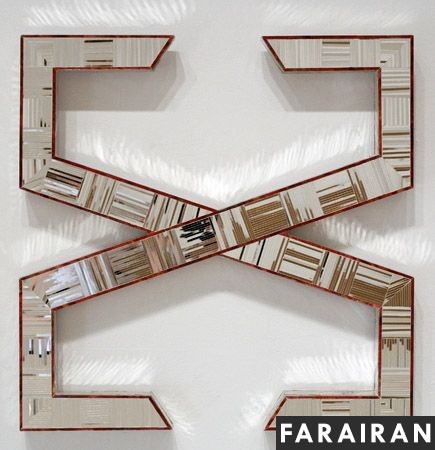
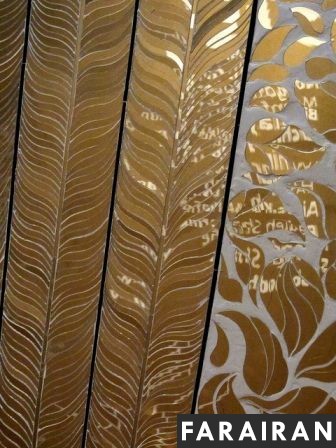
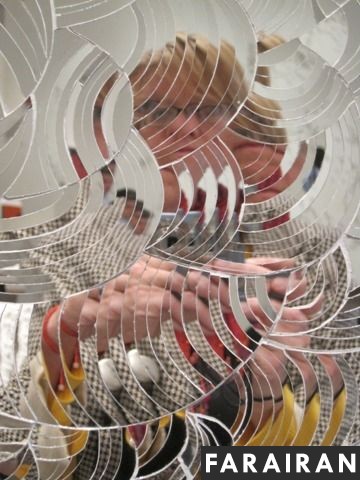
Monir Farmanfarmain is the first contemporary artist using traditional mirror mosaic and reverse glass techniques in her art. Her formula, using wooden and plaster ‘canvases’ allows the pieces to be movable, while traditionally they would have been fixed to the wall. When still young, whenever her father designed Persian carpets at home, Monir would sit beside him, stitching embroidery or drawing and painting flowers. She was still mainly painting flowers when for the first time she decided to use the reverse glass method, which is building up a picture in reverse on the back of glass. When she first tried to add mirrors to the work, she found that the oil paintings of flowers reacted badly with the adhesive she was using, thus she had to drop painting altogether. Now Monir has perfected her technique using different adhesive and glass that cuts to any size, shape and color in her works.
The mirror mosaics reflect many fragments of the world around them, assembling a constructed identity, a life composed of memories, individually disjointed, but beautiful in their overall effect, held in balance by the act of composition. Monir’s compositions, while externally bound and limited, open inwardly to the infinite, underlining the timeless and infinite quality of geometric concepts.
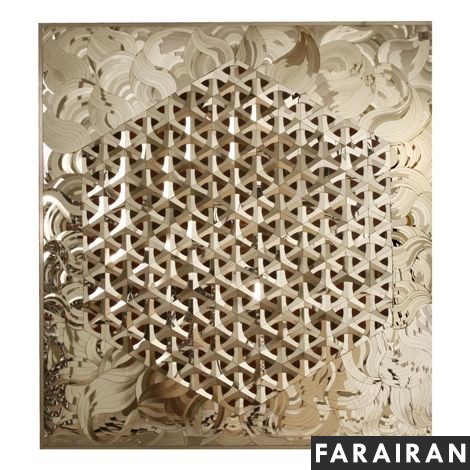
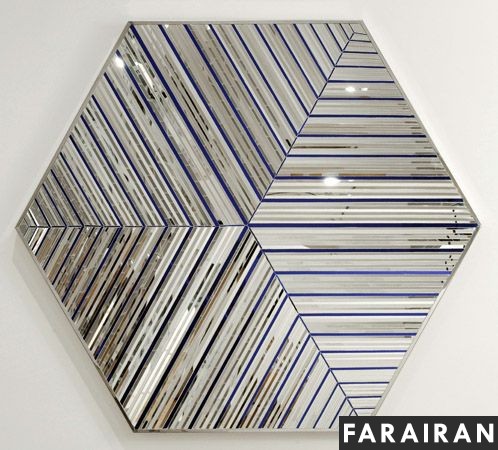
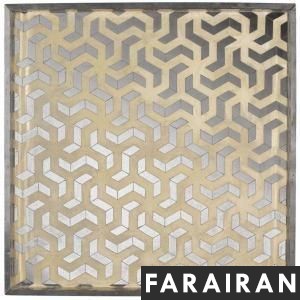
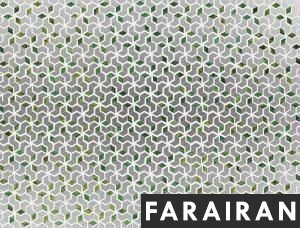
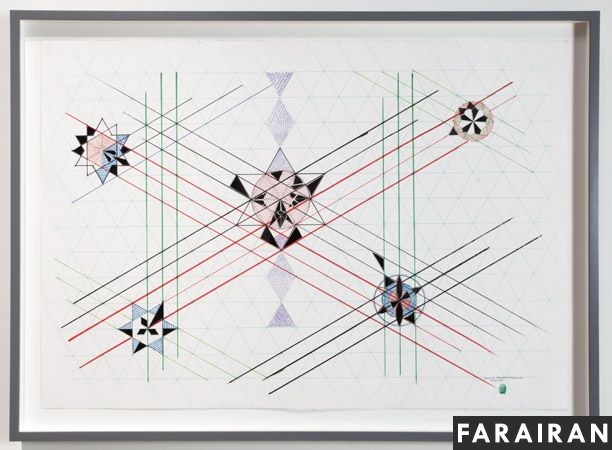
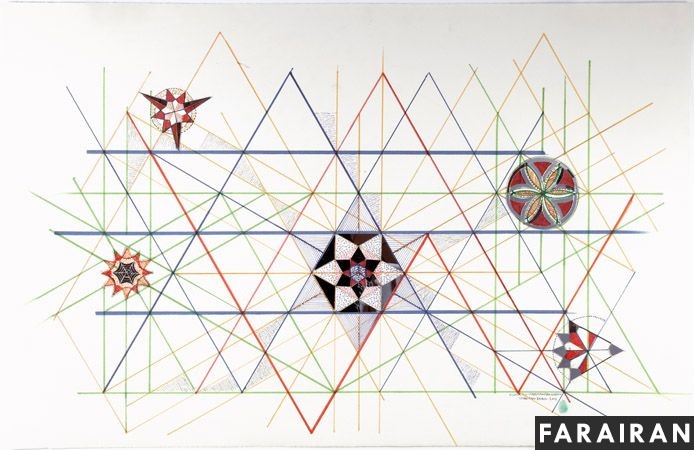
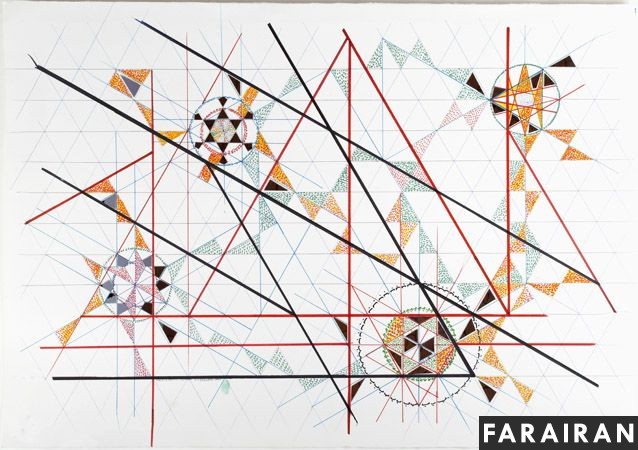
The traditional mirror mosaic designs revolve around geometrical shapes, notably the hexagon, rooted in ancient astronomical science. In her youth when Monir was first drawn to mirror work, she hired a math tutor to teach her the algebra and geometry she needed to construct these intricate and precise pieces. Curator Rose Issa, who also is an old friend of Monir highlights “Monir explores the different interpretations and variations of the flexibility of design that geometry allows.”
In this new period of her artistic creation, she not only continues to explore the variable arrangement of geometric figures, but also to emphasize on the physical movement of the shapes.
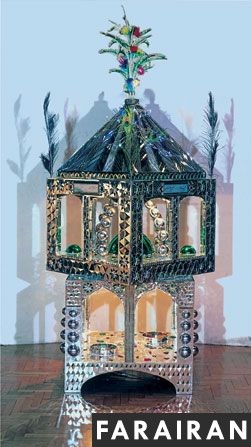
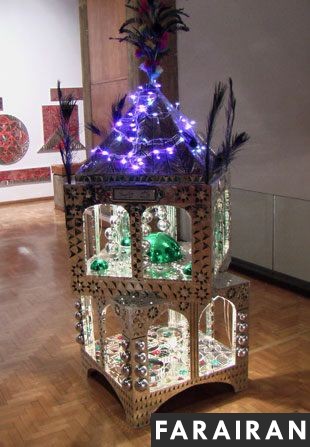
After years of absence from the scene of exhibitions, she held her first solo show in 2006 at Niavaran Artistic Creation Center, Tehran. The following year Monir Farmanfarmaian’s Mirror Mosaics were exhibited at Victoria and Albert Museum (2007). With Hejleh (2007), a mobile shrine used traditionally up in Iran to commemorate someone who has died, one comes to believe that her rebirth now consolidates, as going beyond and transcending the past is an integral part of any re-birth. She makes it in memory of her beloved husband, other family members, poets and other individuals she admired, which sounds like a homage to her personal and national past, the final stage of a metamorphosis, the butterfly is now ready to emerge out of the pupa of her transforming years of exile. No wonder that her next series conveyed the kind of air to be called the Geometry of Hope.
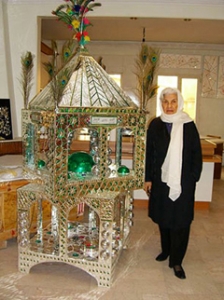
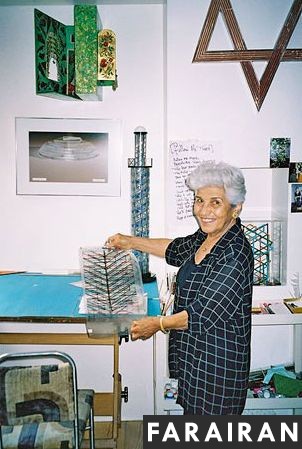
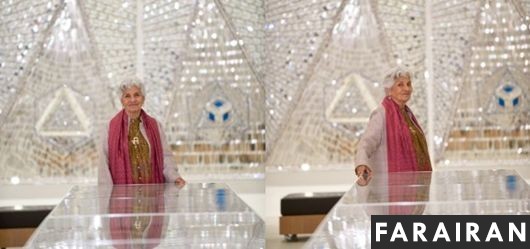
Farmanfarmaian with her work Hejleh
Geometry of Hope curated Rose Issa was held at Leighton House Museum, London in 2008. “I chose to use ‘Hope’ in the title of the exhibition,” explains Rose, “because I am always so happy in Monir’s studio.” The title pays homage to the beauty of Monir’s work, and refers to Sufi poetry where mirrors reflect life, light and hope.
Continuing on the path of surpassing the past, memories are poured out and Recollections (1 & 2) come to life.
Recollection 1, (Third Line Gallery, Dubai 2008), the reverse glass painting fragments that she incorporates among the mirror mosaics are details of flowers. Pen and ink drawings of flowers have been a constant practice throughout Monir’s life and she once spent many happy years creating a beautiful garden out of the bare earth around her (now confiscated) home in Tehran. It is as though with this series she reviews the geometric patterns of her own inner personal circle of life and deals with the outer social circle in Recollection 2.
Like many of her compatriots of her age and the generation after, Monir’s has witnessed the rise and fall of different political regimes in Iran. The Qajar painting fragments in Reflection 2, the dynasty whose fall coincided with Monir’s first birthday (1925) is like marking ‘ the end of a beginning’ and can symbolize the whole social historical past.
Her name appears on the shortlist for Jameel Prize 2011 at Victoria and Albert Museum, London. “I am old, but my mind is much younger. I never took myself seriously. I had no hope that I would be one of [the nominees for the Jameel prize], out of so many artists. But,” she adds with a mischievous cackle, “maybe I do deserve to win it, when I am 87 years old.”
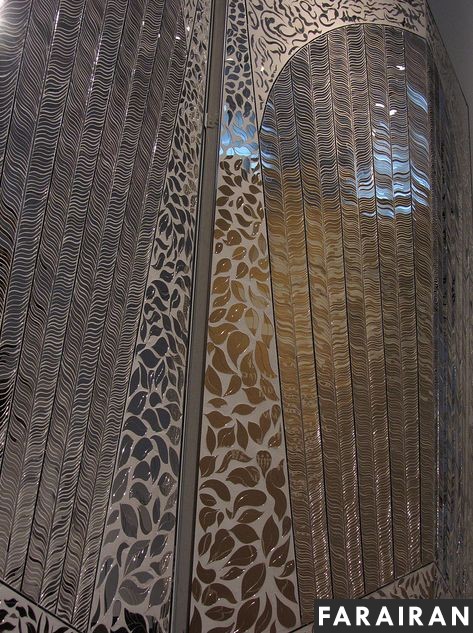
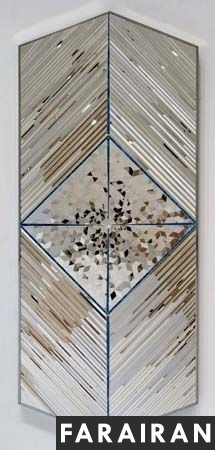
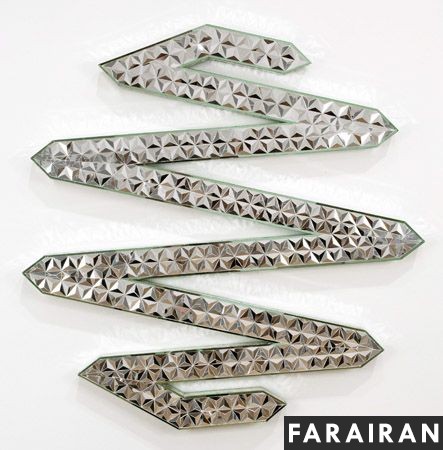
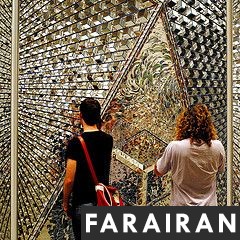
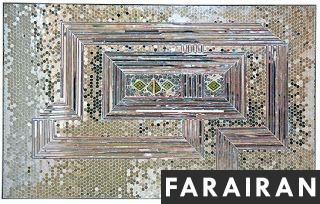
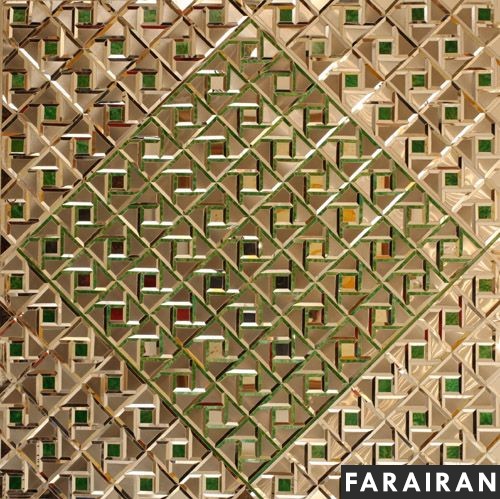
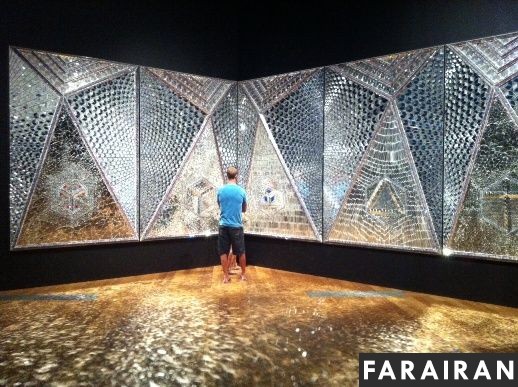
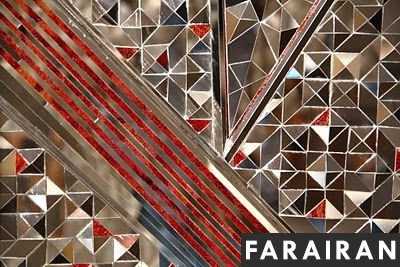
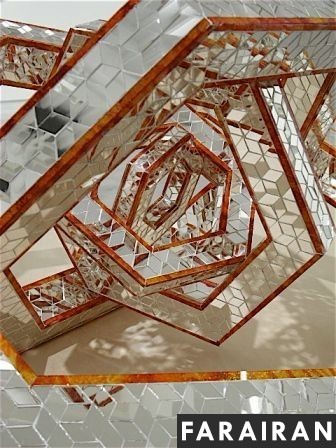
Monir has a command of a visual vocabulary that many would envy. She relies on instinct and intuition rather than theory, and her recent work is the result of a lifetime’s learning and experience. Her pieces are mystical in the play of light and colour from the mirror’s reflection and striking in their mathematical precision, and slick reflective surfaces. They come in a large scale and different shapes, some as a series and incorporate hundreds of tiny geometrical mirrors and reverse glass paintings, some only 1mm thick, carefully cut and positioned to fit. The details never cease to be alluring from 10 metres to 10 centimetres.
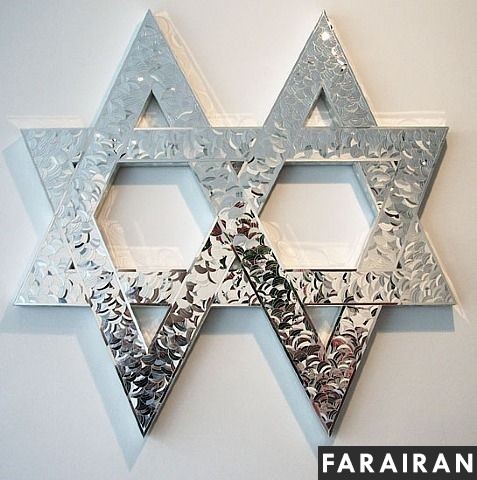
In her Bisections of a Circle Series recently shown at the 29th São Paolo Bienale in Brazil (2009), each work is embedded within a circle of 100 cm diameter; however in joining two overlapping circles Farmanfarmaian also references the mathematical concept of the Venn Diagram, which is used to define relationships between two or more concepts containing the possible iterations and intersections of elements. In this manner the geometric forms that are described within the circle – each articulated by a set number of points that touch the outer diameter- are also examples of the infinite possibilities of these works.
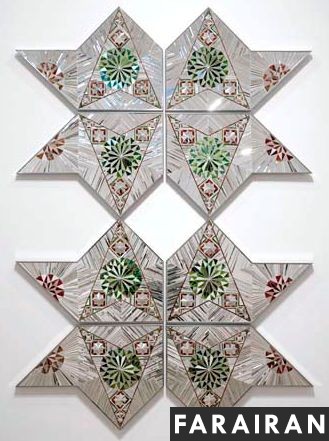
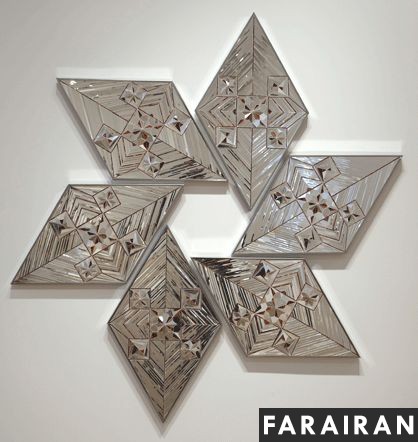
“So far as I am aware, no other artist has made works in five or six pieces that can be arranged in different ways as a collection. For two or three of them, I came up with the designs myself, then went to work on the framing. But most are taken from the geometric designs of old Islamic architecture.
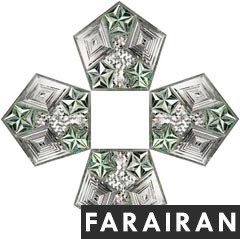
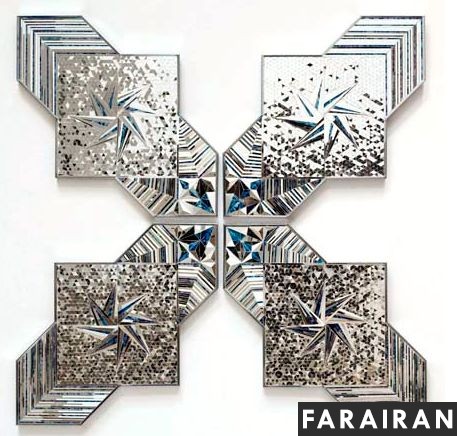
Group 4, Version 4, 2010 – Mirror mosaic, reverses glass painting -100 cm x 100 cm (estimate”
“I take one classic piece of architecture and then design around it with strips or squares, half-circles, hexagons or octagons.
“The first ones were quite simple, and then I begin making them more complex. Then I went in the other direction, simplifying them down as far as I could go.”
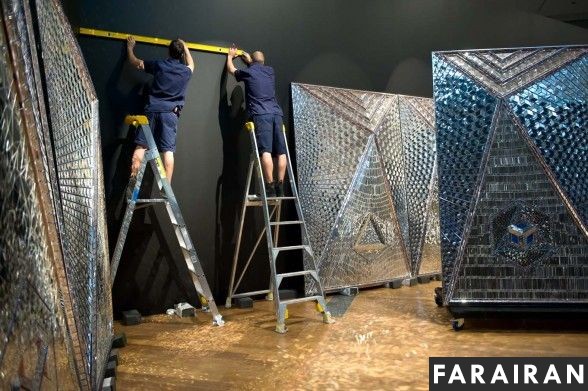
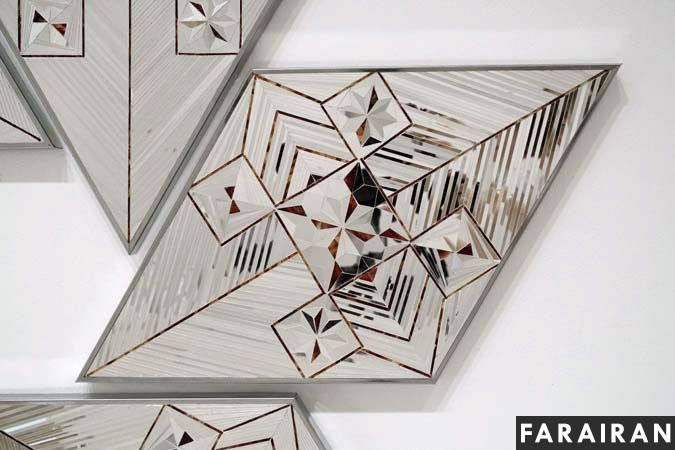
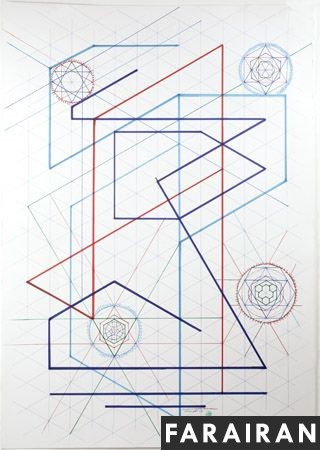
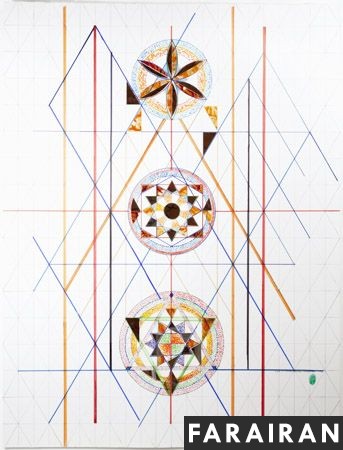
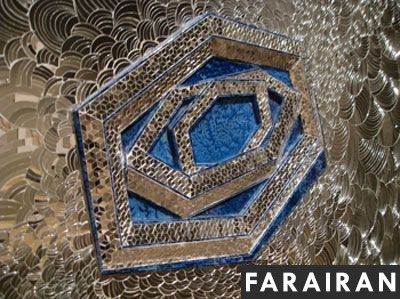
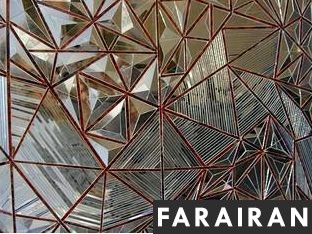
Monir, explains that there is no ‘arty’ inspiration for her work, simply a love of geometrical beauty; she draws out a plan for each work and from this, she works with craftsmen (with master Mohammad Navid as her first instructor) to build the final piece. Monir has a lot of input in the construction of each piece which usually changes from the original drawing. “The men who work for me are very good at what they do, but when it comes to being creative, they cannot do it, they are just craftsmen.” To construct her three dimensional panels, Farmanfarmaian employs them to draft her initial designs. Mirrors are then cut to fit the required shape and placed in geometrical patterns and mixed with plaster to produce new compositions which allow the artist to use colored glass too. The resulting works are complex geometrical patterns which refer to a wide range of influences in traditional art, architecture to sciences.
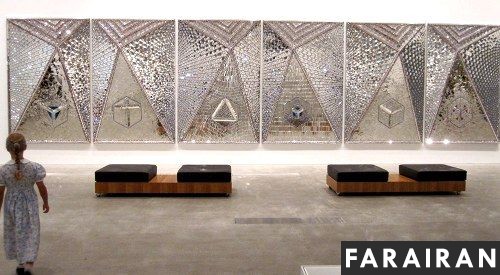
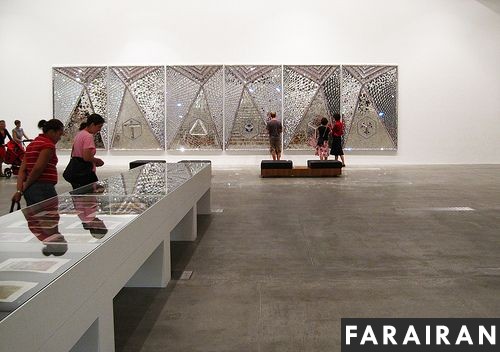
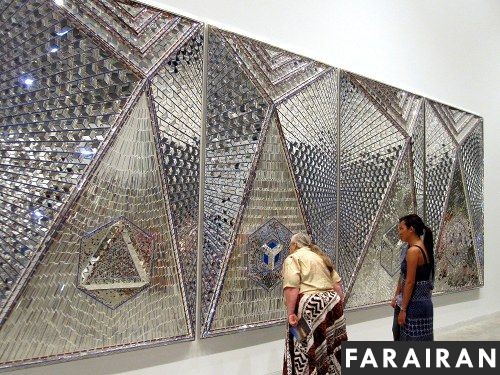
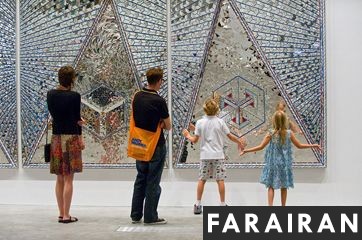
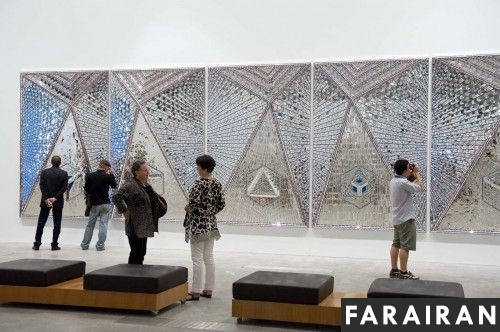
Farmanfarmaian’s work juxtaposes tradition and avant-garde to create colorful and geometric motifs: circles, squares and polygons are skillfully cast within the rigorous mould of classical geometrical design. Aware of her interest in Islamic geometrical patterns, the Queensland Art Gallery commissioned Patterns of infinity also called Lightning for Neda in 2009 for APT6, presented first by Sherman Contemporary Art Foundation. It is a computer touchscreen interactive in which participants can create colorful geometric designs. Children are invited to discover the complexity and beauty of geometric patterns and see how Monir’s installations and mirror mosaics drew inspiration from these time-honored design principles. The artist dedicated this work to the loving memory of her late husband, Dr. Abolbashar Farmanfarmaian.[3]
In this monumental work, the six sides of the hexagon provide an underlying structure and are expanded and elaborated on as a repeated motif. Additionally, the hexagon represents the six directions of motion (up, down, front, back, right, left) and the six virtues (generosity, self-discipline, patience, determination, insight, compassion). In each of the panels of Lightning for Neda, Farmanfarmaian has used over 4000 mirror shards to create myriad patterns across a sublime, glittering surface.
This is how much she has advanced as a product of Zeitgeist, to fill up the generation gap and bring shrines and hejlehs not only to museums, but on computer screens.
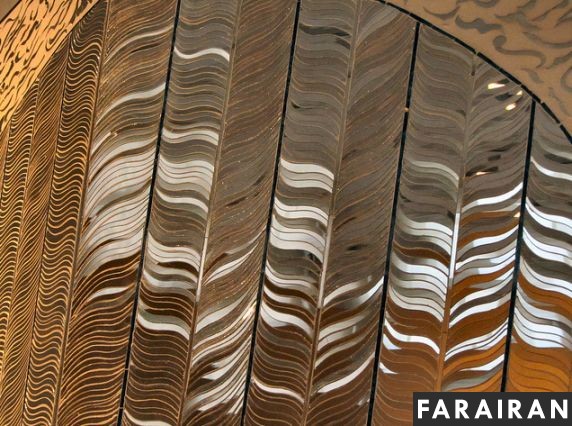
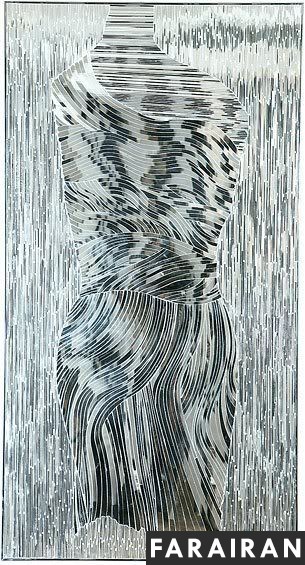
Flight of the Dolphin , (recently acquired by the Metropolitan Museum of Art, New York) is a geometric and reflective kaleidoscope with shard-like forms of color and light slicing through fragments of mirror, showing her ongoing endeavor to emphasize physical movement on a two dimensional surface.
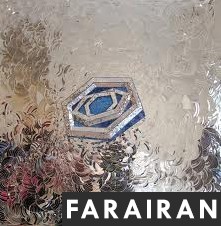
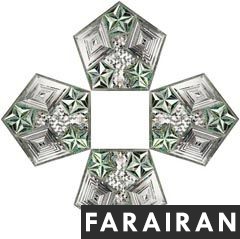
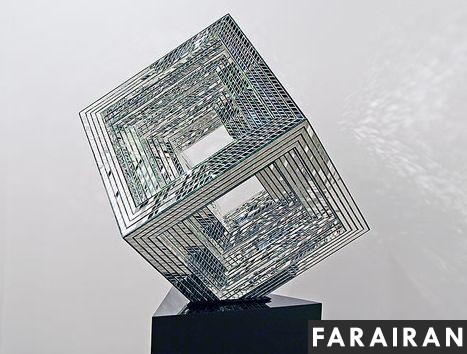
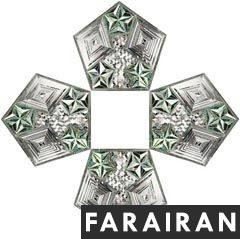
With the detailed intricacies of the cut mirror and her acute sense of modern aesthetics, Farmanfarmaian creates three-dimensional sculptures that challenge the basis of contemporary compositions. In her new work duplicating the selected figure either side by side, or facing each other, yet always connected, Farmanfarmaian creates a series of geometrical formations resulting in a number of kaleidoscopic variations. The negative space created within these formations further manifests other geometric shapes thus creating yet another layer to the work through careful and precise placement. Putting it in her own words: “The negative shapes are very important, so that the combinations can create, say, a four-pointed star in the space inside pentagons.”
Over the past forty years, Farmanfarmaian has explored, reintroduced and restructured the use of mirror mosaics, reverse glass painting and Islamic geometry creating her individualized technique. Inspired by the symbolism of numbers in Islam, where the belief is that at the core of any geometrical expression is the line and single figure based on the Divine Order of nature laws. This has led her to explore the notion of repetition, pattern and form creating elaborate combinations of shapes, color and line. In her latest series, aptly titled the Convertibles, her ornate works elevate this interplay to another level, creating formations that physically can be arranged in multiple variations.
There is no doubt that the evolution of Monir’s powerful and original vision will radiate for years to come, and leave its impact on subsequent generations of artists.