
Shahriar Adl The Knight of the Iranian World (1944-2015)
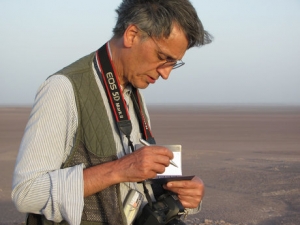
The Knight of the “Iranian World”, Shahriyar Adl was born on 3 February 1944 in Tehran. His father, Ahmad Hossein Khan Adle was from Tabriz and his mother Homa Vali, with the honorary title Zia-ol-Moluk was from the city of Bastam.
After finishing the primary and the first half of the secondary school, he was sent to Paris, for to quote him: “it had become a custom in my family since 19th century.” As a freshman he simultaneously began to study in three fields of Architecture at Beaux Arts, Art History, Oriental or Ancient Archaeology at Louvre’s Collage and Historical Iranian Studies at Sorbonne. Later, in order “to decrease the load,” as he put it himself, he gave up studying Architecture. He acquired his doctorate degree in history and started to teach when 24. “My main career from the very beginning was doing research at the National Center for Scientific Research (CNRS) in Paris… My other position was directorship of the International Editorial Committee of UNESCO’s History of Civilizations of Central Asia… If you ask others about me, depending on their field of interest, and how they have come across my work…some may say, Mr. Adle, is a Cartographer, or more precisely an aerial Cartographic engineer; some might say, he is a specialist in Old Tehran until Qajar era, another may say, he works on the history of photography and films…. Most of my articles are in French and English, but I also have several published articles in Farsi. In regard to executive positions I never had one. But, it happened that I often found myself involved in this kind of work as well…” And by executive posts, he meant, inscription, restoration and surveys of ancient art-works and historical sites in the Iranian World. 1
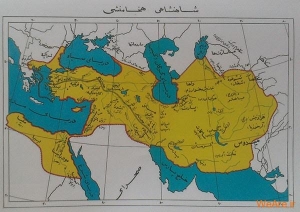
“The Iranian World (the world under the influence of Iranian Culture) is different from the Iranian Political Unit. The Iranian World extends far beyond the present Iran. In addition to Afghanistan, Tajikistan and Uzbekistan, it even includes countries like India and the old Ottoman Empire, which were different political units. Iranians, i.e. the inhabitants of the present Iranian Political unit, exactly like the people of Afghanistan and Tajikistan, are branches of the monumental tree of Iranian Culture and not the center and its sole heir.” 2
According to Shahriyar Adl, “In contrast to what is generally believed, the declining course of the Iranian World began eight centuries ago. It was actually under the Reign of Seljug (a Turkish-Sunni Muslim Persianized dynasty ruling the Iranian World from 1016-1153) when Iran, the whole Orient and the World of Islam in general started to decline. Under the reign of Mongols (1206-1368), we had agricultural decay, in other words, the regression was economic in nature. It was not sociological or philosophical. Our socio-philosophical regression had begun before that; when we came to think and believe that we have found the answer to all & everything and, religious discourses as an example came to a standstill. We reached certainty 800 years ago, henceforth stopped asking questions and from the moment a society stops asking questions, it is doomed to decline and perish… Our last achievements were accomplished at the time of Omar Khayyam (1048-1131). We haven’t had any scientific progress since 800 years ago. What progress, in which field? We have reached such certitude that we no longer ask questions…Old Iranians used to ask questions, but that is the past now.”3
Among Adl’s costly efforts in the field of art history, in addition to his precious researches and writings on the Mongolian, Indian, Safavid and Qajar schools of miniature painting, was the vital role he played to bring back the rare illustrated copy of Ferdowsi’s epic, Epistle of Kings, known as Tahmasbi Shahnameh with the help of Iraj Afshar, which is one of the most precious illustrated copies carried out under the reign of Shah Tahmasb Safavid (1524-1576).
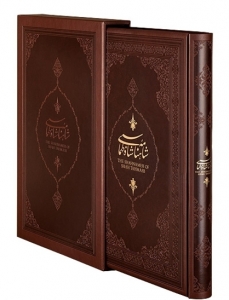
Tahmasebi’s Shahnameh
It is the fruit of 20 years of hard work of professional painters and calligraphers of the time. It was taken from Iran to the Ottoman Empire and from there to Paris, and from Paris to America and finally, back to Iran.4 He is also credited for his efforts in the return to Iran of stolen paintings from Golestan Palace in 1979.
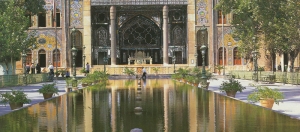
Golestan Palace, Tehran, Iran.
It was then when he discovered the Qajar films now being processed by the Centre National du Cinéma (CNC) with the support of IHF. Among the films found there was also a film by the world’s first woman director, Alice Guy-Blanché called Faust. The discovery inspired him to carry out a research on the history of photography in Iran and together with Yahya Zoka wrote an article in French called. “Notes et documents sur la photographie iranienne et son histoire: I. Les premiers daguerréotypistes c. 1844–1854/1260–1270.” Studia Iranica 12, no. 2 (1983).He also wrote another article on this subject titled Acquaintance with cinema and the first steps of filming and fimmaking in Iran in Farsi which was published in Farairan Quarterly in 2000.
In reply to the question whether he had seen any photographs of nude women in that collection, he points out that, “Under the Qajar, there were special houses in a few districts of Tehran which served the rich and the princes…. That’s why they had prepared a photo album to make the choice easier for the clients.” He has apparently also written an article on this subject in French.5
In addition to his valuable articles on the history of photography and cinema in Iran, one of his last articles titled “Significations and symbolisms of colors in the Iranian World during the Islamic era,” where he deals with the subject why we have images (painting, sculpture and photography) in Iran, but not in western Islamic countries for example.6
With the foresight of an archeologist and art historian, Shahriyar Adl began collecting religious and political posters during and after the Islamic Revolution. “I saw how in a very short time span after the Pahlavi era, in less than two decades, there suddenly appeared an enormous volume of extraordinary images on religious themes intertwined with those of everyday life on the walls of public places, tea-houses, shops, and even houses extending to the remotest villages. Considering Pahlavi’s policies together with the ideological, political and intellectual movements of the era, this amazing widespread appearance of images all over the country in such a short period of time was absolutely incredible and hard to justify. The idea crossed my mind that they are among the most important documents for the future researchers to understand what a sudden tremendous explosion had happened in that historical period of this country and how and to what extent the whole society and culture was revolutionized.”7
His interests as mentioned in passing included a wide spectrum from archaeological studies and art history of the Islamic period of the Iranian World, from painting under Mongols in India and its connection with Iranian Miniature to the history of photography and film-making to earthenware found in Rayy, Kashan to various archaeological surveys in Great Khorasan, Rayy, Kumesh (Semnan), Damghan and Gorgan Plateau; to restoration of Bastam’s Ancient Tower, preparation of meticulous topographical plans of monuments such as the portico of the old mosque in Zuzan in the south of Khorasan, the nine-domed mosque in old Balkh (Afghanistan), one of the oldest mosques of the world (8th century). After the tragic earthquake in the historical region Bam (2003) he made tremendous efforts to protect the remaining remains of its ancient citadel (Arge-Bam 500 BC), making a careful study in his own way, and opposed to the customary method of excavations and destructive explorations carried out by the overwhelming majority of archaeologists of this unique architectural and artistic treasure and its inscription on UNESCO World Heritage.
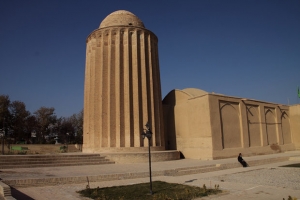
Bastam Tower
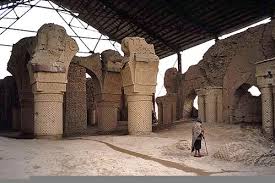
Nine domed Mosque in the Old Balkh (Afghanestan)
“Our archaeologists, no matter what they say are overwhelmingly under the influence of the West. They don’t know that they approach Iranian archaeology exactly in the same manner of Westerners. Despite all their claims, they adopt a Western methodology.” Yet, it seems this deep overwhelming influence goes far beyond even his own imagination to question his own approach to Persepolis when he said: “Nothing in Persepolis is Iranian, but it is all Iranian. It is an Iranian and Achaemenidian complex. The cow’s head is Assyrian, the columns are Ionian, Fravahar, which is its divine symbol is Egyptian and its head is Assyrian, even our architecture is not of stone, but clay, khesht (unheated brick) and brick, while Persepolis is made of stones. Yet, its architecture on the whole is neither Hellenic, nor Assyrian, nor Egyptian, but Achaemenidian and Iranian.” Where does the source of Professor Adl’s information come from? If not from the historians, archaeologists and other specialists of the present “Western Empire?”8
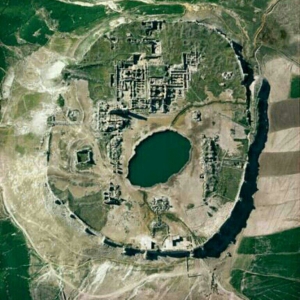
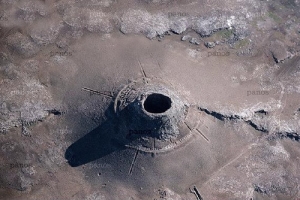
But let us not take it hard on him, as it is the turn of Western Civilization to rule the world and one should not disregard the fact that Adl’s is specialized in the Islamic era and not Ancient Iran. “One of the main reasons I decided to study the Islamic era is that it was neglected field at that time. When nearly all Iranian and foreign archaeologists were focused on pre-Islamic eras, I concentrated on the post-Islamic period.”9 That is why most of his researches in the fields of history and art history concentrate on mid-Islamic period and the Safavid and Qajar eras in particular. He has written an invaluable series of articles on Mongolian, Indian and the Safavid schools of painting.
It was in mid-seventies when he joined the International Editorial Committee of UNESCO’s History of Civilizations of Central Asia and under the deep impact of the historical events taking place in Iran at that time (the Islamic revolution and the war with Iraq) he became deeply concerned and endeavored hard to register ancient historical Iranian monuments and sites on the world heritage list and save them in this way.
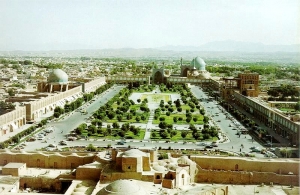
Naghsh-e Jahan Square, Esfahan, Iran
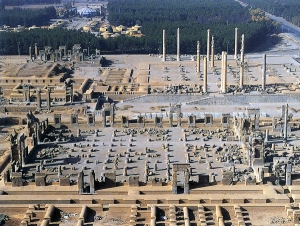
Persepolis, Shiraz, Iran
That is how he relates the story: “I remember how the inscription of Naqsh-e Jahan Square in Esfahan (Isfahan) turned out to be effective. Sadam’s missile hit Esfahan and ruined a part of Jameh Mosque… I remember I appointed myself as the representative of Iran and asked my friend Souren Melikian who was at that time a columnist of Saturday Herald Tribune to interview me as the representative of Iran (although officially I was not). The interview appeared on the first page of Herald Tribune with a photograph of Jameh mosque. In that interview I said Iraqis are bombarding the world’s heritage, an ancient mosque. After that there were no more threats to Esfahan.”10 In fact he managed to register Persepolis and the ancient ziggurat of Choghazanbil at the same time (1979).
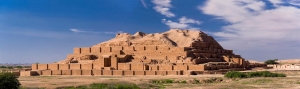
Choghazanbil Ziggurat
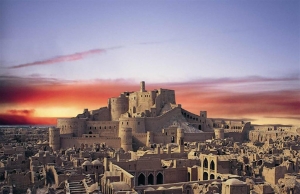
Bam Citadel, Kerman, Iran
After the tragic earthquake in Bam (2003), Shahriyar Adl proceeded in a very intelligent way to succeed in registering the remaining parts of this ancient city with its famous Citadel, the largest adobe building in the world going back to 4-6th centuries BC. With 80 percent of the citadel being destroyed, the work of its inscription on the world heritage list seemed impossible due to some technical archaeological rules and regulations. Here is when the knight steps forward with an ingenious idea: with a history of 7000 years, the historic site has not only a very significant place for Zoroastrians and thus the Iranian World, but as its Arge (citadel) is also known as Solomon’s Throne, it is one of the most holy places for the Jewish people, Christians and Moslems. According to Adl: “based on mythologies, even Cyrus’ Tomb with an altar inside it is attributed to Solomon’s mother.”11
Professor Adl also was instrumental in the preparation of the second cycle of the World Heritage Periodic Reporting in the Asia and the Pacific region and contributed to the serial transnational World Heritage nomination of the Silk Roads.12
He also played a major role in the inscription of other monuments like Sheikh Safi al-din Khānegāh and Shrine Ensemble in Ardabil and Tabriz Historic Bazaar Complex during 2004-2009.
One of his last public appearances was at an international conference organized by Iran Heritage Foundation and sponsored by the British Institute of Persian Studies, among others, in January 2015: From Persepolis to Esfahan: Safeguarding Cultural Heritage, where he gave a talk entitled ‘The Inscription of the First Iranian Sites on UNESCO’s list of World Heritage Properties in the Revolutionary Iran of 1979 and its Aftermath.’13
Shahriyar Adl, was a tireless scholar. As the President of the Editorial Committee of the International Editorial Committee of UNESCO’s History of Civilizations of Central Asia, he described the publication of this series as an immense task, part of his wish to contribute to one of the main goals proclaimed in UNESCO’s Constitution, which aims ‘to develop and to increase the means of communication between peoples and to employ these means for the purposes of mutual understanding and a truer and more perfect knowledge of each other’s lives.’ He participated in the reflection on the cross-reading of UNESCO’s General and Regional Histories.13
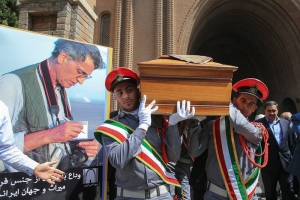
Professor Adl’s Funeral from the National Museum, Tehran, Iran
The sudden death of Shahriyar Adl on 21 June 2015 in Paris shocked the whole Iranian World and deprived it of its singular Knight.
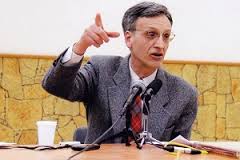
However, the good news is that in an interview with World Zoroastrian Council, his brother Kamran Adl has announced that their parents’ house in Tehran (where Shahriar was born and continued to live whenever in Iran) is hopefully to be turned into Shahriyar Adl’s Museum with his library and other collections now in his home in Paris eventually transferred to this future Museum.14
May that be so!
Farairan is honored to have had Professor Adl as one of Farairan Quarterly’s most respected consultants.
Awards:
1. Bronze Medal of CNRS, 1364
2. The Five Continents Medal of the United Nations Educational Scientific and Cultural Organization, 1967
3. Aristotle’s Silver Medal, UNESCO, 1375
4. Ibn Sina’s Medal, UNESCO, 1382
5. UNESCO’s Sixtieth Anniversary Medal, 1384
6. CNRS’ Medal, 1388
Works:
Books: “Art and Society in the Iranian World,” a collection of articles on The History and Art of Iran from the beginning of Islamic conquest to the Qajar era.
“Tehran, the two-hundred years old Capital,” with collaboration of Bernard Orgard.
The History of Civilization of Central Asia, UNESCO, with collaboration of Irfan Habib (2003). Adle was the editor of the fifth volume of this collection.
Selected Articles:
Significations and symbolisms of colors in the Iranian World during the Islamic era, Actes des colloque international tenu a paris les 11 et 12 janvier 2013, Paris 2016.
Recherche sur le module et le trace corrcteur dans la Miniature Orientale,
See Chahryar Adle, “New Data on the Dawn of Mughal Painting and Calligraphy,” in Making of Indo-Persian Culture: Indian and French Studies, ed. Muzaffar Alam, Françoise ‘Nalini’ Delvoye and Marc Gaborieau (New Delhi, 2000)
Acquaintance with cinema and the first steps of filming and fimmaking in Iran, Farairan Quarterly, No.2 & 3, 2000.
Khorkheh, The Dawn of Iranian Scientific Archaeological Excavation, Farairan Quarterly, No.3 & 4, 2000.
Investigations et releves archeologique a Zuzan Dan le Khorasan, A la frontier Irano-Afghane (1988-1999). Foundation Max van Berchem, 1999.
Daguerreotype, Encyclopedia Iranica, vol.6, 1993
Les artistes nommés Dūst-Muḥammad au XVIe siècle,” Studia Iranica 22/2 (1993),
Chahryar Adle, “Les artistes nommés Dūst-Muḥammad au XVIe siècle,” Studia Iranica 22/2 (1993)
La Reconstitution Photogrammertrique de la Mosquee-Medresse de Zuzan, Foundation Max van Berchem, 1990
Entre Timourides, Mogols et Safavides – Notes sur un Châhnâmé de l’Atelier-Bibliothèque Royal d’Ologh Beg II à Caboul (873-907/1469-1502),” Art Islamique et Orientalisme – Vente aux Enchères Publiques (15 Juin 1990), Drouot-Richelieu (Paris, 1990), pp. 136-48, esp. p. 140.
Le Mausolee d’Abu Yazid Bastami, Dossiers Historie et archeologie, 1987
Adle, Chahryar, and Zokā Yahyā. “Notes et documents sur la photographie iranienne et son histoire: I. Les premiers daguerréotypistes c. 1844–1854/1260–1270.” Studia Iranica 12, no. 2 (1983): 249–80.
Le Minaret du Masjed-e jame de Semnan, Studia Iranica, 4 (1975)
Les Monuments due XIe siècle du Damqan, Studia Iranica, 15, 1972
Note Sur le Qabr-I Sahruh de Damghan, Le monde iranien et l’Islam, II, 1974.
Farairan Quarterly, Issues 5 and 6
There are alos three articles, Duust-Mohammad Mosawwer, Encyclopedia Iranica, Lost treasures at the Amiranshvilli Museum, Tibilisi and IHT: Souren Melikian 10/18/97 cited at www.spongobongo.com/her9982, but all are apparently removed.
Footnotes:
1. All quotations in this paragraph is taken the article Shahriyar Adl in his own words, Hamidreza Hosseini, www.jadidonline.com
2. An extract from an unpublished interview with Shahram Zare,, Bokhara, No.107, 2015.
3. ibid.
4. Hassan Habbibi, The story of how Tahmasebi’s Shahnameh was returned to Iran, www.khabaronline.ir
5. Mohammad Fadaee, “Shahriyar Adl’s Care and Zeal,” Bokhara.
6. Ibid.
7. Ibid. For information about Adl’s new discoveries in Bam, see/Articles/
Ibid. See, Khoobchehr Keshavarzi, A New Approach to Persepolis (1392) and The Lost Citadel of Avesta (1393), Farairanonline.
8.
9. Shahriyar Adl in his own words, Hamidreza Hosseini, www.jadidonline.com
10. Ibid.
11. Shahriyar Adl, The History of inscription of Iranian historical sites, Soltanieh (in Zanjan), Persepolis and…
12. http://www.iranheritage.org/
13. http://whc.unesco.org/
14. Interview of the World Zoroastrian Council with Kamran Adl, http://w-z-c.com.


