The obscure religion that shaped the West

Joobin Bekhrad

Source: Payvand.com
Talk of ‘us’ and ‘them’ has long dominated Iran-related politics in the West. At the same time, Christianity has frequently been used to define the identity and values of the US and Europe, as well as to contrast those values with those of a Middle Eastern ‘other’. Yet, a brief glance at an ancient religion – still being practised today – suggests that what many take for granted as wholesome Western ideals, beliefs and culture may in fact have Iranian roots.

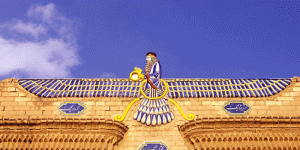
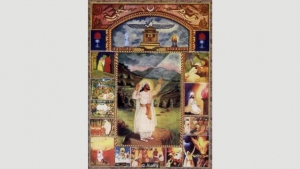
It is generally believed by scholars that the ancient Iranian prophet Zarathustra (known in Persian as Zartosht and Greek as Zoroaster) lived sometime between 1500 and 1000 BC. Prior to Zarathustra, the ancient Persians worshipped the deities of the old Irano-Aryan religion, a counterpart to the Indo-Aryan religion that would come to be known as Hinduism. Zarathustra, however, condemned this practice, and preached that God alone – Ahura Mazda, the Lord of Wisdom – should be worshipped. In doing so, he not only contributed to the great divide between the Iranian and Indian Aryans, but arguably introduced to mankind its first monotheistic faith.

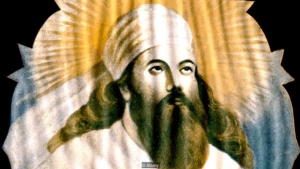
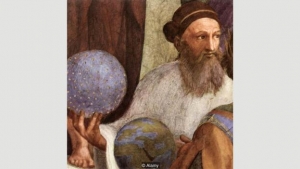
D407XP Portrait of the Zoroastrian prophet Zarathustra

Zoroaster likely lived between 1500 and 1000 BC, but some scholarship suggests he may have been a contemporary of Persian emperors Cyrus the Great and Darius I (Credit: Alamy)

The idea of a single god was not the only essentially Zoroastrian tenet to find its way into other major faiths, most notably the ‘big three’: Judaism, Christianity and Islam. The concepts of Heaven and Hell, Judgment Day and the final revelation of the world, and angels and demons all originated in the teachings of Zarathustra, as well as the later canon of Zoroastrian literature they inspired. Even the idea of Satan is a fundamentally Zoroastrian one; in fact, the entire faith of Zoroastrianism is predicated on the struggle between God and the forces of goodness and light (represented by the Holy Spirit, Spenta Manyu) and Ahriman, who presides over the forces of darkness and evil. While man has to choose to which side he belongs, the religion teaches that ultimately, God will prevail, and even those condemned to hellfire will enjoy the blessings of Paradise (an Old Persian word).


Zoroastrianism may have been the first monotheistic religion, and its emphasis on dualities, such as heaven and hell, appear in Judaism, Christianity and Islam (Credit: Alamy)

How did Zoroastrian ideas find their way into the Abrahamic faiths and elsewhere? According to scholars, many of these concepts were introduced to the Jews of Babylon upon being liberated by the Persian emperor Cyrus the Great. They trickled into mainstream Jewish thought, and figures like Beelzebub emerged. And after Persia’s conquests of Greek lands during the heyday of the Achaemenid Empire, Greek philosophy took a different course. The Greeks had previously believed humans had little agency, and that their fates were at the mercy of their many gods, who often acted according to whim and fancy. After their acquaintance with Iranian religion and philosophy, however, they began to feel more as if they were the masters of their destinies, and that their decisions were in their own hands.

Though it was once the state religion of Iran and widely practised in other regions inhabited by Persian peoples (eg Afghanistan, Tajikistan and much of Central Asia), Zoroastrianism is today a minority religion in Iran, and boasts few adherents worldwide. The religion’s cultural legacy, however, is another matter. Many Zoroastrian traditions continue to underpin and distinguish Iranian culture, and outside the country, it has also had a noted impact, particularly in Western Europe.

Zoroastrian rhapsody

Centuries before Dante’s Divine Comedy, the Book of Arda Virafdescribed in vivid detail a journey to Heaven and Hell. Could Dante have possibly heard about the cosmic Zoroastrian traveller’s report, which assumed its final form around the 10th Century AD? The similarity of the two works is uncanny, but one can only offer hypotheses.

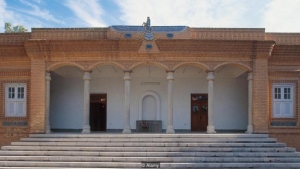
CP59C3 Iran – Yazd. The Temple of Zoroaster (Atashkade).

Zoroastrians worship in fire temples, such as this one in Yazd, Iran – they believe fire and water are the twin agents of purity and necessary for ritual cleansing (Credit: Alamy)

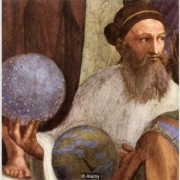
Elsewhere, however, the Zoroastrian ‘connection’ is less murky. The Iranian prophet appears holding a sparkling globe in Raphael’s 16th Century School of Athens. Likewise, the Clavis Artis, a late 17th/early 18th-Century German work on alchemy was dedicated to Zarathustra, and featured numerous Christian-themed depictions of him. Zoroaster “came to be regarded [in Christian Europe] as a master of magic, a philosopher and an astrologer, especially after the Renaissance,” says Ursula Sims-Williams of the School of Oriental and African Studies at the University of London.

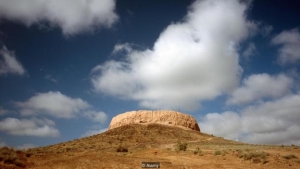
AC2G5W Zoroastrian Tower of Silence at Chilpyk (Karatou) near the Uzbek town of Nukus in Karalkapakstan.

Towers of Silence, such as this one in Chilpyk, Uzbekistan, are where Zoroastrians would leave the bodies of the dead to be consumed by birds (Credit: Alamy)

Today, mention of the name Zadig immediately brings to mind the French fashion label Zadig & Voltaire. While the clothes may not be Zoroastrian, the story behind the name certainly is. Written in the mid-18th Century by none other than Voltaire, Zadigtells the tale of its eponymous Persian Zoroastrian hero, who, after a series of trials and tribulations, ultimately weds a Babylonian princess. Although flippant at times and not rooted in history, Voltaire’s philosophical tale sprouted from a genuine interest in Iran also shared by other leaders of the Enlightenment. So enamoured with Iranian culture was Voltaire that he was known in his circles as ‘Sa’di’. In the same spirit, Goethe’s West-East Divan, dedicated to the Persian poet Hafez, featured a Zoroastrian-themed chapter, while Thomas Moore lamented the fate of Iran’s Zoroastrians in Lalla Rookh.

It wasn’t only in Western art and literature that Zoroastrianism made its mark; indeed, the ancient faith also made a number of musical appearances on the European stage.

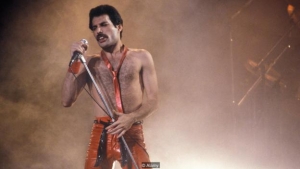
In addition to the priestly character Sarastro, the libretto of Mozart’s The Magic Flute is laden with Zoroastrian themes, such as light versus darkness, trials by fire and water, and the pursuit of wisdom and goodness above all else. And the late Farrokh Bulsara – aka Freddie Mercury – was intensely proud of his Persian Zoroastrian heritage. “I’ll always walk around like a Persian popinjay,” he once remarked in an interview, “and no one’s gonna stop me, honey!” Likewise, his sister Kashmira Cooke in a 2014 interview reflected on the role of Zoroastrianism in the family. “We as a family were very proud of being Zoroastrian,” she said. “I think what [Freddie’s] Zoroastrian faith gave him was to work hard, to persevere, and to follow your dreams.”

Ice and fire

When it comes to music, though, perhaps no single example best reflects the influence of Zoroastrianism’s legacy than Richard Strauss’ Thus Spoke Zarathustra, which famously provided the booming backbone to much of Stanley Kubrick’s 2001: A Space Odyssey. The score owes its inspiration to Nietzsche’s magnum opus of the same name, which follows a prophet named Zarathustra, although many of the ideas Nietzsche proposes are, in fact, anti-Zoroastrian. The German philosopher rejects the dichotomy of good and evil so characteristic of Zoroastrianism – and, as an avowed atheist, he had no use for monotheism at all.


Raphael’s The School of Athens, finished in 1511, includes a figure, seen in this detail from the larger work, many historians think is Zoroaster, holding a globe (Credit: Alamy)

Freddie Mercury and Zadig & Voltaire aside, there are other overt examples of Zoroastrianism’s impact on contemporary popular culture in the West. Ahura Mazda served as the namesake for the Mazda car company, as well as the inspiration for the legend of Azor Ahai – a demigod who triumphs over darkness – in George RR Martin’s Game of Thrones, as many of its fans discovered last year. As well, one could well argue that the cosmic battle between the Light and Dark sides of the Force in Star Wars has, quite ostensibly, Zoroastrianism written all over it.

BEGANT Freddie Mercury of the British Rock Band Queen. Image shot 1980. Exact date unknown.

Freddie Mercury, the legendary lead singer of Queen, drew inspiration from the Zoroastrian faith of his Persian family (Credit: Alamy)

For all its contributions to Western thought, religion and culture, relatively little is known about the world’s first monotheistic faith and its Iranian founder. In the mainstream, and to many US and European politicians, Iran is assumed to be the polar opposite of everything the free world stands for and champions. Iran’s many other legacies and influences aside, the all but forgotten religion of Zoroastrianism just might provide the key to understanding how similar ‘we’ are to ‘them.”

Farairan suggests two sources for further reading: Paul Kriwaczek, In Search of Zarathustra, (2003) & Khoobchehr Keshavarzi, A New Approach to Persepolis, which was published in 2015 (Behjat Publishing, Tehran), with a chapter of it in English found at: /Articles/ArticleDetailEn.aspx?src=159&Page=1

A Visit to Oudlajan, Unremembered Remnant of Old Tehran

NavidJamali
[1] Mina Fatemi[2]
1. Introduction:

Preserving historical fabrics in Iran in comparison to western countries is a newly established endeavor. This concern grew in Europe from several years ago and synchronous to modernization of societies. Technological developments in the twentieth century, providing the possibility to generate multiple copies of artworks firstly heralded a new age, in which Art, previously available onlyto the elite, was taken and brought among the ruck. But, it promptly revealed its destructive aspects. James Fitch, theorist of restoration, believes that in none of the other characteristics of material culture, possibility of frequent reproductions of the original exemplar and placing them in different situations, was as evident as in architecture. The paradigms established by renowned modernist architects, would be executed, lacking compatibility with the context. The cultural consequences of this phenomenon were far more destructive: imported paradigms with their “new” and “universal” prestige had the tendency to make the indigenous forms and thinking, inconsequent and then replace them. Therefore the achievements and valuable examples of autochthonous architecture in most of the historical fabrics were gradually demolishing.[3]

Now we return to modern Iran; a country in which every region and city due to a rich historical background includes an exclusive architecture and urbanism.Architectural traditions grew during several centuries and in harmony with natural landscapes and climatic conditions of each city. Many cities in Iran expanded in the modern era according to western paradigms, inheriting valuable historical fabrics in their central cores. Yet the phenomenon introduced by James Fitch as the destructive process of imported paradigms replacing indigenous constructions, can somewhat be seen in all of these cities.

Tehran as thecapital of Iran in last two recent centuries, has inherited one of the most precious urban fabrics of Qajar era. The modernization of the city precede all other cities of the country and the records of its modernization date back to mid to late reign of Naser al-Din Shah Qajar. The urban structure of Tehran in 1890s shows two distinct layers: the central core or Safavid city zone with all the characteristics of traditional cities in central plateau of Iran, comprising the organic and entwined network of alleys, dead ends, markets and plazas, and in contrast to the grid of streets within the confines of Naseri period expansions. This matter didn’t remain covert for western explorers that the king focused modern constructions on a layer beyond the central core and left the old beautiful neighborhoods in their original form.[4]

In Pahlavi era the construction of new streets took place in the historical core, neglecting the structure and function of the fabric and car-based roads took precedence over them. These constructions caused great damage not only to the original image of thehistorical fabric, but also to the way of thinking about housing and residential fabric. From the middle of this period with the simultaneous construction of new suburban areas around the city, the affluent residents of the historical core moved to the new neighborhoods and migrants from rural areas, who descended to Tehran due to conversion of economy, dwelled in the central core, without having anyattachment to the place.

2. The last remnants of old Tehran

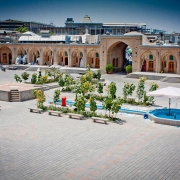
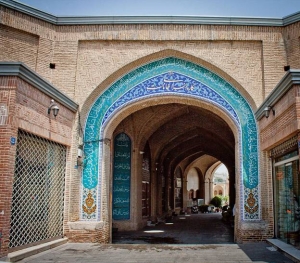
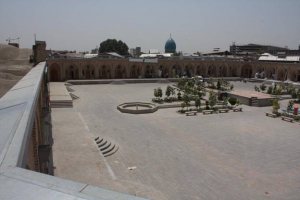
The antiquity of Oudlajan is not accurately determined yet.The name can be seen in historical texts and maps in early Qajar era. The term of “Oudlajan” roots in townsfolk’s accent, still prevalent in the villages of Shemiran city. In this term, “Ou” is the local pronunciation of the word “water”, “drajin” means distribution and “an” is a place suffix. In Qajar era the Arabic orthography of the term was used.[5]Oudlajan is one of the five oldest districts in old Tehran within the confines of Safavid city, located east along NasirKhusrawStreet. From east it beganfrom Amin-ol-hozurjunction and PestehBeig garden, encompassing ImamzadehYahya, reaching to Sarpoolak in south, and led to Bazaar in south west. The current area of the district is approximately 150 hectares. According to statistical analysis in 1868, Oudlajan had been the most densely populated district of Tehran among the five and had had the most residential houses of the time.[6]

Comparisonof three epochs of historical maps chronologically consisting Brezin maps (1841), kriziz (1858), and Abdul-Ghaffar (1887), illustrates the process of expansion of the district towards the gardens in the north. Kreziz map shows the construction of several districts such asShemiran gateway, Sar-Chishmeh and Sar-Takht during 1841 to 1858. In the subsequent years, many county treasurers (Mostofian), ministers and princes moved from southern areas of Oudlajan to these districts and constructed fine buildings that some of them like Qavamoldoleh house, Esmatolsaltaneh house and Sediqoldoleh house have endured through time.

In the modern era along with social and demographic changes, Oudlajan first lost its old and original residents, then with the extension of business services in Tehran’s bazaar, gradually lost its role as a residential fabric.[7] The last decade can be considered as the peak period of destruction and alteration in Ooudlajan, in which more than 70% of the fabric were seized to be used as storehouses and workshops. Currently the residential life continues in small and sporadic hubs in the heart of the district, which is rapidly disappearing. Heretofore several studies had been conducted mostly on rehabilitation and urban regeneration plans ofOudlajan, yet the unknown and forgotten aspects of the neighborhood, including a range of tangible and intangible heritage, are abundant; In the formal quality, many features such as the structure of street network, traditional systems of water supply, construction methods, materials and the art and crafts relevant to architecture can be identified, each worthy of further consideration and survey.

3. Oudlajan Project

Started in 2011 as a voluntary documentation project, Oudlajan project aims to document architecture and urban fabric of the neighborhood, to expedite and facilitate the possible future preservation and rehabilitation programs in the district. The project purposed to study the extant body of traditional urban fabric of Tehran, as a system of human habitation that, through its formation in a specific time and location, could introduce the achievements of previous generations in various aspects of architecture and urbanism. The project began with a survey of each of the five historical neighbourhoods of old Tehran, in order to examine the dispersion of extant historical body over the historical core. As In many instances the buildings were defaced in architectural elements and details, especially in urban walls, while, behind the walls the historical mould of buildings were remained nearly intact, it was impossible to perform the initial survey in field study sessions. The survey was carried out by the comparing aerial photos of 1956 with the latest satellite pictures. This comparison soon revealed that the most of the destructions and reconstructions till 2011 belong to Chal-e Meydan and Sangelajneighbourhoods. Despite of the fact that most changes in Dowlatneighorhood occurred before 1956, and thus the comparison of aerial photos revealed no considerable changes till 2011, the presence of monumental and governmental buildings such as Dar-ol-Fonoun and Golestan Palace, instead of a residential urban fabric, that allows a multivalent study of city as a setting for work and life of social classes, made it inappropriate for such a study. Whereas the historical body in Oudlajan and Bazar neighborhoods had almost remained intact, so that 65% of the physical fabric of Oudlajan had not changed since 1956. For the difficulties of field study in Tehran Bazar, finally Oudlajan was selected as the case study.

In the next step, through a collation of several layers of data, including aerial and satellite photos of various years, plans and historical maps of Oudlajan, over a historical span of two centuries, changes for each lot were traced. Accordingly an estimation of the extant historical buildings was obtained. The first speculation contained 700 historical lots with various usages such as bath, bazaar, house, mosque, schools and synagogue. In the following years field studies were carried out by providing plans and other types of visual documents for each building, and with a level of accuracy and details that corresponds to the architectural value of the building. At the same time, other layers of data, including oral history, old photos, films, etc., were gathered in order to shape a more precise understanding of the historical and pristine image of the neighbourhood. All these documents will be categorized in geocoding system and be available in Oudlajan.org website.

4. Case Studies of Buildings

While documenting Oudlajan, several building were identified and documented for the first time. Among these are some buildings, which present unique samples of architectural-related art crafts: such as brick carving, mirror work, stucco carving and OrosiSazi (craft of making wooden reticular windows) that have deep roots in Iran, and some like brick carving and OrosiSazi deserves reapprehension.

In the following, some extant and important cases are introduced:

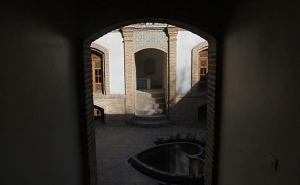
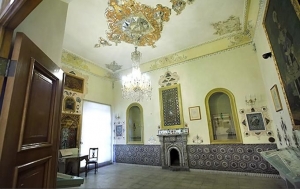
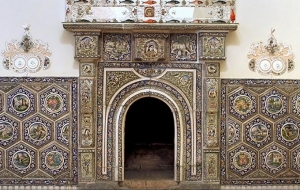
Hajj Reza Khan house:This house is located near 15 Khordad street and according to Abdol-Ghaffar map (1887) belonged to Hajj Reza Khan. This building is one the few instances that represents a residential cruciform plan (Chahar-Soffeh).A fine-shaped elliptical dome, covers the central space of the building. The ceiling of the vaults is adorned with delicate stalactite ornaments (Moqarnas) All over the interior walls are covered with stucco carvings, jutted more than usual and showing themost complicated floral patterns. The upper sides of vaulted recesses in courtyard are decorated with painted tiles (Khashi Haft-Rangi) that display patterns similar to the 19th century European cast iron decoration (Fig. 2,3,4).

Zarrabi House: Thishouse is located in Pamenar, Oudlajan and for many years was in the possession of Zarrabi family. The current building is the only remaining part of a large ensemble that comprised inner (Andarouni) and Outer (Birouni) sections. The walls and recess of the main room (Talar) are decorated with delicate stucco carving and in some parts mirror work is used as points for emphasis. The stucco carving designs are a mixture of floral and animal patterns and mythical creatures(Fig. 5,6).

The Jewish Jeweller House: Regarding the oral history, this house belonged to a Jewish jeweller. The ornaments of Talar comprise integration of stucco carving and decorative cut mirrors. The jutted stucco carvings are adeptly done and rare in other buildings in Oudlajan.Some stucco carvings are done on mirrors and in some parts the decorative mirrors are affixed conversely.These adornments represent herbal patterns, vases and candleholders (Fig 7,8).

Majd-ol-Ateba House: This house is near Amir Kabir Avenue. Its mirror hall is damaged severely, but it is a beautiful sample of reverse painting on mirror (NaqashiPosht-e Ayneh) and a combination of mirror work and painted stucco carving (Fig 9, 10).

Other than those introduced above, there are numerous exquisite houses in Oudlajan. There are also buildings which we witnessed their destruction during recent years, from which the photos and architectural plans provided by the students are the only reminiscences. Since none of these buildings are under legal protection, sooner or later, they would be subjected to destruction. Although documentation of historical edifices will increase the general knowledge on potentialities of Oudlajan, and facilitate future research works, but this process would be completed just once that the public introduction of these potentialities result in devising more acute plans for the future of the neighbourhood. This future, only achievable through participation of all inhabitants, would bring the life back to the neighbourhood.A future we wish to happen in long term.

[1] – Master of Architecture student, Iran University of Science and Technology

[2] – Architecture student, Iran University of Science and Technology

[3] – Fitch, James Marston; Historical Preservation, Curatorial Meaning of The Built World. McGrew-Hill, 1982. PP. 8 & 13

[4]Lorey, Eustache de; Sladen, Douglas Brooke Wheelton.Queer Things About Persia. Philadelphia, J.B. Lippincott co., 1907, p. 44.

[5]- Kariman, Hossein. Tehran Dar Gozashtehva Hal. Tehran University Press, 1976.

[6]- Karampoor, Katayoun; Fadainejad, Somayeh. Tahlil-e Asarat-e TaghiraatKalbadiAnasor-e Shakhes Bar Baft-e MahalehOudljana.Honar-ha-ye Ziba (Tehran), No. 28 (2006) p. 67

[7]- Ayatollah ZadehShirazi, Bagher. BehsaziMahalehOudlajan. Asar (Tehran) No. 2, 3 & 4 (1980) p. 67

The Citadel of the Original Royal Avesta in Persepolis

Khoobchehr Keshavarzi
Translated by Roya Monajem

Source: Payvand Website

Introduction
It is said both in the native and foreign sources that the original Avesta “written on 12,000 prepared cow-skins, and with gold ink,” was burnt together with other treasures and books when Alexander of Macedonia set Parsgarde (Persepolis) on fire. (1) In other sources, it is said that there were actually two copies, one kept in Shapigan treasury and the other in the “citadel of writings” dejnebeshteh (2) whose exact location had never been found, thus a mystery.

In this article based on the remaining architectural features of one of the buildings in Persepolis, known as Tachara Palace, we will first show that this building is not as believed to be Darius’ private palace, but most probably a Zoroastrian Temple (with a yazeshgah);and secondly, that mysterious “citadel of writings” dejnebeshteh, was most probably in the central room of this building.
This article is in fact a chapter of Keshavarzi’s book A New Approach to Pasargade, (Behjat, 2914) which won the prize of Iranian Society of Architects this year.

*******

According to the existing texts, Tachara was the first building of the complex called Pars-garde (Persian City) (1),constructed on the skirts of the mountain of Mehr (Love)later changed to Rahmat (Mercy). Its entrance used to be from the south, which later was closed to some unknown reasons.

Now if we look at this majestic ruined edifice, which is said to be Darius’ private palace known as Tachara, and carefully examine its unique architectural features, we can notice a vital significant secret hidden from the eyes of the honorable scholars so far. These specific features are:

a) The platform of this building is 2.20-3 m higher than the floor of its neigbouring palace of Apadana and its garden. The latter, which is the most distinguished part of the complex has 72 pillars, most probably inspired by 72 yasna-s of the Zoroastrian Holy book, Avesta, as some archaeologists speculate. According to Zoroastrian Tradition, it is only after learning the whole 72 yasnas that one reaches the required existential maturity to understand the Truth.

Despite that, Tachara overlooks the 72-pillared Apadana Palace, pointing to its higher significance in the language of architecture.

b) In contrast to other buildings of the complex, all erected on pillars, this is the sole building made of monoliths, pointing to the fact that durability must have been the major concern of its architects.

c) The sculpted figures on its base-reliefs are different from those of other buildings.

d) It has only one entrance on the west side, which was originally on the south side as mentioned above.

e) And the most challenging point is that there are some shelves in the main hall of this building decorated with engravings all around. According to Professor Shabazi, these shelves were protected by wooden doors.

f) There is a stony water basin (sangaab) and a water channel on the north part of its staircase, which runs down to the south on the west side of the building.

g) The inscriptions found in this building,like a birth certificate mention the five generations of kings who took part in its construction, annexations and subsequent repairs. They all sound very proud of their deed, asking God Ahuramazda to bless,protect and maintain their souls.

h) Finally, in contrast to royal courts, this building is totally isolated without any security routes and pathways. It looks more like a quarantine place than a palace.

Nearly all native and foreign archaeologists and scholars, including Shapour Shahbazi reached the conclusion that this relatively small building of the Persepolis complex known as Tachara, located on western south of Apadana Palace to be Darius’s private palace. The conclusion has most probably been based on the assumption that in classifying the users of Persepolis into distinct separated classes, no doubt, the king and his Royal demeanor and ceremonies would be the first priority.

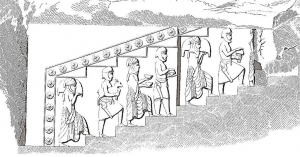
As a Royal private palace, it then would have required a kitchen and it is on this account that the sculpted figures on the base-reliefs of its staircase were interpreted as representing servants working in the Royal kitchen or carrying oblations and the sacrificed animals to the Royal Palace.

Now before dealing further with the unique architectural features of this building and for a better understanding of its most probable real function, I will first examine the inscriptions found in this building, which as mentioned before act like its birth certificate.

Inscriptions

First comes the inscription engraved in three languages, Elamite, Ancient Persian and Babylonian on both sides of the southern threshold of the hall above the head of the king. It reads:

“Darius Shah, the great king, king of kings, king of countries, the son of Vishtaspe Achamenid, built this Tachara.”

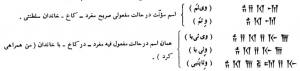
In addition, on the lapis lazuli doorknob found in the same building there is an inscription reading “constructed by Darius.” (see fig.1) This means that Darius’ signature is found on even the relatively insignificant components of this building, pointing to its importance and Darius’prideof his accomplishment. This can also be another seemingly ‘logical’ reason for the assumption that it was his private palace.


Figure 1Source: A Doorknob made of precious stone, Ralph Norman Sharp, The inscriptions in old Persian cuneiform of the Achæmenian emperors

Cornelius de Brown who visited the building in 1904 has reported how he ruined the engravings of the two sides of the west pillar, while trying to remove a part of Daruis’s outfit to take home to Paris. The inscription on the stolen parts now preserved in the treasury of the National Library in Paris,again written in the three above languages reads:

“The Great King Darius, the Son of Vishtaspe Achaemenid.”

There is yet another inscription repeated 18 times on the cornices of its central hall, mentioned above. This too is in three languages and reads:

“The stony frame made for Darius’s vithiya” (see fig.2)


Figure 2. Ralph Norman Sharp,The inscriptions in Old Persian cuneiform of the Achæmenian emperors

The next inscription attributed to the next generation, i.e. Khashayar Shah (Xerses) reads:

“… By the will of Ahuramazda, Daruis who was my father built this palace. May Ahuramazda and other gods protect what my father Darius and I have done.”


Figure 3. Ralph Norman Sharp,The inscriptions in Old Persian cuneiform of the Achæmenian emperors

This inscription is repeated five times in Ancient Persian, Elamite, and Babylonian languages on the southern part of the platform and southern pillars of its balcony.

The inscription of Ardeshir III, in Ancient Persian is seen on the staircase built during his reign. It reads:

“Ahuramazda, the greatest of all gods who created this…, who made me king (Ardeshir), one of the unique kings among many, a unique ruler among many. I am Ardeshir, the great king, the king of kings, the king of countries, the king of this land. I am the son of Ardeshir Shah, Ardeshir Shah was the son of Daruis Shah, Daruis Shah was the son of Ardeshir Shah, Ardeshir Shah was the son of Khashayar Shah, Khashayar Shah was the son of Daruis Shah. Darius Shah was the son of Vishtaspe. Vishtaspe was the son of Arshameh, descended from Achaemenids. Ardeshir Shah says: I have built this stony staircase. May Ahuramazda and the divinity Mehr protect me and this country and whatever I have done.”

The names mentioned in this inscription shows that Ardeshir III, belonging to the fifth generation after Darius the Great was actually the king who repaired the staircase.

There is also another inscription in Sassanian Pahlavi language remaining from Shapur II in which after confessing that the king and all those who have participated in building Pasargade, worship Ahuramazda, it reads:

“… he held a great feast and performed the religious rituals… and then sacrificed an animal for the king of kings Shapur and his soul, and the one who first ordered to build this building.”

A Sassanian king, asking for salvation of the soul of the one who ordered to build this edifice belonging to the dynasty they overthrew! This is a very significant point implying its supreme importance, which should not be overlooked.

In these three inscriptions, three different words are used to designate the building ‘tachara,’ ‘hadish’ and “vi-th’, (‘vithiya’), all apparently having the same meaning as palace (kaakh), but in Persian this wordkhaakhalso implies house, citadel and a tall building, a superb edifice. Most probably as it will be seen later, the use of triple designations for the same edifice is to suggest that it had all the various functions these words imply.

Now considering the relatively large number of inscriptions found in this comparatively small building, remaining from five generations of kings, it is hard to believe the claim that it served as a private palace of only one king. Based on this and the following architectural features, my hypothesis is that this marvelous edifice was a yazeshgaah, a place where religious rites and ceremonies were performed, in short a temple. That can then very well explain the relatively high number of its inscriptions, and why all the kings sound so full of pride for participating in its construction and maintenance.

So, once again before going into more detailed analysis of its unique architecture, let us say a few words about the religious rituals and ceremonies whose performance requires certain objects and procedures which help us to discover who might be those sculpted figures on its base-reliefs interpreted so far as servants working in the royal kitchen.

Relevant Religious Rites and Rituals

1)Rite of Yasna

Literally yasna means worship and prayer. It is also the name of the main liturgical texts (consisting of 72 chapters as mentioned before) and one of the five parts of Avesta. Rite of Yasna consists of reciting yasnas (yazshankhani or yazashana).

Yasna 22-26, are dedicated to the barsam (bareman, barsom, meaning sacred twigs), haoma (a sacred plant) and milk and their corresponding rites performed in veneration of Ahuramazda, sorosh (equivalent to Gabriel or inner voice), amshaspandan (archangels) and fravashi (souls or spirits) of the virtuous. It should be mentioned that barsam is an important part of Zoroastrian liturgical apparatus, prepared from twigs (number varying according to the ceremony) of the haoma plant or pomegranate tied up in bundles.

The ritual is carried out by 7 mobad-s (Zoroastrian priests), whose tasks are:

Zot, is the highest mobad who recites the Yasnas.

Ha’vanan, is the mobad who prepares haoma (scared juice) for the ceremony.

Atrfakhsh attends the fire.

Farabartaris responsible for handing various utensil to the highest priest or Zot.

Abret brings water for the ceremony.

Asnatar is responsible for washing and cleaning the plants and the utensils.

Raovishgar mixes the plants’ juice with milk (usually of goat).

Saroshavarz supervises the whole ceremony.

From the above description, it is clear that water, certain plants, milk and utensils required for grinding and mixing of these plants and extracting their juice are among the necessary means and procedures of the rite (s) performed. The plants need to be thoroughly washed and cleansed and the fresh milk is obtained by milking a goat just right before the rite, at the scene. Thus, making the presence of the stony water basin and water channel next to the building meaningful. The room on the left side then could be the place where the plants were washed and prepared, and those sculpted figures on the base-reliefs are disciples bringing what is necessary. There is one who is carrying (most probably) a goat.

It is not in vain to mention here that a very similar water channel is found in A’zargoshasb Fire temple too, even though A’tashkadeh (Fire Temple) is different from Yazeshgah (Place of Worship) in their functions. Yet, considering that A’zargoshasb was one of the most important fire-temples, then most probably it served as a yazeshgah as well.

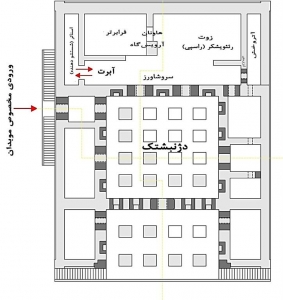
The other requisite for all these preparation iservisgaah, a large square stony table on which the barsom is prepared and the juice of plants is extracted and mixed with milk, while the corresponding yasnas are recited. In Tachara there is a similar structure in the middle of the room on the west side (see fig.4)


Figure 4, From “A collection of Traditional Iranian Architectural works” by Geographic Organization.

In this map, the architectural function is clearly seen in relation to the users.

In his book Iranians and Greeks, Plutarch writes: “A short while after the death of Darius II, his successor Ardeshir went to Parsrgade to perform the ritual ceremony of his enthronement performed by mobad-s. There in a place of worship named after the warring female divinity who can be the equivalent of the Roman Minerva, the goddess of wisdom, war and arts, the heir takes of his outfit and puts on what Darius had been wearing. He then eats a basket of figs, and other fruit with a glass of sour milk. In addition, there are other rituals which are hard to believe unless one sees them with one’s own eyes and hears them with one’s own ears.”

Doesn’t this quotation imply that there should have been a ‘temple’ for mobad-s (priests) to perform the enthronement ceremony?

Bas-reliefs

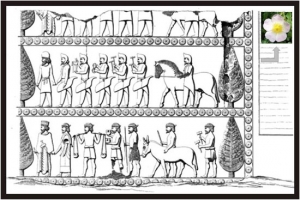
a)Sculpted figures on the bas-reliefs of the southern staircase (fig.5),


Figure. 5 Note that they are alternatively wearing male (Median) and female (Persian) outfits, while both genders have covered their heads.

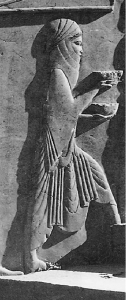
The figures appear in different outfits, but those repeated on the slope of the staircase, are alternatively wearing similar outfits;those wearing the Median coat and trousers are armed and bearded and those wearing Persian pleated dresses have soft feminine faces (see fig.6). They are women, and young boys, as has always been claimed. These figures are of the same stature as the men, thus implying that they are grown up and not adolescent boys who have not still grown beard. And when the faces are carefully scrutinized, little doubts remains about their femininity.


Figure 6, A girl carrying some utensils to the yazeshgah (From Heidemarie Koch Persepolis)

To call them eunuch is like looking at the world from the point of view of recent Sultans who cruelly made young boys sterile. There is no reference to such an inhuman act in any old Zoroastrian texts. On the contrary, looking after one’s health is an imperative in this culture. One of the names of Urmazd or Ahuramazda (the eighteenth according to Urmazd Yasht of Avesta) is ‘one bestowing health.’

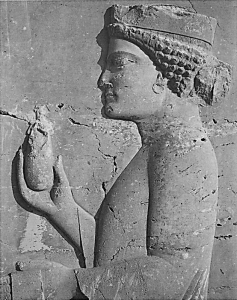
Going back to the same stone-carvings, we can conclude that in contrary to the claim that there is no trace of women in Persepolis, these very figures are the testimony of its falsity. These men and women are all wearing a head covering which is actually a special long shawl wrapped in a specific way as to cover their mouths too. They are carrying mortars and chalices for grinding and extraction of herbal juices, mixing them with milk, zohr water, etc, together with a tray covered by a piece of cloth, most probably for carrying herbs and fruit used for the rite. The men, in addition to small tools, are carrying small goats, whose milk will be used for the rite. One can assume that those whose heads and mouths are covered and are not armed are the only ones who are allowed to enter yazeshgaah. (fig.5)

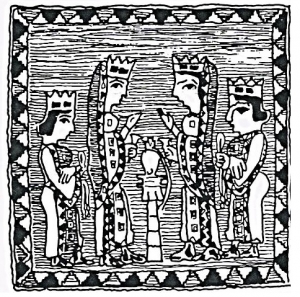
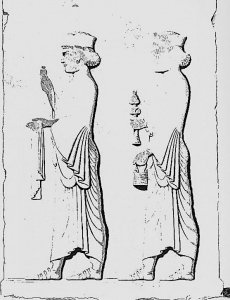
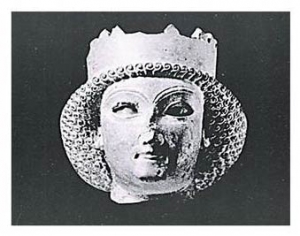
In addition, if we compare the protome of the Achaemenid Lady(fig.7a) with the two sculpted figures on the pillars with one of them carrying a long belt-like ribbon (known as belt of religion, or koshti in Zoroastrianism)in one hand(fig.7b) and a small flask in the other, we can notice the similarity of their hair-dressing, crown and facial anatomy, with the rather prominent curve of their breasts. They must be court ladies entering the building to attend the ceremony and maybe even taking part in it because, they are carrying, a brazier, a liquid container, small bowels and/or mortar.


Figure 7d. From the book Persepolis by Reza Qiasabadi

Figure 7b. Traditional Iranian Architecture, Geographical Organization

Figure 7a. The Protome of the Achaemenid Lady

Finally, the last evidence for the falsity of the claim that these sculpted figures are kitchen servants is Xenophon’s repeated comments in his Anabasis (mainly dealing with Cyrus’ education): “Persians and Achaemenids did not care much about food and eating.”In addition, it is said in certain ancient texts that Persiansateonly once a day. So, how can people who did not care much about food and eating and were content with having one meal a day, would dedicate a whole staircase to kitchen servants?

b) Bas-reliefsof the Central Hall

There are four bas-reliefs in the central hall. Before analyzing what they signify, it is necessary to say a few words about the basic principles of Zoroastrianism.

Devils and their rivals symbolize Ahriman’s (evil spirit) in people and the task of the virtuous people is to follow the example of Amshaspandan to help the Bounteous Spirit and ultimately Ahuramazda in the struggle to subdue and restrain the Spirit of Destruction (Dorough, lies).

In yasna (chapter 31, paragraph 18) it is said:

“Therefore, you should not listen to the words and teaching of Dorvands (followers of dorouj= Lies (doruj) or devils) who bring about destruction and ruin and you should resist them with arms.”

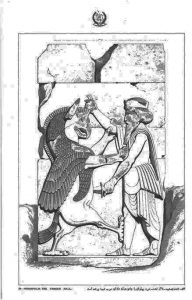
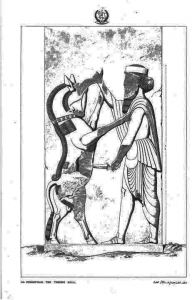
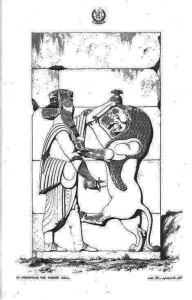
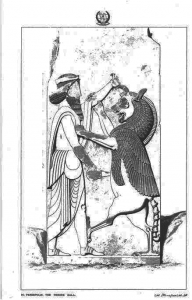
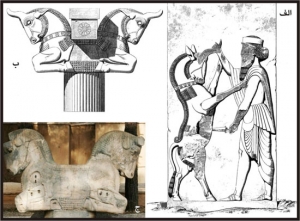
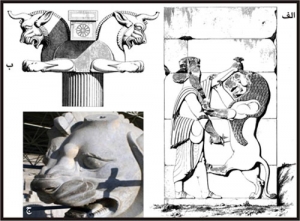
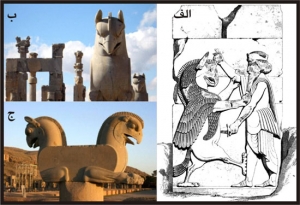
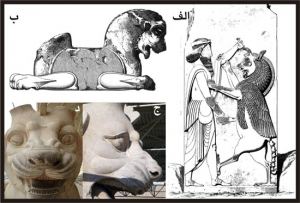
This is what the four stone-carvings of the central hall of Tachara are in fact illustrating: the struggle of the king, hero, the Ideal Human, symbolizing the bounteous spirit of Amshaspand swith the Spirit of Evil, symbolized by complex demonic creatures. (Figures 8-11, notice the spear (the arm mentioned in the above quotation from Avesta) being pushed into the belly of the creature in all the four images). All the images are taken from A Collection of Traditional Iranian Architecture, printed at Iranian Geographical Organization, 1976.

 Figures. 8 and 9 Struggle with inner demons

Figures. 10 and 11Struggle with inner demons

In short, what the stone-carvings of this hall, which based on the remaining inscriptions, had been a very special place,more or less undoubtedly illustrate is the rite of evolutionary passage from the human to the divine stage.

Now we reach the peak of our analysis; the presence of shelves protected by wooden doors in the central hall, each decorated on top with a repeated inscription in the words of Darius, reminding their high importance to the users.

I would like to claim that this square shaped small hall, yet decorated with a comparatively large number of special bas-reliefs depicting the king (ideal human being), entering into the hall from the west-north part, or his exit from yazeshgaah, while holding the barasm, the scenes of his spiritual struggles with the inner demons and beasts, with a separate royal entrance door, an annexed yazeshgaah, with Persian soldiers guarding it from the front as well as the southern balcony, located in a solitary building (thus making it easily accessible to everyone), is most probably that very famous dejnapshank, with shelves made from monoliths, protected with wooden doors, decorated with inscriptions, repeated 18 times, where the Avesta written with gold ink on 12,000 cow skin was kept.

The claim is based on the following additional evidence:

We read in Pour-Davood’s Gathas:

“Tansar (Tosar), the well-known sage (hirbodanhirbod, highest priest) wrote in a letter written about the king Ardeshir Babakan, to the king of Tabarestan 1700 years ago: “You know Alexander burnt our Holy Book written on 12000 cow-skins in the city of Estakhr.” In addition, Pour-Davood writes:

“Now, it is said in the book of Dinkerd, Zardosht Sepanteman gave 21 chapters of Avesta to Gashtasb and according to another tradition he handed it to Dara, the son of Dara. One of these copies was kept in the treasury in Shapigaan and the other in Dejnapshteh. Avesta had 1000 chapters in total. When the cursed Alexander burnt the Iranian Royal Palace, the Holy Book was burnt with it too. The Greeks took the other copy from Shapigaan and translated it into their own language.”

Pour Davood translated “dejnapshtak” as the ‘citadel of papers’ or the registry office (archive).

Now the most valid evidence is perhaps the inscription remaining from the next dynasty, i.e. Sassanian, making it as significant as those of the builders. According to this inscription, found in the same building, when the great Sassanians reached this place they felt obliged to perform certain religious rites, pray for their ancestors and offer sacrifices for those who built this building. This is particularly important when we remember that even though Sassanians were very religious, but as one can speculate, they could not care about the kings of another dynasty, the founders of this majestic Tachara. This inscription belongs to the third century, i.e. nearly 8 centuries after the construction of Persepolis. The remarkable durability of Tachara, the way it still inspired awe and religiosity leaves little doubt about its holiness and religious function.

Conclusion:

As the guiding paradigms of ordinary people, the royal ritual demeanor of Achaemenid kings, the whole complex of Parsagade together with its bas-reliefs were designed and built in harmony with the way they approached human existence and the Universe. Considered as a stone book, its architectural plan and elements, its bas-reliefs and inscriptions are the phrases, manifesting the lofty sacred ideas and ideals expressed in the imperishable spirit of these forms.

In order to reach a deep understanding of this splendid extraordinarily unique earthly palace of existence, one should walk along it, breathe in its majesty, encounter Time, see the signs, hear the voices, perceive the impression of the resonating echoes, endure the weight of awe and supremacy, envision merit and value, recognize depth, learn from light, try and savour pure reflection to the point of having a mirror-like quality, conceive imperatives and rites, discover the impasses of users, and finally take a distance from them all in order to lend wings to these contemplations to assume a three dimensional volume, turn and dance in and out of it, until reaching a point of standstill when the whole complex begins to vibrate with life, revealing its secrets.

The findings presenting themselves in this way would leave little doubt that Tachara was the Royal Zoroastrian palace of rites and ceremonies (yazeshgaah), and the mysterious citadel (dejnebeshteh)of the Original Royal Avesta written with gold ink on 12000 cow-skins with the essence of its content illustrated and preserved on its walls for all the generations to come.

 
Khoobchehr Keshavarzi, born into a Zoroastrian family, is an architect and researcher with many published articles. 

Footnotes:

(1) In old Persian garde means city, so we have Pars (Persian)-garde which the Greek called it thus Persepolis. Due to some carelessness on the side of scholars and researchers, the Persian word for Persepolis is now written and pronounced as Pasargad.
(2 )For more information, see Khoobchehr Keshavarzi, A New Approach to Stone-reliefs of Persepolis, at Farairan Online www.farairanonline.com/Articles/ArticleDetailEn.aspx?src=159.
Later Ms. Keshavarzi elaborated her visions in that article and wrote a book titled: A New Approach to Pasargade, (Behjat Publishing, 20014) which won the prize of Iranian Society of Architectures in 2015.
(3) The essentials of Zoroaster’s teaching in Gathas is the faith in the divinity of Ahuramazda, and the twin opposing spirits Spenta Mainyu, the Bounteous Spirit and Angarah Mainyu, the Spirit of Destruction. Ahuramazda’s seven Amshaspands(archangels) are guiding lights to salvation and happiness in the same way as they assure Ahuramazda’s presence (good spirit) in the soul of righteous people

New discoveries in Afraz (Bam fault)

Source: Farairan

Translated by Arash Aliasghari

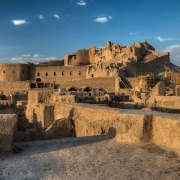
On the eve of the ninth anniversary of Bam earthquake, an expert in the field of world heritage, Dr. Shahriar Adle reported on new discoveries of ancient altars in Afraz (Bam Fault) and the identification of the first layers of Bam citadel (Arg-e-Bam)`s ancient defensive wall.

He told ISNA: During recent years and since the inscription of Arg-e-Bam on the list of world cultural heritage, many measures have been taken in order to preserve this historical complex. This year, in collaboration with the Arg World Heritage Base, several archaeological teams, have done different surveys. Meanwhile, the archaeologists of Arg Base continued their own excavations and they have achieved satisfactory results.

An amateur archaeologist in Bam, succeeded to discover for the first time, a number of petroglyphs related to at least 3 different historical eras depicting hunting scenes and portray animals such as wild goat, ram, …

While looking for a suitable itinerary for Nessa Dam water pipeline, the above mentioned team discovered a number of tombs (Dambi type) belonging to the pre-Islamic era, in different forms similar to pyramids, prisms, semi-spheres covering the surfaces of the tombs. Made of gravel, these tombs covered vast areas in Baluchistan, but in the Bam and Narmashir areas they were still undiscovered until recent.

The discovery of a few altars of Mehr religion and fire and water worshiping

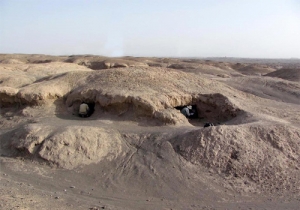
He also added: Another team was working in the Afraz area, that geologists call by the name of “Bam fault”. In this vast region that covers an area of over 2500 acres, the team was able to reach results in their excavations in discovering different kinds of altars (similar to the altars in mosques).

He also mentioned: “we were not aware of the number of these types of foundations which are unique to this region”. He added: “The small altars have been engraved in small chambers made in the slopes of the faults which were carved by water over time, and the others were in the form of two separate altars which were linked by tunnels and dug in a depth of approximately 2 meters on each side of the faults. At least half of the tunnel-like altars in Bam are related to the Mehr religion and there also may be deeper altars available. The double altars were most probably used for water and fire worshiping.

Recognition of the waterways to Darzin

Adle Stated: Another archeological excavation team was working in a region between Bidaram, Darzin and Abaragh in the north-west of Bam. In this region in Abarighak they discovered a vast area which may have been an orchard or something similar. Of course prior to this discovery, another archaeological team which was working in the Bam Citadel also discovered a large stream which directed water from the northern foothills of the Jebale Barez to Darzin. This was an important discovery, since in historical sources, there are references to Darzin as a grand, magnificent and beautiful city, but no explanation has ever been given on how the water reached the city.

He reminded that today only the impressive ruins of Darzin city and its mosque which goes back to the beginning of Islam and the Pre-Mongol era are still remaining and the officials working in Bam and other officials including the governor, the ministries of transport and environment have reached an agreement in their project to reconstruct the vital Kerman-Bam road, to reduce the damages made to the archeological site as much as possible and we hope that in the future by working together, there will not be any other Parking lot constructions on the Abaragh –Bam route and beyond, on the route to Zaahedan so that all these sites can be protected and preserved.

Adle mentioned the activities of another archaeological team in the north-eastern part of the fault, and he reported that in addition to the rereading of the upper part of the wall, they were able to discover precious artifacts in the core of the citadel`s wall.

Defining the age of the core of Bam`s defensive wall

Adle said: Although the Bam citdel`s defensive appears to be made of a single block, in reality, it is composed of different layers which have been added to the primary wall over the course of the years and in different eras of history. And this is how the wall became what it is today. During new researches on the primary core, considerable progresses have been made and since the modern science has reached levels that permits us to use the latest technologies to be able to define the exact age of clay blocks, the archaeological team in Bam has collected the necessary samples for dating the formation of the wall, the palace and old castles of the fault region. These analyses are only possible in a few laboratories around the world and in order to achieve our goals, we actually have to wait for the money exchange problems to be solved by the assistance of regional office of UNESCO in Tehran.

He added that 6000 to 7000 years ago, at Bam citadel, there used to exist a number of installations. The layers of these installations are situated approximately 10 meters beneath the actual surface of Bam citadel region. Since then and until the Qajar era, various layers have been added to the primary core of the wall and this is what makes the absolute dating of each layer so complicated and difficult. We hope that these analysis will provide us with valuable data for the exact dating of the core situated on the upper section of the palace which is believed to be linked to the Achaemenian period.

Adl also stated: The National Cartographic Center (NCC) will resume its flights over the Bam cultural site soon. These flights will provide us with a 1:500 scale map. For the time being we are using 1:20000 scale maps created in the 1960`s in order to reconstruct Bam`s cultural landscape in half a century ago. Thus we hope to get a better view of Bam`s cultural landscape, before the population growth, industrialization of the area and digging of deep veils could change it.

He added: These activities will enable us to create 1:5000 scale maps and to restore a part of artifacts which do not exist anymore. In case of success of the project, we will be able to retrace a suitable and useful image of Bam`s cultural landscape.

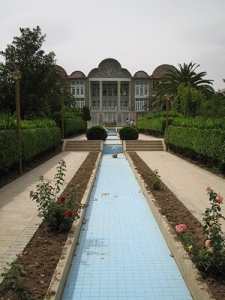
Persian Garden


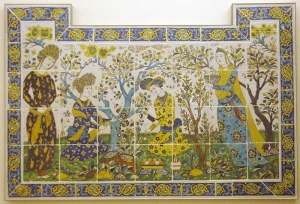
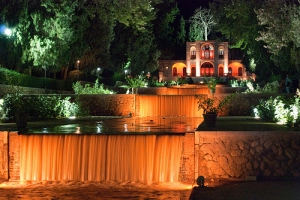
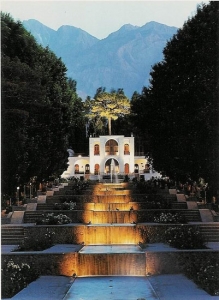
Safavid Mural-Louvre

Khoobchehr Keshavarzi

Translated by Roya Monajem

Abstract:

The great substantial art exhibition held on Persian Gardens at Tehran Museum of Contemporary Arts in 2004 and registration of Persian Gardens on the list of UNESCO World Heritage in 2011, make it opportune to refer to a vital significant point hidden from the eyes of researchers of the subject so far: Persian Garden is the manifestation of a wise-humanist process with its form and geometry naturally following this process. As the result, the garden finds a destiny shared with those who use it. Thus the wiser is the design of the fate and destiny of the garden, the more extensive will be its interaction with the users. On entering a Persian Garden, the users will have all their senses, including their faculty of imagination aroused and inspired with the result that knowingly and unknowingly, consciously and unconsciously, the rhythm of their whole being will harmonize with that of the nature and in this way it is transformed, renewed and refreshed (frashkard)

As a process of an extensive vast complex, Persian Gardens speak of good-mannered persons who created them and through that a signature as transparent and radiant as good mannerism and wisdom appeared under their cultivation which is in fact what grants them such a lofty place. According to the beliefs of constructors, good manner is the result of good thoughts, good words and good deeds; which in itself is a reasonable answer to the two questions: Should the garden be Persian or the approach to the garden? The third question which arises is: how much the name and qualities of the Persian Garden is indebted to the worldview of long-gone people who created them?

First of all, it is necessary to explore the meaning of the name (Persian Garden, Paradise, Ferdos, a symbol of Eden). In recent eras, Persian garden is introduced and defined as an earthly symbol of the heavenly world. What has brought about such a surmise is the word Pardis, Paradise and Ferdos now known as Heaven, Eden. Meanwhile the very word paradaêza (=pairir-daêza) giving rise to all the subsequent heavenly allusions and inspirations is actually lost! In Dehkhoda dictionary under the entry Ferdos it is said: “Ferdos, the Arabic word of the Persian pardis is mentioned twice in Avesta as pairir-daêza consisting of the prefix pairir, meaning surrounding, environment; and daêza, meaning accumulation, piling, enclosing with walls.

Writing about Manouchehr [Pishdadi], the son of Iraj, the son of Afridoun, Ibn Shadi Hamedani (c.590HG) (probably on the basis of Sassanid Khoda’ynameh-s [Epistles of Gods]) says: After the destruction of towns and the land of Iran, all in the city of Ray, by Afrasiayb [Tourani], Manouchehr began to rebuild everything from the scrap because of the scale of demolition, and called it Ma’hjaan (Ma’dga’n), Ma’hma’n (Ma’dma’n) and designated that ruined place, Supreme Ray… Manouchehr then collected various blossoms, flowers and herbs from the mountains and fields and planted them there, ordering to build a wall around that cultivated land.
When the plants all bloomed and spread their scents, he called it bousta’n (flower garden). (2)

“Under the Achaemenids, in the vast land of Iran particularly in Asian Minor, pairir-daêzas or ferdoses were majestic vast gardens of the kings, their khashtarpa’van-s (governors) and courtiers, and enjoyed a great fame. These enclosed places as mentioned by Xenophon in Anabasis or the Expedition of Cyrus and also by Plutarch, had huge trees with water running along them. They raised games for hunt in them. Achaemenid kings encouraged their governors to build such gardens in the territories under their rule. This kind of gardens which were not found in Greece, evidently attracted their attention and they borrowed the Persian name and called them parádeiso. In late Akkadian language, it is called paradise, in Hebrew pardes, in Armenian pârdês, all coming from the Persian word meaning an enclosed place with walls.”

The important point here is that the garden should not be confused with the name defining it, even though there is always a relationship between them. The garden we are speaking about here has most of the things necessary for its emergence, while the garden which actually exists, carries little of its story. This is a very subtle and vital point. When we talk about the wisdom manifested in the garden, we use the magic of words to provoke feeling; while the existing garden should in itself leave an impression by virtue of its complex, which it may sometimes fail to achieve. Herodotus says: No nation can learn foreign rites, ceremonies and traditions as fast as Persians!” The fragile vase of Persian Garden lies in this very point, in the sense that by virtue of this inborn trait or talent, we can ignore and abandon our own ways and insights and instead follow the foot-traces of others. The point is that if we do not tend this fragile vase of Persian garden, it will be replaced by something with no name and history. In other words, we should approach Persian Gardens directly and not merely through Orientalists, because if we discover and follow our own foot-traces here, we will definitely find the garden too.

Like the palm of the hand, Persian Garden is engraved with lines from its past; a past which is found in its every corner, passageway, brook, canopy of trees, bushes, scents and most of all, in people and their relationships. The characteristic behaviour of each tree or bush, their geographic and climatic features and a distinctively holistic approach to them, together with symmetry of the garden which implies physical balance rather than tackling the question of irrigation are what are taken into consideration. In fact, symmetry and balance is one of the most important Iranian beliefs in regard to cosmic order. (The creators of the gardens were wise and intelligent enough to manage the question of irrigation in the best ingenious ways, such as digging qanats (water management technology), invention of ga’vgard (literally meaning a cow going round a circle) carrying out the work of pumping water out of a well or qanat, etc.), Symmetry alludes to a divine secret. In Avesta, yasna 30 (paragraphs 2, 3, 4) it is said: It is the human mind which appraises and evaluates good and evil, beauty and ugliness, abundance and lack, otherwise they do not exist on their own. Zoroaster says that these two primal forces born out of human mind are ‘twins’, with each carrying out its own function alone. Though related, they do not follow each other. They manifest themselves in thoughts, words and deeds, which means that they do not have an independent existence, except in the human mind. These forces are free in their action. Ultimately, Zoroaster says: “Choosing Good is the work of wise people.” Good and evil are among the qualities of matter and their validity depends on the mind. Moderation is the way of the righteous virtuous people.
At the first glance, on entering a Persian garden, the user faces a kind of splendor, based on the worldview of its designer; a kind of splendor immensely praised in his/her sacred scriptures which leads to a heart-filling praise even if it is not uttered. As one continues to walk through the garden and faces all its carefully chosen components, the above state of appreciation and gratitude develops into a higher state resembling to that experienced during what is called a ‘spiritual journey’. In short, through this promenade, one is overwhelmed by a state of humbleness and gratitude which usually happens in a temple.

“We praise all Your good pure creations, You good mannered Ahuramazda who created them in beauty and abundance. We praise those who following you are worthy of praise. And we praise all the beauties of Nature, mountains, seas, Mazda-made fires. We praise all good words.” (Avesta, Yasna 10, 71)
“We praise all waters, we praise all vegetations, we praise the good souls of all the virtuous, righteous people. We name waters and praise them, we name the foliage and flora and praise them, we name and praise the souls of virtuous, righteous people.” (Avesta, Farvardin Yasht, 22, 79)

It is the meaning hidden in all this praises that elevates the Persian Garden to the position of a temple. The same sensual emotional state and the foot-trace of this vegetation song (that is the garden), which is the twin of sacred hymns, is also found in its noble ancient musical pair (Barbad’s musical pieces) such as pieces called Siyavasha’n Garden, Shahriar Garden and Shirin Garden.

According to Arthur Pope: “Iranian Artistic characteristics include, simplicity, fineness, eternal youth and comprehensibility, love of colors, splendor and grandeur.” Maybe he did not know that the meaning of ‘eternal youth’ he has used in his description originates from the old Iranian belief in frashkard (transformation, renewal, regeneration). However, the approval of Pope’s view can be found abundantly in Persian Literature, as for example in this poem by Rudaki:

Practicing the way of heaven, he made an abode / Decorating it with all kinds of signs and symbols
The threshold he made of aloe and sandal wood / The door of silver, the roof of gold

The secret of Persian Garden lies in the fall of the eyes on its components which like the notes of a splendid piece of music follow each other, without the possibility of changing a single note. These components include, an empty-full majestic threshold as an entrance, the axis of the view (imparting the feeling of security and balance to the user at the first glance), limiting what the eyes see with the foliage and flora, and finally, conveying the cosmic order in a way which depends on the designer’s view and approach implied either by the architectural order or the order of moving around.


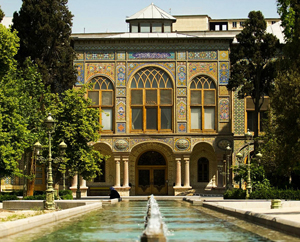
Golestan Palace, Tehran

In fact, secrets hidden in the past events will not be discovered unless deeply sensed. Persian Garden is the process of interaction of favorable and unfavorable geographic-climatic conditions with Iranian people, or better to say, it is a bed of real ecological structures with the foot-print of a wise rational thinking mind! By enclosing one’s own thoughts (paradaêza of mental waves) in a piece of walled land for particular uses such as recreation, performance of religious ceremonial rites, a place for growing and supplying crops, herbal medicine, fodder, dyes and many other needs, one shows one’s personal conception of Nature.

Giving the name of particular trees to the gardens grants a mysterious quality even to their pronunciation. Defining vast expanses with familiar distant names such as ana’resta’n (garden of pomegranates), moesta’n or ta’kesta’n (garden of grapes), and so on, bestows a mysterious fabulous tone to them. The use of sacred numbers also plays a vital role in their division.

The hidden sensual-emotional basis of Persian Garden embodies special concepts: here creates peace, there evokes imagination and thought, at another corner the feeling of pride is fulfilled, at another the feeling of splendor and mastery, here sacredness and salvation is experienced and… in one word, each corners is filled with its own mystery.

The nights of Persian Gardens have also their own tale and considering the role of the moon and its influence on the earth and its inhabitants including human beings, it occupies an important place in the design of Persian Gardens, with Mahta’bi as an architectural example of it. Literally meaning moonlit, Mahta’bi is a ceiling-less room built on a low platform, with three beautifully constructed and decorated walls, surrounded by flowerbeds with flowers emanating their scents especially at nights. Its geographical location in the plan of the garden was determined according to the geographical direction of the moonlight.


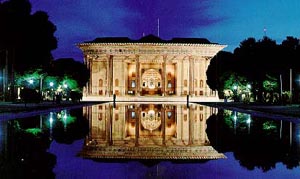
Chehel Sotoun, Esfahan

Iranian designers and gardeners made use of all the qualities of night and with their knowledge of astrology, they calculated the best time for cultivation of various crops. They could even predict droughts (through comets) by looking at the night sky, and contemplate on their plantations and crops accordingly.


Prince Garden-Ma’ha’n, Kerman

All this are excuses for artistic creations in a Persian Garden with trees and flora, some of which mentioned in various texts. In Fars-na’meh (The Epistle of Fars), it is said, fruits of both tropics and cold regions are all found there (i.e. in Fars), walnut, pomegranate, fig, date, na’renj (sour orange) and toranj (begamot), lemon, and other citrus trees are found in every garden. This vast collection of fruits of cold and tropical regions is not found anywhere else.

In Pourda’voud’s Hormozd-nameh (The Epistle of Hormozd), it is said about alfalfa, called Madi plant under Achaemenids, that it can be harvested six times a year and the seeds can last up to thirty years.

Theophrastus says: Persian apple or toranj (begamot) has both good smelling leaves and fruit. It has flowers throughout the year. The ripe and unripe fruit are found hanging next to each other.

Polonius says about the same tree: Any tree separated from its native land should be planted in a smaller place in order to bear fruit, but this tree refuses to grow in any place other than its motherland.

In Ferdos-al-hekama there is a tale about a king who enraged by a man, he sends him to prison. Before that however, the king asks the man, what do you want as your sole food? The man chose toranj.

He made flour out of its fruit proper once dried; and baked bread with it. His vinegar was its sour juice and from its seeds he extracted his cooking oil, from its peels and leaves, he made perfume. That’s how he survived and thrived.
Sa’a’labi Neyshabouri says: Gor is one of the villages of Fars, famous for its red roses having such a divine scent not found in any other places. Rose water of Gor is also divine. Twenty seven thousand bottles of it, together with other things are sent to the Caliphates as tax each ear.

In the ancient book of genesis and cosmology Bondahesh it is said: Each Amshaspand (archangel in Avestan language) is designated with a flower, myrtle and jasmine symbolize Hormozd and iris Morda’d, etc. Each day of the month is also designated with a flower, or a separate flower is attributed to each day of the month and it this way a floral calendar is born. We also have plants with mythological names such as par siyavasha’n (black maidenhair fern), believed to have grown from the blood of Siyavash shed on the earth. (3)

In Ferdosi’s Shahnameh, it is said in this regard:

Soon a plant grew from his blood / Except God nobody knows how
I will now show you that plant / Which you will call a-Siyavasha’n


Fin Garden, Ka’sh’n

Herodotus points out: Iranians are always in search of light and fresh air!
However, we are living in an era, when the beauties of the past have lost their power to the new ugliness. That’s why some parks and gardens give us peace and relief in our struggle against ugliness and disharmony.

It is no exaggeration to say that Persian Garden is a process of a sensual emotional rational exchange of an Iranian human being with his/her native geographic-climatic plants and vegetations, water, earth and light, receiving and embracing all by accepting the responsibility toward self and others. It is not out of place to also mention a few words about the representation of opposite or twin forces in the Persian Garden. Talking about The Prince Garden in the city of Ma’ha’n, Mirfenderski says in a tone of great appreciation: “The space of the garden has taken shape in an air of opposites, like shadow and light, full and empty, open and closed, static and dynamic.”

It is by virtue of these facts that the same phrase: “One was and one was not…” (equivalent of “Once upon a time” in English) marking the beginning of a Persian story, can also begin the story of Persian Garden. It is in this “‘was’ and ‘was not’” that the user searches for a balance between material and spiritual elements and depending on his/her power of imagination which will automatically lead him/her, he/she will intuitively reach a vital imperative, the existence of the Cosmic and Natural Order, bringing about refreshment, renewal, resurrection (frashkard).
To conclude: “You knowledge, the most righteous creation of holy Mazda: If you are ahead of me, wait for me, and if you are behind me, catch up with me!” (Zardosht).


Prince Garden-Ma’ha’n, Kerman

Khoobchehr Keshavarsi is an architect and researcher from a Zoroastrian family.

khoob_tchehr@yahoo.com

Footnotes:
(1) Bahman is the name of Ahuramazada’s first created Amshaspand (archangel), symbolizing good thoughts, words and deeds.
(2) Parviz Azkaee, Zakaria Razi, Tarh No Publishing, Tehran, 2005, quoting Majma-ol-tava’rikh o Al-fesas, p.52
(3) For flowers attributed to Amshaspands, wee, A New Approach to stone-reliefs of Persepolis, by the author, www.farairanonline.com and www.payvand.com

A New Approach to Stone-reliefs of Persepolis

Based on ritual, religious beliefs and the impact of the environment

Khoobchehr Keshavarzi

Translated by Roya Monajem

Abstract:

In the north eastern part of the Persian Gulf in Iran, there is a region called Fars today and Parse in the past. In this mountainous region there is a mountain previously called Mehr (love) and now called Rahmat (Mercy) with a 2500 years old ruined palace still dazzling on its skirts, remaining from the Achaemenid reign over Iran from c.550 to 330BC. Despite considerable research on the religion of this dynasty, Iranologists have not still conclusively reached a definite opinion on this matter and if they have, it is based on questionable evidences and interpretations. Based on remaining inscriptions and stone-carvings of this monument, the article is an attempt to show that the kings of this dynasty were definitely followers of Zoroaster, who founded the first official religion of the world 6 to 7 centuries AD, with all the symbols found in this unique palace having Iranian roots which so far have wrongly been attributed to the beliefs of other peoples and civilizations.

Key words:

Persepolis, Achaemenids, Seven Amshaspands (archangels or benevolent entities), Religious Zoroastrian beliefs, Zoroaster (Zardosht), Lotus or the flower of marshes, Iris, Barsam, Eglantine.

Introduction

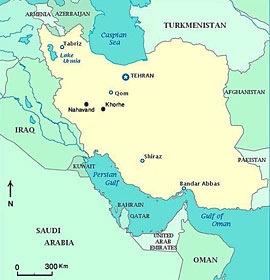
Iran covers a vast plateau in the Middle East of the Northern Hemisphere, extending from 20 to 40 degree north and 44 to 64 degrees east, surrounded by Turkmenistan, Caspian Sea, Armenia and Azerbaijan in the North, Pakistan, and Afghanistan in the East, Iraq and Turkey, in the West and Persian Gulf and Gulf of Oman in the South.

The name Iran is the abbreviated form of Iranokhashatra, land of Aryans (airyana), who actually called their dwelling place Irioda’eenk-honam and after founding a state monarchy, they called it Irianokhashatra literally meaning Iranian Monarchy. The designation was later changed to E’aranshatra, Iranshar and finally abbreviated to Iran. In the south part of Iran there is a land called Pars by ancient Iranians and Pardis by the Greek, but it is called Fars today. It is a mountainous region in the north part of the Persian Gulf, encompassing highlands with Shiraz as its center.

In the land of Parse, there are monuments remaining from the Achaemenid era (c.550-330BC) known as Persepolis (Takhte Jamshid literally Jamshid’s Throne) located at the heart of Fars Province, 1626m above the sea level, with the geographical coordinates Latitude: 29° 56′ 9 N, Longitude: 52° 53′ 23 E (see figure 1a & b). Persepolis was the capital city of the Achaemenid Persian Empire under Darius the Great beginning in c. 522 BCE, until its collapse at the hands of Alexander in c. 331 BCE. It was a center of royal power, a place of imperial ceremony, the locus of regional administration and according to late A. Da’dbeh, the first university of human spiritual development. Its current extant remains include, entrance staircase, the gateway of nations, Apadana Palace and yard, Darius’ Palace (known as Tachar), Khashayar Shah’s Palace (known as Hadish), the palace with three doors or the palace and the main hall, royal tombs, unfinished gateway and the treasury of inscriptions now called Persepolis Fortification Archive (PFA) (Image 2).

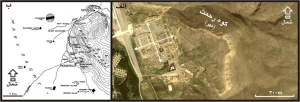
Image 1 – (a) Satellite picture of the Mountain of Mercy (Mountain of Love) and the location of Persepolis in relation to it. (b) Topographic map of the Mountain of Mercy and Persepolis Complex (A Collection of Traditional Iranian Architecture, Geographic Organization)


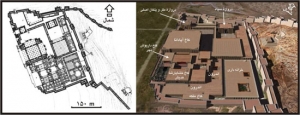
Image 2- Right, Southern view of a three dimensional reconstructed image of Persepolis and the location of its main buildings by Afhami and Gambke(Persepolis3D.com) with written permission (2003). Left, Persepolis plan and the position of its main buildings in relation to North (A Collection of Traditional Iranian Architecture, Geographic Organization)

The complex is situated on a rocky plane at the foot of a mountain now called Rahmat (Mercy), 57 km of north-east of the present Shiraz. The complex is situated on the west side of the mountains with royal tombs facing the 100 columns at the height of 40m (Image.2)

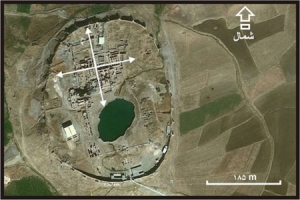
According to Lentz, Darius the Great chose the location of Persepolis according to astrological calculations with the direction of the solar axis at the dawn of certain days of the year coinciding with longitudinal and horizontal axes of the Palace. The same relationship is also found in buildings such as Azargoshtasb fire temple (in the city of Shiz in Azarbaijan). The comparison of satellite images clearly reveals the similarity of orientation of main axes of Azargoshasb Fire Temple with Persepolis (Image.1, 3).


Image 3- Satellite Picture of Azargoshasb Fire Temple in Shiz, Azarbaijan.

The skirts of Kuh-e Rahmat (Mountain of Mercy) which Darius selected as the proper place for construction of Persepolis in 518BC, used to be famous as the Royal Mountain (Kuh-e Shahi) until 200 years ago, and apparently it was called Mehr (Mountain of Love) before.

The main parts of Persepolis were constructed under the reign of Darius the great and his son Khashayar. The oldest source mentioning the name Takhte Jamshid is Aja’yeb-ol-nameh (The epistle of wonders) written by Mohammad ibn Mahmoud Hamedani in 1194. Apparently, Josefa Barbaru was the first European from Venice who visited Persepolis in 1474. Among other Europeans, Sir Thomas Herbert, the English traveler and historian who visited Iran in 1627 was the first who heard this name from the natives and recorded it in his journals. Later other scholars including Arthur Upham Pope, Girschman, Hertzfeld and others also visited this site and in addition to presenting detailed description of all its components, they have also analyzed the inscriptions found there.

In this survey which intends to show how stone reliefs found in this unique palace actually reveal the religious ideas and ideals of Achaemenid kings and their close relationship with the most basic spiritual principles of Zoroastrianism found in Zoroaster’s own writing, Gathas. In other words, it intends to show the Iranian origin of religious and ideological beliefs manifested in the magnificent building of Takht-e Jamshid or Persepolis and illustrate how despite its non-Iranian artists and builders, it is totally inspired by the Iranian worldview..

Evidences:

Achaemenids were from a noble land-cultivating tribe of Pasargade. The far ancestor of Cyrus, Hakhamanesh, with a mythological personality (depicted as an eagle) is the founder of this dynasty. There are numerous evidences which show Achaemenids (particularly Darius the great and Khashayar Shah) were followers of Zoroastrian faith and Darius was an advocate of Zoroastrian reformation.

In Masterpieces of Persian Art, Pope writes: Achaemenid Empire, (the state of freemen), truly manifested this term; graciousness, truthfulness, discipline, purity of the heart, feeling of responsibility, kindness in social relations and faith in a noble religion were among the most remarkable qualities of Achaemenid dynasty manifested in the art of this era. The special features of this period together with its political power and religious passion are manifested in the architecture of the great city of Persepolis which is perhaps one of the most enchanting ruins of the world. The construction of this building began under the reign of Darius the great and it was still unfinished 150 years later. Persepolis was never the permanent place of residence of the kings. It was actually the spiritual and political center of the country where the great majestic feast of Norouz and Mehregan were held…It was under the reign of Cyrus and Darius, when Zoroastrian religion became the official religion of Iran and the first kingdom of the world was founded.”

In Mo-in Persian dictionary it is said about Zoroaster and his world view: “The Iranian prophet Zoroaster was from Sepenytamah family. Most Orientalists believe that he emerged 6 to 7 centuries before Christ. He lived at the same time of Goshtasb, Zoroaster’s contemporary ruling king who accepted his religion. Gathas are Zoroaster’s own words and the religion he founded is called Zoroastrianism. In this religion, Ahuramazda is the great God. The seven Amshaspands (archangels or benevolent entities) and a large group of gods and goddesses carry out his will. Ahriman, the evil psyche, Komarikan and an army of other devils are his companions. The three main principles of Zoroaster’s religion are: Good Thoughts, Good Words and Good Deeds. The belief in an afterworld, with a bridge separating the two worlds, final judgment and the existence of a paradise (heaven) and a hell are among prominent beliefs of this religion. Humans should help Ahuramazda in the battle between good and evil.”

Amshaspands as mentioned above carry out Ahuramazda’s will and in addition to manifesting Ahuramazdian benevolent qualities in this world, they are the guardians of precious elements of the existence. Their names and functions are:

Ordibehesht (Ardibehesht) represents Ahuramazda’s purity, truth and divine order and law. It is the guardian of fire in this world. The third day of each month and the second month of each year are designated after it. In Avesta it is called Ashavahishta meaning the best truth and lawful cosmic order. Its rival devil is called Indera (Indra).

Bahman (Vahumanah) represents Ahuramazda’s good manners and it is the guardian of cattle. The second and eleventh day of each month and the eleventh month of the year are called Bahman. Its rival devil is Bousha’sb.

Shahrivar, represents the chosen land or kingdom, and Ahuramazda’s heavenly land. In other words, Shahrivar is the representative of divine kingdom and power and is the guardian of metals in this world. The fourth day of each month and the sixth month of the year are called after it. Its rival devil is Seora’.

Sepanda’rmaz (Esfand) represents Ahuramazda’s patience and adaptability and is the guardian of the Earth. The fifth day of each month and the last month of the year is called the same. Its rival devil is Taromeyti.

Khorda’d represents Ahuramazda’s perfection. It is the guardian of waters in this world. The sixth day of each month and the third month are called after this Amshaspand.

Amorda’d (Morda’d) represents immortality or Ahuramazda’s imperishable essence. It guards plantations in this world. The seventh day of each month and the fifth month of the year called the same.

In Avesta the name of the last two Amshaspands are often mentioned together.
The seventh Amshaspand is Ahuramazda. Together they guarantee the presence of divinity in the spirit – fravahar- of righteous human beings.

Other Creations of Ahuramazda represented in Persepolis

Farah Vashi (in Avestan) or Fravahar (in Pahlavi) is the hidden force which together with everyone’s psyche and religion (conscience) detaches the body after death and moves to the divine world. In Avesta, it is the force which Ahuramazda has sent to guard and maintain divine creations. Fravahar’s return is to Ahuramazda, the center of the Eternal Light.

Soroush is the first creation of Ahuramazda who learnt Gathas by heart, offering its worship to Ahuramazda with a branch of Barsam. It is one of Bahaman’s companions. Listening to Soroush is to hear and obey Ahuramazda’s orders.

Barsam represents all trees, vegetations and plants. It is a bundle of small twigs of a tree, usually cut from Pomegranate tree or Myrtle by a special knife called Barsamchin while reciting some prayers during the procedure. The whole process is a ritual and after the barsams are cut and washed they are tied together with a strand of palm leaf.

In the Book of creation called Bon-dahesh, each Amshaspand is symbolized by a flower-plant: Below is the list of Amshaspands and the flower attributed to them:

Ahuramazda is represented by Myrtle, Bahman with white Jasmin, Ordibehesht with Marjoram, Sharivar with Basil, Sepandarmaz with Melissa, Khorda’d with Iris, Morda’d with Lily.

As we will see, flowers and plants seen in the stone-carvings of Persepolis are symbols of the above Amshaspands and other determining principles of Zoroaster’s faith. This is a very important point overlooked by all Iranologists who identified them wrongly as enumerated below:

The Barsam held in the hand of the King Darius is identified as Lotus.

Flowers surrounding Frahvashi (Fravahar) are identified as palm tree.

The decorations around the neck of the cow as lotus bud calling it 12 petal flower.

Lotus actually found a place in Iranian art and architecture as the flower symbolizing the Iranian goddess of water, Anahita enjoying a very important place in Iranian Mythology. Later we will show that considering the climatic environment of Persepolis (a dry mountainous place), the flower identified as Lotus (famous as flower of marshes) in its stone-relieves, could not possibly be this flower.

Flowers held by the king and the crown prince are thought to be Egyptian due to the presence of a bud between two blossoms and the arrangement of the stem.

The axis of Zoroaster’s teaching in Gathas is the faith in the divinity of Ahuramazda, and the twin opposing spirits Spenta Mainyu, the Bounteous Spirit and Angarah Mainyu, the Spirit of Destruction. Ahuramazda’s seven Amshaspands are guiding lights to salvation and happiness in the same way as they assure Ahuramazda’s presence (good spirit) in the soul of righteous people. Devils and their rivals symbolize Ahriman’s (evil spirit) in people and the task of the righteous people is to subdue and restrain them. The stone-carvings illustrating wrestling of the kings and heroes in fact symbolize this act of subjugation of the evil spirit and its devils and not what researchers and Iranologists have so far interpreted.

The pendentives of the main hall leading to the rooms are thought to be a royal hero fighting with a lion, cow or the mythological shirda’l (winged monster).

For example, according to Warner the images showing a royal hero defeating a monster or a dangerous animal, Assyrian in origin. “Assyrian King only wrestled with lions which stood on two feet like humans, while Iranian royal hero wrestles with supernatural monsters.”

Now as mentioned above Zoroastrian worldview is based on the opposition of the twin spirits, the struggle of the seven Amshaspands with their rivals and the cooperative role of all righteous creatures in this battle. In addition, Asha (meaning justice and righteousness) plays a vital prominent role in this struggle and asha vana’n (Asha’s followers) are in constant struggle and opposition with dorvenda’n (followers of dorouj, Lie [druj]). The name of Asha is mentioned in almost every page of Gathas.

In Yasna, chapter 29, paragraph 2 it is said:

“The Creator of the universe then asked Asah, who would you like to rule the world who would defeat and restrain the followers of lies and anger?”

In reply (3rd paragraph) Asha said, such a ruler will not do injustice to the world and people. He is kind and harmless. He should be stronger than all the people so that whenever he calls me, I would rush to help him.”

In Yasna (chapter 31, paragraph 18) it is said:

“Therefore, you should not listen to the words and teaching of Dorvands (followers of Lies or devils) who bring about destruction and ruin and you should resist them with arms.”

Now based on what is said above we will analyze the four main stone-reliefs of the main hall. As it can be seen in image number 4, two servants are accompanying a member of the royal family. What is noticeable in this image is the tallness of the high royal figure and the different cut of his beard seen in other stone-carvings too (image number 5). Images 6 -9 show four images of the main hall in which the inner spiritual struggle of the king as a follower of Zoroaster’s teaching is represented in his combat with four rival opposing devils of four of Amshaspands (the human face in all the four images is the same with the same royal beard while the faces of devils change) manifesting the spiritual presence of Amshaspand in the image of the king and the slaughter of the devil in the image of some animal (Yasna, chapter 31, paragraph 18).


Image 4- The Hall of Council (Three Gated Palace) – The king and two royal servants (A Collection of Traditional Iranian Architecture, Geographic Organization)


Image 5- The King and the Crown Prince in one of religious ceremonies. As it can be seen the king’s beard is different from his entourage. The same difference can be seen in Image 4 too. (A Collection of Traditional Iranian Architecture, Geographic Organization)


Image 6- Persepolis, Main Hall (a) The battle of the king with a devil with the head of a cow and his victory (b) The devil entrapped in the form of column capital. (A Collection of Traditional Iranian Architecture, Geographic Organization)


Image 7- Persepolis Main Hall (a) The battle of the king with a devil with the head of a horned lion and his victory (b) The devil entrapped in the form of column capital. (A Collection of Traditional Iranian Architecture, Geographic Organization) (c) The column head in the shape of a lion


Image 8- Persepolis Main Hall (a) The battle of the king with a devil in the form of a bird (b and c) The entrapped devils in the form of column capital. (A Collection of Traditional Iranian Architecture, Geographic Organization)


Image 9- Persepolis Main Hall (a) The battle of the king with a devil in the form of a horned lion (shirda’l) (b) The entrapped devil in the form of column capital. (A Collection of Traditional Iranian Architecture, Geographic Organization) (c and d) The column capitals.
The use of arm (a spear seen in all the four images) suggested in the above-mentioned text of Yasna and the similarity of the sculptures of the head of the devils found under the ceilings with those seen in the main hall actually emphasizes the victory of good Achaemenid kings over the devil (images 6-9). Putting it in words, it is like the four devils depicted on the pendentives of the walls of the main hall represent their defeat and subjugation by goodness. That’s why the head of the defeated devils are used as column capital under the ceilings, like an allusion to their entrapment and restraining (Images 6-9) as ‘salvation arrives when the devils are subdued.”

On the other hand, careful examination of the texts of inscriptions and their comparison with stone-carvings shows that the images are an exact copy of the texts and vice versa. This exact obsessive representation in written and pictorial languages can also be seen in the expression and outer appearance of nations mentioned in inscriptions. For example, necklaces represent Persians, bracelets Medians golden vases, large bowels Assyrian, and so on with all these objects having been unearthed and now preserved in various museums of the world.

According to Zoroaster’s teaching, human salvation is only possible with the knowledge of Ordibehesht, compassion of Bahman, devotion of Shahrivar and patience of Sepanda’rmaz (Esfand), Perfection of Khorda’d and Eternal life of Morda’d. We can see a pictorial representation of the first four passages in the pendentives of the main hall of Persepolis in the form of slaughter of the devils and their use in its column capitals.

Unification with Ahuramazda requires the blending of human knowledge with love and passion of life developed in the service of humanity. It is only in this way that one then can achieve the solid faith of Sepanda’rmaz, perfection of Khorda’d and eternity of Amorda’d. The process of the passage through the six Amshaspands who are closest to Ahuramazda, represent the path of redemption which Darius and Khashayar Shah seem to see themselves worthy of its attainment.

That is why we find in the inscriptions remaining from these kings the phrases such as “We built everything on the approval of Ahuramazda,” “May Ahuramazda protect me,” “May Ahuramazda protect my country and whatever I did and all that my father did,” “Protect these people, for if they propagate, Ahuramazda will bless this dynasty with eternal life.”

For the fifth and sixth part of the above passage, that is the attainment of perfection of Khorda’d and eternal life of Morda’d, completing the circle of perfection with Ahuramazda as its center, in their aspirations the two kings Darius and Khashayar Shah evoke their presence, as recorded in their inscriptions. The name of these two Amshaspands are generally mentioned together both in Avesta and Gathas (see for example, yasna, chapter 44, paragraphs 18 & 19, chapter 45, paragraph 5, chapter 47, paragraph 1, chapter 51, paragraph 7).

In the images of Persepolis, while the first four passages are pictorially represented by the victory of goodness (in the image of the king or a royal hero) over devils, the last two passages through Khorda’d (perfection) and Morda’d (eternal life) representing the highest aspirations, spring of life and creativity, fertility, growth and final unification with Ahuramazda are illustrated masterfully and in a poetical way, in the form of their symbol, the flower Iris (notice the joined stems of images 10 & 11), particularly in those images conveying the concept of holiness.


Image 10- Stems of Iris: (a) Right Persepolis Stone-carvings. (b) Left, Iris Aphylla


Image 11-(a) The underground rhizomes of iris and their connection with each other (b) Iris growing in a line (c) The stone-carvings with underground rhizomes, (d) A general view of Persepolis stone-carving, notice the similarities b/w the real flower of Iris and the stone carvings in (a) and (b).

It is not in vain that the presence of frahvashi (fravahar), symbolizing the whole path of this spiritual journey (passages through the 6 Amshaspands) and attainment of holiness and eternal life (reaching the light of lights (khavarafkhashia) which is the most important part of the Zoroastrian transcendental philosophy is depicted next to Iris (see image 12).


Image 12- Presence of fravashi (fravahar) as the symbol of spiritual evolution (passage through six Amshaspand) and attainment of holiness and eternal life next to Iris.

On the other hand, the flower symbolizing one of the assistants of Amshaspand Morda’d, the divinity Rashn is Eglantine; a flower with a pleasant calming scent seen repeated in the frames of the stone-relieves between cypresses like a scaffold, protecting the line of guests like a canopy (Image number 13). The continued presence of Eglantine as a symbol of protection and preservation of life (both humans and gardens) can be found in “Ershad-ol-zera’-eh” (a guidebook of gardening) written in 16th century, containing the history of garden-making in ancient Iran.


Image 13 – Repetition of flowers in the frames of Cyrus Hall like scaffolds of eglantine sheltering the guests as an allusion to the divinity Rashn – (Images of stone-relieves of Iran, British Museum, 1932).

Now comes the question of lotus and its connection with barsam. As it was mentioned before, a number of researchers have wrongly identified barsam (the symbol of all trees and vegetations) in Darius’ hand as Lotus, and speculated it to be the same flower seen around the neck of animals, overlooking the fact that this flower can hardly grow in dry climatic weather of Pars (Fars). In addition to requiring special conditions for its growth, lotus is very sensitive to light and humidity. It is a flower growing in marshes closing its petals when the light fades. Lotus with the sharp end of its blossoms and the inner curving of its petals as well as its sensitivity and impermanence could not be the flower used during long rituals (from the beginning of preparation of barsam to the end of ceremonies) which instead required a longer lasting flower (Image number 14).


Image No. 14- Lotus and its natural bio-ecological environment (aquatic).

Image number 15 shows the similarity of the flower in Darius’ hand, with pomegranate flower. From the bio-ecological point of view, apart from its sacredness and beauty, pomegranate flower is more in harmony with the climatic conditions of the region and physiologically it is more resistant than aquatic flowers, therefore it is a more appropriate flower to be used in long ceremonies.


Image No.15 –Similarity of barsam in Darius’ hand (right) with pomegranate flower (left).

In Avesta we read: “It is said, the divinity Soroush spreads barsam, three times, five times, seven times and nine times and offers the worship to Ahuramazda.”

In Yasna (chapter 43, paragraph 12) it is said: “When you ordered me ‘Appeal to asha and know her’ you told me unheard words: Try to let Soroush penetrate you to recognize divine graciousness granting reward and punishment to both groups.”

Soroush is one of the divinities playing an important role in the struggle against devils. It is said in Bondahesh: “Soroush received the task of guardianship from Ahuramazda. In the same way that Ahuramazda is the Lord of the heaven and the universe, Soroush is the Lord of the world and it is said, Ahuramazda is a spirit protecting the soul, while Soroush is a spirit protecting the world. For Soroush has not slept well since the creation of living beings in order to guard them. According to Abu Reyhan, Soroush is a divinity guarding the night and some say he is Gabriel. The soul of the dead reaches the Chinvad Bridge protected by Soroush. I praise, the brave pious dutiful Soroush. He is brave because when he turns his club toward Khorasan (East), fear is subsided until he points it to the west. He is dutiful because he obeys the God. And he is astonishing because devils are dispersed by his stroke. He is divine because he rules arzeh (the country of the East) and saveh (the country of the West) (zand akasieh 220, Rahim Afifi, Iranian Mythology and Culture in Pahlavi texts).

That is why holding barsam – whether it is the king or an ordinary Zoroastrian – represents continuous remembrance of the presence of Soroush (Gabriel).

Conclusion:

From all that is said above, Zoroastrian religious and ritual beliefs were so blended with everyday life of ancient Iranians that one can trace them in all aspects of life including their architecture. Illustration of the opposition of good and evil, the spiritual presence of Amshaspands in the figure of the king in stone-reliefs and entrapment of devils by using their sculptures as column capital all point to the above integration. Considering that Persepolis was the place where Achaemenids held their religious rites, ceremonies and mysteries, surely the images found there should be an allusion to the ruling ideas and ideals of their era manifested in the form of mythological symbols of their divinities. The subtle intelligent practice of Achaemenids in illustrating their basic religious beliefs for various peoples with different religious faiths living in the vast Persian Empire attending various ceremonies in the Palace is an example of the respect the kings of this dynasty had for the freedom in faith and ethics of their subjects. In all the stone-carvings with an allusion to spiritual beliefs, the Amshaspands Khorda’d and Morda’d have a prominent presence in the figure of Iris flower. Attribution of a flower to each Amshaspand represents the close relationship of Achaemenid religious beliefs with their natural environment and regional climatic conditions in which lotus can not have a logical reasonable place.

The above analysis is an effort made to show the Iranian origin of what is seen in stone-reliefs of Persepolis, their relation with religious beliefs of that era and refutation of non-Iranian root of the images found there. This is a new approach demanding extensive studies for further decoding of the remaining reliefs.

On the whole archaeologists agree that Persepolis is the manifestation of Achaemenid religious faith. Thus with a new approach to its stone-relieves we can see their adherence to Zoroaster’s teaching in a pictorial way which can serve to decode their details. Emphasizing once more on the above images, the similarities of devils in stone-carvings and the reliefs showing the battle of the king with devils and the use of sculptures of their heads as column capitals is a pictorial representation of the inner human spiritual journey for the attainment of salvation.

Khoobchehr Keshavarsi is an architect and researcher from a Zoroastrian family.

Sources:
Alireza Shapuri Shahbazi, “Persepolis, Documented Guide”, Parseh Research Foundation, Pasargade, Tehran, 2010)
A complete Geographical Atlas, p.10
Rex Warner, Encyclopedia of World Mythology, translated by A. Esmailpour, 2009.
Cambridge World History, Vol.2, The History of Iran, Achaemenid, 2008.

Khana’t Caravansary history living in the Capital

Source: Sharq, Ardehali Art and Culutral Center & Farairan
Khana’t Caravansary in Amin-ol-Sultan Square is like history living in the heart of Tehran. It is not known when it was built exactly, but on the first map of Tehran implemented by the order of Naseraldin Shah in 1302HG, its location is marked by the name Roghani Sara sounding like a small bazaar selling oil which is somehow related. In any case, Khana’t Caravansary is one of the rare historical cultural monuments of the capital still intact after a century of life. Roghani Sara was at that time outside the Safavid wall and near the gate to Shah Abdolazim’s Shrine.

According to Mashreq quoting Sharq, Khana’t Caravansary lies in the heart of the area around Molavi Crossroad, Sa’heb Jam Street and Amin-ol-Sultan Square. It is one of the first caravansaries built in the city of Tehran, continuing its life by the preserving care of the owners of this unique historical cultural site. Covering an area of 10,000 square meters and inspired by the architecture of Persian Gardens, it contains 52 hojreh-s –chamber-shops, 13 on its each side. At present they are leased to dried fruit and nuts wholesalers.

The great yard has two porches, one on the east side leading to a large entrance and the other on the west leading to a second entrance of the caravansary. There are also big hojreh-s on both sides of the main entrance which leads to the main city bazaar and the remaining parts of Amin-ol-Sultan old square.

According to Dehkhoda Persian Dictionary, khana’t and khan mean house as well as caravansary, yet Mohammad Ardehali, one of the private owners and present director the caravansary, says about the name Khana’t: “I don’t know exactly why it is called as such. Khan means hojreh and Khana’t is the plural word, and maybe the caravansary was called such because of having so many chambers.” In any case, according to Ardehali, the main architectural features of the caravansary show that it must have been built towards the end of the Naseri era (i.e. under the reign of Naser-aldin Shah). It was first in the hands of Musa Khan Amin-ol-Molk who sold it to my great grandfather Hajj Ali Ardehali in 1906. It has stayed in the family ever since then.”

Referring to the existing contract wrote then, Ardehali says: “The name and title of people were mentioned with great respect in those years and a trusted clergy must have approved it which in our case it was Ayatollah Qomi.”

Due to its location along the Silk Road in the past, the caravansary was used as the resting place of travelers and when the first vegetable market was established in Amin-ol-Sultan square, it turned into a great commercial center with merchants bringing their goods mostly dried fruit and nuts and cereals on camels from all over the country while staying in the caravansary for sojourn.
With its great yard, it was the best resting place for the merchants and their camel drivers and that is why the merchants rented the chambers for the whole season. The caravansary was also famous for providing carts drawn by nags.


With the arrival of automobile cars and the resulting perishing life in Amin-ol-Sultan square, the caravansary’s commercial life began to decline too and its chambers are now mainly used as store-rooms.
Pointing to the centre of the yard, Ardehali said: There used to be a big water reservoir in the middle of the yard surrounded by tanneries. It was destroyed gradually from 1956-1961, but we have marked the area with red stones.”

One of the calamities that happened to the caravansary was a fire which broke out in 1957 which according to Ardehali was due to chemicals in the rooms “rented by chemical selling merchants. Fortunately, the damage was not extensive, only the ceilings of some of the chambers were ruined which were later restored.”
The major restoration of the caravansary took place in 2003 when it was registered as a national monument by the National Cultural Inheritance Organization as a reminder of the prosperous commercial eras of the past. The work of restoration which began in June 2003 was financially provided by Ardehali family supported by Tehran municipality 12 and the national cultural inheritance organization. It was finished in January 2008. In regard to their financial investment Ardehali says: “None of our family ever thought of selling or destroying the caravansary despite the fact that we could demolish and turn it into a huge shopping mall, as is the custom in our times. Our interest in the urban identity of Tehran encouraged us to go beyond personal interests, as money is not everything in life.”

Khana’t Caravansary history living in the Capital
With its great yard, it was the best resting place for the merchants and their camel drivers and that is why the merchants rented the chambers for the whole season. The caravansary was also famous for providing carts drawn by nags.

With the arrival of automobile cars and the resulting perishing life in Amin-ol-Sultan square, the caravansary’s commercial life began to decline too and its chambers are now mainly used as store-rooms.
Pointing to the centre of the yard, Ardehali said: There used to be a big water reservoir in the middle of the yard surrounded by tanneries. It was destroyed gradually from 1956-1961, but we have marked the area with red stones.”

One of the calamities that happened to the caravansary was a fire which broke out in 1957 which according to Ardehali was due to chemicals in the rooms “rented by chemical selling merchants. Fortunately, the damage was not extensive, only the ceilings of some of the chambers were ruined which were later restored.”
The major restoration of the caravansary took place in 2003 when it was registered as a national monument by the National Cultural Inheritance Organization as a reminder of the prosperous commercial eras of the past. The work of restoration which began in June 2003 was financially provided by Ardehali family supported by Tehran municipality 12 and the national cultural inheritance organization. It was finished in January 2008. In regard to their financial investment Ardehali says: “None of our family ever thought of selling or destroying the caravansary despite the fact that we could demolish and turn it into a huge shopping mall, as is the custom in our times. Our interest in the urban identity of Tehran encouraged us to go beyond personal interests, as money is not everything in life.”

When asked whether the caravansary is listed among tourist attractions of the capital now or not, Ardehali said: “After the international registration of Norouz in 2009, we held the feast of Norouz here with the cooperation of the national cultural inheritance and the Tehran municipality 12 in 2010 and 2011. The municipality has shown appreciable cooperation by introducing it as a tourist attraction site.”

There is now a restaurant which is going to be run as in the good old day in one of the halls of the caravansary.

“We intend to hold the traditional story-telling sessions in this restaurant to keep our culture and identity alive”, said Ardehali. “For the plastic work and ceiling decorations we brought a specialist from Esfahan in order to revive the air of the old times. Our goal is that when an Iranian steps in it be overwhelmed by the feeling of national pride.”
The restaurant is going through the final stages of its completion and it will be opened on the feast of Fetr (last day of fasting).

Khana’t Caravansary’s Entrance the Main Shortcoming:
The major shortcoming of Khana’t caravansary is its entrance. In Ardehali’s words: “Visitors enter a serene nostalgic atmosphere from a busy cacophonous crowded place. It would have been excellent to devise a way to reduce the hubbub of the square and cover the floor of the entrance with stones as it was done in the past.

In regard to the entrance door, one of the unique features of Khana’t caravansary Ardehali said: “It is made of the wood of plane tree (Platunus) 5.30 meters in height, and despite its great size it turns on only four traditional hinges, representing the great art of Iranian architecture.”

The surrounding edges of this huge door are decorated with beautiful tiles on which quotations concerning trade exchange by Imam Ali attract the attention. About the philosophy of this style of tile-work Ardehali explained: “In the past there were clergies sitting in the small and large chaharsu (cross-roads in bazaars) answering merchant’s questions concerning trade exchange according to some verses of the Qura’n. Inspired by that I made a selection of Imam Ali’s advices in this field to be written on the tiles.”

A century old Khana’t Caravansary recently restored by the financial investment of its private owners Ardehali Family, supported by Tehran Municipality 12 and the National Cultural Inheritance Organization is history living in the heart of Tehran…

Photographs provided by Ardehali Art and Cultural Institute

The most valuable house of the world in Tehran

The turmoil of Imam Khomeini and Hassan Abad Squares is so incredible that seldom one would notice the door of a unique museum in Sheikh Hadi Street. According to Mehr News agency, Moqadam Museum is located right amidst all this commotion. Yet, as soon as you put your foot into the entrance vestibule -hashti -of the house, you immediately leave the everyday mechanical life behind. The walls do not allow all this commotion to enter the private enclosure of this house now called the most valuable house of the world.

It came to be known as such in 50s and 60s when Professor Pope, the American art historian wrote an article titled: Survey of Iranian Arts in Sepid-o-Siah magazine on this unique house and its valuable historical objects.The house belonged to Mohsen Moqadam the youngest son of Ehtesab-o-al-Molk, the mayor of Naser-aldin’s Shah’s era.

Mohsen loved painting since childhood. He studied painting at Kamal-ol-Molk School. He can even be seen in Kamal-ol-Molk’s famous painting of his class. Later together with his brother Hassan, Mohsen was sent to Switzerland to study painting. He returned to Iran during the WWII, but left again, this time to study history and archaeology. On returning home he began to travel with archaeological groups to various historical sites such as Deylaman and Shush as a supervisor.

Mohsen Moqadam was one of the fist Iranian archaeologists who worked with great specialists of this field at several historical sites. He was the founder of Fine Art College and taught at Tehran university. Together with his French wife, they decide to dedicate their lives to set up a museum of all the valuable objects on the verge of demolition.

The couple living in Moqadam’s building decided never to marry and instead consider the historical objects in their house as their children which they should look after and leave for the next generations.

The house now mentioned as Moqadam’s Museum was one of the luxurious houses of the Qajar period and has the two normally found sections in the old Iranian houses called biriouni (public wing) and andarouni (private wing).
Along with all the other splendid constituent parts of this majestic house, we can also see exculsively valuable golden tiles which in order to be preserved, Moqadam had installed them in a suitable place in the walls. Some of these tiles are absolutely unique in the world.

Moqadam’s textile collection is also among rare textile collections of the world. They are now kept frozen in the complex and only one is publicly displayed in a glass frame.

In addition to all the doors and titled walls of Moqadam’s gorgeous building, there is also a small room next to the entrance door to the basement with all its door and walls decorated with valuable and semi-valuable gems and beautiful corals.

In his journals, Moqadam has mentioned how he has found most of the existing historical objects now on display, buying them either from vendors or house-owners intending to destroy their historical houses with whatever inside them. Others were either being smuggled out or circulating hands in foreign countries which Moqadam bought with his inherited wealth keeping them in or bringing them back to Iran.

However, some of the other historical objects were given to Moqadam as gifts by foreign ambassadors or guests, like those which are speculated to be from Jerusalem.

There are also objects such as the red potteries of Cheshmeh Ali dating back to the fifth millennium before Christ, which are extremely valuable and nobody knows how they have found their way to this house. They are going to be studied further by the head office of the museums of Tehran University which is now supervising this museum.

Moqadam bequeathed his family house to Tehran University in 1972 and left this world in 1982.

After his death the house was in custodianship of his life-companion until 1990 when she handed it to the University of Tehran.

The hunt for Laodicea: a Greek temple in Nahavand

Mehdi Rahbar & Sajjad Alibaigi

Source: http://www.antiquity.ac.uk

The Greek inscription and other Seleucid finds in Nahavand

The chance discovery of an inscription in Nahavand in 1943 suggested the existence of a Greek temple (Figure 1). Based on the translation of the Greek inscription, the temple was built during the reign of Antiochus III (223-187 BC) (Robert 1949), in the place then referred to as Laodicea (Hakemi 1959). In 1949, five small bronze figures (Figure 2) were discovered by accident in the same area (Rahbar 1976). A little later, whilst visiting the area, Ghirshman happened to identify a Seleucid stone alter (Ghirshman 1963: 19) and in 1978, during a survey and sounding, Gh. Masumi discovered a stone column base in the same location (Masoumi 1978).


Figure 1. The Greek inscription discovered accidentally in Do-Khaharan, Nahavand, in 1943


Figure 2. The bronze figure of a Greek God found in a chance discovery in 1949

New investigations


Figure 3. The location of Nahavand in western Iran.

In 2005, the present authors revisited the site, which is located at Do-Khaharan, in the north-eastern part of the city (Figure 3). During surface survey, we discovered an Ionic column base and capital, in the yard of a house belonging to the Seleucid era (Rahbar 2005:19), and a plain stone shaft, bearing no decoration, which probably dates to the Sasanian period. Local people reported several engraved stones, a column drum, and columns bases which had been recycled in the foundations of walls or as steps. Although excavations were limited in this built-up area, 11 test trenches were cut, bringing to light potsherds, architectural fragments, graves, parts of columns and other stone objects (Rahbar & Alibaigi in press). The finds were all obtained from disturbed contexts. In some sondages the excavations continued to a depth of 450cm from the surface, but all layers were damaged and disturbed because of recent activities. The pottery included examples from the Seleucid (Figure 4), Parthian (Figure 5), Sasanian and Islamic periods.
The most important find was an Ionic stone capital, now in Nahavand Museum. It is 73.5cm in diameter and 26.5cm in height and decorated by two volutes on two sides (Figure 6). A similar capital, found in Iran, came from a Parthian site in Khorhe (Herzfeld 1941: 285, Fig. 384; Hakemi 1990: Fig. 17; Rahbar 2003: 68, Fig. 16) and another, found on the present border of Iran, came from the Oxus Temple in modern-day Tajikistan (Litvinsky & Pichikian 1998: Figs. 4-6).


Figure 4. The drawings of Seleucid potsherds,discovered through the excavation of various trenches


Figure 5. A small Clinky ware jug, found in trench no. 1

Another important item was a column base which had been used as a mortar for many years and then abandoned in the corner of a house yard. It is a circular base, 60cm in diameter and 33cm in height (Figure 7). It is decorated by two rather large bold bands. It is very similar to the Ionic column base from Bisotun (Luschey 1996: 57, Tafel. 7, 2).


Figure 6. The sketch and image of the Ionic capital,discovered during survey in Do-Khaharan


Figure 7. Ionic column base, found during survey in the yard of a Seleucid period house

Conclusion
All the Seleucid finds from Nahavand, such as the Greek inscription, the stone altar, bronze figures of the Greek Gods, column bases, capital and potsherds were discovered in the same location at Do-Khaharan, indicating the most likely site of the Greek temple at Iranian Laodicea.
Acknowledgements
I would like to express my sincere appreciation to the late Dr M. Azarnoush, A. Torabi, A. Farzane, S. Nickrooz and all members of the field team.

References
• HAKEMI, A. 1959 Katibe bozorg Nahavand. Majaleh Bastanshenasi 1&2: 4-8.
– 1990. The excavation of Khorhe. East and West 40(1-4): 11-41.
• HERZFELD, E. 1941. Iran in the ancient east. Oxford: Oxford University Press.
• LITVINSKY, B.A & I.R. PICHIKIAN. 1998. The Ionic capital from the Temple of Oxus (Northen Bacteria). Iranica Antiqua 33: 233-58.
• LUSCHET, H. 1996. Die Ionische basis, in W. Kelaiss & P. Kalmayer (ed.) Bisutun: Ausgrabungen und Forschungen in den Jahren 1963-1967 (Teheraner Forschungen 7): 57. Berlin: Gebr. Mann.
• GHIRSHMAN, R. 1963. Perse: Proto-iraniens. Paris: Gallimard.
• MASOUMI, Gh. 1978. Gozaresh-e gamane zani dar Nahavand,markaz asnad sazman miras farhangi, sanaye dasti va gardeshgari. Unpublished report prepared for the Iranian Center for Archaeological Research (in Persian).
• RAHBAR, M. 1976. Remarks on some Seleucid objects in the Iran Bastan museum, in Akten des VII. Internationalen Kongressses für Iranische Kunst und Archäologie, Munchen 7.-10. September 1976 (Archäologische Mitteilungen aus Iran, Ergänzungsband 6): 249-76. Berlin. D. Reimer.
– 2003. Kavosh-hae bastan shenai-e Khorhe, entesharat-e sazman miras-e farhangi-e ostan-e Markazi. Tehran: Pazineh Press (in Persian).
– 2005. Gozaresh barrasi va gamane zani be manzor-e shenasaie mabad Laodisea, Pazhoheshkadeh bastan shenasi Unpublished report for the Iranian Center for Archaeological Research (in Persian).
• RAHBAR, M. & S. ALIBAIGI. In press. Gozaresh pazhoheshhae bastan shenasi bemanzor-e makanyabi mabad-e Laodisea dar Nahavand, tabestan 1384. Bastan shenasi 6 (in Persian).
• ROBERT, L. 1949. Inscriptions Seleucides de Phrygie et d’iran. Hellenica 7: 6-29.
Authors
* Author for correspondence.
• Mehdi Rahbar
Nahavand Archaeological Project (Director), ICHHO, Azadi St., Nabshe Zanjan Jonobi, Tehran, Iran
• Sajjad Alibaigi*
Institute of Archaeology, University of Tehran, No. 1731, Pesian Station, Vali Asr Street, Tehran, Iran (Email: sadjadalibaigi@gmail.com).

KHORHEH, THE DAWN OF IRANIAN SIENTIFIC ARCHAEOLOGI

Chahryar Adle (1943- 2015)


Khorheh is a village located 225 km southwest of Tehran, near the Qom- Esfahan expressway and three parasangs away from Mahallãt. Two Greek-looking columns standing in this village have long drawn the attention of inquisitive minds and given rise to various views and theories. The last archaeological excavations at Khorheh were led by the Iranian archaeologist Mehdi Rahbar in 1996. These studies were undertaken within the framework of the Research Vice-Directorate of the Iranian Cultural Heritage Organization (ICHO). Mr Rahbar’s ample report on his excavations is to be published shortly by ICHO in Persian under the title Sevomin Fasl-e Kãvoshhã-ye Bãstãnshenãsi dar Khorheh (The Third Archaeological Excavation Season at Khorheh). The present text took shape following the identification of old photographs of Khorheh preserved in the Photothèque (Albomkhãneh) of the Golestan Palace and a visit to Khorheh with the assistance and guidance of Mr. Rahbar. As his report is under print together with maps and technical photographs, it seemed unnecessary to repeat its contents here. This paper is therefore limited to briefly reviewing the excavations carried out at Khorheh during the Qajar period as compared to some other contemporary sites. They are all placed within the evolution of the knowledge and awareness of the past, self-awareness in relation to the past followed by the birth of archaeology in their wake. The paper will also contain a full description of the old photographs of the Khorheh site. At least for the earliest ones, comparative archaeological photographs of other sites even elsewhere throughout the world are rare.
The compilation of this article could not have taken place without the close collaboration of the following personalities and organizations to whom I express my deep gratitude : Mr. Mehdi Rahbar and the Research Vice-directorate of the Iranian Cultural Heritage Organization who, with Mr. Rahbar’s permission, entrusted me with his unpublished report, Mr. Ali-Reza Anisi, the Director of the Golestan Palace, Mr. Javad Hasti and Ms. F. Ghashghaiyan, the Keeper and the Assistant keeper of the Photothèque at the Golestan Palace, who constantly helped me with my research at Golestan, Mr. Claude Karbassi who undertook the very difficult task of translating these pages and Ms. Azizeh Azodi who assisted me in preparing the final English text. Those who read both Persian and English may notice some minor differences between the two versions of my text; these variations were introduced by myself for the sake of clarification and are not attributable to any arbitrary decisions by Mr. Karbassi.

*******

Love for collecting works of art and antiquities, which has been regarded as reprehensible and criminal in Iran during the past two or three decades, is deeply rooted in history and has been a major factor contributing to the emergence of modern archaeology. Love for antiquities and for collecting artifacts became one of the foundations of that science, history and individual and social identification from the moment an object was no longer appraised solely in terms of its material value, but, apart from its intrinsic artistic value, was also viewed as a means of better knowing oneself 1.
It is not known at what point in time an historical vestige was first looked upon as a testimony of the past and a means of acquiring knowledge and understanding, but whatever the case, the search was rooted in man’s nature and steadily developed in the course of time. This need is somehow perceptible in animals, albeit in a primitive form, just as any being’s progeny knows and looks for its mother, if only for the sake of survival.
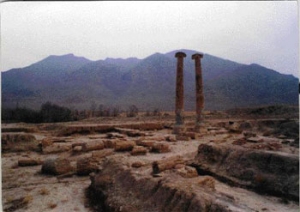

1.Khorheh- Profile view of two pillars remaining from the avian of the Parthian building (ca. 150 B.C). Notheastward view in the direction of Emamzadeh Shahzadeh Abolqasem, Shahzadeh Eshaq and Hakimeh Khatun, in comparison with picture 2 belonging to 1859, the renovation of the building and its altered façade and dome are clearly visible. (Photography by Mehnaz Emadi, winter 999)

A – Excavation in search of oneself
One of the earliest pieces of evidence in this concern was discovered in Mesopotamia: Nabonidus, the last native ruler of Babylonia (556-539 BC), whose kingdom fell to Cyrus the Great, viewed excavated artefacts as testimonies of the past and used them as means of justifying the present and warranting an ideology — the existing governmental system of Babylon. Excavations made upon his order at the temple of Larsa led to the discovery of its foundation stone 2200 years before his time, the display of which lent the temple the role of a kind of museum2.

Nearer to our times, the best art collections — combining both artistic and financial value — belonged to the Safavid kings and princes, and before them to the last Timurid princes and noblemen. The Safavid Shãh Tahmãsp was already fond of painting in the early years of his rule, but perhaps even more important than himself as regards the appreciation of works of art were his brother Bahrãm Mirzã, and ahrãm Mirzã’s son, Ebrãhim Mirzã. From the time of Shah Abbas the Great onward, collecting calligraphy and paintings on loose sheets or bound in albums also became a current practice among the nobility and the rich, and commercial and artistic workshops flourished in such cities as Shiraz or Esfahan to satisfy the demand of these classes. The clientele, whether the king or others, were not interested in excavated items and did not seek to discover their identity in that way. What they mainly sought (besides architecture) were calligraphic specimens and paintings. In the latter domain, the interests of Bahrãm Mirzã, a foremost art-lover, ranged from Chinese drawings to Italian oil paintings. With that worldwide outlook, which has nearly disappeared in the Orient and Iran except for blind imitation, he surpassed even the illustrious men of the Italian Renaissance, because at the time the European’s horizon did not extend further than Rome and Greece, let alone Persia, China and beyond. During the Renaissance, European noblemen and wealthy people set up rooms in their palaces which were called “cabinets de curiosités” and in which they gathered antiquities among other items. The antiquities came from smallscale diggings carried out for that purpose, but excavations on a large scale did not start until 1710 (approximately the end of Safavid rule). In that year, Prince d’Elboeuf ’s excavations at Herculaneum led to the discovery of the city’s theatre, although he was still in search of antique objects to exhibit in his collection rather than finding answers to scientific questions. In 1748 (end of Nãder Shãh’s reign in Iran), the ash-covered city of Pompeii attracted attention. Work on the site began by order of the king and queen of Naples, and the first catalogue was published in 1755. In the next year, Johann Joachim Winckelmann, the German-born scholar considered by many as the father of Greco-Roman (classical) archaeology, published his initial notes about Herculaneum, but the compilation of a detailed inventory of the items discovered there was not begun until 1860. These registers were prepared in Pompeii by Giuseppe Fiorelli. One year earlier, in 1859, the first excavation at Khorheh had taken place upon the order of Nãsserod- Din Shãh. No record of it is available, except for two photographs accompanied by a brief description (pls. 2 and 3). Meanwhile, the unfulfilled British excavations in Susa had come to an end, of which neither a systematic register nor any photographs were made, but handsome drawings were prepared which are extant 3.

Thus, the work at Khorheh proved to be somehow more “high-tech” than that carried out at Susa. Neither the excavations of the British nor those of the first French missions at Susa could be considered scientific in present-day terms, because, as was customary at the time, the real objective at Susa and elsewhere — even often in Europe — was still that of discovering valuable objects (particularly gold) or impressive pieces to send to museums rather than finding answers to definite questions.
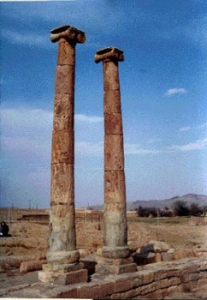

2-Khorheh – General view of the archaeological site and the new mineral water lake formed in 1984-85 (Photograph by Mehdi Rahbar, ICHO)

Of course, this is still often the case, although no one dares acknowledge the fact. As is more or less true even today, the majority of museums, whether in Iran or elsewhere, looked more like Ali Baba’s caves and antiquarians’ bazaars than true centres of research and education. One instance of what may be called a true scientific excavation was perhaps first carried out in the New World. In 1784 — when Iran was about to come under Qajar rule —Thomas Jefferson (1743- 1826), the third president of the United States of America, excavated a burial mound on his lands in Virginia and began stratigraphic studies based on the assumption that the lower strata must be older than the ones above them. Relying on this theory, which appears self-evident today, he demonstrated that the hill in question had been used for burial purposes at different periods and, like similar hills east of the Mississippi river, had not come into being all at once 4. A major step in stratigraphy was taken by a French customs inspector by the name of Jacques Boucher in 1841, i.e., ten years prior to the beginning of the excavations of the British at Susa and eighteen years earlier than those of Khorheh. From this viewpoint, the works on the verge of being undertaken in Iran can be considered as backward. Working on the sand layers deposited at the bottom of the Somme river, Jacques Boucher was able to correlate the items discovered with their corresponding layers and ascribe the ensemble to a period prior to that given in the Old and New Testaments (in fact the items belonged to the Stone Age) 5. This interpretation conflicted with accepted beliefs concerning Creation, but it eventually prevailed. The application of Darwin’s theory of evolution (published in 1859, corresponding with the eleventh year of Nãsser-od-Din Shãh’s reign and the date of the first excavation in Khorheh) to archaeology consolidated the foundations of this newborn science. Later on the theories of Marx (Pre-capitalist Economic Formations,1858) and Engels (Origins of the Family, Private Property, and the State,1884) merged archaeology with economy and sociology 6. Determining whether the impact of materialism on archaeology was good or bad is beyond the scope of this article, but it certainly had positive aspects, although its application to justify the class warfare leading to “the dictatorship of the proletariat” ended in exaggeration and failure. The Westerners’ interest in Iranian or even Egyptian relics, unlike their line of thought concerning China and non-Muslim India, was not (and still is not) the result of an independent scientific quest (aside from economic matters) aimed at identifying the civilization of this region in its entirety, but rather proceeded via Greek and Roman cultures on the one hand, and Christian culture on the other. Western civilization is like a tree with two roots, one based on Greek and Roman cultures and the other founded upon Christianity, and beyond it Judaism. It was following this outlook, and in search of acquiring knowledge about themselves, that Europeans on the one hand became infatuated with Greece, and on the other explored Palestine and Syria, eventually reaching Assyria, Babylonia and Susa. Winkelmann played a major role in consolidating the theory of the Greco-Roman foundations of Western culture, and in propagating the belief that classical Greek art is perfection itself. Classical Greek art, in its turn, often tends to consider man and his vision as utmost perfection and, consequently, is realistic in the perceptional sense (painted grapes are beautiful when attracting sparrows). Since Greek gods have human shape, behaviours and feelings, human beings are in their turn godlike and can be symbols of perfection. Indeed, in the opinion of some Greek philosophers, human visions and impressions constitute absolute truth and reality itself. This is epitomized in a sentence which Plato attributes to Protagoras: “Man is the measure of all things.”. The difference between this outlook and the Achaemenian vision in the same context and at the same time reveals its consequences in the most conspicuous manner in architecture and sculpture: Greek architecture and sculpture in the Parthenon and elsewhere are arts based on the scale of man as an independent individual, whereas in Achaemenian Iran the individual (who is unidentifiable as a person) is a particle of the Empire whom God (Ahurã Mazdã), — rather than the gods —, has entrusted to the King of Kings (see the rock-face inscription at Bisotun and other inscriptions of that period. The social and political impact of these two lines of thought is immense, but it lies beyond the limits of our present discussion).
In conclusion, Greece stands predominantly as a civilization of the individual citizen and cities, whereas Iran represents a vast empire in which the individual plays a minor role as a citizen. In Delphi the columns are made on the scale of man, and in Persepolis on the scale of the empire. In the frieze of the Parthenon figures are individuals, while the long rows of Median and Persian soldiers consist of identical men whose groups (not individuals) mainly differ in their headgear and clothing. In western art, portraiture showing the actual physiognomy of an individual came to exist, while up to the Safavid period Iran nearly always ignored it. Here we cannot enter an epistemological or ethical discussion and delve into the comparative appreciation (true or untrue / good or bad) of these attitudes although the author is inclined to believe that these facts are relative rather than absolute.

3.Khorheh. The new mineral water lake created in 1984-85 (Photograph by Mehdi Rahbar, ICHO)

Be that as it may, the concept of Greek art has imposed itself in the Western world combined with the biblical heritage, and it was with such an outlook that the West approached the Middle-East and Greater Iran. Aimed at thwarting the British, Napoleon Bonaparte’s Egyptian campaign in 1798, which ideologically had a root in the French Revolution and its humanistic values (Universal Values in the revolutionaries’ view), brought some two hundred scholars of various disciplines to that country. It succeeded, by the multitude of results the expedition brought about, in establishing Egyptology as an independent discipline apart from Greek or biblical values. The results included in particular in the creation of independent sections in museums or in Champollion’s decipherment of hieroglyphic writing in 1822 and the publication of such unique books as Description d’Egypte. The Iranian World was not, and still is not, that fortunate: a Persian object may find its way to France and to the Musée Guimet with South Asian objects, to the Louvre with Assyrian or Ottoman vestiges and to the Institut du Monde Arabe with North African items ! The case is identical in other Western countries or elsewhere where they are emulated. Had the Westerners adopted a universal human outlook instead of a biblical and Greek-oriented one, the archaeology of the Iranian World would undoubtedly have developed in a more appropriate way, and these lands would have been known better, i.e., more accurately. An imaginary line drawn from the south-eastern corner of the Caspian Sea to the vicinity of Shiraz clearly shows that, except for a few instances, all the excavations carried out by Westerners, and of course by Iranians who blindly followed them, have been carried out on its western side, particularly in Khuzestan and biblical lands, and that little attention has been paid to other areas. Of course, the historic wealth of these regions justifies this attention, but it cannot explain the neglect of other regions. The above-mentioned outlook, particularly its biblical aspects, has even pervaded religious and philosophical studies, with the resulting drawbacks. The Russian operations, whether on the northern banks of the Aras river or in Central Asia, to a certain extent made up for these shortcomings, but unfortunately, their works remained largely unknown both in Iran and in the West. Because their inquiries were carried out with a view to Czarist (Russian) and later Soviet Imperialism, the interests of the Communist Party and, of course, purely scientific purposes, they remained largely free of Western (biblical and Greco-Roman) concepts, but were instead fraught with Marxist ideological fanaticism, which had noxious effects. Nevertheless, on the whole, their research work was useful.

4- Khorheh – General view of the archaeological site and the new mineral water lake formed in 1984-85 (Photograph by Mehdi Rahbar, ICHO)

The renewed and keen attention of the British having been focused on Susa during the delimitation of the Irano-Ottoman frontier was apparently unrelated with the above-mentioned views; but in fact the overall climate and the process of excavations prevailing there were no different from the general trend dominant in Europe. In particular, because they did not produce remarkable antiquities from that viewpoint, they were discontinued. William Kenneth Loftus (1820-1858) established himself in Susa in May 1850, but his inconclusive excavations only began in January 1851.
Sir Henry Creswick Rawlinson, a famous figure in politics and archaeology, said to Henry Layard, a no less renowned figure in archaeology who had also travelled to Susa: Loftus “turned the mound topsy-turvy without finding much”. Loftus was expected to repeat his accomplishments in Warka and unearth abundant antiquities, but this did not happen7.

Unlike the British, the Iranian government of the time showed a positive reaction to the works undertaken at Susa. It not only officially received a memorandum from its executives in Khuzestan (rather than from the British), which may be considered as the first known scientific and administrative Iranian report on the results of an archaeological excavation, but the authorities (no doubt the Shah himself ) even ordered its publication. The original text, reproduced in part, was written by Mirzã Sayyed Ja‘far Khãn Moshir-od-Dowleh (Mohandes-bãshi) and contained eloquent illustrations of one of the coins discovered at Susa. Mirzã Ja‘far Khãn was one of the five students sent to England in 1815 by ‘Abbãs Mirzã, the crown prince, and Mirzã ‘Issã the first Qã’em-Maqãm. He studied engineering and returned to Persia on July 24th 1819, beginning a career as a professor of mathematics, engineering and artillery. As, in compliance with Article 3 of the Treaty of Erzerum, a commission was to be convened with the participation of representatives from the Russian and British governments in view of determining the boundaries between Iran and the Ottoman empire, Mirzã Taqi Khãn Amir Kabir chose Moshir-od-Dowleh for the task and sent him to Baghdad. As already mentioned, in the framework of these operations, the British once again focused on Susa, and this time seriously. The sessions lasted approximately six years and Moshir-od-Dowleh returned to Tehran in 1854-58. His educational antecedents had prepared his mind for dealing with historical relics and if the complete texts of his writings are eventually found, a clearer picture of the situation will come to the fore. The preparation of that report, which did not have to include archaeological matters alongside political and administrative issues, the immediate publication of its scientific contents in Tehran, the study in the Capital of the coins unearthed, and the printing of illustrations of a sample of a dated coin, all clearly point to the existence of a dynamic atmosphere. Unfortunately, however, this was limited to some members of the upper classes at that period and, notwithstanding the active role of the Dãr-ol-Fonun (Tehran’s Polytechnic), did not become widespread among the majority (the people and even the well-to-do classes, including the bazaar merchants, for instance).

News of the excavations carried out at Susa were published on Thursday April 22nd, 1852, on page 2 of issue No. 64 of the Vaqãye‘-e Ettefãqiyeh (Rajab 2nd1268, Sichqãn-yil), the official newspaper of the Persian government. This was done during the final stages of the British excavations at Susa, before the report of their operations could reach their own superiors, let alone be published. The news published in Iran was not only descriptive, but analytical as well. It included no mention of the names of the British excavators, which is interesting in itself. The wording of the newspaper, which accidentally dropped a certain amount of the text, is as follows: “Picture of an ancient coin discovered at Susa and brought to the Caliphal Abode of Tehran [engraving of the recto and verso of a coin with inscriptions in Kufic script and their translation in naskh script]”, see pl. 1.

According to the last written reports sent by His Excellency Mirzã Ja‘far Khãn Moshir-od-Dowleh to the high authorities of the Exalted Government, vestiges of very massive buildings were unearthed in the ancient city of Susa, located four parasangs away from Shushtar. Among these was the building of Artaxerxes I Longimanus [the Apadana], comprising thirty-six monolithic stone columns; the columns stood seven zar‘ apart and their height could not be determined because they were all broken and had collapsed, but their bases and capitals, which mostly bear figures of calves et alia indicate that these columns were very tall. Although not a fragment of stone can be found on the plain of Arabia [Khuzestan], the thirty-six columns found in front of that building towards the north indicate that salãm (audience) ceremonies were taking place there. The plan and disposition of this building are like the one at Persepolis, there are no differences. Some columns bear inscriptions in Syriac and Chaldean scripts in which the events of … [omission in the original text] imposing… have been buried and most of the bricks, which weigh sixty-eight man, are inscribed with narratives of events. A few white [silver] coins with Kufic inscriptions have been found in the upper part of a building. It is clear that these coins were buried there after the Arab conquest.

They were minted in Basra, Damascus, Wasit, Merv, Herat, Nishapur, Dãrãbjerd, and Estakhr. One of these coins, which is from Wasit, was sent as a sample to the high authorities of the Exalted Government. It is illustrated at the top of this page. This illustration is drawn in the original size [scale 1:1] of the sample that has been brought in. Two of the illustrations depict the recto and verso of the coin, both inscribed in Kufic script, and the two other illustrations show the same inscriptions in the Naskh script for the sake of legibility. This coin bears the date 105 [H./ 723-24 AD], 1163 years before our time and it is astonishing how remarkably intact it has remained after such a period of time. Sepehr, the governmental chronicler of the time and a member of the entourage of Mirzã Ãqã Khan Nuri [the then Persian Prime Minister], summarized the discoveries in his turn in the Nãsekhot- Tavãrikh. Since he refers to gold coins, gives the name of the Caliph Al-Montaser (861-62 AD), mentions the type of stone (alabaster), and other facts not recorded in the newspaper, it must be admitted that Moshir-od-Dowleh’s original report was longer than the published news, and that Sepehr had access to that original. Sepehr wrote: “In the lands of Shushtar, where the city of Susa was founded in ancient times, a palace built by Bahman, the son of Esfandiyãr, called Ardeshir the Long-Armed (Artaxerxes I Longimanus) has appeared in a declivity of the soil. It had thirtysix alabaster columns and wherever baked bricks were used in the building these weighed sixty-eight man. Some gold coins bearing the effigy [in fact the name] of Al-Montaser-Bellãh also surfaced”9.
The article of the newspaper and Sepehr’s text refer to Loftus’ last excavation, which took place from mid-February to early April 1852. Rawlinson’s assessment of Loftus also includes this section. His sentence, which illustrates the general and prevailing object oriented view at the time, appears somewhat cruel today, because, as we saw in the Persian texts, Loftus’ excavations were not that fruitless in scientific terms. On the other hand, it is true that Rawlinson’s ideas universally prevailed at the time, but in view of what was said about scientific progress, Loftus’ excavations could nevertheless have shown a higher scientific level, for example by taking advantage of photography, which was not the case. He employed Henry A. Churchill, fortunately a skilful artist, and limited himself to his graceful sketches. It is notable that the nineteenyear- old Nãsser-od-Din Shãh, who had acceded to the throne only two years earlier, manifested more perspicacity than the British, because in the first half of 1850, at the time of Loftus’ first expedition, he gave orders to have the bas-reliefs of Persepolis photographed by Jules Richard, a Frenchman employed by the Persian government.

5 – Khorheh. Excavation area and beyond it the mineral water lake (Photograph by Mehdi Rahbar, ICHO)

Earlier, in 1811, James Morier, a British citizen of Swiss origin and the witty but vindictive writer of The Adventures of Haji Baba of Isphahan, had initiated excavations at Persepolis while just before, in April 1811, Robert Gordon had gone from Shiraz to Susa10. Gordon was a younger brother of Lord Aberdeen who later became the British Prime Minister in 1852. Morier, Gordon and others were members of the British diplomatic mission to Persia, and were dispatched by their ambassador (Sir Gore Ousely) to explore the country, including its antiquities.
Morier had gone to Persepolis in the closing days of April 1811. He had read the books of such renowned travellers as Chardin and Le Bruyen, through which he had become acquainted with Persepolis. He tried to figure out the subterranean corridors running under the platform of Persepolis, but he failed to recognize these as sewerage channels (p. 77). He went on excavating for two days, before Mirzã Mohammad ‘Ali, the governor of Marvdasht made him stop his work for not having an authorization from the Persian central government (p. 76). Morier was unable to excavate items such as coins or jewellery (p. 77). He writes that the bas-reliefs which came to light were as new as the first day, and that he tried to carry away a large piece of stone with two human figures on it.

6- Khorheh –Examples of Parthian Tiles (Photograph by Mehdi Rahbar, ICHO)

7- Khorheh – Other examples of Parthian Tiles (Photograph by Mehdi Rahbar, ICHO)

In view of its great weight, he decided to have them separated. As a result, the headgear of one of the figures was broken. Morier attributes even this destruction to the Iranians’ incompetence in cutting stone (p. 75). He did not ask himself whether, under the ethical or legal standards prevailing at the time in Persia, or even in England, the very removal of a work of art without a legal permission was a reprehensible deed. Nor did he realize that, even if it was not, he had at least made an error of management by entrusting the task to Persians, whom he considered devoid of any skill or quality, and corrupt. His unscientific character is also revealed in other instances, for example in comparison with Nãsserod- Din Shãh. The Shah expressed his grief at not being able to read an inscription on stone (see below, the text related to footnote 37), whereas for Morier what mattered most was possession. He writes (p. 75) that after the excavations he also found part of an inscription the final section of which Le Bruyen has drawn, to which he adds: were these letters to be deciphered some day, “we should be in possession of the whole inscription”. One cannot even presume in his defence that he perceived ownership in its collective sense (us), for his country and not for himself, because the items found by him and afterwards by Gordon — who went to Persepolis for excavations accompanying his ambassador (11th to 13th of July 1811) — became the private property of the ambassador, Morier and their dependents (p. 114). Ouseley and his companions were obviously motivated by a desire to show off, and particularly by the prospect of financial gains. The proof is that Ouseley later decorated the staircase in his London residence with some of the reliefs (Ouseley, vol. II, pp. 254-55, see below, n. 10), and he and his companions blamed Gordon “for glutting the market in England”.

8- Khorheh, Examples of Islamic Terra-cotta wares (Photograph by Mehdi Rahbar, ICHO)

9-Khorheh –Examples of Parthian Tiles (Photograph by Mehdi Rahbar, ICHO)

Gordon promised not to do so and ended up asking Lord Aberdeen, his brother, to make the bargain with him (Gordon’s letter to Lord Aberdeen is published by Curtis in Iran, p. 49, see below n. 10). As mentioned before, the governor of Marvdasht put a stop to Morier’s excavations, or rather to his treasure hunt, for not having an authorization from the Persian central government; however, slightly later in July, as the British came back to Persepolis reinforced by Gordon and the ambassador in person, the governor found himself unable to face them and let them dig. Pessimists might say that the governor was surely bribed, but at least for the first case, one may wonder why, for all Morier’s eagerness to come into “possession” of works of art — and while the British were always keen (justifiably from the British viewpoint) to bribe Iranians in their own interests —, why the shrewd Morier did not try to bribe the “corrupt” governor or at least start bargaining with him. Could it be that in those days, Persia was not as lawless as it is assumed, that an authorization was required to excavate at Persepolis, and that the governor was not corrupt?

As for Richard, it is true that, having failed to receive the funds to cover his travel expenses due to the government’s financial problems, he returned to Tehran from midway, without taking pictures at Persepolis11. However, this one inconclusive job assumes less importance considering the fact that photographs were made five years later on the initiative of Luigi Pesce, an Italian-born officer also at the service of the Persian government. An album with his photographs of Persepolis and Pasargadae was presented to the Shah on April_ 29th 185812. It is unfortunate that Richard himself did not either then or later realize the universal significance of Nãsserod- Din Shãh’s command. Having served many years in the government, he should have known that, particularly at a time when Amir Kabir was busy reorganizing the country’s financial system, and considering the Shah’s passion for photography, a pay order would be forthcoming sooner or later. Therefore, if he had grasped the far-reaching effect of the Shah’s order, he should have completed the job at his own expense, or even by borrowing the money to immortalize his name, but he missed the opportunity. To end these considerations it must be added that for a long time, the attitude of the French missions in Susa was not very different from that of the British, and that the official overall prevalence of “science” over “object” or “antique” hunting was not established until the advent of Mr. Firouz Bagherzadeh on the Iranian side and Mr. Jean Perrot on the French (see below, paragraph B). The universal reality nevertheless still remains that an object in gold is more valuable than the most ancient and eloquent shard, although this is rarely acknowledged; and many archaeologists might defeat their own ends by preferring a spectacular (“telegenic”) object to a shard which they don’t quite know how to handle at first sight.
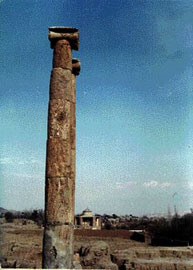

10- Khorheh- Profile view of two pillars remaining from the avian of the Parthian building (ca. 150 B.C). Notheastward view in the direction of Emamzadeh Shahzadeh Abolqasem, Shahzadeh Eshaq and Hakimeh Khatun, in comparison with picture 2 belonging to 1859, the renovation of the building and its altered façade and dome are clearly visible. (Photography by Mehnaz Emadi, winter 999)
B – Excavations at Khorheh

1 – First excavation, first photographs, second half of the summer of 1859 The first photographs at Khorheh were taken in Qoy-yil/1276 ( July 31st 1859 to March 20th 1860), or to be more precise, in the second half of the summer of 1859, one and a half years after the photographic survey of Persepolis. They were made during Nãsserod- Din Shãh’s journey to Qom, Kurdistan, Soltãniyeh and Azarbayjan. At least two photographs were taken during this trip and were included, together with a pencil drawing of its two columns, perhaps sketched by the Shah himself, in the album prepared for and presented to him in the same year (July 31st 1859 to March 20th 1860; pls. 2-4). This superb album is preserved as item no. 7703/679 in the Phothothèque of the Golestãn Palace.

Discussing this work is beyond the scope of the present article, but I believe photographs 1 to 58, and perhaps 61, to be the first known works of Ãqã Rezã, the first Iranian professional photographer, and photographs 62 to 96 those of his master, the French Francis Carlhian13. He came to Tehran at the end of 1858, at the same time as the French military advisors engaged for the Persian army, and joined them during this journey. Carlhian remained in Iran, serving at the Dãr-ol-Fonun (Tehran Polytechnic), and died in this country (b. May 6th 1818, Paris – d. January 6th 1870, Tehran). The reason for my attributing these photographs to Ãqã Rezã is that the quality of photographs 1 to 58, and even up to 61, is not as good as the next series (62 to 96), which I attribute to Carlhian in view of the large number of photographs of Paris among them, as well as the French inscriptions they bear.
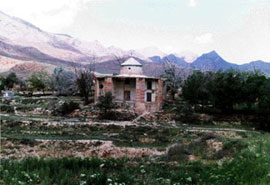

11- Khorheh – Northern view of Emamzadeh Shahzadeh Abolqasem, Shahzadeh Ashaq and Hakimeh Khatun (Photograph by Mehdi Rahbar, ICHO)

The lack of quality may of course be due to Ãqã Rezã’s inexperience. A point is that there is a cyanotype (blue photograph) in this album (no. 141, fol. 122, attendants next to the so-called Throne of Yazid in the Golestãn Palace, 145 x 115 mm.). As cyanotype photography was introduced in Iran by Carlhian, as the photograph is of excellent quality, and as the date when the album was made corresponds approximately with a year after Carlhian’s arrival in Iran, this blue photograph cannot have been made by anyone else but him. And since Rezã also made cyanotype photography, the master-student relationship is again manifest. Ãqã Rezã Eqbãl-os-Saltaneh, the son of Mirzã Esmã‘il Jadid-ol-Eslãm, was born in 1843 and died in 189014. Photograph 31 of this album shows him at the age of seventeen. The compilation of this album once again shows the Shah’s attachment to photography and it is not improbable that he joined Rezã to make photographs on this trip.
As can be seen in pls. 2 and 3, these photographs were made in conjunction with a small-scale excavation in the prolongation of the columns. This excavation was undoubtedly ordered by Nãsser-od-Din Shãh, who was deeply interested in art and history, and the photographs were most probably also made upon his order, as photography was one of his passions. The outcome of this operation, carried out by eleven workers (see the caption of pl. 3, the number of diggers increased to sixteen in the next excavation, in 1892) is not known, but it must not have pleased the Shah, because 32 years later he dispatched another mission to resume these investigations, as was mentioned and will be further explained. It is notable that the conclusions on the period of the building of the columns reported below Ãqã Rezã’s photographs are more accurate than those written for Ãqã Yusef ’s pictures taken during the next excavations. Indeed in Ãqã Rezã’s photographs (caption of pl. 3) the columns are attributed by hearsay to the period of Darius (Dãrã, here to be identified with Darius III) while in Ãqã Yusefs’ they are dated to the Seljuk period. The attribution in Rezã’s work is neither far from reality nor in contradiction with the text of Hassan Qomi (988-89 AD), who believed them to have been erected by Alexander 15, whereas Ãqã Yusef, probably following the assertion of Dr . Feuvrier, who thought that the bones unearthed were of Turkish origin, attributed the columns to the Seljuk period (see below). This erroneous conclusion bears in fact little interest within the framework of the present article, because, rationally speaking, what is important is that a question is raised, continues to be raised, and attempts at answering it are carried out on the basis of scientific data until it is solved. In Khorheh, care was taken for these conditions to be fulfilled and, by keeping up this method, conclusions will eventually be reached. From the methodological viewpoint, the path adopted in the second study of Khorheh was right, but the incomplete data were used inappropriately, leading to wrong conclusions..

12 – Khorheh. An old mineral water stream shaped by deposits (Photograph by Mehdi Rahbar, ICHO)

From the archaeological viewpoint, this photographic approach has at least three valuable results, it showed: 1- the situation of the site 140 years ago with no more than two columns like today; 2- an open, non-built area in front (on the southeast) of the columns, corresponding with the courtyard discovered by Mr. Rahbar; and 3 – a flat hill behind (to the northwest of ) the columns, indicating the prior existence of a large building. Unfortunately, the upper part of this hill, the part at its centre and on its east, disappeared in later years, before the second excavations carried out in 1892, during the reign of Nãsser-od-Din Shãh. As a result, the late Hãkemi and subsequently Mr. Rahbar only had access to its lower layers. Regrettably, these photographs do not help to explain Hassan Qomi’s descriptions in Tãrikh-e Qom, which Mr. Rahbar has quoted.
Thus, it is not clear what Qomi means by the “four pavilions” he refers to; if these four buildings did exist, as mentioned in Tãrikhe Qom (The History of Qom), and if their dimensions were as quoted therein, where were they located and how did they fit into the map presented by Mr. Rahbar? (his fig. 82)16 The features of this building — pavilion or temple — remain unknown, although the existence of such a construction near mineral springs recalls Takht-e Soleymãn on a smaller scale, and one can imagine the existence of an ensemble combining a palace and a temple on this site (see below).

During the 33 year-long interval between Nãsser-od-Din Shãh’s first visit to Khorheh (summer of 1859) and his second journey to its neighbourhood (May 31st1892), the French excavations at Susa began and Prince Farhãd Mirzã initiated some diggings at Persepolis. Other personalities from the king’s entourage also started operations which were, at least from a methodological point of view, more like treasure hunts than archaeological research. These actions included Mo‘ayyer-ol-Mamãlek’s “gold-washing” on 12th and 13th of October 1870 in the ‘Abbãssãbãd valley near Hamadãn, during the king’s journey to the Holy Cities of Irãk. At the time, “goldwashing” operations carried out with the authorization of the government were not considered illegal. It consisted of washing the earth by pouring water on the ground to wash the earth until precious items became visible. Unlike the excavations at Khorheh, and to those of Farhãd Mirzã at Persepolis, these undertakings were not motivated by a scientific quest but rather by a sense of curiosity in which the quest for gold or financial gain was not necessarily absent. Although Nãsser-od-Din Shãh’s own writings on Mo‘ayyer’s activities also refer to gold, his brief description remains scientifically oriented enough to allow the main object unearthed to be attributed to the Achaemenian period: “A thick gold ring was found which instead of a precious stone had a horned bull with two wings pierced with small holes like a perfume container”17. Even in “gold-washing”, the Shah insisted on the rights of his “subjects”. This was one of the Shah’s — i.e. his government’s as he was the Government — good characteristics refuting any personal or commercial interests. Thus, in a brief undated note but concerning Hamadãn, he writes: “As concerns ‘gold-washing’ in Hamadãn, let it be determined how much loss this imposes on [our] subjects in Hamadãn”18.

13 – Khorheh. The new mineral water lake created in 1984-85 (Photograph by Mehdi Rahbar, ICHO)

No documents are available concerning illegal, unauthorized or commercially oriented excavations carried out in this period, but some ten years ago partly coded letters written by the brother of a famous French antiquarian named Vignier, who was dealing in excavated artifacts and ancient manuscripts in the early years of the present century, came to light in Paris. These documents are most interesting and will be published in future19. Nor have any pictures been found so far of excavated artifacts unearthed a century and a half ago, but Vignier’s operations appear to have been accompanied by photographs and several of them are said to be extant, and are being searched for. Some of these must be similar to a recently published photograph taken by Antoine Sevruguin in the early 20th century of a jar and two jugs, all apparently lustre wares produced in Rey, Kãshãn or Sãveh20. Clandestine excavations put aside, those carried out in Susa by the Dieulafoy couple and their successors, particularly de Morgan, deserve seriouscriticism on both scientific and ethical grounds when compared with the highest archaeological standards of the time.
De Morgan did not excavate in Susa, but rather worked it out like a huge open mine. Guided by methods of fast economical extraction of minerals, rather than those of archaeologists or even geologists for identifying strata, he proceeded by digging out 5 meter-thick successive layers. However, at the end of the day, de Morgan’s inappropriate excavations, of which at least documents have remained, were not worse than those effected by many other archaeologists — including our compatriots, because no written reports or drawings and plans of these “excavations” are extant, and the traces themselves have often been destroyed by the very fact of digging up successive lay. French scientists — ranging from de Morgan’s dissatisfied assistants to André Parrot, the former director of the Louvre, and Pierre Amiet, the Head -Curator of its Oriental Section in our time, have written extensively about de Morgan’s shortcomings, and there is no need to analyse them again in this brief article. There are also eloquent reports on de Morgan by his contemporary Iranian observers, including those of Prince Dr Haydar Mirzã Shãhrokhshãhi, Mostafã Manshur-os- Saltaneh and Hossein, from the government’s Main Office in Arabestãn (Khuzestan). These official reports were addressed to the Iranian Ministry of Foreign Affairs under Mozaffar-od-Din Shãh and have just been published21.

In Persepolis, Farhãd Mirzã was apparently the third excavator after Morier and Gordon. On “Government’s instructions”, undoubtedly emanating from the Shah, he sent Mirzã Bãqer — the governor of Marvdasht — with labourers to excavate at Persepolis to find “antique objects” (events taking place between 14th March to 16th April 1870). He himself joined them later for several days.

They found “sculptures in stone, the site of a lofty building, a bridle and an iron plate the pattern of which was not visible” (events taking place between 17th April to 14th May 1877 and the following days). The Prince certainly sent a report on these excavation to the Shah, but it has not yet been found. About six months later (between 19th October to 18th November 1877), he gave permission to Friedrich Carl Andreas, the German Iranologist, to excavate at Persepolis, but on behalf of the Government, refused his request to let him take possession of any item he might have come to discover22. Probably, Andreas did not accept this condition and did not go digging at Persepolis but was active later at Bushehr. Prince Farhãd Mirzã was fond of books and versed in traditional sciences, and he also had some knowledge of modern sciences and knew English (his disputable political attitude towards the British falls beyond the scope of this article). Of course, on the whole, neither he nor any of the other dignitaries of the time of Mohammad Shãh and the early reign of Nãsser-od-Din Shãh could match Prince Malek-Qãssem Mirzã, the Shah’s other uncle, in terms of modern knowledge and political awareness (which could reach undreamtof levels when it came to drafting a Constitution under Mohammad Shãh). Malek-Qãssem Mirzã the art-lover was proficient in cartography as well as in taking daguerreotype photographs and knew several foreign languages. He also had some medical knowledge and was aware of European events23. Such qualities could have made him an experienced archaeologist even in our time, but no evidence of his interest in this domain has as yet come to light.

At this period, the growing importance of archaeology had reached the point where specialists in this domain met at international congresses to deliver lectures and exchange views. The Russian government held one such congress in Tiflis in the autumn of 1882, that is, almost 120 years ago. The Caucasian authorities submitted an invitation to the Consulat Général de Perse in that city for a representative of the Persian government to participate in its sessions. The consul, ‘Alã’-os-Saltaneh, appointed Mirzã Rezã Khãn Dãnesh (later Arfa‘-od-Dowleh and Prince Arfa‘), his subordinate at the time, to take part in the meetings. I think that this was the first presence of an Iranian in an international archaeological congress. Arfa‘ recorded the events of that congress in his memoirs. He mentions that one of the benefits of his participation in it was the discovery of a mosque in Kutais. He writes that the building had an inscription from the Umayyad period, which he identified and read24. Arfa‘ was a great lover of antiquities and of ancient Iran25. In his palatial mansion, which he had built in Monaco between 1908 and 1912 and initially called “Dãneshgãh / Palace of Sciences” and later “Villa Esfahan”, there was a stone bas-relief of the Winged Man from Pasargadae (allegedly Cyrus) carved by Agliardi, a Roman sculptor who had sought refuge in Monaco during World War I (1914-18). Unfortunately, that mansion, which could have represented a powerful symbol of Iran in an important city abroad, was demolished some 15 years ago to be replaced by an apartment building. And the valuable objects in it, many of which (including cylinders of Persian music) bore great importance in terms of Iranian culture, were sold at an auction by Sotheby’s on June 28th 1983. From that collection, three huge flags bearing the Lion and Sun emblem were years later acquired by the author, but no information about the other objects, including the bas-relief mentioned, is available26.
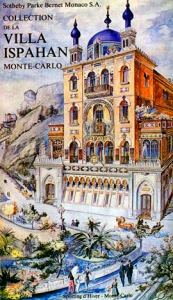

14- Villa Esfahan, residence of Prince Arfa‘ in Monaco. This mansion was initially called “University” and later “Villa Esfahan”. Watercolor painting, 1004 x 670 mm, work of Manfred Vaccari, dated 27 June 1915. As can be seen, this painting illustrated the cover of the catalogue published for the auction of the belongings of Prince Arfa‘, held in this house on 28 June 1982. Unfortunately, the house itself was demolished a little later and replaced by a residential apartment building. The architecture of the house is in the Mauresque style. From the viewpoint of westerners who had seen Ottoman, north African and Spanish houses, this type of building represented a so-called “Islamic” architecture. As far as the author knows, in Iran only the house of Yusef Adle (Qa’em-Maqam-ol-Molk, the father of Pr. Yahya Adle), built by Nikolai Markoff (1882-1957) opposite the Marble Palace in 1933, follows this style. Today, following its restoration by Eng. Mostafa Daneshvar, this building is used as the headquarters of the Expediency Council.

2- Second excavation at Khorheh, second photographic

campaign, creation of an excavation and survey team, May 31st 1892 dring Nãsser-od-Din Shãh’s journey to Persian Irãk (Central Iran), his retinue passed near Khorheh in 1892 and the Shah once again began thinking of the columns. This time he ordered a team to be formed to study these two columns. In his narrative, he briefly notes: “While We were in Mahallãt, We dispatched Hossein Khãn, Officer of the Royal Household and son of Ebrãhim Khãn Sadiq-e Khalvat, together with a photographer and ‘Ãref Khãn, the Translator of Ottoman Turkish, who is accompanying E‘temãd-os- Saltaneh, to Khorheh to make photographs of the ancient columns there as well as the village and its gardens”27. The mission to Khorheh is also mentioned by Mohammad-Hassan Khãn E‘temãdos- Saltaneh. On May31st 1892, he wrote in his diary: “… yesterday I sent Afandi [Efendi: i.e., ‘Ãref Khãn] to Khorheh and he has not come back yet.”28. In fact, ‘Ãref Khan, the photographer, and others were dispatched upon the Shah’s command, and E‘temãd-os- Saltaneh, the Minister of Publications and Director of the Translation Department, obeyed his order but did not take the initiative. These indications show that the team’s mission was serious, it lasted at least three days and two nights. According to the caption of photograph no. 21 (pl. 6), the team consisted of four persons, who arrived at the site on May 31st 1892. These were Hossein Khãn, ‘Ali Rezã Khãn Mahallãti, a relative of Hossein Khãn, Ãqã Yusef, one of His Majesty’s photographers personally present in photograph no. 21 (pl. 6), and ‘Ãref Khãn. In his architectural photographs, Yusef Khãn displays skill by placing a standing man to show the scale.
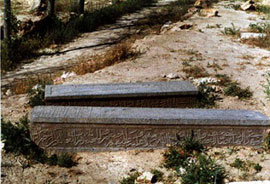
14- Khorheh. Safavid case tombstones adjoining Emamzadeh Shahzadeh Abolqassem, Shahzadeh Eshaq and Hakimeh Khatun. (Photograph by Mehdi Rahbar, ICHO)<

‘Ãref Khãn was undoubtedly in charge of writing the report of the survey and he played an important role. As his name and his main job indicate, he had connections with the Ottoman Empire, and thus ought to have recognized the Ionic style of the columns, but apparently he did not. Perhaps Dr. Feuvrier’s indications on the Turkish origin of those buried at Khorheh ended up by misleading everyone. In his memoirs, he mentions the Greeks in connection with the remains at Khorheh, but apparently he failed to do so with the Persians; had he done so, surely the period to which the columns were finally attributed would have been roughly accurate. Photograph no.17 (pl. 8) shows that sixteen peasants were involved in the operations. The report of the mission is not available, and the Shah makes no mention of it either29. But Prince Manuchehr Mirzã, himself a photographer, and Mirzã Forughi, Mohammad- Hassan Khãn E‘temãd-os-Saltaneh’s secretary, who both went on the same day to see the ruins, related their observations to Nãsserod- Din Shãh’s French physician, Dr. Feuvrier, who accompanied the king during his voyage. In his memoirs, Dr. Feuvrier has included the accounts of both men — who perhaps also went to Khorheh upon the Shah’s and his minister’s order —, together with his own views and the opinion of E‘temãd-os-Saltaneh, who was an expert in antiquities and numismatics, as well as an amateur photographer (see below). It is due to these attitudes, inquiries and excavations, as well as the opinions expressed on the architecture, the graves and the types of skeletons during this expedition — as ordered by the king and the minister in charge, i.e. the government — that the excavations at Khorheh a centuary and a half to a century ago mark the dawn of Iranian scientific archaeological excavations, and differ from other excavations undertaken up to these periods.
Dr. Feuvrier’s memoirs were translated into Persian by the late ‘Abbãs Eqbãl, but as his translation is not sufficiently accurate30, another version is presented here [N.B. in this part in English]. About the interval between May 27th and June 1st 1892, Feuvrier writes that Prince Manuchehr Mirzã and Mirzã Forughi went to visit Khorheh during their five-day sojourn in Mahallãt. The fifth day of their stay coincided with May 31st 1892, that is, the same day as the date given for Nãsser-od-Din Shãh’s excavation in the photograph captions. Therefore, all these explorations and surveys have taken place together and the opinions expressed were submitted to the Shah and his minister (i.e., the government). The date conversion from the Christian to the lunar Muslim calendar in Eqbãl’s translation is mistaken by one day and thus fails to reflect the coincidence of the visit with the excavation: Eqbãl made May 27th 1892 coincide with Shavvãl 30th 1309, although it corresponds with Shavvãl 29th, the 30th of Shavvãl occurring only exceptionally, because this lunar month usually consists of only 29 days. After mentioning the village of Nimvar, from where he soon afterwards saw “fragments of columns and other ruins bearing evidence of a past quite different from the present”, Dr. Feuvrier writes30: “We rested five days at Mahalat… Prince Manuchehr Mirza, who is a highly skilled amateur photographer, took advantage of our stay at Mahalat to visit the ruins of Khorhé in the company of Mirza Floughi [Forughi], the secretary of Etemad es Saltaneh. They found no significant traces of buildings, but close to a kind of square pillar, heavily eroded at its base, they excavated and came across a quantity of human bones. The bones filled what seemed to them as a big basin as they recognized its brick-lined edge; but would not this closed space full of bones rather be one of those sarcophagi in unbaked brick in which the Greeks used to bury [their] dead after battles? Mirza Floughi brought me back a relatively intact skull and eight bronze or copper arrows retrieved from that ossuary.
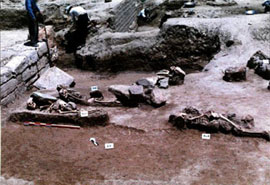

15-Khorheh – Islamic graveyard discovered in the courtyard on the southeast of the avian of the Parthian building (Photograph by Mehdi Rahbar, ICHO

It must be said that, more than anything else, this skull resembles that of a Turk, and this justifies Etemad es Saltaneh’s opinion, who believed this ossuary to date to a period when the Turks forced the Persians to convert to Islam; because the Turks came this way from Arabia to Persia and had to fight battles in these regions. As to the metallic rods, these are 5 to 7 centimetres long, and their more or less blunted tips are pointed or dart-like. One of them has the particularity of having its end bent back on itself by a hammer blow, traces of which are visible. It is not rare to find such weapons with their ends deformed in this manner in ancient graveyards, the intention perhaps having been that they be no longer used after their owner’s death.”
Dr. Feuvrier has in his turn published a photograph of Khorheh ( p. 327), but since he never went there, it must be

attributed to Prince Manuchehr Mirzã, who is mentioned above In Mr. Rahbar’s opinion, since such a relic cannot be seen in Khorheh today, it has either been demolished or must be attributed to somewhere else. The picture actually shows the “square pillar, heavily eroded at its base” mentioned by Dr. Feuvrier, but it is not what Manuchehr Mirzã and Mirzã Forughi saw and reported to him. In fact, Dr. Feuvrier has either misunderstood the description of the two men, or recorded it inaccurately. The probability of a misunderstanding is more likely, because he has also erroneously understood what E‘temãd-os-Saltaneh may have told him about Arabs and Turks. In substance, Manuchehr Mirzã and Mirzã Forughi told Dr. Feuvrier that, following excavations near a column with its lower cylinder heavily eroded and standing on a parallelepipedal base, they found a grave made with unbaked bricks (or covered with unbaked bricks). The column, of course, refers to one of the two columns at Khorheh, near which excavations were carried out and which appear heavily eroded in the photographs (pls. 6 and 10).

Prince Manuchehr Mirzã must not be identified with Manuchehr Khãn ‘Akkãsbãshi (the King’s Photographer), who was his contemporary and whose biography Zokã’ has included in his History of Photography32. In this book, Zokã’ does not mention Prince Manuchehr Mirzã as a photographer, but in his unpublished notes, he writes: “Manuchehr Mirzã, son of Masrur Mirzã, son of Teymur Mirzã, joined the Translation Office of the Ministry of Foreign Affairs in May 1902 and was from 1903 to 1905 the agent for this ministry in Shiraz. He was thoroughly familiar with French language and culture.” Dr. Feuvrier reproduced his portrait on page 331 of his book (p. 267 of the Persian translation). E‘temãdos- Saltaneh, who also did photographic work, was a friend of Manuchehr Mirzã. Two months after their sojourn at Khorheh he wrote on the August 4th 1892 in his diaries: “… accompanied by Manuchehr Mirzã, I once again travelled to the village of Ashtiyãn, and we took photographs of that old man and the village”33. A picture of the old man, surely taken by Manuchehr Mirzã, is reproduced in Feuvrier’s book (p. 359). The Shah himself writes about their journey to Khorheh: “We did not go to see the dam [of Nimvar]. Instead, E‘temãd-os-Saltaneh and Prince Manuchehr Mirzã went and took photographs of it which they presented to us” 34. For unknown reasons, E‘temãd-os-Saltaneh did not personally go to Khorheh, otherwise matters would have been explained more clearly. If he had seen the columns, he would certainly have noticed their Greek style and, in recording his memories of Sunday May 29th 1892 (p. 932, i.e., two days before the excavations at Khorheh), he would have attributed Greek origins to Khorheh, rather than to the mosque of Mahallãt: “I went to the mosque of Mahallãt, which is now in ruins. It is very old. Originally, two thousand and three hundred years ago, it was a Greek temple of idolatry, but it was transformed into a mosque after the victory of Islam. The way its prayer niche (mihrab) is built and other elements indicate that it was not constructed during the Islamic period.” (see a picture of the mosque and its mihrab certainly taken by Manuchehr Mirzã in Feuvrier’s memoir, p. 329). It is not impossible that E‘temãd-os-Saltaneh replaced with “Yunãni (Ionian, i.e., Greek), the term “Rumi (Roman)” that he had heard on the site. For most people, especially in architecture, the term rumi also covered yunãni. Nor is it excluded that the local inhabitants of the region confused the two places, attributing to Mahallãt what actually was true of Khorheh, about 18kms away.
In conclusion, the intricacy of the problem of Khorheh did not allow the investigations to come to a coherent and final conclusion, and this situation continues to the present, while Mr. Rahbar’s research has not yet come to an end. In the research carried out during the reign of Nãsser-od-Din Shãh, uncertainties and contradictions are found in the album captions and in Dr. Feuvrier’s memoirs as well as in the other documents. These can be

summarized as follows:

1 – Perhaps a column, but at least a grave and the arrows therein were somehow connected with ancient Greece in Dr. Feuvrier’s opinion, whereas the Persians believed them to date back to the time of Dãrã, to be identified with Darius, or maybe more precisely Darius III (see captions of pls. 2 to 4, dated 1859). These attributions were not that wrong, but:

2 – In his anthropological examination, Dr. Feuvrier identified a skull as that of a Turk, which is at odds with the Greek origins he had attributed to the tomb. It was probably for the same reason that the columns on photographs dated 1892 (pls. 5 to 10) were mistakenly assumed to be Seljuk works. Mr. Rahbar believes that the columns date back to 150 BC and that the graveyard and all the Islamic graves therein belong to the 14th century AD, which concurs with E‘temãd-os-Saltaneh’s and Dr. Feuvrier’s views about their Turkish origin. In the worst imaginable eventuality, Dr. Feuvrier’s anthropological examination of the skull might be considered as mere “showmanship”, but raising the question here is of no avail, because what really matters is that the need for such an action was felt at the time, and that was the case.

3 – The idea of Turkish origins was E‘temãd-os-Saltaneh’s as well, and it was probably he who told Dr. Feuvrier about the Arab invasion and the much later arrival of the Turks in central Iran. Dr. Feuvrier, who was unfamiliar with Iranian history, misunderstood the sequence of events and recorded them in the confused manner we observed. Raising anthropological or ethnological origins on the basis of bone remains is interesting and marks an innovation in Iran. Racial considerations were widely discussed across the world at the time. The Russian Khanikoff, who had formerly visited Iran, was also involved in these matters, and the Comte de Gobineau, the famous French writer and ambassador to Persia in the early years of Nãsser-od-Din Shãh’s reign, who was reputed to be pro-German, had expressed his racial opinions in a romantic literary style. Nazism later exploited his writings, but that is a separate matter. The study of bones, excluding any political aims, is one of the main fields of present-day archaeology.

4 – It is strange that neither ‘Ãref Khãn nor E‘temãd-os-Saltaneh seem to have noticed the Greek style of the columns, because both were polyglots and aware of Europe. In addition, E‘temãdos- Saltaneh was also the foremost Iranian expert on the Parthians. His history on that dynasty, although written with the aim of demonstrating the unfounded Parthian origins of the Qajars, as he himself admits, was nevertheless fruitful in scientific terms. For reasons mentioned previously relating to the discovery of pre-Islamic Iran, and in view of the ever greater glory that was attributed to old Persia and the Aryans to the detriment of the Turks and Arabs, Nãsser-od-Din Shãh was no longer very fond of his Turkish origins. So when one day E‘temãd-os-Saltaneh blurted out, obsequiously as he himself admits, that the Qajars were of Parthian origin, the Shah immediately ordered him to write a book on the subject. E‘temãd-os-Saltaneh later expressed his remorse at having come out with that assertion, but it was too late and he had no choice but to write the book, which was a good one for its time except for its conclusion35.

As already mentioned, we must assume that the reason why both Dr. Feuvrier and E‘temãd-os-Saltaneh failed to associate the columns directly with Greece and the Parthians was that they had actually never seen them or even their photographs. Otherwise they could not have missed the obvious connection, particularly since they were intellectually predisposed and prepared to notice such things. Indeed, about a day before the excavation at Khorheh, both the Shah’s and E‘temãd-os-Saltaneh’s attention had been drawn to a Sassanian or Sassanian-looking coin, prompting the Shah to write in his memoirs: “We reached the field of Sost Kondor… good water was made to flow down from the upper spring … In the evening we were strolling on the mountain overlooking the spring … Maghrur Khãn the eunuch found a large silver coin in the valley and presented it to Us. We had it read by E‘temãd-os-Saltaneh. It was a coin of Anushirvãn. This is very strange”36. I do not know to what extent the amateur numismatist E‘temãd-os-Saltaneh was familiar with ancient scripts, but Nãsser-od-Din Shãh himself was unhappy about his inability to read ancient texts and in another occasion wrote: “At the upper end of this valley there is a big stone with two rings of cuneiform inscriptions. We went and looked at it. It is quite intact. Traces of a ruined castle were also visible atop the mountain overlooking these inscriptions, and I was very weary and disheartened about being unable to read those inscriptions.”37

5 – As concerns the sarcophagus or the ossuary, it appears that the excavators came across a grave of the type seen in Rey and Bastãm, which was built with bricks in the form of a large case buried under the ground. This type of grave was used at least from Samanid, Ziyarid and Buyid times until the Mongol period. It could reach larger dimensions, acquiring the form of a small cellar and used as collective graves (Zuzan, Torbat-e Jãm, Bastãm, Rey). Mr. Rahbar’s view, who attributes the graveyard here and the tombs next to the Emãmzãdeh at Khorheh to the 14th century AD, does not conflict with the existence of a sarcophagus-shaped grave. The photographs do not show these voluminous graves, and the bones displayed by the excavator in photograph 22 (pl. 7) ndicate the discovery of an individual grave of the type excavated by Mr. Rahbar (see illustrations 83, 84, 95 and 96 of his text). It is possible that even the sarcophagus-shaped grave was in fact of that kind, and the first excavators took its lahad (bricks covering the space where the body is lying) for parts of such a small construction.

6 – In the discussion concerning the arrows, Dr. Feuvrier emphasizes their old age and type, but mentions no date. He expressed an opinion about their bent points which seems admissible by itself, but Mr. Rahbar’s survey indicates that the graves are Islamic and that the arrows are therefore unrelated with the grave in which they were found. The arrows were probably located beside the grave or within the earth dumped on the corpses. No such objects were found in Mr. Rahbar’s excavations.
7 – A systematic excavation based on a geometric grid following present-day standards was not carried out in Khorheh. Instead, earth was removed in places deemed to be important, that is along the direction of the columns.

8 – Neither Nãsser-od-Din Shãh’s team nor anyone of his entourage have expressed an opinion about why these relics were built, and no mention of them is made in books written during his reign. The photographs taken in 1859 (Pl. 2) show that the site consisted of a flat and shallow open area in front of the columns (east of the pavilion/temple) in which fragments of construction materials were scattered, and that no considerable building therefore existed under it. Hence, one can conclude that this environment consisted solely of an open space or courtyard. A flat area approximately 2 meters above the location of the columns existed to the west, parallel with the columns (Pl. 3), which is no longer visible in the photographs taken in 1892 (Pl. 5). This elevated area comprised the pavilion/temple whose vestiges were excavated in later years by Hãkemi and Rahbar. If this flat hillock had not been removed in parts between 1859 and 1892, the building’s walls could have been retrieved up to its roof level or perhaps even higher (see Rahbar’s fig. 98). The function of this building has remained unknown, and today it is difficult to establish any correspondence between Khor b. Arvand’s pavilion as described by Hassan Qomi and the present state of the excavations. Khor’s name nevertheless explains the origin of the name of the present locality. The existence of this relic beside mineral water springs evokes, on the one hand, Takhte Soleymãn on a smaller scale; and, on the other, the fact that the medical virtues of the waters were already so well-known in 896 or 901 AD that according to Hassan Qomi, Amir Borun-e Tork, the emir of Qom, decided to build a caravansary there38. It thus seems evident that the Parthian building must have been the heart of an ensemble connected with the springs, and must have consisted of a palace, a temple and a place of rest or caravansary for ailing people or pilgrims, and the temple must have been dedicated to one of the deities of water, medicine, or both, in the Irano-Greek tradition prevailing during the Parthian period.

**********************

In science, what is important is curiosity; that questions be constantly asked, and that attempts at answering them be made on the basis of rational data. Since even certainty must be challenged, mistakes are not too important, because the way for reconsideration remains always open. In Khorheh, a process of this kind was developed, not absolutely but relatively — even if unconsciously or affectedly: initially about one and half century ago, in 1859, the columns attracted attention by way of curiosity rather than for financial raisons, excavations were undertaken and the columns were photographed (an operation quite progressive in those days), the photographs were gathered in an album which was placed in the Imperial Library (in a way a governmental library as the King was the State)39, and an answer was given to a question (their attribution to the time of Darius). Thirty three years later, a team of experts — as we would call them today — were appointed by the Government (the Shah and his relevant minister), in which the best specialists and authorities in the Shah’s entourage were directly or indirectly involved40; therefore a novel and positive process was taking place. All these elements show the existence of a positive and dynamic attitude at least in some quarters within the cultural and scientific framework of that period; the establishment and activities of the Dãr-ol-Fonun being one of its other aspects. The operations at Khorheh illustrate the continuation of the intellectual approach of Nãsser-od-Din Shãh’s reign, the first spark of which — archaeologically speaking — lit up at Persepolis. Although the first persons involved in the photographic project of Persepolis were Europeans (Richard followed by Pesce), they worked at the service of the Persian government, remained in Persia and died there. The 1850 and 1858 photographic projects of Persepolis were either carried out upon Nãsser-od-Din Shãh’s personal orders or in view of attracting his attention within the cultural framework of the early years of his reign — they took place 150 and 141 years ago, respectively. The efforts made at benefiting from modern sciences, which had begun at the time of ‘Abbãs Mirzã and were pursued by Mohammad Shãh and Hãjj Mirzã Ãghãssi, acquired a systematic nature and an accelerated pace at the time of Nãsser-od-Din Shãh and Amir Kabir, but this pace slowed down later for reasons beyond the scope of the present article. In the history of Iranian archaeology, it was the sum of behaviours, curiosities, excavations and deductions concerning the columns, the grave and the type of the skeleton uncovered under the Shah’s — i.e. the government’s — orders that made the Khorheh excavations over a century ago the forerunner of an Iranian, scientific and governmental approach in this field. Those features distinguish the excavations at Khorheh from other early similar works (whether foreign or Iranian) in Persia and characterize them as a remarkable turning point on a global scale.
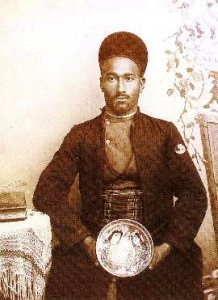
Illustrations

Revised plan of the Pavilion (or the temple?) at Khorheh after Mr. Rahbar’s excavations, 1996 (ICHO). A: Main Open Room provided with one wooden central column standing on a stone base; B: Eyvan with 6 stone columns (2 still standing); C: Courtyard; D: Main entrance; E: Corridor
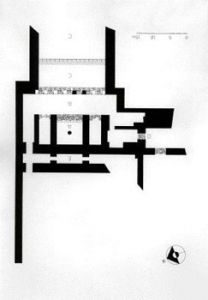
Analytical Description of the Photographs and Images of Khorheh in the Photothèque of the Golestan Palace, Tehran A- Photographs of excavations carried out during the reign of Nãsser-od-Din Shãh in the summer of 1859, preserved in Album 679/7703. Photographs attributed to Rezã, the first professional Iranian photographer. First photographs of an archaeological excavation in Iran.

Technically, photograph no. 12 of this album shows that the pictures were made on glass rather than paper negatives. Unfortunately, these glass originals have not been found as yet.
Pl. 1- Pages 1 and 2 of the Vaqãye‘-e Ettefãqiyeh, the official journal of the Imperial Persian Government, no 64, dated Thursday Rajab 2th 1268 (Sichqãn-yil) / April 22nd 1852. The news of the excavations at Susa are published on page 2, together with a picture of a coin dated from the year 105 AH (723-24 AD). These reports were published at the time of the end of the first British excavation season at Susa, but they are not mentioned.
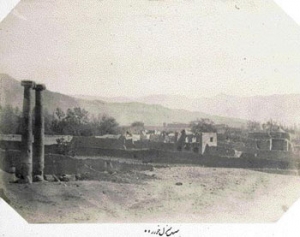
General view of Khorheh, inscribed “Khorreh”. Number 5 here, or numbers 4 and 106 on the next two photographs, indicate their location in the initial album of the Soltãniyeh expedition, which was later on taken apart to create the present album. The camera was set 20 to 25 meters away from the south by southeast corner of the pavilion/temple and the photograph was taken north by north-westward. On the right hand side of the photograph, towards the northeast, one can see Emãmzãdeh Shãhzãdeh Ab-ol-Qãssem, the conical roof of which was neither shaped as it is today (see Rahbar’s fig. 61), nor as it appeared in 1892 (see pl. 5 here, photograph 19 of album 113/7134). A semi-ruined seigniorial building also appears on the photograph, between the Emãmzãdeh and the columns. The area in front of the columns (east of the pavilion/temple), in which fragments of construction materials are scattered, was flat and shallow as today. Therefore, no considerable construction must have existed below the surface of this area and one may conclude that it consisted solely of an open space or courtyard. The elevated surface on the left-hand side of the columns (on the northwest) is not visible here, but does appear in the next photograph. The excavators, who are farmers, are in a shaded depression and do not appear clearly, except for the one standing next to the column, but the fairly considerable amount of earth they have removed from beside the column is clearly visible. The heavily eroded lower part of the column’s cylindrical shaft is more visible in the next photograph. In order to better understand the area, particularly the important changes brought about in later years, it is advisable for the viewer to compare this picture with pl. 5 (photograph 19 in album 113/7134 of 1892).

Pl. 3- Photograph 7 of the album: “Image of the stopover at Khorreh. These columns are said to date back to the

time of Dãrã [Darius]. 4”. Albumen print, yellow-brown coloured, w. 234 x h. 171mm. Here the photographer has set his camera a little further away, slightly to the east of the previous location, and turned its lens northward and slightly to the west to take his picture. The area covered by the vestiges at the time, as compared with photographs taken 33 years later in 1892 (pls. 5 to 10), is distinctly less eroded.
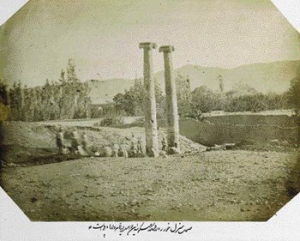

In particular, the flat surface situated some 2 meters above the columns’ site, on their left hand (west) side and parallel with them, is no longer visible in the photographs of 1892. This area can be seen on pl. 5, below the feet of the excavators posing immobile for the photographer. The destruction of the eastern part of the 2 meters-high elevation, where there stood a pavilion/temple the site of which was excavated in past years by the late Hãkemi and then Mr. Rahbar, caused irreparable damages between 1859 and 1892. Had this not happened, the walls of that building could have been retrieved up to the ceiling (see illustration 98 of Mr. Rahbar’s text) or even higher up on the south and west of the area. The destruction of this area must not have occurred on purpose and can be attributed to the removal by farmers of untouched rich soil to their cultivated fields. The flat area in front of the camera and on the right hand (east) side of the columns, visible here and in the previous photograph, has been replaced by a wheat or barley field in photograph no. 19 of album 113/7134 (pl. 5 here). Eleven farmers are visible moving about; their clothing, which looks quite presentable in these pictures, became even better in 1892. It shows that the economic situation at Khorheh was flourishing in those times. Note that the 2 photographs displayed here are the first pictures of excavators busy working on an archaeological site in Iran.

Pl. 4- Folio 97, photograph 106 of the album: Pencil drawing of the two columns at Khorreh, bearing no caption. The number “84” appears at the bottom left corner of the picture. h. 357 x l. 221 mm. Unsigned and undated.

As the drawing bears no inscription, both the name of the artist and the date at which it was drawn are unknown; but as the person who did it was relatively unskilled and not quite familiar with the rules of Italian perspective, and, on the other hand, as this pencil drawing has been included in a royal album, it might be that it was made by Nãsser-od-Din Shãh himself, but this is not certain. It might be presumed that the drawing was made from a photograph, but the lack of accuracy also invalidates this assumption. The inaccuracy of the drawing precludes its utilization for scientific purposes, but its very existence again shows Nãsser-od-Din Shãh’s interest in archaeological remains and graphic arts.

B. Photographs of excavations carried out during the reign of Nãsser-od-Din Shãh in 1892, preserved in Album 113/7134. Second album of a set of six on Nãsser-od-Din Shãh’s travel to Persian Irãk. Photographer: Ãqã Yusef, H. M.’s Photographer.
All the photographs were made on glass plates cut in Iran and a number of them were identified during the latest reorganization of the Golestãn Palace’s Phothothèque in autumn 1998 and winter 1999. The clue to the fact that these plates were cut in Iran appears in their non-uniform dimensions and that they are not absolutely rectangular. On the average, they measure 179 by 129 millimetres, equivalent to the current 13 by 18 centimetres format. The measurement of the plates in the Phothothèque always has to show the dimensions on the left and lower side of a glass, when it is correctly viewed, that is, with its sensitive face on the other side of the glass and its bare side facing the viewer.

Pl. 5- Photograph 19 of the album: “Panorama of the village of Khorheh and the two columns mentioned. 4th of Zi-qa‘deh in the year 1309, Luy-yil” / 31 May 1892. Glass plate no. 5094, w. 179 x h. 128mm. Both the photograph and the glass plate are well preserved. Photograph: light yellow-brown, w. 167 x h. 122mm. Trimmed contact print.

The picture looks towards the Emãmzãdeh (north- eastward) and shows the columns in profile (see pl. 2). A wheat or barley field (courtyard) is visible on the right hand (southeast) side of the columns and the two areas are separated by a brook. The tall flat area that existed on the left hand (northwest) side of the columns (see pl. 3) is visible here but has lost its height due to excavations made between the two photographic sessions. The excavators are seen here and there standing on top of it. Some of the space between the columns and the photographer standing to the southwest of them consists of ploughed soil, and the remainder is not cultivated. Around the columns and to the west, thirteen labourers have interrupted their work and are posing for the photographer.

Pl. 6- Photograph 21 of the album: “The two columns mentioned, photographed at close range to show their diameter. The personalities standing there are gathered upon His Majesty’s command to investigate the state of the two stone columns assumed to date from the reign of Seljuk kings. 4th of Zi-qa‘deh in the year 1309, Luy-yil” / May 31th 1892. Glass plate no 3058, w. 179 x h.129mm. Both the glass plate and the photograph are well preserved. Photograph: light yellow brown with a faint violet hue, w. 178 x h. 122mm. Contact print.

Four men are standing between the two columns of Khorheh and the photograph was taken from a point between the threshold of the pavilion/temple and the columns, looking towards the southeast, that is the courtyard transformed into a field. The names of the personalities present are given below the photograph, from right to left, as: “‘Ali Rezã Khãn Mahallãti, a relative of Hossein Khãn; Hossein Khãn, the Officer of the Royal Household; Ãqã Yusef, H. M.’s Photographer; ‘Ãref Khãn Eslãmboli, the Translator”. Yusef, the photographer, is staring at the camera, waiting for the photograph to be taken. ‘Ãref Khãn, wearing a white beard, is holding a paper on which to write the report of the survey operations. He appears to play the main role in the team dispatched on site, but on the whole, the opinions of such advisors as E‘temãdos-Saltaneh and Dr. Feuvrier bore greater weight with the Shah.‘Ali Rezã Khãn and Hossein Khãn, who are from Mahallãt, are certainly present as guides and to help the party. The photographer’s assertion that the two columns belong to the Seljuk period is probably based on an interpretation of Dr. Feuvrier’s conclusions, who attributed Turkish origins to the skull discovered at Khorheh (see also pl. 7). All around the right hand (south) side column has been excavated to a depth of 30 centimetres, without reaching its parallelepipedal base. The extent of the erosion of the columns’ stones is clearly visible. The photographer is familiar with the issue of scale in architecture and archaeology, and writes that he has taken the photograph at close range so as to show the columns’ diameter [in comparison with the personages] (also see pl. 9).

Pl. 7- Photograph 22 of the album: “A villager of Khorheh who has excavated around the base of the stone columns. After an extensive search, nothing but bones came to light. 4th Zi-qa‘deh in the year 1309, Luy-yil” / May 31st1892. Glass plate no. 3797, w. 180 x h.130mm. Both the plate and the photograph are well preserved. Photograph: light yellow brown with a faint violet hue, w. 164 x h. 124mm Contact print.

A mature man is sitting behind bones he has gathered into a pile. The need to examine a skeleton in its original state of discovery and at the exact point where it was excavated had not yet been understood. Around him brick fragments are scattered on the ground. All the bones, including a complete skull and a pair of thighbones and shinbones, are entirely intact and at least one full leg, with its thighbone and shinbone still joined, is visible. The fact that these bones are well preserved recalls Dr. Feuvrier’s description mentioned above, that they do not appear to be very ancient. The Islamic origins of the bones is confirmed by Mr. Rahbar’s excavations. He attributes the skeletons dug up in the Parthian pavilion/temple,to which these belong, to the 15th century.

Pl. 8- Photograph 17 of the album: “Villagers of Khorheh gathered to excavate around the two stone columns. Made of several drums, these columns are located at the village of Khorheh, three parasangs away from Mahallãt. They are said to be remains of the Seljuk kingdom. They have been photographed by delegation from Hossein Khãn, Officer of the Royal Household. 4th Zi-qa‘deh in the year 1309, Luyyil”/ May 31st 1892. The glass plate does not exist or has not been found yet. Photograph: light yellow-brown, w. 172 x h. 120mm.Trimmed contact print.
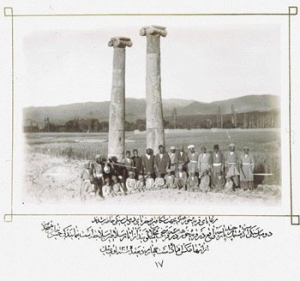
The picture was taken from atop the excavated hill (pavilion/temple) towards the east (the courtyard which has been transformed into a field).
The photograph was made at the bidding of Hossein Khãn, at the end of the excavation, because on the northwest of the columns (in front of the camera) the earth had been removed in their alignment, whereas in Photograph 6 (Photograph 21 of the album) no such removal is visible, which shows that the excavation had not begun. The mass of earth removed is visible in front of the feet of the labourers. Fifteen labourers, all farmers from the village of Khorheh, are standing in a row in front of the columns, with two of them holding shovels and another sitting near thirteen young boys. In comparison with photograph 3, here the diminished height of the pavilion/temple hill on its southern and south-eastern sides is visible, perhaps reaching two meters. Behind the columns (on the east), wheat or barley fields occupy a flat area (courtyard) which existed southeast of the building and is visible in photograph 3. The farmers appear well-dressed (see also pl. 3).

Pl. 9- Photograph 18 of the album: “Two columns in stone made of several drums in the village of Khorheh, 3 parasangs away from Mahallãt, which are remains of the Seljuk period. 4th Zi-qa‘deh in the year 1309, Luy-yil”/ May 31st 1892. Plate no. 3870, w. 180 x h. 129mm. Both the plate and the photograph are well preserved. Photograph: light yellow-brown, w. 165 x h. 120mm. Trimmed contact print.

The picture shows almost the same scene as the preceding one (pl. 8, photograph 17 in the album), but the columns are more visible and the camera looks more towards the northeast. An old man with a white beard has been included to provide the scale of the columns’ height (also see pl. 6).

Pl.10. Photograph 20 of the album: The same two stone columns and gardens and mountains of the village of Khorheh. 4th zigq’adeh in the year 1309, Luy-yil/May 31st 1892. The plae has not been found. Photograph light yellow brown w. 169*h.125cm. Contact print.

Close-range photography of the columns, taken looking East-East-South in the direction of the wheat or barley field. This picture of Khorheh’s lush orchards and fields which are noteworthy wa taken on Nasseraldin Shah’s strict order (see the text). 1/3rd of the lower drum of the column clearly appears eroded. Documents related to its restoration in 1955 are reproduced in Mr. Rahbar’s text. Andre Godard briefly notes that these columns were long believed to belong to a Seleucid temple, but that this assumption was not confirmed in the investigations undertaken by the Iranian Archaeological Department at Khorheh in 1956. No conins or inscriptions proving the existence of an important installation at the site were found.41

Endnotes

1. I hereby apologize for the deficiencies appearing in the footnotes, but since this text was prepared under different conditions of time and place, such shortcomings were unavoidable.

2. Concerning this item and its place in the evolution of the understanding of the past, see the English translation of A. Schnapp, The Discovery of the Past, London, 1996, pp. 13-18 (translated from the French text printed in Paris in 1993). This book contains a good — albeit unconsciously Western-oriented — description of the ways of retracing the past, and their evolution, which brought about the creation of museums and modern archaeology.

3. Concerning these excavations from the viewpoint of the British, see J. E. Curtis, “William Kenneth Loftus and his Excavations at Susa”, Iranica Antica, vol. XXVIII, 1993, pp. 1-55.

4. Unless I am mistaken, Jefferson’s text was first published in France, but it can nevertheless be found in T. Jefferson, Notes on the State of Virginia, New York and London, 1964. Alan Schnapp (see footnote 2) has published Jefferson’s text together with an illustration which evokes his works (pp. 276, 368-370).

5. J. Boucher de Parthes, Antiquités Celtiques et Antédiluviennes, Paris, 1847; see also the illustrations published by Schnapp, pp. 312-13, 372 and the text pp. 271-72.

6. Apart from Alan Schnapp’s studies mentioned in footnote 2, and particularly as concerns the issues raised in these few lines, see C. Renfrew and P. Bahn, Archaeology, Theories, Methods and Practice, 2nd ed., London, 1996. The topics discussed here are given in the form of tables at the beginning of this book, which are most useful for a better understanding of the issues mentioned.

7. Apart from John Curtis’ article about Loftus, mentioned above (footnote 3 ; the assessment on Loftus appears on page 15 of his article), see also its translation into French which thanks to other accompanying articles places Loftus as an individual who began working in Susa before the French, particularly Jacques de Morgan : J. E. Curtis, “Les fouilles de W. K. Loftus à Suse”, Une Mission en Perse, 1897-1912 [Jacques de Morgan], ed. N. Chevalier, Paris, 1997, pp. 36-46.

8. A biography of Moshir-od-Dowleh is provided by Mehdi Bãmdãd, Tãrikh-e rejãle Irãn-e qorun-e 12, 13, 14, 6 vols., vol. 1, pp. 241-4.

9. Mirzã Mohammad-Taqi Lessãn-ol-Molk Sepehr, Nãssekh-ot-Tavãrikh, ed. J. Qã’em- Maqãmi, 3 vols. under a single cover, Tehran, 1958, vol. 3, p. 183.

10. James Morier, A Second Journey through Persia, Armenia and Asia Minor to Constantinople between the Years 1810-1816, London, 1818, pp. 68-69, 75, 114. See also on these adventures a short but important article written by J. Curtis, “A Chariot Scene from Persepolis”, Iran, vol. XXXVI, 1998, pp. 45-51.

11. Dr. Khalil Saqafi (A‘lam-od-Dowleh), Maqãlãt-e Gunãgun, Tehran, 1949, pp. 92-3. For a biography of Richard, see C. Adle and Y. Zoka, “Notes et Documents sur la photographie Iranienne et son histoire, I. Les premiers daguerréotypistes, 1844-1854/1260-1270”, Studia Iranica, vol. 12/2, pp. 249-280, in particular pp. 252-262. In a book recently published by the Sackler Museum (Freer/Smithsonian, Washington) about Antoine Sevruguin, I was quoted from my article in French as stating that since Richard did not consider daguerreotypes appropriate for photographing Persepolis he desisted from the task, whereas the problem was purely a financial one, as I have explained in that paper. For the book see F. N. Bohrer (ed.), Sevruguin and the Persian Image, Photographs of Iran, 1870-1930, p. 20. There are other inaccuracies in this book as well, such as the attribution of Ahmad Shah’s portrait to Malijak (fig. 12), but their analysis is beyond the scope of this paper.
12. Album no. 335/7356 of the Photothèque of the Golestan Palace, which I am endeavouring to publish within the framework of the history of the origins of photography in Iran, Publications of the Iranian Cultural Heritage Organization, Golestan Palace.

13. Mohammad-Hassan Khãn Sani‘-od-Dowleh (E‘temãd-os-Saltaneh), Mer’ãt-olboldãn,vol. 3, p. 20, apud., Yahyã Zokã’. Repeatedly, and for the last time in p. 210 of the above-mentioned book on Sevruguin (see footnote 11), the name of Carlhian is erroneously given as Carlhiée. The inaccuracy has its origin in the text of the late Colonel Qã’em-Maqãmi in whose defence it must be said that the French Colonel Brogniart, who wrote on Carlhian, had an awful handwriting. This fact can truly justify the misreading in Qã’em-Maqãmi’s days when Carlhian was a completely unknown figure. In the same book about Sevruguin it is noted that “Carlhiée” and Blocqueville were the photographers of the French military mission who came to Iran in 1857. Carlhian and Blocqueville did not come to Iran together and did not even belong to that French military mission, but Carlhian travelled in the company of the French military mission which came to Iran in 1858, and not 1857.

14. For a biography of Ãqã Rezã, see Zokã’, Tãrikh-e ‘akkãssi, pp. 47-57.

15. Hassan B. Qomi, Tãrikh-e Qom, tr. Hassan B. Hassan ‘Abd-ol-Malek Qomi, ed. Sayyed Jalãl-ed-Din Tehrãni, Tehran, 1982, p. 68.

16. Probably, one of the four pavilions is none other than the present pavilion or temple with its two standing columns, and if the elevations surrounding that building, particularly the one located approximately 25 meters south of its columns, are excavated perhaps the key to this enigma will be found.

17. Nãsser-od-Din Shãh, Safar-nãme-ye ‘Atabãt, ed. I. Afshãr, Tehran, 1984, p. 45. The Shah’s manuscript is less literary than the printed text which was originally published under his reign. The manuscript also bears allusions to private matters which have been omitted in the printed texts. Concerning the present quotation, the differences are not important except that the “wings” are omitted. The Shah writes: “ … a thick gold ring was found on the top of which there was a horned bull with two holes on its back like perfume containers” (Nãsser-od-Din Shãh, Shahryãr-e Jãddeh-hã, Safar-nãmeh-ye Nãsserod- Din Shãh be ‘Atabãt, ed. M.R. ‘Abbãssi and P. Badi‘i, Tehran, 1983, p. 31.

18. From the documents of the Iranian Ministry of Foreign Affairs published by Khãn-Bãbã Bayãni, Panjãh Sãl Tãrikh-e Irãn dar Dowreh-ye Nãsseri , 6 vols., Tehran, 1996, vol. 4, p. 214; also see here the caption of pl. 8.

19. This is a long story. Just as they suddenly came to light in Paris, these letters once again disappeared without anyone knowing what they were all about and what happened to them. But as I had photocopied them and later showed these copies to Mr Nader Nasiri-Moghaddam, he was able to study them carefully. These letters will be published in the future by the Iranian Cultural Heritage Organization, as per the orders of its director, Mr. Beheshti.

20. Arman Stepanian, “Barressi-ye zibã’i-shenãkhti-e ãsãr-e ‘akkãssãn-e Qãjãr”, in ‘Aks Monthly, no 140, 12th year, November 1998, pp. 21-39. Antoine Sevruguin’s biography was written by Y. Zokã’ in Tãrikh-e ‘ãkkãssi, pp. 136-141, and a book has been published about him to which reference was made in footnote 11.

21. The de Morgan question caused a scandal in France, particularly for financial reasons, and the matter was even raised in parliament and eventually led to his retirement. Much has been written about de Morgan, but here we only refer to Pierre Amiet’s text in a book published about de Morgan three years ago by the Louvre: P. Amiet, “Bilan Archéologique de la Délégation en Perse”, Une Mission en Perse, 1897-1912, ed. N. Chevalier, Paris, 1997, pp. 94-125. Also, thanks to the efforts of Davood Karimlou, the reports of Haydar Mirzã, Mostafã Manshur-os-Saltaneh and Hossein have been published in Tehran in 1999 by The Institute for Political and International Studies of the Iranian Ministry of Foreign Affairs, under the title of Tãrãj-e mirãs-e melli, jeld 1, Hei’at-e Farãnsavi, 1329-1315Q / 1897-1911M / Plundering of National Heritage, vol. 1, French Mission, 1897-1911 A. D. / 1315-1329 H. G. It is worth noticing that photographs were made at Susa by Mozaffar-od-Din Shãh’s order to Haydar Mirzã (document 22, pp. 52, 53 & 63 of the book). A selection of these pictures to which Haydar Mirzã refers was offered by him to the king in 1899. This album is now preserved in the Photothèque of the Golestãn Palace under the number 117/2512. Contrary to the author’s impression in the past and Zokã’s assertion in Tãrikh-e ‘akkãssi (p. 144), the report by Haydar Mirzã proves that he did not take the photographs himself, but rather used the services of an unnamed photographer from Esfahan. In the caption of the photograph on fol. 8r of the album, Haydar Mirzã again vituperates against de Morgan, writing: “Monsieur de Morgan refrains from handing over photographs of anything that bears cuneiform inscriptions and this photograph has accidentally occurred amid this servant’s photographs”. The French archaeological operations in Iran constitute the subject of Mr. Nãder Nasiri- Moghaddam’s very interesting PhD thesis in the University of Paris, to be completed and published in the near future.

22. Vaqãye‘-e ettefãqiyeh, collection of reports of British secret agents in southern Iranian provinces from 1291 to 1322 AH, ed. Sa‘idi Sirjãni, Tehran, 1983, pp. 68, 70, 78 and 79. Contrary to ‘Ãref Khãn (see infra n. 28), Mirza Bãqer cannot be considered as a professional excavator.

23. For a biography of Malek-Qãssem Mirzã, see pp. 262-275 of my article in French mentioned in footnote 11. The drafting of the constitution is not mentioned therein and is a recent discovery of Mr Nãder Nassiri, mentioned above. Y. Zokã and K. Emãmi have extensively written about Malek-Qãssem Mirzã in Tãrikh-e ‘akkãssi, but he in fact never set foot in Europe and the photographs in the album he presented to Nãsser-od-Din Shãh were neither made by him nor taken at the time, but rather belonged to 1280/1863-84.

24. Rezã Arfa‘, Khãterãt-e Prince Arfa‘, ed. ‘Ali Dehbãshi, Tehran, 1999, pp. 75-77.

25. Ibid., pp. 79, 219, 395, 210 and 525. Arfa‘s mention of “a precious jewel discovered in Hamedãn” is interesting.

26. About the fate of this mansion, also see Parviz Adle, Man, Seyyed-e owlãd-e Peyghambar, Navãde-ye Vazir-e Jang-e Amrikã (I…, Descendant of the Prophet and the US War Secretary), pub. Ketab Book Store, Los Angeles 1999, pp. 25-26. As concerns the auction of the objects in the “Dãneshgãh”, or “Villa Esfahan”, see Sotheby Parke Bernet Monaco S. A., Collection de la Villa Esfahan, Monte Carlo, June 28th 1983. The threecoloured flags bearing the Lion and Sun emblem were then auctioned under no. 1734 and acquired by the Parisian antiquarian Jean Soustiel. After his death in the summer of 1999, the flags were again auctioned by his heirs and this time no one bought them, not even the Iranians who were present either in person or by telephone! After that shameful event, the author went after them and eventually bought all three flags, but that is another story (Colléction Jean Soustiel, December 6th 1999, Drouot-Richelieu, lot 456).

27. Nãsser-od-Din Shãh, Safar-e ‘Arãq, lithogrpahy, Tehran,1311/1893-94, p. 42.

28. Mohammad-Hassan-Khan E’temãd-os-Saltaneh, Ruznãmeh-ye khãterãt, ed. I. Afshãr, Tehran, 1966, p. 932. ‘Ãref Khãn Estãnboli, or ‘Ãref Khan Afandi, or “Afandi” in brief, died on February 10th 1893 (ibid., p. 975). As ‘Ãref Khãn served in the ministerial office of E‘temãd-os-Saltaneh (Ministry of the Press and Governmental Translation Office), he may be considered the country’s first governmental and professional excavator and, by including archaeology in the domain of that Ministry, that organization can be somehow equated with the Ministry of Arts and Culture of its period (the Ministry of Sciences of the time by controlling the Dãr-ol-Fonun (Tehran Polytechnic) also had a similar function). Not only in Khorheh, but two months later at Rudãvar, near Tuyserkãn, ‘Ãref Khãn was director of a mission, in present-day terms, i.e., a head excavator personally present on site carrying out the orders of the Shah or the minister (that is, the government). Unlike his task at Khorheh, his operations in Rudãvar do not appear quite scientific and governmental, and, in E‘temãd-os-Saltaneh’s view, who was most probably expecting coins and antiquities to be discovered, was not satisfactory (ibid., 23rd and 26th of July 1892, pp. 943-4). ‘Ãref-Khãn also wrote a geographical report describing the village of Amãmeh, northeast of Tehran, which is recorded in the manuscript Korrãse-ye Alma‘i, preserved in the Majles Library and reproduced by Hossein Karimãn in Qasrãn (Kuhsãrãn), Tehran, pp. 434-36. About ‘Ãref Khãn, see also Mohit Tabãtabã’i’s marginal notes in Sãdeq Malek Shahmirzadi’s article “Eshãre’i mokhtasar bar tahavvol-e bãstãnshenãsi-e Irãn”, Asar, no. 12-14, February 1986, p. 156.

29. Contrary to the usual assumption of whimsical Qajar behaviour, the writing of a report must not be considered a caprice, a masquerade of the kind depicted by some writers of contemporary Iranian history, including the tabloid kind …, as well as some of today’s Iranian filmmakers (including, unfortunately, some of the best ones). As a matter of fact, on another occasion, during his pilgrimage to the Holy Cities of Irãk in 1870-71, Nãsser-od-Din Shãh ordered his French physician, Dr Tholozan, to write a chronicle of his voyage to Babylon to be included in the Shah’s narrative. This was done and Tholozan’s text was reproduced, together with an engraving of the map of Babylon, in the book in question (Nãsser-od-Din Shãh, Safar-nãme-ye ‘Atabãt, ed. Afshãr, op. cit., pp. 141, 207-16. Tholozan’s text is not included in ‘Abbãssi and Badi‘i’s edition). Nãsserod- Din Shãh possessed a perception and a critical sense of historical architectural environments; for example, describing the buildings on the hill of Qasr-e Shirin, he wrote that their “style (oslub)” could be identified (ibid., Afshãr, p. 165; the texts of ‘Abbãssi and Badi‘i do not include the word “style”, but the Shah writes: “I looked attentively”, p. 181); or, describing the Arch of Ctesiphon, which he ordered to be measured, he noted: “I assessed the characteristics of the building” (ibid., Afshãr, p. 144; the text of ‘Abbãssi and Badi‘i, pp. 152-3, is quite different owing to their inclusion of the incident

of Tholozan’s slapping the Shah’s photographer, which was dropped from the earlier print of the Shah’s narrative. Also see hereunder, footnote 36 and Prince Arfa‘, op. cit., p. 159 on land-measuring with a pair of compasses). While the overwhelming majority of Persian Iranologists do not even throw a glance upon the Iranian World outside Persia, Nãsser-od-Din Shãh’s orders concerning Babylon show that he possessed a worldwide outlook. His commands concerning Babylon did not constitute an isolated case, since on the same journey, he perused a large album of photographs which a European photographer had made in Alexandria, Suez and other parts of Egypt (ibid., Afshãr, pp. 146-7; in the texts of ‘Abbãssi and Badi‘i, p. 156, the name of Suez is incorrectly recorded as Swiss), and some seven years earlier the Comte de Gobineau, the French ambassador in Persia, had informed his government that Nãsser-od-Din Shãh wished to have a “Description d’Egypte with its illustrated folios” (Documents of the French Ministry of Foreign Affairs, Iran, 1863). This either meant the book describing Egypt under Napoleon mentioned at the beginning of this article, or the famous book of Egyptian photographs made by Maxime du Camp. Also, contrary to the Western-oriented view prevailing in Iranian archaeology and history as mentioned earlier, Nãsser-od-Din Shãh’s horizon was not limited to Mesopotamia and beyond, but also included the East, and at least India, as well: Even while extremely angry, he did not forget to ask Hãjj Sayyãh to “make photographs of historic sites” in India (Manuscript notes of Hedãyatollãh Rashti, p. 96, apud., A. Rã’in, Farãmush-khãneh va Frãmãssoneri dar Irãn, vol. 1, Tehran, 1978, p. 625). By gathering documents concerning Nãsser-od-Din Shãh’s attitude towards the subjects mentioned in this brief article, one can undoubtedly compile an instructive book. Mozaffar-od-Din Shah, who tried to emulate his father, also had an open mind. Himself an amateur photographer, during whose reign the first automobile and the cinema were introduced in Persia (the 100th anniversary of the first Iranian film will be celebrated in summer 2000), showed interest in French art. Having expressed satisfaction, during a visit he paid to the Louvre in the company of the French Minister of Fine Arts, of the way in which Iranian antiquities were exhibited there, he told the minister: “When I establish my museum in Tehran, I shall dedicate one of its galleries to French works of art”. Of course, he meant a new museum, apart from the one Nãsser-od-Din Shãh had created in the Golestãn Palace. Mozaffar-ed-Din Shãh’s visit to the Louvre took place against the wish of the French minister, who had to entertain his guest long enough for its personnel to have the time to hide the most impressive Persian items on show. In this context, the memories of the man appointed by the French Interior Ministry to assure the Shah’s security are highly interesting (Xavier Paoli, Leurs Majestés, Paris, 1912, pp. 107-8).

30. Dr. Feuvrier, Seh Sãl dar darbãr-e Iran, az 1306 tã 1309, tr. ‘A. Eqbãl, Tehran, 1947, pp. 262-4. For example, the day in question during the excavation is the 29th of Shavvãl and not the 30th, the edge of the pool is lined with bricks and not bare, instead of several arrows exactly 8 were found, the skull found had appeared Turkish rather than Arabic, etc.

31. Docteur Jean Baptiste Feuvrier, Trois ans à la Cour de Perse , pub. Imprimerie Nationale, Paris, 1896, pp. 325-7.

32. Zokã’, Tãrikh-e ‘Akkãssi , pp. 193-96.

33. Mohammad-Hassan-Khãn E‘temãd-os-Saltaneh, Ruznãmeh-ye Khãterãt, p. 496, and also p. 1192 regarding the acquisition of photographic material (light-weight camera) for the voyage.

34. Nãsser-od-Din Shãh, Safar-e ‘Arãq, p. 38.

35. Mohammad-Hassan Khãn E‘temãd-os-Saltaneh (Sani‘-od-Dowleh), Dorar-ottijãn fi-t-tãrikh-e Bani-l-Ashkãn, litho., Tehran, I unfortunately have no more access to my note abut E‘temãd-os-Saltaneh’s expression of remorse, but I think that it was included in one of Iraj Afshãr’s books, articles or publications.
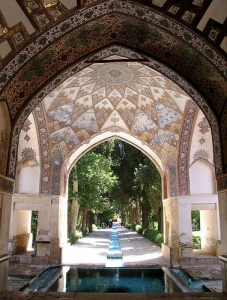
36. Nãsser-od-Din Shãh, Safar-e ‘Arãq , p. 37. A few days later E’temãd-os-Saltaneh also mentions (Ruznãmeh-ye Khãterãt, p. 934) the study of this coin, noting that it belongs to Khosrow-Parviz. Nãsser-od-Din Shãh’s interest in Sassanian coins was not a caprice either, because in the years 1875 to 1880 he ordered Mirzã Rezã Khãn Richard to translate General Bartholomew’s Collection de monnaies Sassanides, published in St. Petersburg. This book is extant in the Photothèque of the Golestãn Palace (No. 896/2367). On E’temãd-os-Saltaneh collecting coins see ibid., pp. 461 and 467 and deciphering the inscriptions on the coins together with ‘Ãref Khãn, p. 467. 37. Nãsser-od-Din Shãh, Safar-nãme-ye ‘Atabãt, p. 44. This visit of the valley of ‘Abbãssãbãd, near Hamedãn, took place on Wednesday October 12th 1870.
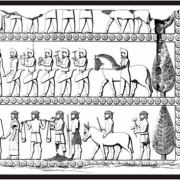
38. Hassan B. Qomi, Tãrikh-e Qom, p. 68. “Khorr” as a name is mentioned in connection with the Parthians from their beginnings, see F. Justi, Iranisches Namenbuch, Hildesheim, 1895, p. 178 under “Xurra”.

39. Had a report been prepared and had the photographs been sent to the Dãr-ol-Fonun, I would have used the title “First Iranian Scientific Excavation” for this article instead of using the term “Dawn”.

40. Those directly involved in the team included ‘Ãref Khãn, in the role of archaeologist, and the photographer Yusef ; while Dr Feuvrier, E‘temãd-os-Saltaneh, Manuchehr Mirzã and Mirzã Forughi took part in the investigations indirectly.

41. A. Godard, L’Art de l’Iran, Paris, 1962, pl. 88, p. 169. Apparently these sentences are Godard’s final conclusions, because, in the text of his book, he tended to believe that the building was a Seleucid temple. After the operations of the Iranian Archaeological Department, the extent of which is not reflected in his book, he was neither convinced of its function as a temple nor of its Seleucid origins.