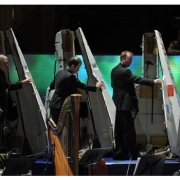
Music to the ears of the post-war avant garde

By Ben Luke

Source: www.theartnewspaper.com
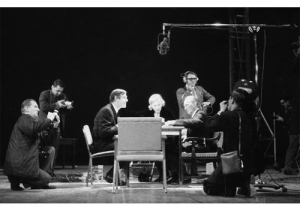

John Cage (seated left) and Marcel Duchamp (seated opposite) perform “Reunion”, a 1968 work by Cage in which the movement of chess pieces generates electronic sounds (Photo: Musicworks Magazine)

Last year marked the 100th anniversary of the birth of composer John Cage, who died in 1992, and the celebrations of his life showed how much he influenced—and was influenced by—some of the greats of American 20th-century art.

John Cage was always clear about visual art’s central importance to his career. For many years, he nurtured the idea of his most famous work, 4’33”, 1952—four minutes and 33 seconds of silence, the beginning and end of which is marked by a musical performer—before taking courage from seeing a radical gesture by his friend and collaborator, Robert Rauschenberg. “His white paintings… when I saw those, I said: ‘Oh yes, I must. Otherwise I’m lagging, otherwise music is lagging.’”
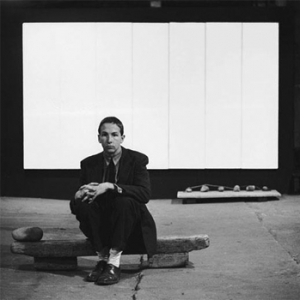

Photograph of Robert Rauschenberg seated on Untitled (Elemental Sculpture) with White Painting (seven panel) behind him at the basement of Stable Gallery, New York 1953, Photograph: Allan Grant, Life Magazine © Time Warner Inc/Robert Rauschenberg/VAGA, New York and DACS, London 2006.

If Cage owes a debt to the visual arts for their role in the creation of one of the great game-changing Modernist masterpieces, it has been repaid on an enormous scale. That thirst for “seeing and making things not seen before”, as he once described it, is among the many aspects of Cage’s life and career that have prompted his phenomenal cultural influence. And as the centenary of his birth is celebrated on 5 September, his flame continues to burn as brightly as ever in the visual arts. So many tendencies in contemporary art, from its emphasis on time as a theme and material to the pronounced role of chance, a promiscuous leaping between media and disciplines and the bestowal of power on the viewer, were at least in part pioneered by Cage.

In his lifetime (he died in 1992), he inspired everyone from Rauschenberg and Jasper Johns to Ellsworth Kelly, the American Minimalists, the Fluxus group and the artists behind happenings and performance and conceptual art. And since his death, the momentum has continued. The variety of recent works directly inspired by 4’33” alone is remarkable, with Philippe Parreno, Tacita Dean and Katie Paterson among those to have made reference to the work.

In the introduction to “Notations: the Cage Effect Today”, the exhibition he co-organised earlier this year at Hunter College in New York, Joachim Pissarro, the director of the galleries and a professor of art history, recalls that Rauschenberg said that he felt Cage had “authorised” him to do things he had thought impossible. “Jasper Johns said the same thing,” Pissarro tells The Art Newspaper. “Both of them looked up to Cage as an elder and somebody who had simply dared to do things that open up paths of thinking, of creation or ‘cross-semination’ that they didn’t think was possible. When you try to define Cage’s role in the art world, it is impossible to come up with fewer than five or six attributes: he is, of course, a composer, but he was also a thinker, a philosopher, a draughtsman, a printmaker, a lecturer and a poet. He was a pivotal force of inspiration for so many different people.”

The artist and curator Jeremy Millar, who was behind “Every Day is a Good Day”, the exhibition of Cage’s prints, watercolours and drawings that opened at the Baltic in Gateshead in 2010 before touring to five other UK venues, suggests that Cage’s influence is “difficult to describe without becoming pseudo-mystical”. A crucial aspect of Cage’s approach was that “he wasn’t standing in front of the work of art and then creating it from some sort of loftier position”, Millar says. “He was responding to circumstance, in the same way that a work, in its moment of coming into the world, responds to circumstance. It feels like he was material in the same way that a work is material, and they adapt to one another, and then they feed back, and you get this incredibly complex relationship.”

He cites footage of Cage making his “River Rocks and Smoke” series of paintings, in which he drew around stones on paper in watercolour. “Cage is saying: ‘Oh, my god, it is so beautiful,’” Millar says. “Ordinarily, an artist saying that about a painting they are making would be an abomination. But when Cage does it, it feels like it’s because he is watching a sunset or listening to traffic, or whatever else you might find beautiful. It feels like he is part of a process that includes the painting that is being made, and none of it has any precedence, none of it has a greater importance.”
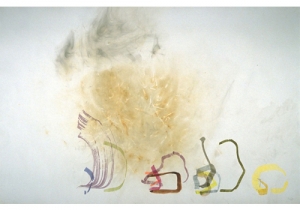

John Cage: “River And Smoke Paintings” #1 (1990)
For Joachim Pissarro, this approach is linked to Cage’s repeated definition of himself as an anarchist, who is “fundamentally about deregulating the modes of the creation of art”, Pissarro says.

The artist Christian Marclay, like Cage, has bridged the musical and art worlds, gaining attention first for his radical use of turntables in the 1980s before establishing himself as a leading video installation artist, particularly with The Clock, 2010, a 24-hour video constructed from samples of countless films. Marclay met Cage and worked with the composer’s partner, the influential choreographer and dancer Merce Cunningham, as well as collaborators such as the composers Christian Wolff and Takehisa Kosugi.

In August, he created a work for the Cage centenary concert at the BBC Proms entitled “Baggage”, featuring the Scottish Philharmonic Orchestra playing their instrument cases. “I titled it ‘Baggage’ because it is a pun on the musical cases, but also because John Cage can be thought of as cultural baggage, a weight that is hard to deal with, in the same way that he had to revolt against his masters like [Arnold] Schoenberg,” Marclay says. “It is always this love-hate relationship, of course—you learn so much from it, but then you have to move on. You can’t just be doing the same thing.”
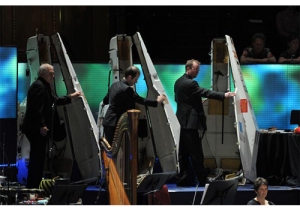

BBC Scottish Symphony Orchestra, performing “Baggage” by Christian Marclay, 2012

Marclay says that Cage’s lesson was to make us listen. “With a classical piece of music, if you have heard it before, it triggers your memory of that past experience, so you never have that fresh ear. You can easily sit back and relax and slip into this almost unconscious state,” he says. “But with Cage, you have to be on the edge of your seat, always active as a listener. In a way, the music only exists through you, through the listener.”

This is a fundamentally Cagean idea—an insistence on the primary role of the audience. “You have to be involved as a participant and make choices,” Marclay says. “That was a lesson Cage learned from Duchamp—that the viewer continues the work of art.”

Duchamp’s presence cannot be underestimated. According to Carlos Basualdo, who co-organised “Dancing Around the Bride: Cage, Cunningham, Johns, Rauschenberg and Duchamp” with Erica Battle at the Philadelphia Museum of Art last autumn, Cage identified very early on with Dadaist tendencies, recognising Duchamp’s importance as early as 1935.

The pair met in 1942 and became firm friends in the five years before the artist’s death in 1968. Duchamp coached Cage in the art of chess, leading to a 1968 performance in which their chess moves inspired sound and light. One of the crucial weapons in Cage’s armoury, his exploitation of chance events, particularly in his use of the ancient Chinese divination text, the I Ching, was a fundamental Duchampian trait.
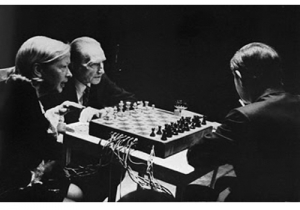

Marcel Duchamps and John Cage performing “Reunion”. (1968)

“Duchamp was in Cage’s mind, but he arrived at chance procedures independently of him,” Basualdo says. Chance, he says, “allowed them to bridge the boundaries between art and life; that is the way they both employed it. I don’t think Cage was really thinking about Duchamp, but then later on he recognised a lot of the elements that were important for him in Duchamp’s work and so adopted him as a predecessor.” It is likely that Cage also pointed Rauschenberg and Johns towards Duchamp, and thus helped to inspire the post-war rediscovery that has ultimately led to Duchamp’s pre-eminence today. “The Duchamp that we know is seen through the filter of the work of these people,” Basualdo says.

That remarkable New York milieu, the band of brothers of Cage and Cunningham, Rauschenberg and Johns and their collaborators, is one of the crucibles in which today’s art was formed. “If you see any of that early footage of [Cage and Cunningham] driving around with Rauschenberg, it is pretty exhilarating,” says the artist Tacita Dean. “There is a real avant-garde energy that you don’t get so much anymore.” Dean feels that Cage’s ability to move between disciplines owes much to that scene. “If you are hanging out with a dancer, a sculptor and a painter, you are going to widen your horizons. They were all open to each other’s exchanges, and that is what gave them that multidisciplinary vocabulary. I am not sure how much they would have had that, had they been solitary people.”

Dean paid tribute to that energy, and especially the lifelong relationship between Cage and Cunningham, in her film installation Merce Cunningham Performs Stillness, 2007, in which the choreographer, who died in 2009, performed a piece he had devised to accompany 4’33”. Dean originally conceived the work when seeking to create a moment of silence in “Il Tempo del Postino”, a sequence of performances at the Manchester International Festival in 2007. “Merce, interestingly enough, had never done a performance himself to that, but had used 4’33” with his dancers,” she says. “So it was always going to be him performing to Cage.” It is a tremendously moving performance and film, as Cunningham pays homage to his late partner. “It’s powerful, because you know that is what he is thinking about,” Dean says. “He never expressed it verbally.”
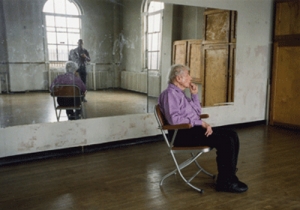

Tacita Dean, “Merce Cunningham performs STILLNESS” (in three movements) to John Cage’s composition 4’33”, New York City, 28 April 2007

Dean acknowledges the influence of both Cage and Cunningham in her use of chance. “They had a more rigorous view of chance than I do,” she says. “They had formulae for provoking chance. I am much more of a dilettante, but am entirely open and welcome chance whenever it happens. If something takes me in a different direction, then I’ll follow it.”

Gerhard Richter is another artist for whom chance plays a crucial role. His “Cage Paintings” are a dramatic tribute to the composer: the group of vast abstract works was so titled because Richter had been listening to his compositions while creating them. Mark Godfrey, who curated the recent Richter exhibition at Tate Modern, says that at the same time as he was making those paintings, Richter was developing other works with Cagean connections—the grid paintings formed from coloured squares inspired by his Cologne Cathedral window, which were shown at the Serpentine Gallery in 2008. “He set up a process to determine what the colours and the orientation would be in the grids,” Godfrey says. “In the studio, there were ping-pong balls with numbers on them, and he would select the ping-pong ball from a jar and the number would correspond to a colour, and that was how he determined how these small grid paintings would look. So in some ways, those works really do use Cagean processes of chance in order to determine not only what the colours are in each one, but their orientation. And what that goes to show is that two bodies of work made around the same time, but looking completely different—the ‘Cage Paintings’ made with squeegee and the others that were made as a result of the Cologne Cathedral window—have something to do with Cage in different ways.”
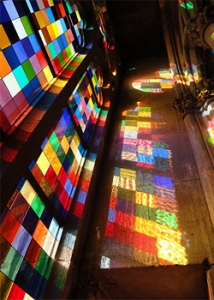

Window by Gerhard Richter in the Cologne Cathedral, 2007

It seems unlikely that Cage’s significance will dwindle. When the Tanks at Tate Modern opened in July, their aim was to reflect the burgeoning disciplines of performance art, installation, and film and video, escaping from art’s traditional reliance on objects. Cage once wrote suspiciously of the tendency “to be secure in the thingness of a work, and thus to overlook, and place nearly insurmountable obstacles in the path of, instantaneous ecstasy”. Artists seeking that very immediacy have dominated the Tanks. “Always with Cage there is an ingrained fear of fetishism—fetishising the work of art, turning it into a sacred object,” says Joachim Pissarro. “He was very detached, in the best sense of the word, very much attempting not to place a burden and an oversized value on the work of art as an object.”

Jeremy Millar believes that spaces like the Tanks simply could not have existed without Cage’s pioneering work, and are a testament to his importance. Millar cites the authoritative Grove dictionary of music and musicians, which states that Cage “had a greater impact on music in the 20th century than any other American composer”. Millar says: “He is undoubtedly the most important composer of the second half of the 20th century and possibly the most influential artist of the second half of the 20th century. And to say that this might be understating things is true. It is almost as though he has changed everything—what we think of now as art—in the same way Duchamp did.”
The Baluchi Zahirig music

Farairan Quarterly,No.10
Jean During

Introduction: Professional Baluchi Musicians1

In ancient times, the Baluchis dwelt in the north and center of Iran. From the 10th century onwards, they slowly moved towards the south until they reached the border of India. They now occupy a vast territory covering the western part of Pakistan, southeastern Iran, and Afghan Khorasan. More recently, they spread along the Arabian coast of the Persian Gulf. During this long process of migration, they met other ethnic groups such as the Brahu’is, the Sindis, and the Lasis. Among them were some tribal groups who distinguished themselves by their skill in handicrafts (jewelry and ironwork) and music making. These groups belong to the social category of the osta2 (masters) and mainly to the Rend and Zangeshahi tribes. They may be the descendants of the Luli or Gypsy nomads whose existence is attested to as far back as 2000 years ago.

The outstanding role of these hereditary professional musicians in Baluchi cultural life, brings forth the question of the “purity” concerning the origin of Baluchi music, mainly that of the South (Makran province). It seems at first glance that the old Iranian strata which is attested to by some modes (Qeble, Salat) and rhythms (6/8, 7/8) have been dominated by the Eastern strata which provides the Baluchi music with a specific flavor whose provenance is between Iran‘s maqam and India’s raga. This d the Lasis. Among them were some tribal groups who distinguished themselves by their skill in handicrafts (jewelry and ironwork) and music making. These groups belong to the social category of the osta2 (masters) and mainly to the Rend and Zangeshahi tribes. They may be the descendants of the Luli or Gypsy nomads whose existence is attested to as far back as 2000 years ago.

The outstanding role of these hereditary professional musicians in Baluchi cultural life, brings forth the question of the “purity” concerning the origin of Baluchi music, mainly that of the South (Makran province). It seems at first glance that the old Iranian strata which is attested to by some modes (Qeble, Salat) and rhythms (6/8, 7/8) have been dominated by the Eastern strata which provides the Baluchi music with a specific flavor whose provenance is between Iran‘s maqam and India’s raga. This impression relies on the centrality of the fundamental degree (sa in India) in all the tunes or modal structures, on the chromatic basic scale system and on some modes unknown in the Iranian-Arabic traditions, not to mention the use of sympathetic strings, the rhythmic drone of the tanburag lute, etc. Rhythmic specificities (“syncopated” accentuations, swing and groove, great flexibility, ambiguity between 4 and 7 beat rhythms, 3 and 5, 5 and 7)—as well as some unusual hexatonic modes—may be traced back to the local traditions handed over by the osta. In any case, all these layers are not clearly separated and constitute the compact ground of the professional Makran musical tradition, the cradle of which is the Dashtiyari region and the urban centers of Kulwa, Rask and the harbors of Chabahar, Gwadar and Pasni in Iran and Pakistan. It is only in this area that what the Baluchi consider the highest musical form is found, namely the shervandi3, or the art of the minstrels. This genre stands out above all the other professional or folk genres such as the song repertory (sowt, nazink, ghazal) or the trance repertory (guati damali).

I. The Zahirig as a Genre and Mode

The shervandi combines vocal compositions and non-measured sections in a virtuoso melismatic style called alhan, comparable to the Persian avaz. This both vocal and instrumental genre—performed on the fiddle sorud, the double flute doneli, and the dulcimer benju—uses a set of modes called the zahirig.4 Zahirig has two meanings: 1) A non-metric melismatic genre; 2) The Baluchi equivalent of the Arabic-Iranian-Turkish concept of maqam or the Indian concept of raga.

In a shervandi session, the singer (sha‘er), generally accompanied by the fiddle sorud, starts with a non-measured melismatic section alhan in a specific mode (zahirig) developed between 30 seconds to 4-5 minutes. In an instrumental performance, one is free to develop the zahirig or to link several of them together. After a measured piece (zimol),5 one often concludes with a short zahirig motive in the same mode. Almost all the instrumentalists perform the introducing alhan in the same mode (zahirig) as the zimol, the relationship between zahirig and zimol being identical to the one between the Indian alap and thumri. Yet strangely enough, the singers generally start with an alhan in one mode and continue with a zimol in another mode, without caring for the modal consistency of the performance.

All the professional Makran musicians know at least two or three basic non-measured melodic types corresponding to specific zahirig, yet quite often they don’t even know the names of these types. This may be the reason why even the concept of zahirig as a modal form (similar to the maqam) has remained unnoticed by the rare scholars dealing with Baluchi-Makrani music. Only the shervandi fiddle performers, (that is, perhaps only a dozen persons) have an extended and clear view of the zahirig-s as modal types. A significant point is that in the same way that knowledge of the zahirig-s as modes serves to increase the competence of a singer or instrumentalist at the height of one’s mastery, the zahirig-s are considered as the essence of Baluchi music, i.e. its very principle (asil), the matrices of all the melodies, tunes or songs. This means that any Baluchi melody follows this or that zahirig like any Turkish classical melody “is” in a specific maqam.

A zahirig can be identified immediately thanks to a few modal features such as its initial note(s) in relation to the fundamental, a very small characteristic motif of 2 or 3 notes, or its general scale.6

Each zahirig has a very specific structure, with initialis, finalis, profile (one could say a sayr), modulations and obligatory motives. In this respect, each zahirig is more or less a composition that allows for a great margin of interpretation.

II. Zahirig as “Classical Baluchi Music”

A. From Practice to Theoretical Concepts
If each zahirig follows rigorous rules, there is no modal abstract representation of the maqam/raga type in Baluchi music.

A kind of conceptualization of the intervals emerges from the concrete act of twisting the pegs of the fiddle to tighten the string. Expressions like “do kasha borax boor” (kasha = pull, that is, “two pull up go,” “go up two twist” means “go up 2 half tones.”

The Baluchi masters refer also to the position of the fingers on the sorud string. In discussions with a shervandi master, the Indian concept of tat appeared, i.e. the basic modal scale. It seems that some shervandi masters make a distinction between basic zahirig and derived zahirig. The symmetry of the finger positions between the A and E strings is emphasized in such a way that the symmetrical modes were considered as basic tat, such as the scale : A B C D / E F# G A (zahirig Manage) or A Bb C# D / E F G# A (zahirig Kara).

B. Zahirig as a Criterion of Competence
In musical hierarchy, the zahirig as a maqam or raga system occupies the most eminent position. It works as the basis, the substance of music as well as its abstract essence, the knowledge of which defines mastery. Master Karimbakhsh often stated with some exaltation that zahirig was “the classical Baluchi music” (klasik baluchi musiqi) in the same way that he used to compare music to an unlimited ocean of science (‘elm) : “As much as you learn it, you still are nothing, nothing.” Actually these zahirig—unlike the measured compositions—are difficult to play (they demand a very good technique) and difficult to memorize. On another level, they reveal the creative capacity of the performer, being much less the case with the other tunes which leave smaller room for improvisation.

Almost all the masters of minor genre (sowt, damali-guati) do not even know the name of the zahirig-s and can rarely play more than fragments of two or three of them in a reduced form.7

Once one of these musicians played a zahirig, and an elder asked him what was its name. He said first parsi zahirig (Persian), a statement which makes no sense, except that South-Iranian-Baluchi style can be opposed to the Karachi trend which makes no use of the zahirig. Then the elder mocked him arguing: “it has a name but you did not learn it.” The musician felt aggressed but maintained that these zahirig have no names, or that perhaps they did have names in the past but they had since become lost. By asking the name of the zahirig, the elder wanted to demonstrate that music was a science, one that every musician does not know.

C. The Zahirig as a Unifying Concept
All these features make the zahirig the touchstone of classicism as opposed to ordinary music: only great masters belonging to hereditary lineage have full access to it.

The very concept of “Baluchi music” (not as a linguistic but as a musical entity) implies the intention to encompass virtually the totality of Baluchi forms. This is however, not possible just by the mere collection of individual pieces, a task which would anyway be impossible to accomplish considering the repertory’s extent and the infinity in its variants. This can only be achieved by the reduction of all of this multiplicity to a modal essence, something that is precisely expressed by the zahirig. In addition to its function of conceptualization, the zahirig possesses the emblematic advantages of sophistication, of expression of a fundamental effect such as nostalgia, as well as a plasticity which confers to it the substantiality of a materia prima out of which all the forms are generated.

The idea that the infinity of measured pieces comes out from a limited modal type does not correspond in itself to a historical reality or an attested practice, in a way that it is impossible to demonstrate that the zahirig is anterior to the measured zimol. One could even contest the originality of such an idea, perhaps borrowed from the Indian or Persian concepts of raga and maqam (which in folk music often means a simple melodic type or “a tune”). Taking into account the impossibility of demonstrating the phylogenetic or ontogenetic anteriority of the zahirig over other forms, we can assume that elevating it to the level of the modal equivalent, such as the raga, may reflect the intention of the Baluchis to systematize their music which is scattered over a very large territory. Similar to any tribal, nomadic and oral culture, the organization of this music is rather blurred. It is therefore not surprising that, in conjunction with the rise of national identity, the idea of collecting the scales and modal structures arose among literate musicians in great cities like Karachi or Zahedan.

D. Maqam and Topos: The Zahirig as a Baluchi Modal Landscape
The zahirig system expresses several levels of specialization which eventually are the condition by which one may evaluate the basis for a theory of Baluchi music: if there is no science without specialization and measurement, then the zahirig modes provide a preliminary level of representation with the position of the finger on the sorud string, a level not achieved by the pure temporal aspects of music.8 Besides scale specialization, Ostad Karimbakhsh compares Baluchi music to a tree whose branches are the main zahirig, such as Sim, Miane, Kara, Vesal, Qebla, Bashkard, etc. with each of them having, in turn, its own branches. This tree of the modes (much similar to the Arabic tree of maqam or tub‘) can be understood in two ways: each zahirig has some derived forms or variants, or each of them give birth to an infinity of “actualizations” (baramad) or forms (shakl) in such a way that “it is one single thing but under different forms.”

On another level, classicism crystallized into the form of the zahirig is linked to a process of deterritorialization of regional motifs reterritorialized in the plan of art, a process that is also found in other cultures with the maqam, the radif and the raga. That is to say that great musicians strove to collect the essence of the repertory existing all over Baluchistan in order to extend their own.

Several zahirig have precise local origins attested to by their names. In each region, folk music runs mainly on one or two modes. Reciprocally, many zahirig-s connote a specific region in Baluchistan. About Kordi, now a common zahirig, Karimbakhsh says: “In the past, it was only sung by old women, and not in the shervand style. It had been introduced later on and went along with Persian poems”. Rasulbakhsh, the most famous sorud player, explains that, before him, the set of zahirig was more limited among shervandi masters. He enlarged the repertory by borrowing from folk music from all over Baluchistan. Musicians like him are always traveling around the country, unlike minor musicians whose cultural environment is restricted to a small area. He says that he sometimes met some of these musicians who played nice old folk melodies; he picked them up and performed them in an artistic and sophisticated style. This is also a way of unification.

E. The Process of “Classicization”
At the antipodes of this science, lies the empirical savoir-faire which is devoid of concepts and names : “Youngsters do not care about knowing what is what. They play the music and that is it. Look at Omar who came here: he plays the doholak well, but he does not mind about the name of the rhythms. This is Baluchistan.” Science is knowing the names and the origin of things. During the years that he spent in Europe, a young refugee Baluchi Master overcame his illiteracy by learning Latin script. With this new intellectual tool, he wrote what can be considered the first “theoretical” or “musicological treatise” on Baluchi music. He took a thick hard-covered notebook and divided the pages into a few chapters of one or two pages each, yet leaving 10 to 20 pages free for further discoveries. It contains chapters such as : “Names of Baluchi poets” (oral tradition), “Names of masters of sorud,” “Names of great singers,” “The great sorud makers (osta),” “List of the zahirig,” “List of ancient tunes” (sowt, etc.) and so on. He learned elements of Indian and Western solfeggio, eventually able to give the scale of some zahirig-s and even of some basic Persian modes (Shur, Mahur). He always carries this notebook with him when he travels to Pakistan as he may expand his knowledge.

One day I discovered that his own master, Karimbakhsh Nuri, who lives in Karachi, had a similar book which contains not only listings but also some poems that he composed or collected, tales, anecdotes on great musicians he had met, some clues on the tuning of the sorud dedicated to his son, etc. In one chapter, he denies the claim of a musician saying that his father knew 300 zahirig : “He is a liar since there are not more than 20 zahirig or so.” He also mentioned the visit of a French musicologist in 1993…

Anyone who knows a little bit about the history of Arabic, Persian or Azeri music could not help but feel great respect for such naive writings since it is precisely through that kind of intellectual process that folk, tribal and popular traditions were raised to the status of art music, and learned music. What was Arabic music like, during the Ummayad or the early ‘Abbasid periods? Would ethnomusicologists have labeled it “art music” if the chronicle Kitab al-Aghani or al-Kindi’s treatises were not written? What was Azerbaijani music in the early XIXth century like: folk, classical or “professional” (the ashyq) ? It is by collecting and writing, that music becomes “art.” Classicism is basically nothing else than classification, listing and inventory, after having collected what was scattered over a large area. Inventory is also the writing of a history, a memory, a chronology and a filiation (gharana or schools, a concept also used among professional Baluchi musicians).

III. Looking for Patronage

After all these discoveries and discussions with a few great masters, I became convinced that Baluchi professional music provides a living example of the intermediate status between folk music and art music or, in other words, “small music” and “great music.” Relying upon the opinion of these masters, I also brought in some other arguments: 1) Like with any art music, it takes no less than ten years to become a professional and twenty-five years to become a master; 2) Shervandi is “learned music” dealing with learned (although basically oral) poetry which can be opposed to damali-guati (trance music), another professional form which is independent from poetry and addresses itself to the average people.

Nevertheless, I was not entirely satisfied with these arguments. One or two things were still lacking: a unified theory of Baluchi music and official recognition. I thought about writing this theory in collaboration with young and old masters. But, instead of passing from the “orally” cultural historical phase to the “literal” one, I found it more efficient to skip the literacy and to jump directly to the “mediatic” cultural phase. This meant producing a videotape explaining “klasik baluchi musiqi” to Baluchis (not to Western musicologists). With the help of a young master, we started shooting as much video documents as we could for that purpose. Then we understood that the last step in this promotion of Baluchi “classical” music was to find a sponsor or a patronage. Musicians used to say: “In old times, there were khans and emirs who patronized singers and poets. Nowadays, nobody understands this music and in a city like Karachi9, we are reduced to playing in trance sessions for peanuts.”

It is only in West Makran or in Dubai that there are some possibilities for shervand musicians to make their living. Baluchi musicians are convinced that there is nothing to expect from the Pakistani or Iranian government. None of the Makranis have even heard of Lok Virsa, the powerful Center of Folk Culture who promotes traditional music. On the other side, the best shervandi, remain unknown by the Iranian institutions, or if they happen to be discovered, they do not accept to cooperate. They never performed in Tehran and don’t want to visit this place. However someone like Karimbakhsh in Karachi used to say, “If only at least they gave me a room where I could receive disciples and teach this music.” (He was living in two rooms with a family of ten people.) I suggested : “Let’s find a rich Baluchi who would be proud to have music sessions and sponsor some traditional masters.” Eventually, we found such a wealthy merchant and we introduced three masters to him and his distinguished hosts. I offered him the CD published by Radio-France. The musicians looked very smart and showed themselves relaxed and mundane doing their best to forget and make forget the atavic social gap between these poor Luli (gypsies) and these bourgeois officials and aristocrats. It is doubtful that all these attempts will be decisive in the evolution of Baluchi art music, but what is sure is that more than once, things have happened more or less like this during the history of “great music.”

1 This paper is based on field researches in Karachi and Gwader (Pakistan) from 1992 to 1996. An extended version has been published under the title: “The Baluchi Zahirig as a Modal Landscape and the Emergence of a Classical Music, The Structure and Idea of Maqam,” J. Elsner & R. Pekka Pennanen, Tampere (:39-63). About this tradition see J. During : Baloutchistan. Bardes du Makran, Paris, Buda, 1995 (compact disc with booklet). About the situation of professional musicians in Karachi, see J. During, Carnets de voyage au Moyen-Orient, La musique et le Monde, Internationales de l’imaginaire, Paris, 1995 (: 115-144). African winds and Muslim djinns. Trance, healing and devotion in Baluchistan, Yearbook of the I.C.T.M., 1997/ 29 (:39-56). 1997

2 From sher = poem and van = singing.

3 Zahirig (var. zahiruk) evokes a deep and nostalgic remembrance. (Man zahirvara(n) : “I am sad.” Musicians usually say that as a genre, the “zahirig is the recalling of the beloved” yad dasht-e dust).

4 In Baluchi terminology, measured melodies are called zimol, a generic concept opposed to alhan, non-measured. These Iranian and Arabic terms have not such a clear definition in Middle eastern traditions.

5 By playing the first note or the first short motif of a zahirig the fiddlers shows explicitly the modal way to the singer.

6 The most common being Ashraf Dorre, Sim (Baho) Kichi, and Liku.

7 Representation of rhythm seems much more controversial and abstract to Baluchi masters, who have names for rhythmic tanburag patterns : rast panjag (3 beats), didi panjag (4 beats), pattal (5 beats), sasuli (7 beats), shervandi (10 beats), etc. (Panjag means stroke of the hand.)
8 This process has been discussed in my Quelque chose se passe. Le sens de latradition dans l’Orient musical. Lagrasse, Verdier, 1995 (Chap. V)
9 Around two million Baluchis are living in Karachi.

An Introduction to Persian Music

Hormoz Farhat
Catalogue of the Festival of Oriental Music,
University of Durham, UK

The artistic gift of the Persian people has produced a staggering literary heritage, an exquisite tradition of decorative arts and handicrafts, a superb legacy in architecture, and a refined musical culture whose influence is evidence as far away as Spain and Japan.

Historic Retrospective
The history of musical development in Iran [Persia] dates back to the prehistoric era. The great legendary king, Jamshid, is credited with the “invention” of music. Fragmentary documents from various periods of
the country’s history establish that the ancient Persians possessed an elaborate musical culture. The Sassanian period (A.D. 226-651), in particular, has left us ample evidence pointing to the existence of a
lively musical life in Persia. The names of some important musicians such as Barbod, Nakissa and Ramtin, and titles of some of their works have
survived.
With the advent of Islam in the 7th century A.D., Persian music, as well as other Persian cultural traints, became the main formative element in what
has, ever since, been known as “Islamic civilization”. Persian musicians and musicologists overwhelmingly dominated the musical life of the Eastern Moslem
Empire. Farabi (d. 950), Ebne Sina (d. 1037), Razi (d. 1209), Ormavi (d. 1294), Shirazi (d. 1310), and Maraqi (d. 1432) are but a few among the array of outstanding Persian musical scholars in the early Islamic period.
In the 16th century, a new “golden age” of Persian civilization dawned under the rule of the Safavid dynasty (1499-1746). However, from that time until the third decade of the 20th century Persian music became gradually relegated to a mere decorative and interpretive art, where neither creative growth, nor
scholarly research found much room to flourish.
Since the early 20’s, once again, Persian music began to find broader dimensions. An urge to create rather than merely perpetuate the known tradition, and an interest to investigate the structural elements, has
emerged. Fundamentally, however, what can be still
recognized as the national music of Iran [Persia] is the tradition of the past with marked imprints of 19th century performance practices.
This traditional or classical music represents a highly ornate and sophisticated art whose protagonists are professional city musicians. Prior to the present
century, such musicians were patronized by the nobility. Today, in a progressively modernizing society, they are generally engaged by broad casting and television media. They are also active as teachers both privately and at the various scholars and conservatories of music.

Structures
Perpetuated through an oral tradition, the classical repertoire encompasses a body of ancient pieces collectively known as the “radif” of Persian music.
These pieces are organized into twelve groupings, seven of which are known as basic modal structures and are called the seven “dastgah” (systems). They are :
Shur, Homayun, Segah, Chahargah, Mahur, Rast-Panjgah, and Nava. The remaining five are commonly accepted as secondary or derivative dastgahs. Four of them: Abuata, Dashti, Bayat-e Tork and Afshari are considered to be derivatives of Shur; and , Bayat-e Esfahan is regarded to be a sub-dastgah of Homayun. The individual pieces in each of the twelve groupings
are generally called “gushe”, but each gushe has a specific and often descriptive title. A gushe is not a clearly defined musical composition; rather, it represents modal, melodic, and occasionally rhythmic skeletal formulae upon which the performer is expected to improvise. Thus, the radif submits an
infinite source of musical expression. The flexibility of the basic material and the extent of the improvisatory freedom is such that a piece played
twice by the same performer, at the same sitting, will be different in melodic composition, form, duration and emotional impact.
The principle involved in the construction of Persian modes is based on the concept of conjunct and disjunct tetrachords comparable to the ancient Greek system. Chromaticism is not used and an octave never contains more or less than seven principal tones. Contrary to a persistent popular notion no such a thing as a quartertone exists in Persian [Iranian] music. A very
characteristic interval, however, is the neutral, second. This is a highly flexible interval; but, in all its variations, it is noticeably larger than the
minor second (half-step) and smaller than the major second (whole-step). Another interval peculiar to some of the modes is an interval which is larger than the major second, but not sufficiently large to be an augmented second. In authentic Persian music the western augmented second is not used.
Rhythmically, the majority of gushes are flexible and free and cannot be assigned to a stable metric order.
However, in every dastgah, there are a number of
metrically regulated gushes which are played among the free meter pieces in order to provide periodic variety in rhythmic effects. Both, double and triple meters are common; asymmetric meters, found in the folk music of certain regions, are rare in the classical music.
As in the case of many non-western musical cultures, Persian music has not evolved a systematic harmonic practice. The development of this music has been primarily melodic. As such it has attained a far greater measure of melodic refinement and subtlety western music.

Instruments
The musical instruments which have been known in the long history of Iran (Persia) are too numerous to name here. The following are those instruments, which are widely used at the present time:
Tar: A plucked string instrument with six strings and a range of two octaves and and fifth.
Setar: An instrument related to the tar with the same range, but with four strings. The setar is strummed by the nail of the right index finger.
Ud: The Arabian name for the ancient Persian instrument called barbat. It is also a plucked string instrument with nine to eleven strings. The European
lute is a derivative of the ud.
Kamancheh: A bowed instrument with four strings, played in the fashion of the violoncello, but with a size and tone range comparable to the violin.
Santur: A dulcimer played with delicate wooden mallets, with a range exceeding three octaves.
Nay: Generic name for numerous verities of flutes.
Tombak: The principal percussion instrument in the [Persian] classical music. It is vase shaped drum open on the narrow and end covered with a tightly stretched skin on the other side.
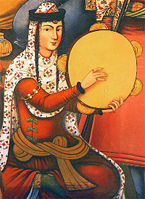
Dayere: Tambourine.

Folk and Popular Music
The modal concepts in Persian folk music are directly linked with that of the classical music. However, improvisation plays a minor role as folk tunes are
characterized by relatively clear-cut melodic and rhythmic properties. The function of each folk melody determines its mood. The varying aesthetic
requirements of wedding songs, lullabies, love songs, harvest songs, dance pieces, etc., are met with transparent and appropriate simplicity.
The majority of the classical instruments are too elaborate and difficult for the folk musicians. Instead, there are literally dozens of musical instruments of various sorts found among the rural people. In fact, each region of the country can boast instruments peculiar to itself. Three types of instruments, however, are common to all parts of the country. They are, a kind of shawm called surnay (or zorna), the various types of nay (flute), and the dohol, a doubleheader drum.
A discussion of Persian music must necessarily include the new hybrid of mixed Persian-Western music which is functioning as a popular-commercial music. The use of western popular rhythms, an elementary harmonic superimposition, and relatively large ensembles composed of mostly western instruments, characterize this music. The melodic and modal aspects of these
compositions maintain basically Persian elements. On the whole, it would be something of an understatement to say that the artistic merit of such a melange as this is rather questionable.

Discovering an International Language

Farairan Quarterly,No.8

Omid Rohani

Iranian music is a rich treasury of harmonious compositions, enchanting melodies and profound, illuminating lyrics. Yet, despite its extraordinary scope and astonishing resources, its deep connection with the essence of Iranian culture and the emotional and spiritual nature of the Iranian psyche, and a history spanning thousands of years, it is not recognized in Western circles as an international musical style, nor as a potential currency for cultural exchange. In its encounter with scientific, academic styles and classical Western music, Iranian music has remained a remote art. Our only accomplishment has been to acquaint a limited audience of educational concerts with this profound and deep-rooted art.
In the cultural exchanges between the East and West, our music has been left far behind that of India, Japan, Africa, and South America. Why has our music been detained from participating in an artistic exchange in the vast domain of art? This question sparked a discussion between Loris Cheknavorian, the composer, musicologist and conductor of Armenian origin, and Fereydoon Nasseri, the musicologist and conductor of the Tehran Symphony Orchestra.

Is Iranian music—composed of regional, folk, and traditional radifi music—capable of being performed on an international scale, and not simply regarded as an Eastern, marginal art?

Loris Cheknavorian: We have a style of folk music that exists among the people of the villages in various parts of the country. This music is the first of three main genres and has been passed down through generations. It is related to certain ceremonies, weddings, circumcision ceremonies, birthdays and such, and has no scientific bearing. In the past, musicians such as Bela Bartók and Komitas have transcribed the folk music of their own countries, but we have not yet attempted to record ours.

The second genre is our dastgahi, radifi or traditional music, which is just as valuable and broad as classical Western music. Mastery of this art requires years of practice and effort.

The third and final style of music is religious, such as that of ta‘ziehs (religious passion plays).

We find these main genres in the music of most nations. They are an intrinsic part of a country’s musical culture. Yet there is another culture which is international, referred to as international academic music. It began with the establishment of orchestras, and is performed by them, using notes and based on scientific principles. Composers from many different countries and cultures have drawn from traditional folk pieces and melodies to create orchestral compositions. Tchaikovsky and Liszt could be mentioned as examples. The use of these melodies is clearly demonstrated in Beethoven’s Third Symphony. This can also be achieved in Iranian music, using orchestral music, or what is referred to as the international language. The composer can present Iranian melodies and tunes within an international structure, so the world may become familiar with and enjoy these melodies. Through the works of Aram Khachatourian, and Amiroff, the world has been acquainted with Armenian music and melodies. Artists, depending on the counterpoint and harmony of their music, can benefit from the folk music of their native land. When Bartók composed a piece, he employed harmonies that conformed to the folk music of his country.

Focus on the use of Iranian music, and its globalization through an international language has just begun. The reason for its absence thus far has simply been the fact that it requires talent and genius, genius that has perhaps not yet made an appearance.

Fereydoon Nasseri: The existence of hundreds of musicians in Germany, Austria, Russia or Italy, from the pre-Baroque era to the present, is due to a number of factors. The most important is the culture of music these countries possess. One cannot find the soloists of Italy, Germany or Russia in Iran. The best solo performers of the world hail from these countries. Our connection with international music had remained severed in the recent years. The few composers we did have were unique individuals, such as Loris Cheknavorian, who left Iran to study in the West. And so in Iran there is but a small minority, while in the West, not only are general and folk musical styles firmly established, but there is also a strong musical culture that supports the continuity of academic music.

The late Minbashian founded a conservatory in 1939 with a handful of Czech and Iranian musicians. The history of these institutions is much older. We have no more than 60 years of sporadic development in this field, while the rest of the world has had 400 years of constant progress. Even so, our developments have been considerable for such a short period of time. Cheknavorian is an Iranian composer whose pieces are performed across the globe. His Rostam and Sohrab, based on the Shahnameh epic, is a composition of international repute. In Iran, we have 10 composers such as Ahmad Pejman and ‘Alireza Mashayekh, whereas in Italy they have 300. The rise of notable composers requires, first and foremost, the permanence of a culture of academic music.

Yet we know that all new arts have entered Iranian culture as proponents of modernity. Classical Western music should be counted among them. We have advanced remarkably in theater, cinema and painting, but have had less success in the field of academic music. Our contributions are very limited. Why is it so?

Cheknavorian: Music is the most difficult of the arts. Proficiency in playing an instrument calls for 30 years of training and practice.

A musician must begin training at the age of five to be able to perform well at the age of thirty. Few arts require such a time-consuming process. Film and theater are multifarious arts where collective creativity and skill are the focus. The language and techniques of painting can be learned in a relatively short time, but artistic creativity rests with the artist. Music is another matter altogether. It is a scientific and technical art. Mathematics and music are essentially intermixed. A musician transcribes mathematics in notes and melodies. Music depends on mathematics at very high levels, and on discipline and careful planning.

An orchestra is made up of a hundred musicians. All must possess the highest degree of competence and the necessary experience in their instrument of choice. Harmony and concord in such a group demands experience, practice and a unified group effort for this mathematical structure to become balanced and melodious. If a composer wishes to create, he must have full knowledge of orchestration and harmony. Harmony can be learned in school, but applying the principles at the level of an orchestra is another matter. Form, harmony, orchestration, technique, coloration, and time… These are the elements of music. They must all converge to create a musical composition. It is after the creation of a piece that one can begin to analyze, to decide whether the composition is an important, original one or not; which means that talent is a separate issue. If there is no talent or genius, then training and skills are of no use. Musical composition is not an industry. Despite all the knowledge that a country like Denmark may possess, they do not have a single renowned composer in the history of music, yet Denmark is situated in the heart of Europe, next to two of the greatest musical cultures of the world. Even Norway has only Edvard Grieg to speak of, and Sibelius in Finland was an exception.

But apparently another style of music, called popular music, has spread throughout the world.

Cheknavorian: This is the age of McDonalds and jeans. In the past, art was the domain of the aristocracy, and a great gap existed between the masses and high society, but in the modern world there was a move towards the accessibility of cultural and artistic resources, and the arts are no longer limited to a privileged few. People are drawn towards the simple and accessible. Rock music is based on emotion and enjoyment of rhythm. It has no scientific basis. The rhythms are repetitive, and occasionally limited variations are built upon these rhythms. The melodies are elementary and linear. Iranian rhythms and melodies have been incorporated into this type of music. They will not prove useful to the advancement of Iranian music. It’s like a dash of saffron on a hamburger. It is a spice, but it cannot change the essence of the hamburger. Rock music is enjoyable and appealing, but cannot be compared to classical music. Anyone with a guitar and a familiarity with music can play a tune, but even several years of constant practice are not enough to play classical guitar pieces.

Nasseri: Even rock music has its own history. After the Beatles, Pink Floyd presented a more mature style with great brilliance. This brilliance is not accidental or without its formative factors. But even in rock or pop music we do not have a continuous trend in this country. Those producing pop music in the West employ tools and terms with a four-decade history such as guitars and drums, saxophones, and the like. Is the Iranian artist who approaches this field aware of the limitations and capabilities of Iranian instruments, or even the limitations and capabilities of Western instruments? Of course, a few creative musicians have begun activities to revive this art, after the twenty-something years of its inception, and our hopes have been raised for developments and originality in this field.

Does Iranian music on the whole have a place in the world of music?

Cheknavorian: Our national music has its own significance within the borders of our own country. National or folk music must be translated into an international language to gain global acceptance. Iranian music, art, and culture is a vast and highly valuable field, but ultimately a national one. In the dialogue among civilizations, our music must be presented in an international language, not in a national one. The Chinese can listen for hours to Chinese music, but Western listeners have a limited capacity for it. For the West, all aspects of Eastern culture are simply exotic concepts, and occupy limited space in their culture.

Regarding the dialogue among civilizations, civilizations can only communicate through a common language. In music, this common language is the language of orchestral music. With an orchestra, composers can introduce their music to the world.

Hungarian music was introduced by Liszt and Bartók. Tchaikovsky employed the Russian balalaika in his fourth symphony, and made it global. Iranian music is a comprehensive whole, but we have not been able to express it in international terms.

If Armenian music was to a certain extent, adapted to two languages, it was due to Armenians belonging to the Christian faith and close to European culture, and Europe being the birthplace of classical music. There is style of Armenian music that is church music. This style has remained restricted to the churches. But in Armenia, the quarter-tone was abandoned 100 years ago. This helped Armenian music move technically closer to the international language. But how can musical composition elevate in Iran? Composing at an international level requires orchestras of that caliber. The first step is to perform the work of Iranian composers in their own country before offering them on the international scene. Let’s say a musical genius is born in Iran. What use is his talent if there is not a single orchestra to perform his work? If it is classical music that we are trying to uplift, then there should be orchestras in Tehran, Tabriz, Esfahan, and other cities. There should be smaller groups to perform duets, trios, quartets and quintets. A few chamber orchestras and one or two symphonic orchestras. Music demands an appropriate culture and environment, which we do not have. We have many noted musicians, Baghcheban, Nassehi, Ostovar, Mashayekhi, Pejman, and others with worthy and presentable work, but only one orchestra, which is forced to play beyond its capacity, and is therefore worn down.

But we have not witnessed new global developments in classical music for quite a while now. The global culture, pop music, and a uniform way of life of the modern world are the reasons why there have been no significant or creative new faces in classical music since Xenakis and Britten.

Cheknavorian: There are of course great composers today, but times have changed. Young people are interested in pop music and rhythm. Television—perhaps due to economic factors, the influence of commercial advertising and the rise of a mass media culture—promotes this way of life, monotonous music, and pop culture.

Nasseri: I don’t agree, there are good musicians all over the world, but a stereotype has emerged; in the past, music was an art, a culture, it is now a commonplace commodity, just like hamburgers.

In Iran however, we are in the process of creating a musical culture. Talented young artists are beginning to emerge. There are diverse areas in Iranian music, and they are all worthy of being performed. When we took Haj Qorban, the do-tar-player, to the Avignon Festival, the response was so overwhelming that most of the other events were cancelled. The audience gave a standing ovation of several minutes, and urged Haj Qorban to remain and play. Haj Qorban replied that he had planted caraway seeds, and he must go to water his caraway plants, otherwise he would lose this year’s crop! The attraction that our music holds for a Western audience is a result of its depth, and a Westerner takes a cultural approach, not a recreational or consumer one.

Mr. Cheknavorian says that Armenian music has eliminated the quarter-tone, and this is a very complex topic, but the truth is that there are intervals in Iranian music that Western instruments have not been tuned for and cannot sustain. In Czechoslovakia, a musician named Alois Hába rose to prominence. The Czechoslovakian government came to his aid and commissioned special instruments for his use. A piano, a harmonium and a clarinet were built to his specifications, so he could play shorter intervals, even quarter-tones. Of course this is laboratory music and will not last. Music must be in tune with daily life.

I have been working as a conductor with the Tehran Symphony Orchestra for ten years now, but for many pieces we still lack skilled musicians and must employ guest musicians for certain instruments. If there were a conservatory, which trained 10 clarinet players a year, the orchestra could provide employment for only four of them. Six others could not be taken on. A musicians needs a permanent home and employment. To provide these we need several orchestras, which we do not have. The government should extend support. A diplomat of the former Soviet Union once told me that should the Soviet government wish it, they could create a symphonic orchestra for every city in Iran. This is no small claim, but he was speaking the truth. When I travelled to that country I understood the truth of his words. I spent a week in Armenia and there were two concerts every night.

We only have the Symphony Orchestra in Iran. Mr. Pejman is a good composer and writes impressive material for the orchestra. But if this orchestra is to perform one of his pieces, how much time and effort should be expended? And even if his work is a success, what of all the other composers? A variety of orchestras are needed. Our conservatory has been inactive for years. Vahdat Hall is the only venue for such events, and it seats a mere 800. Eight million people live in Tehran. If even a fraction of this population is interested in this style of music, we should have at least ten halls like Vahdat. An orchestra cannot perform every night. The musicians will be exhausted and lose their creativity.

These are the factors preventing us from meeting musical standards. We have the musicians and artists, but not the circumstances for presenting their work. The dialogue of civilizations requires facilities, tools, a common language and a great deal of hard work. We may seek to gain recognition through our maqami, traditional and folk music, but our capabilities, and those of our orchestra, are not sufficient for international relevance.