The World of Design,Designs of the World

Mostafa Asadollahi

“Graphic art is a very appropriate means for establishing relations with the world,” says Ebrahim Haqiqi. “It is visual like photography and film, with the difference that it does not depend on music, language and drama. Sometimes, by using graphic design, a connection is established much faster (as in signs, which are an international visual language familiar to everyone; road signs for example). Graphic design is a comprehensive language possessing the capacity for vast development.”

Today, graphic design is everywhere. Stations, airports, gymnasiums, and more recently, in the world of computers. On websites we come across many graphic symbols that are familiar. In effect, we now know the world through a visually global alphabet. “Through graphic art one is able to follow the outlook, social behavior, traditions, and the spirit of the people as living elements of a culture and civilization,” says Sa‘ed Meshki.

The above sentences perhaps express, up to a point, the significance of graphic arts in shaping and developing our dialogue with the rest of the world. In explaining its importance, Qobad Shiva says, “Graphic designers can create the hieroglyphics of their era, invite eyes to an international cultural banquet, and be the promoters of understanding between nations of different civilizations.” As an art which is free from the entanglements of indigenous language, with minimal contact with the traditional culture of tribes, graphic art can be one of the best means of contact between different corners of this earth.

But how can this language become global? Meshki believes, “Since the image, as compared to words, has a wider capacity for human understanding, this sort of dialogue will have a wider audience. Graphic art cannot create understanding, but it can enable us to better comprehend the concept of understanding.”

Explaining how this global language can be established, Majid ‘Abbassi says, “In addition to the knowledge required in this profession, such as technical capacity, and academic background, a graphic artist must have a sufficient grasp of the social and cultural issues of his society. Graphic art is a clear reflection of critical social issues. Therefore, we must use the talents of graphic artists for dialogue between civilizations. In the special medium of his profession, a creative graphic artist can communicate his message to the world.” With respect to the means of making this connection, Farshid Mesqali says, “Through graphic design, our culture can be packaged and distributed in the world. But this is not an individual, isolated, action; rather, a council should be formed in order to decide on the matter. Artists should be under the supervision of one central council. If viewpoints are merely personal, they will ultimately lose their potential capacity for refinement.”

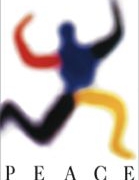
But the question arises, as one part of this relationship, what form should our contact take? In order to be working towards globalization, should we bring ourselves closer to them, or bring them closer to us? Ebrahim Haqiqi replies, “By means of dialogue, we can transfer a culture, at international exhibitions, with topics such as peace, environmental pollution, and helping to protect children… Posters have been distributed with an international language, but at the same time with special national symbols. For example, in most posters representing Japanese artists, images of Japanese culture exist, and these are their merits, for as long as we are not ‘national,’ we cannot become ‘global.’ ” “In this visual dialogue, in order to create a successful and effective work of art,” says Majid ‘Abbassi, “aside from being familiar with an international visual language, a graphic artist must consider his identity to be significant, from a historical and cultural perspective, while being in harmony with contemporary circumstances.”

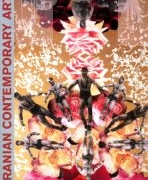
Contemporary Iranian Art at The Barbican Centre

The Artist as Seismograph
Kamran Diba

An exhibition titled “Contemporary Iranian Art,” the first of its kind in the UK, was held at London’s Barbican Centre. The objective of this exhibition was to depict the status of visual arts in Iran and its transformations and development as of two decades prior to the 1979 Islamic Revolution. The exhibition consisted of over fifty works of art by twenty Iranian artists, a number of whom live and work in Iran and some of whom reside in various other countries. The works on display were an array of calligraphy, figurative and abstract art, video art and photography selected from creations by aspiring young talents as well as veteran artists, chosen from among private or gallery collections and public ones from inside Iran and abroad, plus from works of art owned by the Tehran Museum of Contemporary Art which to this date had not been exhibited.

The organization of this exhibition was accomplished with the cooperation of Ms. Rosa Issa, guest curator, and Ms. Carol Brown, the Head of Exhibitions of the Barbican Centre’s galleries. They were supported by the Tehran Museum of Contemporary Art under the directorship of Dr. Sami‘-Azar and other centers of the foundation, such as the Iran Heritage Foundation, the Foreign & Commonwealth Office, The Iran Society, Visiting Arts, Delfina Studios and Iran Air. Upon the final selection effected by the Tehran Museum of Contemporary Art, the works were packed and shipped to London.

The exhibition was inaugurated on April 10, 2001 and selected works of fourteen Iranian artists created in the last forty years were put on display. The artists present at the exhibition alongside their works were Aydin Aghdashloo, ‘Alireza Espahbod, Mohammad Ehsa’i, Ghazal Radpey, Shadafarin Qadirian and Bita Fayyazi.

The inauguration ceremony was attended by the British minister of culture, a number of ambassadors and numerous personalities from the world of art; artists, critics, art collectors, etc., and was one of the most crowded and enthusiastically received events of the Barbican Centre. Many of the guests were Iranians residing in Britain. This exhibition enabled the British audience to acquaint themselves with the quality and development of Iran’s contemporary visual art from an era which has not enjoyed attention in the last two decades. During this period, transformation in the Western art of Europe and the United States inspired and influenced Iranian artists, intermingling with cultural and artistic traditions of Iran through the synthesis of which reputable artists fashioned personal styles. These artists formed the Saqqa-khaneh school, utilizing elements and motifs derived from traditional and religious art, such as images, numerals, signs and talismans and their incorporation with Western artistic motifs or combined with calligraphy, as manifested in paintings by Hossein Zenderoudi, Mohammad Ehsa‘i and Faramarz Pilaram. The same kind of incorporation occurs in the works of sculptor Parviz Tanavoli in his effigies of Heech (nothingness).

In the paintings of Sohrab Sepehri, Western art intermingles with nature and Zen philosophy, whereas Mas‘ud ‘Arabshahi has been influenced by pre-Islamic and Zoroastrian designs and motifs. Marcos Grigorian and Parviz Kalantari have created canvases of soil and straw, inspired by the arid deserts of Iran.

From among the post-revolutionary generation, works from Khosrow Hassanzadeh, a volunteer fighter in the Iran-Iraq Imposed War, were displayed at the exhibition. So were an installation of Bita Fayyazi’s ceramic roaches and samples of the works of Qassem Hajizadeh and Hojjatollah Shakiba, creations based on old photographs of the Qajar period, with a modern view of the painting and photography of that era.

A selection of videos by Ghazal, which were a combination of satire and contradictory aspects of modern life with the prevalent traditions and customs in the society, were also presented.

Also displayed were samples of the most recent works by Fereydoon Ave, inspired by Ferdowsi’s Shahnameh, manifesting the latest manner of incorporating

modern art with the traditional essence of Persian art and culture.

Complementing this exhibition, a screening of Iranian films was also presented, an event comprising short and feature films by Iranian filmmakers and some shorts by expatriate Iranians:

Daughters of the Sun, Maryam Shahriar

The Day I became a Woman, Marzieh Meshkini

Nargess, The Blue Veil, Under the Skin of the City and The May Lady, Rakhshan Bani-‘Etemad

Bashu, the Little Stranger, Bahram Beyza’i

Two Women, Tahmineh Milani

The Apple, Blackboards, Samira Makhmalbaf

The Circle, Ja‘far Panahi

The House is Black, Foroogh Farokhzad

Cold Green, Nasser Saffarian

Zinat: A Special Day, Ebrahim Mokhtari

Passage, Pulse, Shirin Neshat

Divorce Iranian Style, Ziba Mir-Hosseini

But You Speak Such Good English, Parisa Taqi-zadeh and Marjan Safinia

En Attendent Vahid, Delphine Minu’i

Baran – A Mother’s Daughter, Shalizeh ‘Arefpoor

To Have or not to Have, Niki Karimi

A Man for all Reasons, Fatemeh Mo‘tamed-Aria

After years of silence and artistic isolation, a comprehensive collection of Iranian art from the past forty years was exhibited at the Curve Gallery of the Barbican Centre in London. Over 20 Iranian artists were represented at this exhibition.

Presenting a review of Iranian art history, this exhibition begins with the painters of the Saqqa-khaneh school. This group of artists focused on the traditional and popular roots of Iranian culture, but with a modern sensibility. They established their visual language based on certain symbols with which the people of the street were familiar, such as calligraphic decorations and popular symbols of ta‘zieh plays (religious mourning ceremonies), astrolabes and divining pebbles, witchcraft and charms, and the forms which were displayed in Saqqa-khanehs as symbols of charity and piety.

Karim Emami, Iran’s first art critic, named this style of painting Saqqa-khaneh. His writings refer to Parviz Tanavoli and Hossein Zenderoudi as the pioneers of this school, soon to be joined by Faramarz Pilaram, Sadeq Tabrizi, Ma‘sud ‘Arabshahi, and Mansur Qandriz. But these divisions were valid for only a short period of time, for these artists gradually chose their own paths and artistic directions. It is interesting to note that the activities of the Saqqa-khaneh painters coincided with Pop Art in the United States. At the time, Western artists in search of images turned to the popular products of Western consumer culture. The era of post-war prosperity and the widespread consumption of industrial products exposed Western countries to a fundamental cultural transformation. American painters began to take notice of advertising images, movie stars, and boldly printed newspaper headlines, and these common and non-artistic images drew their attention, leading them to reflect these images directly in their works of art.

It is not important whether the artists were protesting or promoting. What is interesting to note is that, like a seismograph, these artists anticipated a global culture dependent on technology, consumerism, and mass communication.

A question that arises here is: Did the Saqqa-khaneh artists, in their turn, by drawing attention to the Shi‘ite religious symbols which were used by the traditional classes of society, predict the religious revolution and government? Painters undoubtedly reflected their own vision; they weren’t attempting to predict the future. In search of creativity and innovation, with a personal and spiritual view, artists were representing the

religious beliefs and culture of the common people.

Soon the Saqqa-khaneh artists were drawn to calligraphy and promulgated access to this cultural treasure among other artists. This was the first section of the exhibition, which included works from the 1960s. Of course, during the 60s and 70s, artists chose their individual paths of personal expression. During these two fruitful decades, Iranian art had exceptional energy and vibrancy.

Astonishing Gap
At first glance, this was an exhibition of Iranian art of the past forty years. However, an analytical study of the works on display reveals an astonishing artistic gap: there are no artworks from the 1980s. The only painter from that era with a prominent presence is Kourosh Shishegaran. Why is it that during the early passionate period of the revolution, which could be artistically active and fruitful, the country’s art scene is a silent vacuum?

If we look at the age group of the artists represented at this exhibition, their average age during the revolution was 30 to 40, which is usually the beginning of an artist’s productivity.

After expressing regret over lost opportunities and wasted lives, it would be apt to end this article on a positive note; the mere fact that such an exhibition was organized at all. This exhibition was undoubtedly made possible by the “Dialogue among Civilizations” and the more open atmosphere in art. This exhibition is indebted to the efforts and foresight of Dr. Sami-‘Azar, the director of the Tehran Museum of Contemporary Art, who not only attempts to fill the gap in pre and post-revolutionary art, but hopes to advance and introduce Iranian art to the world. By presenting its art collection and encouraging private collectors to loan theirs, this museum made such an exhibition in London possible. The Tehran Museum of Contemporary Art owns a large collection of first-rate Iranian and Western art.

In recent years, the museum’s collection of Western art has been loaned for art exhibitions in Europe, and the museum has regained its lost reputation among museums and cultural and artistic centers across the world.

As a last glance at this exhibition one cannot ignore the works of three female post-revolutionary artists. The significance of these artists is not in their being women, for there have been many female artists with prominent roles in Iranian art history: Behjat Sadr, Lily Matin-Daftari, Iran Darrudi, and others who have been influential in the teaching and production of art. The significance of the three young women of the 1990s is in their use of new tools for artistic expression: photography, video, and installation.

Leaving the exhibition, we cannot remain indifferent to Bita Fayyazi’s unforgettable Cockroaches. Cockroaches are never appealing or attractive, but for those seeking hidden messages, this artwork is surely a vehicle for feminist ideals. While doing the housework, a woman is often faced with annoying and at times fearful cockroaches. A symbol of female rebellion? Or perhaps leaving feminism for a moment, we should consider the plight of humanity: a mass of cockroaches, forever lost and searching, gaining hope from the slightest crack or opening.

A New Experience

Bita Fayyazi

The entrance of the exhibition displayed the works of the eminent artists Hossein Zenderoudi, Faramarz Pilaram, Parviz Tanavoli’s bronze Heech, calligraphy by Mohammad Ehsa’i… then works by contemporary artists such as Khosrow Hassanzadeh, his “Memories of War;” and by Shadafarin Qadirian, who in each frame of her photographs had linked Qajar women with modern Western objects, works which have to this date met with great success and were enthusiastically received in various exhibitions outside Iran; followed by the video art of Ghazal Radpey: four monitors placed in a darkened room very much like a movie theater; and finally, my installation, Cockroaches. Just outside the gallery’s exit were a selection of photographs by Seifollah Samadian.

I would like to add that the absence of a great number of artists was intensely felt at this exhibition, and I am well aware that this undertaking was but a beginning and a novel experience, one that will surely continue. Of course all good works can not be included in a single exhibition, yet should the trend continue, all the absent works will eventually be displayed. Organizing such an exhibition is no easy task. I was myself to some extent involved in the two-and-a-half years of preparation, and witnessed the difficulties it entailed. Despite the efforts and precision expended for this event, as in the case of every new task, mistakes are certain to occur, the first step always being the most difficult and unpredictable. Complementing this exhibition, a week of film screenings of the work of female Iranian filmmakers had also been organized for May 3, and was apparently very well-received. Among he filmmakers I recall were Rakhshan Bani-‘Etemad, Fatemeh Mo’tamed-Aria, Nicki Karimi, Shalizeh ‘Arefpour, Delphin Minou’i and Shirin Neshat.

Briefly about my own project: in order to arrange and install the roaches, I needed to be there before the exhibition began. Throughout the time I was there the employees of the Centre were constantly present, offering help and advice and putting up with my bouts of indecision and fussiness with patience and humor. And while I am usually filled with worry and anxiety before an exhibition, this time around all was at peace, punctual and correct, and I may say that it was the best installation of cockroaches I had ever done.

In my opinion, the event itself—an assembly focusing on Iranian art, and on such a grand scale—must have been more interesting than the works themselves. The exhibition was on display until June 3, 2001, after which the works were returned to the private collections and museums they had been borrowed from.

Where Are The Labors of the Alchemists?


Ebrahim Golestan
…No sign of them in this exhibition which presents “Contemporary Iranian Art.” No sign of Manuchehr Yektai, Hushang Pezeshknia, nor Esfandiari, Vishkai, Hossein Kazemi, Zia’pour. So much for the 1940s. And from the later years, Nasser ‘Assar, Azar Khosravi, Behjat Sadr, Morteza Momayyez, Bijan Saffari, Bijan Bassiri… they are not there either. Neither is Bahman Dadkhah, who currently has a sculpture exhibition in France. This list continues with names like Youssefzadeh, Farideh Lasha’i, Victoria Mas‘udi (Amini)…

In an era when ideas and opinions are free—except perhaps in their verbal expression —if you wish to hold an exhibition or publish a journal, with whatever healthy or sick, beautiful or ugly taste you may have, you are free to do so. This will be a personal work by which to measure your level of taste or talent. However, to hold up a work of art in a system which is larger than the individual, whether it’s a museum or an organization larger than the private confines of a storefront, and beyond that, a work that pertains to a nation, a civilization and the history of a people, in a foreign land where you are measured by your fossil fuels and your ancient history, wisdom and conscience demand that one ought to be more precise, have a greater understanding and a deeper discretion.

How can one casually organize an event displaying “Contemporary Iranian Art” without representing its pioneers and founders, and instead, fill the walls with repetitions of uninspired, disjointed works, coming from a level lower than true standards, and lacking individual diversity?

Except for one small work, where is Bahman Mohassess, whose achievements, whether in painting, sculpture or theater, are brimming with emotive power and intellectual value?

…Or Abolqassem Sa‘idi, content to work, insatiable for experience? Where are those blossoming forms of personal expression; those canvasses, 10-12 meters long, covered in the colors and forms of life’s essence and core, a translucent manifestation of sincerity, of the mind and in the mind, not imitating nature, but creating a new nature, its sun drawing brilliance from the artist himself… his work marks the convergence of a contemporary personal creative force and the distilled essence of traditional Iranian art… It was precisely this point that caused André Malraux’s fascination with Sa‘idi’s works. Sa‘idi puts formal traditions aside; he captures the meaning and the soul of these traditions. Through his manipulation of forms he has created a new tradition, and thus enriched the former traditions. But could this single work nailed to the walls of the Barbican be sufficient testimony to this aspect of color and design in contemporary Iranian art?

Or Hossein Zenderoudi, the most innocent instinctive seeker of Iranian traditions of form and color–where are his icons? The twists of his calligraphy? His desert of Karbala? Where are his magical and spellbinding alphabetic forms? He employs the letters of the alphabet playfully, patiently and painstakingly, like an incantation to unravel emotional and nervous tangles. Contrary to those who believe they must tread his path, but with a “better” calligraphy, he has had nothing to do with calligraphy—nothing whatsoever. The alphabet, which gives shape to words, exists in nature, and you are free to put its letters to work in any way you please, as the form of a tree, a bird, a fruit, a stone, or a man. Is it necessary to create a word? Meaning in the work of Hossein Zenderoudi does not come from words. The words are not the focus. You may tie words together in any way you wish, but meaning arises from your emotions, your creation. This is the principle of Zenderoudi’s work. Whenever his mind wanders, leaving its limits, it is as if he has gone off the path, it is as if he is lost, pointless. Do we find a single example of this central focus at the incoherent Barbican exhibition? Hossein Zenderoudi had well perceived how off the mark the organizers of this exhibition were, and so, had not given them any works to exhibit. Or Sohrab Sepehri. Sohrab’s insight lay in his seeking. The principle of his work was searching; how to say what. Both in his poetry and in his painting. He begins with doubt, with asking. His work was a quest for answers. This brought enchantment to the simplicity of his poetry. Here we are not concerned with his poetry of words, but his poetry of form and color. He was always and in any case searching. These efforts would lead to a distillation, like an alchemist. And with distillations such as these, he believed he would reach what he was seeking. This was what prevented disorder in his work. This gave him discipline, in his work, and in his life. The search would become a goal in itself, the work itself, the unavoidable result of work, just as in alchemy, where the initial goal may have been gold. At the end of such a winding path lies imagination and hope—for no end exists. A repetition of this technique results in refinement. Order and precision are achieved, and these were what he accomplished. In the 22 years that I knew him, until the end of his life, Sohrab was a disciplined, untiring seeker who never became slovenly, and never was. His efforts to distill guaranteed the variety of his work. Sohrab was this variety. Where is this variety at this exhibition? They had space for the “cute” photos of wrestlers pasted on a bed of flowers, made room for them on the wall and on the cover of the exhibition catalogue, as an example of contemporary art of Iran, a lost and trampled on Iran. But they could not find room to explore the variety of the works of one who was all about exploration and variety.

Incredible! Sepehri, his tulips, his powerful, abstract forms, his geometric shapes, his air vents and his deserts, his stucco walls and his villages. The crooked logs, the bunches of flowers, the lone tree on a desolate hillside, from the astronauts floating in space to the monochrome image of a woman who disappears in the mysterious darkness of a dusty, door-less room, where secrets lay buried. Except for the floating astronauts, where is a single example of this variety? Where are the traces of their labors, those alchemists spurred on by a sense of bewilderment in search of tranquility? •

· Excerpt from a longer article

Jazeh Tababayee

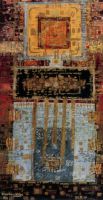
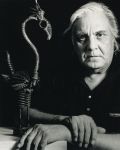
Jazeh Tabataba’i is a hard-working and capable plastic artist whose continued effective presence along four decades of contemporary Iranian painting and sculpture has greatly contributed to the prosperity and wealth of this country’s art. Dealing with such topics as traditional patterns, folkloric visual creations, myths, poetry and manifestations of urban life, he has embarked on a keen review of contemporary social life Jazeh Tabataba’i is a hard-working and capable plastic artist whose continued effective presence along four decades of contemporary Iranian painting and sculpture has greatly contributed to the prosperity and wealth of this country’s art. Dealing with such topics as traditional patterns, folkloric visual creations, myths, poetry and manifestations of urban life, he has embarked on a keen review of contemporary social life and aptly succeeded in recreating it in the domains of painting and sculpture. His deep love for art, his eagerness for acquiring experience, and his creative powers lead Jazeh towards creating novel paintings and sculptures which constitute a precious treasure of contemporary culture documents.
Manijeh Mir-‘Emadipainting and sculpture. His deep love for art, his eagerness for acquiring experience, and his creative powers lead Jazeh towards creating novel paintings and sculptures which constitute a precious treasure of contemporary culture documents.

Manijeh Mir-‘Emadi

Jazeh Tabataba’i was born in Tehran in 1930, in a family most of whose members were inclined towards arts, particularly music and painting. His grandfather was the painter E‘temadi, entitled “Mofatteh-e Rang”, who also designed and wove carpets, and it was from him that Jazeh drew his first inspiration. His father, a military man, preferred his son to follow a political and official career, but Jazeh was attracted towards writing, painting and sculpture ever since his early youth.

He writes his first story, Sand and Reed, at the age of twelve. Later, he turns to writing plays, such as Withered Blossoms, Lord Chichioff, Footprint, and Mister Moochool, which he directs and stages at the Kanoon-e Pishahang. In 1946, he publishes his Story of a Little Boy.

In his youth, he produces his first work, a bas-relief collage, working late at night, unseen by his father. During World War II, his terror of mass killings and his abhorrence of violence elicit his emotional reaction. At nights, he overturns his wooden bed and the space beneath it becomes an underground shelter above which war machines plough the blackened face of the earth. The planks of the bed are covered with black and red splashes of paint and red and white crosses. Shattered, bloodstained doll heads and limbs lie in a corner, while crushed jeeps and trucks and burnt airplanes and wrecked weapons are visible in another. On the right hand side of the work, a shattered skull represents bellicose Mars. The nightmare of war, about which he hears on the newly founded radio, fills his nights, and in the morning, life returns to normality and the daily routine continues.

Meanwhile, the young artist is faced with a work that inspires a new period in his career. Mofatteh-e Rang had hung his daughter’s wedding khoncheh on a wall of his home, as a decorative tableau. A sangak bread sprayed with poppy seeds was pasted with fish glue on a wooden tray amid wild rue and frankincense seeds and colorful paper flowers. The objects pasted on the khoncheh were discolored and altered. Old age had given those incongruent objects an unexpected and beautiful unity.

Seeing this work, the artist realizes that such everyday objects as wedding khonchehs and household utensils can have different functions as well and serve purposes other than their usual ones.

He obtains various diplomas and takes different courses. He goes from the conservatory to the theater school. He earns an acting diploma in 1950 and opens Lux Film Studio on Lalehzar-No Avenue with an official authorization.

He holds his first exhibition of paintings in the neo-miniature style. In the same year, he graduates both from the ballet academy and Dara’i High School. He then enters the Faculty of Law, from which he soon drops out.

In 1951, he publishes the story The Alligator’s Tooth. In 1954, he earns a first grade in theatrical direction and fundaments from the Faculty of Literature and stages the play Sailor Shirt. With his acting diploma in hand, he goes on to the Faculty of Fine Arts to learn sculpture. In 1960, he graduates from the Faculty of Fine Arts and publishes the book The Chess of Life. Before that, in 1955, he has opened the Modern Art gallery at a time when art galleries have not yet achieved a desirable function in Tehran. Although Apadana and Aesthetic galleries have been created in 1949 and 1954, respectively, art galleries have not yet become established institutions. The Modern Art gallery takes shape first on Bahar Avenue and then in his present house on Pa’eez Street. This gallery is the gathering point of innovative painters, sculptors, poets, musicians and artists. Alongside artistic exhibitions, the first Poetic Evenings are held in its hall.

Jazeh’s painting is diverse, but with a common factor, namely “folklore”, or, more precisely in his case, “popular rites and mores”. Actually, he belongs to a category of Iranian painters known as “traditionalist innovators”, whose main characteristic is that they have adopted indigenous culture as a means of expressing their conception of the world around them. This attitude sets them apart from the group of “free innovators”, who are not bound by local characteristics and seek to achieve a universal expression using a cosmopolitan language that is derived from their conception of the inherent function of plastic arts.

In the 1950s, the painter touches on diverse approaches in order to achieve a personal expression. Setting aside such works as A Man of Our City (1956) and Mother, Child, Tulip (1957), which resemble curricular studies, we are confronted with works that reveal Jazeh’s early efforts at depicting his mental world. In his color sketches The Beloved and the Lone Gazelle, The Lover of Gazelles and Source, You Were on My Mind, his painting Patch and Moaning, his color sketch I Travel With the Clouds, and his paintings O Cypress, Tell Me, Red Embarrassment and Goli Agha, made in 1956, and Smoke and Fumes, Weary, Hot and Lost and Panthea in the Fire, made in 1957, the artist’s attempt at a stylization of objects into curvilinear compositions is perspicuous. He seeks to achieve a new understanding of Iranian aesthetics by pondering on the elements and composition of miniature painting, indigenous handicrafts and folkloric arts. These efforts are backed by traditional teachings acquired during his curricular studies.

Jazeh has created a multitude of divs in the various periods of his career, but most of them were made between 1955 and 1957. His div-marked works, whether lithographs, block-printed cloths or “coffee-house” canvases, are mostly influenced by folkloric painting, although the influence of children’s painting should not be neglected either.

Jazeh says: “For me the pomegranate is a symbol of the world, which contains a multitude of separate clusters each of which is filled with many seeds that can be men or planets in a galaxy. This world is closed and enigmatic. This pomegranate is depicted unopened in most of my paintings, except in one, where a bull has torn one open and been rewarded with a bloody death.”

The creature Jazeh calls “Not bird, not man” is created in the 1950s, although, as his gazelles later on, it becomes the predominant element in his paintings of the 1960s and 1970s. In his Falconer, a marionette-like little girl is perched as a falcon on a prince’s arm. Yet, the main characteristics of this creature reach completion in the early 1960s. In his Ashi-mashi Bird, dated, 1961, we are faced with a creature the like of which we had seen in folkloric paintings, particularly on “pseudo-porcelain” plates or bronzed figurines of birds used on mourning signs. Jazeh gradually alters this traditional creature, transforming it into a fairy-like bird that becomes a mythological element of his works.

A cursory glance at his works of the 1950s reveals that he essentially tries to convey the vision of his hasty mind with a minimal amount of line and color. Later this manner reaches its peak in his “string balls”. These “string balls”, the 500 series of which are printed in a booklet, have a simple structure and constitute a rebellious reaction against his figurative paintings, in the sense that here the background achieves perfect harmony with the main subject and the central masses of the painting. Secondly, forgoing the figurative of men and animals, the painter succeeds in recording his feelings

more boldly and freely. Thirdly, breaking free from the traditional limitations of symmetry and likeness, and refusing to deal with social issues, he tries, by adopting the method of automatic creation, to rely on the fluent current of his imagination, to give free rein to his subconscious, so that whatever befits the “creative moment” and the “creative verve” flows onto the canvas.

The 1960s were a prosperous decade, not only for Jazeh, but also for a great many artists and literary figures, because the Iranian economic boom, the transformation of Tehran into a metropolis, the development of international communications, and the ensuing cultural growth and artistic prosperity, particularly in the domains of poetry, painting and cinema, had all occurred within that period. The performance of five biennials, the official recognition of modern painting by cultural policymakers, the serious attention given to plastic arts by the mass media, the art critics and the public, the emergence of a market for paintings and sculptures, the presence of private and public collectors, and the popularity of art galleries and museums had made for a lively market and provided painters and sculptors alike with an opportunity to make the best of that apparently prosperous market.

From the 1960s onward, several main changes and differences become visible in Jazeh’s works. Firstly, in the domain of painting, he recognizes the particular artistic language of his own invention, purifies it and strives at its harmonious development. He knowingly employs the elements scattered in some of his past paintings and, adopting adequate novel techniques and relying on his growing aesthetic knowledge, he devotes his efforts at bringing them together in a harmonious and artistic manner. Thus, transcending their apparent diversity—collages, abstract string balls, neo-miniatures, khonchehs and bas-reliefs, which were none but exercises toward achieving his own artistic expression— Jazeh’s paintings reach a harmonious space in which they approach consistency while retaining their diversity. The unity of his painting style makes his canvases immediately distinguishable from others’ works in terms of composition, coloring, tracing, conciseness of expression and choice of themes.

Although Jazeh likes diversity, he recognizes that prevailing conditions have drawn him to work in different domains. In winter, when conditions for writing, sketching and painting are more favorable, he often writes poems, carries on with his notes on artists, continues his stories and makes small paintings, whereas in clement seasons, he works on larger canvases and turns to sculpture. Yet, his mental outbursts inflict so many exceptions to this apparently rational approach as to deny it the character of a general rule.

Views on Jazeh Tabataba’i
Jazeh’s paintings combine bold free lines—which sometimes appear crude to the ordinary viewer—with bright colors as pure and vivid as a child’s soul, adorning his emotional space with colorful warps and wefts and enlightening it with the radiance of reality… His Rural, Antelope and Parrot sketches, which are made of iron, illustrate this solidity. The clarity and fluency of these sketches in no way detracts from their solidity and attractiveness.

Nader Naderpoor on Jazeh Tabataba’i, April 1961
[Jazeh] is the founder of the first art gallery in Iran. He has trained many prominent pupils, but does not consider himself their teacher. He believes that, rather than teaching his knowledge to his students, a true teacher strives together with them at discovering the unknown, learning in their company, so that both his students’ and his own personality keep growing. Jazeh is highly revered among most of our renowned artists. Such painters as Ovissi, Sepehri, Vaspoor, Ghandriz and Varga Sina’i have made imperishable portraits of him and several squares in Iran and abroad are adorned with his works.

Amir-Hossein Aryanpoor on Jazeh Tabataba’i
… Jazeh Tabataba’i’s renewed style of painting can have another—deep, remote and inexpressible—origin as well. Allow me to open the discussion with the fact that, in Islamic Iran, painters initially had to alter reality, which prompted them to seek a plastic language to express the truth… In psychological terms, this task in fact constitutes a mental phenomenon… Let us remember that, in Plato’s view, an artist, whether poet or painter, must hang on to the world of ideas and existing essences, forgoing that of feelings. The existing world and ideas also has a past of several millennia… An essential distinction exists between Jazeh and the European fauvists. The fauvists give priority to color over form, whereas, on the contrary, Jazeh utilizes color in opposition to form, employing the former to clarify the latter. He simply uses color as a means of delimitating or blurring. This is what Iranian miniaturists did in the past.

Excerpts from an article by the Spanish scientist Luciano del Rio
Although he is a man from the twentieth, perhaps the twenty-first, century and the material he has used is the malleable iron of this century, you see the Iranian blood of ancient times running in his sword-wielding lion, his candle-bedecked man, his good shaliteh-wearing divs, his khonchehs of slanted-necked brides, his birds that are neither bird nor woman, even his Spanish lady with a fan.

Siroos Tahbaz, March 1992

Mother was sick in bed.

I took her a fruit after dinner.

She didn’t eat the single apple I had put on the plate.

She handed it over to me and said:

“Paint it for me,

as a memory to keep.”

I painted it. She said, “It’s beautiful, but

I would have liked it to be an apple like my existence,

just as I am.”

· Jazeh Tabataba’i •

A New look at Nature

Farairan magazine, Nos. 3&4,Spring & Summer 2000
By : Ru’in Pakbaz

The Tehran Museum of Contemporary Arts held an exhibition of a collection of works of modern Iranian artists entitled “A New Look at Nature” during the summer of 1999. In this exhibition, a wide spectrum of different attitudes towards nature (landscapes, plants and objects) ranging from realism to symbolism to abstraction was on show. What connected the different experiences was a new understanding of the natural world beyond imitative art. How has this evolution in “seeing” nature emerged and what is its relation to modern aesthetics?

The painter of our time has left behind a long history of traditions in representing the facets of nature. In the distant past, simplified, symbolic shapes of mountains, rivers or trees appeared now and then in the background of mythological, religious, commemorative and other paintings. It seems that the creators of this type of image took the presence of human beings in this natural environment for granted. However, centuries had to pass before the relation between things and their situation in space and with respect to light was taken into consideration and the painting of landscapes or still-lifes appeared. The history of art shows that, even in this particular approach to the natural world, mere imitation of external appearances was not a certainty.

It appears that the Chinese painters began the experience of landscape painting earlier than the Europeans. In ancient China, even before the formation of the Chan (Zen) sect, the subject matter of “mountain and water” was put forth by literary persons acquainted with art. A strong literary tradition based on the communion of Taoism with nature came into being and then became intermingled with Buddhist tenets, beckoning followers into chosen seclusion and exploration of forests, rivers and mountains. This introspection into nature strengthened the foundations of Chinese landscape painting. Ink painting of the Sung period was the most brilliant expression of the mystic thinking of Chinese artists. The artist expressed the essence of the reality he saw around him with the least of pictorial means and in the most meditated brushstrokes. His intended concepts became contained within a single bamboo reed or a few plum blossoms, i.e., in the slightest manifestations of the mysterious life extending throughout nature. He depicted the human being as a minute part of the wide world, and nature in its various atmospheric moments as an unlimited, effulgent and magnificent world. The unsaid, unpainted, and void spaces had just as much importance in his compositions as the painted sections. In this way, the Sung artist developed a particular definition of space, which thereafter became one of the fundamental and enduring principles of Chinese art.

The Chinese tradition of landscape painting found its way into Japan, wherefrom it later greatly influenced European art. A few Iranian painters — including Nasser ‘Assar and Pari-yush Ganji —were also attracted toward the aesthetics of Zen painting. However, only the poetic-natured Sepehri was able to perceive its deepest characteristics and infuse them into his personal style.

If the far-eastern artist’s ideal was to become one with nature, the western artist long strove to apprehend and depict the physical aspects of nature. In fact, for five centuries western art drew inspiration from the worldly philosophy of the Greco-Roman tradition. The objective of reproducing the natural world called for the invention of pictorial techniques (perspective, modeling, etc.) whose origins lie in the antiquity. Thus, the most ancient remaining examples of ancient Roman landscape and still-life painting attest to significant skill in the representation of three-dimensional space, the volume of objects, light and atmosphere.

Having embraced supernatural thought and values, Medieval Europe let the Greco-Roman naturalistic tradition fall into almost total oblivion. However, 15th century Italy revived it and developed its aesthetic principles. In post-Renaissance Europe, interest in natural representation became so prevalent that landscape and still-life painting became established as independent genres. Now, pthe beauties of nature, yet they often included anecdotal elements into their imagery of forests, plains or seascapes in order to make them more “meaningful”. Even when treating subjects with religious, historical or poetic contents, their aim was to depict scenes and things so that they appeared real. In the course of continuous attempts at verisimilitude, a complete system of painterly skills was created. However, European painters, utterly satisfied with their technical skills, were suddenly confronted with a new rival, namely the photographic camera, whose eye was notably keener than theirs.

Examples of naturalistic painting are rare in the tradition of Persian painting. Even when treating nature as a subject, the Persian miniaturist sought to depict the original essence of natural forms and the design reflected in his inner self. Thus, neither a determined time nor place nor a reflection of physical quantities appears in his paintings, and the rules related to the vision of the world bear no functionality in them. And his mountains, trees and streams are archetypes rather than imitative forms of nature. Therefore, imitative art — which present-day painters have come to consider worthless — was not rooted in Iranian art. It was a phenomenon which reached Iran from the west.

More than three centuries have passed since Iranian artists became first acquainted with European art; however, experiments with landscape and still life date to a less distant past. Perhaps it may be said that Iranian artists began this experimentation when they had completely abandoned the traditional approach to archetypal nature — which constituted the essence of Persian painting aesthetics. Mohammad Ghaffari (Kamal-ol-Molk) became known as the flag-bearer of this rift with tradition; and it was he who promoted the rules and principles of European naturalism in Iran through his followers. At this time, the painters — unlike their predecessors — assumed the responsibility of depicting natural scenes with utter precision, which required them to make use of all their talents for this purpose. The best landscapes and still lifes of Hassan-‘Ali Vaziri, ‘Ali-Akbar Yassami, ‘Ali-Mohammad Haydarian and the other followers of Kamal- ol-Molk show the peak of their capabilities in imitating external appearances; yet, they bear no trace of the painter’s mental world.

Photographic images illustrated not only the ultimate in the imitation of appearances but also the possibility of recording chosen moments of the visible world. By presenting an “image of magical instantaneity”, the photographic camera created an enthusiasm to which the French impressionists strove at responding. They set aside all the “non-pictorial” aspects of earlier painting and devoted themselves entirely to the visual impressions of natural reality. The image of the sky, water, tree and flower was now reduced to a series of chromatic feelings perceived through the atmosphere. In this ephemeral optical realism, the brilliant world of colors was discovered. However, when the entire image is transformed into a harmony of colors and special light effects, the solid structure and linear mold of objects disappears and, consequently, little remains of objects’ palpable distinct characteristics and independent existence. Jeopardizing the world of objects is the first sign of the discredit of the representation of the visible world in the traditional manner, as well as the first step towards the creation of new forms.

The artists who came to be known as post-impressionists left behind not only the impressionistic notion of reality but the entire naturalistic tradition as well. The main reason for their rupture from the past are to be found in the time’s European crisis of values and certainties. In fact, these artists trained in impressionism had lost interest and trust in objective reality, and if they set out to paint still lifes, their aim was to discover a hidden meaning under the visible skin of objects. On a surface beyond appearances — one which did not necessarily reflect shapes and appearances — , they sought another reality. They eventually came to the conclusion that the outer, visible world is only definable in terms of man and his inner world. By delving into formal structural problems, and taking advantage of the decorative possibilities of two-dimensional designs and the meaning of color, post-impressionist masters paved the ground for the experiences of the next generation.

The echoes of these achievements reached Iran about half a century later. A society on its way towards modernity often readily turns to using novel models. This is how emulating western styles and methods first appears in the works of some of Kamal-ol-Molk’s pupils. For example, the landscapes Abol-Hassan Sediqi painted during his first trip to Italy are evocative of the impressionists’brilliant colors and brushstrokes. However, it was during World War II that modern art came into serious demand in Iran. In those years, emulating the works of European modernists was a way out for art students who sought to free themselves from the limitations of academic art. Such painters as ‘Abdollah ‘Ameri, Ahmad Esfandiari, Mahmood Javadipoor, André Govalovich, Habib Mohammadi and Gholamhossein Saber learned from the impressionists that one has to go outdoors and capture the moments of nature and life. They began working in the countryside and rural environments, in bright sunlight, painting scenes which the previous generation had overlooked: lush trees, golden wheat fields, purple mountains and bright blue skies. Of course, these young modernists’ “plein air” landscapes were often technically and stylistically akin to the works of the painters of the Barbizon school. Similarly, those who turned toward the post-impressionists did not become properly acquainted with the works of these masters. In fact, the upshot of these early efforts was the diversity of painting subjects and a kind of freedom in coloring.

Young artists who rise against the conventions of traditional art under the banner of impressionism or post-impressionism are still bound, just as their teachers, to outward reality. But innovative effort soon becomes concentrated on experiences of inward vision and the most diligent artists find motivations for mental research in the highly diverse nature of Iran. Thus, the tree trunks of Sepehri, the branches of Sa‘idi, the flowers of Mansooreh Hosseini and the leaves of Parvaneh E‘temadi appear as inward images; and the mounts and vales of Hossein Kazemi become transformed into symbols of the ambiguity of existence. The categories of landscape and still life in modern aesthetic vision have been utterly transformed. The common tendency of the fauvists, expressionists and many other twentieth century painters has been to use natural subjects as a raw material for creating constructs of color and form. The tendency towards abstraction was the logical result of the emancipation of pictorial means from a purely representational function. On the other hand, the surrealists turned to the world of dreams in their search for new forms. In any case, the modern artist demonstrated that not only did he have no interest in depicting the familiar beauties of nature, but that he had also lost all belief in the natural order. In expressionist painting, under the pressure of a paralyzing terror, men and trees alike are either bent or looking skywards in rapture; at times, space appears stiflingly restrictive and at others reaches so far away that its containment within the framework of the pictures seems astonishing. In the dreamlike surrealistic landscapes too, strange and mysterious objects announce their equivocal presence. Truly, what can be seen in these distorting mirrors other han reflections of a world falling apart and submerged in struggles?

Quite a few Iranian painters have reflected the agitated soul of the modern artist in their depictions of nature. Manuchehr Yekta’i gives assault to the canvas with thick paints, scattering signs of trees, flowers or fruits here and there. Farideh Lasha’i, using a chaos of line and patches, transforms a mass of soil and brushwood into a visual event. In the landscapes of Ya‘qub ‘Ammamehpich, rocks fight with each other, trees move about and mountains and rivers converse. Such pictorial dramas can also be found in the semi-abstract paintings of Mostafa Dashti and Mojgan Moslehi. Such abstract painters as Sirak Melkonian, Kamran Katoozian and Gholamhossein Nami convey a dual feeling of finiteness and infinity, remoteness and nearness, motion and immobility, by altering the dimensions of conventional space. Even Hossein Mahjoobi, who is well familiar with the serene meadows of Gilan, occasionally reveals his anguish in his sinuous trees. Can anyone rest for a moment in the shade of Davood Emdadian’s colossal trees — these “natural skyscrapers”?

Sepehri’s lyrical expressions indicate that the artist of the age of the “ascension of steel” can still be attached to simple, serene and beautiful nature. Desert dunes, faraway alignments of willow trees, pebbles scattered within sight, flowers and bushes growing beside a stream, and occasionally a few apples, are incentives for a moment of communion with nature. Sepehri does not see nature from the outside; he imagines it from within himself. In the minutest objects he depicts, he reflects a generality of which he has become aware by intuition. And we know that this vision is rooted in Iranian mystic thought and far-eastern aesthetics.

Returning to the idyllic garden that once portrayed the creative Iranian soul is unimaginable, but a painter such as Abolqassem Sa‘idi is able to recreate the memory of corners of that garden with his vernal trees. For long years, he only painted lush trees using meandering intertwined lines and round colorful shapes. Later on, he turned to still life and combinations of flowers, fruits and trees. All through, an echo of the past — occasionally mixed with a pleasant nostalgia — is discernible in his paintings.

The experiences of nature in contemporary Iranian painting are much more diverse than the examples mentioned here. Javad Hamidi, ‘Abdorreza Daryabeigi, Jalal Shabahangi, ‘Ali Golestaneh, Ya‘qub Emadian, ‘Ali-Reza. Ahmad Vossuq Ahmadi, Nami Petgar, Mostafa Goodarzi, Manijeh Mir-‘Emadi, Karim Nasr, Reza Hedayat, etc., each occupies a particular space in this vast domain. In our time, nature can be seen with great diversity, but through the eyes of the heart.

Trump’s America: Playing the Victim

Source: E-Flux Journal l #84 – September 2017

Unavoidably (because I am a German citizen), I look at the Trump situation from the European perspective. And so I will try to situate the Trump phenomenon in the broader context of the contemporary nationalist movements that are on the rise in Western countries. The European tradition knows three main lines of political thought: liberal, nationalist (or fascist), and socialist. Thus, it is a bit different from the American tradition that differentiates between liberals and conservatives. Today, it is normal in Europe to speak about neoliberalism as the ideology of capitalist globalization. The conflict between neoliberalism, or globalism, and right-wing nationalism seems to define contemporary politics. In all recent and upcoming elections, including the American presidential election, the second round of the French presidential election, and the coming election in Germany, this conflict has dominated the public space.

Trump’s America: Playing the Victim

Boris Groys

Source: E-Flux Journal l #84 – September 2017

Unavoidably (because I am a German citizen), I look at the Trump situation from the European perspective. And so I will try to situate the Trump phenomenon in the broader context of the contemporary nationalist movements that are on the rise in Western countries. The European tradition knows three main lines of political thought: liberal, nationalist (or fascist), and socialist. Thus, it is a bit different from the American tradition that differentiates between liberals and conservatives. Today, it is normal in Europe to speak about neoliberalism as the ideology of capitalist globalization. The conflict between neoliberalism, or globalism, and right-wing nationalism seems to define contemporary politics. In all recent and upcoming elections, including the American presidential election, the second round of the French presidential election, and the coming election in Germany, this conflict has dominated the public space.

Right-wing nationalist parties are becoming increasingly influential in what was once called Western Europe—in France, Holland, Belgium, and also in Germany—even more influential than they’ve been in what was once called Eastern Europe. These parties are time and again compared with fascist parties from the European 1930s and ’40s. And, indeed, they use similar racist, xenophobic rhetoric. Like their fascist predecessors they advocate a “conservative revolution” directed against the main ideologies of the twentieth century, namely liberalism and socialism, as well as against the political institutions that are historically related to these ideologies. Their propaganda is also directed against similar groups inside their own countries: globalized, cosmopolitan elites and immigrants.

However, the new right is different from the classical fascist movements that were aggressive and expansionist, striving for world domination and trying to establish a universal new order. The neofascist new right is, on the contrary, defensive and protectionist. The ideology of the new right, including the Trump movement, can be seen as a return of the territorial into world economy and politics. The post–Cold War era was a period of globalization—and, to use a Deleuzian term, of deterritorialization. The main symbol of this era was the rhizomatic and at the same time global structure of the internet. Today one is often reminded that the corporations and organizations that operate the internet have certain addresses in real, offline territories that are controlled by certain states. As such these internet corporations and agencies come under suspicion for representing the interests of these states. They come to be regarded as instruments of surveillance, propaganda tools, and sources of fake news. Instead of constituting a virtual space beyond state borders, the internet is seen today more and more as the privileged battlefield for interstate information wars.

This is only one example of the reterritorialization of politics that we experience now. The second—and, actually, the most important—example is the fact that migration and, especially, immigration have became the central point of public concern. It is safe to say that it is primarily the attitude towards immigration that structures the contemporary political landscape—at least in Western countries. The anti-immigration politics of the contemporary new right parties is an effect of what can be characterized as the territorialization of identity politics. The main presupposition of the ideology of these parties is this: every cultural identity has to have its own territory on which it can and should flourish—undisturbed by cultural influences from other cultural identities. The world is diverse and should be diverse. But world diversity can be guaranteed only by territorial diversity. Mixing different cultural identities on the same territory destroys these identities. The world becomes uniform—boring, depressive. And even more importantly, in becomes unprofitable for the tourist industry, which promises to international tourists precisely the combination of traveling to a different territory and encountering a different culture.

Right-wing propaganda sees globalized, deterritorialized elites as the main enemy of this reterritorialized, diversified world order. Elites—the famous 1 percent—are accused by this propaganda of being interested in only the global financial markets and not in the fate of the populations of their countries. They’re accused of being indifferent to the well-being of these populations, to the technological infrastructure installed in their territories—one of the big themes of Trump’s campaign. Globalization is seen as creating a line of division inside every individual society. A small minority profits from globalization, but the majority is left behind. This majority becomes additionally endangered by immigration. Global trends—financial, technological, and informational—destroy traditional lifestyles and professions and make acquired skills and cultural habits useless—skills and habits that have been practiced for generations. This loss of traditional professions and work habits becomes further aggravated by the influx of immigrants with different cultural backgrounds and lifestyles. The elites do nothing to stop this—thus confirming that they are not interested in the fate of ordinary people. So these ordinary people begin to feel and say that the elites have betrayed them and that it is time to do something about the problem. The only question is: What has to be done?

Historically, we know of only two answers to this question: socialism and nationalism. But also from a logical point of view, there are no other possible answers. Let us revisit the picture that I just tried to paint. Globalization presents itself in two forms: rich globalized elites and poor immigrants. If one sees one’s own country as a victim of globalization, one has a choice: to unite with the poor immigrants against the rich elites (the socialist solution), or to unite with the rich elites against the poor immigrants (the nationalist solution).

It is obvious that—at least at the moment—the populations of Western countries have rejected the socialist choice and tend to accept the nationalist choice. The reason for this is also pretty obvious: it is an effect of the victory of neoliberal globalism over socialist internationalism at the end of the Cold War. Indeed, during the historical period after the fall of the Berlin Wall, the Western left was systematically destroyed—first of all the Western communist parties, and then social democracy with its social states. All the socialist models—radical or moderate—were proclaimed to be economically inefficient, historically discredited, and obsolete. So during recent decades a certain consensus was formed: socialism is economically inefficient and, generally, bad. And this is the actual reason for the nationalist, neofascist choice: after neoliberal, anti-socialist propaganda managed to persuade the wider population that socialism is economically ruinous, the socialist choice became blocked—and only the neofascist choice remained possible. Of course, this is not the result that the theoreticians of neoliberalism anticipated. But they failed to anticipate it only because they overlooked a few key things. Let us now consider these things more carefully.


What is the actual difference between socialist internationalism and neoliberal globalism? Socialist internationalism is based on international solidarity, whereas neoliberal globalism is based on global competition. In the context of global markets, everybody competes against everybody—every individual competes against every other individual, every country against every other country, and so forth. Of course, socialism—being based on solidarity—is inefficient in the context of competition. So if one believes that competition is what people should do, socialism is automatically discarded. And this is indeed what neoliberal ideology believes. Of course, this ideology also presupposes that the competition is fair. But who is responsible for the fairness of global competition? Such an institution does not exist. Of course, American politicians say time and again that they feel themselves responsible for global affairs. But then the suspicion emerges that they interpret this responsibility in a way that serves their own interests, to the detriment of the interests of the others.

And what is fairness actually? Is competition fair when it is reduced to market success? Maybe such competition is unfair because it favors a certain human type, a certain cultural identity, a certain way of life based on economic success. Maybe it would be a good idea to protect people who have cultural identities that do not fit so easily into the global competitive framework—help them and defend them, maybe even do so through institutional and military coercion. For example: What happens when American commodities are not so successful and the American workforce is inadequately trained? Then the state can say: buy American and hire American. (Kaufe nicht bei den Juden—do not buy from the Jews.)

Here, the way from neoliberalism to neofascism becomes clear enough. And this way is very short indeed. Both neoliberalism and neofascism believe in competition—this is what distinguishes them from international socialism. Neoliberals tend to think that they will always be the winners of this competition. The losers will be always the famous Other. Liberals are ready to preach recognition of the Other, respect for the Other, etc. But it seems that they can hardly imagine a situation in which they themselves become these Others. I remember listening to a talk by a liberal Berlin professor on German TV, around the time that a right-wing movement against the immigration policies of Angela Merkel started. He said that Germans should accept immigrants because they will always remain in the lowest sector of German society—and thus will not present any danger to the majority of Germans. However, the right-wing German protestors were not so sure about this—and it was precisely this uncertainty that moved them towards the radical right. So one can safely say that the desire to change the rules of competition comes from the uncertainty that these rules are fair—where “fair” is mostly understood as favorable. Thus, Trump says time and again that the trade deals between the US and other countries are unfair—and here “unfair” simply means unfavorable to the US.

In the US, the notion of cultural identity and, in general, identity politics is traditionally related to minority politics. The goal of minority politics is to defend minorities from cultural, political, and economic domination by the majority—the domination of the weak by the strong. So in America, identity politics is traditionally regarded as leftist politics. That is why it seems surprising that the white majority initiated an identity politics from the right. However, the reason for both kinds of identity politics is the same. Today, the US does not feel strong enough, being confronted by competition from countries all over the world, such as China and Mexico. This feeling of weakness is what Trump embraced and exploited. It was especially interesting to see his performance during the debates with his Republican competitors. All of them praised America and everything American at every opportunity: “the greatest people on earth,” “the greatest civilization in human history,” “a shining city on a hill.” Trump alone spoke about everything American as disastrous, catastrophic, and disgraceful—airports, highways, inner cities, wars, and peace treaties. He presented the US not as a historical winner but as a historical loser. And that is how he captured the hearts and minds of so many Americans—not by celebrating American supremacy, but by raising the specter of America’s ultimate defeat. Here, American identity was presented as a losing identity, the whole global system as a means of destroying the US, Americans as the primary victims of the post–Cold War order they themselves created, and American elites as traitors selling out the US on the globalized market. The results of the election show that a significant portion of the American population also sees the US as a power in decline—and sees itself as a victim of recent historical processes. The US thinks of itself as an unhappy country, even a masochistic country, having been exploited and ripped apart by everybody. Here, the question of saving and guarding American identity becomes urgent—and identity politics becomes truly neofascist because it begins to address not minorities but the whole country.


This shift of identity politics from the left to the right is less unexpected than it might seem. First of all, in the European tradition the notion of cultural identity was always the basic notion of right-wing politics. Secondly—and more importantly—the possibility of this shift is opened by the logical structure of cultural identity insofar as this identity becomes connected to the ethnic origin, gender, or sexual orientation of the individual. Here, identity politics produces a phenomenon that can be called “vertical solidarity.” The notion of solidarity is historically connected to the struggle of the exploited classes against the exploiting classes. Thus, in the context of class struggle, solidarity was always “horizontal solidarity.” It was solidarity among the oppressed, directed against the oppressors. In the Marxist tradition, class was defined economically, through its role in the development of the productive forces. According to this tradition, a worker who makes a fortune ceases to be a worker and becomes a representative of the upper class. Horizontal solidarity with a particular person becomes annulled when this person leaves his or her class. The authentically leftist notion of identity is class identity.

But, of course, things are not so simple when cultural identity and the status of oppression comes to be inscribed into the bodies of the oppressed. Solidarity among women was dictated by their unfavorable economic and social position vis-à-vis men. Solidarity among blacks was dictated by their unfavorable position vis-à-vis whites. But what if a woman becomes an entrepreneur, or a black person becomes a politician? Should other women or blacks break their solidarity with them? On the one hand, this female entrepreneur and this black politician have changed their position in the class struggle, moving from the side of the oppressed to the side of the oppressors. And it can be argued that their class ascension does nothing to change the fate of other women or other black people. Indeed, it would be wrong to see in such class ascension signs of the social or economic improvement of women or blacks as a whole. But on the other hand, if somebody with a certain identity rises to the top, it means that they change what one can call their “identity rating.” Theoretically, all identities are equal, but practically, different identities have different ratings—they are related to different expectations for social and economic success, different assumptions about their bearers’ social status. This is the point where horizontal solidarity transforms into vertical solidarity.

Is it easy to show how this shift from horizontal solidarity to vertical solidarity produces fascist politics. Benito Mussolini is a good example of this shift. He started his career as an international socialist. However, at the beginning of World War I he changed his orientation—and gave an interesting explanation for this change. He wrote that in analyzing the situation in Italy, he realized that the absolute majority of Italians were poor. Only a small minority—1 or 2 percent—were rich. So the shift from being an Italian socialist to being an Italian nationalist did not change a lot: the difference between these two positions concerned only a small portion of the population. It was obviously better not to reject this small portion but instead co-opt it into a greater nationalist movement, so that rich Italians could also contribute to the well-being of the Italian population—and strengthen the position of Italy in international competition. Thus, Mussolini did not see the shift from socialism to nationalism as having much importance. Hitler, for his part, spoke about his ideology as “national-socialism.” The idea of solidarity is kept intact, but this solidarity becomes the vertical solidarity of one ethnic-cultural community competing with other ethnic-cultural communities. In other words, the concept of solidarity is subjected to the concept of competition. That is why fascism remains compatible with capitalism, which is based on the concept of competition. Today, we also have two major political forces in the West: conservative liberals and the nationalist right. Both think in terms of competition—but liberals want only economic competition, while nationalists are ready to impose the conditions that they believe will allow them to, if not win, at least not lose.

Cultural identity is seen as a major asset in such a competition. Indeed, as Michel Foucault has shown, it is primarily so-called “human capital” that makes an individual truly competitive. According to Foucault, human capital can be defined as the sum of habits, skills, and norms that an individual inherits from their family and immediate milieu.1 It is precisely this human capital that is meant when one speaks about cultural identity. That is why there is such a defensive attitude towards immigration. Immigration is seen as a force that destroys particular cultural identities and atomizes society, leading to generalized homogeneity: every country begins to look like every other country. Cultural diversity gets lost. In the right-wing European tradition, such a strategy of homogenization through immigration was always associated with Americanization. Today one can also find in the right-wing press a conspiracy theory according to which the current immigration crisis was consciously created by the Americans. According to this theory, the US destroyed the Middle East with the goal of creating a flow of immigrants towards Europe. In this way, European national identity will be destroyed: all cities, including Paris and London, will eventually look like American inner cities. American fast food and mass culture will triumph over the more sophisticated but also more culturally rooted European cultures. That is also why people on the right were so surprised by Trump’s victory. The majority of Europeans always saw the US as the hegemonic power behind the project of globalization—and were shocked to see that this power was becoming uncertain of itself.

Here it is important to realize that the definition of the identity of a person has nothing to do with the how this person identifies himself or herself. Identity, as it is currently understood, is not a subjective attitude but a genealogical or sociological fact. The identity of a person is defined by the identity of their parents and by their place and date of birth. Of course, somebody born, for example, as Jewish or German can reject their identity. But in the eyes of others, such a rejection would only confirm and reproduce a certain pattern of self-denial that is already historically well known—and perceived as being typical for these identities. One has no power of definition, no sovereignty over one’s own identity. The production of identities is always the work of others. The current popularity of the notion of identity has to do with the proliferation of identity documents, like passports and birth certificates, and also of other bureaucratic forms that allow society to become informed about the genealogy of individuals—and, thus, also about their identity. The internet has made this genealogical information much more widely available than ever before. Today it is relatively easy to find out one’s genealogical past. The contemporary notion of identity is dependent on global networks of information and applied to individuals insofar as their genealogies are documented in these networks. And under the conditions of the informational age, almost nobody can escape genealogical control.

Genealogy is closely related to ecology. The reproduction of certain kinds of human animals—human animals with the same identity—requires the sustainability of the biotopes in which this reproduction takes place. That is why the thinking of rightist parties is not so much cultural or economic, but ecological. These parties expand ecological concerns to include human animals, and try to organize particular ecosystems in ways that will favor the (re)production of human bodies with certain identity characteristics. And as with other animals, the main concern here is the stability of these ecosystems, their defense against intruder-animals that could destroy the already existing ecological balance. One might understand this defense of particular ecosystems as an interruption of the global flows of goods, capital, and people. But this is not quite the case.


The widespread interest in territorial diversity and difference is an effect of the expansion of global cultural markets and, especially, of tourism. The contemporary consumer of culture is interested in the diversity and authenticity of cultural markets. Here, the notion of cultural identity plays a central role. Individual cultural products are valued when they reflect the cultural identity of their producers. Otherwise, these products are perceived as inauthentic. When traveling to France, tourists want to experience something uniquely French—and they are disappointed when they see a Chinese restaurant or a McDonald’s. The (re)production of bodies with a particular identity is related to the production of certain cultural goods that have a global rating. That is why rightist parties try to keep certain identities intact and their ratings high and competitive. In this sense the new rightist parties are perfectly compatible with a contemporary neoliberal globalization that lets human animals with different identity characteristics compete on the global scene.

Accordingly, immigrants are rejected not as “people with a different identity,” but rather as agents of the “big world” in which all kinds of identities disappear. In Brussels, I often hear my Flemish friends say that their main problem with immigrants is that they prefer French to Flemish. I’ve heard something similar in Germany—among many other things, immigrants are made responsible for the Americanization of Germany, including the everyday use of English instead of German. Along with the fear of the disappearance of different kinds of animals and plants, one becomes concerned about the possible disappearance of the German or Flemish human animal. In European countries there is a lot of talk about the necessity of “integrating” immigrants into the respective national cultures. But it is obvious for everybody that the opposite process is taking place: the influx of immigrants speeds the integration of local European cultures into the Americanized, globalized, English-speaking world. Immigrants are perceived (and resented) as the agents of empire; again, their arrival in Europe is seen as a US conspiracy. Anti-immigrant affect is, actually, anti-imperial affect. And this affect is not new—in fact, it was the main motivation for the creation of the European Union.

In this sense, it is fitting that one of the creators of the European institutions that still form the foundation of the EU was Alexandre Kojève, who, from the end of WWII until his death in 1968, represented France in the early diplomatic efforts to create a unified Europe. Kojève wrote the first laws that regulated tariff policies in Europe and influenced the further development of the Brussels bureaucracy. However, Kojève’s most important contribution to postwar politics was his project for a new Latin Empire.

As Kojève wrote, the Latin countries—especially France—could not easily find a place in a world dominated by a communist Soviet Union and a protestant United States. So they needed to create a Latin Empire on the basis of a union among France, Italy, and Spain—with cultural links to the Arab countries of the Maghreb and to Latin America. This empire was to have only one goal: to protect the way of life of the Catholic—or rather post-Catholic—Latin cultures. Here Kojève proposes a project of cultural biopolitics, or let’s say, cultural ecology: human animals of the Latin variety should be allowed to live their traditional way of life because only then will they be truly happy. The role of the imperial European bureaucracy should be to protect this way of life from the aggressive and expanding empires of the Soviet Union and the US. This is a project that is not based on any specific future promise, on any specific ideology, on any historical mission. Instead, its goal is to secure the reproduction of a way of life that has its origin in the past.

Before becoming a politician, Kojève was a philosopher. As a philosopher he proclaimed, already in the 1930s, the end of history—by which he actually meant the end of ideologies. According to Kojève, the end of ideologies turns humans into animals. In the famous footnote 6 in the first edition of his Introduction to the Reading of Hegel: Lectures on the Phenomenology of Spirit, Kojève asserts that after the end of history, nature survives. Kojève goes on to refers to Marx in the footnote, who predicted that the historical realm of necessity that opposes man to nature and one class to another will be replaced by the realm of freedom, which will open to mankind the possibility of enjoying, in Kojève’s words, “art, love, play, etc., etc.” in harmony with nature. However, in a note in the second edition of the book, Kojève was more pessimistic, conceding that the disappearance of historical man would actually make traditional notions of art, love, and play obsolete:

Hence it would have to be admitted that after the end of History, men would construct their edifices and works of art as birds build their nests and spiders spin their webs, would perform their musical concerts after the fashion of frogs and cicadas, would play like young animals, and would indulge in love like adult beasts.2

But more importantly, with the end of history, the human animal loses language, which is the only medium of wisdom; discourse, or Logos, disappears:

Animals of the species Homo sapiens would react by conditioned reflexes to vocal signals … What would disappear, then, is not only Philosophy or the search for discursive Wisdom, but also that Wisdom itself. For in these post-historical animals, there would no longer be any “[discursive] understanding of the World and of self.”3

For Kojève, European mankind was already post-historical mankind: pacified, without true ambition, incapable of sacrifice—a society consisting not of humans but of human animals. One can say that what we have here is an early version of the postfascist project. It has certain traces of the fascist concern with keeping specific cultural identities intact. And it presupposes vertical solidarity among members of the same cultural identity. However, Kojève believed that the Latin Empire would be only a first step towards the worldwide, universal, and homogeneous state that Kojève associated with socialist, or rather communist, society.

And this is precisely the point at which the new right-wing protest parties emerge. The ecological protection of the European way of life seems to collapse—the bureaucrats of the European Union lose the trust of the public because of their overly liberal orientation. Of course, liberals are against protectionist, isolationist cultural politics. When liberals speak about culture they mean cultural information—and its free flow across borders. The right-wing parties, on the contrary, understand culture not as a sum of cultural commodities or information about cultural events. Culture for them is rather a certain way of being in the world—the way of being into which a child is born and by which its attitudes, habits, and behavior patterns are formed. This process of cultural formation takes place way before this child becomes an internet user, content provider, and cultural consumer. When the right-wing parties insist on keeping intact a certain cultural identity, they mean this everyday, habitual, “non-formalized,” ecological sense of culture—which has nothing to do with the production and distribution of cultural commodities or the circulation of cultural information. However, even if there is no common understanding of culture shared by liberals and nationalists, their points of view are easily compatible on the economic and political levels. Indeed, economic liberalization and globalization on the one side, and cultural nationalism on the other, are not mutually exclusive—precisely because cultural formations function de facto as preconditions for the effective participation of individuals in economic and political competition. That is why the combination of cultural globalization and extreme cultural conservatism defines the politics and art of our time.

So one can say that both neoliberal ideology and neofascist ideology celebrate diversity and difference but de facto produce cultural uniformity. Neoliberal ideology believes that global diversity should be present in every individual place on earth. But that means, of course, that all places become alike because they present the same set of diversities. (Like the supermarkets full of diverse commodities that are similar all around the world.) This uniformity is criticized by the new right, which believes that true diversity means that different places have different cultural characteristics. This idea seems seductive to many people. However, there is one problem: it can be realized only through mechanisms of control and repression. And these mechanisms are similar all around the world—even if the cultural identities that these mechanisms protect are different. One tries to protect Polish, Hungarian, or Indian cultural identities. They are, of course, very different—however, when one begins to look into the practices of their conservation, one is impressed by the uniformity of these practices. And this uniformity is precisely what the populations of these different places are primarily confronted with in their everyday lives. Diversity, meanwhile, can be experienced only by global tourists.

Globalization inevitably leads to global uniformity—and the resistance to globalization also leads to global uniformity. If this is so, why is contemporary politics, be it neoliberal and neo-rightist, not ready to accept this fact? Why does it continue to insist on difference and diversity? The reason is again the fact that the will to uniformity is associated with socialism—and after the end of the Cold War, everything related to socialism is taboo. To illustrate this point, let me mention a text that was written at the beginning of the Cold War and that treats precisely this point. In his “Notes towards the Definition of Culture” (1948), T. S. Eliot speaks about the perspective of universal and homogeneous culture as an inevitable perspective.4 Eliot is a conservative author and his notion of culture contradicts the understanding of culture as a sum of cultural goods. He understands culture more or less in the same way as contemporary rightist parties do—as an ecologically defined biotope for the reproduction of different kinds of human animals. At the same time, he does not believe that the protection of such biotopes can be effective. And he also does not believe that this protection is beneficial.


The reason for this skepticism is Eliot’s analysis of a shift in patterns of migration. Earlier, individual tribes and small ethnic groups, he writes, migrated in their entirety—so that they brought their culture, their way of life with them. Later, however, migration no longer happened on the level of the whole Volk. Instead, migrants were individuals who left the centers and original areas of their culture—and thus did not transport their culture in its entirety but mixed it with the culture of the populations among which they lived.5 Eliot speaks about this new type of migration in relation to the phenomenon of colonialism. He worries about the influence of Europeans on the sustainability of non-Western cultures. However, today migration is more associated with the movement of people from non-Western countries into Western countries. Thus, for contemporary Europeans, the worries that were formulated by Eliot become even more acute.

But Eliot does not believe in the possibility of stopping migration and protecting the European cultural biotope. He writes:

For if we content ourselves with the ideal of “European culture” we shall be unable to fix any definite frontiers. European culture has an area, but no definite frontiers: and you cannot build Chinese walls. The notion of a purely self-contained European culture would be as fatal as the notion of a self-contained national culture: in the end as absurd as the notion of preserving a local uncontaminated culture in a single county or village in England. We are therefore pressed to maintain the ideal of a world culture, while admitting that it is something that we cannot imagine.6

Now one has to ask: Why is such a culture unimaginable? Eliot answers this question by rejecting all efforts by the “world planners” of the Hegelian-Marxist tradition to create a world state. In the spirit of the beginning of the Cold War, he accuses “our Russian friends,” as he writes, of the desire to eradicate all cultural differences and create a “uniform” world culture that would dehumanize humanity.7 These accusations glorify the historical past in which the humanity of mankind manifested itself in conflict, competition, and rivalry. Basically, it is a kind of Nietzschean aversion to the idea of a pacified, post-historical, socialist humanity that motivates Eliot to proclaim world culture to be an unimaginable project. It is the same aversion that today unites nationalists and liberals in a common celebration of human capital and creativity. Today we are back in the nineteenth century—witnessing a combination of globalized markets and localized cultures, of the internet and Marine Le Pen. And as in the nineteenth century, the only alternative to this combination is the socialist one, which aspires to expand the ecological protection of culture to the whole world. But it seems that this alternative needs some time to become re-actualized in global political practice.

Ethnicity as Spectacle

This essay will follow the course of contemporary Iranian visual art, specifically painting as related to the developments of various contexts. A critical inquiry into the various styles of Iranian visual arts will demonstrate its developmental process from decorative and more ornamental works towards intellectual and more conceptual themes. The focus will be on the creation of ethnicity for spectators through context-building. It will examine how Iranian ethnicity is simulated for use by the mass media and popular culture both inside and outside of Iran. Painting possesses an indirect revelatory power. It can display what is meant to be revealed, celebrated and if necessary created. Or it can conceal what must remain hidden. In particular, effacing the Iranian cultural contour through visual arts will be discussed.

Iranian Modernists and Ethnicity
Since the 1960s, Iranian modern art has gradually catered to its mass market. It has been used in entertainment, business, publicity and, quite frequently, tourism. Under such circumstances a culture of spectacle-oriented mentality has supported a kind of art that is more an “art event.” The most problematic dilemma arises when the content of visual art loses its importance and the attention is founded on the effect of its media existence. Outside the country, it is in the context of supporting non-white, Third World or “Other Arts.” It may also be for socio-political reasons exclusively related to the Iranian situation. At any rate, the Western media has been instrumental in popularizing Iranian arts. Before we discuss the kind of Iranian visual arts produced today and its approach to ethnicity, we should examine “modernism” as related to Iran.

By the 1970s many artists, architects, and university scholars in Iran had already developed their own version of modernism as an aesthetic ideology. While they did not all share the same characteristics, certain elements were shared by many. They reacted against the sentimentality and historicism, influenced by the old styles of European nature paintings, and had already rejected the more traditional style of miniature and Qajar paintings. Iranian modernists embraced technology and its demand for fresh beginnings and new styles. Many celebrated the principle of form following function and the use of new materials in their work; which further broke ties with the past. Innovation, experimentation and originality were celebrated by instructors and students of applied arts. Thus many artists rejected ornamentation on the grounds that they were superficial and signs of the past unreflective society—among them many such as Kazemi, Lasha’i, Shabahanghi, Ehsa’i, and Nami celebrated simplicity, clarity, purity, and order in their works. Others such as Zia’pour, Javadipour, Ruhbakhsh, Esfandiari, and Yekta’i went after primitive, exotic, and naive art to find purity in form.1 The kind of ethnicity and naive art they chose, however, was very much in the context of French Post-Impressionists such as Cézanne, Gauguin, and Van Gogh.

Post-Impressionist subjects or forms were generally borrowed from non-Western sources in order to offer emotive and expressive alternatives to the illusionistic tradition that had prevailed before.

Saqqa-khaneh artists were among the first modernist artists who turned to ethnicity as subject matter. Earlier Marcos Grigorian was among the first who became interested in “Earth Art.” To evoke authenticity, and communicate genuine ethnic feelings, Grigorian turned to multitudes of primitive forms and approaches, incorporating ethnic foods such as nan sangak and abgoosht & dizy, while experimenting with mud as an original material.2

Tanovoli’s use of simple, childish, and pure forms and his exotic use of ethnic crafts as artwork were among the first attempts of Iranian modernists to dissolve the lines separating art and craft.3 Grigorian later produced a series of rugs that erased this separating line even further.

Monir Farmanfarmaian was among the first female artists who used Islamic-Iranian motives in her mirror works and glass paintings. Farmanfarmaian later incorporated these motifs in her boxes and mixed-media constructions.4

Exclusivity, and pride in introducing authentic work were prerequisites of this era. As such, these modernist efforts were the backbones of presentday Iranian art. Their international language was seen as universally applicable and did not apply to geographical boundaries. Thus, outside of Post-Impressionist contexts celebrating Iranian ethnicity in order to serve the traditional aesthetic values, for its own sake, for further critical examination, or as a non-decorative subject matter, this approach was not the norm for modernism. Ethnicity was left to the so-called traditional artists to tackle. Despite the rapid change of art movements and styles, “modernism” still remained a style typical of pre-revolutionary Iran. The result was the production of many museum quality works. However, in the Western World by the end of the 1970s, modernism lost its position as the real and the only style of the modern age and became one of the style from which artists could choose. While the revolution of 1979 was taking place in Iran, in the U.S and the Western world, the term Post-modern began to gain ground, and concepts of pluralism in art, eclecticism, and hybridity in style became the norm. Back in Iran, many artists and scholars turned their attention to reflecting the social-political realities of the Islamic revolution.5 Expressing the socio-political concerns of the society through art became extremely important. Scenes of everyday life of people, rural landscapes, and ritual scenes which were mostly depicted for aesthetic pleasure were substituted by religious and slogan works. Traditional images of poverty and injustice depicted in the pre-revolutionary period of Iran, which were mostly non-political and depicted in the realist style, were not reflecting the goals and aspiration of the Revolution. Even the “Coffee-house” paintings of the earlier part of 20th century, originally made to express religious and traditional beliefs of ordinary people, did not reflect the day to day practices and scenes of a revolutionary culture.6

The importance of “ideology and belief” substituted technique and style as distinguishing elements of this period’s art. Yet this transition did not happen abruptly.

“Serious Art”
By the 1970s, there appeared some social activist traces in Iranian art. Some artists and intellectuals were now turning to the concept of art for a pre-defined political purpose. For them art had to be “serious.” For them, art was only serious in a context of reflecting social problems of the “oppressed” masses. In Europe the philosophers and art critics of the Frankfurt School had already divided art into “serious” and “light.” These neo-Marxist theorists of the 1930s also viewed culture as low and high. To them “a valuable critical function was performed whenever bourgeois fine art made social contradictions visible.” Adorno, for example, described a successful work as one that “expresses the idea of harmony negatively by embodying the contradictions, pure and uncompromised, in its innermost structure.” 7

The neo-Marxist theorists associated with the Frankfurt School such as Adorno, Marcuse, and Benjamin, believed that art should represent social contradictions and should reflect upon the nature of pictorial representation. Unreflective aesthetic enjoyment according to the socialist art critics needs to be supplemented by knowledge about the work’s content. Questions such as the significance of the work for the people at the time it is made, and the historic and social context within which it is produced, were raised in order to have a critical understanding of the art that was produced.

What needed to be examined, according to the neo-Marxist art critics, was not only the formal aspects of art production and its overt content but circumstances leading to its production.8 Benjamin believed that “there is not a document of civilization which is not at the same time a document of barbarism.”9

Even though the Frankfurt School’s writings on art and mass culture provide us with a critical eye to look at art and art production, they are only valuable in deepening our theoretical understanding, which has been the goal of many social historians of art. However, in the context of Iranian political art, it is the works of the artists themselves, influenced by the works of Mexican masters like Diego Rivera and other social activist artists, which have to be examined in order to follow the developmental process in their art practices.

In the Iranian context, among contemporary Iranian artists who were interested in cultural struggles before the revolution, the works of Hanibal Alkhas could be viewed as activist art. Later, the artists of the Islamic revolution committed to a spiritual quest and the representation of God as the Divine beauty in form and image. This they depicted in battle fields and etched in the believer’s soul, refuting the West by incorporating the message of “faith” in form and content in their art. Although art was to belong to the people, it was not to “opiate them and keep them in ignorance.”10

Post-Modern and Ethnicity
By the end of the 1970s in the Western art circles, “retro-styles,” recycling old styles, the use of quotations, plurality of styles, history, tradition, and ethnicity came back as features of art under “post-modernism.” Ornamentation and decoration made a comeback. Complexity, contradiction, and vagueness replaced simplicity, purity, and rationality. A mixture of low and high art, of fine and commercial art styles, multi-purpose and multiple styles capable of pleasing audiences were favored both by the teaching institutions and by the art market. The concepts of beauty and pleasure from art, playfulness, humor, bright and cheerful art, as opposed to concepts such as serious, pure, and genuine were re-introduced and celebrated. The idea of intertextuality, a term used mainly by literary scholars to describe the citing, quoting and alluding to other texts, was heightened in the works of post-modern artists.11

After the revolution, many Iranian artists realized that putting aside the old and traditional, and starting from scratch was not do-able all the time. The flow of artistic information had been minimal in regards to stylistic developments from the West. Iranian artists living outside the country realized that memories and histories of their past generations were still very much alive and with them. In fact, the interplay between the older concepts and the more recent traditions contributed to richness of the imagery of many of these artists. For many Iranian artists their sensibilities were heightened by the experiences of another land. They were deeply stirred and shaped by currents from Iran but also enriched from outside the country, both visually and literary. Many realized that the term “modern” is oversimplified. Thus, the artist’s concept of “now” also contains the “past”. Issues of identity became unavoidable.

These reflections, corresponding to post-modern as a style and an ideology, were best seen in the works of Iranian artists outside of Iran. On the other hand, the diversity and complexity of the contemporary culture of Iran and the multi-media nature of today’s world has worked for this style, both inside and outside the country. One of the basic mottos of post-modern art has been to reject the idea of art for the elite and intellectuals.12 It is argued that everyone can relate to the images of other people without the need for a specialist’s art-historical knowledge.13 Many of the works produced after the revolution reflected this sensibility and in the context of Iranian popular culture were embraced appreciably. Without a conscious realization of post-modern theoretical backgrounds, these works, mainly wall paintings and poster designs with themes reflecting popular culture, consisted of many elements characteristic of post-modernism. They included decorative, intertextual, mix of old miniature paintings or narratives with revolutionary mottos and images, and were concerned with issues of identity.

Just as the Western art scene was going through a cross fertilization and hybrid styles were attracting new attention and freedom of artistic choice was being celebrated, the Iranian art scene was going through a turbulent time. The over-emphasis on traditional miniature paintings, illumination and nature paintings, led to the further use of ornamentation and calligraphy in painting.14 In many instances there has been a regression to the old decorative styles. It has also led to the creation of a new ethnic art, inside and outside the country.

Many scholars have noted that there is no specific aesthetic model for the present-day art of Iran. They argue that the reason for a lack of style is due to a lack of originality, creativity, and innovation of many Iranian artists, and the Iranian society’s rejection of modern art. Political and market changes are also included among the various reasons.15 What should be noted is that by definition, invoking classicism, extreme refinement, extreme primitivism, symbolism, extreme use of mythology, and narrative paintings are all indications and characteristics of post-modern tendencies. The fact is, stylistically, just as there are great post-modern works produced, it is in the nature of post-modern art to result in many shallow works as well. By nature a mixture of different styles can lead to a loss of artistic standards and styles. Also, as is the case of the Western art scene’s obsession with political or religious subjects, and the old and traditional, as seen in ceremonial scenes, nature paintings, and tribal images, can become too simplistic and ultimately result in unreflective over-optimistic artwork.

Yet the most challenging issue is the depiction of ethnicity. In contrast with the international and universal language of modern artists, post-modern art focused on depicting ethnicity and local cultures. In the West, the idea was to “think global and act local.” Artists of the 1990s were encouraged to find local subjects. With that pre-requisite in mind for many artists living outside Iran, ethnicity became their “local narrations.” “The voices of all those suppressed and marginalized,”16 works depicting Iranian women with beautiful black eyes run by a male dominant society, segregated, and powerless! Scenes of Eid and haft sin (the seven Ss) with exotic calligraphy combined with the use of gold leaf showing ethnic ceremonies were considered Iranian, non-foreign and reflecting the realities of the traditional culture.

Iranian Ethics and Aesthetics
In the context of Iranian ethnicity, it is appropriate to consider the issues pertaining to the relations between traditional Iranian ethics and aesthetics. What is the nature of this relationship? There is of course more than one way to compare and contrast this topic. A pre-requisite for this discussion is the confirmation of reality as a subjective parameter. The writings of Jean Baudrillard who first made “hyper-reality” a fashionable term in the 1980s refer to different phases of reality in image making.17

According to him we can no longer distinguish reality from our image of it. An image is a reflection of a basic reality, or a mask of a basic reality, or a mask for the absence of a basic reality, and ultimately an image is its own reality with no relation to any reality. Baudrillard suggests that images have replaced what they once described and authenticity is essentially meaningless.18

Having considered these concepts, it seems that in a more integrated and unified traditional culture, the relationship between the aesthetics of an image and morality are extremely diacritical. Thus, the depiction of Iranian ethnicity would reflect the realities of the culture and do not have to be staged.

Whereas in the more hybrid and fragmented sensibility of today’s Iranian society, which is gradually connecting to the global economy and the electronic age, this relationship between ethics and aesthetics becomes an antithetical one. Technically valuable, in terms of rendering and refinement, scenes of still life with bowls of fruit and pomegranates set on pearlized exotic botteh jeqqeh and termeh doozi backdrops with other various luxury items represent beautiful utopian visions that depict an exotic culture.

Examined from a classical aesthetic point of view they could be reviewed in the context of their treatment and craftsmanship. The question is, are they situated in a dialogical context between the artist and the viewer? Many of these pieces are proper examples and experiments in traditional realist painting.19 Even the most “realistic” portrait of Rostam or Mirza Koochak Khan, or the most “realistic” scene of Abyaneh (now a popular touristic attraction) would force the critical eye to notice elements of theatricality. Many of these works, within a symbolic context, are often deployed as metaphors. Depicting Rostam or Mirza Koochak Khan, who have volumes of script and narratives written about them, in formal costumes with a most serious gesture should not be examined merely from the traditional artistic points of view. Here, the symbolism and the choice of subject matter overwhelm the aesthetic issues. The significance of the subject is instrumental in its own theatricality. Here the portrait of a local and ethnic character is no longer viewed for its artistic merit but is seen in the realm of instrumentalism.

Therefore, works that present the simplicity and goodness of Iranian rural life or general issues of beauty and morality, outside aesthetic contexts, become challenges for many artists and critics. Only for those artists who see art as a process of translation and not creation is this dilemma resolved to an extent. For many of these artists, issues of ethics and morality, appropriation, theatricality, and publicity become valid subject matter to work with. A closer look will reveal an evolutionary process that later leads to many post-modern and pluralistic works by artists who are fluent synthesizers and in command of many styles. Artists whose works are critical of certain injustices, such as socialists, feminists, ecologists, ethnographers, and political activists, and who see the need for alternatives, consider their art as ideological and political interventions that can influence and persuade the viewer. To them art is not created for pleasure, aesthetic reasons or for art’s sake. For them the problems in their culture have to be dealt with seriously. Numerous works of art are originally created with this idea in mind. However, production of artwork with an ethnic flavor can become quite challenging. Among the risks involved in creating ethnic art, is the production of decorative and unreflective pieces without critical inquiries on the issues of identity. Outside the country, access to firsthand information also adds to this dilemma.

Creating Theatrical Ethnicity
Challenges arise when an artist creates theatrical ethnicity or ethnicity that is staged for the purpose of artmaking. Having been drawn to this appropriation of ethnicity, quite often, our artists take on a journalistic approach in their art. In today’s art market, there is an insistent demand for the display of genuine ethnic identity. However, the genuine traditional culture only lives in our imagination and no longer exists as pure as it does in our minds. Hence, in order to present a genuine picture, having realized that the ethnic culture (subject matter) is not there or easily accessible, the artist creates it and stages it. Ethnicity draws attention and exposure; it can become quite exotic and can have a shock value. So the artist creates an identity for viewing purposes, re-creating and re-constructing ethnicity for the sake of exposure.

This performative dimension is based on the idea that an artist can actually stage a culture, make spectacles and being an artist, no one is probably going to question it. Many of these artworks have a quasi-journalistic value and a staged ethnicity combined. Many have performative values and many come with nostalgic packaging for better emotional effects. These presentations make art criticism even more interesting and challenging.

Numerous elements in our culture are perfect examples of cultural hybridity. In the zeal to express pure ethnicity, tradition, and/or socio-political problems of our culture through art, new cultures are drawn out so that too often they reflect a homogeneous picture contrary to the realities of a hybrid culture.

In contemporary Iranian life there are a lot of mixed origins, offspring, and unlike parts. On one hand, Western American pop culture fills the daily life of the majority of our young population within Iran, while at the same time, old traditions, customs, and Persian handicrafts can be found all over the country. The hybridity of our culture is a reality which can not be denied, but when artists stage a unified consciousness of self and the nation, or self and the “exiled” population, as an interlocking unit or element, it can erase many elements of the Iranian cultural contour.

Generalization and stereotyping in visual presentation, stages a unified accepted picture as opposed to a contradictory look which reflects the reality of life in Iran. On the one hand we see a class of people caught up in the westernized culture that has made its way into Iran. T-shirts, jeans and sneaker clad youth, fast food restaurants, computers, TV, and video, are among the effects of the West found even in small towns in Iran. However, we still find alongside these trends, values of innocence, honesty and friendship still intact in our countryside which can be a source of national pride. Today, however, the Iranian ideals of happiness and beauty and homogeneity which are depicted in many of our miniature paintings or ceremonial scenes of Nowrooz, nature scenes of Mazandaran and the Caspian Sea, the tribal images of women of Kurdestan and Lorestan in colorful dresses dancing and singing in the fields with beautiful horses, while perfect for ads and tourism, can become irritants to many viewers’ critical eye.

In conclusion:
Ethnic flavors in a stylistic context, if incorporated and implemented consciously, with a playful sense, and with a new attitude could actually create great art. Artworks that are done with the concept of hybridity in mind can go beyond the physical on a deeper level to connect with the viewer on a general level and with the artist on a personal one. Packaging our art into ethnic and exotic categories is also an individual choice. It is a choice between local, short run, nostalgic, and socio-political issues or more long-term, international issues, with a universal language.

As artists we all internalize various currents into our systems and in the long run, they show themselves in our work, if not in a direct way but indirectly on different levels. Thus, a way to tap into the hybridity of our culture is to have a frank conversation with ourselves. At the same time it is a joy to delve into art that has broad universal themes as well. For a more comprehensive approach to our contemporary art we need to pay attention to all aspects with a critical eye, without denying the original artistic and aesthetic aspects of it. As a result, our artistic processes and experiences could be seen within their own context. Only then

can we have an appreciation for what is being produced.

Creating theatrical ethnicity on one hand is agreeable to the mass market in that it helps create jobs, sells goods and is used to promote tourism and business. On the other hand, it tends to over-simplify cultural issues. It can negatively affect our artistic and creative process unless it is done consciously in a post-modern and a conceptual context. In the production of contemporary art special attention is given to creating critical dialogues and engaging

in cultural questions. Creating ethnicity in contemporary art can not be accomplished without frank and intelligent discussions about, identity, the self, and the viewer. Most importantly, creating ethnicity through art can become instrumental in presenting simulated pictures of our culture, by blurring distinctions, and ignoring issues of pluralism. Effacing and omitting our cultural contours can depict exaggerated images of a culture that is not so

easily accessible for further methodic comparisons.•

1 Pioneers of Contemporary Persian Painting; First Generation, Javad Mojabi, published by Manijeh Mir-‘Emadi, Iranian Art Publishing, 1998.

2 Earth Works, Marcos Grigorian, published in the U.S by Gorky Gallery, 1989.

3 The Picture Is the Window, the Window Is the Picture; An Autobiographical Journey, Abby Weed Grey, New York University Press, the whole section on Iran, 1983.

4 Articles on Monir Farmanfarmaian:

New York Times, May 4,1977

NY Times, Hilton Kramer, Nov 28, 1977

International Herald Tribune, April, 1977

Art News, Malekian, 1978

Art International, Vol. XXII, 1978

Art In America, Oct 1981

New York Times, April 20, 1986.

5 A Decade with Painters of the Islamic Revolution, by the Art Center of Islamic Propagation Organization, compiled by Mostafa Goodarzi, 1989.

6 Coffee-House Painting, Hadi Fays, Published by Cultural Heritage Organization of Iran, 1990.

7 Prism, T.W Adorno (London Neville Spearman),1967.

T.W Adorno quoted in “The Aesthetic Theory of the Frankfurt School, Working Papers in Cultural Studies” (6) 1974.

8 The Affirmative Character of Culture, Negations, H. Marcuse, (Harmondsworth: Penguin Books, 1972 ).

Also The Aesthetic Dimensions: Toward a Critique of Marxist Aesthetics, Macmillan, 1979.

9 Thesis on the Philosophy of History, Illuminations, W. Benjamin (Glasgow: Fontana/Collins), 1973.

10 A Decade with Painters of the Islamic Revolution, published by the Art Center of Islamic Propagation Organization, compiled by Mostafa Goodarzi, 1989.

11 The Language of Post-Modern Architecture, Charles Jencks, London Academy Edition, 1977.

12 Post-Modernism, The New Classicism Art and Architecture, Charles Jenks, 1987.

13 The Avant-garde and Popular Culture in Art and Politics, J. Stezaker, 1977.

14 Negareha; Selection of Works, The Second Biennial of Islamic Iranian Painting, Tehran Museum of Contemporary Art, 1996.

15 R. Pakbaz in Farairan Iranian Art Quarterly, autumn 1999.

16 Digital Highways, Local Narratives, Peter Dunn, British artist;

and Journal of Art and Art Education (27) 1992.

17 Simulations, Jean Baudrillard, New York, 1983.

Also Jean Baudrillard: Selected Writings, M. Poster. Cambridge and Palo Alto Stanford University Press, 1988.

18 Jean Baudrillard: From Marxism to Postmodernism and Beyond, D. Kellnes, Cambridge Polity Press, 1989.

Also Jean Baudrillard: The Disappearance of Art & Politics, W. Chaloupka, Macmillan, 1992.

19 Morteza Katouzian: Book of Paintings published by Negar Publishers.

Conceptual Art

“Conceptual Art” is a contemporary from of artistic representation, in which a specific concept or idea-often personal, complex and inclusive-takes shape in an abstract, nonconforming manner based upon a negation of aesthetic principles. Conceptual art is different from the “concept” as the content of art, but can be considered an abstract from of the idea and perception of the artwork originating in the artist’s mind, which is later displayed in a proposed structure and a variety of forms. Hence a conceptual work of art, in view of its general purpose and the relative aspects of its components, has unalterable qualities. And consequently, for the artists of this movement, the definitions of art and artwork and their relation to humanity, the environment and aesthetics are in the process of re-evaluation, from a standpoint apart from modernism.

Through the employment of diverse techniques – minimalism, performance art, installation, etc. -conceptual artists have essentially sought to reinterpret what Pop artists first presented in a disorganized manner and with no basis in art theory. In fact, by defining the concept of an object in various ways, and through linguistic presentation and written explanations, they have directly questioned the very essence and nature of art-its mental and imagined aspects being a matter of no consequence. In Conceptual Art, the relationship between the artist, the artwork and the viewer has been transformed. A work of “Conceptual Art” is not a mere narration of nature in its many forms; the artist, through personal inference, utilizes the available elements of expression to depict not only the nature of objects, but often political, social and technological subjects as well. In many cases, the spectators and at times the artists themselves are integral parts of the artwork and its basic concept. This form of artistic expression will presumably occur in a society where the predominance of modernism has undergone every form of modern approach, signaling the decline of methods and approaches established by modernism in art. Thus, without an understanding of approaches, a tendency to explore and adequate knowledge of the developments of modern art, “Conceptual Art” and its various manifestations will only be an altered version of the original form. Yet in reality, the developments of art are unpredictable and it appears that an obsession with passing fads has overtaken the art of the postmodern society.

Structured upon diversity, novelty, individualism and a rejection of past traditions, modernism gave rise to the numerous styles and schools in Western art, each adding to the stability and maturation of modern art. Though the content and form is considered to be a result of historic developments in Western art, especially since the Renaissance, modernism unavoidably contradicts its preceding artforms. For, each new experience could potentially be a valid and more comprehensive example of original art.

What was believed to be the investigative and innovative aspect of modern art, and of its pioneers, apparently came to an end in the first half of the twentieth century; the modernism that had renounced museums and their values produced other museums instead. With the onest of the Second World War and the migration of European artists, the centre of Western art shifted to , producing new developments. While these developments were founded upon the basic precepts of the modern masters and the results considered the zenith of modern art, they nonetheless provoked a complete disintegration of classic modernism. The generation of postwar artists created works of psychotic boldness, revealing not only the natural evolution of modernism, but its destruction and termination as well.

As the tragedy of war and its ensuing social and economical crises drew to an end, conditions for economic growth came about, and postwar artistic standards could no longer remain restricted to the form and content of modernism. With the rise of social and individual hedonism, immorality, consumerism, and the dissolution of human values in the name of democracy, modernism could no longer reflect the perplexity, futility and obscure inner turmoil of the post-modern society. The last outcome of modernism was to be seen in the diverse, yet aesthetically and conceptually disorganized works of the Pop Art movement. And at this stage, alongside the experiences of Pop artists, other movements gradually emerged that proclaimed the end of the era of the “ism”s of modernism. With the advent of new artistic currents in the 1960’s, the form and content of an artwork and its relation to humanity and the environment was once again a matter of dispute. Artists were utilising the latest technological advances in expressing their concepts. The ability to magnetically record image and sound, and display the recorded material on any number of screen, brought “Video Art” into visual art exhibitions. In 1965 the Minimalists, inspired by geometric abstraction, utilized the simplest forms and masses conceivable in industrial compositions, striving to have the greatest possible effect on a viewer through the least possible modification in form. The art of “Installation” – which had appeared early in the twentieth century as a direct resulf of modernism’s attempt to flee the constraints of traditional easel painting-now gained widespread use as visual artists sought to expand their working space and large-scale works appropriate to their space and function were created.

In 1968, a group of English artists known as the “Art & Language Group” gathered to discuss theory and practice in relation to artistic creativity. This group denied the “art for art’s sake” approach and the methods derived from modernism, believing the source of meaning in the visual arts to be language, and therefore featured words and written explanations in their works. Joseph Kosuth (1945) was a member of this group, who used written text on different levels; in “One and Three Chairs”, he combined a real chair, a life-size image of the chair and a dictionary entry of the word questioning the reality of his subject matter and the work of art.

During these years a number of artists in left their studios to make use of the vast expanses available in nature: oceans, deserts, farmlands and sites that were inaccessible. These works are categorized as “Land Art”, works erected on a grand scale that covered large areas, but eventually fell apart through gradual exposure to the elements. The transient quality of this art, symbolizing the mutual passion of man and nature, was reminiscent of the legendary memories and myths of human life passed down from ancient history.

On the other hand, there were those who found the human body the most suitable medium for communicating with the audience of an artwork. At times combining the qualities of visual art, body movements and acting skill; at times affecting violence and revolting behavior towards the human body-frequently performed by the artist in a manner intended to shock-the proponents of this artform introduced their concepts. This art has appeared as “Performance Art”, “Happening” and “Body Art”.

Thus “Conceptual Art”, which began as a movement among the many artistic trends of the sixties-conceived to demonstrate precedence of the artist’s envisioned concept over the technique employed for its presentation-was found to encompass far more than its contemporary movements, and was a major influence on later trends. So great was this effect that while many of these artforms possess distinct characteristic and individual names, they are collectively based on the aesthetic viewpoints of Conceptual Art.

“ The First Exhibition of Iranian Conceptual Art” also showcases a wide variety of approaches based upon the precedence of the artistic concept in media ranging from installation to performance.

In recent years, the possibilities of multimedia art have intrigued many young Iranian artists, inspiring them to exhibit their creativity and artistic skill in many different styles. They have even held individual and group exhibitions, but many of these works- due to their inconsistency with the trends of contemporary Iranian art and its audience, and also their unoriginal techniques fell short of success and proved damaging to the foundations of contemporary artistic growth. There were however more serious works among these and while they may seem insignificant when compared to other artistic activities of the recent years, they demonstrate the preoccupations of another generation of contemporary Iranian artists, who as well as maintaining the attributes of “contemporary art”, are searching for artistic concepts with indigenous structures and elements. It should be mentioned that a number of innovative Iranian artists of the 1970’s did create works that could be classified as Conceptual Art, but the movement was not a lasting one, and post-revolutionary social and cultural shifts prevented its establishment in the art world.

The present exhibition, mainly presenting the creative artwork of young Iranian artists, hopes to create the required circumstances for artistic activity and the opportunity to demonstrate the various manifestations of contemporary art; a showcase of the visual arts of contemporary Iran at a level corresponding to the capabilities of Iranian artists and leading to a conformity with the national arts of Iran.

Promising Experiments

The Third Tehran Sculpture Biennial officially began on May 28, 2002 at the Niavaran Cultural Center Gallery. After the First Sculpture Triennial (spring 1995) and the Second Biennial (winter 1999) were both questioned and criticized by viewers and participants, many were apprehensive about the third round of the event. There was however overwhelming enthusiasm about this exhibition. Among its new developments were the addition of open-air spaces at the Niavaran Cultural Center for presenting artwork, and an unprecedented participation by young artists.
Parviz Tanavoli, a sculptor and pioneering artist of the Saqqa-khaneh school, and considered one of the most prominent figures in contemporary Iranian art, was the curator of the biennial. After a lengthy absence from the Iranian art scene, Tanavoli agreed to cooperate with the Tehran Museum of Contemporary Art in organizing this Biennial.

The seven-member jury of the Biennial was comprised of Mohammad Mirfenderesky, Nami Petgar, Kamran Katoozian, Behzad Hatam and three foreign guests; David Galloway, Arnaldo Pomodoro, and Marco Meneguzzo. Galloway, a former chief curator at the Tehran Museum of Contemporary Art (1977-78), is the present Chair of American Studies at Ruhr University (Bochum, Germany). Pomodoro, is a renowned Italian sculptor and recipient of many prizes throughout his career including the Sao Paulo and Venice Biennales, and the Henry Moore Grand Prize of Japan. His work was added to the collection of the Tehran Museum of Contemporary Art in 1977. Marco Meneguzzo, an author, art critic, and founder of the video section at the Venice Biennale was the third of the foreign judges.

The winners of the Biennial were announced during a ceremony on the same day:

1. Kambiz Esma‘ili-Sharif

2. Mahmood Bakhshi-Mo’akher

3. Amir-Ahmad Mo‘bed

4. Fereshteh Moosavi

5. Fatemeh Emdadian

6. Mehdi Omidbakhsh

7. Kambiz Sabri

8. Mehdi Ahmadi

9. Kamran Esma‘ili

10. Neda Shafi‘i-Moqaddam

The first three winners were awarded a Biennial Prize and research trips to Paris, and the remaining seven winners received honorable mention and prizes. Kambiz Sabri’s work was chosen to be included in the permanent collection of the Tehran Museum of Contemporary Art.

During the opening ceremony, Parviz Tanavoli spoke of the achievements of a new generation of Iranian sculptors, and expressed his hopes of continued progress in the field. David Galloway referred to the manner in which new Iranian artists had tapped into the resources of a rich past, without being themselves trapped by its boundaries. “The future lies with artists,” he said.

May 29th marked the beginning of the Seminar, organized alongside the Sculpture Biennial and chaired by Javad Mojabi. Urging young artists to push society towards new viewpoints and concepts, Mojabi, who considers himself more of a writer and critic than an organizer of such events, spoke of Iranian sculpture as being in its “year zero.”

David Galloway delivered a lecture titled “Art as a Multi-media Multi-cultural Experience,” about six artists working in Germany. Marco Meneguzzo delivered a lecture on “Art and Society: Italian Art from Modern to Art Povera; 1958-1968.” The last speech of the day was by Arnaldo Pomodoro who spoke briefly of his work and experiences, and showed a film about his artwork.

It was an honor to be able to speak to the three guest judges of the Biennial on behalf of Farairan Quarterly, to hear their own words on the past, present and future of Iranian art, and their own experiences in this regard.

Interview with David Galloway,Marco Meneguzzo and Arnaldo Pomodoro:

Guest judges of the Third Tehran Sculpture Biennial

May 29, 2002, Tehran

Media Farzin

We are of course very eager to hear your opinions of the Tehran Sculpture Biennial.

Marco Meneguzzo: I think we all agree that there were a lot of talented artists. But talents must be cultivated in a fertile terrain. I think we gave prizes to those that we recognized not as the best, but as the most significant. We also tried to appreciate originality and potential, and the idea of having a global and local identity, which is not easy at all. There is much to be done. We saw art that reminded us of something that had been done twenty, thirty years ago, which is really a problem.

But then I think that a young artist should try, perhaps for a time, to learn about art from those he admires, and he has to steal many things from other artists.

So you think it’s all right to take from other artists?
M. M.: Yes, it is. Because art often comes from other art, from a language, a code. To communicate through art, you must change that language. Not revolutionizing it completely of course, because then you run the risk of not being understood.

Picasso, for instance was the most important thief in art. But everything he stole became a Picasso thing. This is how it is usually done. Perhaps it’s not right, but this is the idea, that art comes from a previously existing language.

Were you looking for original interpretations of previous languages in the works you chose at the Sculpture Biennial?

David Galloway: It wasn’t that explicit, and we weren’t necessarily looking for that. But I do think we all felt that the value of the biennial was in recognizing promise, not necessarily in recognizing ‘achievement’ in the conventional sense. These are people who potentially have something to say, and who should be encouraged and given additional opportunities to find their own voice.

If you want to stay with the question of voice, children learn to speak by imitating their parents, and gradually they break away from that, and form their own style, hopefully. The same thing happens with artists. There was a wonderful Irish poet, named William Butler Yeats, who said, ‘When I was young, my poetry was old, and when I grew old, my poetry became young.’ What he meant was that when he was a young poet, he was imitating other poets, and therefore he had an old voice, but he had to go through that first in order to achieve his new voice, his own young voice. I’m not saying all those people did that, but every now and then you see that ‘this is a bit of Brancusi,’ or ‘this is a bit of Heinz Macke,’ or this is whatever. But that’s perfectly logical. Regardless of the field, you learn by imitation, for example in music, and only when you have mastered the notes, or the language, can you go on and make something that’s uniquely your own. And I’m not sure those were central issues for us.

I think, first of all, we were all very impressed by the energy that was there, by the variety of materials that were used, by the scope of the different idioms that were used, and how many people attempted somehow to tap into the traditional culture of Iran, and yet find something new to do with it, to redirect it.

So you think that there were successful experiments, using the older traditions?

D. G.: No, I think there were promising experiments. I mean, I’m very prejudiced, because my experience of Iran is the experience of the Saqqa-khaneh, and I believe very deeply in what they believed in and tried to do. I think some of them, though not all, were very successful at that. It’s a difficult tightrope act, to work out the rich ancient visual tradition and yet try to be modern, to do something new. And I think some of the Saqqa-khaneh artists succeeded, above all, Parviz Tanavoli of course. I think also Zenderoudi, although… I think there’s always a danger in Zenderoudi’s work that it’s too decorative. But nonetheless I think it’s a success.

But apart from being a successful experience with tradition, is it also a valuable work of art?

D. G.: Art grows out of a context, a society, a time, a climate, a soil, light, history, out of all the art that was created before it […] so I’m not sure you can really ever totally isolate it. It would be very difficult. Because the visual culture here is so rich, so complex, so wonderful and exciting that I don’t know how you can separate a work from that.

I think a work, to a certain extent, has to be seen in this context. And that’s what you meant by local versus global. There’s also a point at which you ought to be able to say, forget all that, and look at the work on it’s own terms.

So although our artists are working within their local culture, they are able to address a global audience. Is this the most promising direction for us to be headed? Can we connect with that global audience?

M. M.: I think now that the avant-garde has ended, there are many possibilities. But in this case, it is a bit more difficult to decide, because one does not know what could be avant-garde and what may be traditional […] so let’s change our point of view a little and speak about success in art. Today, if you want to be successful in art, you must find something that no one else has done before in the same way. There is a word, ‘genius loci,’ which refers to that part of your culture that is not learned, but a part of you. A typical example of Iranian success is Shirin Neshat, a woman. There may be many women in Iran with works like hers, but she was successful, because she interpreted very well the situation of women in Islam and Iran from a Western view.

Of course, individual artists are different. Why an artist who has grown up in the same place with the same ideas, may be so different from another […] is a question of language, intuition, ability, and so on.

[…] But you also must consider the idea of a place and of a reality, the image of a place and reality; these are different things. The Italian trans-avant-garde was a very successful movement, because it revived painting and brilliant color, after a period of mostly conceptual art. And this is what the art world thought of Italian art at the time, and what it should be. Of course in Italy things are more complicated, and many people may not agree with

this opinion. But the success was for that reason.

I think that one of the ways to achieve success is to have few ideas, but to be very clear and to the point so that the audience understands the message immediately.

Mr. Pomodoro, tell us your opinion of this biennial.
Arnaldo Pomodoro: I think, the best thing about this biennial is the opportunity it creates for easy communication. Young Iranian people are very well informed, so I don’t see any difference between Iranian artists and European ones, or those in other parts of the world.

The problem is another one. The image can be impressive all by itself. You may be a well-informed artist, but you have to put something else that is inside of you into your artwork.

I think what Meneguzzo said about stealing […] every artist steals, and every artist has a godfather or a father. I have two fathers. One is Klee, Paul Klee, and the other is Brancusi. The two are very much related, and they opened my mind, because I felt that I was in the same world. In the meantime, you must study and keep learning, visit museums, exhibitions, and so on.

You know, when I was very young, I hated some of the old masters. I couldn’t bear to see classicism because I am Italian and was born in a part of Italy where I was confronted with such great genius that it made things very difficult […] Michelangelo, Leonardo, Piero Della Francesca, Bramante, Di Giorgio Martini. I grew up with these masterpieces. And so I decided to become an architect. And then I discovered Paul Klee, and Brancusi. That doesn’t mean that I had to pass through the Constructivist, Surrealist, and Dadaist movements. But you have to study. If you have not studied cultures, it’s a disaster, and you have to be informed by the image.

We were very curious about the artists while selecting the prizewinning works. Tanavoli gave us a bit of information, because we were very interested in knowing whether the artist was young, old, a man or a woman […]. We really wanted to know a little more. But anyway, to go back, I think and in my opinion the selection was very well chosen, but we still don’t know the artists.

Do you think it would have affected your decision about the artist if you had had information about them beforehand?

A. P.: Oh no. No. It was just curiosity, which comes after a decision. I mean, there were many with three votes, four votes, but we were not convinced, we needed a little bit more information.

M. M.: One of the things I have seen in this biennial is that Iranian artists seem to want to build, to construct. In Italy, and in many other places, they use readymade objects, not only the way Duchamp did, but also in the manner of the Pop artists. So to me, this idea of constructing is very interesting.

A. P.: Also we wanted to see quality in the forms. I like to see craftsmanship in sculptures. You should understand the nature of the material, whether wood, stone, bronze, iron or welded iron sheets. Everything in sculpture must be of high quality. When you see sculptures that are created with objet trouvé, they must have a very powerful mentality behind them, because the world is full of trash. Gonzalez and Picasso are the best examples, and there are others. In America, Chamberlain used junk from an automobile, but to create a form.

I also have to confess my great interest in writing and calligraphy of any kind, even if I can’t read it. I have a lot of work from the early period of my career, in which I used writing. I have many books on Persian, Mesopotamian, Assyrian, and Babylonian writing in my library.

I am stupefied, because every time I go to places like Yemen, Oman, Morocco—wonderful architecture—Turkey, I create works in response to each of these trips and the emotions that I had.

I dedicated a work to the epic of Gilgamesh, the first great poem. We discovered his message, received it from the books, and it is still a great mystery. And we still don’t know if it’s true or not. And this, I don’t see it very much, using script and writing in works, the only one is perhaps Tanavoli.

Perhaps we are afraid of not being understood.
A. P.: But you can’t necessarily read my writing, even myself, sometimes people say, we cannot read the writing of Arnaldo, because I don’t copy exactly […]. Sometimes I call people, Japanese people, other people that I know, to ask if I wrote something, because, I don’t know!

While we’re on the subject of writing, and before we move on to other questions, I am interested in your opinions on Farairan.

M. M.: I hope that you have a lot of readers, because it is a very sophisticated magazine. I think that it takes a lot of courage to undertake such a project in this country. It is a luxury, something glamorous compared with other publications here.

But I wanted to say something that could be useful for you; a warning to young Iranian artists. I spoke about stealing, that the artist has to steal from other artists. But, usually, in countries where freedom of knowledge is achieved after a long period of isolation, the young generation usually attempts to begin to update, immediately. There is nothing worse, because you don’t have to do something that someone else did six months before. This was what we saw with young artists in the former Soviet Union, in the late eighties. They drew initial recognition, there was a curiosity about them, but they soon disappeared. This is a danger.

Because it was not original art?
M. M.: Maybe what I’m telling you now is something very difficult and very conceptual. Art is never original. But there is a language behind it. You must have something. Something small, a little phrase, a poem if you are able to do it. But it must be your own.

D. G.: I wanted to say something about stealing. There are two words that have to be separated in English, ‘to steal,’ and ‘to borrow.’ Shakespeare for example stole every single plot of every single play he ever wrote. All the history plays come out of Raphael Holinshed’s chronicles for example. No one considers Shakespeare a bad playwright because he took his plots from somewhere else. What’s interesting to us is what he did with them, what he made out of them, what came out in the end. And therefore, if you talk about Shakespeare, you don’t talk about ‘stealing,’ you talk about ‘borrowing.’ That’s very interesting. Borrowing is a nice thing to do. I borrow a cup of sugar from you, and someday you’ll get two cups back, or whatever. Borrowing is nice. It’s friendly. Stealing is aggressive, illegal, unkind, and inhumane. So if you do it really well, its called borrowing. If you do it badly, it’s stealing.

A. P.: […] When in front of Brancusi, who is so perfect, I used to feel really angry. I used to think, ‘What can I possibly do?’ In 1959 I was in the Museum of Modern Art in New York, looking at the Brancusi sculptures. I said ‘I must penetrate this perfect form.’ I visualized it then, my sculpture, a very solid geometric form, penetrated. And I was born, as a sculptor—a fulguration, which happened in a few minutes.

So I didn’t steal. I would say it was a gift, which he gave to me. You see, sometimes you think an artist is so complete that you cannot possibly copy. It’s not true, because then I went to the problem of torsion in sculpture, which is very important. Torsion makes the material alive. Sculpture must be alive. I hate stationary sculpture; statues with their massive bases, I really hate them. Like a tomb. I hate bases, and eliminate the bases of my own works as much as possible.

M. M: I think that perhaps I prefer the words ‘to steal.’ Because for me, to steal means ‘I must have it in any way or I will die.’ And the image I have is to take an element, an idea and to run away. This kind of violence, it is a kind of illumination, a brightness, ‘Yes I must have it, I want that, I want it absolutely.’

A. P.: You have to pass through. You receive an emotion, but then the emotion has to be changed, and you say to yourself, ‘I have to do it in another way.’ And then you invent your style, but you even have to change your own style, otherwise you become boring. Sometimes even Picasso is a little boring. Because he repeats himself, but he is always good, because of his skillful hand, the quality of his media, and because he is practically a genius. […] Do you know what is boring? When there is too much craftsmanship. With craftsmanship, you have to be really very careful.

M. M.: You don’t have to be a slave to ability. You don’t have to be a slave to your own ability in doing things.

A. P.: Rigor is the thing. Rigor. Il rigore. Very important. Like Michelangelo said, you have to keep striving to be pure. Puro.

Contrary to what you said in your warning to young sculptors, students of sculpture feel a lack of communication. In the field of music, we have master classes in our universities. Professors from other countries often come to work with students. But we have a lack of

this kind of communication in our sculpture.

M. M.: This is the first problem. We are here to hopefully add something to your knowledge, to ease the communication. I come here with my luggage filled with books, which I gave to the library

of the museum. I know that it’s very, very difficult.

A.P.: Well, you can invite academics here, perhaps for a seminar. They will give lectures, and students can speak to them. We have this system in Europe, exchange of opinion, from all over Europe.

D. G.: You also need more exhibitions and the presence of non-Iranian art.

A.P.: In this period where communication is really so global, I think you should know, even though you are aware to an extent, of what is really going on. And its hard, to have the door open.

M. M.: Seeing the artworks is a different experience altogether. You have few artworks here, and you must change this quantity with quality. You have for instance in the sculpture garden, fantastic sculptures.

So you are encouraging these people whom you say have promise. Then these works, do you believe they could compete in international markets? How much of a chance do they have?

M. M.: Surely not by staying here. Or else, they need someone to come here.

A.P.: But to encourage you, after the war, at the age of 25 or 27, my dream was to go to America as soon as I could. I finally did, when I was awarded a study grant in 1959. I arrived and began to work with a gallery. And that’s what you have to do. The best Iranian artists are there, on the market already.

M. M.: To get the market, you can’t wait for the market to come here.

A.P.: You have to have exhibitions, exchange of exhibitions. And this is a good initiative. You really should thank Tanavoli, because if he didn’t write a letter to me, I don’t know if I was going to accept.

M. M.: May I suggest something? There is really no art market. Build your own art market. Start right now, there is no need to wait for the next exhibition. Why don’t you open small galleries in your kitchen? Open your own studio.

A. P.: Like the two brothers, the twins, we understood they worked even in the street. They can invite people and go to see this sort of thing […].

Mr. Galloway, having experience in working with Iranian artists, what’s your opinion about the history of sculpture in Iran?

D. G.: You don’t have one. But I don’t think that’s necessarily a bad thing, I mean you do have Farhad. You have legends about sculpture, which are maybe sometimes better than the sculpture. But, I mean, Persepolis, it’s a walk-through sculpture. And, if you see the way brickwork is used in traditional Iranian architecture, and even today, if it’s well done, it has a three-dimensional, tactile, quality to it. I think in fact there is a very rich sculptural vocabulary that’s waiting to be used. Again I think that’s what Parviz did.

We were in Golestan palace and we saw the ceremonial door that’s carried for Hossein in the procession. A door like that, its very sculptural, its very three-dimensional, also you fasten things to it, it was again the sort of Saqqa-khaneh idea. So even if you didn’t actually have sculptors, you still had sculptures. You still had a sculptural quality in handicraft, and things like that. I think this is a very tactile culture. The first thing that strikes you is of course color, reflections, mirrors, etc., even something like these horrible wall things here. They’re three-dimensional, it’s stucco, it’s applied, it’s an applied work, and the mirror-work is three-dimensional.

Tell us about the experience of being a jury member, how did you go about selecting the works?

M. M.: Being part of a jury is really not so easy. You need, I think, to have a great deal of experience, to be able to think in the same way as the artist, but to have seen a lot of things and to have fully comprehended them, internalized them, and to see the artist in a compassionate way. You have to transport yourself. You need a kind of objective view. I’m not saying that an objective view is a better view, but a wider view. In the last few days we were judges of something. It’s not easy to be an objective judge, it’s really a heavy responsibility. You must also have a sort of distance. If you are involved, you cannot be a good judge.

D. G.: We took works out of every direction where we thought they were done with sincerity, with skill, with promise, with fantasy. It didn’t matter what the form language was. It didn’t matter if it was abstract, or figurative, or concrete, or whatever. And yet I think what all those works have in common, is that they are done with soul, compassion, engagement, and that they show promise. There’s a vibration. There’s radiance.

I was just telling a crazy story about 1977 when I was trying to find the collection for the Museum, because it was scattered all over Tehran, in this palace, that palace. Some pieces were lost, a lot of stuff was in an old warehouse, an old palace near the Bazaar, which was being used as a warehouse. And in the courtyard, of this palace were two huge wooden crates, colossal, you couldn’t imagine how they got them in there. And we went through all the paintings that were in the palace, some of them were sent to the provinces, a lot of the works were very bad, but among them were Picassos and so forth and so on, and we sorted it all out. And I kept asking people, ‘What is in those big boxes?’ and they said it was road building equipment. And I thought, well, road building equipment must be big, it’s steamer rollers and stuff like that. But on the very last day, before the truck pulled out, I climbed up on the crate with a crowbar and broke open a board, because these crates were [breathing noises] they were radiating, they were…[hums], you put your ear, you could sort of hear them sing, and road building equipment doesn’t sing. So I got this board open … Hallelujah! These voices really sang, and it was Henry Moore, both of the Henry Moores that are here. They had been deposited there, and somebody or other thought they were road building equipment.

What I wanted to say was that these works radiated something. They said ‘save me,’ ‘find me,’ ‘look at me,’ whatever. And this is something that you can’t define. You can’t put your finger on it. You can’t say, because it’s so original or so well executed or something else, all those are factors, but there’s something very mysterious, something magical.

The Long Road Ahead
A Conversation with Parviz Tanavoli
Leila Naqdi-Pari
The Third Tehran Sculpture Biennial provided the occasion to speak with its chairman, Mr. Parviz Tanavoli. We were to speak of the Biennial, but my curiosity led me to inquire of the state of modern Iranian sculpture, and of the artist’s views on young contemporary Iranian artists.

You were the chairman of this year’s Sculpture Biennial, was this the first time you had accepted such a responsibility?

When I was asked to take this on, I accepted for one reason. I had grown apart from the younger generation. I have not been involved in the [Iranian art] scene for about twenty years, and at least two generations of sculptors have been trained in the interval. The works I see in the streets and squares are not much to look at. I wanted to see where we were standing, and also make contact with the younger generation, and so I accepted to chair the Biennial. The results were fortunately very satisfying and successful. Many young people are working passionately and enthusiastically. Great changes have taken place in our sculpture.

What is the source of these changes? Could you tell
us of the history of contemporary sculpture?

The sculpture of the world is one issue, Iranian sculpture is another. Modern Iranian sculpture is basically very young. It may not be much older than I am. We did not have sculpture before that, or if we did, they were works commissioned for town squares and were mere copies of foreign works. As a result, the Iranian public had a limited knowledge of the field. They had only seen figures of a king riding upon a horse or standing, or else busts of historic characters like Sa‘di or Ferdowsi.

This Biennial shows that Iranian sculpture covers a broad spectrum, and can include many other forms and techniques. As you can see, young people have used a wide range of materials to express their beliefs and ideas. We should not begin speaking of world sculpture, for it is too vast a subject for this occasion. Its process of development has never paused. It began with ancient Greece and continued up to the present. It should be discussed elsewhere. But our sculpture, which had been asleep for such a long time is now awakening. The situation is very hopeful.

And what was the situation like, before this long slumber?

Before this, before the Revolution, a sculptural movement had begun.

By whom?

Our sculpture movement began with the Saqqa-khaneh; what had taken place in painting in the early sixties and was also being pursued in Atelier Kaboud. There, I held exhibitions of modern sculpture, pieces made of cement, plaster, car parts or whatever, but in different forms, quite unlike what people had seen in the town squares. The public began to realize that other forms of sculpture existed, in other mediums. These works were shown at this gallery and at Farhang Hall, for there were no other galleries besides Atelier Kaboud. Although there were shocked reactions from some, everyone learned how truly diverse this art form could be.

I was the first to build and install modern public sculptures. The first was Farhad the Mountain Carver, installed in front of the City Theater, and the second was installed in the courtyard of the university in Shiraz, which was torn down during the Revolution. The pieces still exist.

In any case, the first modern public sculptures were produced about thirty years ago. Four generations of Iranian sculptors have been trained in the past forty years, beginning with my generation, just before the Revolution. Sculpture came to halt for twenty years, and then a new generation came forward. They are the fourth generation, whose work we see at this exhibition.

Do you see the progress as a steady development? In cinema, the third generation cannot be compared to the first. Is this the case for the fourth generation of sculptors?

In a country with no sculptural background, the pioneers inevitably had the most difficult time. We have come a long way since the unveiling of the first modern public sculpture. The sculpture department of Tehran University was established forty years ago. At least ten professors now teach there and hundreds of students are being trained. In the recent biennial, nearly four hundred artists participated with over a thousand works. Therefore the number of individuals has greatly increased; in my time there were only two or three active sculptors. Communication has made progress and the public is more familiar with the large number of sculptors. These are very positive points. Today new contemporary sculpture is no longer strange to the Iranian public. They encounter works in squares, parks, public spaces and even homes.

But the twenty-year interim between the generations means they do not know each other. We are familiar with the sculpture of the sixties, we know that nothing much happened in the seventies and eighties, but a new wave emerged in the late nineties, which has continued to the present. These works are undoubtedly original, but they lack the depth of a true work of art. The artists are still in their twenties and thirties, and it is still too early for us to judge them. They need more time to develop. Over ninety percent of the participants in this biennial were under thirty. I hope they continue on the paths they have taken, grow roots, and achieve greater success.

Iran has a long tradition of three-dimensional depiction, which you yourself have researched in the past, such as the designs of locks or on tombstones. Do you consider

them to be part of the history of Iranian sculpture?

The general definition of sculpture includes any voluminous or solid object. Everything, from buildings to furniture, even tables and chairs. Everything we encounter in our daily life, if it appears solid, could be defined as sculpture. This concept has a different background in the West, where it begins with the human body and continues in the same domain. This trend was disrupted in Iran with the Islamic era, but we have always had sculpture: locks, door handles, cages and shrine covers, and even in architecture, in the capitals and bases of columns. We had a wondrous and continuous sculptural tradition. Our people have always produced three-dimensional objects. This is what I have based my artistic career upon, not Western sculpture and figure making. I did not go after the renaissance sculpture of Greece and Rome; I instead based my work on the materials that have a long tradition in this country.

You mean to say that the sculpture of other countries is bound to academic definitions?

Today we are drawing closer to one another. The West has also drawn away from the figurative and turned to imaginative sculpture, using any material that could express the artist’s emotions. Many sculptors today are taking boards and beams and boxes into the gallery, whatever they feel best expresses their intent, quite unrelated to the human body. We may be over a thousand years behind the West regarding the academic tradition of sculpture, but in the end, in the present day, we have drawn closer together. We should not say we are behind, we are not that far apart. We are both at the same point today.

Are we both at the same point, or have they arrived at the path we took years ago?

They have come to take the same path we took years ago. We became their model and they ours. Now if we succeed in returning to our roots and leaving the Western models behind, I believe we will be in better shape. The cultural history of Iranian sculpture is quite different from that of the West. We will never have a Michelangelo, because our traditions and religious background never allowed for a humanistic approach.

Lacking this historical background, can we approach it another way? Don’t we need the historic precedents? When you teach, you surely begin with the basics: lines, shapes, anatomy. Does our sculpture possess this knowledge?

I don’t think it proper to consider the body as the basis of sculpture. Western academies believed they should start from learning to reproduce the human body. This theory is not supported today. It is not required, it is only one path among many. Other paths can be just as important. Anatomy can also be learned at the end of training.

The forms of Iranian sculptural history may also find enthusiasts today. Can they be presented as artworks on their own, or will a combination of these forms and contemporary art lead to the globalization of Iranian sculpture?

We are still lost in the same twisted maze. We still differentiate between the visual arts (sculpture, architecture and design), but I believe the time for such categorizations has passed. A sculptor can now sculpt with poetry or music. The sculptures do not need to be three-dimensional. The artist may produce a sculpture based on other criteria. We have a very rich tradition of poetry. If our sculptors are enriched with poetry, they do not need Michelangelo or da Vinci as models. They can choose Rumi or Hafez and follow in their footsteps. I have always tried to prevent sculptors from taking the old, stale academic paths which no longer attract any supporters, and guide them towards the beauty and richness of Iranian art, an art brimming with poetry, literature, spirit and emotion.

If our poetry is sculpture, has our culture reached the point where it is able to accept it as such?

This should be left to the sculptor to decide. I’m not saying that every poem is a sculpture. Poetry is poetry, but if a sculptor decides to take a poem as a sculpture, it is acceptable today. What brings the sculptor to display the flow of water in a stream as sculpture may also inspire him to consider a poem as sculpture. Do not ask me the reason, for many of these ‘whys’ have now become meaningless, and the basis of art can no longer be defined precisely.

Throughout the world, many of these ‘whys’ and definitions have been withdrawn and a precise meaning cannot be provided. Is it so in Iran? For example, are your sculptures accepted as sculptures?

We actually possess a very rich imaginative culture, which can quickly take us to the forefront. Sculpture is not a weightlifting competition. It is related to the mind and to thoughts, and so an individual with a sharp mind can rise quickly and gain international recognition; this was what happened with [Iranian] filmmakers. Therefore no rule or principle exists. But whether my sculptures are accepted as such… I should say this is relative. Years ago when I held my first modern sculpture exhibition, I don’t think anyone was pleased. The reactions were very extreme. Some people actually lifted my sculptures off their bases and threw them on the ground. They were very angry, for they thought that I had held a culture up to ridicule, but it was the opposite. Today, those same early modern sculptures, such as Farhad the Mountain Carver, are accepted by the public. They pass them by very casually, and may even miss them if they were to be removed from their places. People need originality, but they also need background knowledge and acquired habits. They grow used to something after a time, and as I said, this is relative. I have no statistics to know how many people enjoy my work, but I do know for sure that the number of people who have come to enjoy my work, to enjoy modern sculptures is much greater now than in the past.

Was the modern outlook you speak of in evidence at this year’s Biennial?

Up to a point, yes. For instance, someone had piled sacks of flour on top of each other, and named it their sculpture. It was soft of course, but today soft sculpture is acceptable. They were stacked in the courtyard of the Center and visitors came to admire them. They were completely unrelated to human forms. Another participant had arranged firewood in the courtyard. A group had suspended balls of yarn from the trees. Another group had covered household objects—televisions, tables, and benches—with newspaper. These are ‘concepts’ which the sculptors feel the need to express. They do not want to astonish the spectator. It is very different from fifty years ago, when the folds of clothing, eyelids or the teeth behind a smile had to be carved in stone. These skills were valued in the past, but they are no longer relevant today. They can be learned by any factory worker after a bit of practice. Today the sculptor, like the poet, must have a message to convey, and how that message is expressed is very important.

Visual motifs and symbols were used extensively in the history of our visual arts. How can they be utilized in contemporary sculpture?

If we speak of sculpture in general, then we are including all three-dimensional objects. We are not lacking in sculptures. We should not have complexes over why we did not produce a Michelangelo or a Rodin. With closer attention, we will realize that the West, which did have these artists, has now arrived at a point we have actually left behind. In fact, we are making parallel progress. The West is now in search of signs and symbols.

Signs and symbols play an important part in our lives. Like the red stoplight, which makes an automobile stop, and is a red alarm. It has other precedents, and is related to blood and danger. When someone is angry, his or her face turns red. The color red signifies anger. The green light, which means it is all right to move ahead, is the color of peace and sincerity. These signs and symbols are so meaningful to us that they can provide the basis for our sculptures. For example, I have used locks and cages in my work. They have the same form in all cultures. The lock is a symbol of security, but in Iran it carries other meanings as well, and is considered to possess spiritual and healing properties. You attach a lock to the lattice of a shrine because you are seeking something from a higher power. You are seeking peace, help, and consolation. Therefore, each culture associates certain concepts with certain objects, and these associations must be discovered. Even in our own culture, a cage may be a kind of prison, but it is also where a bird feels safe and at peace. It sometimes symbolizes peace. These concepts are very important, both in our culture and on a global scale, and many artists have explored them, especially in the Unites States, where artists sought refuge in popular culture. Andy Warhol, for instance, used Coca-Cola bottles and film stars that are household names in the US, as the subject of his art. He wished to communicate with people, and that was the best way to do this.

Is this Conceptual Art?
This is the starting point for conceptualism. Before Pop Art, we were enslaved by techniques, and had to take the path we previously spoke of; begin with the academy, master the necessary skills, and create our own abstract forms from that. We were ruled by a dictatorship. After Pop Art, it became obvious that this path was unnecessary. There was no longer a single way to go. Our path, that of Eastern mysticism, is another alternative we may choose, and it is in my opinion a very beautiful path, and can shorten the long road to the truth. Of course I am not against mediums, tools and techniques. But they can be learned and perfected without the learner becoming enslaved. This is why I consider the recent Biennial a new beginning for the younger generation. This beginning is a return to a form of poetry. It signals the end of the enslavement which academies and schools dictate. This Biennial functioned quite free from the definitions of previous years. Young people have turned their backs on old rules and gone in search of new ideas.

Can this outlook you speak of, largely confined to this year’s Biennial and the fourth generation of sculptors,

become global and draw an international audience?

If there is a way, it is by doing what we are doing now. The foreign judges were very impressed. They knew of the proper manner of looking, and they recognized our works as moving in a healthy direction. Mr. Galloway actually said that all the works should receive prizes. It is true that we are a few steps behind, but if we take the correct path to development, we will soon be at the forefront. The exact opposite of this would be the path we have been taking for the past twenty years. It was going nowhere and would lead to regression. It was taking us towards an illusion, a tired imitation of history, a hopeless place.

How distanced from the public is this hopeful new
path? If a distance exists at all, how is it to be bridged?

The public is not to be blamed. They must first be properly introduced to something, instructed on its qualities, and then be expected to like it. History has shown that people were attracted to every new instrument they were introduced to, and they learned to use and enjoy them. Sculpture is no exception to this rule. If you don’t show these works to people, if they do not recognize them, they will naturally draw away. This is the path the West has taken. After the sculptures are first introduced, a number of people will probably grow to like them, and the supporters will increase daily. Early in the twentieth century, Europeans themselves drew away from art. Cubism for one was spurned and condemned. Many thought it to be a distortion of art, and that it could not continue. But today even children in the West understand modern works, and should this generation create something, it will be a modern work, not a classic one. We do not necessarily have to give the public what they are asking for. Sometimes people, in their ignorance, ask for something inappropriate. It is an imitation, a form of regression.

How have other art forms influenced sculpture, both in the past century of Western history and in the past forty years in Iran?

The arts are interrelated without a doubt. Sculpture, as regards development, was among the oldest of the arts. Painters began the first artistic movements, and the sculptors quickly joined their ranks. This is no longer happening today. Many new movements are begun by sculptors, in three-dimensional works. This art moves ahead parallel to the others, and perhaps even ahead of them. Architecture wishes to achieve the purity of sculpture, and painting seeks sculptural three-dimensionality. Sculpture is the eventual goal of other plastic arts as well. Contemporary sculpture is by no means behind other art forms. I believe it to be developing at the same pace, or even more quickly.

You just spoke of what the public wishes to see, and that it is an imitation and regression. Then are public

commissions not considered to be proper sculptures?

Let me give you an example. In the Italian town where I studied, there were a number of stone carvers, called operaio, or workers. They receive commissions from all over the world for sculptures. With astonishing precision and skill they produce everything from a Madonna and child on a tombstone to busts of famous figures. Should one of these works be brought to Iran, the artists will be worshiped, on par with Michelangelo, whereas in Italy, they are called ‘workers’; they have no creativity. They are merely skillful artisans and produce good imitations. This is what we have not yet understood in this country. We praise ‘artists’ who copy carpet designs or miniature paintings, but in my opinion they are not artists. They are artisans who produce copies. In today’s art world, they are not classed as artists, but as workers.

Third Time’s the Charm
Mahmood Bakhshi Mo’akher
Interrupted/Ancient Iran/ Since ‘78
The constantly interrupted refrain of sculpture in Iran is made up of long and short junctions that every once in a while and for reasons not always known, are cut up and then rejoined. Sculpture experiences a relatively long period prior to Islam during which it assigns itself an elevated status in the arts, however, the interruption of this movement during the Islamic era ruins the historically traceable continuity of this art. The only remnants are seen in the muqarnas (squinches) designed by architects of the time, the religious paraphernalia used in mourning ceremonies, stone lions atop graves, and other such examples of indigenous art.

In the years prior to WWII, Sediqi, Kamal-ol-Molk’s student, travels to Italy. At the height of the European modernist movement, he studies the classic style of sculpture with stone, and teaches it to other students. Contrarily, Parviz Tanavoli and a group of young sculptors bring about the contemporary theories of sculpture and present these in a continuous series of five biennials and numerous exhibitions prior to the revolution. After the revolution of 1979, this progression faces the opposition of previous movements.

Activity on the sculpture scene is pending and no news of it is heard till the group exhibition of 1990 at the Tehran Museum of Contemporary Art, composed of the works of several students of sculpture prior to the revolution active during this transitional period. With the museum director’s aid, the first formal exhibition in the country is planned in the form of a triennial for the year 1995 to be held at the Tehran Museum of Contemporary Art. Comprised of sculptors and museum administrators, the event is neither enticing nor successful.

The Second Biennial after four years! It carries the name of a biennial and is a new look at more active sculptors. January 1999, the presence of swarms of young people and independent sculptors is the main event of the biennial. It is one of the most successful exhibitions of the post-revolutionary era and brings much hope to the sculpture scene [in Iran]. The Third Tehran Sculpture Biennial is the fourth official exhibition of sculpture in Iran’s post-revolutionary report card of visual arts activity.

Parviz Tanavoli/Sculpture/Third Biennial/Tehran
Without a doubt, Parviz Tanavoli and his return to the community of Iranian sculptors (not as a guest or passerby but as a teacher and a person in charge) is even more important than the biennial and the sculptures. The distancing of such greats as Tanavoli from any artistic field is in a way its orphaning. I am not mentioning this point to carve out or make up a guardian for a done deed but it is a search for an administrator of the released energy that is facing the future. Sometimes we hear that Tanavoli is the only Iranian sculptor and at other times, the complete opposite is heard. Without a doubt and with an unbiased outlook, Tanavoli is the most important and renowned sculptor in Iran. He has an extensive portfolio, the product and result of a lifetime of uninterrupted and continuing achievements. In the small opportunity presented by this article, it is not possible to name all of these. Let us not forget that his continuing work is at a level unattainable by any other.

Tanavoli’s presence during the short period of six months as a professor in Tehran creates many new relationships between sculptors, city council offices, architects, and builders. From the beginning, Tanavoli regards the biennial as a means to widen sculpture’s circle of activity from museums and galleries to other venues. In his opinion and rightly so, due to high costs, sculpture cannot survive without the cooperation of investor groups, not to mention that both city and architecture also need sculptures. So the most important objective of a biennial is to introduce shining examples of sculpture to these organizations, and to find investors and homes for these large pieces of work.

The presence of the mayors of Tehran, Esfahan, and even several officials from Arabic countries, and their interaction with the sculptors in this exhibition, and the visiting of cultural consultants and talk of purchasing works… is proof of the success of this event. This biennial is a positive and unprecedented move in the direction of economically viable sculpture in post-revolutionary Iran.

Arnaldo Pomodoro/Jury Panel/Galloway/Meneguzzo

The other interesting thing about this biennial is the presence of internationally famous judges in the panel. This issue alone causes a look from the outside world to fall on the works in the biennial and sums up the result of two year’s work in a more comprehensive way. All three judges have previously been to Iran for other reasons. An interesting point is that all three declare wonder and surprise at the extent and amount of the works in the biennial, not foreseeable in a country where sculpture is restricted and financially deficient.

Arnaldo Pomodoro, the renowned Italian sculptor residing in America, as head of the jury brings great worth and esteem to the biennial, which give promise of a more international and global future for the visual arts. Prior to the revolution, in all five biennials held, jury members from European countries and America were present. Since the revolution however, this presence has only been renewed at the cartoon exhibition and it is hoped that this year’s biennial will be a trendsetter for continued collaborations of this kind.

Not only does the presence of foreign judges stop any talk of bias and disagreements regarding the announcement of winners, it also creates new relationships between the local and international art worlds by the nature of the awards given. Instead of allocating funds as prizes, the 1st through 3rd place winners are sent on research trips to Paris, hopefully opening the way for sculpture to expand from its closed circles.

Assemblage/Third World/Originality
The exhibited works at the biennial are mainly abstract pieces. A limited few figurative and representational works, which break the monotony of the show to an extent, are also included. These abstract pieces are somewhat lacking in variety, which when considering the years of inactivity and non-existence of this art in Iran, is acceptable. In a country where industry, economy and even culture is semi-exported and according to some, assembled from prefabricated parts, one cannot expect works that are completely pure and original, especially in its first few steps in this direction. But in these first few steps, the relatively more personal and local language of some of the pieces, are a ray of light and hope for a more fruitful future.

Ramin Sa‘adat-Qarin’s angels, with black and coarse faces of pumice stone, are awe-inspiring sculptures with the purity and innocence of angels. Perhaps burned and turned into flint stone in some volcano; a beautiful paradox which one can neither pass or look at for long (because of excessive dualism and ambiguity).

Mohammad Bahabadi’s work; a pool made of steel filled with liquid mercury is an Eastern and simple play on the universe and the solitude of Zen, shared by the viewer. The playful movement of the liquid mercury is formed anew with every touch. The clean quality of this piece makes it one of the few worthy pieces of this exhibition as most of the pieces at the biennial are haphazardly put together works of sculpture students.

Behrooz Darash and Amir-Ahmad Mo‘bed have created works that are similar in terms of space. Objects are hung and dangling in space and lighting is used to help create special effects.

Fereshteh Mousavi, Mohammad-Reza Khalaji and Neda Shafi‘i-Moqaddam are the creators of the few figurative pieces in the biennial. Fereshteh Mousavi has used a semi-transparent material to mold pieces of the body suspended as a ghost; a nightmare of disintegrating womanhood. Khalaji and Shafi‘i-Moqaddam tell of the loneliness and pressures which people are under.

Fatemeh Emdadian with wooden forms similar to angels’ wings, in continuation of her past series, arranged in groupings of two or three. The calculated placement of the human-like forms creates a successful interaction between their jagged edges in relation to the negative space between them.

Most of the pieces at the biennial have the look and feel of decorative works. This might be because of the strong decorative aspect of Iranian culture or maybe it is because the selection committee had a notion that this is the kind of work that should be chosen (two of these members are graphic designers).

Large-scale Works/the Bigger,
the Better/Winners/Awards

They say that scale is very important for the judges and that the awards are distributed among the artists who have created larger pieces. I hear this so often and after I first see the show, I believe it. However, after viewing the show four times, I find that 80% of the judges’ decisions are accurate and it seems befitting that the pieces exemplifying new ideas and new ways of seeing are recognized, and those responsible for them, awarded prizes. If we consider scale to be one of the significant factors of visual arts and sculpture in particular, then why shouldn’t we value an artist’s ability to recognize this?

The Third Tehran Sculpture Biennial
Three is a strange number, the number of the Holy Trinity or of the devil as in three 6’s. There are sayings and expressions in street culture that include this number and are related to popular beliefs… three’s a charm, three’s a crowd…. Anyway, we passed three.