«Artification and the Aesthetic Regime of Art

Aleš Erjavec

Source: http://www.contempaesthetics.org/

Abstract
The author discusses “artification” and attempts to ascertain whether some common features can be found between artification and Jacques Rancière’s aesthetics, especially his notion of the “aesthetic regime of art.” The author argues that Rancière’s project of “art become life” can be employed as a common denominator of both theoretical frameworks, that of artification and that of the aesthetic regime of art. Nonetheless, the art to which Rancière’s notion primarily applies is different from art in the traditional sense, which seems to form the empirical basis of the notion of artification.

Key Words

aesthetic regime of art, “art become life,” artification, art-like, play

1. Introduction

This article is divided into three parts. I first discuss “artification” and some issues arising from and around this term, and then present Jacques Rancière’s notion of the “aesthetic regime of art” and some related themes. Finally, I bring together artification and the aesthetic regime of art in order to ascertain whether we can find some common conceptual and theoretical terrain, or at least some compatibility, between them or only dissimilarity and incompatibility. In this closing part, I also discuss whether the two notions, in spite of what appear to be insurmountable differences, are, or could be, of significance to each other and to the theoretical framework supporting each of them, or that they arise from completely different theoretical and even practical positions, suppositions, and dispositions, and therefore do not have anything in common.

Before I dwell on these issues, let me explain that my frame of reference will be both recent (modernist) and contemporary art, the main feature of which appears to be indeterminacy of its expressive, creative, institutional, and aesthetic attributes. At the same time, this is also art that, in its post-colonial instances, is a formation and creation of nineteenth-century European culture and its emerging social and cultural institutions. The two pivotal but opposed philosophical authors articulating this strand of thought on art and its philosophical reflection are, of course, Kant and Hegel. Contemporary art furthermore encompasses non-European art. An unlikely aesthetic source, André Malraux, observed in 1957 that around 1900 Europeans ceased to regard “primitive” artifacts as ethnographic curiosities and began to look at them as “art”:

The metamorphosis of the past was first a metamorphosis of seeing. Without an aesthetic revolution, the sculpture of ancient epochs, mosaics, and stained glass windows would never have joined the painting of the Renaissance and the great monarchies; no matter how vast they might have become, ethnographic collections would never have surmounted the barrier that separated them from art museums.[1]

This signifies that since at least a century ago, Western art, together with its indigenous and non-Western similes, has been preparing the stage for the current situation, where all forms and instances of art coexist within a myriad of art worlds. These art worlds themselves exist and coexist in a temporal and cultural flux in which only the general term ‘art’ retains its permanence. Today, once a work is designated as art, it hardly ever loses this designation. This then means that an enormous, universally acclaimed although perhaps also ignored archive of past art exists in various art and culture institutions. At the same time, contemporary and recent art exists in our perception as “art,” but is devoid of the same artistic permanence that traditional (representational) art has enjoyed. In contemporary art, it is increasingly the “process,” or the “event” of the artistic act, including its contextual placement, that makes a work into a work of art. In contemporary art, modern and contemporary aesthetic and artistic criteria apply.

Therefore, the perception today is that we may no longer speak of the aesthetic experience of art but of an overlapping aesthetic and artistic experience, with the “artistic” being essentially linked to “political, moral, and ethical judgments [that] have come to fill the vacuum of aesthetic judgment in a way that was unthinkable forty years ago.”[2]

2. Artification

Let me turn to artification. If I understand the term correctly, ‘artification’ covers the broad terrain of artifacts, events, and processes that are initially not regarded as art but may acquire such designation, to a greater or smaller degree, at a later time by appropriating or acquiring some art-like features. This, I hope, at least partly sums up Ossi Naukkarinen’s and Yuriko Saito’s description of the term in the introduction to this volume. They write: “The neologism refers to situations and processes in which something that is not regarded as art in the traditional sense of the word is changed into something art-like or into something that takes influences from artistic ways of thinking and practicing.”[3]

This programmatic description raises three interrelated issues:
(a) The first (to which I will return in the third part of this essay) concerns “art in the traditional sense.” In my view, this is essentially or primarily art that can be recognized as such, that is, representational art. This may mean that the term does not include art that is non-representational, and most certainly not art that is art only in its “becoming,” in the sense that it is attempting to broaden the existing agreement and understanding of what counts as art. Here I am referring to art that is still attempting to be recognized as art in the institutional sense. It seems that the phrase “art in the traditional sense” intends to limit art primarily to institutional art so as to avoid situations where just about anything could be regarded as art.

My dissenting opinion would be that what is interesting in art is precisely the “excess” of art in its becoming art, in contrast with art that is already art and has been assimilated into the institution called “art.” This idea is also the dominant position of any avant-garde art, be it that of the classical avant-gardes or neo-avant-gardes, with the theory of the avant-garde of Peter Bürger in his Theorie der Avantgarde (1974), along with that of Jean-François Lyotard. These represent perhaps the most obvious instances of philosophical theory highlighting the nature of such “becoming” and the transformation of non-art into art. This tradition, or project, emerged first with anarchism and then continued in the avant-garde activities of the twentieth century. Accordingly, a “theorist of anarchism understands art as an experience. . . . He struggles for a spontaneous ‘art en situation’ that depends on the moment and place (Proudhon).”[4]

An important strand of the philosophy of art during the nineteenth and twentieth centuries thus interprets art as authentically art only as long as it is still striving to attain the status of art, thus paradoxically losing its nature of authentic art once it is relegated into the cultural archive called the museum and art history. Or in anarchist terms and later avant-garde ones, “The artistic act is more important than the work itself.”[5]

(b) Contemporary art is most frequently not concerned with the intentions of the artist. A work, just like any commodity, acquires its own life and intent, which is why the import of a work is on the side of consumption and not creation/production. If some of the crucial questions of art fifty years ago were, “What does the work mean?” and “What did the artist/author with his/her work intend to say?,” then after the death of the artist or author and the deconstruction of his or her status as a Cartesian subject, such issues seem to have become redundant, also due to numerous other poststructuralist and postmodern claims. It is now as if the work itself speaks. If this was not the predominant case today, then the issue of artification would be best qualified as an issue about creation/production as approached and (re)solved by various theories of creativity linked to anthropological Marxism, on the one hand, and to the tradition of la poïétique as developed half a century ago by the French theorist and artist René Passeron, on the other.

We find ourselves now in the middle of the second issue that emerges from the description of artification as related to the “influences from artistic ways of thinking and practicing.” In the nineteenth and the twentieth centuries, creation was essentially represented by art and thus was opposed to repetitive and non-creative manual work associated with the industrial epoch. Today we no longer regard art as an exclusive or paramount form of creativity; with the development of the post-industrial society and its individualized forms of work, the issue of creativity has, at least for the time being, lost much of its relevance. This, of course, does not relate to “art in the traditional sense of the word,” which retains its nature and, it has to be underlined, import for society. I want to note here the important but often insufficiently known successful efforts and practices in Finland to integrate art into education and art education into a general project of human well-being.

The presupposition emerging from the programmatic description of artification described above is that “artistic ways of thinking and practicing” are somehow different from the non-artistic ones. Such a statement would be true if we did not proceed from a general notion of creativity, wherein artistic creativity would be but a specific form of creativity, which also encompasses everyday activities and all those that can, with some measure of evidence, be called creative. Probably the greatest commodification of creative practices emerged in the United Kingdom in the 1980s with “creative industries.”

If we were to use the notion of creativity and creativeness as something typical of art and of describing “artistic ways of thinking and practicing,” then this would facilitate the integration of art into a general theory or philosophy of creativity. We would then be able to regard art as the paramount instance of creativity, with its other forms being seen as its lesser instances. Of course, such a viewpoint primarily concerns an artwork regarded from the position of its author. But does it really? Is this not a case of “art in a traditional sense of the word,” for it requires the link between the artist, the artwork, and the audience (the public)? This viewpoint depends on the supposition that “creative” art is art that is appreciated by the public. It is a position that, at first sight, is very distant from contemporary art and its art worlds, although also presupposed by them, and accords with the positions and practices of modern art during the first half of the twentieth century when it was the dominant artistic form.

(c) There is also the reverse side of the issue of artification: “Something that is not regarded as art in the traditional sense of the word [and] is changed into something art-like” can also appear under other kinds of conditions and circumstances. Consider the tradition of British “Arts and Crafts” started by workshops initiated by William Morris in the middle of nineteenth century and which advocated reverting back to medieval craftsmanship.
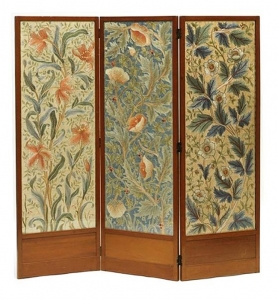

Screen, John Henry Dreale (designer), Morris & Co (manufacturer), 1885-1910

Think, too, of the later Jugendstil (Art Nouveau, Liberty Style), which followed a similar utilitarian aesthetic tradition, or of the introduction in Germany, at the turn of the century, of innumerable workshops that followed in the steps of that tradition in Great Britain. (British success was so astounding that in 1896 “the Prussian government sent the “cultural spy” Hermann Muthesius to England on a six-year mission to study the secrets of British success. Upon his recommendation, workshops were introduced at all Prussian handicraft schools and modern artists appointed as teachers.”[6])
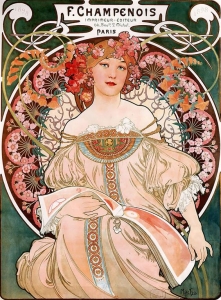

Alfons Mucha – F. Champenois Imprimeur-Éditeur (1897)

The aim of such activities was the “cooperation of art, industry, and crafts in the ennoblement of commercial activity.”[7] It was also from this tradition that the Bauhaus arose. Related cases of art willingly accepting a utilitarian function are those of Russian constructivism[8] and, to some extent and in a different way, of Italian Futurism.
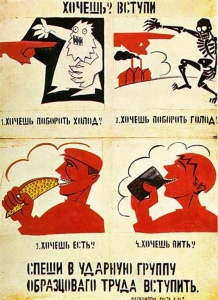

Agitprop poster by Mayakovsky (1919).
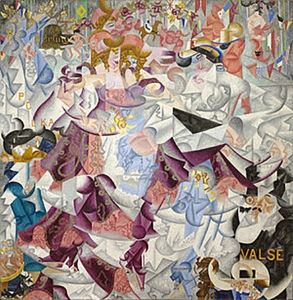

Gino Severini 1912, Dynamic Hieroglyphic of the Bal Tabarin, oil on canvas with sequins, 161.6 x 156.2 cm (63.6 x 61.5 in.), Museum of Modern Art, New York

3. Rancière’s “aesthetic regime of art”

Jacques Rancière’s notion of the aesthetic regime of art is of interest here. The dominant schema, explained in his numerous works, is that a new “regime” of art, namely the “aesthetic” one, emerged with romanticism and Friedrich Schiller, although sometimes he mentions authors who predate romanticism, like Vico or Winckelmann. Rancière argues that this regime of art is still continuing, thereby supplanting both modernism and postmodernism, since both are purportedly theoretically insufficient. In his view, modernism is problematic, first, because it lumps together such disparate authors and works as Adorno and Futurism, and second, because it “wants to hold onto art’s autonomy but refuses to accept the heteronomy that is its other name.”[9] He finds postmodernism problematic because it purportedly only reverses the logic of modernism, offering (through Lyotard, one of the main adversaries of Rancière) the sublime and the unpresentable as the two main features of postmodernism.[10]

Instead of notions of modernism and postmodernism, Rancière introduces the notion of an “aesthetic regime of art.” Its purpose is to replace both modernism and postmodernism, which Rancière considers obsolete and erroneous terms. In his opinion, “The aesthetic regime of the arts, it can be said, is the true name for what is designated by the incoherent label ‘modernity’.”[11]

In the aesthetic regime, the criterion of art is no longer technical perfection, as in the representative regime, “but is ascribed to a specific form of sensory apprehension.”[12] Furthermore, the aesthetic regime of art resembles Fredric Jameson’s “cultural dominant,” for although it is purportedly the dominant regime in the last two centuries, it is admittedly not the only one to exist in this epoch, for it is supplemented and often in conflict with the previous two regimes, the “ethical regime of images,” and especially the “representative regime of art” which immediately precedes the aesthetic regime. What is also typical of the aesthetic regime of art is that it is “the regime that strictly identifies art in the singular and frees it from any specific rule, from any hierarchy of the art, subject-matter and genres.”[13]

As we can see, Rancière’s agenda is to offer his “regimes” as a novel taxonomy that is intended to supersede the present dominant one of the tandem modernism and postmodernism, something that is without doubt an ambitious project. Rancière’s open-endedness of the aesthetic regime primarily implies the obsolescence of the “end of art” theories. In this it somewhat resembles Friedrich von Schlegel’s revolutionary attempt to bring into competitive proximity two art formations of his own time, namely classicism and romanticism, with the latter seen as a continuing process. Romantic art was to strive towards ever higher accomplishments, a view at odds with the recent and dominant viewpoints on the decline or even end of art, such as those of Hegel, Heidegger, and especially Arthur Danto. Rancière’s non-Hegelian view allows for no temporal closures of various regimes and for no totalizations.

One of Rancière’s points of departure is Aristotle, with his claim that man is “political because he possesses speech, a capacity to place the just and the unjust in common, whereas all the animal has is a voice to signal pleasure and pain. But the whole question, then, is to know who possesses speech and who merely possesses voice.”[14] This is the point where politics is brought into Rancière’s philosophy. Democracy is the possibility and the practice of making oneself heard. By making ourselves heard we become political beings: “Politics consists in reconfiguring the distribution of the sensible which defines the common of a community, to introduce into it new subjects and objects, to render visible what had not been, and to make heard as speakers those who had been perceived as mere noisy animals.”[15] The distribution and redistribution of the sensible are also accomplished by art. In the realm of art similar mechanisms as those used in politics are at work, for they are “two forms of distribution of the sensible, both of which are dependent on a specific regime of identification. There are not always occurrences of politics, although there always exist forms of power. Similarly, there are not always occurrences of art, although there are always forms of poetry, painting, sculpture, music, theatre and dance.”[16]

Throughout Rancière’s oeuvre, Friedrich Schiller is singled out as one of the pivotal references for his political philosophy and aesthetics. It is the concept of “play” or play drive (Spieltrieb) that is especially important here, for it brings together “art of the beautiful” and “art of living.” In Schiller’s view, which developed also as a critique of the French Revolution, play is of special importance. As he explains toward the end of the fifteenth letter in his On the Aesthetic Education of Man, “Man plays only when he is in the full sense of the word a man, and he is only wholly Man when he is playing.”[17]

According to Rancière, play “is any activity that has no end other than itself, that does not intend to gain any effective power over things or persons.”[18] “Play” is a new form of distribution of the sensible, an activity with no purpose except itself and with no intent to exert power over others. An artwork is “given in a specific experience, which suspends the ordinary connections, not only between appearance and reality, but also between form and matter, activity and passivity, understanding and sensibility.”[19]

It is not my intention to discuss Rancière’s philosophy and its various themes in detail. I have touched on only a few issues that could be relevant to our topic. Let me end this part by observing that, in Rancière’s view, artistic autonomy and heteronomy are always intertwined, with the aesthetic experience being autonomous and the creation of art heteronomous. In a way, Rancière’s theory, like that of some of the Romantics, echoes the ancient Greek conflation of art and community, that is, the organic consubstantionality of art and the life of the polis.

4. “Art become life”

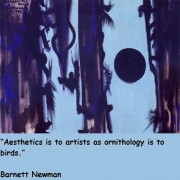
In an exhibition in the spring of 2011, in the entrance hall of the Research Center in Ljubljana, where I work, one of the works consisted of a canvas over which the statement “Public Art is for the Birds” was written in big letters. The sentence, of course, brings to mind the artist Barnett Newman who, in a statement made famous, exclaimed that “Aesthetics is to the artist as ornithology is to the birds.” Since its enunciation around 1952, this claim has been reiterated on innumerable occasions. Its original addressee was Susan Langer, and its intent was to denigrate attempts to introduce semiotics and linguistics into art criticism and aesthetics. It was also often interpreted as criticism of the beautiful on the part of Newman and his embracing of the sublime, although its most frequent interpretation was that of a criticism of aesthetics as such. Be that as it may, for Newman aesthetics obviously was not relevant for art and did not aid in establishing its significance. This, of course, drastically changed in the decades that followed, for today authentic art appears essentially dependent on theory.
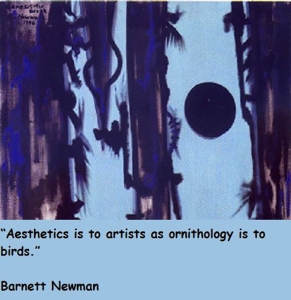

Barnett Newman

But in the 1950s this was not the case, nor is “public” art usually considered “authentic art” today. Instead, in the eyes of some or perhaps many, public art is nowadays often regarded as a type of art, if not “semi-art.” Proper or authentic contemporary art is assumed to be that which is radical, in the sense of subversive and critical of society or of previous art. In both instances, it is the modern and modernist tradition that questions public art and continues to do so, in spite of many well-known instances of modern and postmodern public art, such as that of Henry Moore, Richard Serra, and Anish Kapoor.
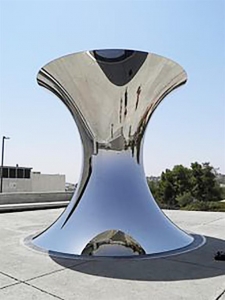

Anish Kapoor, World

If our vantage point is radical art, then, in our opinion, public art today may well be left to the birds and their multifarious activities on pieces of public art. In the eyes of the creator of the work exhibited in Ljubljana, public art may best be left to the birds, for it is not an authentic form of art that would be of genuine artistic concern. From this perspective, public art today may thus very well be seen as a form of artification, that is, an integration of mostly site-specific works into natural or urban ambiances. This was always a feature of public art, but today it is also such art that appears somewhat inauthentic. And this is the essential problem with artification, that people may regard it as inauthentic, especially if it is interpreted as something “art-like.” In the Western tradition, kitsch is something that pretends to be art-like; it aspires to be art-like, but that is as far as it gets. It is fake art. As soon as it crosses the border into the realm of authentic art, leaving fake and kitsch behind, art re/distributes the sensible. It offers something new: it “speaks” instead of being mute and without a voice.

By gaining a voice and starting to speak and express oneself, an authentic artist effects a redistribution of the sensible and broadens the borders of what is perceived and sensed. It is a new “voice” to be heard or seen, in short, experienced, which is another way of designating the mechanism whereby a person becomes an artist and the work an artwork.
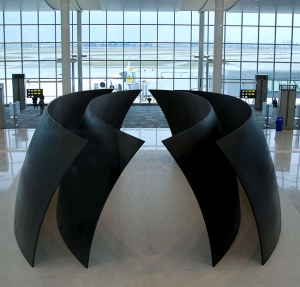

Richard Serra’s Tilted Spheres in Terminal 1 Pier F at Toronto’s YYZ airport
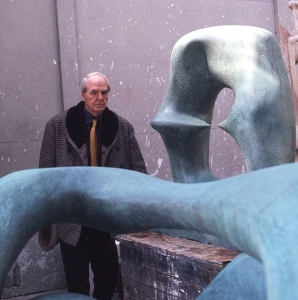

Henry Moore, standing next to his sculpture Working Model for Oval with Points (1975)

Of course, art that is happy with its subordination to another purpose or agency cannot attain its proper purpose, which is one of the reasons why artification encounters difficulties when grappling with art’s assimilation. Only by “playing,” by having a purpose without a purpose, is a man “wholly man.” We may assume that such “play” and its creations are appreciated by the artist as well as by the public, although the relationship is by no means a stable and a predetermined one.

There are numerous cases when a work causes great satisfaction, in the sense of “play,” to the artist but very little to the public. Amateur works are frequently of such nature. There is also the opposite situation, such as when an acclaimed artist makes a simple sketch, which for him is mere amusement, while for the public at large it represents a little masterpiece. Which is it? On the other hand, in modern art there are innumerable cases of art that was art for the artist as well as for the public. This is even more the case in representational art. There, the “quality” and artistic value are relatively easily defined. As we see, art is given various kinds of reception, and especially today our “imaginary museum” is filled with very disparate objects and phenomena. Nonetheless, a salient feature of modern art is not only its variety but its semantic openness and its faith that it is the public that should accommodate the work of art and not the other way around.

Why is it necessary for art to be accommodated by the public? Because (and in this we can follow Adorno) authentic art and culture require effort to overcome the resistance made to it. “Culture, in the true sense, did not simply accommodate itself to human beings; but it always simultaneously raised protest against the petrified relations under which they lived, thereby honoring them. …Cultural entities typical of the culture industry are no longer also commodities, they are commodities through and through.”[20] Interestingly, in instances where art attempts to imitate creations made according to the demands of the public, such fake art remains authentic art, just the opposite of kitsch. Take, for example, the project of Komar & Melamid’s “Most Wanted,” where the two artists created a series of paintings based on a survey of public preferences of the motifs, formats, and colors of individual paintings.[21] In spite of formally following the procedures of the market, the works actually functioned as any other authentic works of art. This illustrates that while artification as a transformation of art into non-art, or of non-art into “something art-like,” may well work as an abstraction, it depends, in fact, on a variety of other factors.
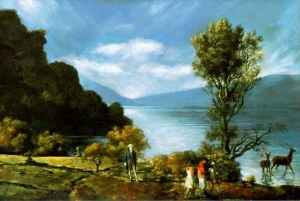

Komar & Melamid’s “Most Wanted,”‌ USA


Komar & Melamid’s “Most Wanted,” Italy
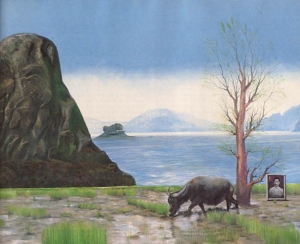

Komar & Melamid’s “Most Wanted,” China

Still, it appears that there are times when non-art may turn into art and the other way around, without endangering the artistic and aesthetic status of art, but the contrary. I refer to examples of what Rancière calls the project of “art become life.”[22] The project is consubstantial with the aesthetic regime of art. It already inspired, in their dreams of artisanal and communitarian Middle Ages, the artists of the Arts and Crafts movement. It was taken up again by the artisans of the Art Deco movement, hailed in their time as producers of “social art,” as it was by the engineers and architects of the Werkbund and the Bauhaus, before again flowering into the utopian projects of situationist urbanists and Joseph Beuys’ “social plastic.”[23]
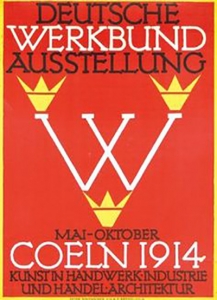

Wekbund, 1914 exhibition poster
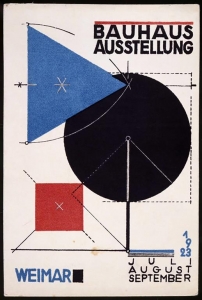

Herbert Bayer, Postcard No. 11 for the Bauhaus Exhibition in Weimar, summer, 1923
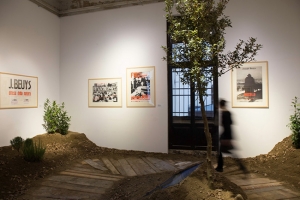

Joseph Beuys, In difesa della Natura. Exhibition view at the Venice International Performance Art Week (2014). Photograph by Samanta Cinquini.

Although artification is said to concern “art in the traditional sense,” it would appear that while some of the movements mentioned above produced works of craftsmanship and thus probably belong to that gray area between the realms of utilitarian production and its aesthetic features, there is no obvious contradiction between the two. In these instances, utilitarian and aesthetic functions and features are conflated seamlessly, even opposing and thus relativizing the old aesthetic belief that a utilitarian object must lose its practical function if it is to attain an aesthetic one. Art Deco or Bauhaus chairs, lamps, architecture, and cutlery are practical and aesthetic; they are non-art (having a practical function) merging with art (having an aesthetic function). Instances of such utilitarian aesthetic works can also be found in Russian constructivism and productivism; in Italian Futurism, with objects ranging from the “anti-neutral clothes” of Giacomo Balla to the architectural sketches of Antonio Sant’Elia; in the “paper architecture” of Lajos Kassák and the more recent “architecture of nothing” by Gábor Bachman; and in the coffee cups, passports, and armbands of the Slovenian artist collective Neue Slowenische Kunst.
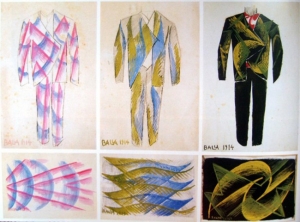

Giacomo Balla,anti-neutral clothes
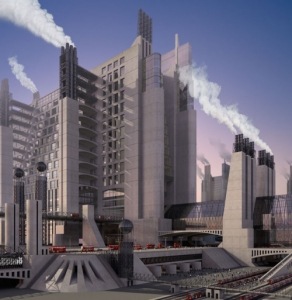

Antonio Sant’Elia
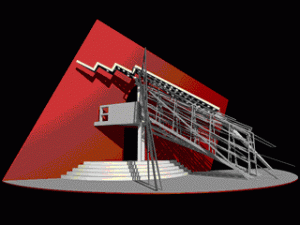

Gábor Bachman, Architecture of nothing
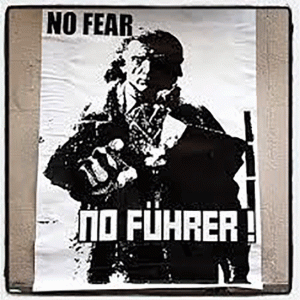

Neue Slowenische Kunst

In brief, the conflation of art and non-art, or the passage of non-art into utilitarian aesthetic and artistic objects, occurs all the time and, as the cases just mentioned illustrate, it is definitely not limited to art in the traditional sense but is as often created by avant-garde artists. In such a context, the issue of subordination of art doesn’t arise; form usually follows function. It is this terrain that could also be relevant to artification.

Before the advent of the aesthetic regime of art, that is, the period of artistic modernity and postmodernity, Mimesis separated out what was art from what was not. Conversely, all the new, aesthetic definitions of art that affirm its autonomy in one way or another say the same thing, affirm the same paradox: that art is henceforth recognizable by its lack of any distinguishing characteristics—by its indistinction. . . . In short, the specificity of art, finally nameable as such, is its identity with non-art.[24]

It is this problematic statement that serves as the conclusion of this essay because it reveals the limits of Rancière’s otherwise useful and important enterprise. Theories of modernism and postmodernism point out certain essential characteristics of the art of the last two centuries, a task as yet not accomplished by the “aesthetic regime of art” that lumps together art of impressionism with abstract art and Duchamp’s projects. Put differently, the art it highlights and comprises is even more disparate than Adorno and Futurism. My reservations are directed also towards some of the other tenets of Rancière’s theory, for the aesthetic regime of art is an interrelated notion within his philosophical framework. Nonetheless, I think that this criticism does not weaken the argument that the project of “art become life” remains valid, both in Rancière and elsewhere, when referring to artification and utilitarian creations of certain traditions and endeavors, in addition to aesthetic avant-garde movements and their related radical projects.

Aleš Erjavec

Ales.Erjavec@zrc-sazu.si

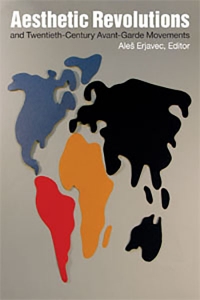
Aleš Erjavec is Research Professor in the Institute of Philosophy, SRC SASA, Ljubljana, and Professor of Aesthetics in Ljubljana University and University of Primorska, Koper, Slovenia. His main interests are aesthetics, contemporary art theory, critical theory, and philosophy of culture. He is currently preparing a book on “aesthetic revolutions.”

Published on April 5, 2012.

Endnotes

[1] André Malraux, La Métamorphose des dieux (Paris: NRF, La Galerie de la Pléiade, 1957), p. 27.

[2] Claire Bishop, “Antagonism and Relational Aesthetics,” October 110 (Fall 2004), 51-79; ref. on p. 77.

[3] Ossi Naukkarinen and Yuriko Saito, “Introduction,” Contemporary Aesthetics, Special Volume 4, 2012.

[4] André Reszler, L’esthétique anarchiste (Paris: P.U.F., 1973), p. 6.

[5] Ibid.

[6] Magdalena Droste, Bauhaus 1919-1933, (London: Taschen, 2006), p. 10.

[7] Quoted in Bauhaus 1919-1933, p. 12.

[8] See, for example, Christina Kiaer, Imagine No Possessions. The Socialist Objects of Russian Constructivism (Cambridge, Mass.: MIT Press, 2005); Maria Gough, The Artist as Producer. Russian Constructivism in Revolution (Berkeley: University of California Press, 2005); and Benjamin H. D. Buchloh, “From Faktura to Factography,” October, Vol. 30 (Autumn 1984), 82-119.

[9] Jacques Rancière, Aesthetics and Its Discontents, trans. Steven Corcoran (Cambridge: Polity Press, 2009), p. 68.

[10] See, for example, Jacques Rancière, The Politics of Aesthetics, trans. Gabriel Rockhill (London: Continuum, 2004), pp. 28-29 et passim. Rancière frequently uses “modernism” and “modernity” synonymously.

[11] Ibid., p. 24.

[12] Rancière, Aesthetics and Its Discontents, p. 29.

[13] Rancière, The Politics of Aesthetics, p. 23.

[14] Rancière, Aesthetics and Its Discontents, p. 24.

[15] Ibid., p. 25.

[16] Ibid., p. 26.

[17] Friedrich Schiller, On the Aesthetic Education of Man, trans. Reginald Snell (Mineola, NY: Dover Publications, 2004), p. 80.

[18] Rancière, Aesthetics and Its Discontents, p. 30.

[19] Loc. cit.

[20] Theodor Adorno, “Culture Industry Reconsidered,” in The Adorno Reader, ed. by Brian O’Connor (Oxford: Blackwell, 2000), p. 232.

[21] See Painting by Numbers. Komar and Melamid’s Scientific Guide to Art, ed. by JoAnn Wypijewski (Berkeley: University of California Press, 1998).

[22] Rancière, Aesthetics and Its Discontents, p. 38. Of course, the project of “art become life” carries another meaning, namely the unity, or mutual support, of artistic revolutionary and social (political) revolutionary projects.

[23] Rancière, Aesthetics and Its Discontents, p. 38.

[24] Ibid., p. 66.
Art, Artists and Activism– 1930s to Today


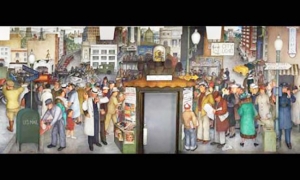
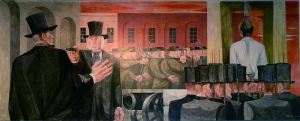
Victor Arnautoff, “City Life” mural, Coit Tower, San Francisco, 1932

Art Hazelwood
Source: http://www.artbusiness.com/artists

Often a question arises when I am talking about my work… it might be hostile or just as often, simply curious. “Do you really think that art can change the world?” Because my art is broadly political, the implication is political art is somehow not effective in the real world. It’s a question that political artists are often confronted with and it is a question, I believe, most are already asking themselves, sometimes in frustration and sometimes in despair. But history and current examples show that it does have an effect. For all political artists the big question should be not whether political art is effective, but how it can have a bigger effect in the world.

There’s a history here that is helpful for political artists to be aware of today. The effectiveness of past and present political artists in organizing, in advocating, in building solidarity in movements and in retaining a history that is often suppressed by the mainstream is essential. For American art, that history can best be viewed as it developed from the Great Depression of the 1930s to today. The lessons from these past actions can help contemporary political artists be more effective.

What differentiates “art for art’s sake” from political art is that political art intends to have an effect on the world. That doesn’t sit well with many who believe art must stay in its place and especially that art should never sully itself with mundane reality… especially with politics. Artists in the 1930s did sully themselves and their artwork with political content. They had solidarity with the 99% against the ruling elites who had increasingly monopolized the wealth of that period. Artists had that solidarity with workers and poor people because they saw themselves as workers and poor people.

In fact, in the 1930s the federal government treated artists as workers. The federal government through the New Deal programs of President Franklin Delano Roosevelt hired artists to create art. That act alone showed an incredibly different approach to artists. Today, a poor artist would be offered “life training skills” and job placement counseling… but certainly not asked to make art at a basic living wage with no restrictions on what was produced and no goal for how the work would be used, which is what the New Deal did for artists. And cut free of the competitive gallery system that had died of economic collapse, artists suddenly turned in large numbers to politics.

Political art rose in the 1930s then fell in the period between World War II and the late 1960s; a marginalized group of artists kept the flame burning during this conservative period before it blossomed again. Sputtering somewhat through the 1990s, it has blossomed yet again in recent years under the twin hammers of endless war and economic injustice.

Organized Artists, Anti-Lynching, Right Wing Responses

The Great Depression was the first time in US history that a widespread movement of artists began to address politics. They actively found ways to influence society through exhibition and distribution of their work. Artists organized exhibitions around social and political themes such as poverty, lack of affordable housing, anti-lynching, anti-fascism and workers strikes. They organized conferences. They actually unionized. They contributed to leftist publications such as the Daily Worker, New Masses, Art Front, all of which had large numbers of subscribers and emphasized artwork as a regular part of their content.


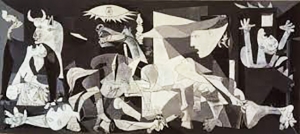
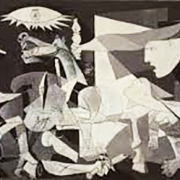
Picasso Guernica, 1937

Many artists of the time joined and organized for political objectives and in 1936, the American Artists’ Congress was formed as part of the Popular Front of a united Left against fascism. The Artists’ Congress represented the height of artists’ political involvement in the 1930s. Hundreds of artists joined the group at the beginning and hundreds more came to the conventions. They organized exhibitions, including the important show, Against War and Fascism. They raised money for the Abraham Lincoln Brigade fighting the Fascists in Spain, and they were responsible for bringing Picasso’s painting Guernica to New York where it remained until the death of the dictator Franco. They pressed the US Congress to establish a permanent Bureau of Fine Arts.


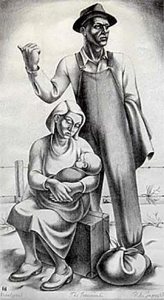
Pele deLappe, Transients, 1938

In 1934 the Federal government was just starting to get involved in the arts. The Coit Tower murals in San Francisco were the first mural project of the Roosevelt Administration. The murals faced media and politicians’ calls for their destruction due to controversies over several Communist references. The San Francisco Chronicle branded them “red propaganda”. At the same time the dockworkers went on strike on the waterfront. Artists in San Francisco supported the waterfront workers when they went on strike against low wages, long hours and terrible working conditions. Many artists such as Victor Arnautoff, Adelyne Cross Eriksson and Louise Gilbert commemorated the events that led to the 1934 General Strike, and some artists like Pele deLappe were working on sign painting and cartooning from the moment the waterfront workers went on strike.


Cross Eriksson Adeline, Grovarbetare

This proliferation of groups, publications and activities among artists represented a tremendous amount of organization on a broad range of social and political themes. One example of how artwork was created and used for political ends can be seen in two rival anti-lynching shows that were staged in New York City in 1935. Lynching was an issue that a wide range of artists responded to in the 1930s. The National Association for the Advancement of Colored People (NAACP) organized an exhibition to draw attention to lynching and to encourage the passage of a federal law banning it. While the House of Representatives passed several different bills in the 1930s, Senators always filibustered and stood in the way. No federal law against lynching was ever passed. It wasn’t until 1968 that the Federal Government prosecuted a lynching case under civil rights statutes.

The Communist Party through the John Reed Club organized an alternative lynching show to the one organized by the NAACP. The show included 43 pieces by Hugo Gellert, William Gropper, Louis Lozowick and others. The Communists saw the futility of working within the political system and sought to build a movement of racial solidarity against the divisions imposed by capitalism with its vast differentiations in wealth. Both exhibitions sought to bring attention to the scourge of lynching. Their efforts drew attention to the cause and had echoes through to the Civil Rights era.


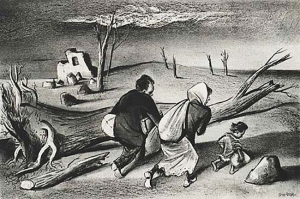
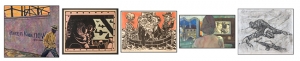
William Gropper, Uprooted

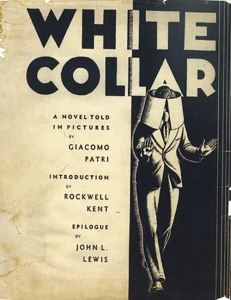
An example of another approach to political art is Giacomo Patri who in the 1930s was a newspaper illustrator, the same trade as the main character in his 1938 book of linoleum cut prints, White Collar. In this novel, with only images and no text, Patri tells a story of the increased political radicalization of the central character. The novel reflected the economic despair that white-collar workers shared with blue-collar workers during the Depression. At the beginning the main character dreams of the road to success but his hopes are repeatedly dashed along the way. As the economic forces of the Depression pull him and his family down, he begins to see that he is part of a wider community of workers. The series of events, the Stock Crash, job loss, health problems, foreclosure, is a litany of the insecurities faced during the Depression. The family moves from home to apartment to shelter until they finally are forced to move into a tent city. His belief in capitalism shattered, he envisions himself joining an army of the dispossessed marching in revolution.
End of the 1930s Experiment in Democratic Art

In a widely cited quote by Abstract Expressionist Arshile Gorky, the powerful political art of the 1930s was dismissed as “poor art for poor people”. The elitism fueled by a reinvigorated art market and the hero worship associated with it was once more in evidence as the economy recovered sufficiently from the Great Depression. Many art world luminaries, curators, gallery owners and artists shared in the strong disdain for political art, a mirror image of the solidarity of 1930s artists.

An improved economy, changing art world trends, a revived commercial art market, fatigue with politics, and even a sense of the futility of political art, have all been offered as reasons for its demise. But among the most sinister forces were the anticommunist witch hunts of the Cold War era. These intimidated many political artists and discouraged a new generation from making political art. Many lost jobs, faced deportation or had their passports revoked on suspicion of Communist sympathies.

In 1938 the House Committee on Un-American Activities (HUAC), claimed that the Federal Arts Project, especially the theater and writers projects were, “a hotbed of communists”. Their investigations were given extensive press coverage. This pressure contributed to a reorganization of the WPA, weakening it substantially. World War II redirected most projects remaining to the war. The WPA was formally ended by presidential order in 1942.


Anton Refregier Mural, 1947

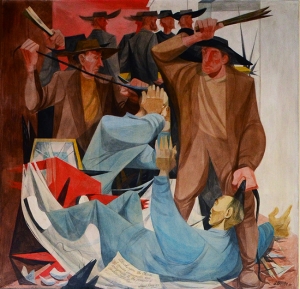
Anton Refregier’s Treasury Section mural at the Rincon Center in San Francisco is titled “The History of California.” Refregier won the commission at the beginning of World War II, which had delayed the project, making it the last project of all New Deal art programs. By the time it was completed in 1949 the political climate had turned very conservative and Refregier was forced to repaint parts that were found offensive to the tastes of the new era. The mural was vehemently discussed and denounced as it progressed. Government officials responsible for the mural did not allow him to include a portrait of FDR. While painting, he was threatened by angry groups that gathered to harass him.


Anton Refregier Mural, Chinese part, 1947

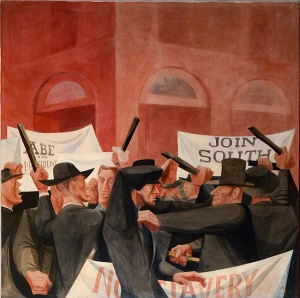
The mural tells the history of California without the usual positive angle that most New Deal murals presented. Controversial issues of vigilante justice, anti-Chinese violence, and the battle over whether California would be a slave state or not were boldly portrayed.


Anton Refregier, Mural, Vigilante, 1947

In another example of the rising tide of right wing bullying, Rockwell Kent, who had been one of the best known artists of the 1930s had his passport revoked by the US State Department, which refused to issue passports to Communists and their sympathizers. Rockwell Kent’s case went to the Supreme Court. He opposed the State Department’s claim of authority to revoke passports based on political association. The case was decided in Kent’s favor in 1958 on free speech grounds. But the message was clearly sent against artists who had leftist leanings.
Artist-Worker Alliances

One model for artists and activists to work together in a politically engaged environment was the California Labor School in San Francisco. A Communist and Union school that included courses for union organizing, trade skills and culture, it was accredited for college level work, and was active from 1942 to 1957. It was shut down as a result of the anticommunist purges of the Cold War. The Graphic Arts Workshop print studio, spun off from the Labor School, survives to this day as its only vestige, now located on Third Street in San Francisco. Before it was shut down, the Labor School art department attracted a wide range of local and international artists with a strong connection to Mexico and the populist art traditions there. Pablo O’Higgins, an American who lived in Mexico and co-founded the collective printmaking workshop Taller de Gráfica Popular (T.G.P) in Mexico City, briefly taught at the Labor School. Mural artists Victor Arnautoff and Anton Refregier also taught at the Labor School. For a time, Giacomo Patri was the head of the art department.

Most of the artists in the San Francisco Bay Area that kept political art alive during this postwar period were somehow connected with the Labor School and the Graphic Arts Workshop. Some of them are better known than others, but the names of these artists have mostly been written out of the standard narrative of Bay Area art. Emmy Lou Packard, Pele deLappe, Richard Correll, Frank Rowe, Victor Arnautoff, Irving Fromer, Stanley Koppel. The FBI harassed all these artists; some were blacklisted, and most were dismissed by the art world. One powerful artist among these was Frank Rowe, a World War II veteran of the 101st Airborne Division who fought at the Battle of the Bulge. Like Scott Olsen who served in Iraq only to come home and discover, when the police stormed Occupy Oakland, that the Bill of Rights does not necessarily apply in America, Frank Rowe returned to the US to find that the rights he had believed he was defending in war were being taken away. He was fired from teaching at San Francisco State University and blacklisted for refusing to sign a loyalty oath. The loyalty oath was later found unconstitutional, but not until Rowe had been hounded by the FBI and forced to move from job to job to survive. He continued to make his powerful political artwork and carry the ashes of struggle to another generation when political consciousness and political art was revived in the late 1960s.


‌ Frank Rowe

Activism Takes New Forms

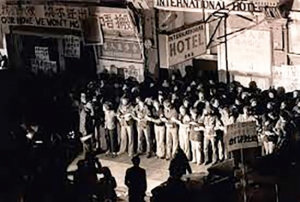
An example of the resurgence of political art and organizing is seen in the struggle around the I-Hotel (International Hotel) in San Francisco. With the postwar prosperity of the late 1940s, redevelopment and urban renewal became the focus of cities around the country. The federal government gave tax incentives that aided in the demolition of neighborhoods and the displacement of huge numbers of poor people. Minorities made up 75% of people displaced nationwide due to urban renewal projects. From Atlanta to Kansas City, from Pittsburgh to Boston, a series of infamous urban renewal projects destroyed poor communities. In 1953, San Francisco’s Western Addition became the target of one of the largest urban renewal projects in the West, encompassing hundreds of city blocks and impacting close to 20,000 residents. By the late 1960s people were fed up with the arbitrary manner of these schemes.

In 1968 plans were made to destroy the International Hotel or I-Hotel in San Francisco, home to fifty elderly tenants, one of the last remnants of the Filipino community known as “Little Manila.” Hundreds of people rallied to the defense of the I-Hotel. Many artists joined in this struggle.


Hotel I, San Francisco, 1968

Between 1975 and 1984, the San Francisco Poster Brigade designed hundreds of political posters. Though they called themselves a “brigade”, there were no more than a few artists involved. Rachael Bell (now Rachael Romero) was the principal artist of the Poster Brigade. She created woodcuts that were later produced as offset posters, distributed at marches and put up on the street. They created several posters to protest the demolition of the I-Hotel. People organized to fight the demolition from 1968 until 1977 when, ultimately, 400 police in full riot gear stormed the building. The builder who evicted the tenants went bankrupt and the lot remained undeveloped for over 20 years. In a bittersweet victory, a new building called I-Hotel Manilatown Center has been constructed at the site.


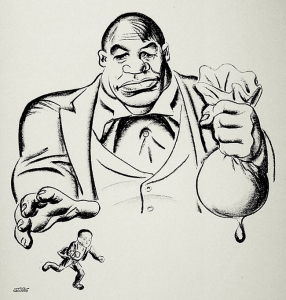
Hugo-Gellert, Primary-Accumulation, The-Money Lender

Mission Grafica was founded in 1982 by artists Jos Sances and Rene Castro. In the early years Mission Grafica created hundreds of screenprint posters with artists from around the world. One of their major focuses was on Central American solidarity with the struggles going on there against US sponsored right wing governments and paramilitary groups. These posters were distributed widely and sent to many other countries. Mission Grafica is one of the largest of the print poster workshops from that era and it continues today, though without the volume of production and without the international scope it once had. But it continues to serve as an incubator for political artist groups that spin off and create their own workshops and political actions. One such group, started in 2000, is the San Francisco Print Collective.
Following in the tradition of the San Francisco Poster Brigade, the San Francisco Print Collective (SFPC) was founded by a group of artists with the purpose of using graphic art to support social justice organizing. The first campaigns of the SFPC focused on the gentrification of the Mission. Again the displacement of poor people became a rallying cry for artists. The SFPC allies itself with various activist organizations to create work and also to help the activists create work that speaks to their struggles. The SFPC uses screenprint posters, banners and murals created in collaboration with organizations including the Coalition on Homelessness and the Mission Anti-displacement Coalition. In 2006, they worked with Northern California War Tax Resistance to create a poster campaign that focused attention on federal spending priorities in a time of war.

We’ve seen a revival of politically oriented art over the last ten years, especially in reaction to the run up to the Iraq War. A lot more artists have created political art. Well-known artists such as Richard Serra and Fernando Botero who rarely touched on politics have made work. But aside from the famous, many other artists threw themselves in with dedication, feeling that they had to do something.

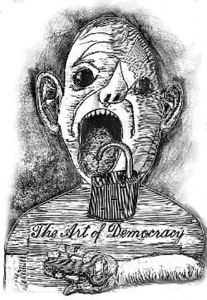
Sensing the need for something to unify these many artists, New York artist Stephen Fredericks and I put together a group of shows to try to give support to these various actions. Our project was called Art of Democracy. We linked up over 50 shows nationwide and distributed more than 100 posters designed and printed by artists all over the country. We had shows in red states and in blue, in museums and in cafes, all at the same time in the run up to the presidential election of 2008. Artists in each of these shows did outreach through events on the street, political actions, billboards, etc. Art of Democracy activated many artists and encouraged them to make political work. Some work was like a cry in the night, a scream of rage, some was simply a call for common sense, and some was sophisticated political commentary. Our inspiration was print shows organized in the 1930s such as Art Against War and Fascism, which took place in multiple cities at the same time.

Another approach to political art is a show I organized with artists Francisco Dominguez and Doug Minkler. The exhibition is called New World Border. Artists were invited to create posters and prints about the border wall that the US is building on the US/Mexico border. The exhibit is set up to travel easily with lightweight artwork ready for hanging. The work has been shown at community centers, high schools, galleries and colleges. Many of the venues have connected the art show to their own programming about the border wall and other border issues. Some of the participating artists are significant figures in Bay Area political art over the last forty years, including artists associated with the Chicano Poster Movement– Malaquias Montoya, and Juan Fuentes; with the Black Panthers– Emory Douglas; with the Kearny Street Workshop– Nancy Hom, as well as younger artists focusing on political issues such as Favianna Rodriguez and Imin Yeh.

Art and Homelessness

In 1979 Ronald Reagan rode to power along with the rise of conservative politics and the dismantling of safety net programs that had originated in the 1930s. Reagan immediately set about destroying New Deal programs. Naturally his first targets were poor people and the mentally ill. In a slow motion repeat of the Great Depression, poverty and homelessness again became visible in cities across the US as public housing was defunded and mental institutions were emptied. By the mid 1980s, emergency homeless shelters were opening across the country. Those emergency shelters remain open today, nearly three decades later. By the late 1980s activists were organizing and artists were starting to respond to the crisis.


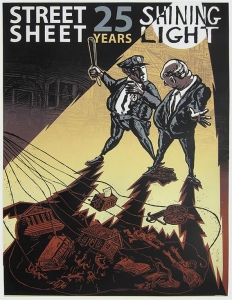
Jos Sances, Street Sheet Shining Light

The San Francisco Street Sheet is the oldest continuously published newspaper about homelessness in the US. It began in 1989 as a publication of the Coalition on Homelessness. The American Friends Service Committee has published the Street Spirit based in Oakland, California since 1996. Both papers have always used paintings, cartoons, woodcuts, screenprints and drawings to address issues of economic justice and homelessness.
The papers draw attention to the struggle for dignity and human rights by low-income and poor people facing eviction, homelessness, psychiatric treatment and other issues. They report from the shelters, soup kitchens and SRO hotels, places the mainstream press rarely visits. Homeless vendors sell the papers, of which there are now twenty-three in various US cities. All these papers have access to a shared Internet archive of artwork that addresses homelessness, another way to broaden the reach of imagery.

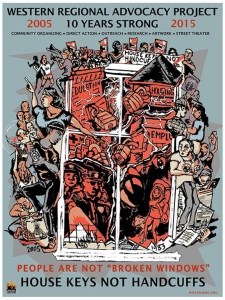
In 2006, the Western Regional Advocacy Project (WRAP) produced Without Housing: Decades of Federal Housing Cutbacks, Massive Homelessness and Policy Failures, a report that pointed out the policies the federal government has pursued since the early 1980s to sharply reduce funding for affordable housing. The report uses artwork to portray the statistical data. I organized artists to illustrate the messages of this report. I also created a poster used in the report that represented the dwindling funds for public housing as ever-shrinking buildings, while the rise in homelessness is represented by larger and larger human figures.

WRAP brings together grassroots groups in the Western US to address wider issues of federal and state policies that affect homeless people. Many of the homeless rights groups are too busy dealing with local issues to have time for the bigger picture. WRAP is an example of an organization that seeks to bring artists into activist realms. It is a mutually beneficial union– artistic imagery can help educate and build the emotional commitment of members and of the public. In turn, by working with these organizations, artists gain a deeper understanding of the issues. The relationship also provides artists with a wider audience for their messages.

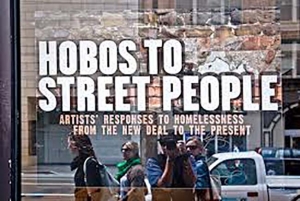
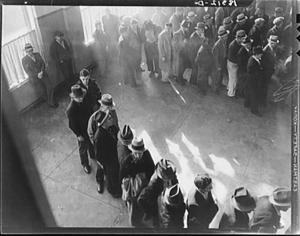
Because of my connection with homeless rights groups over the last seventeen years, I have learned of the activities of many artists to address issues of homelessness and have encouraged others to make art about this issue. In 2009 I curated an exhibition at the California Historical Society called Hobos to Street People: Artists’ Responses to Homelessness from the New Deal to the Present. This show has been traveling since then and will continue for another year to museums around California and in Colorado. For me the act of curating is an extension of art and organizing. Museums are generally slow to respond to current events. Hobos to Street People is one of the few shows (if there are others, I am unaware of them) that deal with the affects of our economic system on society.

While the exhibition was on display in San Francisco, I counted several fashion shows at the big museums, but nothing on the economic dislocation we were all feeling. Of course since that time, museums have had time to react to the worst economic downturn since the Great Depression… and they have given us more fashion shows. This last month, the book I authored to accompany Hobos to Street People was published by Freedom Voices press. The text and images tell the story of the parallels and differences between the 1930s and today. A clear similarity is the artists who have embraced their role as participants in this political struggle for an equitable and just society.


T‌he exhibition: Between Struggle & Hope

Understanding this period of time, and some of the actions that artists took and continue to take, can help political artists to shape how they act in the world. They can form both artist alliances and alliances with activists. By building relationships, artists can keep the resilience needed for the long haul, because there are and will be forces arrayed against you. The truth and justice of a cause will be opposed by the most stunning variety of forces, many you never imagined would oppose you. What seems like a completely rational solution will be the target of vicious attacks from entrenched interests. You will be vilified; you will be shunned. Fellow artists will demonize you. Curators will mock you. Newspapers will dismiss you as a joke. Industry front groups will portray you as a stooge of other industry front groups. To fight back you’ll need allies. The independent heroic artist is a figment of the art marketplace; work with others to build a movement.


This Camera Fights Fascism, David Bacon & Francisco Dominguez
This brings us back to the question posed at the beginning of this article– does political art have an impact on the world? The right wing response is to say art never stopped a war, art didn’t stop lynching, art didn’t save the I-Hotel nor did it end repressive attacks on homeless people. But art does not exist in a vacuum. It is a part of culture. And political art that stands up to the repressive forces of society is a part of the culture of change. Political art does have effects in the real world, it is clearly part of the force, not the only force, but part of the force that keeps the human spirit alive. It keeps the flame of justice burning. It keeps memory alive. It moves with the struggles and moves those struggles forward.

***

Art Hazelwood is the author of the newly released book Hobos to Street People: Artists’ Responses to Homelessness From the New Deal to the Present and has curated three shows currently on display at the de Saisset Museum at Santa Clara University: the traveling show, Hobos to Street People, as well as Between Struggle and Hope: Envisioning a Democratic Art in the 1930s, and This Camera Fights Fascism: The Photographs of David Bacon and Francisco Dominguez.

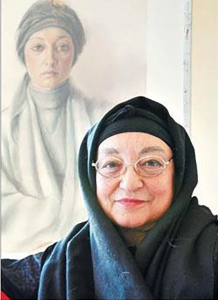
“In order to Create, One must First Destroy”/An Interview with Parvaneh Etemadi

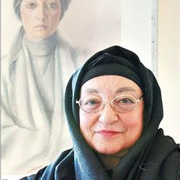
Parvaneh Etemadi in an interview with Parviz Barati from Sharq Newspaper

Translated by Roya Monajem

Parviz Barati- According to Parvaneh Etemadi, she has acquired Bahman Mohassess’ taste and Jalal Al-Ahmad’s courage. She is Frank. Yet, frankness is just one of her personality. She challenges the current form of knowledge and cognition and expresses far-fetched concepts with new modules, which provokes positive and negative reactions to her approach. Last year, her name appeared on the 11th list of 500 artists of the world together with four other Iranian artists, Farhad Moshiri, Reza Derakhshani, Ali Banisadr and Shirin Neshat. Each year in October FIAC – International Contemporary Art Fair in Paris – together with Art Price – the most important source of art market in the world- publish a report which is a criterion for analysis of the situation of contemporary global art from economic and artistic point of view. In the last Tehran Art Auction, one of Etemadi’s ‘untitled’ works was sold for 240 million Toumans. Etemadi usually shuns interviews. However, all this together with a more important pretext of the fiftieth anniversary of her artistic career was the motivation for the present interview, thanks to Shokoufeh Malek-Kiani.

Parvaneh’s Studio

Barati (B)-One of the less known angles of your work is the painting classes you held for 25 years starting from 70s. When did these classes actually start and from where?

Etemadi (E)- They were first held in a studio in Khaneqah alleyway in Saidi Street. My workshop has always been my home, but at that time, considering myself as a professional painter i set up a painting studio which later became my workshop. What i mean is that those interested in learning painting or buying my works came directly to me.

B- Why there?

E- By sheer accident. An acquaintance let me use his property which was an old printing house as a studio. He was a fair person, as I had no income at that time. So our contract was a painting in return to each month’s rent. When he decided to sell his property, I moved to here in Yusefabad district where i had two desks, five easels and that was all. I guided my pupils in the way they were and not in the way i was. Some loved my colored pencil paintings so much that they just wanted to paint like me. I advised them to at least make their copies more meticulously. They were free to use any material. I just observed them and helped them in practice. I taught them the technique of ‘seeing,’ noticing similarities and differences, shifting the phenomena to another place and another time in their minds and how art is a continuous course of discovery and invention. In order to practice that we sometimes looked at the objects upside down to liberate ourselves from habits and instead take other things into account.

B- So in fact you established an “anti-art-college”…

E- Where I was, no matter what you call it was not an academy, but rather a workshop where anybody with any amount of knowledge and any vision could work and evolve, and it was these inner changes which fulfilled and encouraged them. No doubt, their good exercises were exhibited at Seyhoun gallery and in this way they could pay their tuition, their working tools and material, it was like a booty. In this way they were acquainted with the various ways of becoming professional. I did not teach art history, because i thought that would add to their expectations and would dissuade them in the sense that they would imagine they are not talented enough. They approached art masters like saints, as though they had come from another world for creating such masterpieces. In addition, when there is all this confusion and misunderstanding between the artwork, artist and interpreters, how could I be sure of my own interpretations.

I was happy with my pupils. Every day I would see the world from their points of views and was amused. A few of them who did well later, like Avish Kherbreh-zadeh who won the gold medal of Venice Biennial or Reza Danshmir or Sadeq Tirafkan and a couple of others taught me as well. I reflected upon their questions. I had to be familiar with their beliefs, feelings and views to be able to walk with them and reach some conclusions. They too were happy working with me, but there was no reason to stay with me, instead they had to depart with love to pursue their own individual way.

B- Apparently, it was not easy to get into your studio…

E-Yes, there was an entrance exam.

B- How did you test them?

E- The way they dressed themselves was important for me. Nobody had to look better than others. It was not a competition in ostentation. Honesty with a simple smiling dialogue, mutual trust and even the sweetness of the food they made was the test.. In short, personal pupils are tested constantly in an individual way. Some arrived with a reactionary mind wishing to learn painting. They would say we have studied drawing, and now we have come to learn painting.

I talked to them about how the scope of drawing extends to food, fashion design, and a lot of other things… It was only then that they took the point. Sometimes I was forced to assess the degree of their creativity by asking them to instantly make a dish of celery, potato and onion. If Picasso could not make fried eggs, he had to eat his art.

B- How long did they continue their training?

E- 25 years, but of course not all of them. To tell you the truth, they could stay as long as they liked, but for 25 years I carried out all this work with them shoulder to shoulder.

B- Did you give them a certificate?

E- No. They achieved financial and spiritual success. That was the best and sweetest certificate possible.

B- Did they attend art college simultaneously?

E- Again, to tell you the truth, I did not accept art college students, because they expected too much of art, whether of their own or Art per se. I tried to choose the less experienced and younger ones.

B- They came to you when very young?

E- They were of any age. For example, there was a middle-age woman with her husband who owned a factory.

B- How old were Reza Daneshmir or Avish Khebreh-zadeh when they started their lessons with you?

E- Ms. Khebrehzadeh was 13. Her father brought her here. There was also a 12 years old girl who came with her mother and they both worked. Daneshmir was at that time studying architecture at the university.

Qandriz, Qandriz Hall

B- Before setting up your own studio at Sadi street, you were active at Qandriz Hall?

E-That goes back before Qandriz. That was when I was studying at College of Art and Architecture. I remember one day when I went to the university and Ms. Behjat was our teacher, she told me, you better leave the college as soon as you can and pursue your own path. Of course, she had a good point there. The Art college ruined one’s taste. I used to fail or just pass the exams, while my works were regarded exceptional, hard to compare with the works of others. I left the university and joined the painters at Qandriz Hall, which was the opposite pole of Tehran University. I was proud that I was the only female member of the Hall. To make it short, in search of real art i worked with them shoulder to shoulder, and maybe even harder than them. Whenever an exhibition was postponed, I would try to fill the gap and compensate.

B-Analyzing the artistic changes of 60s and 70s shows that three paradigms of Nationalism, Leftism and Traditionalism played a significant role in general development of Iranian Contemporary Art. From this perspective, the relation of Qandriz Hall with the left trends was noticeable. Qandriz Hall was somehow against the general nationalist policy which was one of the most fundamental doctrines of Pahlavi Rule, particularly Secular Nationalism which was an important component of Pahlavi era. Don’t you agree?

E- Your question reminded me of Romantic films of the Resistant forces against French Fascism and Nazis, the forces which were made up of Partisans and Artists with Romantic Revolutionary relations…Dear Mr. Barati, when I was working at Qandriz Hall, we would talk all nights about conceptualism and if any energy was left was spent on analyzing the materials of Carlos Fontana and Wassail Kandinsky, finally going home exhausted, but fulfilled. The next session could be showing our works to each other, their meticulous dissection and critique…

B- Why was Qandriz Hall against Saqakhaneh Movement?

E- To tell you the truth, I never liked Saqkhaneh Movement. If there were such a thing as Saqakhaneh School, what it was doing was copying compositions on magic, superstition and… having enchanting visual effects, appearing very native and original in the eyes of foreigners. If we work in a contemporary way, what have we to do with superstitious or traditionalist traditions?! Unless we are producing works which tourists would love.

B-Qandriz members used to say that they are looking for a revolutionary art, is it true?

E- Basically, an artist is a revolutionary, revolution lies in the artist’s essence. Revolting against old structures, modifying them in the hope of reproducing them. Certain arts have a consumption period and are gradually overthrown by the passage of time and the change of circumstances.

B- Were you still connected to Qandriz Hall, when you founded Parvaneh’s Studio?

E-Two years before the revolution, Qandriz moved from Jomhuri to Bucharest Street, Argentine Square, and I became the manager because others were too busy. I convinced others that we needed to sell works and use the percentage on the expansion of our activities. The Hall lasted two years, but we decided to close it down during the martial laws enacted before the revolution.

Differentiation of Art and Creativity?

B- You differentiate Art from Creativity?

E-Yes.

B- Did you believe in that when you taught children?

E- With children, there are other pedagogic methods. 8-12 years old children with whom I worked, needed to learn and know about their natural surroundings before they could learn what Art can be. I used that to teach them, just to stimulate their personal curiosity, holding their interest through practical amusements. After going through this training, as their mothers usually informed me, those kids had developed an deeper interest in Natural Sciences. Even if those kids did not become Artists, they were at least attracted to another world. Many carry the name of artist, and produce so-called artistic works. There are clients which buy beautiful works to decorated their homes with, but we do not know whether these works are by a creative artist or a sly artisan. That is where the art professional plays the role of using his/her technical skills to make the distinction. A creative person develops an obsession toward the object of her/his inquiry, which will not leave him/her alone until getting somewhere.

B- Why did you close your studio?

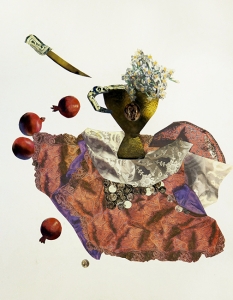
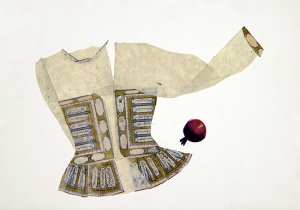
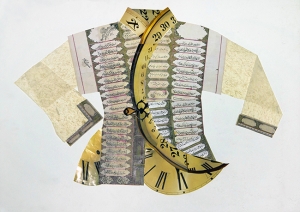
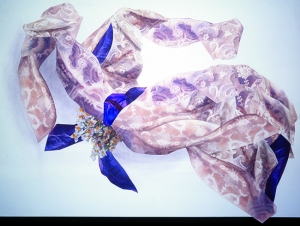
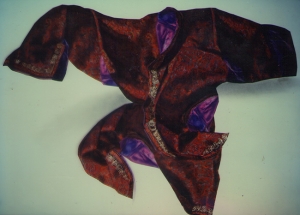
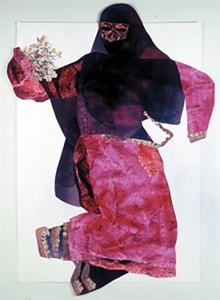
E- I was tired. I taught as much as I could and went on my own way, making my colleges of “The Dowry of Fairy Princess.” I used the bad prints of my colored pencil works, as my material, turning all those colors and forms into the figures in outfits dancing in the wind, and held an exhibition in Niavaran Cultural Center, and some were sent abroad.

B- The variety of media used in your works, from colored pencils to video and cement has a significant role. Did you advise your pupils to do the same?
E- Ah, yes. I always have regarded and regard animation as the future of painting. I sent a couple of them to the Institute for the Intellectual Development of Children and Young Adults to work with Nafiseh Riahi to learn the techniques. Avish has integrated animation in her solid drawings very well. They have surely worked in other fields and media too. In my class, to become a painter was not the imperative.

B- Wasn’t it really necessary to become a painter?

E- No matter in what they were most talented, they displayed its artistic aspect.

B- Weren’t you interested in multiplying yourself?

E-(with a laughter) I don’t even know what to do with myself.

B- Your son Mehrdad, was he in your studio from the beginning too?

E-Yes, he was grown up among them.

B- Did you publish any “call” for your classes?

E- There was no need for that, because i did not have time to go to the Ministry of Culture for permission. After a few years of work, the ministry sent me a first degree certificate which is still in one of the drawers there. In other to join my classes, the recommendation of an acquaintance was enough.

B- How much was your tuition fee?

E- From 800 to finally 10,000 Toumans per month.

B- Did you give any certificate to your pupils?

E- (with laughter) Do I have any certificates, myself? Certificates do not produce real sportsmen or artists.


In the Presence of Bahman Mohassess

B- You were Bahman Mohassess’ pupil. Had he the same approach in teaching?

E- I had given him this role. I always told my pupils that it is you who learn. I don’t teach you anything. Without having any receptors for something, one can not learn. One always learns from one’s own abilities. The teacher reminds one of something and the rest is collected in one’s mind. When Mohassess had classes with me, he would sometime bring a friend or a company and while i was drawing, they talked. True that my hands were busy, but my ears were not idle either! Later he would laugh and say, when he received the envelop containing his tuition fee, he always went to Naderi Cafe with his company and spent it there.

B- Where did Mohassess live?

E- In the second floor of his mother’s house in Safi Ali Shah district. He came to our house to teach.

India, Mohassess and Mysteries

B- When did you first discover India?

E- At 18 or 19, after reading two or three books, I fell in love with India. One of them was Nehru’s “Glimpses at the World History,” and the other I don’t remember its name. The first time I landed in India, I felt the smell once stepping out of the airplane. A blow of humidity, sugarcane, cotton and spices hit my face and my feet sank down. Colored starched turbines and Java tree which had purpled the air, kept me there. In those trips to India, I came to know the world of Indian artists and we carried out some joint paintings, which turned out to be very successful.

Painting with Colored Pencils

B- How did you discover colored pencils?

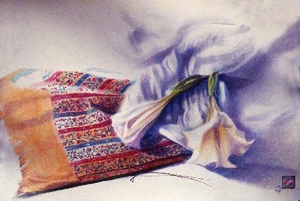
E- Bahaman Mohassess used to say there should be an easel and a box of 6 colored pencils in every studio. Even if the artist works on the floor, on a desk, wherever. In my studio, there already were colored pencils and i began to work with them, and playing with them was pleasurable and calming. My old pupil, Mehdi Jadali too worked very well with them and had successful exhibitions in Tehran and Dubai. I don’t think anybody else would have the courage and perseverance to work with them anymore.

B- Did you sell your works to art galleries?

E-No, at the beginning there were actually no art-galleries. Later, anybody who got bored would open a gallery in their garage. I sent my colored pencils works to Abi Restaurant in Chalus Road, letting them to hand there for a while, but I sold them in my studio.

B- What do you think of art at present?

E-The world is changing and art is changing with it. As the Indians say: it is the age of Kali’s Resurrection, the goddess of destruction and creativity. No doubt, a renaissance will emerge out of all this demolition and ruin, carrying a bag of discoveries, innovation and creativity on its shoulder.

Source: Sharq Newspaper, 16 April 2017

What Art Can Do/Alexander Kluge and Hans Ulrich Obrist


Alexander Kluge, Schiffsuntergänge und Meeresdramen, 2016.

The following conversation took place between Alexander Kluge and Hans Ulrich Obrist on January 1, 2017.

Source: E-Flux Journal #81 – April 2017

Hans Ulrich Obrist: It is the beginning of 2017. What will happen?

Alexander Kluge: It has been one hundred years since the Russian Revolution. Five hundred years since Martin Luther. Be careful of Silicon Valley. They’re the flower children of 1968, so to speak. Which they heavily ignore. That is, the power of it.

HUO: Ignore in what sense?

AK: Rejuvenation. In evolution there are living beings that don’t become fully grown but procreate in their youth and thus survive. And so they’re in the position to say, we can control technology in the world, and we can control the platforms, but we can’t simultaneously control the content. If you do that, it gets difficult. You can only control two of these three things.

We have to alter our communication between the arts. Every single battleship, as we know, is sunk in war. So we have to form the convoys. And they can’t be separated from music, from film, from visual art. The collaborations that you encouraged with Kerstin Brätsch and Adele Röder show how valuable this is. This auratic anchoring that’s possible in visual art: film can’t do this. It gets difficult if it departs from what it can do. Conversely, auratic art can’t really move. The aircraft carrier is missing.

Sometimes only visual art can be seen. The images of Thomas Demand, for example, have a tremendous pull on me. Precisely because nobody can be seen at work. They portray an almost dust-free other nature. And so you imagine the “impure” of reality. An entirely new, self-sufficient form of aura, which isn’t based on autonomy but, on the contrary, on absorption into the other nature. From whose parallel reality we see reality.

And that’s one of the great functions of the aura. We don’t want to immortalize Christian martyrs or paint articles of faith. Cranach paints Luther and the religions. If films respond to this now, then they do some good. But if they just pretend to make art, then it gets difficult and sometimes tedious, that is, esoteric. But films can take up themes outlined by Kerstin Brätsch, by Kiefer, by Demand. Film can create surroundings. Proceeding from an oasis, it can comment like a work of art.

HUO: The thing about the oasis brings us back to the gardens.

AK: Building oases. In a world where there’s too much silicon in the form of chips, it’s very good to have oases. Because too much silicon means the desert.

HUO: You’ve called for a garden of cooperation in an information jungle.

AK: Right. And sometimes jungle, sometimes canal-digging. There are many forms of imaginary gardens.

HUO: There are many possible imaginary gardens.

AK: The paradise garden is an old motif. It means something enclosed against the world, that also contains the world. That’s what art can do.

HUO: The question that arises in connection with these experiments is that of the Gesamtkunstwerk.

AK: The authorial principle that’s still there in the Gesamtkunstwerk is very imperial. The orchestra is hidden. The Gesamtkunstwerk is created by a single artist, a single spirit. And with the power of united individualities, this world has set up so many minefields in the meantime, so much dead work, that is, machinery. There is so much work done and piled up that you can say it’s like lava flowing over the individual. If you want to make the Gesamtkunstwerk today, you’ll become impotent. If you want courage, the opposite of impotence, you have to make alliances. And how do you make alliances while retaining the principle that something responsible, new, and authentic can only come from within? Something that makes no compromises, so to speak? That’s one of Leibniz’s themes. The monad, that’s the artist. It’s also the viewer, who has something to do with the artist.

HUO: Each human being is a monad.

AK: Every person is a monad. A person’s individual capacities, the eyes, the ears, the soles of their feet, are organized monadically. They are hermetically isolated when they produce from the world. And yet a pre-stabilized harmony comes about. This means that all monads together can form a counterworld, the merely technical world.

HUO: All the monads can create a counterforce. A twenty-first-century artwork would possibly be a monadology.

AK: A monadology, with which it permeates the pores of reality, and then counters reality’s systemic terror by forming connections of its own. So connection is one category, monad is the other. Creation remains, as in Romanticism, as in the Renaissance, with the individual. Nothing happens without the individual. But within the individual there are forces cleverer than the individual. It’s like a crystal. We have to develop the dragonfly eye. And it’s true that at first everything goes through one’s inner self. You’re cleverest if you sit on the toilet in the morning uninfluenced by anyone else, just being with yourself.

Consider the role of introspection in questions of love. Introspection is the only authority from which you can obtain advice. You can’t ask the internet what you love. You can either notice this yourself or not. You can only do it through introspection. And so it fundamentally remains with the individual. But if the individual is very strong, very self-aware, then they can lower the ego barrier. Immanuel Kant says it. He turns the subjective and the objective around.

HUO: Kant kind of flips the verb.

AK: He turns it around. When someone understands something and concentrates to create something—like a craftsman, intensively involved with the details—at that moment he’s being with himself. He’s utilizing all the power he has.

HUO: When craftsmen work on the details, they are by themselves. It’s subjective.

AK: It’s subjective. And when someone says, “Today I feel the weather,” this is very individual. In this sleet I have a feeling that runs through me, and my leg twitches, and I even notice my age. When Peter Handke talks about himself, he says he’s the object of his distresses, inside or outside. He doesn’t say that it’s subjective. He has to collect himself first. That’s interesting. That’s the tool, so to speak, with which the ego barrier can be lowered, with which you can also be cooperative, because you’re self-aware. If you’re firmly anchored in your inner self, you have particularly good preconditions for cooperation.

HUO: Let’s talk more about cooperation.

AK: Cooperation doesn’t diminish the intensity of self-will.

HUO: Cooperation doesn’t diminish the intensity of the I.

AK: But cooperation don’t happen between Gesamtkunstwerks, but between the elements that make them up.

HUO: One such example of cooperation is the ballet The Rite of Spring, which was produced by Diaghilev, with compositions by Stravinsky and costumes by Goncharova and Picasso.

AK: But if you take Goncharova’s Angels and Aeroplanes, that’s a painting of aircraft carriers that sometimes look like angels and sometimes like aircraft carriers. And then, like Ben Lerner, I can counterpoetize. I can take a verse from his counterpoetry and write a story. Another instance of cooperation. And now, with this painting by Goncharova as a guiding aura, a navigation sign, a lighthouse, we can evolve our own expression quite individually.


Natalia Goncharova, Mystical Images of War [Voina: misticheskie obrazy voiny], 1914. Lithograph, 10 x 13 in. University of Notre Dame, Hesburgh Library, the Department of Rare Books and Special Collections.

HUO: I’d be very curious about the cooperation between you and Ben Lerner.

AK: I was sent The Lichtenberg Figures by one of my staff. That’s a sequence of sonnets by Lerner in German and English. I took some lines from it. “The sky stops painting and turns to criticism”—that’s critical theory—“we envy the sky its contradictions.”

Then I wrote a story to this verse, about the eastern sky of Aleppo, the Aeos, which Homer described as coming from the east, and which is very colorful in the Middle East. It’s in The Epic of Gilgamesh. The dawn is more colorful than in Poland, Germany, or Russia, where it’s misty. And from this wonderful play of color, which was so magical to Caspar David Friedrich, come silver dots. And they turn out to be airplanes, which are now dropping bombs. And so I develop the idea into stories like that. There’s a verse by him that fascinates me: “In medieval angelology, there are nine orders of snow.”

HUO: It’s snowing now.

AK: I don’t think I can say what the angelic nature of snow is. But I was thrown onto the nine orders of snow. When I step before the face of God, I burn. Burning is actually the quality of the angels. They’re creatures of flame. And here they’re interpreted as snow. And so I come into a variety which before had neither an impression, nor an angel, nor art, but only a general idea [die weder Ausdruck, noch Engel, noch auf die Kunst, auf eine generale Idee hätte].

I made a film about Chernobyl. It’s a silent film with a soundtrack on which Svetlana Alexievich is talking to her translator, Tietze. She talks about “the wife of the machinist.” In Chernobyl, during the first few hours, an electrician was responsible for the safety of the mains, and he didn’t want a second, conventionally caused catastrophe to occur, so he went into the contaminated zone and disconnected all the cables. A hero. And his body was completely destroyed. A head like a melon. He was so contaminated and his body radiating so much that the doctors didn’t enter his room anymore. And his wife took care of him. She injected him with two liters of vodka. She slept with him regardless. Svetlana relates this, and then she asks, “What is Tristan and Isolde” next to this story, “the wife of the machinist”? And now, if you like, we’re back to your Gesamtkunstwerk.


An original photograph of the Kinraide negative documents a “filiciform discharge” also known as the “Lichtenberg Figures.”

HUO: I see it as a triad. There’s Studs Terkel, Svetlana, and you. In all three cases, world literature comes about through the form of conversations. All three of you turn the interview into literature.

AK: This can happen as long as there is orality, like the communication of early tribal societies that didn’t have writing. Trust comes from the tone. Trust in the dialect. In your tone I hear whether you’re lying or speaking the truth. As long as there’s this orality, there isn’t only one single reality. There’s always a pleonasm. There are always many realities.

HUO: It’s what Carlos Fuentes told me about the novel. The novel is a polyphony of truths.

AK: That’s true. And they chafe at each other, and each one would no longer be true. There’s no element without context and correlation. And without the element there’s no connection. That’s a radical modernity. We want to answer Walter Benjamin after all. I have the same problem that he rightly diagnoses, namely, that film has no aura and doesn’t produce one, because it blows the aura away. It may be that someone’s fascinated and gripped by a single image, but that’s the function of film; it’s what makes the self-activity of the viewer so strong. Now we have the problem that these films can’t be brought into exhibitions in the conventional curatorial way.

HUO: It’s a conundrum.

AK: We can boldly say in film-historical terms: inability.

HUO: Harald Szeemann did an exhibition in Vienna at the end of his life, in which his attempted solution was to take three-, four-, five-, six-, seven-minute excerpts, and the public could only see these clips.

AK: That comes near to the MoMA chamber of horrors, where they screen art films. The movie theater has to be dark, or people won’t pay. In the theater, film has to keep pace in a particularly modern way with depictive realism, with all forms of art. It has to be pre-chewed, the whole plot. Manufactured film is pre-chewed food. There’s no ideal of authenticity anywhere. I’m not talking about Murnau; I’m not talking about Godard. I’m talking about the few who work differently. Even my favorite, Fritz Lang, is manufactured. He’s unsuccessful in this. There are elements of genius in it, but he had to take the films apart. But Szeemann’s right there, when he only takes the authentic scenes from the Doctor Mabuse films, the ones pervaded by Fritz Lang’s temperament. If we only had these moments, we’d have a wonderful impression of film history continuing. But this impression is weakened in a strong context. If you’ve seen it once, you think you’ve understood it and don’t need to repeat it. Everyone thinks he knows what the Doctor Mabuse series is, and forgets the details. You should rather emphasize the details and the overall history.

HUO: You could pick out singularities.

AK: The concept kills the particular. But the particular is the real heart of art. You have to do something or other. I’m not saying you should make blind art but that you have to form convoys. The minesweeper has a different task from the submarine and the aircraft carrier and the GPS guiding the fleet.

HUO: With Svetlana and you and Studs Terkel, it’s about listening. Can one function of art be to make people listen?

AK: You can’t dictatorially say, “You should listen.” Art needs to open itself up. Luther says that seeing and the worker’s hands are worldly, while hearing is a matter for God, which is one-sided. And mildly dictatorial.

But this is true of all forms of communication. It’s true of the tribal society that could only speak and couldn’t write. It’s true of writing, which begins with the Mesopotamians and goes from accounting to literature and can record something. It’s true of the sphere of Gutenberg, who can print everything and deliver us from handwriting. And it’s true of the digital revolution, which really is a revolution of all these elements except orality, which hardly occurs in the digital world.

In each of these phases there is a human habit and a refusal. Criticism, for example, is a defense mechanism that comes about because of the inflation of writing in human society. Criticism only comes about after Gutenberg. And finally it leads, in the three volumes of Immanuel Kant, to what we can’t or shouldn’t or wouldn’t like to know. These are defense mechanisms against the too-much.

People react against it. They defend their earlier forms of communication. The solitary writing of the monk. The level of personal trust in the tribe. They defend it against this modernity of Gutenberg. I can’t read everything, so I look for a reason to reject everything. It’s the Trump effect. Yeah?

HUO: It describes one part of the Trump effect.

AK: One part. The other is the principle of the charisma of the drunken elephant. Namely, that I’m not allowed. I’m sitting in the Rust Belt, in the Bible Belt somewhere in the US, and I’m being disciplined. Reality is torture, but I don’t cross the boundaries. Now, if somebody ostentatiously and successfully tramples down the boundaries all at once, then half of my soul, the part that isn’t suppressed and disciplined, says: I want to be like that. Max Weber saw it. That lack of self-control, along with even lying and propaganda, belongs to the charisma of the dictator. The lack of self-control of the controllers. The fat Göring, who stole so many paintings in Europe.

If you show a lack of self-control, you’re forgiven. And in the Bible Belt there’s an additional Calvinistic element. Because God has preordained everything and is cruel, I can only ascertain the mercy of God in successes, like a scout. And if against all probability one person has such a vigorous effect, then it can only be God’s will. That’s the fine print of the writing on the wall. Those are the instructions for reality.


Alexander Kluge, The Artist in the Circus Dome: Clueless, 1968. 1′ 43”

HUO: So you’ve always loved elephants?

AK: Yeah, always loved elephants. My grandparents were simple peasants. As a child, I saw two elephants in the circus. What I do isn’t art. It’s recording something through the optics of art as a lens.

HUO: That means that art in this sense isn’t autonomous. It becomes a tool instead.

AK: A very respectfully used tool. It’s as if the image emerges from the material. Alienation is unnecessary here. It’s only used on things that contain their own cliché.

HUO: So it’s interdependence.

AK: Interdependence, yes, and you must not do it extremely exactly. It should be free so that you can choose.

HUO: You can see it again and again. It’s like a painting. You can see it again.

AK: It’s not linear montage.

HUO: Circular montage.

AK: Someone wants to invent gold and discovers porcelain. A good alchemist. We don’t have the luxury of also wanting to do everything right. In the face of Silicon Valley and the reality principle of this massive objective reality that almost kills everything, our mistakes are just as important as the things we do right.

HUO: But they have to be present.

AK: The main thing is for them to be personal. I mean, the Trump election is a kind of mistake. If I look at why such mistakes occur, I can suggest a different mistake to this root, and so we could grope forward together. Art is a navigational aid here. But to go back to the circular montage. It can link the aura of an artwork. Film can do this.

HUO: You combine two things, if you like, that otherwise aren’t combined.

AK: Exactly. The more you stay with film and don’t pay attention to art, the better you can combine the elements of the artwork. I noticed that Okwui Enwezor’s exhibition “Postwar: Art Between the Pacific and the Atlantic” at the Haus der Kunst, which I think is great, doesn’t contain music. If I count from 1945 to 1965, the greatest piece of music was written for an opera, Die Soldaten (The Soldiers), by Bernd Alois Zimmermann. It’s the greatest work of the twentieth century. It isn’t present. Even if you only played three minutes of it over the loudspeaker, the work would be present. Around the same time, Arno Schmidt was writing his novel Zettels Traum (Zettel’s Dream), a continuation of Joyce, and there’s nothing of it in the exhibition. He and Bernd Zimmermann were both at the TV channel WDR. They must have worked together. They ought to have worked together. Museums should actually enable cooperation.

HUO: Just like the encounter between Joyce and Eisenstein.

AK: It took place in 1929, in the same month as Black Friday. And we shouldn’t let go of 1929. And if the project they discussed was never completed, then you have to realize it.

HUO: It remained an unrealized project, the film version of Ulysses.

AK: That kind of thing needs a place in the world. It can’t be commercial cinema, which is covered with the lava of producers’ intentions. Film history doesn’t progress that way. Michael Haneke would belong there, or Edgar Reitz, but they’re only really visible at festivals.

HUO: So it’s about the realization, then, of this unrealized project, not as part of commercial cinema, but by doing this nine-hour film on Capital. In this context you describe yourself as an archaeologist.

AK: Yes. In archaeology there’s the good image where we have to ride away. In the archives of the past we’ll find the future.

HUO: And that’s even more important in the current dystopian moment.

AK: Absolutely. It’s very comforting. We can do it. Parallel with a reality that’s becoming more and more crazy. You can dig tunnels, alternative mines. There’s nothing else you can do.

HUO: How can you do Eisenstein’s unrealized film of Marx’s Capital now? A few years ago you said that our time could be read with a false map, but it remains a false map, because it isn’t the map of our time. How can we read the present era via this matrix?

AK: If you read Marx, Benjamin’s Arcades Project, and critical theory, then you can choose the principle of antagonism, which is the human reaction when people are injured and adversely affected by reality. And thus you deselect civilization under the condition that it is a component of reality. Only civilization isn’t only anchored in the reality principle but also in dreams and the libido. So civilization is more richly anchored than we think. It’s as Blumenberg said: we’ve embarked on a sinking ship.

HUO: It’s not that here is you and here is the raft. You’re on the raft. And Sloterdijk then also says that a lot of ships no longer have captains in the Anthropocene age.

AK: That’s right. On the art side there are enough people who know and say that, and are also trained in navigation. But curators of exhibitions sometimes seem foolish or delayed to me. There are brilliant people too, whom I admire very much, but I’m surprised that this transformation of viewing sites into production sites, this remedial maintenance …

HUO: These are places of observation transformed into places of production. And that’s of course what Cedric Price says with his unrealized Fun Palace, which we’re now recreating with Tino Sehgal. It was never realized. That’s similar to Eisenstein with the film on Capital. There’s this big unrealized project by Cedric Price. Not only can we learn from the past but also from unrealized projects.

AK: You’re coming to the point where there’s a fascination, an aura, in the arts. And then you can depict Caspar David Friedrich’s The Wreck of Hope and then vary it until hope looks out. You would build a raft from this wrecked ship. And by some means you have to reach the North Sea and a harbor. Not “ta-da, we’ve reached the sea,” but rather “we’re on shore again.” That’s one task of the convoy, which can counter Silicon Valley to a certain extent, and is thus able to cooperate with Silicon Valley. We’re on equal footing if we use content on equal footing.

HUO: You said in an interview last year that human beings are not interested in reality. They have wishes.

AK: They’re creatures of illustration. It’s what Nietzsche says the whole time. We are trained for illustration purposes, otherwise we couldn’t bear it. And by mistake we can still think, and as a by-product we can be political for a moment. Then we poison Socrates once again. When we’re really political, it’s never for long. And with these barren means, this dearth of mutations, the human creature is suitable neither for predation nor peace. Originally the human being is a scavenger who can only walk. The gazelles are much faster. We’re neither quicker nor can we bite better than other animals.

But it’s repeating today. People are in a pre-objective world shot through with minefields, in which we can actually predict that things can only go awry. We shouldn’t imagine building a Noah’s Arc and then bringing on the animals—no way. We have to build an entire fleet of boats with trunks of writing in the holds. All of literature, all the tomes have to go in. The pictures that move us. On the scale of Demand and Kiefer, I need both. I need the reductive image, which omits and thus has an antirealist effect. And antirealism, which has to do with inner forces that don’t just consist of wishes but continually want to supplement something. You see something, and there’s something missing, and you have the desire to complete it.

HUO: The way Adorno pushes Bloch up against the wall and demands that he finally tell him what utopia is and Bloch says: “Something is missing.”

AK: I can enter this “something missing” with my imagination. This basic principle of the playful element in the human being.

HUO: There was a good interview with Judith Butler in the Neue Zürcher Zeitung the day before yesterday, where she quotes Adorno to the effect that she can’t lead a good life in a bad world.

AK: But we have to. There’s no right life in the wrong one. But because we have nothing other than the wrong one, it’s a matter of navigation in the wrong one. In the middle of the shipwreck, we’re called upon to repair the ship.


Illumination detailing the hierarchies of angels as found in the book The Passional of Abbess Kunigunde (1312–21).

HUO: That leads us to the principle of resistance. Lyotard did an exhibition at the Musée Immateriaux. It was the first exhibition in which he raised the issue of the internet. And then much later, when he was much older, he wanted to do a second exhibition, which was never realized. It was called “Resistances.” The interesting thing is that he wanted to do a group exhibition. He said that the problem with exhibitions is that they take place and then come apart. Lyotard said that he would like there to be a ubiquitous aspect to this group exhibition, as in a film, which you can show anywhere.

AK: And projects should come about from the exhibition. Connections between people. And then they collaborate. Every exhibition is a cooperative context that goes on working.

HUO: And that’s the project we are trying to resurrect. It will be the first exhibition in the history of art curated by a dead philosopher. Lyotard couldn’t do it anymore, so we’re doing it with Philippe Parreno and Daniel Birnbaum at the LUMA Foundation.

AK: Great idea. If you can imagine the 1905 revolution in Russia—it wasn’t very much, but it whipped up feelings. It wasn’t guilty of anything, because it didn’t have the opportunity. We wouldn’t be celebrating the hundredth anniversary of the Russian Revolution now if it weren’t for the one in 1905, without which the one in 1917 wouldn’t have happened. We should reassess the 1905 revolution. A group of people, and then those that came after them, worked continuously and tirelessly starting in 1905 to eventually bring about the revolution of 1917. That gives us hope. That’s resistance in reality. There is no resistance in the moment of despair.

HUO: Resistance is not the moment of despair, but hope.

AK: In 1928 I could have created conditions with eight hundred thousand teachers that would have prevented me from sitting powerlessly in a basement in 1945. I can start now to solve the problems of 2026, which my children will live to see. And if we set up this working group now, it’s better than only doing it in 2036, in mourning for what went wrong in 2026.

HUO: With all the catastrophes of 2016, there’s the question of what can art do.

AK: It can’t do anything in 2016. Aleppo can’t be liberated through art. But in 1918–21, when Syria was founded, it could have. With preparation, they could have set the course differently at every fork in the road. And art can’t do what I’m telling you, but it can celebrate and orient, so that you have a sense of possibility. This is why we need curiosity cabinets again—science and art.

Art doesn’t collect. It has gravitation. Science and art together are something strong again. Now they need to play. Play is not a matter for children. Freud says play is quite serious.

HUO: And Robert Louis Stevenson says that art is like play, but with the seriousness of children playing.

AK: Exactly. What else does Anselm Keifer do but play, albeit with the seriousness of children? All these things require a change of thinking in these little oases that we call museums.

HUO: So we have to rethink our oases.

AK: Modernity doesn’t consist in an imaginary future or in today’s obsessive will to reform. Time is past and a new one is coming. That’s Alexandria and the Museion. The last authentic departures from the Museion are the scholar artists from Byzantium in 1453. They are banished and go to Tuscany and cofound the Renaissance. It wasn’t the banker sons and the bankers themselves. It was infection by the scholars. And musicians are involved as well, and all the others.

HUO: You talk about rethinking the museum, turning it into a production site, a laboratory.

AK: A laboratory—and it shouldn’t just make the products themselves but do development work.

HUO: A laboratory that does a kind of R&D.

AK: At the beginning of this development there should be a combination of people who know each other. At best they should fall in love with one another. Now we’ve come to the Platonic symposium.

HUO: It’s a wonderful combination: the combination of people who fall in love with each other. It’s the museum, it’s the laboratory; like what J.G. Ballard said: it’s junction-making. A creation of connections.

AK: You’re a specialist there. The way you sent Sarah Morris to me. That was such a nice day.

HUO: I sent her to visit you in Munich because she rang me, and then she told me for about ten minutes what she wanted to do. And when she talked, I interrupted her. I said it’s absolutely obvious. You and Alexander can do it. It was just so obvious that you two have common ground.

AK: And this itself is a work of art—to put brains or senses together. How do you call this? Fingertips; fingertips of two persons belong together.

HUO: That’s what happened at Black Mountain College.

AK: Yes, exactly, and we need an imaginary Black Mountain College. Yeah?

HUO: And how could it work, an imaginary Black Mountain College?

AK: Like you do.

HUO: So we do an imaginary Black Mountain College by intensifying the junction-making; that’s a nice motto for the new year.

AK: That’s a perfect motto for the year. Reality is only accessed via museums, not via the stock exchange.

HUO: One last question: I’m continuing to work against the disappearance of handwriting. We’re putting out a sentence, a doodle, every day on Instagram. Jane Goodall, who works with animals—she’s now working in Tanzania—says that by working together we make this a better world for all. Not just for people but for all living beings. Or Etel Adnan: the world needs togetherness, not separation. Love, not suspicion. A shared future, not isolation. I wanted to ask if you could write something down for the beginning of the year.

AK: [writes] Not to make yourself stupid from the power of others and not from your own powerlessness.

×

Alexander Kluge is a German author, philosopher, academic, and film director.

Hans Ulrich Obrist is a Swiss curator and art critic. In 1993, he founded the Museum Robert Walser and began to run the Migrateurs program at the Musée d’Art Moderne de la Ville de Paris where he served as a curator for contemporary art. In 1996 he co-curated Manifesta 1, the first edition of the roving European biennial of contemporary art. He presently serves as the Co-Director, Exhibitions and Programmes and Director of International Projects at the Serpentine Gallery in London.

© 2017 e-flux and the author

What to Make of MoMA’s Stand on Trump’s Travel Ban/A closer look at what the rehang actually means.

Source: ArtNet News

By Ben Davis, February 2017


A couple looks at artwork by Parviz Tanavoli, “The Prophet, 1964” at The Museum of Modern Art. Courtesy of Angela Weiss/AFP/Getty Images.

This week, New York’s Museum of Modern Art (MoMA) rehung its prized Modern galleries, swapping out works by greats like Henri Matisse and Pablo Picasso for works by artists from the Muslim-majority countries affected by President Trump’s travel ban.
It’s not exactly as if MoMA has draped itself in a “Muslim Lives Matter” banner. Still, this rapid response, conceived by curators Ann Temkin, Jodi Hauptman, and Christophe Cherix over the weekend of cresting outrage over Trump’s executive action, stands out as an unusually direct statement on current events for a major art institution—appropriately enough, since this is an alarming time. The Art Newspaper reports that the curators plan to integrate still more works in coming weeks.


A man looks at artwork by Iranian artist Tala Madani’s Chit Chat (2007) at The Museum of Modern Art on February 3, 2017 in New York City. Courtesy of Angela Weiss/AFP/Getty Images.

The first wave of new artists are all either of a generation of post-war modernists—the Iranians Siah Armajani (b. 1939), Marcos Grigorian (1925-2007), Parviz Tanavoli (b. 1937), and Charles Hossein Zenderoudi (b. 1937), plus the great Sudanese painter Ibrahim El-Salahi (b. 1930)—or more contemporary figures: the architect Zaha Hadid (1950-2015), the painter Tala Madani (b. 1981), and the photo-conceptualist Shirana Shahbazi (b. 1974).
Consequently, their artworks are technically out of place where they appear, in MoMA’s Modern galleries, which are mainly devoted to the earlier part of the 20th century. Chronologically, the works should either be in the galleries opposite Andy Warhol and James Rosenquist, or displayed with the more recent art.
The logic of their placement lies in the need to make a statement: The Modern galleries are where MoMA keeps the crown jewels. Inserting the new works alongside the museum’s foundational treasures gives a certain kind of symbolic weight to the inclusion. It interrupts business as usual.
I might, in a different mood, have questions about the curatorial choices made. For instance, Madani is known for small paintings depicting scenes of patriarchal brutality. Her hand-painted two-minute animation, Chit Chat (2007), installed opposite expressionist canvases by Chagall and Kirchner, depicts two of her characteristic subjects—balding Middle Eastern men, cyphers of a more general patriarchal authority for her—conspiratorially arguing, overseen by a devilish figure. At certain points, they puke yellow onto each other, as if literally overflowing with nastiness.

Lobbing such a work into the debate over the Muslim ban seems odd, since it could easily be used, out of context, to illustrate some ugly stereotypes about Iranians.
On the other hand, consider another of the added artworks, Shirana Shahbazi’s [Composition-40-2011] (2011), a large photo of three colored spheres on a black background, inserted into the galleries normally devoted to Marcel Duchamp. The connection, it seems, is that Shahbazi’s work shares a heady puzzle-character with the Frenchman, which seems apt.


Shirana Shahbazi’s [Composition-40-2011] (2011) on view next to Marcel Duchamp’s To Be Looked at [from the Other Side of the Glass] with One Eye, Close to, for Almost an Hour (1918). Courtesy of Ben Davis.

Shahbazi’s earlier series of photos, titled “Goftare Nik / Good Words,” had a more direct documentary feel, depicting modern life in Iran. Yet she was already blurring the line between documentary and set-up photos, and wrestling with the stereotypes a Western audience projected onto Iranians (“It seems to strike people as a very touching or moving matter that a woman with a veil should be smoking,” she said of the reaction to one picture. “I wasn’t aware of how touching it could be for a Westerner to see that. To me it is completely normal.”) I’ve always read her later, willfully inscrutable style of work, including the one inserted here, as a reaction to this, an attempt to frustrate her viewers, to force them to see themselves trying to make sense of a picture.
In other words, Shahbazi’s photo-conceptual work can be interpreted as representing a distrust in the Western audience’s ability to distinguish the nuances of representation—the same nuance that the inclusion of Madani’s grotesque animation demands.

In the end, it seems obvious that MoMA’s gesture is a blunt one because it is responding to a blunt, unrefined discourse. The statement is: You want to devalue people from Muslim countries? Well, we value them! The curators acted fast because the conversation was urgent. That seems worth applauding.
I do think, however, that there’s more to say about this act, and the history behind it.
The story that MoMA was built to tell is the story of Euro-American modernism. All by itself, this story is very much one of immigrants and refugees: Duchamp hopped the Atlantic to get clear of WWI; Willem de Kooning came to the US as a stowaway; Josef and Anni Albers fled the Nazis to the US; Arshile Gorky was a refugee from the Armenian Genocide; the list goes on.
Yet this is a story of mainly white European immigration. And one of the unintended side effects of MoMA’s emergency rehang is to remind you that there are other, non-Western modernisms, which have only been imperfectly incorporated into the story it tells.

Which brings me to the artists I was most excited to see here, El-Salahi, and the cluster of Iranian artists who found their creative voices in the early 1960s.


Ibrahim El-Salahi, The Mosque (1964). Courtesy of Ben Davis.

Seeing them highlighted is terrific, even if the way they are deployed doesn’t do them full justice. El-Salahi’s small black-and-white canvas, The Mosque (1964), is placed in the Picasso galleries, intended to play off of the Spanish artist’s interest in African art. But the lone, small work gives only a hint of the scale of El-Salahi’s achievement or his vision, the proximity to better-known Cubist masterpieces only accentuating the relative scarcity of familiar aesthetic context for his work.
Similarly, the Iran-born Charles Hossein Zenderoudi appears via a large work on paper in the Matisse galleries, which is meant to make sense because of the Fauvist great’s interest in Islamic decorative art. But the mellow tones of Zenderoudi’s K+L+32+H+4. Mon père et moi (My Father and I) (1962) look a little muted next to the famous exuberance of Matisse’s The Dance, one of the world’s most iconic paintings.


Visitors look at K+L+32+H+4. Mon père et moi (My Father and I), 1962 by Iranian painter and sculptor Charles Hossein Zenderoudi at the Museum of Modern Art on February 3, 2017 in New York City. Courtesy of Angela Weiss/AFP/Getty Images.

Like I said, it’s all better than nothing. But in a different world, giving the full due to these artists could make a truly vital point right now.
El-Salahi was one of the fathers of the Khartoum School in the Sudan (along with Ahmed Shibrain and Kamala Ishag). They brought a modernist freedom to the canvas, but self-consciously welded it with Islamic imagery and local vernacular culture, including decorative patterns, Quranic verses, and Sufi poetry.

“We had a problem then that separated the contemporary artist from the local public,” El-Salahi recalled in a previous interview. “I personally felt that a bridge had to be built to close that gap between the two parties.”
Zenderoudi, Tanavoli, and the other Iranian figures here are generally known as part of the Saqqakhaneh movement. The term “Saqqakhaneh” refers to Shi’ite shrines, small alcoves with a water dispenser where people leave religious offerings, decorated with various kinds of metalwork and devotional objects.


Parviz Tanavoli’s The Prophet (1964), with Umberto Boccioni’s Unique Forms of Continuity in Space (1913) in the background. Courtesy of Ben Davis.

Their mission was to create a strain of indigenous Persian modern art, welding the vitality of Islamic folk culture with various experiments. Indeed, if Zenderoudi’s color scheme doesn’t attain the unfiltered sensuality of Matisse, that is because, as Hamid Keshmirshekan has argued, it is very deliberately meant to evoke the characteristic tones of Iranian religious folk art: gold, green, ochre, orange, and red.
Both the Khartoum School in Sudan and the Saqqakhaneh movement in Iran would pioneer a turn towards “calligraphic modernism,” finding in calligraphy a tradition that could be organically developed into new forms of abstract art. More than that, though, what they shared was the spirit of region-wide ferment in the 1960s era, what Iftikar Dadi calls this the “heroic age” of “nationalist modern,” rejecting the idea that they had either to reiterate static tradition or be imitators of European innovations.

In Dadi’s words:
“The new culture was to be individuated, yet collective; it was to be completely modern in the sense of being in dialogue with artistic production in the industrialized world, yet it was also mandated to represent local histories and lived practices that were hitherto suppressed; and, above all, the new culture was to be emblematic of national specificity.”

The point is this: These artists are important as examples not just because they are very accomplished figures who also happen to be from Muslim-majority countries. Given its proper historical context, their art rebuts the “clash of civilizations” stereotype of Islamic culture as chained to a past that is innately hostile to being integrated into the present.

We can’t have enough of those examples now. MoMA has started a conversation. It seems more urgent than ever not to leave it there.

Farairan’ Note: You can read the first news of this important exhibition at the following link: http://farairanonline.com/News/NewsDetailEn.aspx?src=24480

Iranian Voices


Bahman Mohassess, Untitled. Lithograph, 1971.

British Museum is holding a small display of works by Iranian artists . The modern and contemporary art of Iran tells a multiplicity of stories. Made by Iranian artists of different generations, the works in this display include a variety of media from collage to artist books and photography. The narratives highlight an engagement with Iranian history from the legendary tales of the Shahnameh or Book of Kings (an epic in verse written by the Persian poet Ferdowsi in about AD 1010) to insights into the politics of recent decades. Between them, they present a series of vivid snapshots of the art and preoccupations of some of Iran’s most significant artists:
Bahman Mohassess, Parviz Tanavoli, Mitra Tabrizian, Parastou Forouhar, Ahmad Aali, Nahid Hagigat, Mohsen Ahmadvand, Shahpour Pouyan, Afsoon, Fereydoun Ave, Ali Akbar Sadeghi, Shideh Tami, Bahman Jalali, Ali Banisadr, Tarlan Rafiee & Yashar Samimi Mofakham. (British Museum Website)

Below is an article by Lizzy Vartanian Collier on the exhibition of Iranian Voices, which appeared at Payvand.com


Bahman Jalali (b.1945) Image of Imagination (Zurkhane Series), C-print 2012

Bringing together past and current generations of Iranian artists through works on paper

A small section in the middle of the lower ground floor of the British Museum has a beautiful red carpet laid out, and surrounding walls adorned with a selection of recent acquisitions of works on paper by Iranian artists from both inside and outside Iran. The works – collages, drawings, artist books, and photographs – fill three glass cases standing on both sides of the carpet. Of the two walls devoted to the exhibition, the entirety of one has been given over to a series of collages by the late modernist Bahman Mohassess. A notable work entitled Pour Munch is a nod to Edvard Munch’s 1944 The Scream, in which a grotesque, animal-like figure mimics the Norwegian original. Similar misshapen figures are present in the other works by Mohassess, complete with twisted and warped visages. His figures can be described as bestial, as they certainly do not appear human. To the right-hand side of Mohassess’ collages is the artist’s own portrait, taken by Ahmad Aali, often referred to as the father of fine art photography in Iran. The black-and-white image shows Mohassess seated in front of one of his mythical artworks, facing away from the camera. He looks pensive, and seems far more serious than the artworks the photograph has been placed beside.


Bahman Mohassess (1931–2010), Kuseh (Shark) and Pour Munch collage 1991.

Directly opposite Aali’s image is a composite photograph that has been put together by Mitra Tabrizian. Surveillance depicts three different time zones in one image moving from left to right in a non-chronological order. Firstly, she shows the 1953 coup d’état, then the Iran-Iraq War of the 80s, and lastly, the Iranian Revolution. Women are at the forefront of Tabrizian’s image; they take centre stage in front of a crowd that looks to be full of men.


Mitra Tabrizian (b. 1959), Surveillance, Lightjet print, 1990

At the end of this particular wall hang two more images focusing on women by New York-based artist Nahid Haghighat, who reveals a woman removing her headscarf in Escape, a 1975 aquatint.


Nahid Haqiqat (b.1943), Surveillance, Aquatint, 1977

Nestled in-between Tabrizian and Haghighat’s work – dark, monochromatic images – lie a series of red and green digital prints by Parastou Forouhar. While Forouhar’s work is more colourful, the sentiment it conveys it less so. In the accompanying wall text is a quote by the artist from 2002, which reads:
All surfaces are covered with vibrations of patterns. They represent the harmony of the world … But this untouchable harmony can only be appreciated from a distance, as it conceals a great potential for brutality.


Parastou Forouhar (b.1962) Red is my name Green is my name 2008

While these words were quoted six years before Red is My Name, Green is My Name was made in 2008, they perhaps couldn’t describe the work on show at the Museum more perfectly. At first glance, Forouhar’s work could be seen as containing beautiful fabric patterns, covered in geometric shapes. However, on closer inspection, the viewer is faced with contorted figures who have become devoid of identity as a result of their faces and eyes having been covered with their hands or black bandaged strips.


Ali Akbar Sadeqi (b.1937), The Sun King & Boasting, animation, celluloids, 1975

The subject matter is somewhat lighter in the two vertical glass cabinets at either end of the exhibition space. In a move away from politics, a number of pieces heavily influenced by the Shahnameh (Book of Kings) of Ferdowsi are on display. The works of Ali Akbar Sadeghi, Mohsen Ahmadvand, and Shahpour Pouyan have revived the Shahnameh for 21st century audiences. Sadeghi has done this in the form of animation, ‘modernising’ Ferdowsi’s epic through movement, while still keeping his characters clothed in traditional dress.


Mohsen Ahmadvand (b.1982) Rostam from the series Revolution, colored pencil on paper,

Ahmadvand, however, has given the hero Rostam a millennial-style makeover, showing him wearing a t-shirt and jeans beneath the helmet he made of the skull of the White Div (devil) of Mazandaran. Ahmadvand’s trendy Rostam has been placed against a blank background, as though truly having walked out of antiquity into the present. Pouyan, however, goes a step further than Ahmadvand by eradicating Rostam completely, as he’s done with figures in a series of modified Persian miniatures by the likes of Kamaleddin Behzad and others. Displayed beside a 16th century miniature depicting the famous scene of Rostam slaying the White Div, Pouyan’s After Rostam Slaying the White Div shows a near-identical image in which a blank space replaces Rostam. By doing this, Pouyan creates a cavity forcing the viewer to look at the surrounding imagery and away from the narrative.


Shahpour Pouyan (b.1980) After Rustam Slaying the White Div, Mixed Media 2015

At the other end of the gallery, opposite the Shahnameh-inspired pieces, is a case filled with collaborative works by artist couple Tarlan Rafiee and Yashar Samimi Mofakham in the form of silkscreen prints with heavy, black calligraphic outlines. The images reference classical works of Western art such as the Venus de Milo. Mofakham’s figure, however, has been beheaded, while her breasts have been censored and covered by Iranian stamps celebrating the anniversary of the Iranian Revolution. Rafiee’s works, while visually in the same vein as Mofakham’s, are a little less politically charged in their colourful depictions of pop icons such as Googoosh, which have been made to reinforce the notion that Iran is about more than just the politics reported on in the West.


Tarlan Rafiee (b.1980) and Yashar Samimi Mofakham (b.1979), Thirty Years, Silkscreen, 2015

The case resting on top of the red carpet plays host to a series of works displayed flat. Amongst these are portraits by Afsoon, whose subjects have come from old family photographs. The sentimental collages look like linocut prints with their heavy use of black and the odd pop of red and blue accessories. The artist has said that the images were created to stretch her heart, in reference to the Persian expression ‘My heart has shrunk for it’/Delam barayash tang shodeh ast.


Afsoon (b.1972) Verbal Nostalgia, Collage 2005-2006

Afsoon’s figures have been cut off below the shoulders, and likewise, bodiless portraits have been made by Shideh Tami. Tami’s handmade artist book displays two heads side by side, both depicted against golden backgrounds with the artist’s poetry written around them. These verses discuss light and darkness, the left-hand image being composed of a black calligraphic outline and the opposing right-hand figure being completely white.


Shideh Tami (b.1962) Handmade artist’s book in mixed media, 2004

Beside all the work on paper, sculptures by master artist Parviz Tanavoli have also been included in the exhibition. These are shown in the form of a small bronze medal depicting a hand holding a bird, as well as one of his famous Heech (‘nothingness’ in Persian) sculptures. Beside the medal is an illustration made by the artist, inspired by a page of a book (Ghazvini’s The Wonders of Creation and the Oddities of Existence) Tanavoli had found in a flea market. The inclusion of the sculptural work has perhaps been included to remind audiences that drawings, while often overlooked, frequently serve as the beginnings of subsequent pieces. With Tanavoli being one of the most important contemporary Iranian artists around, the addition of his pieces is even more noteworthy.


Parviz Tanavoli (b.1937), Man and Sculpture II, Wonders of the World Series)


Fereydoun Ave, Persian Miniatures 1, photography, 2003


Ali Banisadr (b.1976) 4M, mixed media on paper, 2010

Iranian Voices, while small, covers many subjects, styles, and disciplines. The two commonalities of the artists’ Iranian ethnicity and their having made works on paper has allowed for diversity to come together in the centre of the British Museum’s Addis Gallery to form an intriguing and memorable display. With works on paper usually receiving less attention than their canvas and photographic counterparts, Iranian Voices provides a unique and novel look at how generations of Iranian artists, past and present, have been utilising a simple, yet powerful medium to tell their stories.

‘Iranian Voices’ runs through April 2, 2017 at the British Museum.

“Uncertain States – Artistic Strategies in States of Emergency”


Source: Akademie der Künste, Berlin

In times of uncertainty, art and culture become free spaces to transform cultural differences and political conflicts. “Uncertain States”, the Academy’s main autumn programme, opens up a space of artistic resistance to the loss of cultural memory, and to violence and xenophobia.

This artistic research, which relates the present dramatic situation of refugees to the historical experience of flight and exile between 1933 and 1945, focuses on the fragility of individual and societal conditions triggered by wars, poverty and terrorism. Approximately 50 selected objects and documents from the Akademie der Künste archives of Walter Benjamin, Bertolt Brecht, Hanns Eisler, Valeska Gert, Lea Grundig, Lilian Harvey, Heinrich Mann, Bruno Taut, Kurt Tucholsky and others are juxtaposed with and related to contemporary art works reflecting today’s experiences of crises and flight, instability, violence and loss. The works on show are by 32 artists including Francis Alÿs, Reza Aramesh, Ayşe Erkmen, William Forsythe, Mona Hatoum, Isaac Julien, Sigalit Landau, Marwan Kassab-Bachi, Maziar Moradi, Graciela Sacco, Nasan Tur, Micha Ullman and Arkadi Zaides.Selected objects and documents from the Academy archives of, among others, Walter Benjamin, Valeska Gert, Heinrich Mann and Kurt Tucholsky, find their equivalent in the current experiences of crisis and flight reflected in 35 contemporary artistic positions, including works by Francis Alÿs, Ayşe Erkmen, Mona Hatoum, Isaac Julien and Arkadi Zaides.

Uncertain States is an exhibition which investigates the significance of memory and narrative within processes of social and cultural transformation through art. By combining an experiential space created from objects found in the Academy’s archives with an exhibition of contemporary art and lectures it creates a thinking space (Denkraum) for scholars, activists and artists.

In an era of grave uncertainty fuelled by the destabilising state and social order in the eastern Mediterranean region as well as terrorism and new forms of nationalism and racism in Europe, artists take up the responsibility for the “History of the Other”, for communicating in an open and differentiated way where our own artistic position is located in relation to the other.

The fragility of individual, societal and political conditions, triggered by wars, poverty and terrorism, are the focus of an artistic investigation, in which the currently dramatic situation surrounding the refugee movement makes reference to historical experiences of flight and exile between 1933 and 1945.

This involves dealing with such concerns as collective traumatisation, the loss of identity, empathy and the attempt to understand, and the experience of profound precariousness. Through their works, visual artists offer a platform not just for sharing and exchange, but also with the potential to transform experience. For this reason, the exhibition is structured around two equally essential elements – political, social and cultural studies research and debates as well as a series of remarkable documents and objects from the Akademie archives presenting artists’ memories during conditions of states of emergency in Germany between 1933 to 1945. Together, in the media of film, video, photography, sculpture and painting, these elements create an interplay of discursive, documentary and narrative contributions.


Revolver owned by Kurt Tucholsky, after 1926; photo: Nick Ash


Passport issued to Walter Benjamin, Berlin Grunewald, 10 August 1928; photo: Nick Ash


Heinrich Mann’s pocket calendar, February 1933; photo: Nick Ash


Ammunition box with personal documents from Ella Jonas-Stockhausen, no date; photo: Nick Ash

In this short compilation of this great event, we will deal only reproduce what is said in the catalogue about the two participating Iranian artist. For more information visit the website mentioned at the end of the page)


Maziar Moradi, from his 1979 series

Maziar Moradi is particularly interested in people and their search for identity – a search which can falter in the face of radical societal and political turmoil. His series 1979 traces the blows of fate suffered by his family during the Iranian Revolution and the subsequent Iran-Iraq War (1980–88). Here, many of Maziar Moradi’s family members are exemplary for the fractures and dramatic change experienced by nearly all Iranian families in these troubled years. Maziar Moradi has elaborated key re-enactments from those scenes which his family described, and then captured images of the scenes with the people involved as the performers in their own stories. In conversations held over months, he researched the details of individual experiences. Photographs taken in Iran show family members re-enacting these experiences – images that become ciphers of a family now scattered across the globe by political and cultural upheavals.


Maziar Moradi, from his 1979 series


Maziar Moradi, from his 1979 series

Born in 1979 Iranian artist Maziar Moradi’s photo series 1979 comprises 37 works reconstructing the life journey of his family who fled their home in 1985 during the Iran-Iraq War. To create the series, Moradi, who based his work on intensive research with those involved, decided to use staged photography at the original sites of the family’s escape. Through his method of personal, authentic re-enactment, he has not only created impressive photographs in the service of memory, but also triggered a process of working though the trauma of flight. The images become symbolic codes for a family that today, due to political and cultural upheavals, are scattered across the globe. Moradi’s works is on show in the section called Cultural Memory as Resistance.


Action 117. Viet Cong Prisoner, Thuong Duc, January 23rd 1967, 2016

The Iranian artist Reza Aramesh adopts a similar strategy in his monumental triptych Aktion 117 (2011) in which the gesture of the suppressed is projected into a black-and-white photograph of the baroque interior of Louis XIV’s Versailles. In all his works the artist demonstrates a profound knowledge of the history of art, film and literature of both the orient and the occident. The mass media images from war zones and photographic reportages form the raw material for his numbered series of silhouetted figures. The actions 175–179 are generated from decontextualized snapshots of prisoners in crisis regions across the world, but this abstract outline remains in a subordinate position that is completed by photo prints of landscape images. The constant representation of violence in the mass media can induce a sense of fatigue as we move as voyeurs among the group of silhouettes, encountering our own mirror image. Aramesh’s anonymous figures become protagonists in his exploration of the mechanisms of violence. His works is on show on the section called Narration as an Act of Decolonisation.


Between the Eye and the Object Falls a Shadow (2008)

Born in 1970 in Ahwaz, Reza Aramesh is a painter, photographer and sculptor. He takes his war photography motifs from archive documents, as well as press, Internet and social media reports on the conflicts in Vietnam, Palestine, Iraq, Afghanistan and Korea. But instead of bloody bodies and violence, Aramesh shows invisible human suffering, with his works often recalling the poses of martyrs. In its sheer monumentality, the triptych Aktion 117 creates a direct connection to the image narrative in the Hall of Mirrors at the Palace of Versailles – but orchestrated with refugees. In this way, Aramesh creates several often contradictory associations: poverty and wealth, the beauty of the body and of the space, intimacy and public space, Versailles as the epitome of absolutism in Europe set against colonialism and its long-term consequences. (for more information about Reza Aramesh, see Reaz Aramesh featured artist at Farairan-online)


Walking in the darkness of a promised light (2011)

In addition, a series of lectures and special events will address current political questions on themes such as neo-colonialism, the causes for flight and migration, and the new rise in nationalism in Europe, posited from within the context of cultural and artistic positions. A thinking space will be created through lectures, debates, concerts, film presentations, performances and theater, turning the “Uncertain States” into a thinking and action space in which artistic positions are linked to current discourses.

The speakers in the “Discourses” lecture series include Nikita Dhawan, Natasha A. Kelly, Grada Kilomba, Claus Leggewie, Michael Lüders, Katharina Lumpp, Norman Manea, Chantal Mouffe, Jochen Oltmer, Gesine Schwan and Rita Süssmuth and Armin Nassehi, the German-Iranian sociologist.
.
Born in Tübingen in 1960, Armin Nassehi is one of the most prominent Sociologists in Germany. The 1960 born son of a German and an Iranian questions the so-called ‚traditional society’. In his speech he will focus on the chances that can result from the society’s “disintegration“, triggered in part by both forced and voluntary migration.

His research primarily focuses on the sociology of culture, knowledge and politics. Aside from his work in the university context, Professor Nassehi is also active as a journalist, speaker and consultant. Since 2012 he has been the editor of the cultural journal Kursbuch.

DISKURSE, a series of lectures and discussions, addresses today’s key issues. Europe is facing challenges such as xenophobia, Islamophobia and anti-Semitism. What are the causes of this new fundamentalism? How can the growth of right-wing populism and racism be curbed and overcome? How can immigration policies be improved? And what role does art have to play in coping with the crisis?

“Uncertain States’ exhibition and Events which opened on 15 October 2016 will run until 15 January 2017.

For more information see: http://www.adk.de/de/projekte/2016/uncertain-states/pdf/Uncertain-States_Booklet.pdf

Towards the New Realism

Boris Groys

Source: Journal #77 – November 2016


Vija Celmins, Desert, 1975. Lithograph on paper. 315 x 416 mm. Copyright: Vija Celmins

Recently we have seen a growing interest in realism, which for a long time seemed historically passé. But the notion of realism is not as obvious as it seems. One often understands “realism” to mean the production of mimetic images of “reality.” One can of course agree with this definition. However, the question remains: How do we initially meet reality? How do we discover reality in order to become able to make an image of it? Of course, we can speak about reality as everything that presents itself to our “natural,” uninformed, and technologically unarmed gaze. Traditional icons seem to us to be nonrealistic because they seek to present the “other,” normally nonvisible world. And artworks that seek to confront us with the “essential core” of the world or with a particular artist’s “subjective vision” are usually not recognized as realistic either. We would also not speak of realism when looking at pictures produced with the help of a microscope or telescope. Realism is often defined as the readiness to reject religious and philosophical visions and speculations, as well as technologically produced images. Instead, realism usually involves the reproduction of an average, ordinary, profane view of the world. However, this profane vision of the world is not especially exciting. The desire to depict and reproduce this profane image of the world cannot be explained by its alleged “beauty,” which it obviously does not have.

We initially discover reality not as a simple sum of “facts.” Rather, we discover reality as a sum of necessities and constraints that do not allow us to do what we would like to do or to live as we would like to live. Reality is what divides our vision of the imaginary future into two parts: a realizable project, and “pure fantasy” that never can be realized. In this sense reality shows itself initially as realpolitik, as the sum of everything that can be done—in opposition to an “unrealistic” view of the conditions and limitations of human actions. This was the actual meaning of nineteenth-century realist literature and art, which presented “sober” and elaborate descriptions of the disappointments, frustrations, and failures that confronted romantic, socially and emotionally “idealistic” heroes when they tried to implement their ideals in “reality.” From Flaubert’s A Sentimental Education to Dostoyevsky’s The Idiot, European literature of the time described the failure of all attempts to merge “art and life.” As a result, one could see that nothing that the heroes desired or planned could be realized—everything that they aspired to was demonstrated to be “nonrealistic,” pure fantasy. The best consequence of this realist tradition was formulated by the movement of 1968: be realistic, demand the impossible. Thus, the object depicted by realist literature and art was not reality itself—as described by the natural sciences—but the human psyche suffering from the shock of a failed reality test. Nineteenth-century realism was, in actuality, psychologism. Reality was understood not as a place of “objective” scientific investigation but as a force of oppression that endangered or even crushed the hero.

Modern and contemporary art are, by contrast, products of the long history of depsychologization that many critics—for example, Ortega y Gasset—experienced as a history of dehumanization. Avant-garde and post-avant-garde artists wanted their art to be not realist but real—as real as all the other processes taking place in the world. The artwork was understood as being a thing among other things—like a tree or a car. This did not mean that avant-garde artists did not want to change the world—on the contrary, they radicalized this desire. But they did not appeal to the psyche of the reader, listener, or spectator to achieve this goal. Rather, they understood art as a specific kind of technology that was able to change the world by technical means. In fact, the avant-garde tried to turn art spectators into inhabitants of the artwork—so that by accommodating themselves to the new conditions of their environment, these spectators would change their sensibilities and attitudes. Speaking in Marxist terms: art can thus be seen as either part of the superstructure, or part of the material base. In other words, art can be understood as either ideology or technology. The radical artistic avant-gardes pursued the second, technological way of world transformation. This was pursued most radically by the avant-garde movements of the 1920s: Russian Constructivism, Bauhaus, De Stijl.


Liubov Popova, Textile Design, 1923-4. Gouache on paper, 115 x 92 mm.

However, the avant-garde never fully succeeded in its quest for the real because the reality of art—its material side, which the avant-garde tried to thematize—was permanently re-aestheticized; these thematizations were subjected to the standard conditions of art representation. The same can be said for institutional critique, which also tried to thematize the profane, factual side of art institutions. Like the avant-garde, institutional critique remained inside art institutions. However, this situation has changed in recent years—due to the internet, which has replaced traditional art institutions as the main platform for the production and distribution of art. Now the profane, factual, “real” dimension of art is thematized by the internet. Indeed, contemporary artists usually work using the internet—and also put their works on the internet. Artworks by a particular artist can be found on the internet in the context of other information about the artist one finds there: their biography, other works, political activities, critical reviews, personal details, etc. Artists use the internet not only to produce art—but also to buy tickets, make restaurant reservations, conduct business, etc. All these activities take place in the same integrated space of the internet—and all of them are potentially accessible to other internet users. Here the artwork becomes “real” and profane because it is integrated with information about its author as a real, profane person. Art is presented on the internet as a specific kind of practical activity: as documentation of a real working process taking place in the real, offline world. Indeed, on the internet art operates in the same space as military planning, tourist business capital flows, etc. Google shows, among other things, that there are no walls in internet space.

The word “documentation” is crucial here. In the wake of recent decades, the documentation of art has increasingly been integrated into art exhibitions and art museums—alongside traditional artworks. However, art documentation is not art: it merely refers to an art event, or exhibition, or installation, or project that we assume to have really taken place. On the internet, art documentation finds its legitimate place: it refers to art as its “real,” external referent taking place in “reality itself.” One can say that avant-garde and post-avant-garde art has finally achieved its goal—to become a part of “reality.” But this reality is not one with which we are confronted, or in the middle of which we live. Rather, it is a reality of which we are informed. In the contemporary world we are de facto confronted not with art but with information about art. We can follow what is going on in art milieus the same way we follow what is going on in other spheres of social life: by using contemporary social networks like Facebook, YouTube, and Instagram.
It is this positivist facticity of contemporary art that produces a nostalgia for realism. If art becomes a real practice—a legitimate part of reality—then discontent with reality turns into a discontent with art and all its institutions: the art market, exhibition practices, etc. And this discontent, this conflict with reality, calls for a new description: the New Realism. But why can such a description only be an artistic description? The answer to this question is obvious: discontent with the reality—insofar as it does not manifest itself through violent protest or revolutionary action—remains hidden, and is thus always under suspicion of being fictional. If I hate my job but nevertheless do it, there is no possibility to objectively prove my discontent with the reality of my existence. This discontent remains “fictional.” As such it can be described by literature and art, which have traditionally been regarded as domains of the fictional, but it cannot become a subject of serious scientific study.

For a very long time the origin of a given artwork was sought in the psyche of the artist who created it. This was the time of psychological realism in literature, art, and the humanities. The revolt against nineteenth-century psychologism, which determined the fate of art in the twentieth century, was provoked by a very obvious methodological observation: the origin of an artwork cannot be found in the psyche of its creator because it is impossible to access this psyche. An external spectator cannot penetrate an artist’s subjectivity—but nor can artists themselves discover their inner psychic life by means of introspection. It was concluded that the “psyche” itself is purely fictional—and as such cannot serve as an explanatory term for cultural history. Accordingly, art and literature began to reject psychologism. The human figure came to be dissolved in the play of colors and forms, or in the play of words. The reality of image and text became autonomous from representations of psychology—be it the psychology of the author or the psychology of his or her characters. Of course, this strategy of depsychologization seems perfectly legitimate. Indeed, the psyche cannot be accessed and scientifically investigated. However, this does not mean that the assumption that there is a psyche—i.e., that there is an internal discontent with the reality that cannot be diagnosed externally—can be rejected as purely fictional.

This becomes clear when one goes back to Hegel’s description, in The Phenomenology of the Spirit, of the moment when self-consciousness—and the assumption of the self-consciousness of the Other—initially emerges. In this moment we experience the other as a danger—even as a mortal danger. Of course, we are subjected to many “natural” or technologically produced dangers. But these dangers do not aim at us personally; we experience them as accidental. However, we cannot experience as accidental somebody’s attempt to kill us—by, for example, shooting us. We tend to ask ourselves why someone would want to do this to us, and our attempt to answer this question produces a series of fantasies, conjectures, and projections concerning the psyche of the potential killer. These projections never lead to any final result, but at the same time they seem unavoidable. Today, we can observe this phenomenon almost daily when the media offers psychological explanations and speculations regarding this or that terrorist act. In other words, post-factum, after the violent terrorist excess has happened, external observers are ready to accept the assumption that the subject of this violent act lived in a state of discontent with the reality of his everyday existence—even if at the same time the news coverage almost always stresses that this subject seemed quiet and satisfied with his social environment. In other words, before the violent act happens, the inner psychological discontent seems fictional, but after the act takes place, it becomes retrospectively “real.” Time and again in his novels, Dostoyevsky made fun of these retrospective attempts to psychologize a crime. But these very novels present nothing less than Dostoyevsky’s own attempts to do the same. The entirety of psychological literature is basically crime literature. It treats human beings as especially dangerous animals—dangerous precisely because they are “psychological” animals.

The return of realism means a de facto return of psychology and psychologism. And, indeed, one can see this return in the new popularity of the psychological novel, psychological cinema, psychological theater, and, in a small circle of contemporary art, the increasing presence of photography and video works that thematize the psychology of the artist who created them and/or the protagonists who inhabit them. The reason for this return is obvious. The interpretation of art as techne was closely connected to the expectations of avant-garde and many post-avant-garde artists that art would give a certain direction to technological progress, leading it towards a utopian telos, or at least compensating for its destructive aspects. In our time, these hopes seem to have been dashed. The dynamic of technological progress has resisted attempts to impose any kind of control on it. It is this resistance to being controlled by any “subjective” artistic project that has made technological progress into “reality.” It is very telling that contemporary post-Deleuzian, neo-Dionysian, accelerationist, and “realist” admirers of technological progress explain their admiration in exclusively psychological terms: as the ecstasy of a self-annihilation that produces extreme intensities in their psyche.


Helena Almeida, Untitled, 1975. Acrylic on photograph. Photo: Filipe Braga. Copyright: Fundação de Serralves, Porto.

Realism describes reality not “as it is” but as it is psychologically experienced by artists. That is why Marx, and Lukács after him, liked Balzac and other French authors of the realist school so much. Whereas science described social, economic, and political reality as a “system,” these writers described it “psychologically” as the place of antagonistic conflicts and despair. In this sense they thematized the revolutionary potential of the psychological discontent produced by capitalist society—a discontent that was covered up by “objective” statistical data and that had not yet broken through the surface of everyday life. Fiction becomes reality when it enters reality—when the psychological conflicts described by art lead to revolutionary action. Before this revolutionary moment, “realist fiction” remains a fiction.

Thus, the return of realism is the return of the psychological—and the return of a discontent with reality experienced as an oppressive force. Let me make one last remark here. Realism is often misinterpreted as an art form that depicts the realities that lie beyond the art system—“simple people,” or the “working class.” However, the art system, as previously noted, is already part of reality. Realism is needed not for its description of the outside of the art system, but for the revelation of the latter’s hidden inside—of the discontent with the realities of the art system that its protagonists experience. Only when writers and artists begin to feel like failures in their conflict with reality will they ask themselves what it means to conform to reality, to live a simple life like everybody else allegedly does. An inner, psychological problem is projected towards the outside. In his A Confession, Tolstoy wrote that he was curious why “simple people” do not commit suicide but instead go on living, even when they must know that life has no meaning or goal. This question led him to take an interest in the way of life of people living beyond privileged literary and intellectual circles. Here one can ask, of course, if this assumption that “simple people” are internally, psychologically in conflict with their way of life and experience their life as meaningless is not a pure fiction—Tolstoy’s projection of his own inner conflicts onto the psyches of others. However, the violent explosion of the October Revolution posthumously confirmed Tolstoy’s diagnosis. Thus, writers and artists, if they want to be realist, have to learn to live with the suspicion that their descriptions of the human psyche are pure fiction—until history confirms the realism of their work.

Boris Groys (1947, East Berlin) is Professor of Aesthetics, Art History, and Media Theory at the Center for Art and Media Karlsruhe and Global Distinguished Professor at New York University. He is the author of many books, including The Total Art of Stalinism, Ilya Kabakov: The Man Who Flew into Space from His Apartment, Art Power, The Communist Postscript, and, most recently, Going Public.

One and Three Ideas: Conceptualism Before, During, and After Conceptual Art

Terry Smith

Part One
Tactically, conceptualism is no doubt the strongest position of the three; for the tired nominalist can lapse into conceptualism and still allay his puritanic conscience with the reflection that he has not quite taken to eating lotus with the Platonists.

—Willard van Orman Quine

1
Philosophers often add “-ism” to a term in order to highlight a distinct approach to a fundamental question, that is, to name a philosophical doctrine. For example, when it comes to universals,

There are other definitions, but the point about the use of “-ism” to name a philosophical doctrine is clear. For art critics, curators, and historians, however, “-isms” have somewhat different purposes: they name movements in art, broadly shared approaches that have become styles or threaten to do so. During the heroic years of the modern movement, when critics, artists, or art historians first added “-ism” to a word, they usually meant what the suffix usually means in ordinary language: that The Oxford Dictionary of Philosophy tells us that “Conceptualism is a doctrine in philosophy intermediate between nominalism and realism that says universals exist only within the mind and have no external or substantial reality.”2x is like y, even excessively so. Often with ridicule as their aim, they highlighted a quality twice removed from the source of that particular art, from its authenticity. Thus “Impressionism” and “Cubism,” neither of which names what is really going on in the art to which it refers: each takes up a banal misdescription and then exaggerates it into a ludicrous delusion on the part of the artists. The success of the early twentieth-century avant-gardes led to a plethora of “-isms” that gradually lost these negative connotations and become almost normal descriptors. By mid-century, anyone could generate an “-ism,” and too many artists did so in their efforts to link their unique, often quite individual ways of making art to what they, or their promoters, hoped would be market success and art historical inevitability. When Willem de Kooning, at a meeting of artists in New York in 1951, said: “It is disastrous to name ourselves,” his was a lone voice, quickly silenced by the tide that named all present Abstract Expressionists.
By the 1960s this kind of naming had become so commonplace, so obvious a move, and such a sure pathway to premature institutionalization and incorporation, that many artists rejected it, to avoid being comfortably slotted into what they regarded as an ossified history of modernist avant-gardism. In the 1970s, for example, artists driven primarily by political concerns consciously blocked efforts to designate their work as belonging to a “political art” movement. Yet for some artists, long excluded from any kind of historical recognition, this was a risk worth taking: feminist artists emphasized their feminism, for instance, precisely because it connected their practice to the broader social movement to vindicate the rights of women.

As the artists most acutely aware of the powers and the pitfalls of exactly these processes, conceptual artists refused to embrace the term “conceptualism” during the 1960s, ’70s, and ’80s. They were, however, happy to use terms such as “conceptual” for their work, because questioning the concept of art was precisely the main point of their practice. As we shall see, they foresaw that the tag “Conceptual Art” would inevitably be associated with their work, and thus tie it too closely to art that had already resolved its problems. Their goal was to keep their art (practice) problematic to themselves by keeping it at a (critical) distance from Art (as an institution). They therefore sought to prevent the precipitous labeling of their art by adopting one or both of two strategies: insist that the term “conceptual” be applied so broadly (describing any art no longer governed by a traditional medium) as to be meaningless, or so narrowly (indicating only language-based art that dealt with Art per se) as to be offensive to almost everyone.

It is a nice paradox that the term “conceptualism” came into art world existence after the advent of Conceptual art in major centers such as New York and London—most prominently and programmatically in the exhibition “Global Conceptualism: Points of Origin, 1950s–1980s” at the Queens Museum of Art in New York in 1999—mainly in order to highlight the fact that innovative, experimental art practices occurred in the Soviet Union, Japan, South America, and elsewhere prior to, at the same time as, and after the European and US initiatives that had come to seem paradigmatic, and to claim that these practices were more socially and politically engaged—and thus more relevant to their present, better models for today’s art, and, in these senses, better art—than the well-known Euro-American exemplars. I explored a variant of this idea—that conceptualism was an outcome of some artists’ increased global mobility—in my selections for the “Global Conceptualism” exhibition, and in my catalogue essay, “Peripheries in Motion: Conceptualism and Conceptual Art in Australia and New Zealand.”3 Retrospection of this kind has also shone spotlights on what were once regarded as minor movements in Euro-American art (Fluxus, for example).

The question posed by the exhibition “Traffic: Conceptual Art in Canada 1965–1980,” presented at the University of Toronto Art Galleries in 2010, is whether a similar valuing structure might be applied to certain strands in art made in Canada from the 1960s to the present. Even though Canadian artists were conspicuously absent from “Global Conceptualism,” certain artists have since been valued as contributors to the international tendency. Thus the exhibition asks us to look in more detail at work of the time made throughout the regions of Canada and consider whether perhaps this valuing can be extended to them. There is no suggestion that this art was nationalistic—on the contrary, it was everywhere based on skepticism about official national culture-construction. The implication is that regional conceptualisms existed—that is, that conceptualist developments (in the broadest sense) occurred differently in each of the distinct regions of Canada. Again, the implication is skeptical: in every case it is about regionality in transition, not a self-satisfied parochialism.

Triggered by remarks made by some of the key artists back in the day, I wish to revisit the terms “Conceptual art” and “conceptualism” as indications of what was at stake in the unraveling of late modern art during the 1960s and in art’s embrace of contemporaneity since. I will do so by asking what conceptualism was before, during, and after Conceptual art, and I will show that there were at least one, usually two, and sometimes three conceptions of conceptualism in play at each moment—and that these were in play, differently although connectedly, in various places, at each of these times.


Josef Kosuth, Art as Idea as Idea (Meaning), 1967. Photostat on paper mounted on wood.

Let me begin with the question as seen from within orthodox art historical narratives, as a matter of the meaning of style, a concern of art historians. I start from before Conceptual art was named as a style, before the term “conceptualism” had any currency, to see what might count as Conceptual art in that circumstance.

Ian Burn, in conversation in late 1972, said of Joseph Kosuth’s Art as Idea works:“If they were made in 1965 like he claims, they are Pop Art. If they were made in 1967–8, when they were exhibited, then they are among the first conceptual works, strictly speaking.” In his 1970 essay “Conceptual Art as Art,” Burn gave these works this latter dating and characterized them as key examples of the “strict form of Conceptual Art” because they were analytic of the nature of art, their (minimal) appearance being of the most minimal relevance.4 Why did an artist with such a critical attitude toward orthodox art history’s puerile dependence on style terms apply such crude criteria to the work of a close colleague?5

Kosuth’s response was outrage at applying such anti-conceptual criteria to such work: he was an art student who had the ideas but not the resources to realize them; by the time he did have these resources a few years later, everyone (including Burn) was dating their work to the moment of conception—immediacy was the new currency.6


Josef Kosuth, One and Three Chairs, 1965.

In one sense Kosuth’s One and Three Chairs (1965) is Pop-like in that its statement about what constitutes a sign is all there, all at once, and obvious, as in your face as Richard Hamilton’s 1956 collage Just what is it that makes today’s homes so different, so appealing?, but without the fascinated irony that informs the British artist’s perspective. To an observer outside the US sphere of cultural influence—or, more accurately, at its waxing and waning borders—One and Three Chairs might seem to offer viewers an open choice as to which item seems the most attractive constituent of “chairness,” thereby reducing spectatorship to supermarketlike art consumption, and artmaking to the provision of competitive goods.7 To the extent that this is true, Conceptual art that turns on overt demonstration or the instantiation of an idea (as does much of the better known and easily illustrated work—think Baldessari, Acconci, or Huebler) shares something with what might be called ordinary language Pop art, that which recycles the visual codes of consumer culture.

But the matter does not end there. In my view, the invitation to look in One and Three Chairs is at least as subtle as it is in key works on this subject by Rauschenberg, Johns, and Warhol in its conceptual questioning of what it is to see, what an image might be, what an idea looks like. These artists regularly juxtaposed photographs and objects such as actual chairs (in Rauschenberg’s Pilgrim, for example), or evoked black-and-white photography and overtly displayed the tools that made them (Johns’s Periscope (Hart Crane), 1963, for example). Warhol’s Dance Diagram (“The Lindy Tuck-In Turn-Man”), 1963, is an appropriation of an illustration, but it is also a demonstration of what constitutes a visual sign, especially when displayed, as he preferred, on the floor. Indeed, Warhol now seems the most nakedly conceptual of artists (in this pre-Conceptual art moment), precisely in his instinct for setting out one visual idea at a time, in showing an image as an idea, in making artworks that plainly demonstrated how visual ideas achieved appearance in the culture, in the visual culture, in popular imagination, in unArt, in America. The idea-image, for him, was in David Antin’s brilliant perception, a “deteriorated image.”8


Warhol, Dance Diagram


Joseph Kosuth, Art as an Idea


Rauschenberg, Pilgrim

There were of course many others striving to picture the many dichotomies afforded by the idea-image interplay that was taking shape at the time: a random list must include Guy Debord, with his films such as Hurlements en faveur de Sade (1952) and his collaborations with Asger Jorn; concrete poets of all kinds; Jim Dine; Kaprow, with his early happenings; Ed Ruscha; and many others, all of whom converge with Pop in certain ways, although they, like the artists mentioned above, were on a track much more interesting than that which can be encompassed by that term. In Canada, Greg Curnoe’s work throughout the 1960s offers a fascinating instance of a figurative painter, alert to the stylistics of Pop and flat color abstraction, yet, like Kurt Schwitters, drawn irresistibly to the potency of words and texts as they occur in the flow and stuff of everyday life. Add to this a Wittgensteinian consciousness that we are all products of our language-worlds, and an interesting outcome is assured. Thus, in Westing House Workers (1962), the names of a group of laborers are stamped out on a sheet that seems taken from a factory cafeteria notice board, while Row of Words on My Mind #1(1962) stamps out a set of names of people, things, promises, and so forth, that seem as random as anyone’s everyday ruminations. By 1967, however, Curnoe had evidently seen tautology-based conceptualism (either through reproductions or via the agency of Greg Ferguson): Front Center Windows (1967) is a blue vertical rectangle stamped with black letters that describe a façade in the language of a builder’s report, while Non-Figurative Picture (1968) is a vertical column stamped with the letters of the alphabet.

These examples tell us that the question “Is it Pop or Conceptual art?” is at best a provocation (as it was for Burn), and at worst a badly formulated misunderstanding of the deeper stakes of both kinds of work. Rather, we can see that various kinds of conceptualization inspired the most inventive artists of the late modern era, and that the conceptual qualities of their work were among its most important. This is the first, the most rooted, sense in which the three ideas of what it is for art to be conceptual could count as one idea: the term “conceptual” as an adjective is most fitting to this sense. Quite properly, this basic usage precedes any real usage of the terms “conceptualism” and “Conceptual art” in art discourse, as these are derivative from it. It permits us this proposition, the first part of a proposal that I advance—with full awareness of how paradoxical a gesture it is—as “a theory of conceptualism”:

1. At its various beginnings, conceptualism was a set of practices for interrogating what it was for perceiving subjects and perceived objects to be in the world (that is, it was an inquiry into the minimal situations in which art might be possible).9


Dan Graham, March 31, 1966.
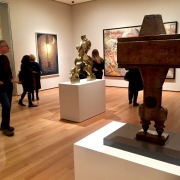
These remarks combine elements from three recent lectures. The first was delivered on November 27, 2010, at the conference organized by Barbara Fischer, director of the Justina M. Barnicke Gallery, University of Toronto, in association with the exhibition “Traffic: Conceptualism in Canada,” shown at the University of Toronto Galleries during the preceding months. The second, dedicated to the memory of Charles Harrison, was delivered at the Courtauld Institute of Art, University of London, on March 8, 2011, as part of a series on Global Conceptualism organized by Sarah Wilson and Boris Groys. The third was presented on April 14, 2011, as part of a conference titled “Revisiting Conceptual Art: The Russian Case in an International Context,” convened by Boris Groys and organized by the Stella Art Foundation, Moscow. I would like to thank all those concerned.

Terry Smith

is Andrew W. Mellon Professor of Contemporary Art History and Theory in the Department of the History of Art and Architecture at the University of Pittsburgh, and Distinguished Visiting Professor, National Institute for Experimental Arts, College of Fine Arts, University of New South Wales, Sydney. In 2010 he received the Franklin Jewett Mather Award for Art Criticism conferred by the College Art Association (USA) and the Australia Council Visual Arts Laureate Award (Commonwealth of Australia). He was a member of the Art & Language group (New York) and a founder of Union Media Services (Sydney). He is the author of a number of books, notably Making the Modern: Industry, Art and Design in America (University of Chicago Press, 1993; inaugural winner Georgia O’Keeffe Museum Prize, 2009),Transformations in Australian Art, volume 1, The Nineteenth Century: Landscape, Colony and Nation, volume 2, The Twentieth Century: Modernism and Aboriginality (Craftsman House, Sydney, 2002), The Architecture of Aftermath (University of Chicago Press, 2006), What is Contemporary Art? (University of Chicago Press, 2009), and Contemporary Art: World Currents (Laurence King and Pearson/Prentice Hall, 2011).
Footnotes:

1

Cited on a file card from the catalogue/exhibition by Gary Coward with Arthur Bardo and Bill Vazan, “45°30’N-73°36’W + Inventory ,” Williams Art Gallery, Montreal, 1971.

2

Simon Blackburn, ed.,

The Oxford Dictionary of Philosophy (Oxford: Oxford University Press,1996.) Oxford Reference Online.

Oxford University Press, posted April 8, 2008.

3

Terry Smith, “Peripheries in Motion: Conceptualism and Conceptual Art in Australia and New Zealand,” in Luis Camnitzer, Jane Farver, and Rachel Weiss, eds. Global Conceptualism: Points of Origin, 1950s–1980s (New York: Queens Museum of Art, 1999), 87–95.

4

Ian Burn, “Conceptual Art as Art,” Art and Australia(September 1970): 167–70.

5

During the 1990s, Burn became acutely aware of what he saw as the growing disjunction between the histories of art written by art historians and what he saw as the historical work, on both art and history, being undertaken in certain works of art: “While any image or object can be fitted into many historical discourses, it cannot be at the expense of the historical discourse within the image itself.” (Ian Burn, “Is Art History Any Use to Artists?,” in Ian Burn, Dialogue: Writings in Art History (Sydney: Allen &Unwin, 1991), 6.) To Burn, artists created that discourse less as picturing of it (as if it were a parade occurring at a representable distance), more in the way they composed their works, in the disposition of elements internal to each work. Sidney Nolan and Fernand Léger were prominent examples: in one of his essays, Burn showed that Nolan used some compositional ideas of Léger’s not to create a local modernism, nor to modernize his own art by imitation, but to negotiate a reconception of what landscape might mean in Australian art and history. “Sidney Nolan: Landscape and Modern Life,” in Burn, Dialogue, 67–85.

6

Conversation, New York, March 27, 2011.

7

An observation made by Boris Groys in a seminar at the Courtauld Institute, University of London, March 9, 2011.

8

“Before the Warhol canvases we are trapped in ghastly embarrassment. This sense of arbitrary coloring, the nearly

obliterated image and the persistently intrusive feeling. Somewhere in the image there is a proposition. It is unclear.” David Antin, “Warhol: The Silver Tenement,” Art News (Summer 1966): 58. Cited by Leo Steinberg, see Harrison & Wood , 953.

9

I first published these propositions, under the heading “A Theory of Conceptualism” in “Conceptual Art in Transit,” chapter 6 of Transformations in Australian Art, volume 2, The Twentieth Century – Modernism and Aboriginality

(Sydney: Craftsman House, 2002),127. They may be found in a nascent form, but applied to the Art & Language group only, in my essay “Art and Art & Language,” Artforum XII, no. 6 (February 1974): 49–52.

Geopolitics and Contemporary Art, Part II: The Nation-State as the Possible Container for Global Struggles


Irmgard Emmelhainz

Source: E-Flux

Continued from “Geopolitics and Contemporary Art, Part I: From Representation’s Ruin to Salvaging the Real”

One of the consequences of globalization and the deterritorialization of financial capital has been that the decisions that affect world citizens are now made by representatives of a corporate oligarchy untethered from the direct interests of nation-states. Secret negotiations and treaties have taken the place of constitutions and other forms of social contract, becoming the dominant method for managing natural resources, transnational security, copyright, privatization, food autonomy, financial fluxes, drug patents, and so forth. The International Monetary Fund, the World Bank, the Group of Seven, the GATT, and other organizations and agreements, like the TTIP and the TPP, make up our de facto global government, one designed to serve the interests of transnational corporations, banks, and investment firms. What does the loss of national autonomy mean for the project of self-legislation more generally? What sort of sovereign practices remain available to nation-states when most of their historical mandate has been remanded to the coordinating committee for transnational accumulation?
At the peak of the antiglobalization movement in 2000, Frederic Jameson argued that despite its faults, “the Nation-State today remains the only concrete terrain and framework for political struggle.” This was so despite “the recent anti-World Bank and anti-WTO demonstrations” which, although they seemed “to mark a promising new departure for a politics of resistance to globalization within the US,” nevertheless left it “hard to see how such struggles in other countries could be developed in any other fashion than the ‘nationalist’ [one].”1 This was the case because the only apparent alternatives to national struggle were cultural forms of resistance based on religion or a general defense of “our way of life.” And these are limited by the lack of a universalizing frame.


In other words, for Jameson, the struggle still boiled down to a conflict between the “social” and the “economic,” and, for this reason, the forms of social cohesion that preceded globalization, alongside national myths and narratives, remained an indispensable precondition for any effective and long-lasting political struggle. But twenty-five years into neoliberal reforms, the liberalization of the market, and the global homogenization of culture, it is worth asking if the nation-state can still serve as such a framework. Can the nation-state still be the container for defending the commons—infrastructure, biodiversity, natural resources, traditional knowledge, the means of production and reproduction—against the ravages of transnational corporations?
As the nation-state has become a proxy for global corporate and oligarchic interests, what precisely is at stake is the legitimacy of governments and their institutions. Following the Invisible Committee, must we wage war against any and all infrastructure that organizes life by suspending and sacrificing worlds, in order to delegitimize institutions which rely on our consent to operate and oppress? This would involve creating zones of dissent and then establishing strategic links to other dissident zones so as to pursue secession through a different geography than the nation-state—not by revindicating the local, but against the global:

As the Zapatistas have shown, the fact that each world is situated doesn’t diminish its access to the generality, but on the contrary is what ensures it. The universal, a poet has said, is the local without walls. There seems, rather, to be a universalizing potential that is linked to a deepening per se, an intensification of what is experienced in the world at large. It is not a question of choosing between the care we devote to what we are constructing and our political striking force. Our striking force is composed of the very intensity of what we are living, of the joy emanating from it, of the forms of expression invented there, of a collective ability to withstand stresses that is attested by our force.2

This would mean exerting the power of society over the state—not to free the individual from the social (one of the main principles of neoliberalism), but to take seriously the idea that the individual can be freed only through the social. That is to say, the individual’s well-being always depends on the collective’s well-being, and vice versa. As Castoriadis put it,

to abolish heteronomy does not signify abolishing the difference between instituting society and instituted society—which, in any case would be impossible—but to abolish the enslavement of the former to the latter. The collectivity will give itself the rules, knowing that it itself is giving them to itself, that these rules are or will always at some point become inadequate, that it can change them.3

Undoubtedly the nation-state arose as one such set of self-given rules. The question today is whether these have become inadequate, and thus how and in what way they should be changed.


Palestinians climb Israel’s separation wall to attend prayers at Al-Aqsa Mosque, July 26, 2013. Photo: Oren Ziv.

The Impossibility of the Nation-State
A remnant of the anti-imperialist and decolonizing struggles from the 1960s and ’70s, the Palestinian struggle is one that is still being fought within the horizon of the nation-state, as ending Israeli occupation is understood to mean the recognition of Palestine as a sovereign, self-determining nation. In this respect, the so-called “two-state solution” is really a “two nation-state solution,” and it is interesting to consider the way this struggle has been variously framed over the decades as political vocabularies have changed.

In the 1960s, the armed struggle of the Palestinians was posited as a manifestation of anti-imperialism in the service of national liberation, and it elicited the corresponding solidarity from the international Left. In the 1980s and ’90s, the Palestinians were cast as seeking recognition on the way towards the restitution of their human rights, including the right of return.

Today, and in contrast to the 1970s, militarism and armed struggle are almost always perceived as “mistaken” or as a suspicious form of politics because of their association with terrorism and dictatorship. Instead, solidarity with the Palestinian cause is expressed through the International Solidarity Movement, as activists around the world act as human shields protecting Palestinian houses slated for demolition and document abuses on the ground in an effort to give visibility to the numerous injustices perpetrated in the Occupied Territories. There is also the Boycott, Divestment, and Sanctions (BDS) campaign against Israel, a form of putting pressure on Israel inspired by a similar movement against apartheid in South Africa.

In spite of the fact that the idea of nationhood, cultivated through memories passed on from generation to generation, is what unites Palestinians inside and outside the Middle East, facts on the ground make it increasingly difficult to envision a two-state solution. According to many observers, Israel-Palestine is a binational state governed by Israel in two distinct ways. Israel governs Palestinians not as an occupying power—which, according to international human rights law, would imply being responsible for providing services such as healthcare, education, and so forth—but through differential governing, with Palestinians as “impaired citizens,” according to Ariella Azoulay. In her account, Israel actually governs Palestinians differentially through a set of mechanisms that deny them citizenship by treating them as exceptions to the rule.4

Azoulay shifts the paradigm of analysis by highlighting the discrepancy between considering Palestinians as citizens of a hypothetical Palestinian state and considering them as citizens of the actual state of Israel that currently governs them. From this perspective, in the territory in which Palestinians live, power is programmatically deployed to create a state of suspension premised on violence and the threat of violence. Through targeted assassinations, the destruction of infrastructure and homes, violent arrests, restrictions on travel, bombings from the air, nighttime raids, expropriation, and the prohibition of demonstrations, the existence of Palestinians remains on the threshold of catastrophe, a chronic and prolonged situation which is known to the locals in the West Bank and Gaza as “the tyranny of incertitude.”

In fact, the way Palestinians are governed by Israel is less exceptional than characteristic of nation-states in the era of neoliberalism. Nation-states often resort to the logic of exception as a way of obscuring their own relative powerlessness. According to Aihwa Ong, neoliberal governments treat different populations differentially, creating a diversity of zones, each with different regimes and levels of exception. She calls this model “graduated sovereignty”:

The model of graduated sovereignty shows that it is not so much a question of market versus the state, but that market society at our particular moment in history entails the existence of some areas in which the state is very strong and its protections very significant, and other areas where it is near absent, because these zones must be flexible vis-à-vis markets, or else they become structurally irrelevant. What we see then is a system of displaced sovereignty, a model of galactic governance that may be traceable back to premodern roots in Southeast Asian trading empires.5

The differential governing of Palestinians in Israel, as an extreme form of graduated sovereignty, is thus different only in degree from the rest of the world’s experience, rather than different in kind. The Palestinian case is simply one of the more extreme examples of differential governing, which manifests as episodes of targeted violence against a backdrop of manufactured precariousness justified by an underlying ethnic and religious narrative. But just as the Palestinian National Authority is sometimes described as a proxy for non-national interests, the same is said, for example, of the Mexican government, which has been described as a “failed state” because it is not fully sovereign in its own territory. If Palestine is governed according to foreign and Israeli interests, Mexico is governed according to the interests of transnational corporations and organized crime, two pillars of the international oligarchy that are often difficult to distinguish in practice. Arguably, neither is a case of state malfunction, but rather, they exemplify the way in which nation-states operate under neoliberalism, as instruments for denigrating or even exterminating forms of life in accordance with the needs of oligarchs.

This model of governance emerged alongside new regionalizations and territorializations that began in the 1960s and ’70s as a response, arguably, to the success of the workers’ movement in leveraging first-world national communities to raise the price of labor. The resulting capital flight arranged the world into clusters of innovation and progress, or alternatively, of destitution and poverty. With its ability to go beyond national divisions, the globalized market integrated first and third worlds, forcing certain areas to “develop” by creating pockets of wealth and cultural sophistication within the third world, and areas of destitution and misery within the first. The result is that it is increasingly difficult to think in terms of first- and third-world nations—or even developed and underdeveloped ones—rather than in terms of territories and zones connected in various degrees to global processes. There are thus zones where the extraction of surplus value is particularly intense, coexisting side by side with abandoned zones or pacified spaces: Milan and Campania, Tel Aviv and the Gaza Strip, San Diego and Tijuana, Los Angeles and Skid Row. The question then arises: How can the destitute territories and enclaves be politicized? What would that politicization look like?


Anti-TTIP protesters gather in Berlin, May 6, 2014. Photo: Mehr Demokratie/Flickr.

New Forms of Commonality
In the 1960s, the notion of underdevelopment served as a frame uniting the disparate efforts of third-world countries to utilize state intervention as an instrument of development and progress. In contrast, current “underdeveloped” areas are not abandoned by the state but governed differentially (as targeted neglect, strategic betterment, cultural intervention, violent dispossession, and so forth), and according to the demands of the global market. Through programs geared at “developing” these areas in the name of progress, international financial organizations, governments, and NGOs systematically undermine subsistence by subsidizing agriculture in the form of transgenic seeds and chemical fertilizers, and by creating forms of labor—whether on industrial farms, in tourist complexes, or in sweatshop factories—that destroy traditional forms of community organization, seeking to transform native peoples into consumers. These kinds of state and nonstate intervention reproduce global discrimination and poverty. “Development” nowadays means dispossessing peoples of their lands, providing differentiated (low-quality, in this case) access to healthcare, education, and employment, destroying traditional knowledges, and undoing communal forms of living and the idea that life can be independent and individualized. Contemporary “development” creates novel forms of intolerable interdependence, destroying the environment and transforming resources into privileges to which part of the population has access based on the dispossession or destruction of communities elsewhere.

If in the 1960s and ‘70s emancipation meant an alternative to capitalism and a means to overcome colonized identities, realize equality of rights, and de-repress sexuality, today emancipation means equality in the sense of achieving equal rights of access to goods, services, a living wage, and other kinds of privileges like water, electricity, and infrastructure. And yet, access to these kinds of commodities and their corresponding infrastructure implies an impossible model of development, since the Earth lacks enough resources for everyone to live modernized lives. Evidently, the main problem is the logic of development and progress driving extractive capitalism. Perhaps emancipation and equality must now also mean taking into account the ethical dimension of the intolerable forms of injurious dependency—that is to say, the exploitation, dispossession, and destruction of many within what Naomi Klein calls “sacrificial zones”—for the benefit of a few.6

It is no longer the nation-state which is at stake, but life itself, and what is needed is the self-organization of our common life against neoliberal forms of social engineering. More than anticapitalism—which, embodying the everyday dialectic of leftist common sense, condemns capitalism without imagining anything else—what is urgently needed are new forms of collective organization. According to Sylvère Lotringer, we are just beginning to experience the consequences of savage industrialization and the massive exploitation of natural resources—mass extinctions, permanent war, climate change—and these do not fit into our existing idea of politics and critique. Thus, critique is not an answer to capitalism, because it introduces distance where there is none.7 What is needed—and this is where art can play a crucial role—is a form of struggle that would elicit a long-term shift in values, leading to systemic change.

What is key here, as Jaime Martínez Luna suggests, is to plant the seeds for a new form of political organization, not through political identification or democratic participation, but as a form of belonging: a concrete relationship that presupposes commitment, obligation, and agreement. Identity (or common interest, which gives cohesion to a political cause) is an abstraction that mutates depending on the political action executed, while belonging is what is concrete. Belonging is the site for identity, and can help us create assemblages based on respect, work, and reciprocity. In the context of such assemblages, the relationships within social cells become concretized; as Martínez Luna puts it, such assemblages “exist to create life: that is movement, action, realization, intervention.”8

A key concept that would be useful here is “comunalidad,” a notion from Oaxaca, Mexico that emerged in the 1980s. It describes communal being in traditional ways of organizing, opposing capitalism and colonialism in favor of an ethical reconstruction of peoples. Communality is a way of being in the world that revolves neither around a commons administered by bureaucrats, nor some transient, ephemeral, and nonbinding postcommunism. Rather, it is a pact that considers the commons less as common property, as something owned in common, but as a common way of life—without forgetting that communality implies new forms of inhabiting territories from the other side of modernity. According to decolonial thinking, modernity and coloniality are inextricable: two elements of the same movement, which involves establishing truth at the expense of different forms of knowledge. In this regard, decoloniality is the outside of modernity and embodies other forms of feeling, making, thinking, being, and inhabiting the world—forms which are nonmodern and non-Western. Following decolonial theorist Rolando Vázquez, the recognition of nonmodern geo-genealogies and trajectories would reveal the movement of exclusion, violence, invisibilization, and forgetting that are inseparable from modernity, and would open up new forms of politicization—for instance, the notion of “buen vivir,” or living in plenitude, which orients indigenous communities and organization.9

According to Vázquez, this axial principle from outside modernity encompasses and recognizes the participation of human beings in a vital collectivity of close relationality, in the sense of mutual dependence and shared vulnerability. The notion of buen vivir also provides a different conception of the human, where the human is always in relation with the cosmos and with nature, beyond modern modes of appropriation and representation. The survival of humanity might depend on taking up a conception of the world beyond the dichotomy between humanity and nature in order to surrender the anthropocentric point of view. In this regard, I am not advocating a romanticized, ultraleft politics based on a return to the pastoral, as exemplified by the Zapatista experiments with autonomy. Rather, we must understand the role of the nonhuman world in helping us to construct more livable worlds by translating the autonomous forms of organization pioneered by indigenous peoples into urban contexts. For instance, in parts of Mexico citizens organize and arm themselves for the sake of their safety under a legal practice recognized as indigenous peoples’ “usos y costumbres” (uses and customs). In this way, vigilante and community police forces have proliferated throughout Mexico as a means to stop organized crime and its complicity with differentially governing state institutions, or to prevent political powers from auctioning off the commons. Currently, there are self-defense groups in the states of Hidalgo, Puebla, Veracruz, Oaxaca, Guerrero, Michoacán, Tamaulipas, Quintana Roo, and areas of the State of Mexico; and although they are indeed recognized by the law as usos y costumbres, the government has begun to criminalize them.10 These forms of autonomy point at the urgent need to experiment with means to build radically different socioeconomic relationships, instituting communal defense, property, and commons-management regimes. Another example would be the Territorial Land Use Law in Cuetzalan, in the State of Puebla, Mexico, which implies citizen participation in defining and diagnosing land use.11 Thanks to this law, the municipality of Cuetzalan has recently been victorious in insisting that the area remain free of mining exploitation, hydroelectric plants, carbon extraction, and the use and exploitation of water by private entities.12 This model of autonomous organization sets an important precedent in the struggle against neoliberal destruction.


Third-annual worldwide protest against Monsanto’s monopoly, May 2015. Protesters claim Monsanto controls 90 percent of the seed market in the US.

We must take into account that autonomous community organizing in cities tends to be transitory and cut off from the means to satisfy immediate needs or the capacity to control territory. This is because relationships in cities tend to be highly stratified, as capitalist modes of organization create fictitious communities through hierarchical social structures, concentrating decision-making mechanisms in a few hands; therefore, it becomes difficult to establish authentic dialogues and long-lasting relationships. As I mentioned in Part I of this article, one of the strategies of neoliberal governance is to implement fictitious inclusion and participation mechanisms, hiding the fact that political decisions affecting citizens are taken in secret and are extremely remote from our influence. Is it possible to build autonomous spaces and to recuperate the immediate bases of social reproduction in cities? This is a difficult question. It must be remembered that if, in the countryside, what is at stake is territory, in cities the key is the materialization of forms of power and their distribution in space.

Moreover, autonomy is a communal and relational form of organization and thus, an alternative to the state and the market. In this regard, the “common” is a vague and yet necessary concept for today’s struggles; it needs to be posited as an alternative horizon contesting the mercantilization of life and the seduction of the collective imaginary by capitalism. Communality is everything we share, but it also means rejecting our five-hundred-year-old system of socioeconomic relationships. It implies building new relationships outside the logic of capitalism and the market, which people all over the world are attempting to do through an array of experiments with cooperatives, collective work, solidarity, urban gardens, time banks, and free universities. These experiments are the beginning of the production and sharing of wealth in common, which would also fund, plan, project, establish, and organize something that already exists to institute forms of autonomy that are different from the forms of participation offered by neoliberal governance.

These experiments happen within the folds of institutions and against institutional fascisms that oppress and make decisions against our interests. Their aim is to disperse and transform power relationships. Autonomy means creating sites where rules different than those imposed on us by the neoliberal system can be applied to construct different political, social, and economic relationships. To build autonomous spaces is to recover the immediate bases of social reproduction in urbanized areas. What is at stake is the materialization of forms of power and how they are distributed in space. In that regard, art has been, and can continue to be, a privileged laboratory for studying fields of power and for experimenting with sociatry, therapy, and new models of assemblage, organization, exchange, and the reproduction of life, not of capital. But without a social base, without establishing long-lasting collectivity in relation to a political project, it is difficult to begin building and inhabiting the world differently.

Irmgard Emmelhainz is an independent translator, writer, researcher, and lecturer based in Mexico City. Her work about film, the Palestine Question, art, cinema, culture, and neoliberalism has been translated to Italian, French, English, Arabic, Turkish, Hebrew, and Serbian, and she has presented it at an array of international venues. She is member of the editorial board of Scapegoat Journaland has recently finished a book on neoliberalism as a sensibility and common sense embedded in urban planning, work and life, culture, social movements, mourning, and women’s struggle.

1 Frederic Jameson, “Globalization and Political Strategy,” New Left Review 4 (July–August 2000) →

2 The Invisible Committee, To Our Friends, trans. Robert Hurley (Los Angeles: Semiotext(e), 2015), 194.

3 Cornelius Castoriadis, Political and Social Writings: Volume 3, 1961–1979, ed. David Ames Curtis (Minneapolis, MN: University of Minnesota Press, 1992), 330.

4 Ariella Azoulay, The Social Contract of Photography (New York: Zone Books, 2009).

5 Aihwa Ong, Neoliberalism as Exception: Mutations in Citizenship and Sovereignty(Durham, NC: Duke University Press, 2006), 96.
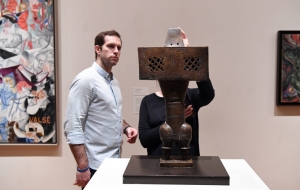
6 Naomi Klein, This Changes Everything: Capitalism vs. the Climate (New York: Simon and Shuster, 2014).
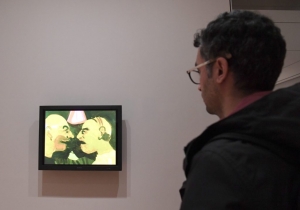
7 Etienne Turpin, “Conversation with Sylvère Lotringer,” Art in the Anthropocene: Encounters Among Aesthetics, Politics, Environments and Epistemologies, eds. Heather Davis and Etienne Turpin (London: Open Humanities Press, 2015), 375.

8 Jaime Martínez Luna, “Pertenencia Asamblearia,” edicionespatito.org, April 15, 2015 →

9 Rolando Vázquez, “Colonialidad y Relacionalidad,” in Los desafíos coloniales de nuestros días: Pensar en colectivo, eds. María Eugenia Borsani and Pablo Quintero (Neunquén: Editorial de la Universidad Nacional del Comahue, 2014), 173.

10 Linaloe R. Flores, “La violencia amplía el menu de autodefensas,” Sinembargo, February 18, 2014 →

11 Aurelio Fernández F., “Cuetzalan: defenderse y construir,” La Jornada, April 9, 2014 →

12 Sandra Barillas, “El cabildo de Cuetzalan, en sesión abierta, oficializa el rechazo a proyectos mineros e hidroeléctricos” La Jornada de Oriente, November 6, 2014 →