One and Three Ideas: Conceptualism Before, During, and After Conceptual Art

Terry Smith

Part One
Tactically, conceptualism is no doubt the strongest position of the three; for the tired nominalist can lapse into conceptualism and still allay his puritanic conscience with the reflection that he has not quite taken to eating lotus with the Platonists.

—Willard van Orman Quine

1
Philosophers often add “-ism” to a term in order to highlight a distinct approach to a fundamental question, that is, to name a philosophical doctrine. For example, when it comes to universals,

There are other definitions, but the point about the use of “-ism” to name a philosophical doctrine is clear. For art critics, curators, and historians, however, “-isms” have somewhat different purposes: they name movements in art, broadly shared approaches that have become styles or threaten to do so. During the heroic years of the modern movement, when critics, artists, or art historians first added “-ism” to a word, they usually meant what the suffix usually means in ordinary language: that The Oxford Dictionary of Philosophy tells us that “Conceptualism is a doctrine in philosophy intermediate between nominalism and realism that says universals exist only within the mind and have no external or substantial reality.”2x is like y, even excessively so. Often with ridicule as their aim, they highlighted a quality twice removed from the source of that particular art, from its authenticity. Thus “Impressionism” and “Cubism,” neither of which names what is really going on in the art to which it refers: each takes up a banal misdescription and then exaggerates it into a ludicrous delusion on the part of the artists. The success of the early twentieth-century avant-gardes led to a plethora of “-isms” that gradually lost these negative connotations and become almost normal descriptors. By mid-century, anyone could generate an “-ism,” and too many artists did so in their efforts to link their unique, often quite individual ways of making art to what they, or their promoters, hoped would be market success and art historical inevitability. When Willem de Kooning, at a meeting of artists in New York in 1951, said: “It is disastrous to name ourselves,” his was a lone voice, quickly silenced by the tide that named all present Abstract Expressionists.
By the 1960s this kind of naming had become so commonplace, so obvious a move, and such a sure pathway to premature institutionalization and incorporation, that many artists rejected it, to avoid being comfortably slotted into what they regarded as an ossified history of modernist avant-gardism. In the 1970s, for example, artists driven primarily by political concerns consciously blocked efforts to designate their work as belonging to a “political art” movement. Yet for some artists, long excluded from any kind of historical recognition, this was a risk worth taking: feminist artists emphasized their feminism, for instance, precisely because it connected their practice to the broader social movement to vindicate the rights of women.

As the artists most acutely aware of the powers and the pitfalls of exactly these processes, conceptual artists refused to embrace the term “conceptualism” during the 1960s, ’70s, and ’80s. They were, however, happy to use terms such as “conceptual” for their work, because questioning the concept of art was precisely the main point of their practice. As we shall see, they foresaw that the tag “Conceptual Art” would inevitably be associated with their work, and thus tie it too closely to art that had already resolved its problems. Their goal was to keep their art (practice) problematic to themselves by keeping it at a (critical) distance from Art (as an institution). They therefore sought to prevent the precipitous labeling of their art by adopting one or both of two strategies: insist that the term “conceptual” be applied so broadly (describing any art no longer governed by a traditional medium) as to be meaningless, or so narrowly (indicating only language-based art that dealt with Art per se) as to be offensive to almost everyone.

It is a nice paradox that the term “conceptualism” came into art world existence after the advent of Conceptual art in major centers such as New York and London—most prominently and programmatically in the exhibition “Global Conceptualism: Points of Origin, 1950s–1980s” at the Queens Museum of Art in New York in 1999—mainly in order to highlight the fact that innovative, experimental art practices occurred in the Soviet Union, Japan, South America, and elsewhere prior to, at the same time as, and after the European and US initiatives that had come to seem paradigmatic, and to claim that these practices were more socially and politically engaged—and thus more relevant to their present, better models for today’s art, and, in these senses, better art—than the well-known Euro-American exemplars. I explored a variant of this idea—that conceptualism was an outcome of some artists’ increased global mobility—in my selections for the “Global Conceptualism” exhibition, and in my catalogue essay, “Peripheries in Motion: Conceptualism and Conceptual Art in Australia and New Zealand.”3 Retrospection of this kind has also shone spotlights on what were once regarded as minor movements in Euro-American art (Fluxus, for example).

The question posed by the exhibition “Traffic: Conceptual Art in Canada 1965–1980,” presented at the University of Toronto Art Galleries in 2010, is whether a similar valuing structure might be applied to certain strands in art made in Canada from the 1960s to the present. Even though Canadian artists were conspicuously absent from “Global Conceptualism,” certain artists have since been valued as contributors to the international tendency. Thus the exhibition asks us to look in more detail at work of the time made throughout the regions of Canada and consider whether perhaps this valuing can be extended to them. There is no suggestion that this art was nationalistic—on the contrary, it was everywhere based on skepticism about official national culture-construction. The implication is that regional conceptualisms existed—that is, that conceptualist developments (in the broadest sense) occurred differently in each of the distinct regions of Canada. Again, the implication is skeptical: in every case it is about regionality in transition, not a self-satisfied parochialism.

Triggered by remarks made by some of the key artists back in the day, I wish to revisit the terms “Conceptual art” and “conceptualism” as indications of what was at stake in the unraveling of late modern art during the 1960s and in art’s embrace of contemporaneity since. I will do so by asking what conceptualism was before, during, and after Conceptual art, and I will show that there were at least one, usually two, and sometimes three conceptions of conceptualism in play at each moment—and that these were in play, differently although connectedly, in various places, at each of these times.


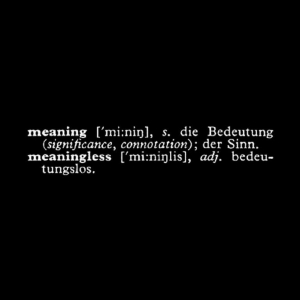
Josef Kosuth, Art as Idea as Idea (Meaning), 1967. Photostat on paper mounted on wood.

Let me begin with the question as seen from within orthodox art historical narratives, as a matter of the meaning of style, a concern of art historians. I start from before Conceptual art was named as a style, before the term “conceptualism” had any currency, to see what might count as Conceptual art in that circumstance.

Ian Burn, in conversation in late 1972, said of Joseph Kosuth’s Art as Idea works:“If they were made in 1965 like he claims, they are Pop Art. If they were made in 1967–8, when they were exhibited, then they are among the first conceptual works, strictly speaking.” In his 1970 essay “Conceptual Art as Art,” Burn gave these works this latter dating and characterized them as key examples of the “strict form of Conceptual Art” because they were analytic of the nature of art, their (minimal) appearance being of the most minimal relevance.4 Why did an artist with such a critical attitude toward orthodox art history’s puerile dependence on style terms apply such crude criteria to the work of a close colleague?5

Kosuth’s response was outrage at applying such anti-conceptual criteria to such work: he was an art student who had the ideas but not the resources to realize them; by the time he did have these resources a few years later, everyone (including Burn) was dating their work to the moment of conception—immediacy was the new currency.6


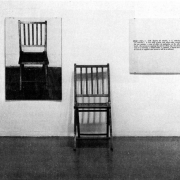
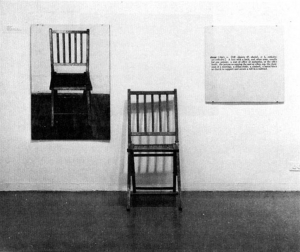
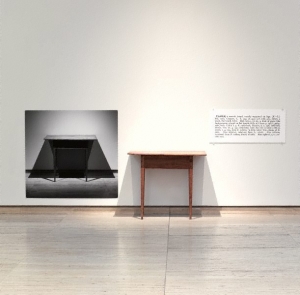
Josef Kosuth, One and Three Chairs, 1965.

In one sense Kosuth’s One and Three Chairs (1965) is Pop-like in that its statement about what constitutes a sign is all there, all at once, and obvious, as in your face as Richard Hamilton’s 1956 collage Just what is it that makes today’s homes so different, so appealing?, but without the fascinated irony that informs the British artist’s perspective. To an observer outside the US sphere of cultural influence—or, more accurately, at its waxing and waning borders—One and Three Chairs might seem to offer viewers an open choice as to which item seems the most attractive constituent of “chairness,” thereby reducing spectatorship to supermarketlike art consumption, and artmaking to the provision of competitive goods.7 To the extent that this is true, Conceptual art that turns on overt demonstration or the instantiation of an idea (as does much of the better known and easily illustrated work—think Baldessari, Acconci, or Huebler) shares something with what might be called ordinary language Pop art, that which recycles the visual codes of consumer culture.

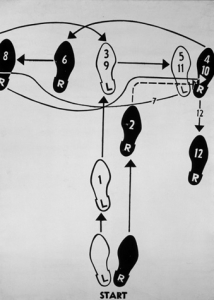
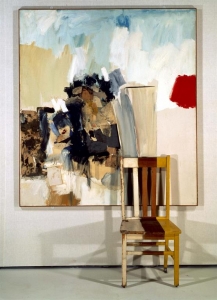
But the matter does not end there. In my view, the invitation to look in One and Three Chairs is at least as subtle as it is in key works on this subject by Rauschenberg, Johns, and Warhol in its conceptual questioning of what it is to see, what an image might be, what an idea looks like. These artists regularly juxtaposed photographs and objects such as actual chairs (in Rauschenberg’s Pilgrim, for example), or evoked black-and-white photography and overtly displayed the tools that made them (Johns’s Periscope (Hart Crane), 1963, for example). Warhol’s Dance Diagram (“The Lindy Tuck-In Turn-Man”), 1963, is an appropriation of an illustration, but it is also a demonstration of what constitutes a visual sign, especially when displayed, as he preferred, on the floor. Indeed, Warhol now seems the most nakedly conceptual of artists (in this pre-Conceptual art moment), precisely in his instinct for setting out one visual idea at a time, in showing an image as an idea, in making artworks that plainly demonstrated how visual ideas achieved appearance in the culture, in the visual culture, in popular imagination, in unArt, in America. The idea-image, for him, was in David Antin’s brilliant perception, a “deteriorated image.”8


Warhol, Dance Diagram


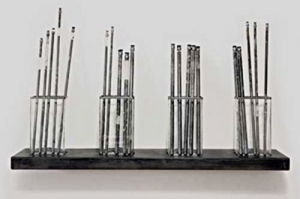
Joseph Kosuth, Art as an Idea


Rauschenberg, Pilgrim

There were of course many others striving to picture the many dichotomies afforded by the idea-image interplay that was taking shape at the time: a random list must include Guy Debord, with his films such as Hurlements en faveur de Sade (1952) and his collaborations with Asger Jorn; concrete poets of all kinds; Jim Dine; Kaprow, with his early happenings; Ed Ruscha; and many others, all of whom converge with Pop in certain ways, although they, like the artists mentioned above, were on a track much more interesting than that which can be encompassed by that term. In Canada, Greg Curnoe’s work throughout the 1960s offers a fascinating instance of a figurative painter, alert to the stylistics of Pop and flat color abstraction, yet, like Kurt Schwitters, drawn irresistibly to the potency of words and texts as they occur in the flow and stuff of everyday life. Add to this a Wittgensteinian consciousness that we are all products of our language-worlds, and an interesting outcome is assured. Thus, in Westing House Workers (1962), the names of a group of laborers are stamped out on a sheet that seems taken from a factory cafeteria notice board, while Row of Words on My Mind #1(1962) stamps out a set of names of people, things, promises, and so forth, that seem as random as anyone’s everyday ruminations. By 1967, however, Curnoe had evidently seen tautology-based conceptualism (either through reproductions or via the agency of Greg Ferguson): Front Center Windows (1967) is a blue vertical rectangle stamped with black letters that describe a façade in the language of a builder’s report, while Non-Figurative Picture (1968) is a vertical column stamped with the letters of the alphabet.

These examples tell us that the question “Is it Pop or Conceptual art?” is at best a provocation (as it was for Burn), and at worst a badly formulated misunderstanding of the deeper stakes of both kinds of work. Rather, we can see that various kinds of conceptualization inspired the most inventive artists of the late modern era, and that the conceptual qualities of their work were among its most important. This is the first, the most rooted, sense in which the three ideas of what it is for art to be conceptual could count as one idea: the term “conceptual” as an adjective is most fitting to this sense. Quite properly, this basic usage precedes any real usage of the terms “conceptualism” and “Conceptual art” in art discourse, as these are derivative from it. It permits us this proposition, the first part of a proposal that I advance—with full awareness of how paradoxical a gesture it is—as “a theory of conceptualism”:

1. At its various beginnings, conceptualism was a set of practices for interrogating what it was for perceiving subjects and perceived objects to be in the world (that is, it was an inquiry into the minimal situations in which art might be possible).9


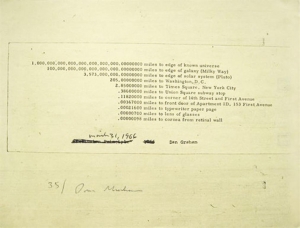
Dan Graham, March 31, 1966.

These remarks combine elements from three recent lectures. The first was delivered on November 27, 2010, at the conference organized by Barbara Fischer, director of the Justina M. Barnicke Gallery, University of Toronto, in association with the exhibition “Traffic: Conceptualism in Canada,” shown at the University of Toronto Galleries during the preceding months. The second, dedicated to the memory of Charles Harrison, was delivered at the Courtauld Institute of Art, University of London, on March 8, 2011, as part of a series on Global Conceptualism organized by Sarah Wilson and Boris Groys. The third was presented on April 14, 2011, as part of a conference titled “Revisiting Conceptual Art: The Russian Case in an International Context,” convened by Boris Groys and organized by the Stella Art Foundation, Moscow. I would like to thank all those concerned.

Terry Smith

is Andrew W. Mellon Professor of Contemporary Art History and Theory in the Department of the History of Art and Architecture at the University of Pittsburgh, and Distinguished Visiting Professor, National Institute for Experimental Arts, College of Fine Arts, University of New South Wales, Sydney. In 2010 he received the Franklin Jewett Mather Award for Art Criticism conferred by the College Art Association (USA) and the Australia Council Visual Arts Laureate Award (Commonwealth of Australia). He was a member of the Art & Language group (New York) and a founder of Union Media Services (Sydney). He is the author of a number of books, notably Making the Modern: Industry, Art and Design in America (University of Chicago Press, 1993; inaugural winner Georgia O’Keeffe Museum Prize, 2009),Transformations in Australian Art, volume 1, The Nineteenth Century: Landscape, Colony and Nation, volume 2, The Twentieth Century: Modernism and Aboriginality (Craftsman House, Sydney, 2002), The Architecture of Aftermath (University of Chicago Press, 2006), What is Contemporary Art? (University of Chicago Press, 2009), and Contemporary Art: World Currents (Laurence King and Pearson/Prentice Hall, 2011).
Footnotes:

1

Cited on a file card from the catalogue/exhibition by Gary Coward with Arthur Bardo and Bill Vazan, “45°30’N-73°36’W + Inventory ,” Williams Art Gallery, Montreal, 1971.

2

Simon Blackburn, ed.,

The Oxford Dictionary of Philosophy (Oxford: Oxford University Press,1996.) Oxford Reference Online.

Oxford University Press, posted April 8, 2008.

3

Terry Smith, “Peripheries in Motion: Conceptualism and Conceptual Art in Australia and New Zealand,” in Luis Camnitzer, Jane Farver, and Rachel Weiss, eds. Global Conceptualism: Points of Origin, 1950s–1980s (New York: Queens Museum of Art, 1999), 87–95.

4

Ian Burn, “Conceptual Art as Art,” Art and Australia(September 1970): 167–70.

5

During the 1990s, Burn became acutely aware of what he saw as the growing disjunction between the histories of art written by art historians and what he saw as the historical work, on both art and history, being undertaken in certain works of art: “While any image or object can be fitted into many historical discourses, it cannot be at the expense of the historical discourse within the image itself.” (Ian Burn, “Is Art History Any Use to Artists?,” in Ian Burn, Dialogue: Writings in Art History (Sydney: Allen &Unwin, 1991), 6.) To Burn, artists created that discourse less as picturing of it (as if it were a parade occurring at a representable distance), more in the way they composed their works, in the disposition of elements internal to each work. Sidney Nolan and Fernand Léger were prominent examples: in one of his essays, Burn showed that Nolan used some compositional ideas of Léger’s not to create a local modernism, nor to modernize his own art by imitation, but to negotiate a reconception of what landscape might mean in Australian art and history. “Sidney Nolan: Landscape and Modern Life,” in Burn, Dialogue, 67–85.

6

Conversation, New York, March 27, 2011.

7

An observation made by Boris Groys in a seminar at the Courtauld Institute, University of London, March 9, 2011.

8

“Before the Warhol canvases we are trapped in ghastly embarrassment. This sense of arbitrary coloring, the nearly

obliterated image and the persistently intrusive feeling. Somewhere in the image there is a proposition. It is unclear.” David Antin, “Warhol: The Silver Tenement,” Art News (Summer 1966): 58. Cited by Leo Steinberg, see Harrison & Wood , 953.

9

I first published these propositions, under the heading “A Theory of Conceptualism” in “Conceptual Art in Transit,” chapter 6 of Transformations in Australian Art, volume 2, The Twentieth Century – Modernism and Aboriginality

(Sydney: Craftsman House, 2002),127. They may be found in a nascent form, but applied to the Art & Language group only, in my essay “Art and Art & Language,” Artforum XII, no. 6 (February 1974): 49–52.

Geopolitics and Contemporary Art, Part II: The Nation-State as the Possible Container for Global Struggles


Irmgard Emmelhainz

Source: E-Flux

Continued from “Geopolitics and Contemporary Art, Part I: From Representation’s Ruin to Salvaging the Real”

One of the consequences of globalization and the deterritorialization of financial capital has been that the decisions that affect world citizens are now made by representatives of a corporate oligarchy untethered from the direct interests of nation-states. Secret negotiations and treaties have taken the place of constitutions and other forms of social contract, becoming the dominant method for managing natural resources, transnational security, copyright, privatization, food autonomy, financial fluxes, drug patents, and so forth. The International Monetary Fund, the World Bank, the Group of Seven, the GATT, and other organizations and agreements, like the TTIP and the TPP, make up our de facto global government, one designed to serve the interests of transnational corporations, banks, and investment firms. What does the loss of national autonomy mean for the project of self-legislation more generally? What sort of sovereign practices remain available to nation-states when most of their historical mandate has been remanded to the coordinating committee for transnational accumulation?
At the peak of the antiglobalization movement in 2000, Frederic Jameson argued that despite its faults, “the Nation-State today remains the only concrete terrain and framework for political struggle.” This was so despite “the recent anti-World Bank and anti-WTO demonstrations” which, although they seemed “to mark a promising new departure for a politics of resistance to globalization within the US,” nevertheless left it “hard to see how such struggles in other countries could be developed in any other fashion than the ‘nationalist’ [one].”1 This was the case because the only apparent alternatives to national struggle were cultural forms of resistance based on religion or a general defense of “our way of life.” And these are limited by the lack of a universalizing frame.


In other words, for Jameson, the struggle still boiled down to a conflict between the “social” and the “economic,” and, for this reason, the forms of social cohesion that preceded globalization, alongside national myths and narratives, remained an indispensable precondition for any effective and long-lasting political struggle. But twenty-five years into neoliberal reforms, the liberalization of the market, and the global homogenization of culture, it is worth asking if the nation-state can still serve as such a framework. Can the nation-state still be the container for defending the commons—infrastructure, biodiversity, natural resources, traditional knowledge, the means of production and reproduction—against the ravages of transnational corporations?
As the nation-state has become a proxy for global corporate and oligarchic interests, what precisely is at stake is the legitimacy of governments and their institutions. Following the Invisible Committee, must we wage war against any and all infrastructure that organizes life by suspending and sacrificing worlds, in order to delegitimize institutions which rely on our consent to operate and oppress? This would involve creating zones of dissent and then establishing strategic links to other dissident zones so as to pursue secession through a different geography than the nation-state—not by revindicating the local, but against the global:

As the Zapatistas have shown, the fact that each world is situated doesn’t diminish its access to the generality, but on the contrary is what ensures it. The universal, a poet has said, is the local without walls. There seems, rather, to be a universalizing potential that is linked to a deepening per se, an intensification of what is experienced in the world at large. It is not a question of choosing between the care we devote to what we are constructing and our political striking force. Our striking force is composed of the very intensity of what we are living, of the joy emanating from it, of the forms of expression invented there, of a collective ability to withstand stresses that is attested by our force.2

This would mean exerting the power of society over the state—not to free the individual from the social (one of the main principles of neoliberalism), but to take seriously the idea that the individual can be freed only through the social. That is to say, the individual’s well-being always depends on the collective’s well-being, and vice versa. As Castoriadis put it,

to abolish heteronomy does not signify abolishing the difference between instituting society and instituted society—which, in any case would be impossible—but to abolish the enslavement of the former to the latter. The collectivity will give itself the rules, knowing that it itself is giving them to itself, that these rules are or will always at some point become inadequate, that it can change them.3

Undoubtedly the nation-state arose as one such set of self-given rules. The question today is whether these have become inadequate, and thus how and in what way they should be changed.


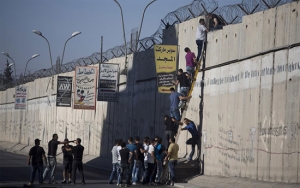
Palestinians climb Israel’s separation wall to attend prayers at Al-Aqsa Mosque, July 26, 2013. Photo: Oren Ziv.

The Impossibility of the Nation-State
A remnant of the anti-imperialist and decolonizing struggles from the 1960s and ’70s, the Palestinian struggle is one that is still being fought within the horizon of the nation-state, as ending Israeli occupation is understood to mean the recognition of Palestine as a sovereign, self-determining nation. In this respect, the so-called “two-state solution” is really a “two nation-state solution,” and it is interesting to consider the way this struggle has been variously framed over the decades as political vocabularies have changed.

In the 1960s, the armed struggle of the Palestinians was posited as a manifestation of anti-imperialism in the service of national liberation, and it elicited the corresponding solidarity from the international Left. In the 1980s and ’90s, the Palestinians were cast as seeking recognition on the way towards the restitution of their human rights, including the right of return.

Today, and in contrast to the 1970s, militarism and armed struggle are almost always perceived as “mistaken” or as a suspicious form of politics because of their association with terrorism and dictatorship. Instead, solidarity with the Palestinian cause is expressed through the International Solidarity Movement, as activists around the world act as human shields protecting Palestinian houses slated for demolition and document abuses on the ground in an effort to give visibility to the numerous injustices perpetrated in the Occupied Territories. There is also the Boycott, Divestment, and Sanctions (BDS) campaign against Israel, a form of putting pressure on Israel inspired by a similar movement against apartheid in South Africa.

In spite of the fact that the idea of nationhood, cultivated through memories passed on from generation to generation, is what unites Palestinians inside and outside the Middle East, facts on the ground make it increasingly difficult to envision a two-state solution. According to many observers, Israel-Palestine is a binational state governed by Israel in two distinct ways. Israel governs Palestinians not as an occupying power—which, according to international human rights law, would imply being responsible for providing services such as healthcare, education, and so forth—but through differential governing, with Palestinians as “impaired citizens,” according to Ariella Azoulay. In her account, Israel actually governs Palestinians differentially through a set of mechanisms that deny them citizenship by treating them as exceptions to the rule.4

Azoulay shifts the paradigm of analysis by highlighting the discrepancy between considering Palestinians as citizens of a hypothetical Palestinian state and considering them as citizens of the actual state of Israel that currently governs them. From this perspective, in the territory in which Palestinians live, power is programmatically deployed to create a state of suspension premised on violence and the threat of violence. Through targeted assassinations, the destruction of infrastructure and homes, violent arrests, restrictions on travel, bombings from the air, nighttime raids, expropriation, and the prohibition of demonstrations, the existence of Palestinians remains on the threshold of catastrophe, a chronic and prolonged situation which is known to the locals in the West Bank and Gaza as “the tyranny of incertitude.”

In fact, the way Palestinians are governed by Israel is less exceptional than characteristic of nation-states in the era of neoliberalism. Nation-states often resort to the logic of exception as a way of obscuring their own relative powerlessness. According to Aihwa Ong, neoliberal governments treat different populations differentially, creating a diversity of zones, each with different regimes and levels of exception. She calls this model “graduated sovereignty”:

The model of graduated sovereignty shows that it is not so much a question of market versus the state, but that market society at our particular moment in history entails the existence of some areas in which the state is very strong and its protections very significant, and other areas where it is near absent, because these zones must be flexible vis-à-vis markets, or else they become structurally irrelevant. What we see then is a system of displaced sovereignty, a model of galactic governance that may be traceable back to premodern roots in Southeast Asian trading empires.5

The differential governing of Palestinians in Israel, as an extreme form of graduated sovereignty, is thus different only in degree from the rest of the world’s experience, rather than different in kind. The Palestinian case is simply one of the more extreme examples of differential governing, which manifests as episodes of targeted violence against a backdrop of manufactured precariousness justified by an underlying ethnic and religious narrative. But just as the Palestinian National Authority is sometimes described as a proxy for non-national interests, the same is said, for example, of the Mexican government, which has been described as a “failed state” because it is not fully sovereign in its own territory. If Palestine is governed according to foreign and Israeli interests, Mexico is governed according to the interests of transnational corporations and organized crime, two pillars of the international oligarchy that are often difficult to distinguish in practice. Arguably, neither is a case of state malfunction, but rather, they exemplify the way in which nation-states operate under neoliberalism, as instruments for denigrating or even exterminating forms of life in accordance with the needs of oligarchs.

This model of governance emerged alongside new regionalizations and territorializations that began in the 1960s and ’70s as a response, arguably, to the success of the workers’ movement in leveraging first-world national communities to raise the price of labor. The resulting capital flight arranged the world into clusters of innovation and progress, or alternatively, of destitution and poverty. With its ability to go beyond national divisions, the globalized market integrated first and third worlds, forcing certain areas to “develop” by creating pockets of wealth and cultural sophistication within the third world, and areas of destitution and misery within the first. The result is that it is increasingly difficult to think in terms of first- and third-world nations—or even developed and underdeveloped ones—rather than in terms of territories and zones connected in various degrees to global processes. There are thus zones where the extraction of surplus value is particularly intense, coexisting side by side with abandoned zones or pacified spaces: Milan and Campania, Tel Aviv and the Gaza Strip, San Diego and Tijuana, Los Angeles and Skid Row. The question then arises: How can the destitute territories and enclaves be politicized? What would that politicization look like?


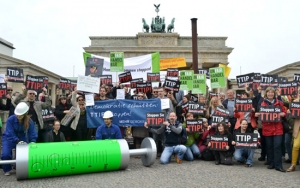
Anti-TTIP protesters gather in Berlin, May 6, 2014. Photo: Mehr Demokratie/Flickr.

New Forms of Commonality
In the 1960s, the notion of underdevelopment served as a frame uniting the disparate efforts of third-world countries to utilize state intervention as an instrument of development and progress. In contrast, current “underdeveloped” areas are not abandoned by the state but governed differentially (as targeted neglect, strategic betterment, cultural intervention, violent dispossession, and so forth), and according to the demands of the global market. Through programs geared at “developing” these areas in the name of progress, international financial organizations, governments, and NGOs systematically undermine subsistence by subsidizing agriculture in the form of transgenic seeds and chemical fertilizers, and by creating forms of labor—whether on industrial farms, in tourist complexes, or in sweatshop factories—that destroy traditional forms of community organization, seeking to transform native peoples into consumers. These kinds of state and nonstate intervention reproduce global discrimination and poverty. “Development” nowadays means dispossessing peoples of their lands, providing differentiated (low-quality, in this case) access to healthcare, education, and employment, destroying traditional knowledges, and undoing communal forms of living and the idea that life can be independent and individualized. Contemporary “development” creates novel forms of intolerable interdependence, destroying the environment and transforming resources into privileges to which part of the population has access based on the dispossession or destruction of communities elsewhere.

If in the 1960s and ‘70s emancipation meant an alternative to capitalism and a means to overcome colonized identities, realize equality of rights, and de-repress sexuality, today emancipation means equality in the sense of achieving equal rights of access to goods, services, a living wage, and other kinds of privileges like water, electricity, and infrastructure. And yet, access to these kinds of commodities and their corresponding infrastructure implies an impossible model of development, since the Earth lacks enough resources for everyone to live modernized lives. Evidently, the main problem is the logic of development and progress driving extractive capitalism. Perhaps emancipation and equality must now also mean taking into account the ethical dimension of the intolerable forms of injurious dependency—that is to say, the exploitation, dispossession, and destruction of many within what Naomi Klein calls “sacrificial zones”—for the benefit of a few.6

It is no longer the nation-state which is at stake, but life itself, and what is needed is the self-organization of our common life against neoliberal forms of social engineering. More than anticapitalism—which, embodying the everyday dialectic of leftist common sense, condemns capitalism without imagining anything else—what is urgently needed are new forms of collective organization. According to Sylvère Lotringer, we are just beginning to experience the consequences of savage industrialization and the massive exploitation of natural resources—mass extinctions, permanent war, climate change—and these do not fit into our existing idea of politics and critique. Thus, critique is not an answer to capitalism, because it introduces distance where there is none.7 What is needed—and this is where art can play a crucial role—is a form of struggle that would elicit a long-term shift in values, leading to systemic change.

What is key here, as Jaime Martínez Luna suggests, is to plant the seeds for a new form of political organization, not through political identification or democratic participation, but as a form of belonging: a concrete relationship that presupposes commitment, obligation, and agreement. Identity (or common interest, which gives cohesion to a political cause) is an abstraction that mutates depending on the political action executed, while belonging is what is concrete. Belonging is the site for identity, and can help us create assemblages based on respect, work, and reciprocity. In the context of such assemblages, the relationships within social cells become concretized; as Martínez Luna puts it, such assemblages “exist to create life: that is movement, action, realization, intervention.”8

A key concept that would be useful here is “comunalidad,” a notion from Oaxaca, Mexico that emerged in the 1980s. It describes communal being in traditional ways of organizing, opposing capitalism and colonialism in favor of an ethical reconstruction of peoples. Communality is a way of being in the world that revolves neither around a commons administered by bureaucrats, nor some transient, ephemeral, and nonbinding postcommunism. Rather, it is a pact that considers the commons less as common property, as something owned in common, but as a common way of life—without forgetting that communality implies new forms of inhabiting territories from the other side of modernity. According to decolonial thinking, modernity and coloniality are inextricable: two elements of the same movement, which involves establishing truth at the expense of different forms of knowledge. In this regard, decoloniality is the outside of modernity and embodies other forms of feeling, making, thinking, being, and inhabiting the world—forms which are nonmodern and non-Western. Following decolonial theorist Rolando Vázquez, the recognition of nonmodern geo-genealogies and trajectories would reveal the movement of exclusion, violence, invisibilization, and forgetting that are inseparable from modernity, and would open up new forms of politicization—for instance, the notion of “buen vivir,” or living in plenitude, which orients indigenous communities and organization.9

According to Vázquez, this axial principle from outside modernity encompasses and recognizes the participation of human beings in a vital collectivity of close relationality, in the sense of mutual dependence and shared vulnerability. The notion of buen vivir also provides a different conception of the human, where the human is always in relation with the cosmos and with nature, beyond modern modes of appropriation and representation. The survival of humanity might depend on taking up a conception of the world beyond the dichotomy between humanity and nature in order to surrender the anthropocentric point of view. In this regard, I am not advocating a romanticized, ultraleft politics based on a return to the pastoral, as exemplified by the Zapatista experiments with autonomy. Rather, we must understand the role of the nonhuman world in helping us to construct more livable worlds by translating the autonomous forms of organization pioneered by indigenous peoples into urban contexts. For instance, in parts of Mexico citizens organize and arm themselves for the sake of their safety under a legal practice recognized as indigenous peoples’ “usos y costumbres” (uses and customs). In this way, vigilante and community police forces have proliferated throughout Mexico as a means to stop organized crime and its complicity with differentially governing state institutions, or to prevent political powers from auctioning off the commons. Currently, there are self-defense groups in the states of Hidalgo, Puebla, Veracruz, Oaxaca, Guerrero, Michoacán, Tamaulipas, Quintana Roo, and areas of the State of Mexico; and although they are indeed recognized by the law as usos y costumbres, the government has begun to criminalize them.10 These forms of autonomy point at the urgent need to experiment with means to build radically different socioeconomic relationships, instituting communal defense, property, and commons-management regimes. Another example would be the Territorial Land Use Law in Cuetzalan, in the State of Puebla, Mexico, which implies citizen participation in defining and diagnosing land use.11 Thanks to this law, the municipality of Cuetzalan has recently been victorious in insisting that the area remain free of mining exploitation, hydroelectric plants, carbon extraction, and the use and exploitation of water by private entities.12 This model of autonomous organization sets an important precedent in the struggle against neoliberal destruction.


Third-annual worldwide protest against Monsanto’s monopoly, May 2015. Protesters claim Monsanto controls 90 percent of the seed market in the US.

We must take into account that autonomous community organizing in cities tends to be transitory and cut off from the means to satisfy immediate needs or the capacity to control territory. This is because relationships in cities tend to be highly stratified, as capitalist modes of organization create fictitious communities through hierarchical social structures, concentrating decision-making mechanisms in a few hands; therefore, it becomes difficult to establish authentic dialogues and long-lasting relationships. As I mentioned in Part I of this article, one of the strategies of neoliberal governance is to implement fictitious inclusion and participation mechanisms, hiding the fact that political decisions affecting citizens are taken in secret and are extremely remote from our influence. Is it possible to build autonomous spaces and to recuperate the immediate bases of social reproduction in cities? This is a difficult question. It must be remembered that if, in the countryside, what is at stake is territory, in cities the key is the materialization of forms of power and their distribution in space.

Moreover, autonomy is a communal and relational form of organization and thus, an alternative to the state and the market. In this regard, the “common” is a vague and yet necessary concept for today’s struggles; it needs to be posited as an alternative horizon contesting the mercantilization of life and the seduction of the collective imaginary by capitalism. Communality is everything we share, but it also means rejecting our five-hundred-year-old system of socioeconomic relationships. It implies building new relationships outside the logic of capitalism and the market, which people all over the world are attempting to do through an array of experiments with cooperatives, collective work, solidarity, urban gardens, time banks, and free universities. These experiments are the beginning of the production and sharing of wealth in common, which would also fund, plan, project, establish, and organize something that already exists to institute forms of autonomy that are different from the forms of participation offered by neoliberal governance.

These experiments happen within the folds of institutions and against institutional fascisms that oppress and make decisions against our interests. Their aim is to disperse and transform power relationships. Autonomy means creating sites where rules different than those imposed on us by the neoliberal system can be applied to construct different political, social, and economic relationships. To build autonomous spaces is to recover the immediate bases of social reproduction in urbanized areas. What is at stake is the materialization of forms of power and how they are distributed in space. In that regard, art has been, and can continue to be, a privileged laboratory for studying fields of power and for experimenting with sociatry, therapy, and new models of assemblage, organization, exchange, and the reproduction of life, not of capital. But without a social base, without establishing long-lasting collectivity in relation to a political project, it is difficult to begin building and inhabiting the world differently.

Irmgard Emmelhainz is an independent translator, writer, researcher, and lecturer based in Mexico City. Her work about film, the Palestine Question, art, cinema, culture, and neoliberalism has been translated to Italian, French, English, Arabic, Turkish, Hebrew, and Serbian, and she has presented it at an array of international venues. She is member of the editorial board of Scapegoat Journaland has recently finished a book on neoliberalism as a sensibility and common sense embedded in urban planning, work and life, culture, social movements, mourning, and women’s struggle.

1 Frederic Jameson, “Globalization and Political Strategy,” New Left Review 4 (July–August 2000) →

2 The Invisible Committee, To Our Friends, trans. Robert Hurley (Los Angeles: Semiotext(e), 2015), 194.

3 Cornelius Castoriadis, Political and Social Writings: Volume 3, 1961–1979, ed. David Ames Curtis (Minneapolis, MN: University of Minnesota Press, 1992), 330.

4 Ariella Azoulay, The Social Contract of Photography (New York: Zone Books, 2009).

5 Aihwa Ong, Neoliberalism as Exception: Mutations in Citizenship and Sovereignty(Durham, NC: Duke University Press, 2006), 96.

6 Naomi Klein, This Changes Everything: Capitalism vs. the Climate (New York: Simon and Shuster, 2014).

7 Etienne Turpin, “Conversation with Sylvère Lotringer,” Art in the Anthropocene: Encounters Among Aesthetics, Politics, Environments and Epistemologies, eds. Heather Davis and Etienne Turpin (London: Open Humanities Press, 2015), 375.

8 Jaime Martínez Luna, “Pertenencia Asamblearia,” edicionespatito.org, April 15, 2015 →

9 Rolando Vázquez, “Colonialidad y Relacionalidad,” in Los desafíos coloniales de nuestros días: Pensar en colectivo, eds. María Eugenia Borsani and Pablo Quintero (Neunquén: Editorial de la Universidad Nacional del Comahue, 2014), 173.

10 Linaloe R. Flores, “La violencia amplía el menu de autodefensas,” Sinembargo, February 18, 2014 →

11 Aurelio Fernández F., “Cuetzalan: defenderse y construir,” La Jornada, April 9, 2014 →

12 Sandra Barillas, “El cabildo de Cuetzalan, en sesión abierta, oficializa el rechazo a proyectos mineros e hidroeléctricos” La Jornada de Oriente, November 6, 2014 →

Geopolitics and Contemporary Art


Geopolitics and Contemporary Art, Part I: From Representation’s Ruin to Salvaging the Real

Irmgard Emmelhainz

Source: E-Flux

In the 1960s and ’70s, politicization meant taking a position, establishing and following a political program, taking up armed struggle, putting one’s skills (including art) at the service of the revolution, fighting in the name of the horizon of state socialism, and acting in solidarity with anti-imperialist and decolonization struggles. Artists and militant networks were drawn together by political affinities, and Palestine, Vietnam, and Chile were symbols of anti-imperialism. This form of politicization translated into an aesthetic practice of international vanguardism, contestation, criticality, counterhegemony, and postcolonial memorialization and assertion, within the framework of a politics of representation. Since that time, however, this kind of politics has come to be perceived as a form of violent nationalism that led to authoritarian states and propagandist aesthetics. Politics has become inseparable from the neoliberalized political economy, as well as from culture.

Within representation’s ruin, what used to be “outside” of capitalism—like marginality, queerness, or race—has been symbolically incorporated and deprived of its capacity to disrupt and contest. Figures of otherness have disappeared and been subsumed into “lifestyle” options. The underclass is a blurry horizon disconnected from the flows of global capitalism; far from being a political figure, the underclass is sometimes subject to site-specific intervention, pacification, betterment, development, and community-building projects. Its emancipatory horizon lies in entrepreneurship. Moreover, in the twenty-first century politics is no longer representative, but what some theorists call “post-politics.” Following Jodi Dean, this means that politics now aspires to a superficial democracy that neutralizes antagonism and denies democracy’s limits and mechanisms of exclusion. “Post-politics” thus implies the disavowal of the fundamental division conditioning politics, as equality has come to mean inclusion, respect, and entitlement. “Post-politics” means consensual politics, the end of ideology, the neoliberal withering away of the state in some areas and its strengthening in other strategic ones, and the financialization of the economy.1

Insofar as democracy has become the goal of political action, visibility has become a key feature. This form of politicization presupposes that displacing signs may contribute to destabilizing or mobilizing people, providing tools for articulations that can enable specific political goals. As a consequence, cultural production has become inextricable from political action. We must also consider what was made evident by the 2011–13 worldwide mobilizations: the huge gap that exists between government (political parties, elections, institutions) and the actual forms in which we are being governed, which give shape to our lives and the ways we make a living—according to the interests of international trade organizations and corporations. “Que se vayan todos,” or “They all have to go,” has been the motto on the streets of Argentina since the early 2000s, even if “they” all eventually end up staying. In Egypt, Tahrir Square took Mubarak’s head, and the Tamarod (rebellion) movement took Morsi’s. Collective self-determination was reclaimed in the streets, and yet the people’s goal was not to get organized and take power because, first, power creates the fiction that gathering and protesting is enough to change things, and second, because politics no longer works as representation.

If traditional forms of power were representative and lodged in institutions and persons, power is now hidden in infrastructure (a highway, a supermarket, software, fiber optics, a data center, corporate providers of energy and water) and materialized as spatial arrangements. Post-representative forms of power manifest themselves as the organization, design, and configuration of the world; these forms of power are architectural and impersonal, as opposed to representative and personal.2 Moreover, politics is also post-ideological, which means that critical disposition, symbolic gesture, political position, and everyday life are completely dissociated. This dissociation leads to pervasive contradictions: denouncing hunger in Africa, but drinking coffee at Starbucks; expressing solidarity with Palestinians in Gaza, but consuming Israeli goods; protesting against violence, but exploiting one’s own employees; opposing slavery, but buying clothing manufactured by enslaved people in Southeast Asia; expressing concern about global warming, but buying food in supermarkets; applying for government and corporate funds to produce projects that critique them. Our post-political and post-ideological era is characterized by a sharp discrepancy between political position, political action, and symbolic gesture.

In what follows I would like to address the transformations in militantism in the context of the shift from representation to post-politics and post-ideology, as manifested in politicized art in recent decades. This shift embodies the passage from the ruin of representation to sensible politics: from internationalism to multiculturalism, antiglobalization, and recent artistic production that, aside from taking up the task of rendering visible the invisible, has proposed forms of salvaging reality, of self-organizing transient communities, bettering the conditions of living and working, and imagining new forms of communal organization, social therapies, and useful art. One of the questions that urgently needs to be asked concerns the role that contemporary art plays in geopolitics, if we consider the art world as an industry, as the harbinger of neoliberalism, and as a tool for pacification, normalization, and gentrification. Relatedly, can the nation-state can still function as a container for globalized struggles? What can the political art and militancy of the 1960s and ’70s contribute to these struggles?3


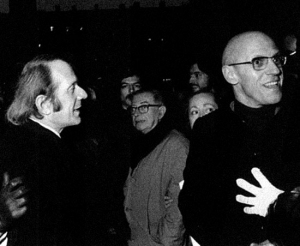
“Gilles Deleuze and Michel Foucault discussed the shifts in militantism and their implications in a public dialogue on March 4, 1972.”

The Ruin of Representation

A century ago and up until the 1960s, political action was framed under unions, parties, and associations, and consisted in attending rallies and organizing strikes, meetings, and marches. In this context, militants delivered pamphlets and gave speeches—what is known as “agitation” work. For instance, Lucy Parsons was a member of the Communist Party and an indefatigable agitator who also belonged to the Chicago Working Women’s Union and joined the Socialist Worker’s Party in 1877. Parsons travelled throughout the United States and became a well-known labor leader and one of the main defenders of anarchism, Black people, and the rights of prostitutes.4 Another militant, French philosopher Simone Weil, sought to transcend the domain of politicized speech (although she was known to have given speeches at workers’ meetings in Le Puy, where she taught philosophy) and engaged in factory and peasant work as well as in armed struggle with the Republican Army in Spain. In the 1960s, a major shift took place in political engagement, especially after May ’68. Following in Weil’s footsteps—and in opposition to Jean-Paul Sartre, who kept militant action and philosophy as two separate activities—figures such as journalist Ulrike Meinhof, philosopher Régis Debray, and filmmaker Masao Adachi bypassed the party as the container for progressive politics and engaged directly in armed struggle, seeking to join theory and practice. Maoist students also rejected the party and worked alongside laborers and peasants, no longer seeking (as Lenin’s had prescribed in his text “What is to be Done?”) to militate ahead of them, but to learn from them.

Gilles Deleuze and Michel Foucault discussed the shifts in militantism and their implications in a public dialogue on March 4, 1972.5 They posed the question of the role of intellectuals in relation to the struggles of students, workers, and prisoners. In the discussion, Foucault defined two types of politically involved intellectuals: “outcasts,” who engage in actions that are regarded as subversive or “immoral” by bourgeois society (i.e., Jean Genet); and “socialists,” who use discourse to reveal particular truths (i.e., Rosa Luxemburg). Intellectuals had traditionally taken the latter role, serving as “the consciousness of the people.” The events of May ’68, however, marked the awareness that the masses no longer needed intellectuals to represent them or to describe their various forms oppression. For Deleuze, the role of the intellectual was no longer to situate himself ahead of workers, but to contest the very forms of power that position intellectuals as producers of knowledge. Thus, what was problematized by May ’68 was precisely the notion of the “representative consciousness.” Intellectuals had been rendered aware of how they propagate discourses of power disguised as “knowledge,” “consciousness,” and “truth.” For Foucault and Deleuze, there could be no representation, not because there wasn’t a signifier (“archaism”) that could bring together a given group based on common interests, but because in “speaking for others,” there is always an unconscious desire operating: to know, appropriate, and have power over the Other, denying him or her the right to self-consciousness.

Foucault and Deleuze thus gave intellectuals the task of organizing struggles beyond representation and “class consciousness.” They posited militantism as a matter of denouncing, speaking out, finding targets, and creating tools to fight different forms of power and oppression. This cleared a path for an array of different struggles beyond class consciousness, rooted in the cultural and social arenas, as well as for a politics of counter-information, which privileged the mass media as a site of militant intervention. New micropolitical struggles targeted the processes of subjectivation (subjectivation) and subjugation (assujettisement or sujétion), which assigned roles, functions, and identities to individuals subordinated by a given form of power. These struggles sought to use the logic of subjectivation to organize militant self-consciousness, constructing an active, politically constituted subject or subjectivity that could counter the process of subjugation. In the domain of art, after the shifts prompted by the ruin of aesthetic-political representation (manifested in philosophy as post-structuralist theory), artists developed conceptual art strategies that aimed to dematerialize the art object in order to resist its ever increasing status as a commodity. Through institutional critique they began to question the conditions of art production, and through a pedagogy of viewership, they made art (most notably video art) that sought to counter the spectacle.

From Anti-Imperialism to the Global Celebration of Difference

Parallel to student and worker struggles in Europe, anti-imperialism and decolonization battles were underway in the third world, seeking to establish alternatives to Western capitalism. Cuba, China, Palestine, Chile, and Vietnam were key referents in the 1970s. Communism was a “living hypothesis,” a horizon that mobilized the belief, passion, and will of a large part of the revolution and inspired solidarity from the Western world.6 The political figures brought about by anti-imperialism were the empowered peasant or slum-dweller and the colonized subject fighting for their own emancipation against empire. By the 1980s, however, the revolutionary anti-imperialist subject and project had been disavowed as a sort of aberration of decadent socialism, A new de-ideologized form of third-world emancipation, beyond the international division of labor and the figure of the worker as a politically self-defined subject, was foregrounded. Anti-imperialism had implied universalizing a cause or giving a name to a political wrong; the “wretched of the earth” emerged for a historically specific period of time as a new figuration of “the people” in the political sense. But a new ethical humanism took over, replacing revolutionary and political sympathy with pity and moral indignation, transforming the latter into political emotions within the framework of human rights.7


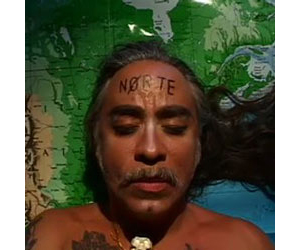
Guillermo Gómez-Peña, Declaration of Poetic Disobedience, 2006. Video still. Image copyright of the artist, courtesy of Video Data Bank.

This led to new figures of alterity in the 1980s and ’90s: the “suffering other”’ who needs to be rescued, and the postcolonial subaltern demanding restitution, presupposing that visibility would follow emancipation. These figures became the postcolonial, ethnically self-defined and self-represented subjects struggling for recognition and for a place from which to speak their own suppressed, unheard, or forgotten narratives: “I speak therefore I am,” utters performance artist Guillermo Gómez-Peña in his Declaration of Poetic Disobedience (2006). In order to avoid the representation of identities based on archaisms (or “essentialisms,” as Gayatri Spivak put it) that would perpetuate the discourses of Western society’s “Other” through nationalisms, myths, and other types of ethnic-specific narratives, in the 1980s postcolonial theorists posited a differential structure of identification, in which identity was conceived as always being in the process of formation, constructed through ambivalence and “splittings.”8 What became crucial politically, according to Homi Bhabha, was the articulation of “interstitial moments,” or processes produced in the articulation of differences. For Bhabha, “third spaces” can allow for an elaboration of “communal” representation, generating “new signs” of cultural difference as “sites of collaboration.”9 The concept of “difference,” however, came to be trivialized. By the late 1990s it manifested itself in the art world as biennials in marginal corners of the world, somehow fulfilling the multicultural utopia of globalization.

Under the site-specific intervention model of the biennial, space came to be regarded as epistemically rich; delivering experiences or intervening in everyday processes took over from representation. Site-specific art sought to infuse social criticism into the everyday. As a moral statement, however, site-specific intervention became the limit of its own political effect. Confined within the art world, it provided contrasts and pointed at potentials, yet fell short of modifying the background of political turmoil, and even caused epistemic violence to the site in question. Site-specificity had been liberatory insofar as it had enabled the displacing of essentialized nation-state identities and had introduced the possibility of multiple identities, allegiances, and new meanings. This was prompted by what Susan Buck-Morss described as a compensatory fantasy that responded to the intensified fragmentation and alienation of an expanded market economy.10 Thus, in the “biennialized” art world, multiculturalism, polyphony, and marginality actually came to affirm white hegemony, insofar as they expressed a moral struggle for recognition. Considering that fluid identities are made possible by the privilege of mobilization and thus bear a specific relationship to power, a new class division based on degrees of mobility was established: on one side, a transnational class of cultural workers with smooth access and safe passage, pondering the elsewhere of global processes; on the other, migrant workers and refugees crossing borders as “illegals” to survive.


Minerva Cuevas’s Mejor Vida Corp offers a student card to an exhibition visitor, 2012.

Globalphobic Aesthetics and Tactical Media

With the fall of the Soviet Union in 1989, the political horizon of communism as a promise, a utopia, an intellectual construct, and a political vision waned. Instead, it became a place and an event in actual history, a disastrous experiment manifested in totalitarian dictatorships.11 As neoliberal policies were implemented and free trade agreements were signed across the world, the antiglobalization movement arose in the mid-1990s, opposing neoliberal reforms and fighting for fair trade, sustainable development, human rights, and corporate accountability. Following Brian Holmes, this movement was the first attempt at a widespread, meshworked response to the chaos of the post-’89 world system. Within this framework, anticapitalists critiqued the failures of neoliberal governance from an array of different positions: democratic sovereigntists, anti-border libertarians, and the more traditional, union-oriented Keynesians.12 The antiglobalization movement conceived itself as a social base for criticizing corporate capitalism, globalization, and the growing political power of multinational corporations, exercised through trade agreements and deregulated financial markets.

Antiglobalization protesters converged at gatherings of world leaders, most notably in Genoa 2001, and at their own international conferences, like the World Social Forum in Porto Alegre, Brazil that same year. The political subjectivity embodied by the movement was theorized by Michael Hardt and Antonio Negri, who, in line with May ’68 post-representational politics, sought to go beyond the worker-based identity of the “proletariat” and the homogeneity inherent in the concept of “the people.” They thus they coined the term “the multitude.” For Hardt and Negri, the multitude is a social being formed in the no-place of capitalism. It is a decentered network of singular cells within Empire immanently producing the “common,” which is also the substance of the multitude and the condition and end of production (the locus of surplus value). The multitude exists within the imperial rule of biopower, a form of social control that regulates and administers life from within, extending through consciousness, bodies, and the entirety of social relations. As opposed to taking over power and the means of production, as Marxism prescribed in the twentieth century, for Hardt and Negri the task of the multitude is to democratize the common(s), exploit networks of social production with the purpose of achieving autonomy, and undermine the sovereignty of biopower. The flesh of the multitude, however, embodies a series of ambivalent conditions that can become dangerous: social production can either lead to liberation, or be caught in a new regime of exploitation and control, feeding biopower.

In parallel with the antiglobalization movement, artistic production veered toward anticapitalist politics, characterized by interdisciplinarity and the adoption of an array of countercultural positions and political affiliations, with the goal of creating autonomous zones, albeit symbolically. Examples include art collectives producing counter-informative, didactic, and symbolic interventions or actions against capitalism in the public sphere: REPOhistory, Group Material, Guerrilla Girls, WochenKlausur, Colectivo Cambalache, Las Agencias (Yomango, Prêt à Revolter, and so forth), Ne Pas Plier, Haha, the Yes Men, Superflex, Mejor Vida Corp., the Center for Land Use Interpretation, the Atlas Group, Raqs Media Collective, and Chto Delat. At the same time, tactical media emerged, with strategies like attacks on servers as digital “sit-ins.” But while this form of creative activism lasted only until a globally integrated system of electronic surveillance was implemented after September 11 (as clandestinity became impossible and this form of attack was criminalized), antiglobalization art and activism have been criticized for having no political program, or for having the vague program of using imperialism against itself.13

For Hardt and Negri, the multitude has the desire for world equality, freedom, and a global democratic society, and it has the power to achieve them; but it has no discernible goals or agenda beyond opposing capitalism and appropriating production. The limitations of the antiglobalization agenda are illustrated by one of the actions performed within the framework of Yomango, a Spanish artistic project of social disobedience. The Yomango project involved disseminating instructions on how to appropriate goods available in globalized stores, followed by gatherings in which the goods were shared. Designed to facilitate the redistribution of the commons, the action, however, obscured the international and thus imperial division of labor and the conditions of production surrounding the goods that the participants appropriated for themselves.

Following Brian Holmes, the antiglobalization movement ultimately faltered due to the cultural consequences of globalization, that is to say, the global success of American mass culture, which extinguished local cultures only to resurrect them in a Disneyfied form. The antiglobalization movement was also defeated by the very neoliberal program that launched it in the first place, which manifested itself as a military, moral, and religious return to order, a massive expansion of capital, and a worldwide clampdown on civil liberties.14 In the realm of “high culture,” the expansion of American mass culture went hand in hand with the globalization of Western modernism as the lingua franca of contemporary art, derived from an emptying-out of postmodernity as a critical and temporal category, and its replacement by a singular and internally differentiated global modernity.15


Suzanne Lacy, Annice Jacoby, and Chris Johnson, The Roof is On Fire, 1994. Performance, Oakland, California.

Relationality and Salvaging Art

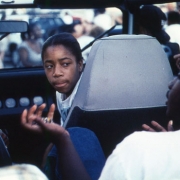
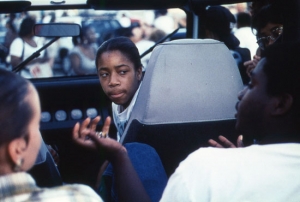
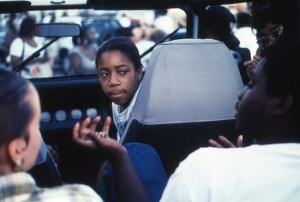
In parallel with the antiglobalization agenda, a current in art production sought to experiment with different forms of collectivity and community beyond identity and processes of identification. Relational art of the 1990s was the catalyzer for transient communal gatherings that sought to revive social relations and counter the alienation brought about by the spectacle. This form of art, described by Nicolas Bourriaud, envisioned the audience as a community and unfolds in the realm of human interactions, elaborating meaning collectively. Instead of having a “utopian” agenda, relational artists sought to find provisional solutions in the here and now; this is why relational artworks insisted on being used rather than contemplated.16 Another current of this participatory aesthetics was described by Claire Bishop, who put antagonism at its core in the creation of situations in which the members of a collectivity are confronted, thus drawing the limits of society’s ability to fully constitute itself.17 There were also “dialogical” practices, exemplified by the work of Suzanne Lacy, which brought together an array of different people (i.e., high school students, the police, the media) and dispositifs, repurposed for the creation of transversal spaces for dialogue.18 In Lacy’s piece The Roof is On Fire (1994), part of her Oakland Projects, 220 public high school students took part in unscripted conversations about family, culture, race, and education while sitting in one hundred cars on a rooftop garage, with Oakland residents listening to them. Lacy’s work combines institutional and social apparatuses with educational workshops, mass media, and policy development.

We can regard relational, participatory, and dialogical art practices as experiments with new models of social and political organization. These experiments emerged in the face of the fragmentation, the destruction of social bonds, and the alienation brought about by globalization. These practices also evidenced how art has become a form of experimental activity that overlaps transversally with the world through its flight into other disciplines, dispositifs, and regimes, with the purpose of addressing sociopolitical concerns. Participation, however, has its limits, as it is one of the forms of neoliberal governance and power. Following Eyal Weizman, at the horizon of participation there is collaboration, “the tendency to forcefully, or willingly, align one’s actions with the aims of power, be it political, military, economic or a combination thereof.”19 The problem is that the options from which we are allowed to choose cannot themselves be challenged, and thus participation ends up forcing the subject into compliance with power. This form of power has been conceptualized by Wendy Brown as “neoliberal governance,” and its focus is creating incentives to negotiate goals in common.20

Governance in this regard implies the creation of systems that enable administered or controlled inclusion through the fetishization of democracy. Via integration, individuation, and cooperation, democracy is reduced to “participation,” yet divorced from justice. Discontent is placated.21 Participation thus raises political and ethical dilemmas, demanding that the power relations enabling participation be urgently questioned. Participatory art, however, can be understood as an effort to experiment with ways to restore community links that have been destroyed or threated by neoliberal policies. Similar to Jean-Luc Godard, who has posited the image as a form of “salvaging the real,” W. J. T. Mitchell has posited site-specific or relational art as a form of “salvaging,” digging out things, recovering ruins, and rescuing neighborhoods by involving art and collaboration between institutions and communities.22

Art is expected to “save” reality by reviving the singularity of places and persons—here we can recall the use of locality and site- or cultural-specificity in the 1990s. It is not that the world or reality has been lost, but rather that our connection to and belief in them have been destroyed, and thus need to be saved. Art can help. For Mitchell, art’s new vocation is to remake the world both literally and symbolically as a way of constructing social solidarity and forms of imagining together (e.g., Pedro Reyes’s repurposing of guns as musical instruments, or Theaster Gates’s Dorchester Project, which involved the renovation of formerly abandoned buildings in Chicago’s South Side). The role of this kind of art has been to experiment with ways to restore vital contact with the real, highlighting the current crisis of presence due to extreme alienation in the West.


The group Yapi Sanat places a protest statue in front of the Istanbul Biennale at Istanbul Modern.

Politics of the Art World and Politics of Resistance

Antiglobalization, relational, and interventionist forms of aesthetic practice exemplify the different ways in which art and politics have related to each other within politicized aesthetics. But there are other ways in which politics and aesthetics converge. There is, for instance, a politics of the art world, as exemplified by Hito Steyerl’s video Is the Museum a Battlefield? (2013). In this video-performance, which is also a kind of documentary, Steyerl eloquently connects a shell casing found on a battlefield in Turkey to the military-museum-industrial complex, revealing the ties between the weapons industry, transnational corporations, “starchitecture,” and global biennials. The genealogy of Steyerl’s video can be traced back to the institutional critique of 1970s, ’80s, and ’90s, which aimed to elucidate the discourses behind exhibition practices and raise concerns about art sponsorship.

Taking institutional critique even further, recently there have been mobilizations that transcend the domain of art production to become direct political action within museums. For instance, last June members and allies of the group Gulf Labor temporarily occupied the Guggenheim in New York to protest the working conditions of laborers building the new Guggenheim museum in Abu Dhabi. The group Liberate Tate has also engaged in various direct actions to shed light on British Petroleum’s sponsorship of the museum. Artists are less and less keen to separate creativity, exhibition venues, and the sponsors that support them. They are reluctant to give credibility to sponsors that fund art in order to whitewash their own crimes.23 These political acts—which involve taking a position, issuing demands, and boycotting—are different from the politically engaged practices I elucidated above, which have used the art world as a strategic space for political discussion and experimentation.

Through disruptive actions, groups Gulf Labor and Liberate Tate protest against labor exploitation, the capture of public space, climate injustice, and gentrification. They denounce the art world as “a spectacular subsystem of global capitalism revolving around the display, consumption, and financialization of cultural objects for the benefit of a tiny fraction of humanity, the 1%.”24 Artists at the 2015 Istanbul Biennial organized a “productive disruption” to highlight the escalation of violence in Turkey, demanding a return to peace negotiations between the Turkish government and the Kurdish PKK.25 At the 2015 Venice Biennale, artists issued a “Letter for Palestine” that called attention to the campaign for the academic and cultural boycott of Israel.26 Also expressing solidarity with Palestine, at the 2014 São Paulo Biennial 176 of 199 participating artists signed an open letter opposing Israeli “cultural sponsorship” of the event. The curators supported the letter, and in response the Fundação Bienal de São Paulo agreed to “clearly dissociate” Israeli funding from the overall sponsorship of the exhibition.27 Artists are now raising awareness about the epistemic and physical violence committed in sites of art production elsewhere. They are trying to restore contact with the political real by investigating and denouncing labor exploitation and new forms of enslavement: the figure of the worker as a site for politicization is returning to the fore.

Creating assemblages that link actors from the art world to projects oriented toward political action, these actors seek to create subjectivities and terrain for political acts by locating power struggles (instances of subjectivation), and are sometimes linked to social and political movements, autonomous collectives, and alternative media. Following Gregory Sholette, however, these forms of art tend to be characterized by the problematic absence of any ideological counternarrative to capitalism and by the belief (ever diminishing) that “cultural producers can bring something extraordinary to the underprivileged masses via the benefits of serious art.”28 Many of these practices described so far do not constitute political acts in themselves: images and symbolic gestures have served as back-ups to help activists gain political influence and visibility. While art and the art world have indisputably served as a self-reflexive site, and elucidated on global processes of oppression and expropriation, experimental laboratories or platforms for communal organization, collective therapies, speculative politics, yet as vehicles for visibility, politicized aesthetics these formats are not in and of themselves, a means to resist. Moreover, we must consider that critiques of capitalism need a social base, as well as forms of organization to resist against the neoliberal destruction of forms ways of life and common experiences. We must also take into account that nowadays, power is embedded in everyday objects and environments, that power is the order of things itself: it is not only infrastructure, but the way in which it works, is controlled, and built.29 These forms of power make the nation-state deaf to any demands we might make of it. The nation-state today legitimizes itself not through democratic processes, but by neutralizing citizen demands through governmentality, and by governing its populations differentially, as we will see in the following part of this essay.

****
Irmgard Emmelhainz is an independent translator, writer, researcher, and lecturer based in Mexico City. Her work about film, the Palestine Question, art, cinema, culture, and neoliberalism has been translated to Italian, French, English, Arabic, Turkish, Hebrew, and Serbian, and she has presented it at an array of international venues. She is member of the editorial board of Scapegoat Journal, and has recently finished a book on neoliberalism as a sensibility and common sense embedded in urban planning, work and life, culture, social movements, mourning, and women’s struggle.

1 Jodi Dean, “Politics without Politics,” Parallax 15.3 (2009): 20–36.

2 See Comité Invisible, A nos amis (Paris: La fabrique, 2014), 72–83.

3 These were some of the questions posed at the Sharjah March Meeting in May 2015.

4 See Angela Y. Davis, Mujeres, raza y clase (Madrid: AKAL, 2004), 157–159.

5 Gilles Deleuze and Michel Foucault, “Intellectuals and Power: A Conversation Between Michel Foucault and Gilles Deleuze,” Language, Counter-memory, Practice, ed. Donald F. Bouchard (Ithaca: Cornell University Press, 1977).

6 See Maurizio Lazzarato, “From Knowledge to Belief, from Critique to the Production of Subjectivity,” Transversal, April 2008 →

7 See Irmgard Emmelhainz, “From From Third Worldism to Empire: Jean‐Luc Godard and the Palestine Question,” Third Text 23.100 (Fall 2009): 649–656.

8 See Stuart Hall, “Old and New Identities, Old and New Ethnicities,” Culture, Globalization and the World-System: Contemporary Conditions for the Representations of Identity, ed. Anthony D. King (Minneapolis: University of Minnesota Press, 1997), 43.

9 Homi Bhabha, “Frontlines/Borderposts,” in Displacements: Cultural Identities in Question, ed. Angelika Bammer (Bloomington: Indiana University Press, 1994), 269.

10 Susan Buck-Morss, Thinking Past Terror: Islamism and Critical Theory on the Left (London: Verso, 2003), 64.

11 See Boris Groys, “The Post-Communist Condition” →

12 Brian Holmes, “Continental Drift: Activist Research, From Geopolitics to Geopoetics,” framework X ephemera 5.X (2005): 741.

13 See Gregory Sholette, “Art Out of Joint: Artists’ Activism Before and After the Cultural Turn,” The GULF: High Culture/Hard Labor, ed. Andrew Ross (New York: OR Books, 2015), 80.

14 Holmes, “Continental Drift,” 741.

15 See Peter Osborne, “The Postconceptual Condition or, the Cultural Logic of High Capitalism Today,” Radical Philosophy 184 (March-April 2014): 19. This singular modernity is akin to what Nicolas Bourriaud termed the “Altermodern” in his Altermodern (London: Tate Publishing, 2009).

16 See Claire Bishop, “Antagonism and Relational Aesthetics,” October 110 (Fall 2004): 51–79.

17 As in Santiago Sierra’s confrontations or in Thomas Hirschhorn’s Bataille Monument (2002), which was part of Documenta 11. Ibid.

18 See Grant Kester, Conversation Pieces: Community and Communication in Modern Art (Los Angeles: University of California Press, 2004).

19 Eyal Weizman, “The Paradox of Participation,” introduction to Markus Miessen, The Nightmare of Participation (Frankfurt: Sternberg Press, 2011), 9.

20 Wendy Brown, Undoing the Demos: Neoliberalism’s Stealth Revolution (New York: Zone Books, 2015),

21 Ibid., 129.

22 Mitchell delivered these remarks in a lecture at the 2015 Sharjah March Meeting. The voice-over in Godard’s Histoire(s) du cinema (1998) says the following: “Même s’il est bondé d’égratignures au point de ne plus être utilisable, un petit rectangle de 35 millimètres est capable de sauver l’honneur de la réalité toute entière” [Even fatally scratched, a small rectangle of 35 millimeters is capable of saving the honor of the whole of reality].

23 See Global Ultra Luxury Faction (G.U.L.F.), “On Direct Action: An Address to Cultural Workers,”in The GULF, 134.

24 “Global Ultra Luxury Faction (G.U.L.F.) Manifesto,” June 25, 2015 →

25 See “Artists at Istanbul Biennial plan ‘Productive disruption’ to demand resumption of peace talks,” e-flux conversations, September 1, 2015 →

26 See Hrag Vartanian, “Artists Launch Letter for Palestine Campaign at Venice Biennale,” Hyperallergic, August 13, 2015 →

27 See Guy Mannes-Abbott, “The Emergent Wave of Artworld Activism,” The GULF, 98.

28 Sholette, “Art Out of Joint,” 83.

29 Comité Invisible, A nos amis, 84–86.

How artists see

By Sadie F. Dingfelder

Published by the American Psychological Association
Monitor, 2010, Vol 41, No. 2

Can you sketch a landscape, or even a convincing piece of fruit? If not, chances are that your brain is getting in the way, says painting teacher and landscape artist David Dunlop.

“People don’t see like a camera,” he says. “We go through life anticipating what we are going to see and miss things — which is why so many wedding invitations go out with the wrong date.”

In his art classes, one of the first things Dunlop tells students is to stop identifying objects and instead see scenes as collections of lines, shadows, shapes and contours. Almost instantly, students sketches look more realistic and three-dimensional.

Artists have long known there are two ways of seeing the world, says University of Oslo psychology professor Stine Vogt, PhD. Without learning to turn off the part of the brain that identifies objects, people can only draw icons of objects, rather than the objects themselves. When faced with a hat, for instance, most people sketch an archetypal side view of a hat, rather than the curves, colors and shadows that hit our retina.


Rembrant, 1629, Gardner Museum, USA

In fact, artists’ special way of seeing translates into eye scan patterns that are markedly different from those of nonartists, according to a study by Vogt in Perception (Vol. 36, No. 1). In her study, she asked nine psychology students and nine art students to view a series of 16 pictures while a camera and computer monitored where their gazes fell. She found that artists’ eyes tended to scan the whole picture, including apparently empty expanses of ocean or sky, while the nonartists focused in on objects, especially people. Nonartists spent about 40 percent of the time looking at objects, while artists focused on them 20 percent of the time.

This finding suggests that while nonartists were busy turning images into concepts, artists were taking note of colors and contours, Vogt says.


Rembrandt, 1655, Kunsthistorisches Museum, Germany

While it takes years of training to learn to see the world like an artist, a common visual disability may give some people a leg up, says Bevil Conway, PhD, a neuroscience professor at Wellesley. In a study published in the New England Journal of Medicine in 2004, he and Harvard neurobiologist Margaret Stratford Livingstone, PhD, analyzed 36 Rembrandt self-portraits, and found that the artist depicted himself as wall-eyed, with one eye looking straight ahead and the other wandering outward.

This condition, called strabismus, affects 10 percent of the population and results in stereoblindness — an inability to use both eyes to construct an integrated view of the world. Stereoblind people can’t see “magic eye” images, in which a chaotic background turns into a single three-dimensional image. They also have limited depth perception and must rely on other clues, such as shadows and occlusion, to navigate the world.

Rembrandt’s stereoblindness, says Conway, may have given him an advantage in seeing the world like an artist. It’s no accident that art teachers often tell their students to close one eye before sketching a scene, he says. The eye’s imperfect optics, which form a slightly blurred image of any scene, also may be a factor, he adds.

“Rembrandt had a whole lifetime of honing the ability to render three-dimensional images in two-dimensional space,” he says.


Rembrant,1657-59, National Gallery of Scotland, Edinburgh

Stereoblindness may also give lesser-known artists an advantage, Conway says. A yet-unpublished study by Conway and Livingstone finds that the art students are far more likely to have the visual disability than non-artists.

Vogt, a painter as well as a scientist, says that stereoblindness and concept-blindness help artists see the world as it really is, as a mass of shapes, colors and forms. As a result, artists can paint pictures that jar regular people out of our well-worn habits of seeing.

“As artists, our job is to get people to enjoy their vision, instead of just using it to get around,” she says.

This article was published by the American Psychological Association. Monitor on Psychology, 2010, Vol 41, No. 2
http://www.apa.org/monitor/2010/02/artists.aspx

For a similar article published in the New York Times see “A Defect That May Lead to a Masterpiece” by Sandra Blakeslee, June 13, 2011.

Baharestan: Tehran’s Spring Urban Art Event

By Maya Baraona

In recent years, in celebration of the Persian New Year, the Tehran Municipality and the Organization of Tehran Beautification have been organizing an annual spring urban art event comprised of art exhibits and installations in public spaces around the city. With each coming year the event has grown larger with a greater number of participating artists and encompassing a wider range of art forms.

This year, Tehran’s spring urban art event was officially named “Baharestan”, meaning “spring garden”; it included mural painting, sculpture, graphic design, installation and environmental/urban art, with a special section dedicated to Norouz “egg painting”.

The event was organized as a competition and the Municipality received an overwhelming number of proposals from artists in all fields. In the sculpture and environmental art sections, 1’431 proposals were submitted by 532 artists out of which 160 artists were invited to participate in the event.

The artworks started going on display in public spaces around the city before the arrival of the New Year and will be exhibited through the end of Farvardin (April 18).The installations are quite varied with each artist marking the cityscape with their own unique style and imagination. The exhibits can be viewed along Vali’asr Ave. from Rahahan to Tajrish; along Enghelab St. from Meydaneh Enghelab to Ferdowsi and also on Keshavarz Blvd.

Fantasy, imagination, humor, nature, and the playful transformation of everyday city objects are prominent themes throughout the artwork. Concrete bollards transformed into mini-people, winged chairs floating on tree tops, pink ladders crossing bubble clouds, trees dressed in colorful yarn, walls with big ears and large imaginary creatures seated on city walls are just a few examples.


In the Norouz “egg painting” section, 694 artists submitted 2’122 proposals, out of which approximately 119 proposals were selected as finalists. In addition to the winning artists, a number of well-known established artists such as Mahnoush Moshiri, Parviz Rastegar and Jamshid Haghighat Shenas were also invited to participate in the event and thus a total of 250 eggs were painted and displayed in 5 major parks: Mellat, Laleh, City Park (ParkehShahr), Ferdows Garden and Abbasabad Norouz Garden.

The concept behind the “egg painting” section was to use the eggs as a canvas for painters and illustrators to showcase their art rather than create merely decorative objects. In addition to being one of the important elements of the “Haft-seen” spread (2), the eggs are a symbol of spring, fertility and birth.

In the murals section of the event, 94 artists created new mural paintings on the walls of Tehran where they will remain as permanent art pieces.The graphic design section of Baharestan showcased work by 44 designers on billboards across the city.

Such public art events are not a novelty throughout the world; New York, Paris Berlin and many other great cities stand as precedents to Tehran. The main question here is how does Tehran’s Baharestan compare to events organized by other cities?

Two major differences stand out in comparison to other cities and these have to do with the quality and quantity of the artwork presented through the event. In comparison to other cities, the number of participating artists and artworks created during this year’s Baharestan event is absolutely mind boggling! To think that in such a short period, 160 installations, 94 murals, 250 eggs and a large number of billboards were created and set up for exhibition throughout the city is both amazing and alarming. It is amazing because no other event has produced so much work in so little time; and alarming because it seems that in the minds of the curators the question of concept, thought and careful execution was forfeited by the idea of “the more the merrier”.

Tehran’s Baharestan may not be an exhibit of the finest and most sophisticated examples of Iranian contemporary art but it has certainly been a huge success in terms of providing an opportunity and platform for the younger generation of Iranian artists who cannot easily find venues for their creativity and constantly face an uphill battle in the world of elitist galleries and art shows. And while more is not necessarily better, in this case it has certainly been “merrier”. With large numbers of young enthusiastic artists painting, sculpting and setting up installations throughout the city, a wave of joy and creativity has engulfed the mega-city, bringing vitality and creating a spirit of renewal. This spring cultural event has been so well received across the social spectrum that in addition to the many renowned artists, actors, filmmakers and city planners who have made positive comments, individuals such as Ali Parvin -the popular Iranian athlete- have also shown their support.

One of the most important aspects of public art is that it is accessible to a wide range of social groups. According to Penny Balkin Bach, the founder of America’s first non-profit organization dedicated to the integration of art and urban planning “public art occupies a unique position within the art world. In comparison with big-name gallery shows, public art is often “under-appreciated” much like landscape architecture is. But there’s lots to applaud: “It’s free. There are no tickets. People don’t have to dress up. You can view it alone or in groups. It’s open to everyone.” As Bach points out, bringing art to urban spaces is a major step towards raising social consciousness and unlike museum exhibits and gallery shows which are visited by a very select social group, urban art reaches out to all layers of society.

Finally, as a socio-cultural event, Baharestan should be praised for two major achievements: firstly for providing an opportunity for young artists to exhibit their work and secondly for promoting art and creativity by exposing art to all layers of society.

To participate in the Baharestan photo competition please visit:
http://zibasazi.ir/fa/calls/item/7804

Sources:
http://zibasazi.ir/fa/urban-arts/

http://www.fardanews.com/fa/news504745/

http://www.iscanews.ir/news/619727

“Why Public Art is Important”, dirt.asla.org/2012/10/15/why-public-art-is-important/

PERSIAN PAINTING: A VISUAL WINDOW INTO A GENDERLESS LANGUAGE

By Najmeh Khatami

Note: This article published in Pakistan Journal of Women’s Studies: Alam–e-Niswan Vol. 20, No. 1, 2013, pp.73-86, ISSN: 1024-1256, does not necessarily reflect the views held by Farairan.

Abstract A discerning trait of Persian painting, which differentiates it from the Western style of painting, is the irrefutable resemblance between the male and female figures. Persian painting is closely entwined with Persian poetry and therefore, the primary focus of this study are the illustrations accompanying poems which narrate Persian folklores in order to have portrayals of culturally well-known male and female figures. An attempt is made to compare and demonstrate the similarities between the studies done on Persian literature and metaphor, and the studies done on Persian art. Previous studies on Persian paintings have mainly associated the genderless nature of the painted figures to widespread homosexuality in mediaeval Persia. However, this study investigates this trait of Persian paintings with a new outlook; it scrutinizes the relationship between the genderless nature of Persian language and the similarity between the different genders’ figures in classical Persian paintings. The ambiguity of the gender, which could be possible only by the usage of a genderless language such as Persian, was transferred in Persian paintings in the form of similarity between the female and male appearances.

Keywords: Persian painting, gender-less language, medieval poetry, Iran, visual rhetoric
Historical Overview
By the end of the ninth century and the beginning of the tenth century, with the collapse of the Abbasids, the last Arab dynasty’s more than three hundred years dominion over Persia ended. Several Persian dynasties gained power one after the other for the next ten centuries until the end of monarchy in Iran in 1979. It was only after the end of the Arab sway that a movement towards rediscovering the Persian language, pre-Islamic cultural values, and arts, revival of the Zoroastrian religion in a Persian Islamic body, Shiism, and a sense of nationhood among the Persians began. This movement became faster and stronger especially under the Safavids who ruled Persia from the sixteenth to the eighteenth centuries (Canby, 1999). In the Safavid era, Persia again became a regional superpower, and peace and stability spread out within the country’s borders; consequently, Persian literature, arts, philosophy, and medicine witnessed a great blossoming during this period (Azhand, 2000). Persian painting and calligraphy were not excluded; Persian artists, for the first time in the history of Persia, established the art of bookmaking in its modern style. This technique was a combination of various art forms such as poetry, calligraphy, painting, decorative borders, and bookbinding and covering. Books were prepared under the orders of the rulers and authors were patronized by the court. Among such works are included masterpieces such as Shahnameh (The Books of Kings) of Ferdowsi, Panj-Ganj or Khamsa, Quinary of Nezami Ganjavi, Bostan (The Orchard) and Gulistan (The Rose Garden) of Saadi, which were written in beautiful hand writing by a consummate calligrapher and images painted by an accomplished painter, and then boarded and bound by skilful artists. Safavid rulers, who themselves were familiar with the arts of calligraphy, poetry writing and painting, surrounded themselves by a circle of court artists such as court poets, painters, calligraphers, illustrators, and architects. (Azhand, 2000). From among the famous Persian artists of this era, we can recall master calligraphers Mir Emad, and Ali Reza Abbasi, and adept painters such as Kamal ud-Din Behzad, Mohammad Zaman Negargar, Mohammed Qasim, titled as ‘the Universal Painter’ and Mohammad Yusuf Mosarar (Canby, 2000).


Shah Abbas and young page, Mohammad Qasim (1620-25), Louvre Museum.

Why Persian Paintings and Not Persian Miniatures?
The same style of painting which was commonly used in Pre-Islamic Persian mural paintings, and was found in excavations in Central Asian countries, India, Afghanistan and the western parts of China, the areas that were parts of the ancient Persian Empire, was modified and recreated by medieval Persian painters, and probably were transferred to paper (Grabar, 2000). It is because of this that some Iranian scholars are reluctant to use the word miniature, which traditionally is used for all works of art of miniature size. Iranian scholars, instead, prefer the word Negareh, which refers to the style rather than the size of a painting. Derived from the Latin word minium which means red lead the term ‘miniature’ was initially used for the medieval illuminations as their principal pigment was red lead. Later, it was used for “very small portrait paintings finely executed on vellum (skin), precared cards, copper or ivory, jewelry, boxes, lockets, palm leaves and paper” (Pande & Lavanya, 2004). This paper uses the term ‘Persian paintings’ and not ‘Persian miniatures’.

A discerning trait of Persian paintings, beside their colourful theme, their superficial simplicity, and dense accumulations of minutely rendered details, is the irrefutable resemblance between the male and female figures. If it was not for the differences in their headgears, turban, or crown for men versus veil or tiara for women, it was very difficult to decide whether we are looking at a male portrait or a female portrait. Male figures with slender and delicate appearance and long hairless faces, arched V shaped eyebrows and thin lips resemble women’s faces, and female figures with boyish, long willowy bodies without any feminine curves even in the scenes in which women are shown nude – with no breasts – are not unlike young men’s figures. What could possibly persuade a painter to create such “genderless” humans? Could this trait of traditional Persian painting, before it was influenced by Western art, be suggested by the language, Persian language, the genderless language of the poems that accompany these painting?

In this study, I tried to investigate my hypothesis, and find out if there is really a relationship between the genderless nature of Persian language and the similarity between the different genders’ figures in classical Persian paintings. I conducted a library-based research in an attempt to familiarize myself with the existing work in the field, and seek a convincing answer to my research question. In addition to the scholarly works done on the paintings inside and outside Iran, which I should confess are unfortunately very limited, I also looked into the studies conducted in the field of Persian literature and metaphors – especially the parts pertaining to description of human figures – in order to have a firmer comprehension of the reasons circling my research question. The focus of my study is more on the visuals accompanying poems which narrate Persian folklores in order to have portrayals of culturally well-known male and female figures. I tried to compare and demonstrate the similarities between the studies done on Persian literature and metaphor, and the studies done on Persian art, and finally draw a conclusion based on my observations in order to help the audience to comprehend my point.

Classical Persian Paintings


Woman with a veil, album folio attributed to Riza-i ‘Abbasi, circa 1590-95. Isfahan, Iran. Sackler Gallery, Smithsonian.

By contrast, with the monuments of Western painting, which one can easily see, well framed and hanging in the museumsof the world, Persianpaintings are usually hidden in books, often fragile, kept in the rare book rooms of libraries in manuscript rooms reserved for specialized scholars and known connoisseurs (Grabar, 2000). These paintings are found in two variations, albums, and manuscripts, both made for the contemporary king to please the royal taste, or to be given to other princes and kings from neighbouring Muslim countries as royal gifts. Albums contain collections of images with different themes, whereas, manuscripts contain poems from well-known Persian poets and images illustrating the climaxes of the stories narrated by the poems (Grabar, 2000).

As it was mentioned earlier after the departure of the Arabs, Persian artists revived and modified the same style of painting which was practiced in pre-Islamic Persia in different forms of arts, such as carpet weaving, ceramic painting, painting, etc. (Canby, 2000). Persian painting and design underwent different changes in different periods of times in the classical era and every so often a new style appeared. From prominent styles of painting in medieval Persia, we can mention Herat traditions, Timurid traditions, Jalayirid traditions, Baghdad and Tabriz traditions (Roxburgh, 2003). The same scenes –for instance the scene of Khosrow watching Shirin bathing in the river – were painted in different styles over different periods of time (Canby, 2000). As pointed out by Roxburgh (2003) “Herat paintings had a larger painted surface area, combination of flat color with expansive areas of wash, and coding of spatial recession by overlapping planes and the bluish effect of atmospheric perspective. Later years, the formal aspects of painting became increasingly coherent and codified”. With the passage of time, the paintings got more intricate and refined and consequently the number of paintings per book decreased as the paintings needed more labour and resources (Roxburgh, 2003). Nature, people, and animals were the main objects of these paintings and early Persian painters used their art to depict the local flora and fauna, the architectural monuments and landscape. (Canby,2000).


Leyli and Majnun last meeting. Khamsaof Nizami, Mid 16th century. Shiraz, Iran. Freer Gallery of Art.

Unlike Western painters, Persian painters did not paint from live subjects, but used their own imaginations inspired by Persian literature to create exotic scenes, and therefore, their paintings had a distinct dream-like style free from painting rules imposed in Western paintings such as perspective, lighting etc. Also in these paintings, there is a striking resemblance between male and female figures, and unless for their headgears, it is impossible to establish the gender of the figure. By the mid-seventeen century with the arrival of huge groups of European explorers and missionaries to Asian countries prior to the colonization era, the Persian painting style was influenced by the European style of painting and, unfortunately, could never return to its original forms.

Classical Persian paining, as mentioned earlier, is closely entwined with classical Persian poetry, therefore unless one does not have a firm understanding of the theme and style of these poems, to understand and comprehend these visuals is not easy. The following section discusses the links between classical Persian poetry and Persian paintings.


Reza Abbasi circa 1600, Isfahan, Iran. Hermitage Museum of Amsterdam.

Classical Persian Poetry & its Relation to Classical Persian Painting
There is an impartible strand between Persian art and Persian poetry. Yarshater points out “yet little attempt has been made to take poetry, the monumental art of Persia, into consideration, and explore fully the features it shares with the visual arts of the country” (Yarshater, 1962). Not much has been done thus far to colour the invisible union between the elements of Persian arts, especially painting, and the Persian language for example something similar to what Kress and Leeuwen have done for Western languages in their book Reading Images: The Grammar of Visual Design. This section first provides some background information about classical Persian poetry, followed by a brief study of how Persian poetry, Persian painting and Persian design, are interrelated.
At the end of the ninth century, after “two centuries of silence”, Persian poetry was reborn, and Persian poets once again started composing poems in Modern Persian – the language that was developed after the Arab invasion in the seventh century – instead of Arabic. The poetry belonging to this era until the seventeenth century is regarded as the classical

era of Persian poetry. Classical Persian poems are divided into “three kinds according to the poems’ length: long (narrative), medium (lyric and panegyric), and short (epigrammatic: encapsulating a mood, insight, complaint, compliment or witticism)” (Davis, 1996). These poems are not only important for their unique, elegant style and the fact that they preserved the ancient Persian mythology and folklore, but also because “they provide fascinating occasional glimpses into vanished and extraordinary way of life in the Persian medieval courts” (Davis, 1996).
Although at the beginning medieval Persia poetry was secular and was used mainly in court panegyric style for praising and entertaining a king or a prince and his companions, or describing erotic love, however, it very quickly developed in the direction of mysticism, and the same extravagant language that was used for praising a king or describing an erotic love, was eminently used for poems of religious devotion. Therefore, as Davis points out, “the rhetoric of panegyric, often with ambiguously erotic overtones – is the addressee a prince, a beloved or God? – was reinforced rather than diluted by its adoption as the language of mystical verse” (Davis, 1996).


Rostam chooses his horse, 1589-90. Enscribed by Qiwam ibn Muḥammad of Shiraz. Peck Shahnameh. Princeton University Library.

One of the vital features of classical Persian poetry is its imaginary view towards the world, where everything is perfect and nothing vulgar or common obtrudes, even the grass is turned to emeralds and dew to pearls. Not surprisingly, with the history of Persian culture that Pope presents us, explaining the extensive role of nature in early Aryan beliefs that was later passed on to their descendants, i.e. the Persians, such as a Cypress tree symbolizing immortality in Aryan beliefs or water as the fluid of life and youth (Pope, 1972). Thus, in classical Persian poems “different kinds of beautiful trees and flowers – Cypress tree, weeping willow, box tree, jasmine, narcissi, pomegranate flower, etc. – as well as precious substances – gold, silver, different gems, musk, old wine, moon, sun, etc. – are utilized to describe the beloved’s body and face” (Davis, 1996). Most of these metaphorical comparisons are culturally understood codes and do not make sense to outsiders as the poet for extending the beauty of the poem and sometimes for holding back the truth and creating more ambiguity for the audience, most of the times omits the tenor of each metaphor. According to Davis “often what is offered [in classical Persian poems] is not reality direct, or the excitement that such reality might generate, but some special nuance of aesthetic effect that reality and its attendant excitements and anxieties can be called on to suggest” (Davis, 1996).


Homay Crowning Darab, Enscribed by Qiwam ibn Muḥammad of Shiraz. Peck Shahnameh 1589-90. Princeton University Library.

Another conspicuous trait of Persian poetry, understood only by those who read the poetry in its original language, is caused by the genderless-ness of Persian language and while the poet is talking about his beloved the reader faces some difficulty to find out whether the beloved is a he or a she. Although Davis points out other indications for indicating the beloved’s sex in these poems, such as pomegranate flowers as a periphrasis for a woman’s breasts or the new grass of spring as a periphrasis for the first signs of an adolescent boy’s beard (Davis, 1996), in most cases it is up to the reader to guess – or not – the beloved’s gender. In fact, ambiguity is part of classical Persian poems created deliberately by the poet by exploiting the genderless nature of the language, and unless he chooses to reveal his intentions – such as in Attar’s case and his poems about Christian- boy-love for the intention of religious divisions and conversion from one faith to another (Lewis, 2009) – it is hard to get rid of it. This ambiguity lets the poet celebrate the moments of heterosexuality as much as homosexuality within a culture that homosexual relationships cannot be fully explored as a social taboo without getting too much into it. It is also important here to mention Davis’ observations in describing unisex human beauty in classical Persian poetry which includes pale skin, rosy cheeks, long torso, sloped shoulders, joined V eyebrow, small mouth, dark curly hair with beauty marks such as moles in addition to the ambiguity of the gender of beloved in classical Persian poetry, and the ambiguity in the romantic or mystical love mentioned earlier (Davis, 1996).

Yarshater scrutinizing the similarities between Persian arts and Persian poetry, carefully, points out the abstract quality of both, and the fact that Persian poetry and design fly away from naturalism. He comments, “Persian poet is concerned more with the subjective interpretation of reality than with its external manifestation…in [Persian] painting, too, we are generally introduced to a picture of the world on an abstract plane, and external realities do not interest the artist” (Yarshater, 1962). Similarly, as the classical Persian poet tried to create an immortal world by ignoring the temporal and perishable aspects of life, the Persian classical painter did his best to portray the abiding features of the living objects. Explaining this, Yarshater comments that “One needs to consider the vivid and brilliant delineation of the spring, autumn and winter in early classical poetry, or the ubiquitous sparkling wine in all its splendor of shade, fragrance or taste or again, the gorgeous garden scenes, to realize that the exuberance and splendor of the world communicated to us by Persian painting or in Persian carpets is even more fully present in the poetry”(Yarshater, 1962).

Yarshater also adds another common feature between Persian poetry and design, which is the harmony. He claims that the same harmony observed in Persian poetry that chains different events, erotic scenes, poet’s feelings and thoughts to each other, is also observed in Persian carpets or Persian paintings in weaving or depicting animals, buildings, humans or plants next to each other and the beautiful borders around them. (Yarshater, 1962).


Battleground of Timur and Egyptian King, Behzad, 1515.

Analysis
The polychromatic intricate Persian paintings are the best examples of Mitchell’s theory that visuals are “inevitably conventional and contaminated by language,” and that “…the dialectic of word and image seems to be a constant in the fabric of signs that a culture weaves around itself. What varies is the precise nature of the weave, the relation of warp and woof” (Mitchell, 1987). Pope in his study of Persian arts and culture, points out some of the common metaphorical conventions of Persian culture, and examines how the same symbols appear in Persian arts as well (Pope, 1972). Interestingly, Davis in his studies of Persian poetry highlights the same metaphors practiced by the Persian poets (Davis, 1996). The symbols such as cypress trees symbolizing immortality, golden fruit trees symbolizing royalty and glory, and water symbolizing life and youth, are a few examples that Pope mentions, which are interestingly observed abundantly in Persian poetry (Davis, 1996), and paintings (Pope, 1972) from the medieval era.

As Kress and Leeuwen stress, “meanings belong to culture, rather than to specific semiotic modes” (Kress & Leeuwen, 2006), the roots of the unique style of classical Persian painting definitely are embedded in Persian language and culture, and Persian paintings encapsulate various aspects and features of the language and culture. Therefore, as Roxburgh mentions these paintings cannot be understood and analyzed using Western paradigms, and one has to be familiar to the culture, language and the rich literature, to be able to comprehend the artist’s message. He also warns the scholars not to separate the visuals from the texts and at the same time not to underestimate the vital role of the paintings in the narratives (Roxburgh, 2003). The reader/viewer has to have the knowledge of Persian language to comprehend the genderless-ness of the beloved in Persian poems so that the resemblance of the male and female figures in Persian paintings is coded and accepted. Mitchell claims that pictures are not alive objects and do not have minds of their own but this is the viewer’s consciousness that draws meanings out of pictures (Mitchell, 1996).


By Muin Mussavar 1642, Isfahan. Freer Gallery of Art.

The similarity between male and female characters in Persian paintings could not be an arbitrary choice and with no motivations and there must have been a subtle relationship between the language as a cultural entity and the visuals. “In our view signs are never arbitrary, and ‘motivation’ should be formulated in relation to the sign-maker and the context in which the sign is produced, and not in isolation from the act of producing analogies and classifications. Sign-makers use the forms they consider apt for the expression of their meaning, in any medium in which they can make signs…language is no exception to this process of sign-making, ” (Kress & Leeuwen, 2006). Moreover, it is the genderless-ness of Persian language that is also reflected in Persian images illustrating Persian poems. “We take the view that language and visual communication can both be used to realize the ‘same’ fundamental systems of meaning that constitute our cultures…,” (Kress & Leeuwen, 2006).
The ambiguity of the beloved’s gender, which could be possible only by the usage of a genderless language such as Persian, was transferred in Persian paintings in the form of similarity between the female and male appearances. This fact was left unnoticed by the Persian viewer who spoke the language and was familiar with the genderless-ness feature of the language and therefore unconsciously deciphered the images without any effort. However, it shocked the Western viewer of the medieval era who spoke a gendered language and found it difficult to decode these visuals and comprehend them. Therefore, when watching through different lens, the Western viewer interpreted these images as a sign of homosexuality commonly practiced in the medieval Persian society (Najmabadi, 2001). “People often accept and come to defend a particular viewpoint, not because they have carefully thought through and evaluated the available alternatives, but because they identify with other people holding the same opinion position or because challenging or denying the position would challenge their own self-concept” (Hill, 2003). The Western audience’s consciousness about the gender differences in language and arts created awareness for the Persians of medieval age and enforced changes in the Persian style of painting to include the detailed renderings of physiological parts of human forms.

Observations & Concluding Remarks
The study of Persian painting is not more than a hundred years old. What interested the early scholarly works were the texts, and not the images accompanying them. In the first catalogues of the manuscripts of the museums and libraries in London, Paris, or Berlin, the images were hardly mentioned (Grabar, 2000). The political system of Iran has never provided an apt setting for scholars to study these paintings systematically. Further, studying these images requires a great deal of historical, cultural, social, and philosophical background knowledge about Persia and a rich understanding of Persian literature, language and arts – a barrier that discouraged many scholars inside and outside Iran to take the challenge willingly. The difficulties of access to Persian paintings are another considerable reason for the lack of scholarly work on them; most of these paintings are now outside Iran, spread across the world in various museums, university libraries, and private collections. The few studies done by Western and Iranian scholars do not do justice to the field as the existing studies do not cover all the different angles of these paintings and extensive work is required to gain an in-depth understanding of these paintings.


Prophet’s Me’raj, Behzad, Nezami’s Khamse, 1494-5.

Most of the existing scholarly works on the manuscript Persian paintings were done by treating them as separate entities from the text that these paintings have been trying to visualize, and they ignore the relationship between the text and visuals, a discerning mistake that might go back to the scholars’ lack of knowledge of the language or literature. In addition, most of these studies are infected by generalization, looking at that simple formula to explain these complex masterpieces. Only a few scholars noticed the astonishing similarity between the female and male characters’ portraits in these paintings, and this fact was simply attributed to the technique of painting and was downplayed to be studied further and in more depth. Some scholars interpreted these paintings as visualizing the divine place that God promises good Muslims will enter after their death by the painter (Nasr, 1987). They explain that the men portrayed in these images are visualized images of young Qelmaqs and women are beautiful Hurs who will serve the men of God in heaven by God’s will. This interpretation is not satisfying for two reasons, first, this style of painting although for the first appeared on paper after the coming of Islam in Persia, but very similar style of painting has been discovered in excavations in Iran, Afghanistan and other countries in central Asia and parts of India that were part of Pre-Islam Persian Empire (Grabar, 2000). Images that constantly appear in these paintings such as a flowered tree, water, a golden fruit tree, cypress etc. each represent a symbolic meaning that according to Arthur U. Pope, are rooted in Pre-Islam Persian history and culture (Pope, 1931).

Secondly, Islam strictly prohibits Muslims from drawing/painting humans, animals or any other living creatures and according to Mohammad, the Prophet of Islam, Angels (of Mercy) do not enter a house wherein there is a dog or a picture of a living creature (a human being or an animal) (Sahih Bukhari, 448). Consuming alcoholic drinks (Qur’an, 5:90) and enjoying un-related women’s company for men and un-related men’s company for women (Qur’an, 24:30-31) are strictly prohibited in Islam. These commandments are absolute and eternal and must be obeyed by all true Muslims (Qur’an, 5:3). Despite these commandments, the two constant scenes appearing in Persian paintings are drinking – even if the characters are not holding wine goblets, there is a pitcher of wine and goblets sitting on the floor by the characters – and erotic scenes such as embracing lovers or desiring gazes of lovers towards each other.
This group of scholars unrealistically explain that the wine portrayed in these images refers to heavenly wine that God talks about in the Qur’an and the love scene view in these paintings interpret the artist’s desire for true love which is divine love. Again, it is important to study these paintings along with the text that accompany these images and hesitate to consider them as individual entities, because the text works as a helpful tool in having a true interpretation of these images. Drinking wine and erotic desires are constant parts of both poetry and prose in Persian literature. As E. Yarshater points out, in some of these literary texts, even there are long narrations about the custom of wine drinking in medieval Persia.He refers to different evidences, and explainsthat wine drinking has been a constant custom of Persian culture from the ancient era and it even continued after Islam was established in Persia (Yarshater, 1960).

Some of the scholarly works refer to the similarity between the men’s and women’s figures portrayed in Persian painting to the fact that homosexuality was commonly practiced among Persian men in medieval Persia (Najmabadi, 2001). These scholars stretch their ideas far as interpreting even the female figures appearing in these painting as men as the artists left it to the viewer to decipher the image (Najmabadi, 2001). Again, this interpretation can result only from a superficial view towards Persian arts and culture. Despite the fact that homosexuality has always been present throughout history and among all nations as well as in Persia, and the fact that homosexuality was subtly mentioned in Persian poems, a clever reference to the poet’s desire for young moon-faced men which is referred to as shahid-bazi, I firmly disagree with this interpretation for several reasons. First, we should not forget that medieval Persia was considered as a Muslim Empire, even if Islamic rules were not followed strictly, Islam was a part of Persian beliefs. It is realistic to accept that homosexuality was practiced in medieval Persia as it was and is elsewhere throughout the history of human beings, but to claim that it was a common practice among Muslim Persian men and acceptable by the society is not a realistic view. Such an assumption could only justify the scholars’ lack of understanding of Persian culture.


Haroon-al-Rashid Bathing, Behzad 1450-1553.

Second, the manuscript Persian paintings, as it was mentioned before, play a narrative role, helping the reader of the poems in visualizing the heroes, heroines, lovers, kings, princes, and princesses etc. In many of the poems, there are well-known female characters such as Shirin, Khosrow Parviz Shah’s first beloved and later his wife, or Humayun, Humayun’s beloved or other literary or historically well-known female characters. This makes it difficult to believe that the artist by portraying for example Shirin, meant the painting’s viewer to visualize another man and consequently an erotic love between two men. Third, this group of scholars explain that during the seventeenth and eighteenth centuries by the entrance of excessive number of Westerners, the traditional style of Persian painting was eventually changed due to the critics of Westerners regarding the homosexual themes of the painting style (Najmabadi, 2001). This interpretation is in contrast with the historical facts, as most of these Western travellers either did not have their wives accompanying them or were missionaries who practiced celibacy and this caused Persian men be astonished by the fact that Western men avoided marriage or female company (Najmabadi, 2001). Therefore, the logical reason that Westerners noticed the resemblance of the male and female figures could be related to the linguistic differences between their native languages and Persian in treatment of the gender. The frustration that the naïve viewer might feel while looking at these painting, in order to be able to read the picture beyond its colourful and exotic superficial beauty, might be very similar to the frustration that one who is not a native speaker of Persian language and is trying to learn the language, might feel after learning about the genderless-ness of Persian language. This can be related to what Barthes stated “…the linguistic message is indeed present in every image…” (Barthes, 2004) and we can claim that text and image in this context are like mirrors facing each other and the reflections of one can be seen in the other and vice versa.

Finally, classical Persian paintings in their traditional style were created with the purpose of cultural appeal, which according to Hill is that “culturally shared values and assumptions are utilized in persuasive communication, and how these shared values and assumptions influence viewers’ responses to mass- produced images” (Hill, 2003). Although the viewer who does not have the knowledge of Persian language might still enjoy viewing these images, but certainly for having a deep understanding of them, one has to have a profound understanding of the language and culture in order to be able to decipher the visuals and symbols which are commonly used in Persian culture. Viewing these images without considering the language will turn them into “a series of discontinuous images” (Barthes, 2004) with no message and to the viewer who has a limited knowledge of the language, the text might even misguide him that these images were works of an Arab artist – both languages use Arabic script.

Reading these images would not be possible without having rich background knowledge in language and culture and viewing these images via Western lens and trying to read them using codes familiar to Western cultures will create a confusion and misunderstanding and resulting in something far from the artist’s intended message. Such results are not rare in the scholarly works done on these paintings, and such hasty interpretations are only misleading and do not offer strong pillars for future scholarly works to stand on. Studying Persian paintings, before the Western influence on the art, is important, because it provides an opportunity to have a better understanding of classical Persian culture and philosophy. It also helps to have a better understanding of the social settings in the medieval Persia, and the role of gender in the society and calls for further extensive investigations in the field especially through the relationship between the language and visuals.

References

Azhand, Y., 2000. “Innovation and Modernization in Safavid Art,” Fine Arts. Tehran University 7: 4-10.

Babaie, Sussan. 2009. “Visual Vestiges of Travel: Persian Windows on European Weaknesses”. Journal of Early Modern History. 13 (2/3): 105-136.

Canby, Sheila R. 2000. The Golden Age of Persian Art, 1501-1722. New York: Harry N. Abrams.

Davis, Dick. 1996. Borrowed ware: medieval Persian epigrams. London: Anvil Press Poetry. Grabar, Oleg. 2000. Mostly miniatures: an introduction to Persian painting. Princeton, N.J.:

Princeton University Press.

Handa, Carolyn. 2004. “Rhetoric of the Image”, in Visual Rhetoric in a Digital World: A Critical Sourcebook. Boston: Bedford/St. Martins, 152-163.

Hill, Charles A., and Marguerite H. Helmers. 2004. Defining visual rhetorics. Mahwah, NJ: Lawrence Erlbaum.

Kress, Gunther R., and Theo Van Leeuwen. 2006. Reading Images the Grammar of Visual Design. New York: Routledge.

Lewis, Franklin. 2009. “Sexual Occidentation: The Politics of Conversion, Christian-love and Boy-love in ‘Attar”. Iranian Studies. 42 (5): 693-723.

Mitchell, W. J., 1996. “What Do Pictures ‘Really’ Want?,” October 77, 71-82.

Najmabadi, A.,“Gendered Transformations: Beauty, Love, and Sexuality in Qajar Iran,”Iranian Studies34(2001): 1-4.

Najmabadi A. 2001. “Gendered transformations: beauty, love, and sexuality in Qajar Iran”. Iranian Studies : Bulletin of the Society for Iranian Cultural and Social Studies. 34 (1-4): 1-4.

Nasr, Seyyed Hossein. 1987. “The World of Imagination and the Concept of Space in the Persian Miniature,” in his Islamic art and spirituality. Albany: State University of New York Press, 177-84.

Pande, R.& Lavanya, B. 2004. “Miniature Paintings of Golconda and the Representation of Women,” Journal of Interdisciplinary Studies 1, 73-86.

Pope, Arthur Upham. 1972. An introduction to Persian art: since the seventh century A.D. Westport, Conn: Greenwood Press.

Roxburgh, David J. 2003. “Micrographia: Toward a Visual Logic of Persianate Painting”.

RES: Anthropology and Aesthetics. (43): 12-30.

Yarshater, E. 1960. “The Theme of Wine-Drinking and the Concept of the Beloved in Early Persian Poetry”. Studia Islamica. (13): 43-53.

Yarshater, E. 1962. “Some Common Characteristics of Persian Poetry and Art”. Studia Islamica. (16): 61-71.

Najme Khatami was born and raised in Iran. She has a B.Sc. in Physics from the University of Science & Research in Tehran, and a Masters Degree in Professional Writing from Old Dominion University in Norfolk, Virginia. She currently resides in Ontario, Canada, and intends to pursue a second Masters in Gender Studies & Feminist Research. In her spare time, Najme also writes short stories, portraying women’s issues.

Provincialism Perfected: Global Contemporary Art and Uneven Development

By David Hodge & Hamed Yousefi

June 20th 2015, E-flux online journal 56th Venice Biennale


“CLOUD”, Installation by Canadian artists Caitlind R.C Brown and Wayne Garret.

Looking back on twentieth century modernism from the standpoint of today, it seems that its major aesthetic component was actually provincialism. Across the world, different forms of social and economic modernization emerged, leading artists to develop new practices that broke from tradition to engage with these shifting circumstances. However, the early canonization of “modern art” in Western Europe, followed by the transfer of power to New York towards the middle of the century, meant that most practitioners were inevitably forced to benchmark themselves against external examples. This produced major power imbalances between artists from different nations.
One key text on this issue is the Australian critic Terry Smith’s 1974 essay “The Provincialism Problem.” Smith argued that modernists from outside the international centers were constantly pulled between

“two antithetical terms: a defiant urge for localism (a claim for the possibility and validity of “making good, original art right here”) and a reluctant recognition that the generative innovations in art, and the criteria for standards of “quality,” “originality,” “interest,” “forcefulness,” etc., are determined externally.”
Smith insisted that this was the condition of “most artists the world over,” and that even practitioners living in New York were largely provincial, since “the overwhelming majority of artists here exist in a satellite relationship to a few artists, galleries, critics, collectors, museums, and magazines.”

Nonetheless, the situation was undoubtedly very different for non-Western artists living in colonial and post-colonial situations. Smith remarked that while Jackson Pollock could be internationally accepted as a “great artist,” outside his home country, Sidney Nolan could only ever be received as “a great Australian artist.” This would only be exacerbated in the case of artists from less economically developed nations.

Consequently, the many assertions of defiant local modernity that emerged from the “peripheries” throughout the twentieth century demand to be read as critical attacks on colonialism and uneven development.

But in what ways has provincialism altered since 1989? Contemporary art is characterized by aesthetic pluralism, with a great multiplicity of styles constantly sharing the stage. This overwhelming diversity is inseparable from globalization, which sees artists from different sides of the world frequently exhibiting together through an international circuit of institutions and events. Furthermore, as Peter Osborne, Miwon Kwon, and others have argued, contemporary art is largely “contemporary” by virtue of its being international. As Kwon explains, contemporary art is:

the space in which the contemporaneity of histories from around the world must be confronted simultaneously as a disjunctive yet continuous intellectual horizon, integral to the understanding of the present (as a whole).
This can make it appear as if the provincialism problem has been solved, with the structural disconnect Smith identified between local and global having disappeared.Because the international scene thrives on diversity and valorizes cultural difference, in some cases non-Western artists are even permitted entry precisely because they demonstrate their local identities.

However, contrary to being solved, the provincialism problem has actually been neoliberalized. To explain this, we will particularly emphasize three things: continuing disparities in institutional and educational access; the peculiarity of contemporary art’s aesthetics, which can largely only prosper in the very specific educational environment offered by Western art schools; and the shifting “social form” of art practice, which is now primarily structured as an agonistic competition between individualized agents, undermining the formation of collective solidarities.

While the international art world may have no stylistic lingua franca, entry into this arena does require a certain kind of formal complexity. As James Elkins claimed in 2009, there is a “persistence, in current art, of late-modernist values, aesthetic judgments, and assumptions about quality.”

Despite the absence of necessary materials, techniques, or traits, this question of quality still primarily turns on something profoundly formal: the fostering of a certain auto-reflective, self-critical torsion within the work. Artworks are expected to induce a kind of “dissensus,” deferring the closure of meaning and opening space for reflection.

Far from a “natural” component of art practice, this is a very specific type of formal complexity, which can only be cultivated amongst significant numbers of practitioners through a particular form of education. Indeed, this is precisely what most Western art schools teach—students are encouraged to undertake independent research (to deepen and specify their work), but are also taught to develop rich connections between theory and practice, as well as process and product. The overwhelming concentration of this particular form of education in Western art schools means that while in principle artists can hail from anywhere, in practice they usually have to pass through certain key geographical hubs.


Bernard Khoury/DW5, “Catherine Wants to Know” Lightbox, 2009

This great migration of contemporary artists is also due to the connections with galleries and other institutions that students are able to foster in “global cities.” While it would be untrue to say that young artists in London or Berlin have an easy passage into the upper echelons of the international scene, the opportunities available to them are entirely at odds with those encountered by practitioners in most other locations. Particularly illustrative of this disparity are the visits that curators commonly make to different countries while preparing an international show. These gatekeepers inevitably receive a partial and highly contingent view of any given scene, primarily directed by recommendations from acquaintances and local guides. The suggestions they rely on are rooted in a whole range of personal, political, and artistic factors of which the curator can only be dimly aware. For a whole generation of artists in this city, such occasions are among the few real opportunities for being “beamed up” into the international circuit, despite the fact that this is probably already the primary “imagined community” for which their work is intended. While some will indeed be mystically transubstantiated from local artists into international artists, most will be overlooked.

The other major factor behind the ongoing unevenness of the international scene stems from the way in which it blocks off collective movements by turning practitioners into individualized competitors. The art world’s endless production of difference is not only due to the cohabitation of diverse national identities, but also a consequence of the way that artists, writers, and curators are forced to jostle for positions within the field. Consequently, while the biennial has so often been discussed as the exemplary site for international contemporary art, the global circuit’s underlying logic is arguably much more fully represented by the culture of residencies. As most artists will only very rarely be able to actively participate in biennials, residencies form a core stage in the development of many young practitioners, often compensating for the lack of infrastructure at state level (although some are also increasingly beginning to charge hefty fees). Residencies offer artists time and space to develop their practices, as well as opportunities to meet people and experience new places, but they are also inevitably temporary. In order to string opportunities together, artists must perennially apply for further places or grants, and while the enforced migrations of the residency circuit might broaden horizons, they also militate against the formation of lasting collective bonds.
Consequently, residency culture exemplifies a general trend within the international scene toward the internalization of precarity, opportunism, and especially individualization into art practice. While twentieth-century modernism was so often characterized in its different national guises by the formation of avant-garde movements, the sociality of contemporary art is that of a dispersed network of competing individuals who never cohere into a historical subject with the capacity for collective resistance. The word “network” is here most productively read in relation to the career-building strategy of “networking.” Individuals certainly come into contact with each other, work together, and engage in critical discussion, but they do so at points of transition along decidedly individual trajectories.

The political significance of this shift in the social form of art practice is enormous. In recent times it has commonly been argued that the globalization of the art world, combined with its aesthetics of critical “dissensus,” have turned the international art circuit into a highly valuable political platform. As Okwui Enwezor and Caroline Jones have suggested, by fostering direct contact between art from different continents, the international scene opens a window onto the contradictions of globalization, allowing the realities of conflict and contestation to emerge from under the illusion of smooth progress.
It is easy to imagine why the apparent openness and criticality of the international circuit might appeal to politically committed artists, especially those who lack local platforms for free dissemination and discussion. In this sense the global circuit can be envisioned as a new form of artistic autonomy that is enabled by globalization, but also provides the means to take up arms against this process. However, while the aesthetics of contemporary art may make it a privileged site for critical projects, the socio-economic structure of the international scene means that artists lack any shared political horizon to concretize their affirmations of difference into a strong attack on hegemonic conditions. Without strong solidarities, they are inevitably encouraged to seek individual progress over collective emancipation, leaving very few opportunities to produce structural change.

Far from having been solved, then, the provincialism problem has actually been neoliberalized in two key respects. Firstly because the unevenness of contemporary art is now hidden by the illusion of individual freedom.

In the twentieth century, it was clear that most artists were barred from international success as a result of institutional discrimination. Today, in contrast, it can seem as if artists who do not succeed in gaining a global reputation are either just unlucky or (more likely) let down by their own personal failings.The reality is that the vast majority lack necessary structural amenities, and the global circuit does nothing to provide them. Its principle of stylistic openness operates as a meritocracy, obscuring its own failure to provide infrastructural support with the promise of individual betterment.
Secondly, because so many practitioners are now able to imagine themselves as participants within the seemingly open field of international contemporary art, many take their place in a constant stream that passes through continual rounds of grant applications, residencies, and MFAs, even though it is universally understood that most will never gain entry to the art world’s higher chambers. The individualized career trajectories demanded by this grueling process detract from the formation of regional or transnational solidarities that might provide the basis for infrastructural change. This second form of neoliberalization cuts much deeper than the first. Rather than simply failing to level the playing field, it perpetuates unevenness, catalyzing greater class divides rather than encouraging redistribution. Consequently, ongoing inequalities of institutional access must not be written off as temporary problems that can progressively be ironed out by the movement of globalization. In reality, the international “supercommunity” continues to elbow the sub-communities of local scenes into peripheral status. The conduits connecting the provinces to the global hubs still largely transmit value in only one direction.

The Fate of Art in the Age of Terror

Boris Groys

Source: E-Flux

The relationship between art and power, or art and war, or art and terror, has always been an ambivalent one, to put it mildly. True, art needs peace and quiet for its development. And yet time and time again it has used this quiet, of all things, in order to sing the praises of war heroes and their heroic deeds. The representation of glory and suffering of the war was for very long time a preferred topic for art. But the artist of the classic age was only a narrator or an illustrator of the war events – in the old times the artist was never competing with a warrior. The division of labour between war and art was quite clear. The warrior made the actual fight, and the artist represented this fight by narrating it or depicting it. That means: Warrior and artist were mutually dependent. The artist needed the warrior to have a topic for an artwork. But the warrior needed the artist even more. After all, the artist was able to find also another, more peaceful topic for his or her work. But only an artist was able to bestow on the warrior the fame and to secure this fame for the generations to come. In a certain sense the heroic war action was futile and irrelevant without an artist who had a power to witness this heroic action and to inscribe it into the memory of the mankind.


Francis Goya: The Execution of the Rebels, or The Third of May 1808

But in our time the situation has changed drastically: The contemporary warrior does not need an artist any more to get fame and inscribe his action into the universal memory. For this purpose the contemporary warrior has all the contemporary media at his immediate disposal. Every act of terror, every act of war are immediately registered, represented, described, depicted, narrated and interpreted by the media. This machine of the media coverage is working almost automatically. It does not need any individual artistic intervention, any individual artistic decision to be put into motion. By pushing the button that let a bomb to explode a contemporary warrior or terrorist pushes a button that starts the media machine.

Indeed, the contemporary mass media has emerged as by far the largest and most powerful machine for producing images, indeed – vastly more extensive and effective than our contemporary art system. We are constantly fed with images of war, terror and catastrophes of all kinds, at a level of image production and distribution with which the artist with his artisan skills cannot compete. And in the meantime, politics has also shifted to the domain of media- produced imagery. Nowadays, every major politician, or rock-star, or TV-entertainer, or sport hero generate thousands of images through their public appearances – much more than any living artist. And a famous general or terrorist produces even more images. So it seems that the artist – this last craftsman of present-day modernity – stands no chance of rivalling the supremacy of these commercially driven image-generating machines. And beyond that the terrorists and warriors themselves begin to act as artists nowadays.

Especially video art became the medium of choice for the contemporary warriors. Bin Laden is communicating with the outer world primarily by the means of this medium: We all know him as a video artist in the first place. The same can be said about the videos representing beheadings, confessions of the terrorists etc. In all these cases we have to do with the consciously and artistically staged events that have their own easily recognisable aesthetics. Here we have the people who do not wait for an artist to represent their acts of war and terror: Instead, the act of war itself coincides here with its documentation, with its representation. The function of art as a medium of representation, and the role of the artist as a mediator between reality and memory are here completely eliminated. The same can be said about the famous photographs and videos from the Abu-Ghraib prison in Baghdad. These videos and photographs demonstrate an uncanny aesthetic similarity with alternative, subversive European and American art and filmmaking of the 60-and 70s. The iconographic and stylistic similarity is, in fact, striking. (Viennese Actionism, Pasolini etc.). In both cases the goal is to reveal a naked, vulnerable, desiring body that is habitually covered by the system of social conventions. But, of course, the strategy of the subversive art of the 60s and 70s had a goal to undermine the traditional set of beliefs and conventions dominating the artist’s own culture. In the Abu-Ghraib art production this goal was, we can safely say, completely perverted. The same subversive aesthetics was used to attack and to undermine a different, other culture in an act of violence, in an act of humiliation of the other (instead of self-questioning including the self-humiliation) – leaving the conservative values of the own culture completely unquestioned. But in any case it is worth to mention that on the both sides of the war on terror the image production and distribution is effectuated without any intervention of an artist.

Now I leave aside all the ethical and political considerations and evaluations of this image production because I believe that these considerations are more or less obvious. At the moment it is important for me to state that we are speaking here about the images that became the icons of the contemporary collective imagination. The terrorist videos and the videos from the Abu-Ghraib prison are impregnated in our consciousness or even subconsciousness much more deeply than any work of any contemporary artist. This elimination of the artist from the practice of image production is especially painful for the art system because at least since the beginning of Modernity artist wanted to be radical, daring, taboobreaking, going beyond all the limitations and borders. The avant-garde art discourse makes use of many concepts from the military sphere, including the notion of the avant-garde itself. There is talk of exploding norms, destroying traditions, violating taboos, practicing certain artistic strategies, attacking the existing institutions etc. From this we can see that not only does modern art go along with, illustrate, laud or criticize war as it did earlier, but also wages war itself. The artists of the classical avant-garde saw themselves as agents of negation, destruction, eradication of all traditional forms of art. In accordance with the famous dictum”negation is creation”, which was inspired by the Hegelian dialectic and propagated by authors such as Bakunin or Nietzsche under the title of ”active nihilism”, avant-garde artists felt themselves empowered to create the new icons by destruction of the old ones. A modern work of art was measured by how radical it was, how far the artist had gone in destroying artistic tradition. Although in the meanwhile the modernity itself has often enough been declared passé, to this very day this criterion of radicalness has lost nothing of its relevance to our evaluation of art. The worst thing that can be said of an artist continues to be that his or her art is ”harmless”.

This means that Modern art has a more than ambivalent relationship with violence, with terrorism. An artist’s negative reaction to repressive, state-organized power is something which almost goes without saying. Artists who are committed to the tradition of the modernity will feel themselves unambiguously compelled by this tradition to defend the individual’s sovereignty against State oppression. But the artist’s attitude to individual and revolutionary violence is more complicated, insofar as it also practices a radically affirmation of the individual’s sovereignty against the State. There is a long history to the profound inner complicity between modern art and modern revolutionary, individual violence. In both cases, radical negation is equated with authentic creativity, whether in the area of art or politics. Over and over again this complicity results in a form of rivalry. Art and politics are connected at least in one fundamental respect: both are areas in which a struggle for recognition is being waged. As defined by Alexander Kojève in his commentary on Hegel, this struggle for recognition surpasses the usual struggle for the distribution of material goods, which in modernity is generally regulated by market forces. What is at stake here is not merely that a certain desire be satisfied but that it is also recognised as socially legitimate. Whereas politics is an arena in which various group interests have, both in the past and the present, fought for recognition, artists of the classical avant-garde have already contended for the recognition of all individual forms and artistic procedures that were not previously considered legitimate. In other words, the classical avantgarde has struggled to achieve recognition for all visual signs, forms, and media as the legitimate objects of artistic desire and, hence, also of representation in art. Both forms of struggle are intrinsically bound up with each other, and both have as their aim a situation in which all people with their various interests, as indeed also all forms and artistic procedures, will finally be granted equal rights. And both forms of struggle are thought in the context of Modernity as being intrinsically violent.

Along these lines, Don DeLillo writes in his novel Mao II that terrorists and writers are engaged in a zero-sum game: by radically negating that which exists, both wish to create a narrative which would be capable of capturing society’s imagination – and thereby altering society. In this sense, terrorists and writers are rivals – and, as DeLillo notes, nowadays the writer is beaten hands down because today’s media use the terrorists’ acts to create a powerful narrative with which no writer can contend. But, of course, this kind of rivalry is even more obvious in the case of the artist as in the case of the writer. The contemporary artist uses namely the same media as the terrorist: Photography, video, film. At the same time it is clear than the artist can not go further than the terrorist does, the artist cannot compete with the terrorist in the field of radical gesture. In his Surrealist Manifesto Andre Breton famously proclaimed the terrorist act of shooting into the peaceful crowd to be the authentically surrealist, artistic gesture. Today this gesture seems to be left far behind by the recent developments. In terms of the symbolic exchange, operating by the way of potlatch, as it was described by Marcel Mauss or by Georges Bataille, that means by the rivalry in radicality of destruction and self-destruction, art is obviously on the loosing side.
But it seems to me that this very popular way of comparing art and terrorism, or art and war is fundamentally flawed. And now I will try to show where I see here a fallacy. Art of the AvantGarde, art of Modernity was iconoclastic. There is no doubt about that. But would we say that the terrorism is iconoclastic? No, the terrorism is rather iconophile. The terrorist’s or the warrior’s image production has the goal to produce the strong images – the images that we would tend to accept as being ”real”, as being ”true”, as being the ”icons” of the hidden, terrible reality that is for us the global political reality of our time. I would say: these images are the icons of the contemporary political theology that dominates our collective imagination. These images draw their power, their persuasiveness from a very effective form of moral blackmail. After so many decades of modern and post-modern criticism of the image, of the mimesis, of the representation we feel ourselves somewhat ashamed by saying that the images of terror or torture are not true, not real. We can not say that these images are not true, because we know that these images are paid by a real loss of life – a loss of life that is documented by these images. Magritte could easily say that a painted apple is not a real apple or that a painted pipe is not a real pipe. But how can we say that a videotaped beheading is not a real beheading? Or that a videotaped ritual of humiliation in the Abu-Ghraib prison is not a real ritual? After so many decades of the critique of representation directed against the naive belief in photographic and cinematic truth we are now ready to accept certain photographed and videotaped images as unquestionably true, again.

That means: The terrorist, the warrior is radical – but he is radical not in the same sense as the artist is radical. He does not practice the iconoclasm. Rather, he wants to reinforce the belief in the image, to reinforce the iconophilic seduction, the iconophilic desire. And he takes the exceptional, radical measures to end the history of the iconoclasm, to end the critique of representation. We are confronted here with a strategy that is historically quite new. Indeed, the traditional warrior was interested in the images that would be able to glorify him, to present him in a favourable, positive, attractive way. And we, of course, have accumulated a long tradition of criticising, deconstructing such strategies of pictorial idealisation. But the pictorial strategy of contemporary warrior is a strategy of shock and awe. It is a pictorial strategy of intimidation. And it is, of course, only possible after the long history of modern art producing images of angst, cruelty, disfiguration. The traditional critique of representation was driven by a suspicion that there must be something ugly and terrifying hidden behind the surface of the conventional idealised image. But the contemporary warrior shows us precisely that – this hidden ugliness, the image of our own suspicion, of our own angst. And precisely because of that we feel ourselves immediately compelled to recognise these images as being true. We see things that are as bad as we expected them to be – maybe even worse. Our worst suspicions are confirmed. The hidden reality behind the image is shown to us being as ugly as we expected it to be. So we have a feeling that our critical journey came to its end, that our critical task is completed, that our mission as critical intellectuals is accomplished. Now the truth of the political revealed itself – and we can contemplate the new icons of the contemporary political theology without a need to go further. Because of these icons being terrible enough by themselves. And so it is sufficient to comment on these icons – it makes no sense any more to criticise them. That explains the macabre fascination that finds its expression in many recent publications dedicated to the images of war on terror emerging on the both sides of the invisible front. That is why I don’t believe that the terrorist is a successful rival of the Modern artist – by being even more radical than the artist. I rather think that the terrorist or the anti-terrorist warrior with his embedded image production machine are the enemies of the Modern artist because they try to create the images that have a claim to be true and real – beyond any criticism of representation. The images of terror and war were in fact proclaimed by many today’s authors as the signs of ”the return of the real” – as visual proofs of the end of the critique of the image as it was practiced in the last century. But I think that it is too early to give this critique up. Of course, the images about which I am speaking have some elementary, empirical truth: They document certain events and their documentary value can be analysed, investigated, confirmed or rejected. There are some technical means to establish if a certain image is empirically true or if it is simulated, or modified, or falsified. But we have to differentiate between this empirical truth and empirical use of an image as, let say, a judicial evidence, and its symbolic value inside the media economy of symbolic exchange.


The icon tree of Social Media

The images of terror and counter-terror that circulate permanently in the networks of contemporary media and became almost inescapable for a contemporary TV viewer are shown primarily not in a context of an empirical, criminal investigation. They have a function to show something more than this or that concrete, empirical incident. They produce the universally valid images of the political sublime. The notion of sublime is associated for us in the first place with its analysis by Kant who has used as examples of the Sublime the images of the Swiss mountains and of the sea tempests. Or with the essay of Jean- Francois Lyotard on the relationship between Avant-Garde and Sublime. But, actually, the notion of the Sublime takes its origin in the treatise of Edmund Burke on the notions of Sublime and Beautiful – and there Burke uses as an example of the Sublime the public exposure of beheadings and tortures that were common in the Centuries before the Enlightenment. But we should also not forget that the reign of the Enlightenment itself was introduced by the public exposure of the mass beheadings by guillotine in the centre of revolutionary Paris. In his Phenomenology of Spirit Hegel writes about this exposure that it created the true equality among men because it made perfectly clear that no one can claim any more that his or her death has any higher meaning. During the 19th and 20th Centuries the massive depolitisation of the Sublime took place. Now we are experience the return not of the Real but of the political Sublime – in the form of repolitisation of the Sublime. The contemporary politics does not represent itself as beautiful any more – as even the totalitarian states of the 20th Century still did. Instead, the contemporary politics represents itself as sublime again – that means as ugly, repelling, unbearable, terrifying. And even more: All the political forces of contemporary world are involved in the even increasing production of the political Sublime – by competing for the strongest, most terrifying image. It is as if Nazi Germany would advertise for itself using the images of Auschwitz, and the Stalinist Soviet Union – using the images of Gulag. Such a strategy is new. But not as new as it seems to be.


Stop the Violence, Art made of human bones by Francis Roberts

The point that Burke had originally tried to make is precisely this: also a terrifying, sublime image of violence is still merely an image. Also an image of terror is produced, staged – and can be aesthetically analysed and criticised in terms of critique of representation. This kind of criticism does not mean any lack of moral sense. The moral sense is at place where it relates to the individual, empirical event that is documented by a certain image. But at the moment as an image begins to circulate in the media networks and acquires the symbolic value of being a representation of the political sublime it can be subjected to an art criticism as every other image. This art criticism can be a theoretical one. But it can be also a criticism by the means of art itself – as it became a tradition in the context of modernist art. It seems to me that this kind of criticism is already taking place in the art context but I would not like to name names at the moment because it would bring me away from the immediate goal of my presentation that consists in the diagnostics of the contemporary regime of image production and distribution as it takes place in the contemporary media. I would only like to point out that the goal of contemporary criticism of representation should be a double one. First of all this criticism should be directed against all the kinds of censorship and suppression of the images that would prevent us from being confronted with the reality of war and terror. And this kind of censorship is, of course, still there. Some weeks ago ABC refused to broadcast the Film of Steven Spielberg ”Saving Private Ryan” because of the scenes of ”graphic violence” in this movie. This kind of censorship legitimising itself by the defence of ”moral values” and ”family rights” can be, of course, applied to the coverage of the wars that takes place today – and sanitise their representation in the media. That was also the immediate reaction of some American journalists (Frank Rich from NY Times). But at the same time we are in need of the criticism analysing the use of these images of violence as the new icons of the political sublime and of the symbolic competition, of the potlatch in production of such icons..


Steve Spielberg, Saving Private Ryan

And it seems to me that the art context is especially appropriate for this second kind of criticism. The art world seems to be very small, closed and even irrelevant compared with the power of today’s media markets. But in reality, the diversity of images circulating in the media is highly limited compared to the diversity of contemporary art. Indeed, in order to be effectively propagated and exploited in the commercial mass media, images need to be easily recognisable for the broad target audience. This makes the mass media extremely tautological. The variety of images circulating in the mass media is, therefore, vastly more limited than the range of images preserved in museums of Modern art or produced by contemporary art. Even the terrifying images of the political sublime are only images among many other images – not less, but also not more. Indeed, already the classical avant-garde has opened up the infinite field of all possible pictorial forms, which are all lined up alongside one another with equal rights. One after another, so-called primitive art, abstract forms and simple objects from everyday life have all acquired the kind of recognition that once only used to be granted to the historically privileged artistic masterpieces. This equalizing art practice has become progressively more pronounced in the course of the twentieth century, to the same degree as the images of mass culture, entertainment and kitsch have been accorded equal status inside the traditional high art context.
Now, this politics of equal aesthetic rights, this struggle for aesthetic equality between all visual forms and media that modern art has fought to establish was – and still is even now frequently criticised as an expression of cynicism and, paradoxically enough, of elitism. This criticism was directed against Modern art from the right and from the left – so that Modern art was criticised for a lack of genuine love for eternal beauty and, at the same time, for a lack of genuine political engagement. But, in fact, the politics of the equal rights on the level of aesthetics is a necessary precondition of any political engagement. Indeed, the contemporary emancipatory politics is a politics of inclusion – directed against the existing exclusions of the political, ethnical or economical minorities. But this struggle for the inclusion is possible only if the visual signs and forms in which the desires of the excluded minorities manifest themselves are not rejected and suppressed from the beginning by any kind of aesthetic censorship operating in the name of the higher aesthetic values. Only under the presupposition of the equality of all the visual forms and media on the aesthetic level it is possible to resist the factual unequality between the images – as imposed from the outside, and reflecting cultural, social, political or economical unequalities. But at the same time the politics of aesthetic equality is also preventing certain images to raise the claim to the exclusive representation of the political sublime. Since Duchamp the modern art practiced an elevation of the ”mere things” to a status of the artworks. This upward movement created an illusion that being artwork is something higher and better than being simply real, being a mere thing. But at the same time Modern art went through a long period of self-criticism in the name of reality. The name ”art” can be used in this context as accusation, as denigration. To say it is ”mere art” is even a greater insult as to say it is a mere object. The equalising power of Modern and contemporary art works both ways – it valorise and devalorise at the same time. And that means: to say about the images produced by war and terror that on the symbolic level they are merely art means not to elevate or sanctify but to criticise them.

As Kojève already pointed out, the moment when the overall logic of equality underlying individual struggles for recognition becomes apparent creates the impression that these struggles have to some extent surrendered their true seriousness and explosiveness. This was why even before World War II Kojève was able to speak of the end of history – in the sense of the political history of struggles for recognition. Since then, the discourse about the end of history has made its mark particularly on the art scene. People are constantly referring to the end of art history, with which they mean that these days all forms and objects are ‘in principle’ already considered works of art. Under this premiss, the struggle for recognition and equality in art has reached its logical end – and became therefore outdated and superfluous. For if, as it is argued, all images are already acknowledged as being of equal value, this would deprive the artist of the aesthetic tools with which the artist can break taboos, provoke, shock or extend existing boundaries of art – as it was possible during the whole history of Modern art. Instead, by the time history has come to an end each artist will be suspected of producing just one further arbitrary image among many. Were this indeed the case, the regime of equal rights for all images would have to be regarded not only as the telos of the logic followed by the history of art in modernity, but also as its terminal negation. Accordingly, we now witness repeated waves of nostalgia for a time when individual works of art were still revered as precious, singular masterpieces.

The fascination with the images of the political sublime that we can now watch almost everywhere can be interpreted as a specific case of this nostalgia for a masterpiece, for a true, real image. The media – and not the museum, not the art system – seems to be now the place where the longing for such an overwhelming, immediately persuasive image is expected to be satisfied. We have here a certain form of a reality show that has a claim to be a representation of the political reality itself – in its most radical forms. But this claim can only be sustained by the fact that we are not able to practice the critique of representation in the context of the contemporary media. The reason for that is quite simple: The media shows us only the image of what happens now. In contrast to the mass media, art institutions are places of historical comparison between past and present, between original promise and contemporary realisation of this promise and, thus, they possess the means and possibilities to be sites of critical discourse. Because every such discourse needs a comparison, needs a framework and a technique of comparison. Given our current cultural climate the art institutions are practically the only places where we can actually step back from our own present and compare it with other historical eras. In these terms, the art context is almost irreplaceable because it is particularly well suited to critically analyse and challenge the claims of the media-driven zeitgeist. The art institutions are a place where we are reminded of the egalitarian art projects of the past, of the whole history of the critique of representation and of the critique of the Sublime – so that we can measure our own time against this historical background.

Art and Money

Boris Groys

Source: E-Flux Journal
The relationship between art and money can be understood in at least two ways. First, art can be interpreted as a sum of works circulating on the art market. In this case, when we speak about art and money, we think primarily of spectacular developments in the art market that took place in recent decades: the auctions of modern and contemporary art, the huge sums that were paid for works, and so forth—what newspapers mostly report on when they want to say something about contemporary art. It is now beyond doubt that art can be seen in the context of the art market and every work of art can function as a commodity.

On the other hand, contemporary art also functions in the context of permanent and temporary exhibitions. The number of large-scale, temporary exhibitions—biennials, triennials, Documenta, Manifestas—is constantly growing. These exhibitions are not primarily for art buyers, but for the general public. Similarly, art fairs, which are supposedly meant to serve art buyers, are now increasingly transformed into public events, attracting people with little interest in, or finances for, buying art. Since exhibitions cannot be bought and sold, the relationship between art and money takes here another form. In exhibitions, art functions beyond the art market, and for that reason requires financial support, whether public or private.

I would like to stress a point that is often overlooked in the context of contemporary discussions about exhibitions. These discussions often suggest that art can exist even when it is not shown. The discussion of exhibition practice thus becomes a discussion of what is included and what is excluded by a certain exhibition—as if excluded artworks can somehow still exist somewhere, even when they are not shown. In some cases artworks can be stored or hidden from the public view and still exist as they wait to be exhibited later. But in most cases, to not show an artwork simply means not allowing it to come into being at all.


Detail of Susan Hiller, Measure by Measure , 1973-ongoing. Paintings burnt annually, in glass burettes, on shelf.

Indeed, at least since Duchamp’s readymades, artworks that only exist if they are exhibited have emerged. To produce an artwork means precisely to exhibit something as art—there is no production beyond exhibition. Yet when art production and exhibition coincide, the resulting works can very rarely begin to circulate on the art market. Since an installation, by definition, cannot circulate easily, it would follow that if installation art were not to be sponsored, it would simply cease to exist. We can now see a crucial difference between sponsoring an exhibition of, let’s say, traditional art objects and sponsoring an exhibition of art installations. In the first case, without adequate sponsorship, certain art objects will not be made accessible to the wider public; nevertheless, these objects will still exist. In the second case, inadequate sponsorship would mean that the artworks, understood as art installations, would not come into being at all. And that would be a pity at least for an important reason: artistic and curatorial installations increasingly function as places that attract filmmakers, musicians, and poets who challenge the public taste of their time and cannot become a part of the commercialized mass culture. Philosophers, too, are discovering the art exhibition as a terrain for their discourses. The art scene has become a territory on which political ideas and projects that are difficult to situate in the contemporary political reality can be formulated and presented.

Public exhibition practice thus becomes a place where interesting and relevant questions concerning the relationship between art and money emerge. The art market is—at least formally—a sphere dominated by private taste. But what about the art exhibitions that are created for wider audiences? One repeatedly hears that the art market, distorted by the private taste of wealthy collectors, corrupts public exhibition practice. Of course, this is true in a sense. But then what is this uncorrupted, pure, public taste that is thought to dominate an exhibition practice that surpasses private interests? Is it a mass taste, a factual taste of wider audiences that is characteristic of our contemporary civilization? In fact, installation art is often criticized precisely for being “elitist,” for being an art that the wider audiences do not want to see. Now this argument—especially because it is so often heard—deserves careful analysis. First of all, one has to ask: If installation art is elitist, what is the elite that is assumed to be the natural audience for this art?

In our society, if we speak about the elite, we understandably refer to the financial elite. Thus, if somebody suggests art to be “elitist,” it would seem to imply that this art is made for spectators coming from the affluent and privileged classes of our society. But, as I have already tried to show, the contrary is true in the context of installation art. Affluent, privileged art collectors buy expensive art objects that circulate in the international art market, and are not as interested in installation art, which functions primarily as part of public art exhibitions and cannot be easily sold. And it is usually the case that, after stating that advanced installation art is elitist, the responsible authorities will invite wealthy collectors to show their private collections inside a public space. The notion of the elite thus becomes completely confusing, for no one can understand who this “elite,” implied by accusations of elitism, is actually supposed to be.

In an attempt to clarify what people could mean by the word “elitist,” let us turn to Clement Greenberg’s essay “Avant-Garde and Kitsch” (1939), a text that became a well-known example of the so-called elitist attitude to art. Today, Greenberg is mostly remembered as a theoretician of modernist art who coined the concept of flatness, but “Avant-Garde and Kitsch” deals with another question: Who can financially support advanced art under the conditions of modern capitalism?

According to Greenberg, good avant-garde art tries to reveal the techniques that old masters used to produce their works. In this respect, an avant-garde artist can be seen as comparable to a well-trained connoisseur concerned less with the subject of an individual artwork—as Greenberg states, this subject is dictated to the artist mostly from the outside, by the culture in which the artist lives—than the artistic means through which the artist treats this subject. The avant-garde in this sense operates mainly by way of abstraction—removing the “what” of the artwork to reveal its “how.” Greenberg seems to assume that the connoisseurship enabling the spectator to be attentive to the purely formal, technical, and material aspects of the artwork is accessible only to members of the ruling class, to the people who “could command leisure and comfort that always goes hand-in-hand with cultivation of some sort.” (1) For Greenberg, that means that avant-garde art can only hope to get its financial and social support from the same “rich and cultivated” patrons that have historically supported art. Avant-garde art thus remains attached to the bourgeoisie “by the umbilical cord of gold.” (2) These formulations stuck with many of Greenberg’s readers, and defined the reception and interpretation of his text.


François Pinault posing in front of his art collection.

But what makes Greenberg’s essay still interesting and relevant today is the fact that after stating his belief that only the “wealthy and educated”—that is, the elite in the traditional sense of the word—can be capable and willing to support avant-garde art, Greenberg immediately rejects this belief and explains why it is wrong. The historical reality of the 1930s brings Greenberg to the conclusion that the bourgeoisie is unable to provide a social basis for avant-garde art through its economic and political support. To maintain its real political and economic power under the conditions of modern mass society, the ruling elite must reject any notion or even any suspicion of having “elite taste” or supporting “elite art.” What the modern elite does not want is to be “elitist”—to be visibly distinguishable from the masses. Accordingly, the modern elite must erase any distinction of taste and create an illusion of aesthetic solidarity with the masses—a solidarity that conceals the real power structures and economic inequalities. As examples of this strategy, Greenberg cites the cultural policies of the Soviet Union under Stalin, of Nazi Germany, and Fascist Italy. But he also suggests that the American bourgeoisie follows the same strategy of aesthetic solidarity with mass culture to prevent the masses from being able to visually identify their class enemy.

In applying Greenberg’s analysis to the current cultural situation, one can say that the contemporary elites collect precisely the art that they assume to be spectacular enough to attract the masses. This is why big private collections appear “non-elitist” and well-adjusted enough to become global tourist attractions whenever they are exhibited. We are living in a time in which elite taste and mass taste coincide. One should not forget that, in the current moment, significant wealth can only be gained by selling products with mass appeal. If contemporary elites suddenly become “elitist,” they will also lose touch with mass expectations in their business practices and, accordingly, lose their wealth. Thus, the question arises: How is something like “elitist” art possible under these conditions?

The same essay by Greenberg suggests an answer to this question. If the avant-garde is nothing other than an analysis of traditional art from its productivist side, then “elitist” art is the same as “art for artists”—that is, art made primarily for the producers of art and not exclusively for the consumers of art. Advanced art wants to demonstrate how art is made—its productive side, its poetics, the devices and practices that bring it into being. Greenberg gives avant-garde art a definition that casts it beyond any possible evaluation by taste, wither popular or elite. According to Greenberg, the ideal spectator of avant-garde art is less interested in it as a source of aesthetic delectation than as a source of knowledge—of information about art production, its devices, its media, and its techniques. Art ceases to be a matter of taste and becomes a matter of knowledge and mastery. In this sense, one can say that, as a modern technique, avant-garde art is, generally, autonomous—which is to say, independent of any individual taste. Therefore, artworks should be analyzed according the same criteria as objects like cars, trains, or planes. From this point of view, there is no longer a clear difference between art and design, between an artwork and a mere technical product. This constructivist, productivist point of view opens the possibility to see art not in the context of leisure and informed aesthetic contemplation, but in terms of production—that is, in terms that refer more to the activities of scientists and workers than to the lifestyle of the leisure class.


Fernand Léger, Ballet Mécanique, 1924. Film still of the mechanized, animated Chaplin which opens and closes the film.

In a later essay, “The Plight of Culture” (1953), Greenberg insists even more radically on this productivist view of culture. Citing Marx, Greenberg states that modern industrialism has devaluated leisure—even the rich must work, and are more proud of their achievements as they enjoy their leisure time. This is why Greenberg simultaneously agrees and disagrees with T. S. Eliot’s diagnosis of modern culture in his book from 1948,Notes Toward the Definition of Culture. Greenberg concurs with Eliot that the traditional culture based on leisure and refinement came into a period of decline when modern industrialization forced all people to work. But at the same time, Greenberg writes: “The only solution for culture that I conceive of under these conditions is to shift its center of gravity away from leisure and place it squarely in the middle of work.” (3) Indeed, the abandonment of the traditional ideal of cultivation through leisure seems to be the only possible way out of innumerable paradoxes that were produced by Greenberg’s attempt to connect this ideal with the concept of the avant-garde—the attempt that he undertook and then rejected in “Avant-Garde and Kitsch.” But even if Greenberg found this way out, he was too careful to follow it. He writes further about the proposed solution: “I am suggesting something whose outcome I cannot imagine.” (4) And further again:
Beyond such speculation, which is admittedly schematic and abstract, I cannot go. … But at least it helps if we do not have to despair of the ultimate consequences for culture of industrialism. And it also helps if we do not have to stop thinking at the point where Spengler and Toynbee and Eliot do. (5)

It becomes obvious that when saying avant-garde art is “elitist,” what one actually means by the word “elite” is not the ruling and wealthy but the art producers—the artists themselves. It would follow that “elitist” art means that art which is made not for the appreciation of the consumers, but rather that of the artists themselves. Here we are no longer dealing with a specific taste—whether of the elite or of the masses—but with art for the artists, with art practice that surpasses taste. But would such an art that surpasses taste really be an “elitist” art? Or, put differently: Are artists really an elite? In a very obvious way, they are not, for they are simply not wealthy and powerful enough. But people who use the word “elitist” in relation to art produced for artists do not actually mean to suggest that artists rule the world. They simply mean that to be an artist is to belong to a minority. In this sense, “elitist” art actually means “minority” art. But are artists really such a minority in our contemporary society? I would say that they are not.

Perhaps this was the case in Greenberg’s time, but now it is not. Between the end of the twentieth century and the beginning of the twenty-first, art entered a new era—namely, an era of mass artistic production following an era of mass art consumption. Contemporary means of image production, such as video and cell phone cameras, as well as socially networked means of image distribution such as Facebook, YouTube, and Twitter give global populations the possibility of presenting their photos, videos, and texts in a way that cannot be distinguished from any other post-conceptual artwork. And contemporary design gives the same populations the possibility of shaping and experiencing their own bodies, apartments, or workplaces as artistic objects and installations. This means that contemporary art has definitively become a mass cultural practice. Furthermore, it means that today’s artist lives and works primarily among art producers—not among art consumers. Or, to use Greenberg’s phrase, the artist is finally put squarely into the context of production. This places professional contemporary art outside the problem of taste, and even outside the aesthetic attitude as such.

Under these new social and economic circumstances, the artist should have no shame in presenting him- or herself as being interested in production and not consumption—as being an artist today means to belong not to a minority but to a majority of the population. Accordingly, an analysis of contemporary mass image production has to substitute the analysis of the art of the past as Greenberg theorized it. And this is precisely what contemporary professional artists do—they investigate and manifest mass art production, not elitist or mass art consumption.


Claes Oldenburg, VitelloTonnato, 1962. Muslin on painted glazed clay on a dish.

The aesthetic attitude is, by definition, the consumer’s attitude. Aesthetics, as a philosophical tradition and academic discipline, relates to and reflects on art from the perspective of the art consumer—the ideal art spectator. This spectator expects to receive the so-called aesthetic experience from art. At least since Kant, we know that the aesthetic experience can be an experience of beauty or of the sublime. It can be an experience of sensual pleasure. But it can also be an “anti-aesthetic” experience of displeasure, of frustration provoked by an artwork that lacks all the qualities that “affirmative” aesthetics expects it to have. It can be an experience of a utopian vision that leads humankind out of its present condition to a new society in which beauty reigns; or, in somewhat different terms, it can redistribute the sensible in a way that refigures the spectator’s field of vision by showing certain things and giving access to certain voices that were earlier concealed or obscured. But it can also demonstrate the impossibility of providing positive aesthetic experiences in the midst of a society based on oppression and exploitation—on a total commercialization and commodification of art that, from the beginning, undermines the possibility of a utopian perspective. As we know, both of these seemingly contradictory aesthetic experiences can provide equal aesthetic enjoyment. However, in order to experience aesthetic enjoyment of any kind the spectator must be aesthetically educated, and this education necessarily reflects the social and cultural milieus into which the spectator was born and in which he or she lives. In other words, the aesthetic attitude presupposes the subordination of art production to art consumption—and thus the subordination of art theory to sociology.

In fact, the aesthetic attitude does not need art, and it functions much better without it. It is often said that all the wonders of art pale in comparison to the wonders of nature. In terms of aesthetic experience, no work of art can stand comparison to even an average beautiful sunset. And, of course, the sublime side of nature and politics can be fully experienced only by witnessing a real natural catastrophe, revolution, or war—not by reading a novel or looking at a picture. In fact, this was the shared opinion of Kant and the Romantic poets and artists that launched the first influential aesthetic discourses: the real world is the legitimate object of the aesthetic attitude (as well as of scientific and ethical attitudes)—not art. According to Kant, art can become a legitimate object of aesthetic contemplation only if it is created by a genius— understood as a human embodiment of natural force. The professional art can only serve as a means of education in notions of taste and aesthetic judgment. After this education is completed, art can be, as Wittgenstein’s ladder, thrown away—to confront the subject with the aesthetic experience of life itself. Seen from the aesthetic perspective, art reveals itself as something that can, and should be, overcome. All things can be seen from an aesthetic perspective; all things can serve as sources of aesthetic experience and become objects of aesthetic judgment. From the perspective of aesthetics, art has no privileged position. Rather, art comes between the subject of the aesthetic attitude and the world. A grown person has no need for art’s aesthetic tutelage, and can simply rely on one’s own sensibility and taste. Aesthetic discourse, when used to legitimize art, effectively serves to undermine it.


Stephen Willats, Metafilter, 1973-5, Painted wood, Perspex, computer, slide projector and problem book. Collection of Fonds National d’Art Contemporain, Paris

Our contemporary world, though, is primarily an artificially produced world—in other words, it is produced primarily by human work. However, even if today’s wider populations produce artworks, they do not investigate, analyze, and demonstrate the technical means by which they produce them—let alone the economic, social, and political conditions under which images are produced and distributed. Professional art, on the other hand, does precisely that—it creates spaces in which a critical investigation of contemporary mass image production can be effectuated and manifested. This is why such a critical, analytical art should be supported in the first place: if it is not supported, it will be not only hidden and discarded, but, as I have already suggested, it would simply not come into being. And this support should be discussed and offered beyond any notion of taste and aesthetic consideration. What is at stake is not an aesthetic, but a technical, or, if you like, poetic, dimension of art.

A good object and example of such an investigation can be found in the poetics of the internet—the dominant medium of mass production in our time. The internet often seduces the average spectator—and even some serious theoreticians—to speak about immaterial production, immaterial workers, and so forth. And indeed, for someone sitting in an apartment, office, or studio looking at the screen of his or her personal computer, this screen presents itself as an opening, as a window into the virtual, immaterial world of pure, floating signifiers. Apart from the physical manifestations of fatigue that are inevitable after a few hours in front of the screen, the body of a person using the computer is of no consequence. As a computer user, one engrosses oneself in solitary communication with the medium; one falls into a state of self-oblivion, an oblivion of one’s body that is analogous to the experience of reading a book. But one is also oblivious to the material body of the computer itself, to the cables attached to it, the electricity it consumes, and so forth.

But the situation changes drastically if the same computer is placed in an installation, or, more generally, in an exhibition space. An art exhibition extends the attention and focus of the visitor. One no longer concentrates upon a solitary screen but wanders from one screen to the next, from one computer installation to another. The itinerary of the visitor within the exhibition space undermines the traditional isolation of the internet user. At the same time, an exhibition utilizing the web and other digital media renders visible the material, physical side of these media: their hardware, the stuff from which they are made. All of the machinery that enters the visitor’s field of vision thus destroys the illusion that the digital realm is confined to the space of the screen.

The standard exhibition leaves an individual visitor alone, allowing him or her to individually confront and contemplate the exhibited art objects. Moving from one object to another, this visitor necessarily overlooks the totality of the exhibition space, including his or her own position within it. An art installation, on the contrary, builds a community of spectators precisely because of the holistic, unifying character of the space produced by the installation. The true visitor of the installation is not an isolated individual, but a collective of visitors. The art space as such can only be perceived by a mass of visitors—a multitude, if you like—and this multitude becomes part of the exhibition for each individual visitor, and vice versa. The visitor thus finds his or her own body exposed to the gaze of others, who in turn become aware of this body.

An exhibition that uses and thematizes digital equipment stages a social event, one that is material and not immaterial. The installation is frequently denied the status of a specific art form because it is not obvious what the medium of an installation actually is. Traditional artistic media are all defined by a specific material support: canvas, stone, or film. The material support of the installation medium is the space itself—though this is not to say that the installation is somehow “immaterial.” On the contrary, the installation is material par excellence, because it is spatial—for being in space is the most general definition of being material. The installation transforms the empty, neutral public space into an individual artwork—and it invites the visitor to experience this space as the holistic, totalizing space of an artwork. Anything included in such a space becomes a part of the artwork simply because it is placed inside this space. One might then say that installation practices reveal the materiality and composition of the things of our world. Turning back to the beginning of my discussion, here lies the critical, enlightening character of truly contemporary art: while the commodities produced by our civilization circulate on the global markets according to their monetary and symbolic value—with their pure materiality manifesting, at best, through their private consumption—it is contemporary art alone that is able to demonstrate the materiality of the things of this world beyond their exchange value.

(1) Clement Greenberg, “Avant-Garde and Kitsch,” in Art in Theory 1900-1990, eds. Charles Harrison and Paul Wood (Oxford: Blackwell Publishing, 2003), 543.

(2) Ibid., 542.

(3) Clement Greenberg, “The Plight of Culture,” in Art and Culture (Boston: Beacon Press, 1961), 32.

(4) Ibid.

(5) Ibid., 33.

Boris Groys (1947, East Berlin) is Professor of Aesthetics, Art History, and Media Theory at the Center for Art and Media Karlsruhe and Global Distinguished Professor at New York University. He is the author of many books, includingThe Total Art of Stalinism, Ilya Kabakov: The Man Who Flew into Space from His Apartment, Art Power, The Communist Postscript, and, most recently, Going Public.

×

Related Articles:

Boris Groys, Introduction—Global Conceptualism Revisited
Boris Groys, Marx After Duchamp, or The Artist’s Two Bodies
Boris Groys, The Weak Universalism
Boris Groys, Comrades of Time
Jörg Heiser, Torture and Remedy: The End of -isms and the Beginning Hegemony of the Impure
Barbad Golshiri, For They Know What They Do Know
Sven Lütticken, Viewing Copies: On the Mobility of Moving Images
Boris Groys, Self-Design and Aesthetic Responsibility
Omnia El Shakry, Artistic Sovereignty in the Shadow of Post-Socialism: Egypt’s 20th Annual Youth Salon
Pauline J. Yao, A Game Played Without Rules Has No Losers
Zdenka Badovinac, What Will the Next Revolution Be Like?
Boris Groys, Religion in the Age of Digital Reproduction
Boris Groys, Politics of Installation
Boris Groys, The Obligation to Self-Design

The Labor of the Inhuman, Part II: The Inhuman

Reza Negarestani

Continued from “The Labor of the Inhuman, Part I: Human”

Source: e-flux

Reza Negarestani is a philosopher. He has contributed extensively to journals and anthologies and lectured at numerous international universities and institutes. His current philosophical project is focused on rationalist universalism beginning with the evolution of the modern system of knowledge and advancing toward contemporary philosophies of rationalism, their procedures as well as their demands for special forms of human conduct.

Enlightened humanism as a project of commitment to humanity, in the entangled sense of what it means to be human and what it means to make a commitment, is a rational project. It is rational not only because it locates the meaning of human1 in the space of reasons as a specific horizon of practices, but also and more importantly, because the concept of commitment it adheres to cannot be thought or practiced as a voluntaristic impulse free of ramifications and growing obligations. Instead, this is commitment as a rational system for navigating collateral commitments—their ramifications as well as their specific entitlements—that result from making an initial commitment.
Interaction with the rational system of commitments follows a navigational paradigm in which the ramifications of an initial commitment must be compulsively elaborated and navigated in order for this commitment to make sense as an undertaking. It is the examination of the rational fallout of making a commitment, the unpacking of its far-reaching consequences, and the treating of these ramifications as paths to be explored that shapes commitment to humanity as a navigational project. Here, navigation is not only a survey of a landscape whose full scope is not given; it is also an exercise in the non-monotonic procedures of steering, plotting out routes, suspending navigational preconceptions, rejecting or resolving incompatible commitments, exploring the space of possibilities, and understanding each path as a hypothesis leading to new paths or a lack thereof—transits as well as obstructio­ns.

From a rational perspective, a commitment is seen as a cascade of ramifying paths that is in the process of expanding its frontiers, developing into an evolving landscape, unmooring its fixed perspectives, deracinating any form of rootedness associated with a fixed commitment or immutable responsibilities, revising links and addresses between its old and new commitments, and finally, erasing any image of itself as “what it was supposed to be.”

To place the meaning of human in the rational system of commitments is to submit the presumed stability of this meaning to the perturbing and transformative power of a landscape undergoing comprehensive changes under the revisionary thrust of its ramifying destinations. By situating itself in the rational system of commitments, humanism posits itself as an initial condition for what already retroactively bears a minimal resemblance, if any at all, to what originally set it in motion. Sufficiently elaborated, humanism—it shall be argued—is the initial condition of inhumanism as a force that travels back from the future to alter, if not to completely discontinue, the command of its origin.

God Told Me To, a 1976 Larry Cohen film, follows a detective trying to solve a series of murders whose perpetrators claim to have been ordered by God. This still is from the opening sequence of the movie.

1. The Picture of “Us” Drawn in Sand

The practical elaboration of making a commitment to humanity is inhumanism. If making a commitment means fully elaborating the content of such a commitment (the consequent “what else?” of what it means to be human), and if to be human means being able to enter the space of reason, then a commitment to humanity must fully elaborate how the abilities of reason functionally convert sentience to sapience.

But insofar as reason enjoys a functional autonomy—which enables it to prevent the collapse of sapience back into sentience—the full elaboration of the abilities of reason entails unpacking the consequences of the autonomy of reason for human. Humanism is by definition a project to amplify the space of reason through elaborating what the autonomy of reason entails and what demands it makes upon us. But the autonomy of reason implies its autonomy to assess and construct itself, and by extension, to renegotiate and construct that which distinguishes itself by entering the space of reason. In other words, the self-cultivation of reason, which is the emblem of its functional autonomy, materializes as staggering consequences for humanity. What reason does to itself inevitably takes effect as what it does to human.

Since the functional autonomy of reason implies the self-determination of reason with regard to its own conduct—insofar as reason cannot be assessed or revised by anything other than itself (to avoid equivocation or superstition)—commitment to such autonomy effectively exposes what it means to be human to the sweeping revisionary effect of reason. In a sense, the autonomy of reason is the autonomy of its power to revise, and commitment to the autonomy of reason (via the project of humanism) is a commitment to the autonomy of reason’s revisionary program over which human has no hold.

Inhumanism is exactly the activation of the revisionary program of reason against the self-portrait of humanity. Once the structure and the function of commitment are genuinely understood, we see that a commitment works its way back from the future, from the collateral commitments of one’s current commitment, like a corrosive revisionary acid that rushes backward in time. By eroding the anchoring link between present commitments and their past, and by seeing present commitments from the perspective of their ramifications, revision forces the updating of present commitments in a cascading fashion that spreads globally over the entire system. The rational structure of a commitment, or more specifically, of commitment to humanity, constructs the opportunities of the present by cultivating the positive trends of the past through the revisionary forces of the future. Once you commit to human, you effectively start erasing its canonical portrait backward from the future. It is, as Foucault suggests, the unyielding wager on the fact that the self-portrait of man will be erased, like a face drawn in sand at the edge of the sea.2Every portrait drawn is washed away by the revisionary power of reason, permitting more subtle portraits with so few canonical traits that one should ask whether it is worthwhile or useful to call what is left behind human at all.

Inhumanism is the labor of rational agency on human. But there is one caveat here: the rational agency is not personal, individual, or necessarily biological. The kernel of inhumanism is a commitment to humanity via the concurrent construction and revision of human as oriented and regulated by the autonomy of reason, i.e., its self-determination and responsibility for its own needs. In the space of reason, construction entails revision, and revision demands construction. The revision of the alleged portrait of human implies that the construction of human in whatever context can be exercised without recourse to a constitutive foundation, a fundamental identity, an immaculate nature, a given meaning, or a prior state. In short, revision is a license for further construction.


Food rations transported in an assembly line in Richard Fleischer’s 1973 movie, Soylent Green.

2. When We Lost Contact with “What Is Becoming of Us”

Whereas, as Michael Ferrer points out, antihumanism is devoted to the unfeasible task of deflating the conflation of human significance with human veneration, inhumanism is a project that begins by dissociating human significance from human glory.3 Resolving the content of conflation and extracting significance from its honorific residues, inhumanism then takes humanism to its ultimate conclusions. It does so by constructing a revisable picture of us that functionally breaks free from our expectations and historical biases regarding what this image should be, look like, or mean. For this reason, inhumanism, as it will be argued later, prompts a new phase in the systematic project of emancipation—not as a successor to other forms of emancipation but a critically urgent and indispensable addition to the growing chain of obligations.

Moreover, inhumanism disrupts a future anticipation built on descriptions and prescriptions provided by a conservative humanism. Conservative humanism places the consequentiality of human in an overdetermined meaning or an over-particularized set of descriptions which is fixed and must at all times be preserved by any prescription developed by and for humans. Inhumanism, on the other hand, finds the consequentiality of commitment to humanity in its practical elaboration and in the navigation of its ramifications. For the true consequentiality of a commitment is a matter of its power to generate other commitments, to update itself in accordance with its ramifications, to open up spaces of possibility, and to navigate the revisionary and constructive imports such possibilities may contain.

The consequentiality of commitment to humanity, accordingly, lies not in how parameters of this commitment are initially described or set. Rather, it lies in how the pragmatic meaning of this commitment (its meaning through use) and the functionalist sense of its descriptions (what must we do in order to count as human?) intertwine to effectuate broad consequences that are irreconcilable with what was initially the case. It is consequentiality in the latter sense that overshadows consequentially in the former sense, before it fully proves the former’s descriptive poverty and prescriptive inconsequentiality through a thoroughgoing revision.

As Robert Brandom notes, every “consequence is a change in normative status” that may lead to incompatibilities between commitments.4 Therefore, in order to maintain the undertaking, we are obliged to do something specific to resolve the incompatibilities. From the perspective of inhumanism, the more discontinuous the consequences of committing to humanity, the greater are the demands of doing something to rectify our undertakings (ethical, legal, economic, political, technological, and so forth). Inhumanism highlights the urgency of action according to a tide of revision that increasingly registers itself as a discontinuity, a growing rift with no possibility of restoration.

Any sociopolitical endeavor or consequential project of change must first address this rift—or discontinuity effect—and then devise a necessary course of action in accordance with it. But doing something about the discontinuity effect—triggered by unanticipated consequences and, as a result, the exponentially growing change in normative status (that is, the demands of what ought to be done)—is not tantamount to an act of restoration. On the contrary, the task is to construct points of liaison—cognitive and practical channels—so as to enable communication between what we think of ourselves and what is becoming of us.

The ability to recognize the latter is not a given right or an inherent natural aptitude; it is, in fact, a labor, a program, that is fundamentally lacking in current political projects. Being human does not by any means entail the ability to connect with the consequences of what it means to be human. In the same vein, identifying ourselves as human is neither a sufficient condition for understanding what is becoming of us, nor a sufficient condition for recognizing what we are becoming, or more accurately, what is being born out of us.

A political endeavor aligned with antihumanism cannot forestall its descent into a grotesque form of activism. But any sociopolitical project that pledges its allegiance to conservative humanism—whether through a quasi-instrumentalist and preservationist account of reason (such as Habermasian rationality) or a theologically charged meaning of human—enforces the tyranny of here and now under the aegis of a foundational past or a root.

Antihumanism and conservative humanism represent two pathologies of history frequently appearing under the rubrics of conservation and progression—one an account of the present that must preserve the traits of the past, and the other an account of the present that must approach the future while remaining anchored in the past. But the catastrophe of revision erases them from the future by modifying the link between the past and the present.

Magnified grains of sand are shown in the opening sequence of Hiroshi Teshigahara’s Woman in the Dunes, 1964.

3. The Revisionary Catastrophe

The definition of humanity according to reason is a minimalist definition whose consequences are not immediately given, but whose ramifications are staggering. If there was ever a real crisis, it would be our inability to cope with the consequences of committing to the real content of humanity. The trajectory of reason is that of a general catastrophe whose pointwise instances and stepwise courses have no observable effect or comprehensive discontinuity. Reason is therefore simultaneously a medium of stability that reinforces procedurality and a general catastrophe, a medium of radical change that administers the discontinuous identity of reason to an anticipated image of human.

Elaborating humanity according to the discursive space of reason establishes a discontinuity between human’s anticipation of itself (what it expects itself to become) and the image of human modified according to its active content or significance. It is exactly this discontinuity that characterizes inhumanism as the general catastrophe ordained by activating the content of humanity, whose functional kernel is not just autonomous but also compulsive and transformative.

The discernment of humanity requires the activation of the autonomous space of reason. But since this space—qua the content of humanity—is functionally autonomous even though its genesis is historical, its activation implies the deactivation of historical anticipations of what humanity can be or become at a descriptive level. Since antihumanism mostly draws its critical power from this descriptive level either situated in nature (allegedly immune to revision) or in a restricted scope of history (based on a particular anticipation), the realization of the autonomy of reason would restore the nontheological significance of human as an initial necessary condition, thus nullifying the antihumanist critique. What is important to understand here is that one cannot defend or even speak of inhumanism without first committing to the humanist project through the front door of the Enlightenment.

Rationalism as the compulsive navigation of the space of reason turns commitment to humanity into a revisionary catastrophe, by converting its initial commitment into a ramified cascade of collateral commitments which must be navigated in order for it to be counted as commitment. But it is precisely this conversion, instigated and guided by reason, that transforms a commitment into a revisionary catastrophe that travels backward in time from the future, from its revisionary ramifications, in order to interfere with the past and rewrite the present. In this sense, reason establishes a link in history hitherto unimaginable from the perspective of a present that preserves an origin or is anchored in the past.

To act in tandem with the revisionary vector of the future is not to redeem but to update and revise, to reconstitute and modify. As an activist impulse, redemption operates as a voluntaristic mode of action informed by a preservationist or conserved account of the present. Revision, on the other hand, is an obligation or a rational compulsion to conform to the revisionary waves of the future stirred by the functional autonomy of reason.

John Whitney, Permutations, 1966.

4. Autonomy of Reason

But what exactly is the functional autonomy of reason? It is the expression of the self-actualizing propensity of reason—a scenario wherein reason liberates its own spaces despite what naturally appears to be necessary or happens to be the case. Here “necessary” refers to an alleged natural necessity and should be distinguished from a normative necessity. Whereas the given status of natural causes is defined by “is” (something that is purportedly the case because it has been contingently posited, such as the atmospheric condition of the planet), the normative of the rational is defined by “ought to.” The former communicates a supposedly necessary impulsion while the latter is not given, but instead generated by explicitly acknowledging a law or a norm implicit in a collective practice, thereby turning it into a binding status, a conceptual compulsion, an ought.

It is the acknowledging, error-tolerant, revisionary dimension of ought—as opposed to the impulsive diktat of a natural law—that presents ought as a vector of construction capable of turning contingently posited natural necessities into the manipulable variables required for construction. In addition, the order of ought is capable of composing a functional organization, a chain or dynasty of oughts, that procedurally effectuates a cumulative escape from the allegedly necessary is crystalized in the order of here and now.

The functional autonomy of reason consists in connecting simple oughts to complex oughts or normative necessities or abilities by way of inferential links or processes. A commitment to humanity, and, consequently, the autonomy of reason, requires not only specifying what oughts or commitment-abilities we are entitled to, but also developing new functional links and inferences that connect existing oughts to new oughts or obligations.

Whether Marxist agenda, humanist creed, or future-oriented perspective, any political philosophy that boasts of commitments without working out inferential problems and without constructing inferential and functional links suffers from an internal contradiction and an absence of connectivity between commitments. Without inferential links, there is no real updating of commitments. Without a global program of updating, it becomes increasingly difficult, if not impossible, to prevent humanism from stagnating as an organ of conservatism, and Marxism from sliding into a burlesque of critique, a grab bag of cautionary tales and revolutionary bravado. No matter how sociopolitically adept or determined a political project appears, without a global updating system, such an enterprise is blocked by its own internal contradictions from prescribing any obligation or duty.

Indeed, in its commendable attempt to outline “what ought to be done” in terms of functional organizations, complex hierarchies, and positive feedback loops of autonomy, the recent “#Accelerate Manifesto” signifies a Marxian project that is in the process of updating its commitments.5 It should come as no surprise that such an endeavor receives the most derision and scorn from those strains of Marxism which have long since given up on updating their cognitive and practical commitments.

5. Functional Autonomy

The claim about the functional autonomy of reason is not a claim about the genetic spontaneity of reason, since reason is historical and revisable, social and rooted in practice. It is really a claim about the autonomy of discursive practices and the autonomy of inferential links between oughts, that is to say, links between constructive abilities and revisionary obligations. Reason has its roots in social construction, in communal assessment, and in the manipulability of conditionals embedded in modes of inference. It is social partly because it is deeply connected to the origin and function of language as a de-privatizing, communal, and stabilizing space of organization. But we should be careful to extract a “robust” conception of the social, because a generic appeal to social construction risks not only relativism and equivocation but also, as Paul Boghossian points out, a fear of knowledge.6 The first movement in the direction of extracting this robust conception of the social is making a necessary distinction between the “implicitly” normative aspect of the social (the area of the consumption and production of norms through practices) and the dimension of the social inhabited by conventions, between norms as intervening attitudes and normalizing norms as conformist dispositions.

Reason begins with an intervening attitude toward norms implicit in social practices. It is neither separated from nature nor isolated from social construction. However, reason has irreducible needs of its own (Kant) and a constitutive self-determination (Hegel), and it can be assessed only by itself (Sellars). In fact, the first task or question of rationalism is to come up with a conception of nature and the social that allows for the autonomy of reason. This question revolves around a causal regime of nature that allows for the autonomous performance of reason in “acknowledging” laws, whether natural or social. Therefore, it is important to note that rationality is not conduct in accordance with a law, but rather the acknowledging of a law. Rationality is the “conception of law” as a portal to the realm of revisable and navigable rules.

We only become rational agents once we acknowledge or develop a certain intervening attitude toward norms that renders them binding. We do not embrace the normative status of things outright. We do not have access to the explicit—that is, logically codified—status of norms. It is through such intervening attitudes toward the revision and construction of norms through social practices that we make the status of norms explicit.7 Contra Hegel, rationality is not codified by explicit norms from the bottom up. To confuse implicit norms accessible through intervening practices with explicit norms is common and risks logicism or intellectualism, i.e., an account of normativity in which explicit norms constitute an initial condition with rules all the way down—a claim already debunked by Wittgenstein’s regress argument.8

6. Functional Bootstrapping and Practical Decomposability

The autonomy of reason is a claim about the autonomy of its normative, inferential, and revisionary function in the face of the chain of causes that condition it. Ultimately, this is a (neo)functionalist claim, in the sense of a pragmatic or rationalist functionalism. Pragmatic functionalism must be distinguished from both traditional AI-functionalism, which revolves around the symbolic nature of thought, and behavioral variants of functionalism, which rely on behaviors as sets of regularities. While the latter two risk various myths of pancomputationalism (the unconditional omnipresence of computation, the idea that every physical system can implement every computation) or behavioralism, it is important to note that a complete rejection of functionalism in its pragmatic or Kantian rationalist sense will inevitably usher in vitalism and ineffabilism, the mystical dogma according to which there is something essentially special and non-constructible about thought.

Pragmatic functionalism is concerned with the pragmatic nature of human discursive practices, that is, the ability to reason, to go back and forth between saying and doingstepwise. Here, “stepwise” defines the constitution of saying and doing, claims and performances, as a condition of near-decomposability. For this reason, pragmatic functionalism focuses on the decomposability of discursive practices into nondiscursive practices. (What ought one to do in order to count as reasoning or even thinking?). Unlike symbolic or classic AI, pragmatic functionalism does not decompose implicit practices into explicit—that is, logically codifiable—norms. Instead, it decomposes explicit norms into implicit practices, knowing-that into knowing-how (which is the domain of abilities endowed with bootstrapping capacities—what must be done in order to count as performing something specific?).

According to pragmatic or rationalist functionalism, the autonomy of reason implies the automation of reason, since the autonomy of practices, which is the marker of sapience, suggests the automation of discursive practices by virtue of their algorithmic decomposability into nondiscursive practices. The automation of discursive practices, or the feedback loop between saying and doing, is the veritable expression of reason’s functional autonomy and the telos of the disenchantment project. If thought is able to carry out the disenchanting of nature, it is only the automation of discursive practices that is able to disenchant thought.

Here, automation does not imply an identical iteration of processes aimed at effective optimization or strict forms of entailment (monotonicity). It is a register of the functional analysis or practical decomposability of a set of special performances that permits the autonomous bootstrapping of one set of abilities out of another set. Accordingly, automation here amounts to practical enablement or the ability to maintain and enhance the functional autonomy or freedom. The pragmatic procedures involved in this mode of automation perpetually diversify the spaces of action and understanding insofar as the non-monotonic character of practices opens up new trajectories of practical organization and, correspondingly, expands the realm of practical freedom.

Once the game of reason as a domain of rule-based practices is set in motion, reason is able to bootstrap complex abilities out of its primitive abilities. This is nothing but the self-actualization of reason. Reason liberates its own spaces and its own demands, and in the process fundamentally revises not only what we understand as thinking, but also what we recognize as “us.” Wherever there is functional autonomy, there is a possibility of self-actualization or self-realization as an epochal development in history. Wherever self-realization is underway, a closed positive feedback loop between freedom and intelligence, self-transformation and self-consciousness, has been established. The functional autonomy of reason is then a precursor to the self-realization of an intelligence that assembles itself, piece by piece, from the constellation of a discursively elaborative “us” qua an open-source self.

Rationalist functionalism, therefore, delineates a nonsymbolic—that is, philosophical—project of general intelligence in which intelligence is fully apprehended as a vector of self-realization through the maintaining and enhancing of functional autonomy. Automation of discursive practices—the pragmatic unbinding of artificial general intelligence and the triggering of new modes of collectivizing practices via linking to autonomous discursive practices—exemplifies the revisionary and constructive edge of reason as sharpened against the canonical self-portrait of human.

To be free one must be a slave to reason. But to be a slave to reason (the very condition of freedom) exposes one to both the revisionary power and the constructive compulsion of reason. This susceptibility is terminally amplified once the commitment to the autonomy of reason and autonomous engagement with discursive practices are sufficiently elaborated. That is to say, when the autonomy of reason is understood as the automation of reason and discursive practices—the philosophical rather than classically symbolic thesis regarding artificial general intelligence.9

Stan Brakhage, Twenty-Third Palm Branch, 1967.

7. Augmented Rationality

The automation of reason suggests a new phase in the enablement of reason’s revisionary edge and constructive vector. This new phase in the enablement of reason signals the exacerbation of the difference between rational compulsion and natural impulsion, between “ought to” as an intervening obligation and “is” as conformity to what is supposedly or naturally the case (contingency of nature, necessity of foundation, dispositions, conventions, and allegedly necessary limits).

The dynamic sharpening of the difference between “is” and “ought” heralds the advent of what should be called an augmented rationality. It is augmented not in the sense of being more rational (just like augmented reality that is not more real than reality), but in the sense of further radicalizing the distinction between what has been done or has taken place (or is supposedly the case) and what ought to be done. It is only the sharpening of this distinction that is able to augment the demands of reason and, correspondingly, propel rational agency towards new frontiers of action and understanding.

Augmented rationality is the radical exacerbation of the difference between ought and is. It thereby, from a certain perspective, annuls the myth of restoration and erases any hope for reconciliation between being and thinking. Augmented rationality inhabits what Howard Barker calls the “area of maximum risk”—not risk to humanity per se, but to commitments which have not yet been updated, because they conform to a portrait of human that has not been revised.10 Understood as the labor of the inhuman, augmented rationality produces a generalized catastrophe for unupdated commitments to human through the amplification of the revisionary and constructive dimensions of “ought.” If reason has a functional evolution of its own, cognitive contumacy against adaptation to the space of reason (the evolution of ought rather than the natural evolution of is) ends in cataclysm.

Adaptation to the evolution of reason—which is the actualization of reason according to its own functional needs—is a matter of updating commitments to the autonomy of reason by way of updating commitments to human. The updating of commitments is impossible without translating the revisionary and constructive dimensions of reason into systematic projects for the revision and construction of human through communal assessment and methodological collectivism. Even though rationalism represents the systematicity of revision and construction, it cannot by itself institute such systematicity. To rephrase, rationalism is not a substitute for a political project, even though it remains the necessary platform that simultaneously informs and orients any consequential political project.

Stan Brakhage, Prelude: Dog Star Man, 1962.

8. A Cultivating Project of Construction and Revision

The automation of reason and discursive practices unlocks new vistas for exercising revision and construction, which is to say, engaging in a systematic project of practical freedom. This is freedom as both the systematicity of knowledge, and as knowledge of the system as a prerequisite for acting on the system. In order to act on the system, it is necessary to know the system. But insofar as the system is nothing but a global integration of tendencies and functions, and insofar as it has neither an intrinsic architecture, nor an ultimate foundation, nor an extrinsic limit, it is imperative to treat the system as a constructible hypothesis in order to know it. In other words, the system should be understood by way of abductive synthesis and deductive analysis, methodic construction as well as inferential manipulation of its variables distributed at different levels.

Knowledge of the system is not a general epistemology, but rather, as William Wimsatt emphasizes, an “engineering epistemology.”11 Engineering epistemology—a form of understanding that involves the designated manipulation of causal fabric and the organization of functional hierarchies—is an upgradable armamentarium of heuristics that is particularly attentive to the distinct roles and requirements of different levels and hierarchies. It employs lower-level entities and mechanisms to guide and enhance construction on upper levels. It also utilizes upper-level variables and robust processes to correct lower-level structural and functional hierarchies,12 but also to renormalize their space of possibilities so as to actualize their constructive potentials, yielding the observables and manipulation conditionals necessary for further construction.13

Any political project aimed at genuine change must understand and adapt to the logic of nested hierarchies that is the distinctive feature of complex systems.14 This is because change cannot be effected except through both structural modifications and functional transformations across different structural layers and functional levels. Numerous intricacies arise from the distribution of nested structural and functional hierarchies. Sometimes, in order to make change at one level, a structural or functional change at a different, seemingly unrelated level must be made. Moreover, what is important is to change functions (whether at economic, social, or political levels). But not every structural change necessarily leads to a functional change, while every functional change—by virtue of functions playing the role of purpose-attainment and dynamic stabilization for the system—results in a structural change (although such an alteration in structure might not take place in the specific structure whose function has just changed).
The significance of nested hierarchies for the implementation of any form of change on any stratum of our life makes the knowledge of different explanatory levels and cross-level manipulation a necessity of utmost importance. Such knowledge is yet to be fully incorporated within political projects. Without the knowledge of structural and functional hierarchies, ambition for change—whether through modification, reorganization or disruption—is misguided by the conflation between different strata of structure and function on the levels of economy, society, and politics. Therefore, only explanatory differentiation of levels and cross-level manipulations (complex heuristics) are able to transform dreams of change into reality.

In a hierarchical scenario, lower-level dimensions open upper levels to possibility spaces, which simultaneously expand the possibility of construction and bring about the possibility of revision. At the same time, descriptive plasticity and stabilized mechanisms of upper-level dimensions adjust and mobilize lower-level constructions and manipulations. Combined together, the abilities of lower-levels and upper-levels form the revisionary-constructive loop of engineering.

The engineering loop is a perspectival schema and a map of synthesis. As a map, it distributes both across different levels and as a multitude of covering maps with different descriptive-prescriptive valences over individual levels. The patchwork structure ensures a form of descriptive plasticity and prescriptive versatility, it reduces incoherencies and explanatory conflations and renders the search for problems and opportunities of construction effective by tailoring descriptive and prescriptive covering maps to specificities. As a perspectival compass, it passes through manifest and scientific images (stereoscopic coherence), assumes a view from above and a view from below (telescopic deepening), and integrates various mesoscales which have their own specific and nonextendable explanatory, descriptive, structural, and functional orders (nontrivial synthesis). The revisionary-constructive loop always institutes engineering as re-engineering, a process of re-modification, re-evaluation, re-orientation and re-constitution. It is the cumulative effect of engineering (Wimsatt) that corresponds to the functional and structural accumulation of complex systems,15 as that corrosive substance that eats away myths of foundation and catalyzes a cumulative escape from contingently posited settings.

The error-tolerant and manipulable dimensions of treating the system as a hypothesis and engineering epistemology are precisely the expressions of revision and construction as the two pivotal functions of freedom. Any commitment that prevents revision and does not maintain—or more importantly, expand—the scope of construction ought to be updated. If it cannot be updated, then it ought to be discarded. Freedom only grows out of functional accumulation and refinement, which are characteristics of hierarchical, nested, and therefore decentralized and complex systems. A functional organization consists of functional hierarchies and correct inferential links between them that permit nontrivial orientation, maintenance, calibration, and enhancement, thereby bringing about opportunities for procedurally turning supposed necessities and fundaments associated with natural causes into manipulable variables of construction.

In a sense, a functional organization can be interpreted as a complex hierarchical system of functional links and functional properties related to both normative and causal functioning. It is able to convert the given order of “is” into the intervening and enabling order of “ought,” where contingently posited natural limits are substituted by necessary but revisable normative constraints. It is crucial to note that construction proceeds under normative constraints (not natural constraints) and natural determinations (hence, realism) that cannot be taken as foundational limits. Functional hierarchies take on the role of ladders or bootstraps through which one casual fabric is appropriated to another, one normative status is pushed to another level.

This is why it is the figure of the engineer, as the agent of revision and construction, who is public enemy number one of the foundation as that which limits the scope of change and impedes the prospects of a cumulative escape. It is not the advocate of transgression or the militant communitarian who is bent on subtracting himself from the system or flattening the system to a state of horizontality. More importantly, this is also why freedom is not an overnight delivery, whether in the name of spontaneity or the will of people, or in the name of exporting democracy. Liberation is a project, not an idea or a commodity. Its effect is not the irruption of novelty, but rather the continuity of a designated form of labor.

Rather than liberation, the condition of freedom is a piecewise structural and functional accumulation and refinement that takes shape as a project of self-cultivation. Structural and functional accumulation and refinement constitute the proper environment for updating commitments, both through the correcting influence of levels over one another and the constructive propensity inherent in functional hierarchies as engines of enablement.

Liberation is neither the initial spark of freedom nor sufficient as its content. To regard liberation as the source of freedom is an eventalist credulity that has been discredited over and over, insofar as it does not warrant the maintaining and enhancing of freedom. But to identify liberation as the sufficient content of freedom produces a far graver outcome: irrationalism, and as a result, the precipitation of various forms of tyranny and fascism.

The sufficient content of freedom can only be found in reason. One must recognize the difference between a rational norm and a natural law—between the emancipation intrinsic in the explicit acknowledgement of the binding status of complying with reason, and the slavery associated with the deprivation of such a capacity to acknowledge, which is the condition of natural impulsion. In a strict sense, freedom is not liberation from slavery. It is the continuous unlearning of slavery.

The compulsion to update commitments as well as construct cognitive and practical technologies for exercising such feats of commitment-updating are two necessary dimensions of this unlearning procedure. Seen from a constructive and revisionary perspective, freedom is intelligence. A commitment to humanity or freedom that does not practically elaborate the meaning of this dictum has already abandoned its commitment and taken humanity hostage only to trudge through history for a day or two.

Liberal freedom, be it a social enterprise or an intuitive idea of being free from normative constraints (i.e. freedom without purpose and designed action), is a freedom that does not translate into intelligence, and for this reason, it is retroactively obsolete. To reconstitute a supposed constitution, to draw a functional link between identifying what is normatively good and making it true, to maintain and enhance the good and to endow the pursuit of the better with its own autonomy—such is the course of freedom. But this is also the definition of intelligence as the self-realization of practical freedom and functional autonomy that liberates itself in spite of its constitution.

Adaptation to an autonomous conception of reason—that is, the updating of commitments according to the progressive self-actualization of reason—is a struggle that coincides with the revisionary and constructive project of freedom. The first expression of such freedom is the establishment of an orientation—a hegemonic pointer—that highlights the synthetic and constructible passage that human ought to tread. But to tread this path, we must cross the cognitive Rubicon.

Indeed, the intervening attitude demanded by adaptation to a functionally autonomous reason suggests that the cognitive Rubicon has already been crossed. In order to navigate this synthetic path, there is no point in staring back at what once was, but has now been dissipated—like all illusory images—by the revisionary winds of reason.16

1 Throughout the text, the term “human” often appears without a definite article in order to emphasize its meaning as a singular universal which makes sense of its mode of being by inhabiting collectivizing or universalizing processes. This is “human” not by virtue of being a biological species, but rather by virtue of being a generic subject or a commoner before what brings about its singularity and universality. Accordingly, human, as Jean-Paul Sartre points out, is universal by the singular universality of human history, and it is also singular by the universalizing singularity of the projects it undertakes.

2 See Michel Foucault, The Order of Things: An Archaeology of Human Sciences (New York: Vintage Books, 1970), 387.

3 See Michael Ferrer, Human Emancipation and ‘Future Philosophy’ (UK: Urbanomic, 2015, forthcoming).

4 Robert Brandom, Between Saying and Doing: Towards an Analytic Pragmatism(Oxford: Oxford University Press, 2008), 191.

5 See Nick Srnicek and Alex Williams, “#Accelerate: Manifesto for An Accelerationist Politics,” in Dark Trajectories: Politics of the Outside([Name] Publications, 2013). Also available online at →

6 See Paul A. Boghossian, Fear of Knowledge: Against Relativism and Constructivism (Oxford: Oxford University Press, 2006).

7 See Robert Brandom, Making It Explicit: Reasoning, Representing, and Discursive Commitment (Cambridge, MA: Harvard University Press, 2001).

8 See Ludwig Wittgenstein, Philosophical Investigations (New York: Pearson Education, 1973).

9 For an account of the connection between philosophy and artificial intelligence, see David Deutsch, “Philosophy will be the key that unlocks artificial intelligence,” The Guardian, October 3, 2012 →

10 Howard Barker, Arguments for a Theater(Manchester: Manchester University Press, 1997), 52.

11 William C. Wimsatt, Re-Engineering Philosophy for Limited Beings: Piecewise Approximations to Reality (Cambridge, MA: Harvard University Press, 2007).

12 For detailed and technical definitions of processes and mechanisms, see Johanna Seibt, “Forms of emergent interaction in General Process Theory,” Synthese vol. 166, no. 3 (February 2009): 479–512; and Carl F. Craver, “Role Functions, Mechanisms, and Hierarchy,” Philosophy of Science vol. 68, no. 1 (March 2001): 53–74.

13 Manipulation conditionals are specific forms of general conditionals that express various causal and explanatory combinations of antecedents and consequents (if… then…) in terms of interventions or manipulable hypotheses. For example a simple manipulation conditional is: If x were to be manipulated under a set of parameters W, it would behave in the manner of y. For a theory of causal and explanatory intervention, see James Woodward, Making Things Happen: A Theory of Causal Explanation(Oxford: Oxford University Press, 2003).

14 For a realist take on complexity, see James Ladyman, James Lambert, and Karoline Wiesner, “What is a complex system?”European Journal for Philosophy of Science vol. 3, no. 1 (January 2013): 33–67. And for more details, see Remo Badii and ‎Antonio Politi, Complexity: Hierarchical Structures and Scaling in Physics (Cambridge: Cambridge University Press, 1999).

15 See William C. Wimsatt, Re-Engineering Philosophy for Limited Beings.

16 My thanks to Michael Ferrer, Brian Kuan Wood, Robin Mackay, Benedict Singleton, Peter Wolfendale, and many others who either through suggestions or conversations have contributed to this text. Whatever merit this essay might have is due to them, while its shortcomings on the other hand are entirely mine.