Bijan Bani-Ahmad and Subjective photography

Pirooz Sayyar
Farairan Quarterly,Nos.3&4,Spring & Summer 2000

The 1960s were an important period in contemporary Iranian art. Tehran University’s Faculty of Fine Arts, established two decades earlier, had educated students in a variety of visual arts fields, and the growing familiarity of Iranian artists with international artistic styles had opened new roads in the country’s various artistic circles. In this context, photography did not remain unaffected by these new influences. Becoming acquainted with the works and viewpoints of great European and American photographers, a few Iranian photographers acquired a new vision and tried to free this art from its traditional molds. Alongside them, a number of amateur photographers carried out studies in European schools of art and became closely acquainted with the new manners and the expressive and aesthetic possibilities of this art. Upon returning to Iran, they initiated developments in this field, the study of which can help clarifying the evolution of contemporary Iranian photography. Bijan Bani-Ahmad is one of these photographers, and the present article is dedicated to introducing his art.
Bijan Bani-Ahmad was born in Tehran in 1936. In his early childhood, he began learning the art of painting from his father, who was a professor of painting and a carpet designer. His father followed a teaching method which he had called “subjective painting”, and had published a book by the same title. This method later became manifest in Bani-Ahmad’s photographic work, particularly since his German photography teacher had also created the school of “subjective photography” and believed that a photograph must reflect the photographer’s imagination and inner feelings.

After completing his secondary studies, Bani-Ahmad went to Germany, where he spent six years studying psychology. During that period, he became interested in animated pictures and began making films with a 16mm Bolex camera. His acquaintance with the works of great European, particularly German, photographers, and seeing of the accomplishments of famous news photographers, gave him a deeper insight of the expressive capabilities of this art. Viewing an exhibition of the works of the great German master photographer, Otto Steinert, had a decisive effect upon him and prompted him to join Folkwang Schule, in Essen, where Otto Steinert was a professor. In 1965, after successfully passing the Folkwang Schule’s entrance test, he began his photographic studies.

The Folkwang Schule was one of the most prestigious photography schools in Europe, which had educated numerous photographers from various nationalities. In this school, photography was divided into 14 fields which each student had to complete in the course of his studies. Otto Steinert, the famous professor of this school, was in fact a physician, but his mastery in the art of photography and his wide knowledge of the styles and works of great international photographers had made him a highly capable professor in this field. Otto Steinert founded a style which became known as Subjektive Fotografie. He believed that the constituent factors of the visual quality of a photograph must be identified.

In his view, these factors constitute a frame which cuts out a section of the image of the outer world and isolates elements from it, the photographic perspective, which is different from that of the human eye, the neutral quality of the photographic image, which, unlike in human vision, covers a narrow range of gray scale values, and finally the instantaneous characteristic, which freezes the mobile reality. He used to say: “Photography has given us, for the first time, a perception of the structure of objects which had ever eluded the eye because of its limitations in accomodation.” In Otto Steinert’s view, photography was a process all the phases of which had to be thought out by the photographer and none left to chance, and that, eventually, a photograph had to embody the photographer’s imagination and inner feelings.

It was with this frame of mind that Bani-Ahmad began studying photography. He thus speaks of his experience of studying with Otto Steinert: “I began studying photography very late, at the age of thirty. In the photography school, our professor altered the students’ basic paste. He added water to it and softened it before giving it a new shape. He did this with each and every student. He gradually educated their views and talents, albeit indirectly. He would never say do this or don’t do that. He would say go and try it. Even today, whenever I want to take a picture, I remember his imagination and temper. He would always tell us to create. He abhorred imitation and thoughtless work. He told us that we should think, that he should be able to see and feel that a work has been thought out.”

Besides cooperating with the German press, Bani-Ahmad spent three years working as the photographer of the opera of Essen, regularly taking pictures of its performances. During this period, he became familiar with the methods of photographing various artistic representations, in which the photographer often has to work in weak lighting conditions and which require him or her to be fully familiar with the performers or dancers’ motions in order to best record their postures. For example, a ballet dancer remains immobile for a few tenths of a second during his or her motions, and the photographer has to know these moments and swiftly record them. Bani-Ahmad continued photographing artistic performances in Iran and, for ten years, took pictures in various theaters in Tehran and acquainted his students with the methods used in this field of photography.

After his studies at the Folkwang Schule, Bani-Ahmad worked for a year and a half as a professional photographer in Germany, cooperating with an agency active in news and commercial photography. At the same time, an exhibition of a selection of his works was held at the Landsknecht Gallery in Buer. One of the themes of Bani-Ahmad’s work in this period, in which his capabilities were well exposed, was architectural photography. His architectural photographs display consummate balance and composition. The main elements forming the architectural space are skillfully juxtaposed and their relationship is expressively shown. One of these photographs is that of the church of Maria Regina, built in a modern, non-traditional style in Stuttgart. Its roof forms a truncated cone topped by a circular light aperture. This light aperture, which illuminates the interior of the church, symbolizes the sun, or the divine light in more religious terms. Taking advantage of the optical possibilities offered by photography, Bani-Ahmad has juxtaposed the main elements of this architecture, i.e., the roof, the light aperture, and the interior space of the church, masterfully displaying their unity. The geometric shape of the light aperture has been altered by his use of a wide-angle lens, assuming an elliptical shape which has increased the attractiveness of the photograph and the dynamic character of its geometric masses. The photographs of this church and several of his other architectural photographs from this period were published in the German press.

Bani-Ahmad returned to Iran in 1970 and initially worked as a news photographer for the Rheinischer Merkur newspaper. Alongside this occupation, he traveled to regions in northern and southern Iran and spent some time photographing the local nature and rural environment. In these pictures of Bani-Ahmad, a still, uncrowded atmosphere prevails and the people have an inconspicuous presence subdued by their environment. One of these expressive pictures, taken in the village of Ziarat, near Gorgan, shows a village girl weaving cloth with primitive instruments. With its abundance of environmental elements within a cramped space — an impression reinforced by their shadows — this enchanting picture appears at first glance to be an aggregate of several photographs. The multitude of elements within the

composition and their patches of light and darkness are masterfully combined and the play of lines is particularly striking. The curving, slanting and upright lines scattered in apparently chaotic arrangement, together with their shadows, draw the viewer’s eye here and there in the picture, giving him an impression of tension and turmoil. At the same time, the girl sitting in the background weaving without paying attention to the camera is in distinct contrast with the chaotic play of lines; as though these tense lines have overwhelmed this girl’s leisurely life and enveloped her existence in a cocoon.

In 1971, a collection of Bani-Ahmad’s photographs made in Germany and Iran was exhibited at the Khane-ye Aftab gallery. Since then, because of his increased activities in news photography, Bani-Ahmad has not been able to continue his travels around Iran. In fact, news photography has taken up most of his time, compelling him to travel across five continents in about one decade. One of his fruitful activities in this period has been to hold news photography courses for the students of the Communications Sciences Faculty and the photographers of Pars News Agency and Kayhan newspaper. During these courses, the students became acquainted with modern methods and the instruments and materials used in this branch of photography. Of course, in news photography, the quality of the equipment is of secondary importance and what matters is that the photographer be able to anticipate events by relying on his experience. Bani-Ahmad says in this concern: “The best news photographs have been those whose photographers were able to foresee, to feel what could happen, what the present situation was and what the next would be, and were prepared to record it. This is a postulate. A news photographer must have a sense of anticipation and acquire experience. After working for 5 or 10 years, a news photographer can better imagine and foresee moments.” Another quality which Bani-Ahmad believes is important in news photography is impartiality in retelling events, because the optical and mechanical possibilities which the camera and editing facilities provide allows him or her to magnify or diminish the importance of events. Of course, in the politically biased press, photography is sometimes used as a means of distorting reality so as to promote specific objectives, but true news photography should keep as close as possible to reality and reflect it truthfully, whether beautiful or ugly.

In 1973, another exhibition of Bani-Ahmad’s photographs, entitled “The People of Iran”, was held simultaneously in the Goethe Institute in Tehran and Berlin. The pictures in this exhibition consisted of portraits of Iranian people from different social strata.

In conclusion to this article, a description of Bani-Ahmad’s work in the domain of portrait photography seems appropriate. All along his career, Bani-Ahmad has been fond of portraiture, which he has always practiced. This fondness is perhaps due to his earlier psychology studies and his interest in people and their characters, which he later began recording in photographs. Also, his professor, Otto Steinert, himself a highly capable portraitist, emphatically advocated this field of photography. He believed that portraits should most expressively show the models’ inner traits, and that, because each person has a character of his own, the photographer’s method should be adapted accordingly; that an artist’s portrait should be created differently from that of a politician.

Bani-Ahmad began making portraits of artists in Germany. For this purpose, he always preferred to photograph them in their studios, giving relief to their portraits by utilizing the elements surrounding them. One of his successful photographs in that period was a portrait of the German sculptor Kappen posing beside his works, with his favorite sculpture, The Imaginary Beloved, which he would not sell, sitting on his lap. This photograph shows the intimate relationship between an artist and his creation. Later on, back at home, Bani-Ahmad also created a collection of portraits of Iranian painters, sculptors and calligraphers, which the models Bani-Ahmad has chosen for this collection have particularly expressive faces. In order to make their portraits, Bani-Ahmad has selected them from within the exterior environment and photographed them against an utterly plain background. The result of this approach is that the viewer only sees the face of the model, without any element from the surrounding environment distracting his eye or any secondary atmosphere interfering with the picture. Before him, Richard Avedon and David Bailey had experimented with this method, and indeed achieved successful results.

Besides these collections, Bani-Ahmad has made a multitude of portraits of world famous politicians. In fact, alongside his work as a news photographer, he has been busy making portraits of political figures, and these pictures constitute his largest collection of portraits. These pictures have continually been in demand by the press and have been printed, alongside his news photographs, in such foreign publications as Rheinischer Merkur, Die Welt and Bunte Illustrierte.
A Persian Outlook

Regards Persans
Iran,une revolution photographique
Farairan Quarterly,No.8
Seifollah Samadian

This was the title of an exhibition organized by the Electricité de France Foundation and the cultural section of the French Ministry of Foreign Affairs. Held in cooperation with the Tehran Museum of Contemporary Art, this exhibition ran from June 21, 2001 at the Espace Electra Museum, Paris, and I was present as its coordinator. The initial selection of photographs was undertaken by Ms. Michket Krifa, a famous figure in French photographic circles. After seeing the works of Iranian photographers, Ms. Krifa, together with the museum’s artistic council, came to the conclusion that the outlook of Iranian photographers living in Iran or abroad had undergone a tremendous evolution in the past two decades; and this had been the reason which had prompted her to hold this exhibition. After being chosen as the coordinator of the participating Iranian photographers, I had the announcement of the exhibition printed in the magazine ‘Aks (Photo). In the short time available, the photographers promptly sent us their works on CDs, in small formats, and even as photocopies.

Following an initial selection by Michket Krifa, the photographs were sent to the artistic council of the Paris Museum for final selection. The selection criteria, as had been previously agreed, would be based on global standards of photography. My aim was to ensure that the photographs were evaluated and selected from a cultural and not political viewpoint. Thus the final selection was more a display of technical skill in photography than trite emotional subjects and clichéd political statements.

The exhibition was comprised of three sections: Creative Photography, Documentary Photography and Photojournalism. Thus, areas of the history of Iranian photography which had hitherto remained hidden were put on display. Even if we had been prepared to spend millions of dollars, we could never have exhibited photographs of the Iran-Iraq War or the Islamic Revolution at the Paris Museum. Yet the Mayor of Paris, who rarely attends gallery openings, inaugurated this exhibition. Upon his invitation, the Iranian ambassador and cultural attaché also attended. The four-storey Electra building was completely filled with an audience including many artists and members of the press. According to experts, artists and critics, the event was an unprecedented success.

Iranian photojournalism is fortunately of a very high quality, and Iran can be considered as one of the top ten ranking countries in this field. In documentary style photography however, our

photographers are grappling with an age-old problem: on the one hand, self-censorship; and on the other, the limitations of an undeveloped visual culture among the audience and authorities.

The first and foremost achievement of this exhibition, in my opinion, was the fact that it actually took place. We were limited to the boundaries of our own country for many years, and had not appeared in international photographic circles. Hence this exhibition was the first of such endeavors, and first attempts do not always accomplish all that they set out to do. Another point is that with my knowledge of the quality of Iranian photography, I can say that this exhibition perhaps displayed only fifty percent of what I had had in mind.

Alfred Ya‘qoob-zadeh is the Iranian photographer who captured the famous photograph of the basiji soldier crawling through mud in the early years of the Iran-Iraq War. He has been involved in the

Palestinian crisis for about eight or nine years now, and was wounded and miraculously saved while covering the Chechnyan crisis. After viewing the exhibition, he told me that members of the French press and audience had expressed their enthusiasm for the exhibition. Many had told him that they had previously believed Iranian photography was nothing more than what they had seen in the press. The exhibition had revealed the diversity of Iranian outlooks, and also proved that there are more talented Iranian photographers than those who now receive recognition outside Iran.

Concurrent with the exhibition “Regards Persans: Iran, une révolution photographique” in Paris, a book was published containing 120 photographs by 42 photographers: Koorosh Adim, Yasaman ‘Ameri, ‘Abbas ‘Attar, Fereydoon Ave, Arman Stepanian Avrooshan, Jamshid Bayrami, Nader Davoodi, Manoochehr Deqqati, Reza Deqqati, Isabelle Eshraqi, Mohammad Eslami-Rad, Mohammad Farnood, Jassem Ghazbanpoor, Ghazel, Kaveh Golestan, Peyman Hooshmandzadeh, Bahman Jalali, Sa‘eed Jan-bozorgi, Ra‘na Javadi, Amir-‘Ali Javadian, Mahmood Kalari, Kaveh Kazemi, ‘Abbas Kiarostami, Behrooz Mehri, Mehran Mohajer, Rumin Mohtasham, Javad Montazeri, Malekeh Na’ini, Shirin Neshat, Sa‘ed Nik-zat, Javad Poorsamad, Shadi Qadirian, Mohsen Rastani, Ehsan Rajabi, Mohammad Razdasht, Sa‘eed Sadeqi, Seifollah Samadian, Hassan Sarbakhshian, Mohammad Sayyad, Shervin Shahrokh, Sadeq Tirafkan, Alfred Yaqoob-zadeh.

The book also contains the following texts:

1. “A Good Photograph Is Worth a Thousand Words,” by Seyyed ‘Atao’llah Mohajerani, advisor to President Khatami and head of the Center for Dialogue Among Civilizations, as well as the former minister of Culture and Islamic Guidance.

2. “The Mirror of a Nation’s Spirit,” by Dariush Shayegan.

3. “Iran, a Revolution in Photography,” by Michket Krifa.

4. “The Wind Has not Taken All,” by Emmanuel Daydé.

5. “A Brief Glance at Iranian Photography,” by Ra‘na Javadi.

The book, like the exhibition, is divided into three categories: Creative Photography, Documentary Photography and

Photojournalism. Each section has been briefly introduced by Michket Krifa, and several photographers have written about their own work. The book concludes with short biographies of the photographers.

The exhibition was motivated by the Dialogue Among Civilizations. During Krifa’s first trip to Iran, negotiations took place with the Tehran Museum of Contemporary Art for selecting the photographs. Ultimately, “the coordination and responsibility for selecting the photographs within Iran was undertaken by Tasvir journal”; a responsibility which Seifollah Samadian, upon hearing the objections of many photographers, described as “the possibility that I would see more photographs. ” [“Mass‘ud Amir-lu’i Interviews Seifollah Samadian,” ‘Aks magazine, November-December 2000, No. 164, p. 3]

After its opening in Paris, the exhibition was met with various reactions from Iranian photographers. These photographers can be divided into the following categories:

A) The group of photographers who, due to an inadequate announcement, were not informed of the exhibition.

B) The group who were informed but for various reasons refrained from entering their photographs in the exhibition, or due to time limitations were unable to present their photographs.

C) The group who were informed, presented photographs, but whose photographs were not selected.

D) The group who presented photographs, and whose photographs were selected, but were dissatisfied with the results.

E) The group who presented photographs, whose photographs

were selected, and were pleased with the results.

Now we shall attend to the details and the viewpoints of the photographers in each category:

A) The announcement of the exhibition was published in ‘Aks magazine, No. 164, p. 3; some of the photographers were also contacted by mail or telephone. The announcement stated, “An important point is that only works will be accepted which have been photographed within Iran.” Samadian had emphatically requested, “Contrary to an ancient tradition, for the first time, please do not delay sending the photographs until the eleventh hour!”

Although many Iranian photographers are readers of ‘Aks magazine, not all of them read this publication. Therefore, it is

only natural that many photographers would be unaware of this exhibition. Apparently, the letters and phone calls were not sufficient.

In my opinion, the call for entries had been inadequately planned, especially since the organizers had wasted a substantial amount of time, and in order to compensate for their own negligence, had asked photographers not to delay sending in their entries until the eleventh hour. The exhibition should not only have been announced in ‘Aks, and via letters and phone calls, but publicized far more widely to notify photographers.

B) The group of people who were informed of the exhibition either by reading the announcement in ‘Aks magazine, or by letter or telephone, but due to the limited time available to them were unable to present their photographs. Here, too, one must call the organizers of the exhibition into question. In offering a reason for their response, people from this group who, despite being informed, did not present photographs, explained that they were not sufficiently acquainted with the organizers. Some referred to the situation where political schemes and economic negotiations involving vast sums are seen to be more easily arranged through the gateway of cultural/artistic relations. In reality, they argued, photographers would be sacrificed as the front line of the battle, the advancing guard who would lead the way for politicians, economists and foreign investors to follow. And they were not inclined to have their work used for promoting such issues.

C) The group of photographers whose works were not selected for the exhibition. Experience has shown us that certain people who are passed over for entry into an exhibition will raise objections and consider the exhibition to be filled with flaws. They will regard the selection committee as having poor taste, and the existence of connections between certain committee members and artists to be the reason certain works were selected. The organizer or coordinator of the event will use this facet of the protests to justify the faults in the process of gathering the photographs within Iran. In doing so, they can insist that the exhibition has been “flawless” and that the objections are a mere case of sour grapes.

The unswerving claims of both groups are hereby rejected. Evidently, photographers who raise such objections are taking a limited view of the matter, but for the organizer to also hide behind such justifications is also taking a clearly biased view of the situation. Many of the photographers raised objections unrelated to their work not being accepted, objections which were indeed well-founded. And as we shall see below, protests on the part of group D proved their point.

D) The group of photographers whose works were entered in the exhibition, but nevertheless raised objections. This group believed that from the numerous photographs which they had made available to the exhibition organizers, the selected works were not representative of their capabilities. They were of the opinion that the organizer had selected photographs which presented an unrealistic picture of Iran. They considered the organizer’s viewpoint as politically inclined and critical of Iranian

society. Due to reasons which I will present here, I am personally in agreement with them. Among the photographers in this group, two who reside outside of Iran, Manoochehr Deqqati and Reza Deqqati, raised objections despite the fact that their photographs were admitted to the exhibition. They claimed that “government institutions in Iran had supported this exhibition and paid a part of its expenses,” and in protest (or perhaps as a bid for publicity), they requested their photographs to be withdrawn from the Paris exhibition in an announcement published in Le Monde. In the same publication, Krifa denied the truth of their claims.

E) The group of photographers whose photographs were exhibited and were generally satisfied with the outcome. It is natural for a participant in an exhibition to consider his/her own taste to be in harmony with that of the organizer, and express approval of the proceedings. However, what is more desirable is that the seal of approval be given through fairness and objectivity, not because of personal interests. Undoubtedly, one can find evidence of both types of motivation among this group.

An exhibition of Iranian photography outside of Iran is a valuable endeavor, because it shows what a long way Iranian photographers have come in the 23 years since the Islamic Revolution. In spite of the severe limitations and obstacles in their way, they have been able to honorably contribute to the progress of photography in Iran. They must be recognized on the international scene and their works displayed abroad, but not for just any reason and at any price. They face many limitations. From an economic point of view, most of our photographers are in difficult circumstances. While taking a photograph in their own country, they constantly face suspicion and incomprehension. The Tehran Museum of Contemporary Art, which is now offering their wholehearted cooperation and support to the exhibition in Paris, has practically discontinued holding the Iranian Photography Biennial. This same museum has stopped purchasing photographs as works of art from our photographers. They face numerous obstacles when selling their photographs to their own country’s press. The Iranian press does not even purchase a photograph of the President while delivering a speech at Shahid Shiroodi Stadium; it obtains it from the internet lest it give a negligible sum to the Iranian photographer.

Despite innumerable difficulties in his own country, the Iranian photographer is not prepared to seek global recognition at the expense of discrediting his own country. This is not a slogan. Like any artist, the Iranian photographer believes in setting things right. He is not an enemy.

Let us return to the exhibition and its photographs in the book. “A Persian Outlook” was held with the support of Dupon Laboratory, with the cooperation of the Tehran Museum of Contemporary Art, the Paris Municipality, the French ambassador in Iran, the Iranian ambassador in France, and the French Foreign Ministry. As stated by Seifollah Samadian, the selection of the photographs was done by Michket Krifa. About 4,000 photographs were delivered to the office of Tasvir journal for selection.

The book begins with an article by Seyyed ‘Ata’ollah Mohajerani entitled, “A Good Photograph Is Worth a Thousand Words.” Dr. Mohajerani’s article treats the subject in general terms; it is evident that he has not examined the works closely.

The second article is by Dariush Shayegan, “The Mirror of a Nation’s Spirit.” His article analyzes Iranian society—how politicians act and how people react. In evaluating the photographs of Shadi Qadirian, whose subjects are all women (her close friends), he examines the photographer’s feminist tendencies, whereas Shadi Qadirian’s point of view—while at times feminist—is a general view of the coexistence of two “opposing” elements: the new and the old.

The third article is by Michket Krifa, entitled, “Iran, a Revolution in Photography.” She examines Iranian photography from a political point of view. Her article does not contain valuable information for an Iranian reader, although due to lack of sufficient information on the situation of photography in Iran, Westerners might consider it valuable to a point. Krifa’s article is not so much based on scientific research but rather on hearsay.

Emmanuel Daydé has written an article entitled, “The Wind Has not Taken All,” which, compared to Krifa’s article, is based more on research. He is familiar with the poetry, literature, and history of Iran. Like Krifa, Daydé looks at Iran politically, however, he is more successful in examining Iranian photography. Opening his article with a poem by Omar Khayyam, he later quotes Mowlana (better known as Rumi in the West). He refers to the existence of a wall or an obstacle which had caused a break between photography and film, but has now fallen. He considers this to be the reason why the filmmaker Kiarostami can now also become a photographer. However, we all know that such an obstruction has never existed (at least not in Iran). Even many of our cinematographers and filmmakers have entered filmmaking via photography. Examples are aplenty: Amir Naderi, Mahmood Kalari, Seifollah Samadian…

In an article entitled, “A Brief Look at the History of Photography in Iran,” Ra‘na Javadi reviews Iranian photography since the Qajar era. The great number of landmark events in photography and, most probably, haste in writing have caused some of the important activities to be overlooked, such as the various regional festivals and classes at the Iranian Young Cinema Society.

Following the above-mentioned articles, the photographs are presented in the book under the same categories under which they appeared at the exhibition.

Contrary to the opinion of some photographers, who claim the photographs in the book appeared disorganized, in my opinion they are well placed and carefully arranged. In the first section, we see the photographs of Malekeh Na’ini, Arman Stepanian, Shadi Qadirian, and Yasaman ‘Ameri, in all of which there exist elements of both “the old world” (whether real or imaginary) and “the new,” side by side. A sense of nostalgia has led to the creation of both Stepanian and Na’ini’s photographs. However, by emphasizing the contrast between the old elements and the new, Qadirian, on the one hand, points to the reality of this coexistence, while on the other hand sees it as comical, thus negating it.

The presence of ‘Abbas Kiarostami, our country’s renowned film director, who participated with My Trees, drew protest from photographers. Considering him to be a filmmaker, some claimed that he should not have participated in a photography exhibition. These objections are unfounded, for an artist has the right to be active in any field, and the results should be evaluated for their relative merits. If we evaluate Kiarostami’s photographs without taking into consideration his reputation as a filmmaker, we can focus on their strengths and weaknesses, as related to the appropriateness of his inclusion in the exhibition. In this manner, when Kiarostami’s works are compared to similar approaches in the field, we will certainly find other photographers whose work would take precedence over his. In addition, his photographs are the only ones in the book that do not possess national [Iranian] identity. His trees could belong to any region on earth.

In an interview with photographers, Samadian stated that he had no role in selecting the photographs, and Krifa had undertaken the entire selection process. She came to Iran and selected whatever photographs she liked and took them back to France, to show the world what an Iranian photographer sees, and what his/her capabilities are. This selection, however, could have taken place with the cooperation of a group of our country’s leading photographers and achieved better results, because they have a greater familiarity with our country’s photography.

Anyone can present their approach towards a subject to others, but no one has the right to present a flawed and false image through unfair selection. By selecting works which generally take a negative view of Iran, or by selecting photographs from a collection of works of our country’s photographers which are in no way representative of their full potential, Krifa has imposed her personal views on the exhibition. She has stated many times that she is not concerned with a “good” photograph. What is important to her is a photographer’s outlook: an outlook which has been filtered through her own. Krifa’s scales, however, are unjustly tipped. She sees everything “politically,” while many Iranian photographers do not hold such convictions. The matter was taken to the point of excess, and thus works without political overtones were neglected, resulting in an overtly political exhibition. It is her biased outlook—and not that of Iranian photographers—which seeks to find conflict, backwardness, and desolation. In her selection there is no sign of the new face of Iran; it abounds with backwardness, hopelessness, dirty environments, desolation, infirmity, death, fleeing from war, a tearful and hopeless basiji, the fear that rules the trench… [You may refer to the photographs of Mahmood Kalari, Rumin Mohtasham, Sa‘ed Nik-zat, Seifollah Samadian, Alfred Ya‘qoob-zadeh, Jassem Ghazbanpour, Bahman Jalali, Sa‘eed Sadeqi, Mohammad Farnood…].

I do not refute the existence of such phenomena in our country; but this biased selection portrays an untruthful image of Iran to the world. I once again stress that Krifa’s views were not fair or impartial. The presence of Yasaman ‘Ameri’s photographs cannot be justified, for various reasons. Titled Self-Exiled People, her photographs have been taken of Iranians who have migrated to Canada. In his announcement in ‘Aks magazine, Seifollah Samadian clearly stated, “Only works will be accepted that have been photographed within Iran.” These photographs, however, were taken in Canada, and their inclusion is yet another reference to Krifa’s political bias. Furthermore, photographs were included in the Paris exhibition which may well encounter difficulty in their planned exhibition at the Tehran Museum of Contemporary Art.

Much can be said regarding “A Persian Outlook.” A complete rejection would be biased and unfair. However, it may have been more appropriate if a group of Iran’s leading photographers had participated in the selection of photographs in order to present to the world their own country and its photography, as they see it. Of course, I do not claim that an empty, unrealistic, promotional image of Iran should be presented. Such an exhibition would have had the same pitfalls as the present one. One does not cure one extreme with another.

Kaveh Golestan
More than anything else, the exhibition, with all its positive and negative characteristics, and its inherent values and anti-values, is a precise reflection of the times we have been living in. A time of turbulence and contradictions of beauty and ugliness, justice and injustice, protests and violations. The photographs and the photographers are the result of over twenty years of domination by the atmosphere, spirit, and events

of this this country, with all their glories and embarrassments.

We are all photographers and mirrors, and we have been looking in all directions, both inside and outside of ourselves. The credibility and superiority of an “outlook,” a point of view, is determined by the function and application of that “outlook” and not by a critic’s personal preferences.

It is necessary to hold respect and value for the views, speech, and actions of others, even if they are against our own views, methods, spirits, and demands.

Today, our times call for tolerance. We must have the ability to progress with the advance of time.

This is the difference between being dead, or alive!

Archeologist or Photographer

(Farairan Quarterly,No.9)

Jacques de Morgan and the Photograph of his First Scientific Mission in Persia (1889-1891)
Archeologist or Photographer

‘Ata Ayati

A collection of photographs made by the French archaeologist Jacques de Morgan during his first scientific mission in Persia was recently discovered in an antiquarian’s shop in Chartres by ‘Ata Ayati, an Iranian researcher residing in France. The originality and the cultural and scientific value of this collection were confirmed by several experts, following which, with the assistance of Dr. Ehsan Naraqi, Mrs. Homeira Ayazi (Sellier), a philanthropist residing in Europe, provided the sum needed for its acquisition. After the completion of the transaction, the photographs were inventoried and arranged as four albums before being sent to their land of origin. Today, these albums are preserved in the Album House of the Golestan Palace and may be used as an invaluable guide by scholars doing research on the history, society and people of Iran in the closing years of Nasser-ed-Din Shah’s reign. In the present article, ‘Ata Ayati briefly examines de Morgan’s life, the characteristics of the photographs, and their cultural and scientific aspects.

Jacques Jean Marie de Morgan was born on June 3, 1857 in an aristocratic family of Huisseau-sur-Cosson. He completed his primary and secondary education in his hometown. Youthful exuberance attracted him toward cockfights and collecting antiquities. He went on to Paris to continue his studies, graduating from the École des Mines in 1882. During his studies in this school, he manifested such aptitude in the domain of archaeology that, immediately after obtaining his mining diploma, he was sent on excavation missions in northern Europe. (It is notable that his elder brother, Henri de Morgan, had previously taken part in archaeological research in America.) After the publication of the results of De Morgan’s research, the French minister of public education sent him on two excavation missions to India and Malaysia. It was then that his later scientific interest in the orient took shape. Benefiting from his mining knowledge, de Morgan traveled, at his own expense, accompanied by his wife and daughter, to the Caucasus, where he spent two years excavating in view of amassing a substantial capital. During his stay, he was also able to carry out research in various other scientific fields, including ethnology. The publication of these research works prompted the French minister of public education to adjoin him to his ministry. Thanks to this position, and the support of two eminent figures of the time, the archaeologist Maspero and the anthropologist Dr. Hamy, his first mission to Persia was organized by that ministry. Thus, his first mission in Persia, aimed at identifying the country’s archaeological sites and surveying its geographical and geological situation, began in 1889. In his own words: “It was in August 1889 that my real scientific career began with my being sent to Persia. Until then no harmony had existed between my efforts and my scientific activities, each proceeding _in accordance with the conditions of the day.”1

Following the delivery of his mission orders and the ratification of the budget involved (550,000 Francs, later augmented by another 100,000 Francs), de Morgan embarked at Marseilles, in the company of his first wife, Noémie de Saint Martin, and his servant, Pierre Vaslin, toward Persia.

On his way to Persia, de Morgan landed at Batum, whence he continued toward Baku. Before reaching Persian soil, he stayed for a short while in the Caucasus, where he hired a translator. He then returned to Baku and continued his journey to Persia. He passed through Rasht, Manjil and Qazvin before reaching Tehran, where he was welcomed by the French chargé d’affaires, Paulze d’Ivoy de la Poype (Poupe?). Accompanied by the chargé d’affaires in Tehran, de Morgan paid a visit to the Shah in order to obtain his firman. That was the second time he was seeing the Shah. The first time dated back to a meeting he had had with his brother in England, which coincided with Nasser-ed-Din Shah’s first journey there (1873). He had not been favorably impressed by those meetings, going as far as writing in derisive tones about Qajar kings, particularly Nasser-ed-Din Shah.2

After spending several weeks in Tehran visiting the historic monuments of the capital, he attempted the ascent of Mt. Damavand, reaching an altitude of 5670 meters. From there he traveled to Mazandaran, visiting Sari, Ashraf (present Behshahr) and Astarabad. In each of these towns he studied its historic relics and geographic situation. Among these, Ashraf particularly attracted his attention, and he described the palace of Shah ‘Abbas and the panoramas around the town as the “Versailles of Persia”. He also traveled along the Caspian coast, visiting Gilan, Lankaran and Astara and studying the region of Aras River. His arrival in Tabriz coincided with the month of Moharram. He photographed the mourning ceremonies of the city’s population. He dwelt in the house of Hassan-‘Ali-Khan Garrussi, known as Amir-Nezam-e Garrussi, and became acquainted with M. G. Lampre, the French teacher of Amir-Nezam’s son, Yahya-Khan. He employed Lampre as his secretary in Persia. Thereafter, Lampre accompanied de Morgan in all his expeditions in Persia, which continued until 1912.

Leaving Tabriz, de Morgan toured the region of Lake Orumiyeh before going on to Maragheh. He then traveled to Mian-do-Ab and eventually reached Kordestan-e Mokri (northern Kordestan), where he was welcomed by the region’s governor, Safi-ed-Din-Khan-e Sardar. In Sardasht, he came across a former student of the Saint-Cyr Military Academy by the name of Farrokh-Khan. He then visited Baneh, Saqqez, Sardar-Abad and Sahneh. He has expressed his admiration for the minus 17 degrees Celsius-cold nights he spent sitting up, under the korsi, among Kurdish families. Reaching Hamadan, he found all the dreams of his youth fulfilled. He also traveled to Kermanshah, Kangavar, Tisfoon (Ctesiphon), Qasr-e Shirin and Sar-e Pol-e Zahab.3 Crossing the passages of Poshtkooh, he traveled across Lorestan visiting Borujerd, Khorram-Abad, Dowlat-Abad, Tuyserkan, Nahavand and Oshtoran-Kooh and surveying their archaeological and geological features. His long stay in the region and the visits he paid to the different tribes living there gave him an insight into tribal feuds and migratory life.

Early in July 1891, in 33 degree Celsius heat, he traveled from Dezful to Shush (Susa), which became the main site of his subsequent archaeological campaigns. De Morgan’s mission came to an end after a three week-long stay in Shush and visits of Khorramshahr and Bushehr. He left for Egypt, eventually reaching Paris on October 1, 1891.4

In the course of this mission, de Morgan covered more than 20,000 kilometers in 27 months (700 days). On his return to France, he took with him his chest of antiquities and three maps he had drawn of the areas around the Caspian Sea, Kordestan-e Mokri and Shush. The publication of his voluminous four-volume Mission Scientifique en Perse in 18945 illustrated the scientific notes he had taken in Persia.

Jacques de Morgan’s photographs of his first mission in Persia

In 1893, after completing his mission in Persia, de Morgan published excerpts of his memories in the bulletin of the Société Géographique in Paris, noting in conclusion that he had made 620 photographs during his travels in Persia.6 One year later, in the preface of the first volume of his book, concerning Persian geography, he writes: “I took with myself 750 photographic plates of the gélatino-bromure d’argent type and a portable camera to Persia. All the photographic equipment was supplied by the photographic firm Guilleminot, located at No. 6, Rue Choron, in Paris.”7 In 1997, an exhibition was held at the Louvre on the occasion of the 100th anniversary of the signature of the agreement concerning the French monopoly of the exploration of antiquities in Persia.8 De Morgan’s diary was also published at about the same time. A passage of this book reads: “Fortunately, my mission to Persia was completed from beginning to end. I brought back to France important maps, 650 photographs, a multitude of notes and various collections of antiquities.”9 As the inventory of the photographs of the acquired photographs shows, the last picture taken in Bushehr bears the number 622. This is in agreement with the figure given by de Morgan in his diary. It is notable that de Morgan’s photographs were first printed on cardboard and these prints were later glued to cardboard pages. This type of photographic reproduction was common practice at the time.

Scientific and artistic value of de Morgan’s photographs10
Jacques de Morgan’s name must therefore be mentioned among those of archaeologists who have utilized photography in the course of their explorations. In comparison with others who have relied on this method, his outlook of cultural realities appears wider and more comprehensive. He often annotates his photographs with indications concerning the altitude and geographic orientation at which they were taken, or on what moonlit night. The photographs he has left behind of the historic relics and the peoples living in different regions of Persia are greatly useful and instructive from historic, artistic and ethnological viewpoints. Some of them provide information about a building and its architecture at the time, enabling us to draw its plans anew. His photographs of the population, of their dwellings and garments, their caravan arrangements, hunting expeditions, snake shows, carpet weaving, mourning ceremonies, bathing, etc., gives playwrights, filmmakers and researchers of social sciences an opportunity to more easily recreate the various aspects of the cultural and social life of the past in their works. The garments worn by Mazandarani, Taleshi, Kurdish and Turkish children, those of the destitute and wealthy classes in Tehran, as well as the dwellings and working conditions in different regions of Persia, are among other information available in these photographs. Such data can prove useful in studying the evolution of certain traditions in our country. Another useful quality of these photographs is their inclusion of some cultural ceremonies, such as the Mir-e Nowroozi Festival11, which has been abandoned in the course of time. (One photograph in de Morgan’s collection illustrates this festival.) In addition, a number of buildings of that period and some important historic monuments which are no longer in existence or have partly fallen into ruin are visible in de Morgan’s photographs. These include buildings in Ashraf (Behshahr), part of the citadel of Tabriz, the fortifications of Maragheh, the Bagh-e Shah (King’s Garden) in Dezful, and the vaults of the gates of Tehran.

Consequently, one must say that photographs such as those recorded by de Morgan during his first mission in Persia can be of great assistance in learning the social and geographical realities of our country in his time. These photographs in fact also show a kind of cultural continuity between certain regions of Persia, such as Talesh, Kordestan, Khorram-Abad, Tehran, Qazvin and Tabriz, and their neighboring areas, such as Georgia. In those regions, humans and geographic variations cannot be delimited and separated by artificial boundaries.•

1 Mémoires de Jacques de Morgan (1857-1924) – Souvenirs d’un Archéologue, publiés par Andrée Jaunay, préface de Jean Perrot, Paris; L’Harmattan, 1997, p. 251.

2 J. de Morgan, Le Chah du Mabhoulistan (roman satirique), Paris, 1923.

3 De Morgan’s visit of the region of Sar-e-Pol-e Zahab, and his discovery of oil resources, occurred in February and March 1891. He wrote an elaborate report on the subject for the École des Mines in Paris, which began with the words: “I have accomplished this research solely for the interests of the Persian government.” See J. de Morgan, “Notes sur les sites de naphte de Kind-e Chirin”, in Annales des Mines, Paris, 1892, p. 1. But this report failed to attract the attention of French authorities. It was only in 1901 that William d’Arcy began prospecting and extracting oil in the region.

4 Beginning in1892, de Morgan was appointed general director of a 6 year-long mission of exploration for antiquities in Egypt. Then, in 1897, he returned to Persia as the representative of the general director of the French archaeological mission in this country. It was during this trip that, on behalf of the French government, he signed the ignominious agreement granting that country the monopoly of excavations throughout Persia for a period

of sixty years with the ailing and indigent Mozaffar-ed-Din Shah.

As to de Morgan’s fate, as mentioned in the text, Lampre cooperated with de Morgan’s archaeological explorations until 1908, when, in complicity with Louis Watelin, another of de Morgan’s collaborators, he began conspiring against de Morgan at the French ministry of public education. Thus, he spread the rumor, or perhaps divulged, that de Morgan had embezzled part of the funds allocated to archaeological exploration in Persia. This rumor (or disclosure) reached its peak in 1912, with de Morgan retiring, after 15 years of scientific activity, his direction of the archaeological mission in Persia. His retirement brought about his gradual isolation from scientific and scholarly circles, and also his financial indigence, until his death on June 12, 1924. (For further information, see sections 11 to 14 of his diary.)

5 J. de Morgan, Mission Scientifique en Perse, Paris, 4 t., Ernest-Lerous (Leroux?), 1894.

6 J. de Morgan, “Relation sommaire d’un voyage en Perse et dans le Kurdistan”, in Bulletin de la Société Géographique, Paris, 1893, V, p. 27.

7 J. de Morgan, Mission Scientifique en Perse, t. 1, préface, p. XI.

8 To date, three exhibitions concerning ancient Persian works of art have been held in Paris: the first, entitled “Relics of Susa”, was organized by de Morgan in the Grand Palais in 1912, lasting two months. It included a statue of Hammurabi excavated in Shush; The second exhibition, entitled “Seven Thousand Years of Persian Art”, was held in the same locale in 1962; And the third, entitled “De Morgan’s Scientific Expedition”, was held in the Louvre in 1997.

9 Mémoires de J. de Morgan…, p. 331.

10 In the domain of ethnology in Persia, the first person who utilized photography was Nicholas Khanikoff, the Russian geographer and ethnologist residing in Paris. He began his ethnological studies in Persia in 1848. In the preface of a book he published in this concern, he advocated the use of photography and model casting as a method for “object-oriented ethnology”, which he applied in his study of ethnic groups living in Khorasan. In the field of “object-oriented ethnology”, the drawings and model castings made by the French ethnographer, E. Duhousset, from 1860 to 1862 greatly contributed to the French people’s knowledge of part of Persian culture. (For further informetion in this concern, see ‘Ata Ayati, ”French Military Missions at the Dar-ol-Fonun”, in Rahavard Monthly (USA), 1998, no. 49, pp. 293-308). Between 1881 and 1886, the Dieulafoy couple was able to make photographs of individuals as well as historic monuments in Persia. Upon their return to Paris, painters were able to make etchings from their photographs (but those photographs are not available today). After them, in 1885, H. Binder was dispatched to Persia by the French ministry of public education with the mission of exploring the ancient monuments in parts of Iran. Before de Morgan, he visited Tabriz, Orumiyeh, Kind-e Shirin, Zahab, Hamadan, Tehran, Qazvin, Gilan and Anzali, taking fine photographs of people from various social groups as well as ancient relics. He reproduced a number of those pictures in his book Kurdistan, Mesopotamia and Iran, which he published in 1887.

11 Quoting one of his friends, Mohammad Qazvini thus writes about Mir-e Nowroozi: “In spring of 1923 AH, I had gone to Bojnurd for a medical cure. I stayed there from the first to the fourteenth of Farvardin. On the tenth of Farvardin, I saw a large group of people passing by, with one of them wearing elegant clothes, riding a magnificent horse, with something perched on his head. And the crowd was flowing before and after him… Several individuals were holding long sticks on top of which animal heads, such as cows and sheep, could be seen… This was a metaphor signifying that the king has victoriously returned from war, bringing back the heads of slain enemies… Inquiring about the matter, I was told that, come Nowrooz, one person is appointed king, remaining in charge of the town until the thirteenth of Farvardin… On the thirteenth, his rule comes to an end. It said that this position was hereditary in a family.” (Qazvini, Mohammad, “Mir-e Nowroozi”, in Yadegar, 1945, no. 3, pp. 13-16.) But, in an interview with the author, Dr. Hossein Fazel (residing in Paris), who is from Khorasan and lived for a time in Bojnurd, he added the following points to Mohammad Qazvini’s account: “In Bojnurd, the Shadloo tribe, of Kordish origins, enjoyed great power. For that reason, Reza Shah exiled them to Esfahan. Following that event, it had become customary for a group to go to the Bab-e Aman, that is the town’s gate. As soon as a stranger reached the city, they captured him and gave him the title of Amir-e Nowroozi. A large crowd gathered at his service… and he was given great prerogatives until the sunset of the thirteenth day. Then (at sunset), the population took the Amir beside a ditch full of rotten water and threw him in it. This tradition was considered “settling an account”, and it also meant that the fate of a powerful ruler or Amir is to be hurled in a ditch.

Before Your Eyes

Men Are Not Allowed

Tahereh Emami
Translated by Roya Monajem

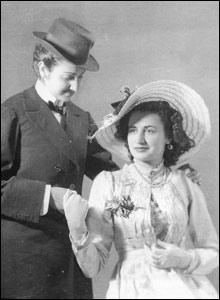
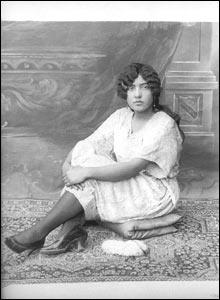
An exhibition of portraits of Iranian Women after removal of obligation of wearing chador under the reign of Pahlavi I, titled Before Your Eyes was held in May 2011 at No.6 Gallery in Tehran. The collection was compiled and reproduced by Parisa Mandan, photographer, researcher and teacher.

The displayed works make up a part of the photographs Parisa Mandan revived during her project of finding and collecting photo archives of old photographers of the city of Esfahan from 1991 to 2000.

As a part of her research, she reproduced photo glasses of the photography studios of Mirza Mehdi Khan Chehreh Nama’, Gholamhosseyn Derakhshan, Abolqasem Jala (calling his studio Sharq) and of Minas Pa’t Kerhanian and others, and prepared them for publication.

The displayed photographs were a part of the above collection which did not receive the required permit for publication, but were allowed to be shown at an exhibition held exclusively for women.

They are all portraits which as mentioned in the catalogue of the exhibition show “Women in the studio, acting the poses and gestures their male photographers instructed. Though they appear yielding, nevertheless it is evident that going to a photography studio and sitting in front of the camera must have been according to their own personal will and decision, thus the choice of their outfits and make- up must have been according to their own conscious choice too.


Photographs as Historical Documents

The photos can be looked upon as a document of social status of women during the transition period of transfer of power from the Qajar to Pahalavi. Considering the style of hair dressing and self-chosen outfit of women in these photos, one can assume that most were taken during the reign of Reza Shah Pahlavi.

It seems in that period, graceful, serene tender poses devoid of violence were preferred. Softy curved hands, arms touching the body and feet close to each other, in some cases hand under the chin in a sitting or recline position were among current postures. Tame women in the way men love.

Recordings of the Camera

There are several very interesting points in the 22 photos displayed at this exhibition: Most women have curled their short hairs with the kind of hairdressing instruments prevalent at the time, all wear mostly white thick stockings, with high hilled shoes differing very little. In some photos they have the kind of eyebrows fashionable under the Qajar, extremely wide and long with or without woad (traditional eyebrow liner).

Their dresses are usually so thin that their underwear and handmade bras can be seen. This shows that it is the period when lining and priming was not fashionable yet. In one or two photos their dresses are quite transparent. One can see that there have been women in that period too who wished to have their photos taken with dresses different from the rest, or maybe some of these photographs, with inviting poses were taken for definite purposes.

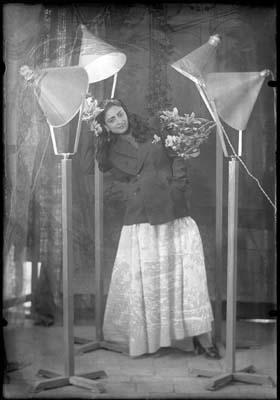
There are a few photos showing women in a place other than a photography studio. Here they are mostly seen next to their family or their husbands with more natural poses. In a satirical photo, a man and a woman have dressed up like a dervish and sa’qi (bartender) and in one, a very beautiful woman with gorgeous body, may be a foreigner is seen wearing a short nightgown sitting leisurely on an armchair next to a clean bed, smiling. In another photo a woman is seen wearing a swimming suit of the type fashionable in Europe in those days, though at the same time wearing long stockings with a long lace covering her shoulders.

In some photos, women are seen next to dolls. For example, in one of them is a toy-dog like those pet dogs French women had in those days and in another photo a woman is seen with several foreign made dolls next to her.

Considering the fact that during the pre and post WWI, a doll factory was built by foreigners (most probably Russians) in the city of Ardebil, northwest of Iran for export of dolls and there is still an alleyway in Ardebil called Toy – meaning wedding in Turkish besides its literal English meaning – and considering the special material used in these dolls, we can assume that these women and their families were rich enough to purchase expensive export goods or had travelled abroad bringing them back as souvenir, or maybe received them as presents from some family members coming back from abroad. If true, then one can conclude that they were enthusiastic to be familiar with certain aspects of western culture and modernism and by displaying these dolls next to themselves, they perhaps wished to emphasize on this cultural point, if not showing off.

One of the most interesting examples of this collection shows a decent graceful lady reading a book and another shows a young woman wearing a guipure or lace underwear lying down with her hand under her head holding an enlarged photograph of two men in her other hand, and another similar photograph is seen on the floor. She is wearing round glasses resembling those which Sadeq Hedayat (well-known Iranian author) used to wear.

Two large photos of this exhibition were gorgeous showing two very beautiful women, very chic for the time in places other than a studio. A copy of both was given to anybody interested. The range of price of these photos varied from 400000 to 1700000 dollars.


The Atmosphere

Most visitors went around and looked at the photos several times; some young girls enlivened to discover a hole in the socks of one of the women of the photographs. Famous photographers like Maryam Zandi, Niyousha Tavakolian and Hengameh Golestan were among the first visitors and other artists including painters, actresses, theater directors, dress designers, authors, translators and poets arrived one after the other.

The ministry of Islamic Guidance issued the permit for the exhibition on the condition that men do not visit it, which was politely mentioned on the invitation card and the notice seen outside the gallery as Men Are Not Allowed.

Considering that most of these brave avant-garde females seem to be women living with democrat men, they had the courage ‘to swim opposite to the current’, as the saying goes. All must be dead by now, thus intensifying the research aspect of the displayed photographs, representing a document about the transition period when the society was moving from traditionalism to modernity with the middles class just taking shape; as this was a fact known to all visitors, it seemed strange that men were not allowed to visit the exhibition.

One can ask if a male researcher had carried out the same project and had discovered these lasting photographs, would he then be forbidden to continue his research just because the subject under study was women?

No doubt, the social history and documents of each country belongs to all the people of that country. It is not possible to draw line in history or make it forbidden for half the society to stop learning about some past historical documents for gender reasons or deprive them of the freedom to see such documents.

Parisa Damandan

Born in 1967, Parisa is a photography graduate, photographer, and researcher of the history of photography.

She began her artistic career with social documentary photography and held a few exhibitions inside and outside Iran including, Portraits, Human Being and Labor, Steel Miners of Nakhlak Mine, With Gulf Shores Dwellers, Tehran’s Youth Prison and Bashagard.

As the milieu of documentary photography narrowed down, she appealed to research since 1993 with the aim of preservation of old endangered photography archives. In addition to collecting photographs of old photographers of Esfahan, she organized the photography collections of Ernst Holster, German telegraph specialist and photographer found in Tehran’s Center of Documents of Cultural Inheritance, cleaning and collecting photos from ruined photography studios in Bam after the earthquake, carrying out an experimental project in the British Library, organizing a photography collection, creating a digital bank of visual information and documents on the great contemporary Iranian poet Ahmand Shamlu. She has also translated and published by John Berjer’s Another Way of Telling and Instant Light: Tarkovski’s Polaroids into Farsi.