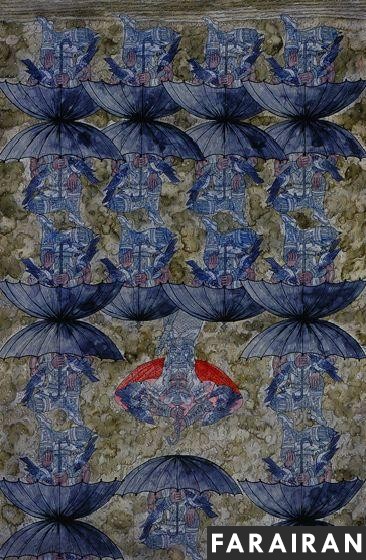
Farairan’ Choice Ali-Akbar Sadeghi
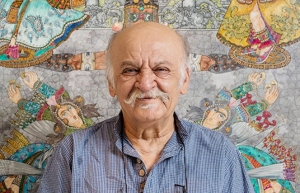
Image processed by CodeCarvings Piczard ### FREE Community Edition ### on 2018-01-29 12:55:19Z | http://piczard.com | http://codecarvings.com
Born in Tehran in 1937, Ali Akbar Sadeghi entered the college of fine arts of Tehran University in 1958. While still at high school, he studied watercolor painting with Avak Hyrapetian. Later in 1959, Sadeghi created a characteristically Iranian style of stained glass art. During his college years he engaged in such various fields as poster painting, advertisement graphics, packaging and book cover designs.
Upon graduation, Sadeghi produced a few animations for the center of intellectual development of children and young adults and illustrated a few books for the same institute. He soon became quite distinguished in the field of animation, book illustration, watercolor, and oil painting. His animations include: The Seven Cities (1971, 18 minutes), Flower Storm (1972, 9 minutes), Boasting (1973, 11 minutes), Coalition (1973, 12 minutes), The Rook (1974, 10 minutes), Malek Khorshid (1975, 22 minutes), and Zal and Simorgh the Bird (1977, 25 minutes) with cooperation of Alireza Kavian-Ra’d.
Teaching art students in Oman, teaching animation in the University of Decorative Arts, teaching book illustration at the College of Fine Arts of Tehran University, supervising more than 20 students studying animation and illustration at both undergraduate and postgraduate levels, honorary member of Society of Iranian Painters, a member of the Society of Children Books Illustration, commemorated as the distinguished Iranian children books illustrator in 2006, also as a pioneer animation director and the first Iranian director in folklore animation films and..
Awards:
1978 Grand Prix, Noma Concours, for Children’s Picture Book Illustrationfor “Contemplation is the Best Worship”, “Hero of Heroes” and “Voyages of Sindbad, the Sailor”
1980 Grand Prix, Best Designed Books from All Over the World, Leipzig, for “Contemplation is the Best Worship”
1985 Grand Prix, First Biennale of Iran Graphic Design Exhibition for Book Illustration
1989 Honorable Mention, Intellectual Development of Children and Young Adults, for “Victory
Awards for Flower Storm:
1972 Gold medal from Tehran 7th international film festival of children and young adults
1973 Honorable Mention, Tampere International Short Film Festival, Finland
1974 The Soviet Painters Association Award
1974 The Grand Prix of Lebanon Educational Film Festival
1975 Bronze Medal, Columbus Film Festival
1975 Bronze Medal, Columbus Film Festival for the idea and motif in production of Flower Storm
1975 Honorable Mention, International Animation Film Festival, New York
1975 Bronze Medal, International Animation Film Festival, New York
Awards for Boasting:
1974 C.I.D.A.L.C, Gandhi Peace Prize at 24th international Filmfestpiele Berlin
1974 Bronze Medal, C.I.D.A.L.C. Annual International Committee, Paris
1974 Honorary Diploma for the best short film, Tehran International Festival of Films for Children and, Young Adults
1974 Honorary Diploma, Krakow 12th International Film Festival
1975 Bronze Medal, Krakow 12th International Film Festival
1975 Gold Medal, Virgin Islands International Film Festival
1975 Silver Medal, Chicago International Film Festival
1975 Honorable Mention, Los Angeles International Festival of Children’s Film
1975 Honorable Mention, New York 4th International Film Festival
1975 Honorable Mention, San Francisco 4th International Festival of Children’s Films
Awards for The Rook:
1974 Honorary Diploma for the best short film, Tehran 9th International Festival of Art Film for children and young adults
1974 Honorary Diploma, Krakow 12th International Film Festival
1974 Bronze Medal, Krakow 12th International Film Festival
1975 Gold Medal, Virgin Islands International Film Festival
It is noteworthy that 38 countries participation in this festival and there were 2000 film entries.
1975 Silver Medal, Chicago 11th International Film Festival
1975 Honorable Mention, Los Angles International Animation Film Festival
Honorable Mention, San Francisco 4th International Festival of Children’s films
1975 “Rook” was selected as an outstanding film of the year for presentation at London Film Festival
Awards for Malek Khorshid:
1977 Honorary Diploma, the Festival International de court Metrage pour la Jeunesse – Paris
Books Illustrated:
The Hero of Heroes (1970, also published in Japanese in Japan)
Abdolrazzaq the Hero (1972)
Gordafarid (1973)
Contemplation is the best worship: Aphorisms of the Prophet Mohammad (1974)
The Bronzesmiths (1974)
The Rain, The Sun , and The Story of Tiles (1974)
Be the Child of Your Times: Aphorisms of Imam Ali (1975)
Let us play Chess (1975)
The Prophets’ Mother (1975)
The Voyages of Sindbad The Sailor (1976)
They Are Alive, The Life of Zeinab, Imam Ali’s Daughter (1977)
Shine, Lady Sun! (1977)
Let Us Live Together (1977)
A Visit to the Province of Chahar Mahal and Bakhtiari (1977)
Keep Your Spirit Alborz: The Mystical Sayings of Khajeh Abdollah Ansari (1978)
Victory (1985)
The Chapter Entitled Chaharshanbeh Suri: An Iranian Traditional Ceremony” in Asian Games (Published in English in Japan), and the film posters forThe Rook, Boasting, and Malek Khorshid.
Awards for Book Illustrations:
1978 Grand Prix, Noma Concours, for Children’s Picture Book Illustration for “Contemplation is the Best Worship”, “Hero of Heroes” and “Voyages of Sindbad, the Sailor”
1980 Grand Prix, Best Designed Books from All Over the World, Leipzig, for “Contemplation is the Best Worship”
1985 Grand Prix, First Biennale of Iran Graphic Design Exhibition for Book Illustration
1989 Honorable Mention, Intellectual Development of Children and Young Adults, for Victory
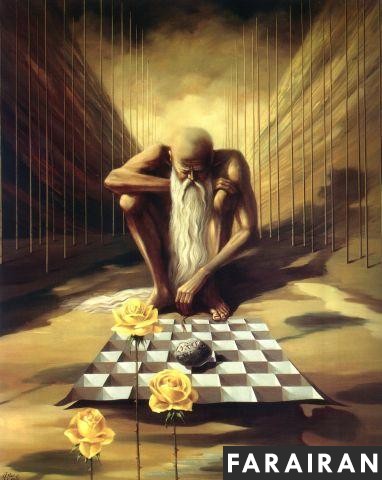
In 1977 Sadeghi stopped making films altogether and devoted himself entirely to painting in the style of Surrealism, also resumed watercolor painting after many years. He says in this regard: When I feel relieved of tensions and constraints which drive me to surrealist painting, and at times of mental serenity and peace I turn to watercolor paintings.
In 1989 Sadeghi added an exhibition room to his studio called Sabz Art Gallery, in order to offer a space for contemporary Iranian artists to show their works.
Exhibitions:
Commemoration of Parviz Fanizadeh, Niavaran Cultural Center, Tehran
Commemoration of Asghar Mohammadi, Niavaran Cultural Center, Tehran
1988 Museum of Contemporary Arts, Tehran
1988 La Chaux-de-Fonds Art Gallery, Switzerland
1989 Iranian Watercolor Painters, Museum of Contemporary Arts, Tehran
1989 Watercolor Paintings Sabz Art Gallery, Tehran
1989 Opening of Sabz Gallery
1990 Commemoration of Firooz Shirvanlu, Noqreh Publishing, Tehran
1990 Commemoration of Firooz Shirvanlu, Seyhoun Art Gallery, Tehran
1990 For the Victims of the Earthquake, Museum of Contemporary Arts, Tehran
1991 Painting & Miniatures, Exports Development Center, Tehran
1991 Watercolors, Sabz Art Gallery, Tehran (solo),
1992 Watercolors, Iran the Land of Love, Part 1, Sabz Art Gallery, Tehran
1992 Watercolors, Iran the Land of Love, Part 2, Sabz Art Gallery, Tehran
1992 Sketches of oil paintings, Sabz Art Gallery, Tehran
1992 Watercolors, Sabz Art Gallery, Tehran (solo)
1993 Painting & Miniatures, Export Development Organization of Iran
1992 Images of Iran’s Contemporary Arts, Museum of Contemporary Arts, Tehran
1992 Painting exhibition in support of the people of Bosnia and Herzegovina, Niavaran Cultural Center, Tehran
1993 Painting Biennial, Tehran
1993 “Watercolor exhibition, Iran the Land of Love,” Sabz Art Gallery, Tehran,
1995 Painting Biennial, Tehran
1996 “Watercolor exhibition, Kerman, Memorial of Presence,” Sabz Art Gallery, Tehran (solo),
1996 “Watercolor and oil painting exhibition in Salau Palace,” Bern, Switzerland,
2001 Painting exhibition, Los Angeles
2003 Watercolor exhibition, Los Angeles
2008 Painting Exhibition, Dubai
2011 Painting Exhibition, Aran Gallery, Tehran
Sadeqi has participated in more than 70 group exhibitions inside and outside the country
Publications:
Whispers, Ali Akbar Sadeghi’s Watercolors, Negar Publication
Iran, The Land of Love, Sadeghi’s Watercolor Paintings, Gooya Publishing
Alphabet, A Philosophical Analysis of 50 Works of A.Sadeghi, by Nader Ebrahimi, Farhangan Publication
Memories, Watercolors Album No. 1, Gooya Publishing
Memories, Watercolors Album No. 2, Gooya Publishing
Memories, Watercolors Album No. 3, Gooya Publishing
Kerman, Memorial of Presence, Watercolors, 1997, Kerman Studies Center
Membership of Juries:
1974 Painting Exhibition of Tamasha Magazine for children and teenagers
1975 Iran’s Representative in the Week of Animation Film Makers, Zagreb, Yugoslavia
1976 Iran’s Representative in the Seminar of Animations Film Makers, Alma Ata, Kazakhstan
1989 The First Exhibition of Illustrators of children’s book, Tehran
1991 The Seventh International Festival of Film for children and teenagers, Tehran
1991 Honorary Diploma from the First Painting Biennial, Tehran
1992 The First Exhibition of Flowers and Nature in the works of Iranian painters, Tehran
1993 Member of Selection Board, Painting Biennial, Tehran
1995 Member of Selection Board, Painting Biennial, Tehran
1996 International Festival of Paris Children’s Film, Aubervilliers
Tributes
1991 Tribute at the 25th Anniversary of the Foundation of the Institute for The Intellectual Development of Children and Young Adults for his outstanding artistic achievements in the field of book illustration and film making, his participation as a jury member in more than 40 TV animation festivals, one minute films and cinema animation festivals, participation as a jury and selecting member for native and international book festivals, participation as a jury member in tens native biennials, honorary guest at Iranian short films festival in Washington and production of more than 15 reliefs for Saderat Bank and so on. He has been commemorated in more than 70 film and book festivals
1996 Golden key of the Aubervilliers, at International Festival of Paris Children’s Films, Aubervilliers
2000 Commemoration for illustration of religious books
2006 Commemoration on the international day of animation
2008 Selected as an everlasting figure
2008 Commemoration at Art Academia
2010 Commemoration at animation festival, South Korea
The following is an extract from: Alikabar Sadeghi, Selected works (1977-1997), Iranian Art Publishing, 1992, Tehran
Turning Toward New Horizons
Javad Mojabi
Since the beginning of modern painting movement in Iran, going back to forties (Iranian twenties), the major academic advices, that is taking advantage of tradition has had a tremendous impact on the main Iranian painting genres for subsequent decades. The question however is: How can cultural inheritance be utilized, remain Iranian and at the same time accomplish an international esteem?
Undoubtedly, innovation in any domain revolves around the existing tradition, but not in a convergent direction, like a spring that spirals toward its center and, by enveloping the shell of tradition and apparently repeating it, is reduced into a more compressed state. The innovator begins with tradition, realizing its real dimensions, he/she goes beyond it and with a divergent turn from its center opens up to other horizons. In this way by utilizing the overall human accomplishment, he/she finds a dynamic share in the development of native art and adds to the universal art treasury.
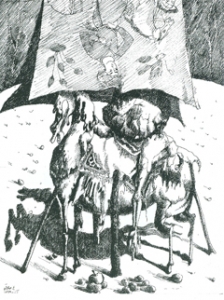
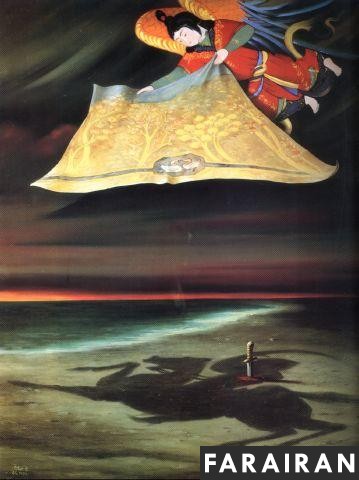
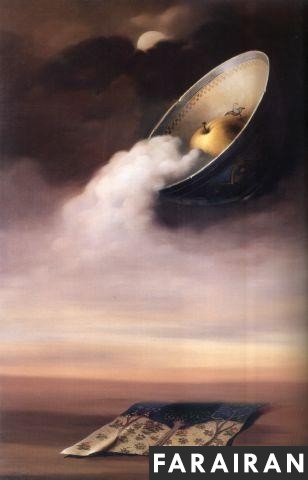
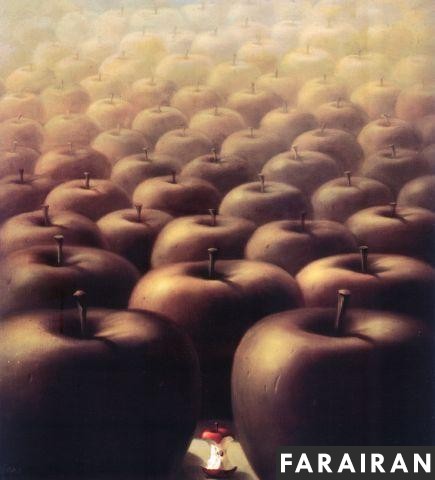
In his particular interpretation of tradition, Sadeghi first deals with the characteristic Iranian world, and subsequently with the roots of human universe. In contemplating upon these worlds, he sometimes makes time and space to fade away in his works, invoking the entire humanity to an infinite world, to an eternity in which the world is observed at the stage when apple, tree, horse and the first human beings were created, as though, after centuries of efforts, human beings have already reached its apocalypse.
The Planet of Imagination
If we accept the premise that art is the interaction between imagination and reality, in the sense that the artist’s imagination draws vigor from the outer reality and affects it in return, with art being born out of this continual exchange, then this interpretation fits Sadeghi better than any other painter, because he has made real use of imagination in his works. This imagination is not of the fantastic, unbridled or sickly nightmarish type. Rather, in the language of Iranian sage artists, it is a kind of attitude, a worldly outlook of existence. Our past artists and men of letters believed that the imaginary world can provide an interpretation of existence superior to that resulting from the means of experience or reason.
Sadeghi has built an imaginary planet with a strange geography, chimerical peoples, a real history and surreal adventures. His colorful imaginary planet bears similarities to our world. At times its link with it is filial. At others it is so remote that identifying it with the mother planet becomes difficult.
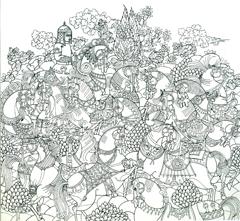
The planet of Sadeghi’s paintings is made, not out of reality, but of the substance of imagination. His active imagination transforms the surrounding realities into the form and color of an imaginary space; although the boundary between reality and fantasy has long become so blurred that separating them seems so naïve and credulous.
He begins his work with the pictorial heritage of his own culture that is Iranian painting, which is the outcome of his ancestors’ imagination in the face of the real world. Past Asian painters, particularly Iranians, contemplated the materiality of the real world at large but did not reproduce it as such. Instead, they depicted their subjective mental reactions to the surrounding world and people in an intuitive way, in esoteric signs. The aim was to depict one’s mystical understanding of the world rather than to faithfully reproduce it.
Iranian artists recognized the microcosm and the macrocosm in the mirror of mysticism, poetry and myths: in the realm of imagination. They believed that the meaning of the universe is nothing but a transcendent imagination. Imagination, therefore, is an effective means of understanding existence. Material experiences and reason cannot lead one to the universal truth as effectively as active imagination.
After graduating from the Faculty of Fine Arts, Ali-Akbar Sadeghi touched upon various experiments in painting, stained glass and graphic design, which resulted in his acquiring brilliant technical skills in various fields of plastic arts. But his cooperation with the Children and Young Adults Intellectual Development Center as book illustrator and film producer was the beginning of a new period in his artistic career which he has ever since pursued at an accelerated pace and with stupendous diversity.
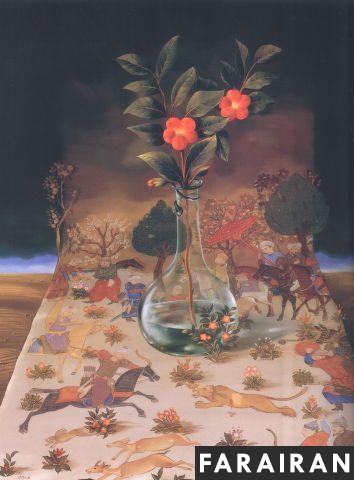
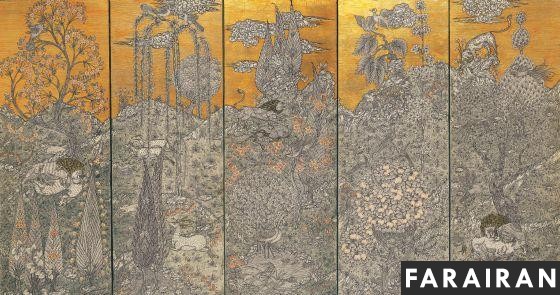
In his illustrations of the Hero of Heroes (1970) and other books, mostly published during 1970s, and in his five or six animation films, which range from the Seven Cities to Zal and Simurgh the Bird, he utilizes the apparent mold and space of miniature paintings, thus aligning himself with many contemporary painters who revived or renovated miniature painting in order to preserve traditions and adopt an indigenous iconography.
In this period, Sadeghi simplifies the forms and spaces of miniatures and applies this ultimate stylization to his colors as well as to his lines and forms. But what distinguishes Sadegi from his peers is his next step in exploring the world of miniatures. Beyond the apparent face of miniature forms, he reaches the essence of Iranian painting, and this essential discovery saves him from imitating, copying and playing with forms. He is instinctively aware of the intuitive perception ancient artists had of existence. He senses that miniature painting is the fantasy of this world, and not an exact reproduction. So, imagination is the foundation and not formal appearances. Thus one may discard the appearance of miniature forms and pay attention to its spirit which amount to understanding the imaginary space and apprehending the “symbolic world.” One can imagine the world differently and still function in a genuine way like ancient artists, and benefit from their knowledge about existence. The outer appearance disappears. A door opens. Sadeghi finds a way into the immensity of imagination, where the world can be recreated in fantasy and paint that transcendent reality in a mystic space. This immensity, this essential universe, is filled with poetry and mysticism. One can soar in it on the wings of myths and fables. Here, dreams and nightmares transcend actual reality. Symbols, mysteries and allegories rule in this eternal universe, which is the universe of reflections and enlightenments, of wonderful human fantasies, or artistic creation.
In the world of modern painting, when passing through new experiences, some avant-garde artists alter both foundations of their work, i.e. form and content in a harmonious way. That is, when they chose ‘subjectivity’ and instead of presenting an exact representation of Nature, reproduce their own subjective world, they change both their subject matter as well as their way of dealing with it, just as Picasso and Joan Miro changed both their vision of painting and their style of materializing it. But Sadeghi – like Dali and Magritte – cautiously retains one foundation unchanged, and that is the classical way of depicting his subjective world to which he has grown accustomed and which he has mastered, while altering the other foundation, which is the context of his world of paintings. Thus, in order to maintain his relationship with his innumerable audience he does not take the risk to alter both form and content simultaneously and while renewing his subjective world, he does not cut the string of his bonds with tradition and current visual habits.
The Inhabitants of the Imagined Planet
In visual terms, Sadegi’s oil paintings can be divided into several categories. He has created numerous paintings with specific elements, for example apples, trees, clouds, horses, horse-riders, knights, women, masks, water, boats …
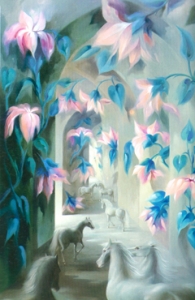
He toys with a single theme or concept for a period of time, each time picturing its dimensions and qualities differently. At one time he paints the subject – an apple or a boat – in relation with other objects within a pictorial ensemble, at another he sets it by itself alone at the center of his canvas, as though he were picking every detail of his elaborate paintings one by one, exposing them to revealing light and dissecting their innards. Apples occupy a prominent place in his works, appearing each time in a different color and with a different meaning. Here it signifies life. There it symbolizes love. Elsewhere it is a metaphor of natural moderation, when it is a hermetic world the painter is enthusiastically tempted to crack open.
This treatment can be pursued at length in each of the painter’s various themes, in which he has indulged in all sorts of plays, be it a boat, water, fog, woman and… But these are to be seen rather than described, and what is said here is merely a reference to the mental function of the painter and how like an inexhaustible experimenter, he takes his ‘subject’ to the other side of tolerance to test it with pictorial experiences, each time creating an amazing world out of a simple element.
Conceptual Painting and Interpretations
The contemporary plastic world shies away from interpretation, because interpretation limits it to its apparent image. But conceptual paintings, which belong to the Eastern universe of fantasy and imagination, just as its mystical poems and tales, allow for interpretation and each viewer, according to his/her thoughts, finds a particular meaning or various interpretations in them, even if these meanings and interpretations are not compatible or the same as those the artist elaborated in some hidden place of his mind
In the rock-land desert, a herd of horses is circling within an invisible enclosure. A few are drowsy and unaware, while most are excited and frightened, because a cube of inflamed space is about to fall; a steely mass out of which six deadly spears are protruding. The herd is aware of the mortal menace and its horror of this inescapable fate is natural. Among the rocks lies an apple; a memory of a lost peace, a sign of a lovely innocence or a departed freshness.
The onslaught of that dreadful steel mass upon the circle of the existence of a herd of horses, which symbolizes beauty, dignity and dynamism, represents the eternal combat between the forces of Ahura-Mazad (God) against Ahriman’s (Devil’s) invasions, a theme often repeated in the Manichean space of Sadeghi’s works. In this Manichean space, evil is dominant, besieging beauty and the good, so often evil disguises itself as good or has engulfed good in its depth. Yet, hope is not lost in the turmoil, even if it is as small as an apple in a rocky desert. Such is the miracle of being a human being creating a spiritual garden against the material wilderness out of an apple.
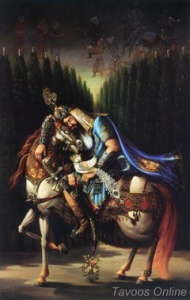
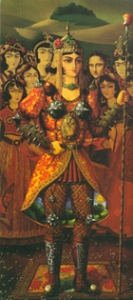
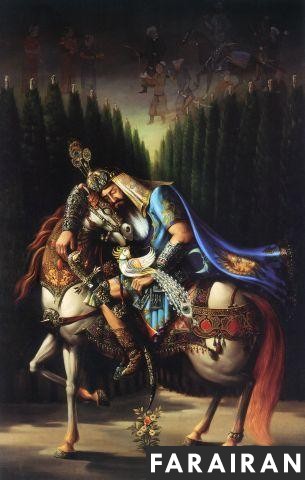
His horsemen are often warriors from historic dynasties, legends or symbols of various powers in different eras. In terms of composition, the hero is depicted at the center of the painting and everything else in the margins and background takes shape as the result of this central image. This arrangement is repeated in many of Sadegi’s works, as for example in his Female Warrior where the subject is centrally located surrounded by tables, women and khatuns of Nasseri era, with an uninvited guest “Joconde”.
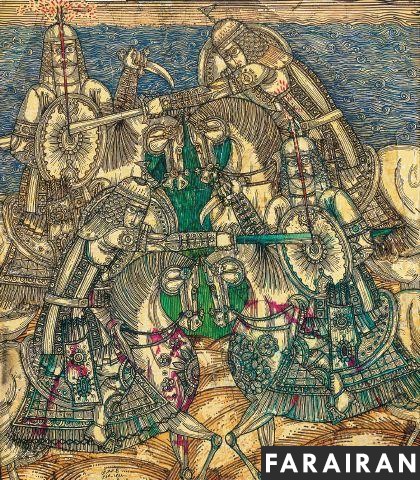
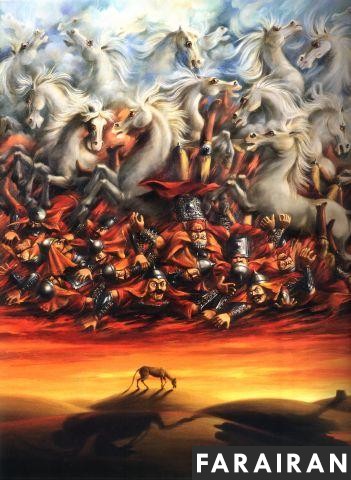
In Sadeghi’s Manichean universe, evil ultimately annihilates itself, as in the case of the four warriors who, out of ignorance or cruelty, draw sword against one another, each one mutilating the other and being mutilated by another. The similarity of their faces, attitudes and weapons, imply that these four knights are in fact one and the same, in a dual state preoccupied with opposing forces and bewildered at his own ordeal. These slayers and slain may even be innocent. Their crime is ignorance or a blind, hopeless enmity. Each is a paradoxical combination of the victim and the executioner. They have opted for evil. They have attempted to kill one another, and therefore themselves. It is as though Sadeghi is repeating this divine message: “To kill one man is like killing all mankind”.
A Life at a Glance
Sadeghi’s works can be categorized in several ways. One is to consider his oil paintings and watercolors separately, because of their clear differences. In Sadeghi’s own words, his watercolors are the outcome of his “recreation breaks” at home, after taking a rest from his oil paintings elaborated the whole day in the studio of his mind.
Whereas, in his oil paintings, he is attached to the world of meanings and a thematic view of existence, proceeding on the path of imaginary creation by precise construction and execution, in his watercolors, he often frees himself of restraints of concepts, nightmares, the surreal world and freely and hastily depicts the objects around him. Still life, panoramas constitute his materials. He simply, swiftly, not feeling indebted to imagination, he goes on making realistic representations of surrounding objects and forms: flowers, plants, fruit, lamps, bowls, buildings and natural views.
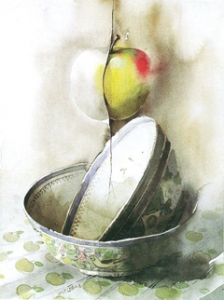
Perhaps his watercolors are his response to a deep need unconsciously driving him toward a different kind of painting. Accustomed to the ornate and masterful manner of creating paintings overfilled with imaginary figures, and respectful of conceptual painting, he is spontaneously and unconsciously drawn to a style which is in direct contrast to his works: no more imagination and imaginary painting, but direct representation of objects.
A. Structural Particularities
Accomplished Technique
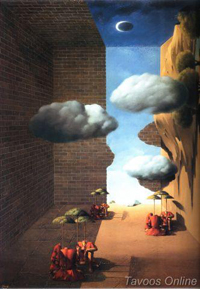
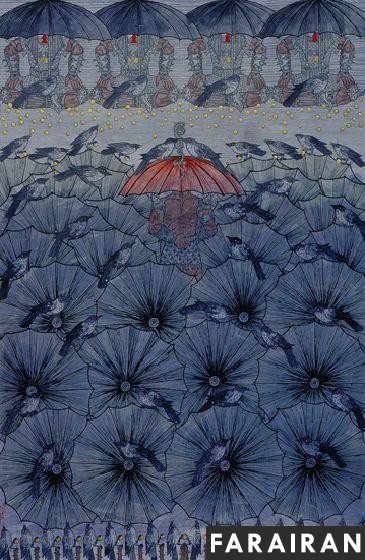
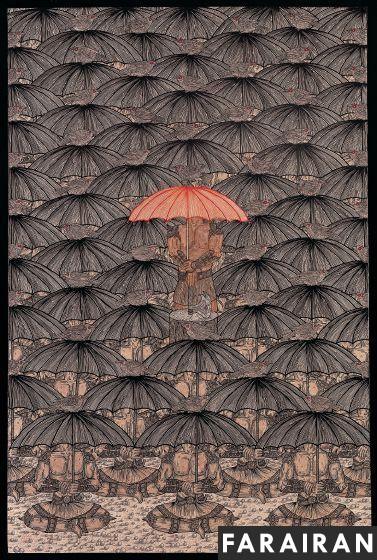
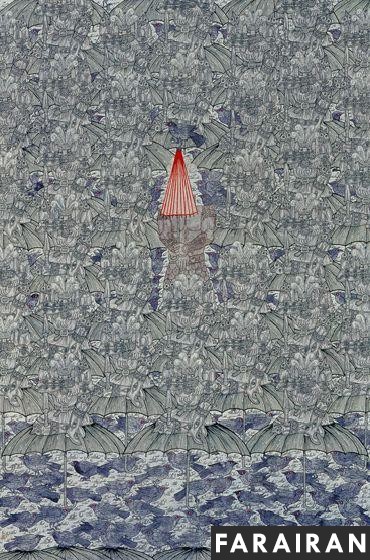
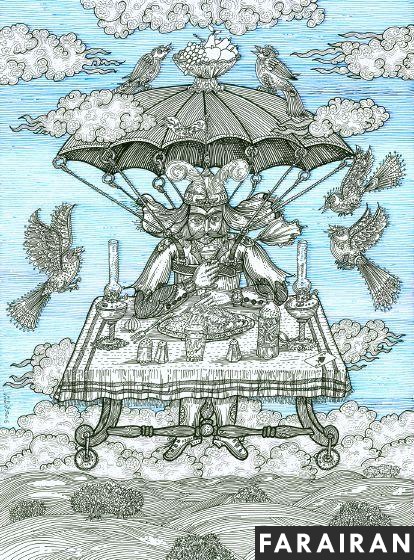
Sadeghi masterfully applies painting techniques in the most appropriate way. He is able to construct and execute whatever he wishes and this technical skill and mastery is the fruit of forty five years of continuous work in various fields of visual arts, half of which make up the foundation to accomplish his creations in the past two decades. This technical skill often astonishes the painter’s audience, which is somehow intentional. He has paintings which can be viewed from two different angles. In fact, they are two paintings in one. They can be viewed from top or bottom, or left and right. In some of his paintings, this device has structurally perfected the work, although this is not always the case, occasionally giving way to unnecessary sophistication. This artistic tour de force reaches perfection in his Green Umbrellas.
Complete Sketches
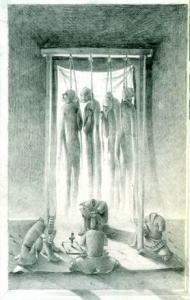
Wherever the opportunity arises, the artist records his pictorial notes in notebooks, to which he later refers when painting. These sketches usually begin with a line. Then comes another line. The sketch takes shape piecemeal until it is carefully completed. The sketches of one of these notebooks were once published alongside their painted counterparts. The sketches and corresponding paintings were not very different and only certain fine details had been deleted or added. Sadeghi’s professional discipline is exemplary and one of the reasons for his voluminous output is this very outer discipline and inner order which he observes in his work.
Palette
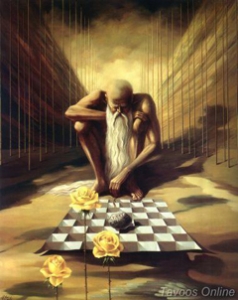
Sadeghi’s coloring technique is extraordinarily varied and has an amazing power. He rarely uses original, pure paints. He mixes and combines. A single color theme often dominates his paintings, and this is the most arduous achievement in view of the extreme colorfulness of his works. The presence of blue, azure, gold, silver, orange is conspicuous in most of his works, although, just as in the case of his teacher, Nature, one cannot say which one he prefers. His colors are brilliant, vivid, pulsating, fluid, youthful. His seas are as varied as his apples and involve the same colors and shades.
B. Contextual Particularities
Manichean contradiction
It was pointed out that Sadeghi’s mind is involved in an incessant opposition whereby he sees the world and existence at the mercy of good and evil forces. The context of his paintings, as a whole and in their details, is based on this antagonism. At times this duality is obvious, as in the opposition of day and night, desert and sea, or flower and stone: at other times it is hidden and metaphorical, as body in the hand of passage of time, bondage yearning for freedom, germination wrestling with erosion.
Although evil overcomes, giving a bitter taste to his works, as the one where the desert yearns for the sea while the sea is an image on a wrapped scroll hanging from nowhere, yet, in this Manichean world filled with evil, a liberating light of hope ever glimmers and the painter does not consider the domination of any of these forces to be absolute, and this is the result of his doubt in the judgment of expedient Reason and at last he finds Love to be the salvation.
Humoristic mind
Sadeghi’s faces the surrounding reality with humor and, unbelieving in history and its current clichés, takes refuge in a superior reality where the logic of dreams, inversion, displacement, ambiguity and grotesque space rules.
Legend, Lyricism and Epic
Sadeghi’s looks upon history but does not believe in it. He is a history-watcher rather than a historiographer, just as he is a legend observer and not a legend painter. He sees the world as a legend fabricated by others. Finding the reality in such cloak, he gets involved with it. In this involvement, he makes no judgment. He only records. He leaves the judgment to the viewer. He likes people and is familiar with their folklore. He looks upon the era’s superstitions and rituals, their customs and beliefs. He records them without judging, for he does not see himself separate from people.
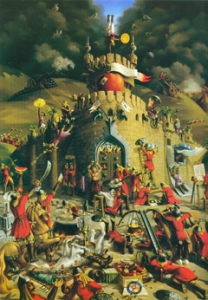
Sometimes he looks at the world lovingly, as a dream of crystal and tears. Look at the house with a fountain of mist pouring on the lush green valley through its window. This is a materialized paradise of lyrical peace untainted with sadness. Or look at the painting in which a building is visible amidst the grass, fog and cloud, with columns and arcades of the substance and color of air, perceptible but inaccessible, just as a well turned poem. Sometimes the epic recorder is saddened at the fate of heroes who, like Don Quixote, have set foot in the world at the wrong time. Occasionally fairies appear in his paintings beside or against monsters and devils.
He dose not flee into the past. For him, time is eternal and the past and the future happen coincidently with the ephemeral present. The simultaneity of non-contemporary eras gives him the opportunity to reflect unhindered with conventional divisions of time, alongside ordinary men-who are unbounded by temporal, spatial and racial constrains and to ultimately deplore their fate with deep love.
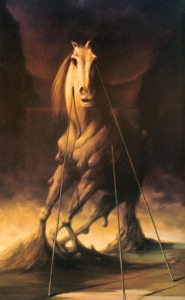
Sadeghi’s is the narrator of contemporary man’s complicated and contradictory world. Such complexity extends from the heart of the atom to the periphery of the galaxy, with human being left alone in this wondrous world. The artist sadly paints human solitude amid the crowd, but does not surrender to this loneliness and isolation. At the end of this smoky horizon, he thinks about a sunny future in which every human being empathizes with every other human being. Unlike Man of the Age of Reason, he is not solely infatuated with rationality and science. Rather, just as his ancestors, he still seeks the wisdom of life in art and despairingly hopes that art would teach him all that the science fails to bestow to human beings and the world.
Sadeghi’s last exhibition was held at Aran Gallery last week (from 22 April 2011) showing a new stage in his inexhaustible artistic activity. In fact, what is said above does not include the last two decades of his life and works which hopefully will be dealt in the near future.
-

- 2011-Untitled – Ink on paper mounted on canvas -100×150 cm
-

- 2011 -Untitled – Ink on paper mounted on canvas – 100×150 cm
-

- 2011- Untitled – Ink on paper mounted on canvas -100×150 cm
-

- 2011 – Untitled – Ink on paper mounted on canvas -100×150 cm
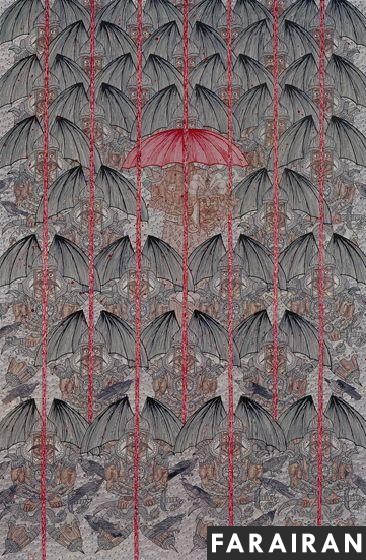
-

- 2010-Untitled – Ink on paper mounted on canvas
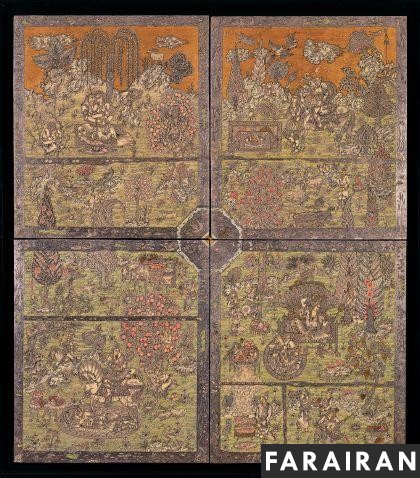
-

- 2010 -Untitled – Ink on paper mounted on canvas -100×150 cm
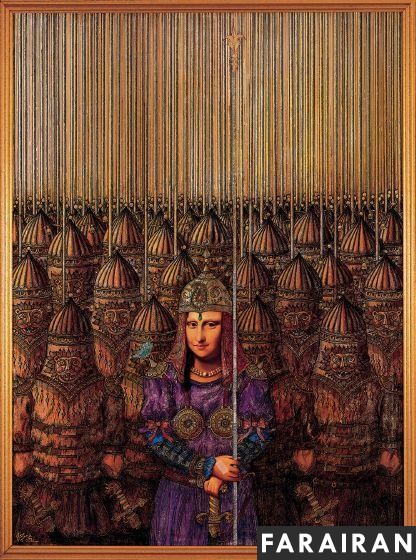
-

- 2010 – Untitled
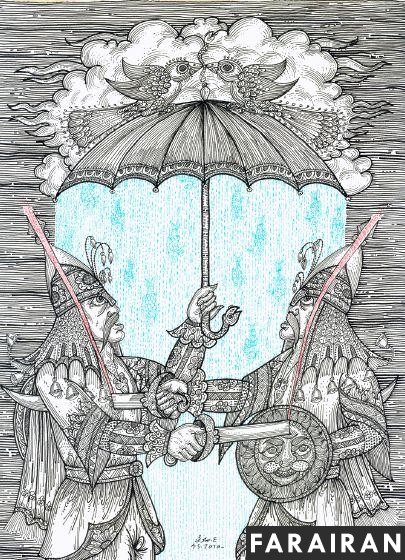
-

- 2010 – Untitled – Ink on paper mounted on canvas
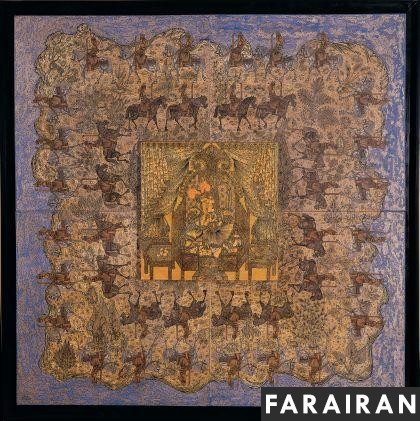
-

- 2010 – Untitled
-

- 2009 – Untitled
-

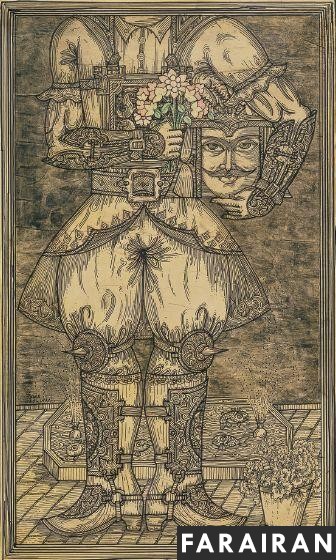
- 2009 – Untitled
-

- 2009 – Untitled
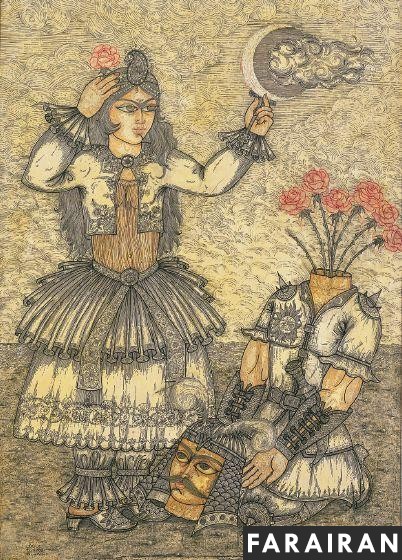
-

- 2009 – oil on canvas
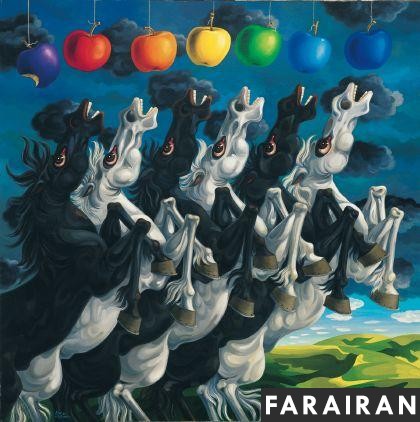
-

- 2008- oil on canvas
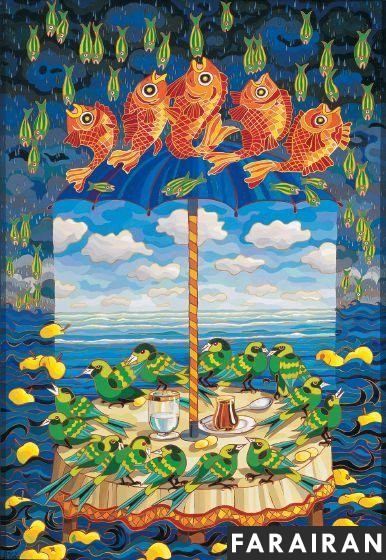
-

- 2008 – oil on canvas
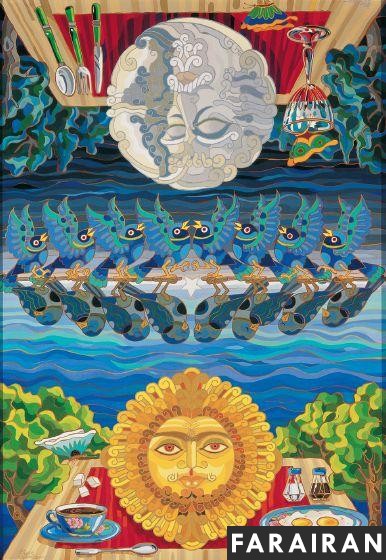
-

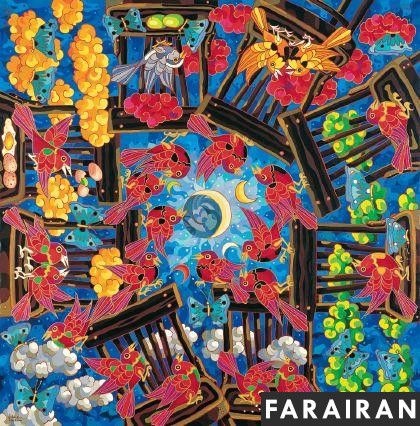
- 2007-oil on canvas
-

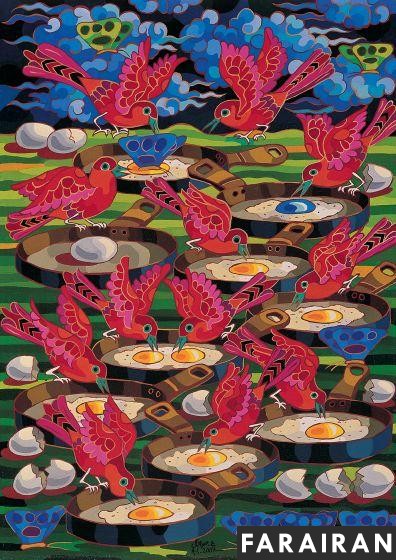
- 2007- oil on canvas
-

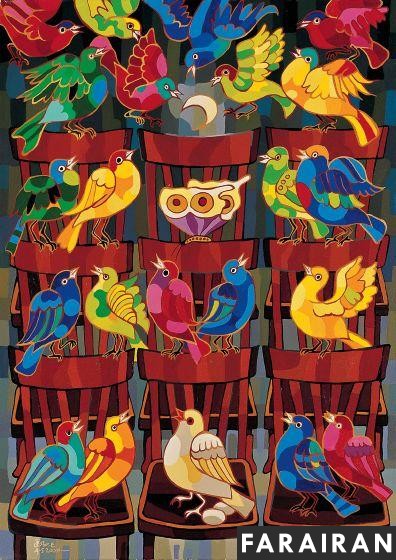
- 2007 – oil on canvas
-

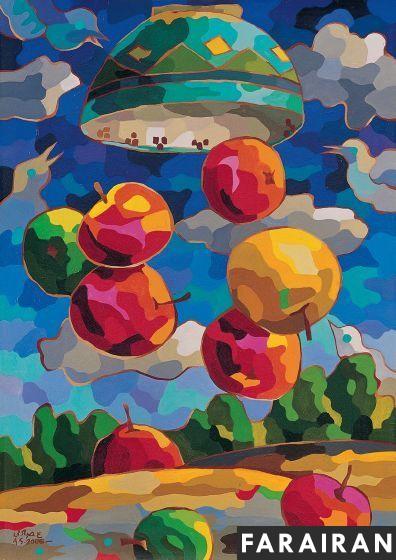
- 2006 – Oil on canvas
-

- 2005 – Mixed media on canvas – 50×70 cm
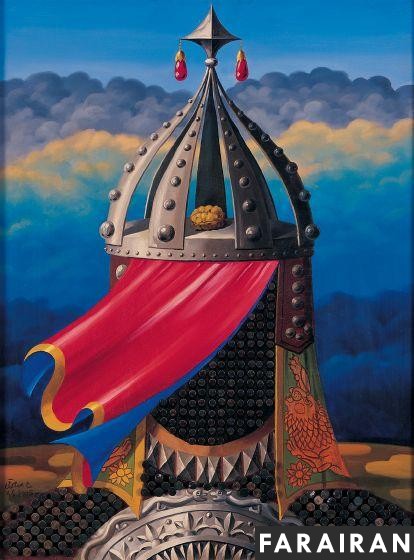
-

- 2004- Mixed media on canvas – 50×70 cm
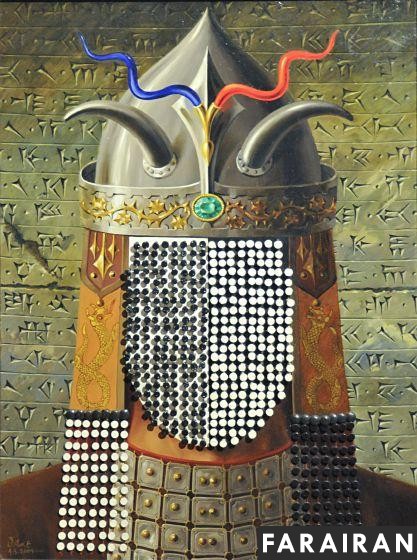
-

- 2004 – Mixed media on canvas – 50×70 cm
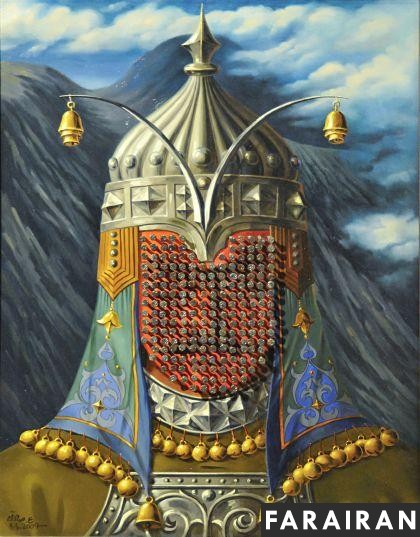
-

- 2004 — Mixed media on canvas – 50×70 cm
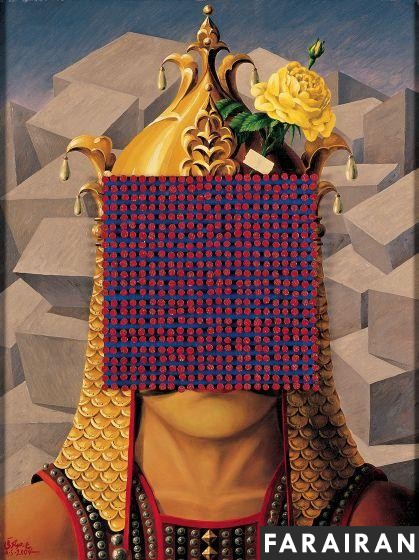
-

- 2004 – Mixed media on canvas – 50×70 cm
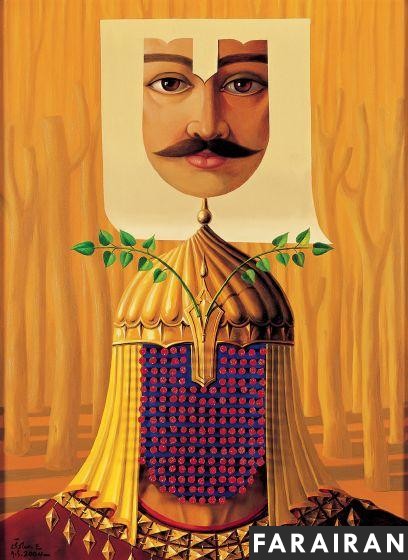
-

- 2004 – Mixed media on canvas – 50×70 cm
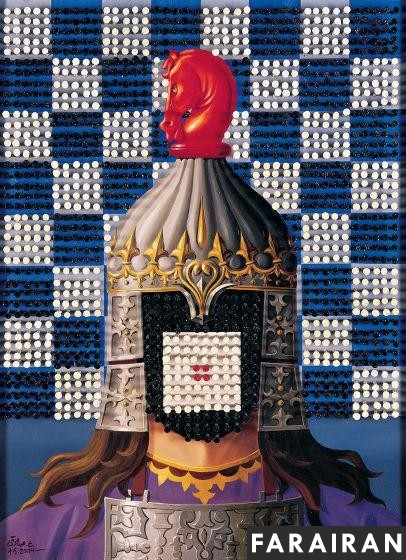
-

- 2002 – Mixed media on canvas – 50×70 cm
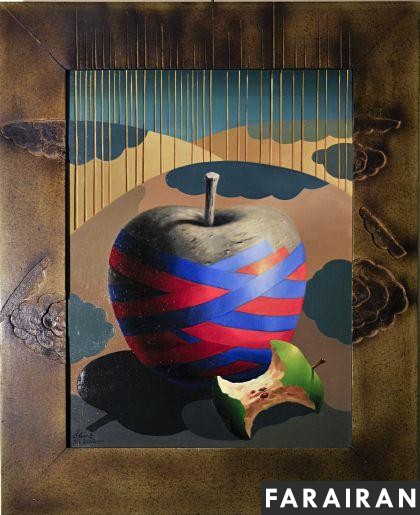
-

- 2001 – watercolor
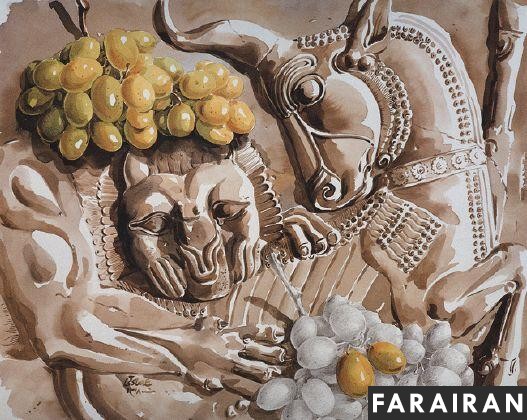
-

- 2000 – wotercolor
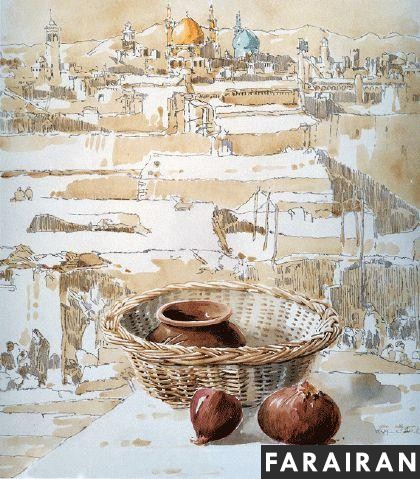
-

- Untitled
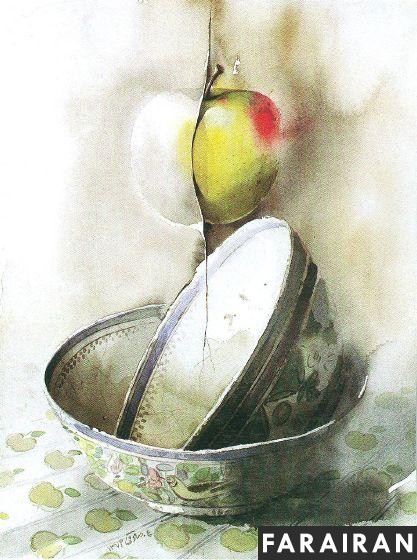
-

- Untitled
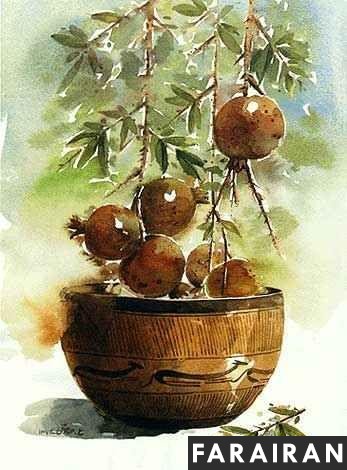
-

- The book Victory
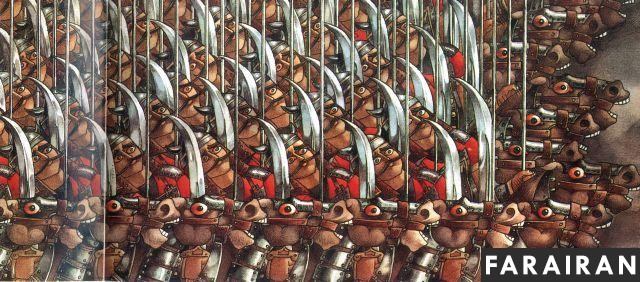
-

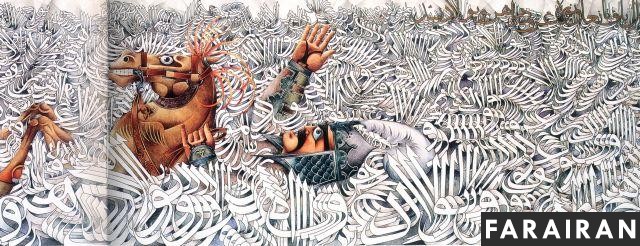
- Submerged by iron and steel
-

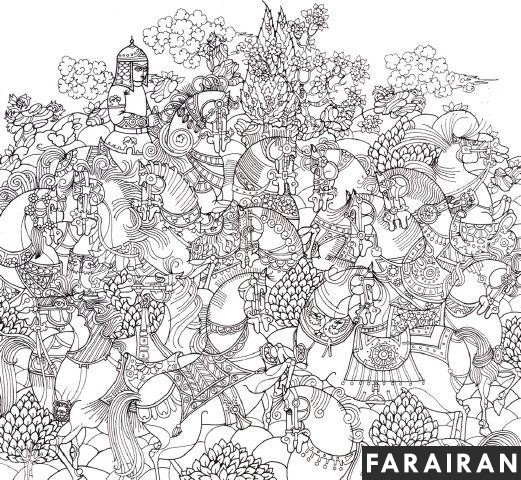
- Stained glass-Zinkhaneh museum
-

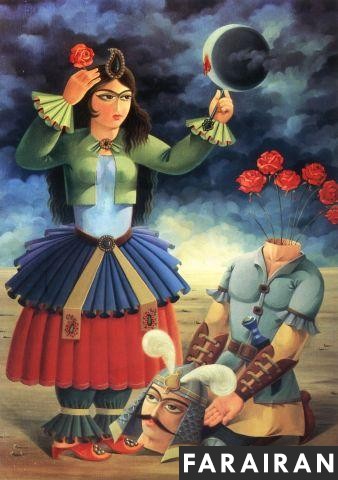
- Coordinates-1977-70x100cm
-

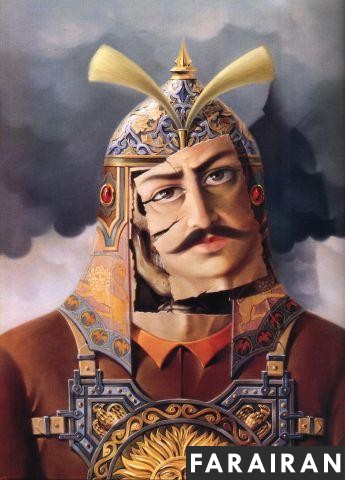
- Substraction-1979-61x76cm
-

- Volume-1981-60×75.5cm
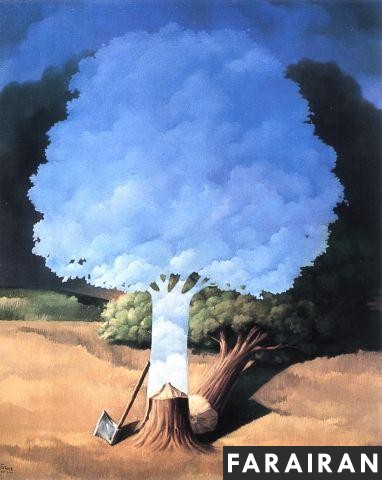
-

- Adition-1982-71x92cm
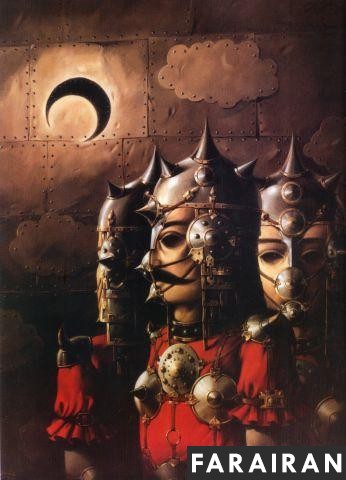
-

- Eqation-1985-45x91cm
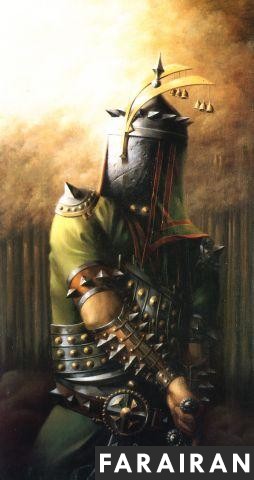
-

- Symemetric-1983-76x102cm
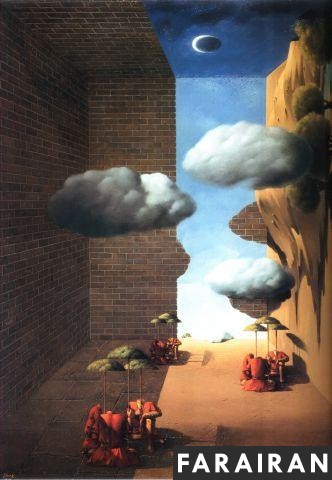
-

- Real-1984-46×60.5cm
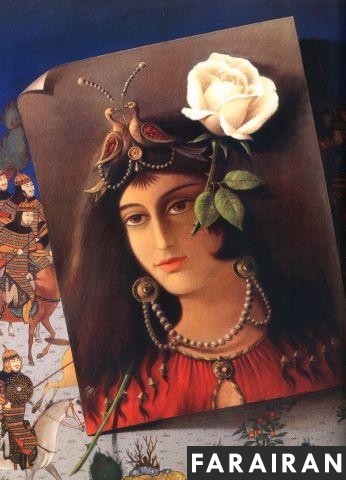
-

- Juncture-1984-45.5x60cm
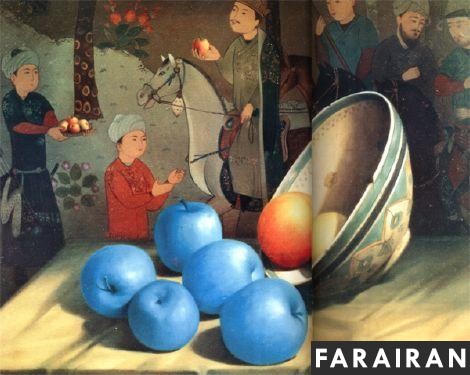
-

- Function-1986-60×75.5cm
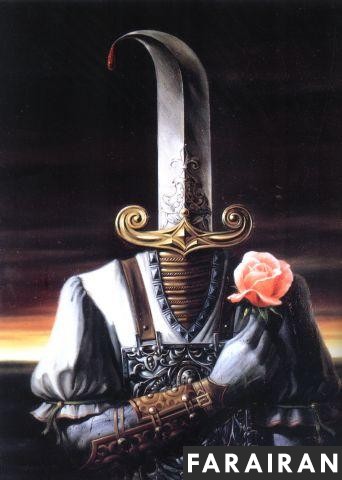
-

- 13-Reason-1985-60x91cm
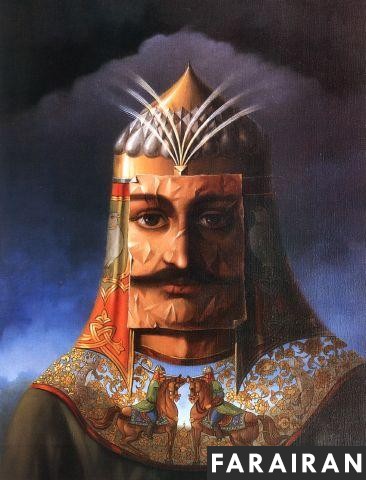
-

- 14-Line-1987-60×75.5cm
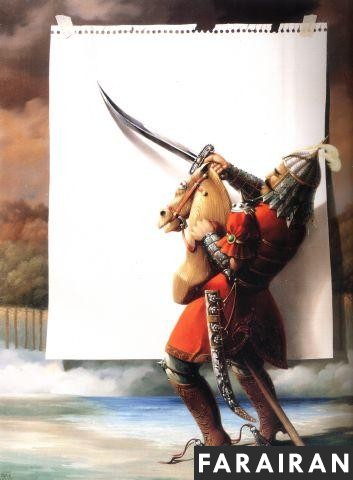
-

- Radius-60x75cm
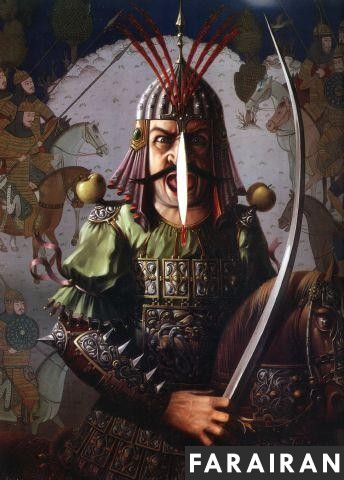
-

- Dividend – 1987 – 26×35.5 cm
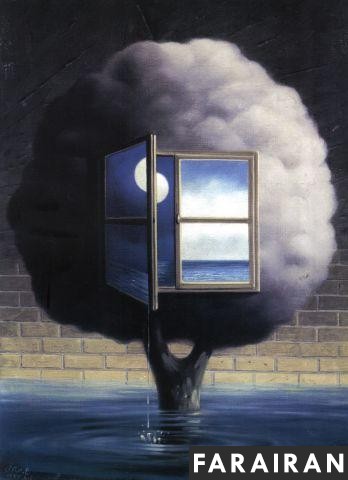
-

- Absolute value-1987-35.5×45.5cm
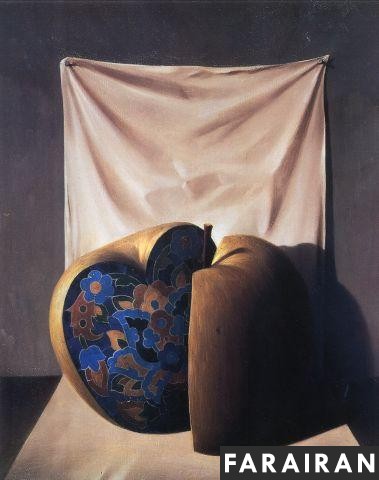
-

- Irregular-1988-60x75cm
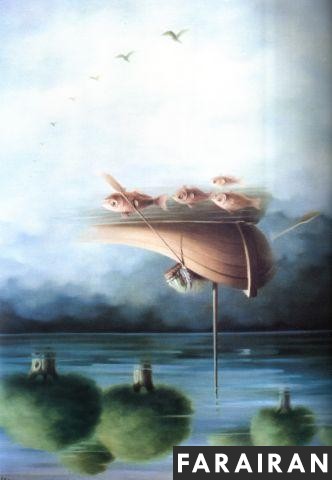
-

- Decimals-1988-89x119cm
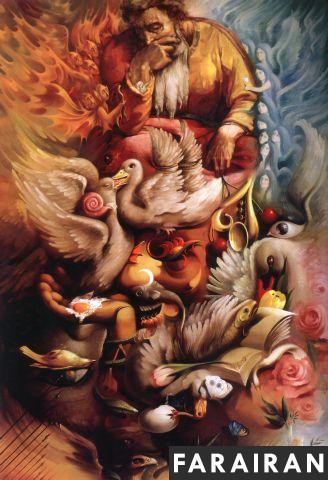
-

- Vector-1990-80x110cm
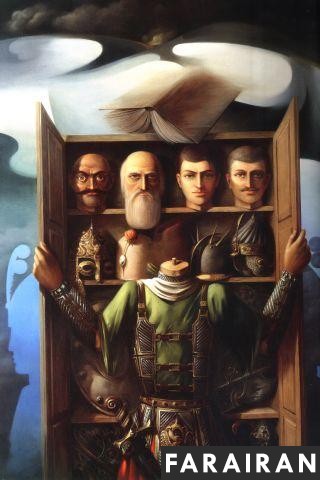
-

- Prism-1990-61x76cm
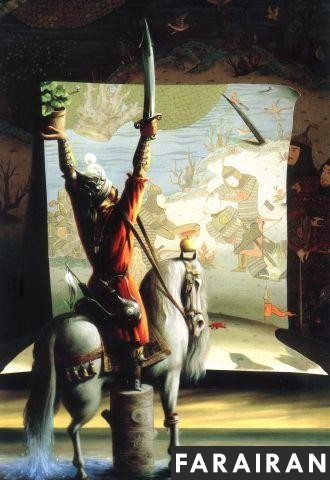
-

- Negative-1991-61x76cm
-

- Series-1992-51x76cm
-

- Equal-1993-45x50cm
-

- Second chapter -1993-60x75cm
-

- Cylinder-1993-61x76cm
-

- Lenght and width-1996-80x110cm
-

- Problem-1997-61x76cm
-

- Untitled – Ink on paper mounted on canvas
-

- Untitled
-

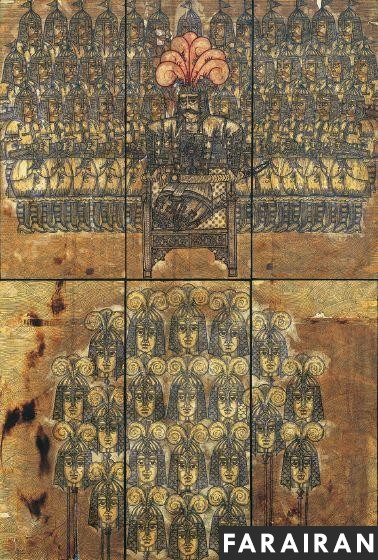
- 2011-Untitled – Ink on paper mounted on canvas -100×150 cm