
Farairan’ Choice Iran Daroudi
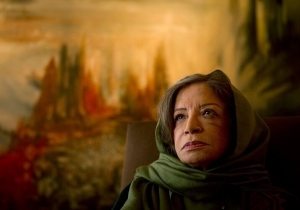
Born in 1936 to a prominent dynasty in the ancient city of Neyshapur, in the province of Khorasan, Iran. Iran Darroudi is a revered Iranian painter, director, writer, art critic and university professor. Her paternal family was among well-known merchants in the north-eastern province, while her maternal family were Caucasian merchants, who immigrated to Iran and settled in Mash-had after the Soviet. In 1937, the family moved to Hamburg for her father’s business, but with the outbreak of the World War II they were forced to return to Mash-had.
“We escaped Germany in the middle of the war, under very grave circumstances. When we reached Iran, war had also reached Iran and Mash-had was under air strikes. Famine was at its peak. There were many Russian soldiers in the town. I was five years old then.” (1)
Back in Mash-had they lived in a house near the Green Dome mosque, leaving its deep impression on her personality and appearing in her artworks and paintings.
Darroudi discovered her passion for arts and music at a young age. Her father was interested in arts and particularly the art of painting and taught her daughter many primary lessons of this art, such as the importance of line, volume and colours. Her mother was a pianist and on her part taught their daughter her first piano lessons. This early passion for both music and painting has left its lasting impression on Daroudi’s later artwork.
“My father had a determining role in the development of my love for Iran. As a young girl when I talked about Dali with my father, he always would say: “You better learn Farsi well and speak the language properly and then talk about arts. You should discover your national identity and culture first…. Following his advice, my interest in the culture and history of my birthplace grew more and more to the extent that in my book In the Distance between two points, I write: “Painting Persepolis is not solely a reference to history. It is to tell the fable of a love, my love for my country.” (2)
“In youth, I learnt to love Iran from Ebrahim Pourdavood and made it the aim of my life. I learnt courage from Simin Behbahani. From Taha Behbahani I learnt balance, and from Parviz Kimiyavi, simplicity and succinctness, from Shamlou and his poetry, infinite dimensions, from Abbas Kiarostami, rhythm in painting, from Mahmoud Dolatabadi, spatial arrangement and tacitly; from Fereydoon Moshiri, friendship in the real sense of the word, from Parviz Nateq Khanlari, awareness of the universal culture and pure verse; from Shafi-ee Kadkani, human psychology, from Bijan Mofid, not to deceive and be deceived; from Ahmad Mahmoud, simplicity and serenity; from Akhavan Sales, the need for beauty and living beautifully, but one of these great figures was my father who taught me all this from my childhood…(3)
In 1945, the family moved to Tehran where she completed her secondary school in 1954. She then joined her sister in Paris to study at l’École des Beaux Arts. After graduation in order to learn the secrets of successful colour mixing, she headed to the Belgian capital and attained a course in “stained glass” at the Imperial and Royal Academy of Brussels. Darroudi completed her education with a degree in the History of Art at Ecole du Louvre in Paris.
Meanwhile she took part in several group exhibitions and won a few prizes. Her first solo Exhibition was held in Miami in 1958 and her first exhibition in Iran was held in April 1960 at the Farhang Hall.
In 1968 Darroudi was commissioned by the ITT Corporation to create an artwork, entitled Iranian Petroleum, on the occasion of the launch of a pipeline from Abadan to Mahshahr. The painting received a wide media coverage and was published in important magazines inlduing Time magazine, Newsweek and Life Magazine.
The painting was later dubbed by the distinguished Iranian poet, Ahmad Shamlu “Our Veins, the Earth’s Veins,” who composed a poem for her in 1973 with the following relevant line:
Painters before you
Brought to life many deer by compositions of leaves..
Or a flock of sheep on the mountain skirts…
Paint us the lines of similarity..
Paint us the cry…
Paint us my era
Paint us my life…
We had all the words of the world
And virtually said nothing
For it was not about only a single one word
Freedom
We did not say it
You paint it!
Following her success in arts, Darroudi took on a new adventure. In 1966 she began to learn directing at the RCL institute in New York City. That’s where she met her husband, Parviz Moghadasi, who was also studying television directing at the time. The two began to collaborate on various projects at a newly established television production company. Over the period of six years, they produced over 80 documentaries about both Iranian and international artists.
After the death of her husband in 1985, Darroudi continued to paint and display her work, proving herself a never ending artist.
Her work was consequently recognized by Iran’s university of Sharif, where she was invited to lecture as an honorary professor on Art History, always emphasizing to her students that “science and industry are not separate from art and aesthetics.” (4)
In an interview which was held with her on the occasion of a retrospective exhibition of her work with the title “Everlasting Persian Gulf” in 2008 at Tehran Museum of Contemporary Art, she talks about her passion for Paris, which is in a way her second home and most of her works were still kept in her studio there. “All these years, whether as a student, or a traveler and finally a resident, I have always felt a special infatuation for this city filled with artistic and cultural attractions. I have had my sweetest and most bitter experiences of my life there. I love its architecture and particularly its urban form, always discovering something of beauty there. I have had a studio in many areas of the city during various periods of my artistic life… What is strange is that when I paint in Paris, its gray sky and the fading pink colour of its sunsets penetrates my paintings.
“Despite its tremendous beauty Paris would never creep under my skin like the city of Yazd with its wind-towers and covered alleyways or Esfahan with its necklace like domes. No doubt, the roots of my identity dominate over my passions and fancies.”
The majority of the works belonging to ‘the freezing period’ have been painted in Paris with some of them conveying a peculiar coldness. That is the period when I left Iran. I lost my father and then my husband. Iran was at war with Iraq. In other words, they do not speak of unknown fears, but rather of the bitter reality of my life.
“Ultimately, I look into human being who is capable of overflowing the world with love, even though human figure is rarely found in my paintings. I try to attain order out of chaos and attain balance out of instability and then paint this disorderly order to reach my own world. I believe humans should at the end discover their own abilities and nature and should not surrender to earthly or heavenly fate… I live the world beyond my sight, beyond my senses. When I decide to paint, it is when something is squeezing my throat. Fears and qualms begin. I feel the weight of my suppressed cries in my chest… I am not scared of my paintings, nevertheless I can not tolerate the weight of some of my works. (5)
In the opinion of the contemporary art critic Javad Mojabi, “Iran Darroudi’s paintings have remained faithful to the bright light of Iran; a light rooted at once in geography, owing to the sharp angle at which sunlight shines on this land, in culture, reflecting the lofty thoughts of our great mystic scholars, and in history, mirroring the inner light of the collective life of the peoples living on this plateau. …. Akin to crystals glittering in the sunlight, Iran Darroudi’s late paintings are filled with the flamboyant light of the desert. Bathing in a mystical light, their constituent elements are combined into resplendent compositions. .. The artist’s intuitive awareness of her fatherland’s culture has indeed led her towards mysticism, prompting her to declare the eventual victory of light across her oriental fatherland.” (6)
“I do not see color separate from the life texture because if you take away the color from it, it is like taking away the love from it. Light is vital for me and I think I am one of God’s selected individuals who has seen the light in the heart of humans. As I see life condensed and short, I don’t prefer any colors in particular and all of them are noble for me.” (7)
Darroudi’s lifetime achievements include her 60 individual exhibitions and 200 group exhibitions, art critiques published in various newspapers, colourful speeches in cultural and artistic establishments around the world, some 80 collaborative documentaries, and last but not least an autobiography, “Distance Between Two Dots”. These are the results of more than 50 years of her work in Contemporary Art of Iran. The same activities that she carried out while rubbing shoulders with great individuals such as Andrew Marlowe, Salvador Dali, Jean Cocteau, Antonio Rodriguez and others turned her into a great international artist.
In the same interview held on the occasion of her “Eternal Persian Gulf” Daroudi says: “How beautiful that at 70 instead of repeating myself, I have entered a new phase. I always feared repeating myself, even though certain people do not see any difference between the periods of red colours, such as “Such a “ white period, freezing cold periods such as “For Riders of Death”, but I know that my attitude is constantly changing. This new period is in reality the concluding turn of the life of a painter. Today I paint more solidly than before and laugh at these poor works. Painting returned the reward of patience, endurance and faith to my work.”
“I value life and growth and regard death as the end of all pains and a rebirth. However, I believe that one should keep one’s head up during the most difficult moments of one’s life.
Today she’s hailed as one of the most influential artists in the world, with her artwork displayed at internationally recognised venues such as the Tehran Museum of Contemporary Arts, the Kerman Museum of Fine Arts, the Sa’dabad Palace, the Saheb Gharani-e Palace, Belgium’s Ixelles Museum and a number of exhibitions of Contemporary Art in New York.
In her opinion: “Certain doors should remain closed. Certain secrets should not be revealed. Those who should know, have found the knowledge and those who wish to know, will find the way to knowledge. My paintings are reflections of my mentality. In other words, my paintings are the result of my life and not my entire life. (8)
I think the sky is jealous of me for standing so strong and warring against it. Those who love life and human beings, will rise from their own ashes. Maybe I am one of them. In order to reach where I am standing now my only trick has been my honesty and I have never failed to reveal my weaknesses on this path.” (9)
Her latest project, to open an art foundation with her own expenses and donation of 150 works to it has taken Darroudi back to her motherland.
In reality, it is not immorality that I wish to attain. My aspiration has always been to devote my love to this land, expressing my gratitude somehow. The only think I have in mind is to present all my works to her. That is why I am making the roads shorter in order to return to the soil on which I was born… A green leaf as the gift of a dervish… (10)
On her birthday in 2016, Tehran Municipality allocated a 1500 square meters piece of land near a park in Tehran to this aim. According to Iran Daroudi, her foundation and museum “will be a cultural center to teach painting, hold conferences on Art. I will build the museum for the future generation in order to be in contact with the contemporary world and its changes. After my death a board will run the museum. After my death, a directing board will run the museum.” (10)
All my life I was obliged to asses myself and my abilities in regard to my wishes. One of my characteristics here is that I have always cherished life. I experienced death when facing cancer and I regarded it as the miracle of my life. That is why it is our attitude to life which increases our powers… I tell those who have lost hope in life: Aren’t you enjoying the virtue of being alive?
“Humans are the fruit of their mental attitudes. Now that life is challenging us, we should equip ourselves and make everything anew. The most important thing on this path is that human life is a purpose . I believe every hardship of life is an experience and a lesson from which we have to learn. Those who have a purpose in life will neither lose hope nor will stop fighting. (12)
Individual Exhibitions
1958 Miami Beach Art Centre, USA
1958 Columbia University, New York
1959 Royal Hilton Hotel, Tehran
1959 Farhang Hall, Tehran
1961 Iran-America Society, Tehran
1961 Farhang Hall, Tehran
1963 Museum of xelles, Brussels
1964 Galeria Santa Maria Pizza, Milan
1964 Borghèse Gallery, Tehran
1965 Iran-America Society, Tehran
1969 Negar Gallery, Tehran
1970 Royal Hilton Hotel, Tehran
1970 Sharif Industrial University, Tehran
1972 Goethe Institute, Tehran
1973 Space Gallery 2000, New York
1973 Goethe Institute : Shiraz, Abadan, Mashhad, Isfahan
1973 Drouant Gallery, Paris
1973 Atrium Artis Gallery, Geneva
1974 21 Gallery, Zurich
1974 National Iranian Oil Company, Abadan
1974 Ferdowsi University, Mashhad
1975 Darroudi Gallery, Tehran
1975 Drouant Gallery, Tokyo
1975 La Galleria Gallery, Mexico
1976 Museum of Bellas Artes, Mexico
1976 Heritage Gallery, Toronto
1976 Ferdowsi University, Mashhad
1976 Isfahan University, Isfahan
1976 National Iranian Oil Company, Abadan
1976 Iranian National Television, Shiraz
1976 Alexander Gallery, Tehran
1978 Prime Minister’s Club, Tehran
1978 Intercontinental Hotel, Geneva
1982 Motte Gallery, Geneva
1987 Bailleul Gallery, Paris
1988 Salon Roland Garros, Palais de Chaillot, Paris
1988 Studio Q, New Jersey
1988 Art Decor Gallery, Washington D.C.
1989 First Credit bank, Los Angeles
1991 A.M.O.R.C. Cultural Center, Paris
1991 Iran Cultural Center, Dusseldorf, Germany
1992 Azadi Museum, Tehran
1993 Sepehri Gallery, Tehran
1994 Art 54 Gallery, New York
1994 United Nations, New York
1995 Barg Gallery, Tehran
1999 Hourian Gallery, San Francisco
1999 Virginia Tech University, Virginia
1999 U.C.L.A. University, Los Angeles
2002 Artists’ House, Tehran
2002 Museum Of Modern Art, Isfahan
2003 Pegah Gallery, Kerman
2008 Museum of Modern Art, Tehran
Group exhibitions
200 group exhibitions in France, Belgium, Switzerland, USA, Mexico, Australia, Japan, and Germany also exhibitions with Iranian artists in Iran, France, USA, Canada, Monaco, Germany and UAE.
Other activities
Since 1964, a member of International Congress of Artists, Art Critics and Artistic Studies of Rimini, Verrucchio, San Marino, Italy.
From 1967-1972, producing and directing 1900 minutes of documentary film for television on “Art Appreciation”.
Producing and directing a 55 minute documentary film entitled “Biennial of Venice 1968 ”.
1970-1972, Honorary professor of “History and Art Appreciation” in Sharif Industrial University, Tehran.
A series of conferences about painting and the role of women in the Iranian history and the contemporary art, and also about her book entitled “ In the Distant between Two Points”.
Conferences:
1988 Cultural Society of Iranian Immigrants, Brussels.
1998 The Library of Iran’s Study Center; London
1998 Virginia Tech University, Virginia
1999 L.A. University, Los Angeles
1999 Berkeley University, San Francisco
1999 San Jose Experts Society, USA
1999 Kahrizak ‘Cultural Institution’, San Francisco,
1999 Virginia Tech University, Virginia
1999 Sokhan Society, San Francisco
1999 Sokhan Society, Los Angeles
1999 Iranian’s Cultural Society, Sacramento
1999 Cultural Society of Iranian Immigrants in New Jersey
Publishing:
Research on “ The Art of Achaemenians ”, printed in Sokhan and Negin press in 1957 and 1958.
Articles and criticism on painting in Iranian press and Sokhan magazine.
1973 “Iran Darroudi’s Paintings ”, Tehran, first edition
1976 “Iran Darroudi’s Paintings ”, Tehran, second edition by Amir Kabir
1995 “In the distance between two points…!”, Her autobiography, first edition by Ney
2004 “Hearing Eye” Iran Darroudi’s Paintings, Tehran, First edition
2007 “In the distance between two points…!”, Ninth edition
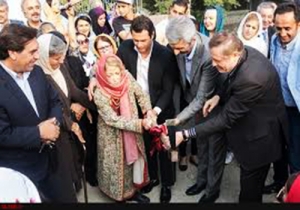
Iran Daroudi, officially inaugurating her future museum on her birthday, 2016
Sources:
Iran Daroudi, website
Iran Daroudi: An Everlasting Artist, by Shamsi Shahrokhi, Persian Tribune
“I am not scared of my paintings,” an interview with Iran Daroudi,
The Ideal World of an influential contemporary artist, an interview with Iran Daroudi, Pejman Mosavi, Sharq Newspaper, reproduced at Aftab news webstie.
Footnotes:
1)“I am not scared of my paintings,” an interview with Iran Daroudi.
2) Ibid.
3) The Ideal World of an influential contemporary artist…
4) “I am not scared of my paintings,”
5) Ibid.
6) Iran Daroudi’s website
7) The Ideal World of an influential contemporary artist…
8) “I am not scared of my paintings,”
9) Ibid.
10) The Ideal World of an influential contemporary artist…
11) Ibid.
12) Ibid.


