
Imam ‘Ali (pbub)Mirrored in Art
(On the occasion of Moharram month)
Farairan Quarterly,Nos.5&6,Autumn2000-Winter 2001
Shurideh Ghazi
As this year has been named “the year of Imam ‘Ali”, an exhibition entitled “‘Ali (pbuh) Mirrored in Art” was held at the Sahebqaraniyeh Palace Museum, part of the Niavaran Historical-Cultural Complex, with the help of the manager of Rivand Gallery, Ms. Shurideh Ghazi, and Dr. Hessameddin Khorrami. A valuable and substantial collection of the works of Iranian artists from the Safavid era was on display in this collection. The exhibition was of the icons of Imam ‘Ali and the Panj Tan-e Al-e ‘Aba1, accompanied by works of naskh2, sols3 and nasta‘liq4 calligraphy, as well as a unique set of calligraphic paintings which completed this collection.
In Iran, the history of carving figures on stone and designs on walls goes back to the pre-Islamic era. Illustrated books, like Mani’s Arjang, were acclaimed and admired. The Book of Khosrovan was profusely illustrated, and coins of the Achaemenid, Parthian and Sasanian eras were minted with effigies of kings. But in the Islamic era—due to certain misunderstandings, and following the Hebrew tradition of banning pictorial representation in religious books—paintings and illustrations were banned in public spaces, especially mosques, and in the holy Qoran. It would appear that this ban on pictorial representation in the first century of Islam was intended to prevent a return to idolatry.
The Arabs were less involved in sculpture and illustration. Nevertheless, in many countries where Islam was embraced as a divine religion the tradition of sculpture, painting and carving began to develop, despite the attitudes towards idolatry. These arts evolved in Anatolia, Mesopotamia, Iran and later India as part of the cultural history of these countries that was now in the service of Islam.
In the early centuries of Islam, arabesque and floral designs were used to decorate bare architectural surfaces; this art developed extensively in Shiite countries. The Egyptian Moslems preferred sculpture and illustration, using the bibles and churches as models. Depictions of the human form were used at the Alhambra mosque. Illustration and painting were gradually revived, but remained strictly excluded from the holy Qoran and mosques. But calligraphy gained a newfound importance, and sols, kufi5 and naskh achieved greater heights. Islam was the inheritor of numerous cultures: Rome and Greece, Coptic and Pharaonic Egypt, and Iran. The Romans inherited the art of the Greeks. The Roman arts, especially sculpture, drew on the ancient Etruscan traditions. The Etruscans created wax effigies of their ancestors to decorate the porches of their homes. Of course this art was exclusive to skilled craftsmen, not the common Etruscan citizens. Considerable progress was made during the time of St. Augustine, and from the fifth century onwards, interior architectural decoration was accompanied by painting. Painting evolved from being a Roman and Byzantine art to one embraced by many cultures. Painting on pottery was gradually developed, but did not have much religious significance. The panels drawn for Roman generals created major changes in this art.
These panels were similar to the pardehs6 created in the late Safavid era to portray the event of Karbala and other religious spectacles. Large canvases were covered with images of the desert of Karbala, the tragedy of ‘Ashura, or scenes of the Judgement Day. A pardeh, or curtain, was draped on these images, and the storyteller, or pardehdar would slowly pull away the pardeh and recount the tragedy of Karbala.
These images and religious canvases were of particular importance to the dervishes and followers of Imam ‘Ali (pbuh), and found expression in depictions of the Imam, known as icons. Iconography itself is derived from the art of ancient India. Images of the Buddha, with a golden halo surrounding his head, began in India four centuries before the birth of Christ. This halo later enters Christian art, and from the fifteenth and sixteenth centuries it is also features in the art of Iran. The presence of a halo or drapery on the faces of religious figures also goes back to historic times.
Icons are first displayed in tekiehs7 . The image of Imam ‘Ali and his zolfaqar (double-edged sword), sometimes as a solitary figure, sometimes in the company of his sons, Imams Hassan (pbuh) and Hossein (pbuh), or other companions. The image of ‘Abbas (pbuh) is hung in saqqa-khanehs8 . Depictions of Imam ‘Ali (pbuh), at times in battle and at times in the city of Kufa, and the images of Imam Hossein (pbuh) in the desert of Karbala adorn the tekiehs and Hosseiniyyehs9 , and later find their way into zoor-khanehs10, khaneqahs11 and coffee-houses.
The oldest icons of Imam ‘Ali belong to the Safavid era. Variety in depictions was taken to be disrespectful to the Imam, yet the style of depiction follows the conventions of the Herat school. The old Persian word for these icons is kesmeh.
The icons of Imam ‘Ali (pbuh) occupy a special place in Iranian culture. Research into historical and religious aspects of this art attest to the significance of the Imam as a prominent figure in the history of the world and a continuous presence in the lives of Iranians. Springs and qadamgahs12 across the country have been named after him, and poetry and literature have also sung his praises.
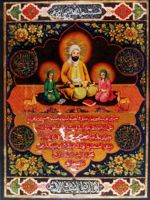
“The Icons of Imam ‘Ali Mirrored in Art”, contained a comprehensive collection of the iconography and religious calligraphy of Iran. In addition to the icons, the Sahebqaraniyeh Museum has put on display a collection of calligraphic works from the Safavid era—from nasta‘liq to calligraphic relief—which add to the richness of this exhibition.
1. The five holiest figures of Islam: the Holy Prophet Mohammad (pbuh), his daughter Hazrat Fatemeh (pbuh), Imam ‘Ali (pbuh), Imam Hassan (pbuh) and Imam Hossein (pbuh).
2. A type of Islamic script.
3. A type of Islamic script.
4. A type of Islamic script.
5. A type of Islamic script.
6. Narrative painted panels.
7. Building or locale where mourning ceremonies are held.
8. Locale where water is stored for thirsty passers-by and
which is considered blessed.
9. Building or place dedicated to Imam Hossein (pbuh) in
which mourning ceremonies are held.
10. Traditional gymnasiums.
11. A locale where dervishes and holy men reside and
perform mystical rites.
12. Religious sites where the footsteps of a holy figure are
believed to exist.


