The Labor of the Inhuman, Part I: Human

Reza Negarestani

Source: e-flux magazine, February 2014

Reza Negarestani is a philosopher. He has contributed extensively to journals and anthologies and lectured at numerous international universities and institutes. His current philosophical project is focused on rationalist universalism beginning with the evolution of the modern system of knowledge and advancing toward contemporary philosophies of rationalism, their procedures as well as their demands for special forms of human conduct.

Inhumanism is the extended practical elaboration of humanism; it is born out of a diligent commitment to the project of enlightened humanism. As a universal wave that erases the self-portrait of man drawn in sand, inhumanism is a vector of revision. It relentlessly revises what it means to be human by removing its supposed evident characteristics and preserving certain invariances. At the same time, inhumanism registers itself as a demand for construction, to define what it means to be human by treating human as a constructible hypothesis, a space of navigation and intervention.1

Inhumanism stands in concrete opposition to any paradigm that seeks to degrade humanity either in the face of its finitude or against the backdrop of the great outdoors. Its labor partly consists in decanting the significance of human from any predetermined meaning or particular import set by theology—thereby extricating human significance from human veneration fabricated as a result of assigning significance to varieties of theological jurisdiction (God, ineffable genercity, foundationalist axiom, and so forth).2

Once the conflated and the honorific meaning of man is replaced by a minimalist yet functionally consequential, real content, the humilific credo of antihumanism that subsists on a theologically anchored conflation between significance and veneration also loses its deflationary momentum. Incapable of salvaging its pertinence without resorting to a concept of crisis occasioned by theology, and unsuccessful in extracting human significance by disentangling the pathological conflation between real import and glorification, antihumanism is revealed to be in the same theological boat that it is so determined to set on fire.

Failing to single out significance according to the physics that posits it rather than the metaphysics that inflates it, antihumanism’s only solution for overcoming the purported crisis of meaning comes by adopting the cultural heterogeneity of false alternatives (the ever increasing options of post-, communitarian retreats as so-called alternatives to totality, and so forth). Rooted in an originary conflation that was never resolved, such alternatives perpetually swing between their inflationary and deflationary, enchanting and disenchanting bipolar extremes, creating a fog of liberty that suffocates any universalist ambition and hinders the methodological collaboration required to define and achieve a common task for breaking out of the current planetary morass.

In short, the net surfeit of false alternatives supplied under the rubric of liberal freedom causes a terminal deficit of real alternatives, establishing for thought and action the axiom that there is indeed no alternative. The contention of this essay is that universality and collectivism cannot be thought, let alone attained, through consensus or dissensus between cultural tropes, but only by intercepting and rooting out what gives rise to the economy of false choices and by activating and fully elaborating what real human significance consists of. For it is, as will be argued, the truth of human significance—not in the sense of an original meaning or a birthright, but in the sense of a labor that consists of the extended elaboration of what it means to be human through a series of upgradable special performances—that is rigorously inhuman.

The force of inhumanism operates as a retroactive deterrence against antihumanism by understanding humanity historically—in the broadest physico-biological and socioeconomical sense of history—as an indispensable runway toward itself.

But what is humanism? What specific commitment does “being human” represent and how does the full practical elaboration of this commitment amount to inhumanism? In other words, what is it in human that shapes the inhuman once it is developed in terms of its entitlements and consequences? In order to answer these questions, first we need to define what it means to be human and exactly what commitment “being human” endorses. Then we need to analyze the structure of this commitment in order to grasp how undertaking such a commitment—in the sense of practicing it—entails inhumanism.
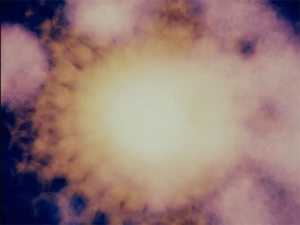

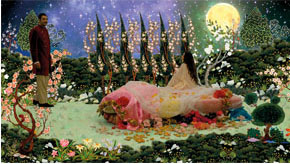
Jordan Belson, Samadhi, 1967. Film still.

1. Commitment as Extended and Multimodal Elaboration

A commitment only makes sense by virtue of its pragmatic content (meaning through use) and its demand to adopt an intervening attitude. This attitude aims to elaborate the content of a commitment and then update that commitment according to the ramifications or collateral commitments that are made explicit in the course of elaboration. In short, a commitment—be it assertional, inferential, practical, or cognitive—can neither be examined nor properly undertaken without the process of updating the commitment and unpacking its consequences through a full range of multimodal practices. In this sense, humanism is a commitment to humanity, but only by virtue of what a commitment is andwhat human is combined together.

The analysis of the structure and laws of commitment-making and the meaning of being human in a pragmatic sense (i.e., not by resorting to an inherent conception of meaning hidden in nature or a predetermined idea of man) is a necessary initial step before entering the domain of making prescriptions (whether social, political, or ethical). What needs to be explicated first is what it takes to make a prescription, or what one needs to do in order to count as prescribing an obligation or a duty, to link duties and revise them. But it must also be recognized that a prescription should correspond to a set of descriptions which at all times must be synchronized with the system of modern knowledge as what yields and modifies descriptions. To put it succinctly: description without prescription is the germ of resignation, and prescription without description is whim.

Correspondingly, this is an attempt to understand the organization of prescription, or what making a prescription for and by human entails. Without such knowledge, prescriptive norms cannot be adequately distinguished from descriptive norms (i.e., we cannot have prescriptions), nor can proper prescriptions be constructed without degenerating into the vacuity of prescriptions devoid of descriptions.

The description of the content of human is impossible without elaborating it in the context of use and practices, while elaboration itself is impossible without following minimally prescriptive laws of commitment-making, inference, and judgment. Describing human without turning to an account of foundational descriptions or an a priori access to descriptive resources is already a minimally but functionally hegemonic prescriptive project that adheres to oughts of specification and elaboration of the meaning of being human through features and requirements of its use. “Fraught with oughts” (Wilfrid Sellars), humanism cannot be regarded as a claim about human that can only be professed once and subsequently turned into a foundation or axiom and considered concluded. Inhumanism is a nomenclature for the infeasibility of this one-time profession. It is a figure for the impossibility of ever putting the matter to rest once and for all.

To be human is a mark of a distinction between, on the one hand, the relation between mindedness and behavior through the intervention of discursive intentionality, and on the other hand, the relation between sentient intelligence and behavior in the absence of such mediation. It is a distinction between sentience as a strongly biological and natural category and sapience as a rational (not to be confused with logical) subject. The latter is a normative designation which is specified by entitlements and the responsibilities they bring about. It is important to note that the distinction between sapience and sentience is marked by a functional demarcation rather than a structural one. Therefore, it is still fully historical and open to naturalization, while at the same time being distinguished by its specific functional organization, its upgradable set of abilities and responsibilities, its cognitive and practical demands. The relation between sentience and sapience can be understood as a continuum that is not differentiable everywhere. While such a complex continuity might allow the naturalization of normative obligations at the level of sapience—their explanation in terms of naturalistic causes—it does not permit the extension of certain conceptual and descriptive resources specific to sapience (such as the particular level of mindedness, responsibilities, and, accordingly, normative entitlements) to sentience and beyond.
The rational demarcation lies in the difference between being capable of acknowledging a law and being solely bound by a law, between understanding and mere reliable responsiveness to stimuli. It lies in the difference between stabilized communication through concepts (as made possible by the communal space of language and symbolic forms) and chaotically unstable or transient types of response or communication (such as complex reactions triggered purely by biological states and organic requirements or group calls and alerts among social animals). Without such stabilization of communication through concepts and modes of inference involved in conception, the cultural evolution as well as the conceptual accumulation and refinement required for the evolution of knowledge as a shared enterprise would be impossible.3

Ultimately, the necessary content as well as the real possibility of human rests on the ability of sapience—as functionally distinct from sentience—to practice inference and approach non-canonical truth by entering the deontic game of giving and asking for reasons. It is a game solely in the sense of involving error-tolerant, rule-based practices conducted in the absence of a referee, in which taking-as-true through thinking (the mark of a believer) and making-true through acting (the mark of an agent) are constantly contrasted, gauged, and calibrated. It is a dynamic feedback loop in which the expansion of one frontier provides the other with new alternatives and opportunities for diversifying its space and pushing back its boundaries according to its own specifications.

2. A Discursive and Constructible “We”
What combines both the ability to infer and the ability to approach truth (i.e., truth in the sense of making sense of taking-as-true and making-true, separately and in conjunction with one another) is the capacity to engage discursive practices in the way that pragmatism describes it: as the ability to (1) deploy a vocabulary, (2) use a vocabulary to specify a set of abilities or practices, (3) elaborate one set of abilities-or-practices in terms of another set of abilities-or-practices, and (4) use one vocabulary to characterize another.4

Discursive practices constitute the game of giving and asking for reasons and outlining the space of reason as a landscape of navigation rather than as a priori access to explicit norms. The capacity to engage discursive practices is what functionally distinguishes sapience from sentience. Without such a capacity, human is only a biological fact that does not by itself yield any propositional contentfulness of the kind that demands a special form of conduct and value attribution and appraisal. Without this key aspect, speaking about the history of human risks reducing the social construction to a biological supervenience while depriving history of its possibilities for intervention and reorientation.

In other words, deprived of the capacity to enter the space of reason through discursive practices, being human is barred from meaning anything in the sense of practice in relation to content. Action is reduced to meaning “just do something,” collectivity can never be methodological or expressed in terms of a synthesis of different abilities to envision and achieve a common task, and making commitment through linking action and understanding is untenable. We might just as well replace human with whatever we wish so as to construct a stuff-oriented philosophy and a nonhuman ethics where “to be a thing” simply warrants being good to each other, or to vegetables for that matter.

Once discursive practices that map out the space of reason are underplayed or dispensed with, everything lapses either toward the individual or toward a noumenal alterity where a contentless plurality without any demand or duty can be effortlessly maintained. Discursive practices as rooted in language-use and tool-use generate a de-privatized but nonetheless stabilizing and contextualizing space through which true collectivizing processes are shaped. It is the space of reason that harbors the functional kernel of a genuine collectivity, a collaborative project of practical freedom referred to as “we” whose boundaries are not only negotiable but also constructible and synthetic.

One should be reminded that “we” is a mode of being, and a mode of being is not an ontological given or a domain exclusive to a set of fundamental categories or fixed descriptions. Instead, it is a conduct, a special performance that takes shape as it is made visible to others. Precluding this explicit and discursively mobilizable “we,” the content of “being human” never translates to “commitment to human or to humanity.” By undergirding “we,” discursive practices organize commitments as ramifying trajectories between communal saying and doing, and they enact a space where the self-construction or extensive practical elaboration of humanity is a collaborative project.

Making a commitment to something means vacillating between doing something in order to count as saying it, and saying something specific in order to express and characterize that doing.

It is the movement back and forth, the feedback loop, between the two fields of claims and actions that defines sapience as distinguished from sentience. To make a commitment means “what else,” “what other commitments” it brings forth and how such consequent commitments demand new modes of action and understanding, new abilities and special performances that cannot be simply substituted with old abilities because they are dictated by revised or more complex sets of demands and entitlements. Without ramifying the “what else” of a commitment by practically elaborating it, without navigating what Robert Brandom calls the rational system of commitments,5 a commitment has neither sufficient content nor a real possibility of assessment or development. It is as good as an empty utterance—that is, an utterance devoid of content or significance even though it earnestly aspires to be committed.
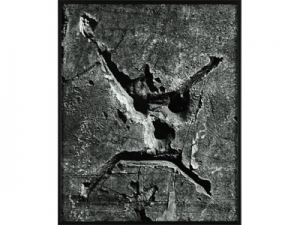

Brassaï Untitled from the Series II “La mort,” 1930. Gelatin silver print. Collection MACBA, Barcelona.

3. Intervention as Construction and Revision

Now we can turn the argument regarding the exigencies of making a commitment into an argument about the exigencies of being a human, insofar as humanism is a system of practical and cognitive commitments to the concept of humanity. The argument goes as follows: In order to commit to humanity, the content of humanity must be scrutinized. To scrutinize this content, its implicit commitments must be elaborated. But this task is impossible unless we take humanity-as-a-commitment to its ultimate conclusion—by asking what else being a human entails, by unfolding the other commitments and ramifications it brings about.

But since the content of humanity is distinguished by its capacity to engage rational norms rather than natural laws (ought instead of is), the concept of entailment for humanity-as-a-commitment is non-monotonic. That is to say, entailment no longer expresses a cause and its differential effect, as in physical natural laws or a deductive logical consequence. Instead, it expresses enablement and abductive non-monotonicity in the sense of a manipulable, experimental, and synthetic form of inference whose consequences are not simply dictated by premises or initial conditions.6 Since non-monotonicity is an aspect of practice and complex heuristics, defining the human through practical elaboration means that the product of elaboration does not correspond with what the human anticipates or with the image it has of itself. In other words, the result of an abductive inference that synthetically manipulates parameters—the result of practice as a non-monotonic procedure—will be radically revisionary to our assumptions and expectations about what “we” is and what it entails.

The non-monotonic and abductive characteristics of robust social practices that form and undergird the space of reason turn reasoning and the intervening attitude that it promotes into ongoing processes. Indeed, reason as rooted in social practices is not necessarily directed toward a conclusion, nor is it aimed at establishing agreements through the kind of substantive and quasi-instrumentalist account of reason proposed by Jürgen Habermas.7Reason’s main objective is to maintain and enhance itself. And it is the self-actualization of reason that coincides with the truth of the inhuman.

The unpacking of the content of commitment to humanity, the examination of what else humanity entitles us to, is impossible without developing a certain intervening attitude that simultaneously involves the assessment (or consumption) and the construction (or production) of norms. Only this intervening attitude toward the concept of humanity is able to extract and unpack the implicit commitments of being a human. And it is this intervening attitude that counts as an enabling vector, making possible certain abilities otherwise hidden or deemed impossible.

It is through the consumption and production of norms that the content of a commitment to humanity can be grasped, in the sense of both assessment and making explicit the implicit commitments that it entitles us to. Accordingly, to understand the commitment to humanity and to make such a commitment, it is imperative to assume a constructive and revisionary stance with regard to human. This is the intervening attitude mentioned earlier.

Revising and constructing human is the very definition of committing to humanity. Lacking this perpetual revision and construction, the commitment part of committing to humanity does not make sense at all. But also insofar as humanity cannot be defined without locating it in the space of reasons (the sapience argument), committing to humanity is tantamount to complying with the revisionary vector of reason and constructing humanity according to an autonomous account of reason.

Humanity is not simply a given fact that is behind us. It is a commitment in which the reassessing and constructive strains inherent to making a commitment and complying with reason intertwine. In a nutshell, to be human is a struggle. The aim of this struggle is to respond to the demands of constructing and revising human through the space of reasons.

This struggle is characterized as developing a certain conduct or error-tolerant deportment according to the functional autonomy of reason—an intervening attitude whose aim is to unlock new abilities of saying and doing. In other words, it is to open up new frontiers of action and understanding through various modes of construction and practices (social, technological, and so forth).
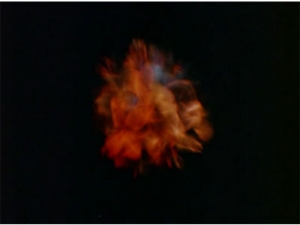

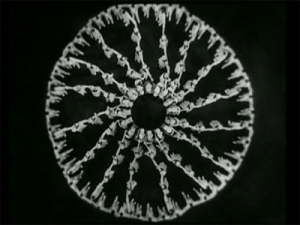
Jordan Belson, Samadhi, 1967. Film still.

4. Kitsch Marxism

If committing to being human is a struggle to construct and revise, today’s humanism is for the most part a hollow enterprise that neither does what it says nor says what it does. Sociopolitical philosophies seeking to safeguard the dignity of humanity against the onslaught of politico-economic leviathans end up joining them from the other side.

By virtue of its refusal to recognize the autonomy of reason and to systematically invest in an intervening—that is, revisionary and constructive—attitude toward human and toward norms implicit in social practices, contemporary Marxism largely fails to produce norms of action and understanding. In effect, it subtracts itself from the future of humanity.

Only through the construction of what it means to be human can norms of committing to humanity be produced. Only by revising existing norms through norms that have been produced is it possible to assess norms and above all evaluate what it means to be human. Again, these norms should be distinguished from social conventions. Nor should these norms be confused with natural laws (they are not laws, they are conceptions of laws, hence they are error-tolerant and open to revision). The production or construction of norms prompts the consumption or assessment of norms, which in turn leads to a demand for the production of newer abilities and more complex normative attitudes.

One cannot assess norms without producing them. The same can be said about assessing the situation of humanity, the status of the commitment to be human: humanity cannot be assessed in any context or situation unless an intervening, constructive attitude toward it is developed. But to develop this constructive attitude toward human means to emphatically revise what it means to be human.

A dedication to a project of militant negativity and an abandonment of the ambition to develop an intervening and constructive attitude toward human through various social and technological practices is now the hallmark of kitsch Marxism. While kitsch Marxism should not be inflated to the whole of Marxism, especially since class struggle as a central tenet of Marxism is an indispensable historical project, at this point the claim of being a Marxist is too generic. It is like saying, “I am an animal.” It does not serve any theoretical or practical purpose.

The assessment of any Marxist agenda should be done by way of determining whether it has the power to elaborate its commitments, whether it understands the underlying mechanisms involved in making a commitment, and above all, whether it possesses a program for globally updating its commitments. Once practical negativity is valorized and the intervening attitude or the constructive deportment is dismissed, the assessment of humanity and its situations becomes fundamentally problematic on the following levels.

Without the constructive vector, the project of evaluation—the critique—is transformed into a merely consumptive attitude toward norms. Consumption of norms without producing any is the concrete reality of today’s Marxist critical theory. For every claim, there exists a prepackaged set of “critical reflexes.”8 One makes a claim in favor of the force of better reason. The kitsch Marxist says, who decides? One says, construction through structural and functional hierarchies. The kitsch Marxist responds, control. One says, normative control. The kitsch Marxist reminds us of authoritarianism. We say “us.” The kitsch Marxist recites, who is “us”? The impulsive responsiveness of kitsch Marxism cannot even be identified as a cynical attitude because it lacks the rigor of cynicism. It is a mechanized knee-jerk reactionism that is the genuine expression of norm consumerism without the concrete commitment to producing any norms. Norm consumerism is another name for cognitive servitude and noetic sloth.

The response of kitsch Marxism to humanity is also problematic on the level of revision. Ceasing to produce norms by refusing to undertake a constructive attitude toward human in the sense of a deportment governed by the functional autonomy of reason means ceasing to revise what it means to be human. Why? Because norms are assessed and revised by newer norms that are produced through various modes of construction, complex social practices, and the unlocking of new abilities for going back and forth between saying and doing. Since being human is distinguished by its capacity to enter the game of giving and asking for reasons, the construction of human ought to be in the direction of further singling out the space of reason through which human differentiates itself from nonhuman, sapience from sentience.

By transforming the ethos of construction according to the demands of reason into the pathos of negativity, kitsch Marxism not only puts an end to the project of revision. It also banks on a concept of humanity outside of the space of reason—even though reason’s revisionary force is the only authorized force for renegotiating and defining humanity. Once revision is brought to an end, understanding humanity and acting upon its situations has no significance, since what is deemed to be human no longer enjoys any pertinence.9Similarly, once the image of humanity is sought outside of reason, it is only a matter of time before the deontological distinction between sapience and sentience collapses and telltale signs of irrationalism—frivolity, narcissism, superstition, speculative enthusiasm, social atavism, and ultimately, tyranny—heave forth.

Therefore, the first question one needs to ask a humanist or a Marxist is: Are your commitments up to date? If yes, then they must be subjected to a deontic trial—either a version of Robert Brandom’s deontic scorekeeping or Jean-Yves Girard’s deontic ordeal, where commitments can be reviewed on the basis of their connectivity, evasion of vicious circles and internal contradictions, and recusal instead of refutation.

If commitment to humanity is identified by active revision and construction, ceasing to revise and refusing to construct characterize a form of irrationalism that is determined to cancel out what it means to be human. It is in this sense that kitsch Marxism is not just a theoretical incompetency. It is also—from both a historical and cognitive standpoint—an impulse to regress from sapience back to sentience.

To this extent, it is not an exaggeration to say that within every kitsch Marxist agenda lies dormant the germ of hostility to humanity and the humanist project. Practical negativity refuses to be a resignation, but it also refuses to contribute to the system and develop a systematic attitude toward the affirmative stance “implicit” in the construction of the system.

Humanism is distinguished by the implicitly affirmative attitude of construction. Insofar as the kitsch Marxism resignation implies an abandonment of the project of humanism and a collapse into regressive passivity, we can say that kitsch Marxism’s refusal to both resign and to construct is tantamount to a position that is neither passive nor humanist. Indeed, this “neither/nor” approach signifies nothing but a project of active antihumanism that kitsch Marxism is in reality committed to—despite its pretensions to a commitment to human. It is in the wake of this antihumanism or hostility toward ramifications of committing to human that the identification of kitsch Marxist agendas with humanism appears at best as a farce, and at worst as a critical Ponzi scheme for devoted humanists.

In its mission to link the commitment to humanism to complex abilities and commitments, inhumanism appears as a force that stands against both the apathy of resignation and the active antihumanism implicit in practical negativity as the fashionable stance of kitsch Marxism today. Inhumanism, as will be argued in the next installment of this essay, is both the extended elaboration of the ramifications of making a commitment to humanity, and the practical elaboration of the content of human as provided by reason and the sapient’s capacity to functionally distinguish itself and engage in discursive social practices.

To be continued in “The Labor of the Inhuman, Part II: The Inhuman”

1 Throughout the text the term human has often occurred without a definite article in order to emphasize the meaning of the word human as a singular universal which makes sense of its mode of being by inhabiting collectivizing or universalizing processes. This is human not merely by virtue of being a species but rather by virtue of being a generic subject or a commoner before what brings about its singularity and universality. Human, accordingly, as Jean-Paul Sartre points out is universal by the singular universality of human history, and it is also singular by the universalizing singularity of the projects it undertakes.

2 A particularly elegant and incisive argument in defense of human significance as conditioned by the neurobiological situation of subjectivityinstead of God or religion has been presented by Michael Ferrer. To great consequence, Ferrer demonstrates that such an enlightened and nonconflated revisitation of human significance simultaneously undermines the theologically licensed veneration and the deflationary attitude championed by many strains of the disenchantment project and its speculative offshoots.

3 “Multi-person epistemic dynamics can only work profitably if the stability of shared knowledge and the input-connection of this knowledge (its ‘realism’) are granted. If not, a system of knowledge, although cognitively possible, cannot be socially enacted and culturally elaborated. As in complex social networks, Darwinian selection operates at the level of social entities (which survive or disappear), only species, which have solved this problem, can exploit the benefits of a higher level of cognition. The question is therefore: How does language, or do other symbolic forms, contribute to the evolution of social awareness, social consciousness, social cognition?” Wolfgang Wildgen, The Evolution of Human Language: Scenarios, Principles, and Cultural Dynamics(Philadelphia: John Benjamins, 2004), 40.

4 See Robert Brandom, Between Saying and Doing: Towards an Analytic Pragmatism(Oxford: Oxford University Press, 2008).

5 Ibid.

6 Abductive inference, or abduction, was first expounded by Charles Sanders Peirce as a form of creative guessing or hypothetical inference which uses a multimodal and synthetic form of reasoning to dynamically expand its capacities. While abductive inference is divided into different types, all are non-monotonic, dynamic, and non-formal. They also involve construction and manipulation, the deployment of complex heuristic strategies, and non-explanatory forms of hypothesis generation. Abductive reasoning is an essential part of the logic of discovery, epistemic encounters with anomalies and dynamic systems, creative experimentation, and action and understanding in situations where both material resources and epistemic cues are limited or should be kept to a minimum. For a comprehensive examination of abduction and its practical and epistemic capacities, see Lorenzo Magnani, Abductive Cognition: The Epistemological and Eco-Cognitive Dimensions of Hypothetical Reasoning (Berlin: Springer, 2009).

7 See Anthony Simon Laden, Reasoning: A Social Picture(Oxford: Oxford University Press, 2012).

8 Thanks to Peter Wolfendale for the term “critical reflexes” as an expression of prepackaged theoretical biases used to preempt the demands of thought in the name of critical thought.

9 It is no secret that the bulk of contemporary sociopolitical prescriptions are based on a conception of humanity that has failed to synchronize itself with modern science or take into account social and organizational alterations effected by technological forces.
Allegories of Art, Politics, and Poetry

Alan Gilbert

Source: e-flux Journal, January 2013

1. Shifting the Landscape

Politics without the imagination is bureaucracy, but the imagination is never a neutral category.

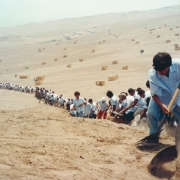
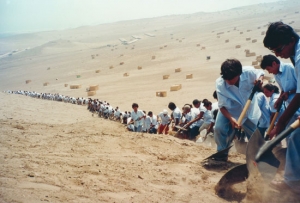
The shantytowns built on the outskirts of Lima, Peru, are the product of civil war, economic turmoil, ethnic struggle, and ecological crisis. Populated by underemployed laborers from the city and displaced peasants from the Andes, frequently of indigenous descent, a number of these shantytowns were originally constructed in the 1970s.1 In 2002, one of these shantytowns, named Ventanilla, was home to more than seventy thousand people without plumbing, electricity, paved roads, or other basic infrastructure. The surrounding landscape is desert. To move a mountain on this landscape, Francis Alÿs gave each of five hundred volunteers from Ventanilla a shovel and asked them to stand side by side and slowly work their way up the dune, or as he described it in an interview published in Artforum: “This human comb pushed a certain quantity of sand a certain distance, thereby moving a sixteen-hundred-foot-long sand dune four inches from its original position.”2 This combination of poetic vagueness and precise instruction is central to Alÿs’s storytelling approach to artmaking.

Many of Alÿs projects are about leaving a rumor, a story, or even a myth in the landscape as opposed to fashioning an object. In a piece from 1997 entitled The Rumor, Alÿs went into a town in Mexico and told a story about a man who disappeared from a local hotel. The rumor quickly spread through the town. However, once a police sketch was made—i.e., an accompanying object created—Alÿs ended his involvement in the piece. In The Green Line(Sometimes Doing Something Poetic Can Become Political and Sometimes Doing Something Political Can Become Poetic) from 2005, he casually carried a can of green paint with a hole in the bottom and walked the now-erased original boundary line of the state of Israel following the 1948 Arab-Israeli War.

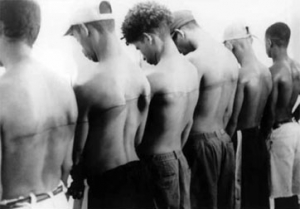
A Belgian living in Mexico who travels often, freedom of movement is an important component in Alÿs’s artwork. However, his brand of itinerancy—determined as it is by financial resources and post-September 11th legal circumscriptions—is in marked contrast with forced exile and involuntary migration. What interests me about When Faith Moves Mountains is the line that Alÿs’s disenfranchised workers drew in the sand. If anything, it reminds me of the line in Santiago Sierra’s 160 cm Line Tattooed on 4 People … (2000). Unlike dominant strategies in socially engaged art, Sierra’s material practices don’t aim to draw audiences into a vague consensual sociability.3 Rather, viewers are strongly provoked to recognize systems of economic, social, and representational exploitation in which they—meaning, you and I—likely participate, however
indirectly.


Francis Alÿs, When Faith Moves Mountains, 2002.Performance, Ventanilla, Peru.

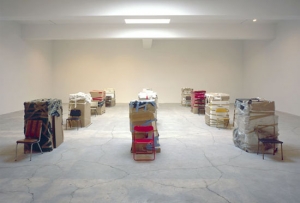
Upon entering a large room at Sierra’s exhibition in 2000 at Ace Gallery in New York, I saw a set of oversized cardboard boxes, possibly for shipping appliances. Boxes in grids of any sort signal Minimalist art, and particularly the work of Donald Judd, but before I could get very far along this art-historical tangent, the back of my neck began to tingle. It was clear that I wasn’t alone in the room, even though I appeared to be alone in the room. At a certain point, and without it being indicated by noise or movement, I realized that there were people inside those boxes. Sierra’s title for the piece summarizes it succinctly: Remunerated People to Stay in the Interior of Cardboard Boxes. On the way out, I asked the gallery attendant for more information, and she said that Sierra had solicited unemployed immigrants in various situations of financial duress to sit inside the boxes for money, and that some did, but others found the work too degrading, and so only about half the boxes were occupied at any given time. Information, stories, rumors are always unreliable. Nevertheless, the point of my implication in vast systems of exploitation, however inadvertent in this instance, had been made in a way that was both metaphorical and totally real, i.e., more than skin deep.


Santiago Sierra, “Remunerated People To Stay In The Interior Of Cardboard Boxes”, 2000, Ace Gallery, New York.

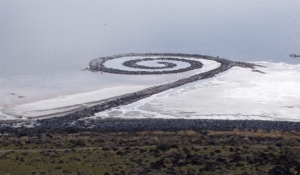
Perhaps in response to the antagonisms and absolutisms of political strife—from the war between the Shining Path and the Peruvian government to the misnomered “clash of civilizations” in the wake of the September 11th attacks, six months or so before the opening of the Lima Bienal, which commissioned When Faith Moves Mountains—what’s notable about Alÿs’s piece is that while it may be a line drawn in the sand, it’s a shifting one, and one influenced by both environmental and human-social forces. In this sense, it would be interesting to revisit the location of the work in the way scholars, conservators, and art tourists have done with Robert Smithson’s Spiral Jetty (1970), which itself has been the subject of its own set of environmental and human-social forces. Specifically, Spiral Jetty has been threatened with the construction of solar evaporation ponds that would drain the water surrounding it, and also with the proposed building of nearby oil wells, which would potentially spoiled its “viewshed.”4 In other words, the art-world institutionality that Smithson and other Land art practitioners tried to escape by going deep into the American West—that most mythic of places—has been redrawn on a much larger canvas to include multinational corporations and global ecology.
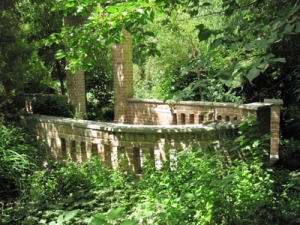

Robert Smithson,”Spiral Jetty”, 1970, Great Salt Lake, Utah.

Plenty of artists, designers, and architects are parachuted into sites in order to create works meant to engage with the surrounding landscape (Frank Gehry’s Guggenheim Museum Bilbao being among the most famous examples), but Alÿs turns the landscape into an allegory that is local, global, and—the only thing that might be more powerful than both—climatological. As he says in the Artforum interview: “When Faith Moves Mountains is my attempt to deromanticize Land art … Here, we have attempted to create a kind of Land art for the land-less, and, with the help of hundreds of people and shovels, we created a social allegory.”5 Work and workers are in a battle with the elements, which, again, are never exactly natural—be they economic or environmental. It’s not a coincidence that the words “economy” and “ecology” share the ancient Greek word oikos [οἶκος], or “house.”


Santiago Sierra, 160 cm Line Tattooed on Four People, 2000.

2. Poetry

In a world where a fundamental strategy of ruling ideologies is to make themselves appear natural, the absurd can be its own form of critique. “Allegories are, in the realm of thoughts, what ruins are in the realm of things,” Walter Benjamin writes in The Origin of German Tragic Drama.6 Allegories need time to unfold, but all time is scented with death—to use a description in the spirit of Benjamin’s analysis of the German baroque. The danger with allegory is that it so easily turns into myth when lifted out of time and history. Hence Benjamin’s desire to keep allegory directed toward death and ruins.

In a post to the Verso blog about the then-burgeoning Occupy Wall Street phenomenon, McKenzie Wark wrote: “So what the occupation is doing is taking over a little (quasi) public square in the general vicinity of Wall Street in the financial district and turning it into something like an allegory.”7Wark goes on to equate allegory with the abstract, but that’s not quite right if, per Benjamin, allegories are deeply temporal phenomenon. Wark then compares the occupation to symbols, which, as Paul de Man’s “The Rhetoric of Temporality” instructed those of us raised on deconstruction in the late 1980s, are definitely not the same as allegories.8 What Wark might mean instead is “poetic,” though there are very few words in the English language as misunderstood as this one. From the Greeks and Romans until the rise of Romanticism, poetry was inseparable from the category of rhetoric, which, among other things, meant that poetry was understood to have a social impact. Since Romanticism—and here I’m speaking of a specific European-US tradition—the “poetic” has come to signify the opposite of that. This historical situation—after all, any aesthetics is a product of a particular history, as is the concept of aesthetics itself—was ironically confirmed by the twentieth-century avant-garde’s obsession with non-instrumental art and language. Everything else is kitsch, or so the story goes.

But what deconstruction taught is that all texts are rhetorical constructs—pre- and post-Romantic. This insight is both a blessing and a curse—a blessing because it teaches a rigorous mode of analyzing the internal contradictions, and therefore inherently self-defeating authority, of any text, by which is meant much more than just writing; a curse because when I watch someone like Glenn Beck pontificating, I can’t help but think it’s all a ridiculous rhetorical performance, and that Beck himself knows this.9 This is what used to be meant by rhetoric. And this is also related to what Occupy Wall Street does so well: it builds a self-deflating authority into its own ideology and organizational modes. Its signifiers slide. It foregrounds rhetorical performance in a self-conscious way that at the same time is deadly serious. It believes that bodies are material signs. In other words, it might be a kind of poetry.

People get impatient with the poetic. I’m a poet, and I get impatient with the poetic, as I got impatient with deconstruction for its endless discursive hairsplitting. At this point, I may be something of a reformed Foucauldian, because the only thing left to be privatized is our bodies. Yet if police responses to Occupy encampments around the United States prove anything, it’s that beneath all the soft power is a powerful police arsenal, much of it overfunded in the wake of September 11th, waiting, even eager, to be deployed, however clumsily.

The way in which we are subjects, the way in which we are governed, is more intensely personal now, which both Foucault and second-wave feminism realized almost simultaneously. The slogan “We are the 99%” is an attempt to elude this intensely scrutinized subjectivity, or to put it in the words of the French anarchist collective Tiqqun: “There is no ‘revolutionary identity.’ Under Empire, it is instead non-identity, the fact of constantly betraying the predicates that THEY hang on us, that is revolutionary.”10 In seeking this anonymity, Occupy Wall Street has stirred up debates within the Left between broad-based social movements and identity-oriented political struggle, a dialectic perhaps impossible to resolve. But as anyone who went to Zuccotti Park during the two months that Occupy Wall Street had a physical presence there might have noticed, the core group of protesters did diversify, even if the encampment itself was eventually riven with social, cultural, and class tension to the point that a few of the lead organizers were actually grateful for New York City Mayor Bloomberg’s heavy-handed, middle-of-the-night clearing of the park.

While some might argue that political indoctrination occurs via the state and its affiliate apparatuses, and others might claim that it happens through the corporate media, it’s clear that what’s been hijacked aren’t our thoughts per se but our desires. The service industry is predicated on capturing desire in a way that a manufacturing economy, with its checklist of items to buy, never was. It’s why design is superseding manufacturing (or outsourcing the latter), and why interactivity precedes content, especially in digital media, but increasingly in more traditional commodity culture as well.11The most perverse part is that these developments will be hidden behind the façade of interactivity, of choice, of guided desire. If that sounds depressing, it’s not. There’s an aimlessness and entropy and creative wisdom that even the most efficient systems can never account for or contain. Occupy Wall Street was instigated by what can only be considered an advertisement published in Adbusters,an anti-corporate magazine that doesn’t take ads. By not formulating a set of clear talking points, Occupy Wall Street has allowed people to project their own desires onto it. There’s something poetic in this too.

Placing a story into a landscape has the potential to make a difference, and maybe that difference occurs to the extent that the story resembles a poem. Think of the significant impact made on artistic practice this past decade by WalidRaad’s imaginary and fictional documentaries of the Lebanese Civil Wars. The allegory that Occupy Wall Street tells is still unfolding, even if its archive has become an important concern for preservation. In its very structure, allegory is a combination of critique and hope. I want my physical interfaces to be seamless, but not my intellectual and ideological ones. I’m skeptical of poetry by design because it always has something to sell, even if poetry itself doesn’t sell.


Steve Lambert and Andy Bichlbaum (The Yes Men), A Celebration, 2008. False New York Times newspaper issue. This periodical was a collaboration which included, besides the two authors, thirty writers, fifty advisors, around 1000 volunteer distributors, CODEPINK, May First/People Link, Evil Twin, Improv Everywhere, and Not An Alternative.

3. Public Space

Another favorite recent artwork of mine also involved a story inserted into a landscape. On the morning of November 12, 2008, commuters in various US cities, though mostly in New York City, were handed 80,000 free copies of a special edition of the New York Times with the banner headline “Iraq War Ends”—except that it was dated July 4, 2009, was only fourteen pages long, and the Gray Lady’s famous motto had been changed from “All the News That’s Fit to Print” to “All the News We Hope to Print.” Otherwise, it looked identical to the New York Times, right down to the layout, typeface, and ads. Article titles included “Nationalized Oil to Fund Climate Change Efforts”12on the front page, “National Health Insurance Act Passes”13 in the “National” section, and “New York Bike Path System Expanded Dramatically”14 in the “New York” section. Ads that carefully replicated the look of their real New York Times counterparts included ones for De Beers diamonds, HSBC, and Exxon Mobil, but with modified text so that, for instance, the De Beers ad read: “Your purchase of a diamond between now and 2026 will help fund the creation, fitting, and maintenance of a prosthetic for an African whose hand was lost in one of that continent’s brutal conflicts over diamonds.”15

Produced by social-art/activist group the Yes Men in collaboration with many other individuals and organizations, this fake New York Times might be understood as a public art project for the information age and its pervasive mediascape. The Yes Men have spent a decade inserting into this fuzzy public sphere sometimes absurd though always historically specific and corporate-focused counter-narratives, which have targeted Dow Chemical, the World Trade Organization, Chevron, and so on. These counter-narratives are frequently performance-based, more interested in concrete as opposed to abstract social bodies, and sometimes involve a subtle camping of male heteronormativity. “Site-specific” used to mean how deeply something was embedded in a place; now it refers to how thoroughly you’re being data-mined. It’s very difficult to define public art when there’s so little public space anymore, and the general public itself seems like an increasingly outdated concept. At the very least, following Nancy Fraser and feminist critiques of Jürgen Habermas’s notion of the public sphere, it might be more useful to think in terms of many publics, alternative publics, and counter-publics.16 In any case, public space is becoming indistinguishable from a contested mediascape; similarly, the commons is becoming virtual as part of the internet era’s version of expropriation.

Occupy Wall Street’s lack of a traditional political platform is directly related to its role as a media intervention, as a meme, as an ideological contagion. This isn’t at all to deny the necessity of more conventional forms of activism or to ignore the fact that it was Occupy Wall Street’s physical presence at Zuccotti Park, its willingness to fill New York City jails, and videos of its bodies being billy-clubbed and pepper-sprayed that significantly raised the movement’s profile. But to then demand from it a coherent political program is to somewhat miss the point of its political imagination and frustration with business as usual writ large across the US political and economic system. The Occupy movement is proposing a different paradigm of viral politics and radical, participatory democracy. At another level, as Glenn Greenwald and others have pointed out, protesters simply want to see the law upheld and enforced, particularly around financial practices.17 Those who think Occupy Wall Street should be the Left equivalent of the Tea Party are welcome to line up some billionaire backers, start their own influential news outlet to serve as a mouthpiece, and handpick some candidates.


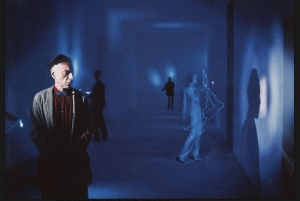
David Hammons, Concerto in Black and Blue, 2002. Installation view with artist.

I probably wouldn’t have said this ten years ago, or maybe even five, but it’s important to recognize imagination as a social and political force to reconfigure the real. We need to acknowledge how much innate creativity, and its direct relationship to desire, is challenged and threatened by the products of the culture industry, which includes parts of the art world. Confronted with the latest Hollywood blockbuster or Katy Perry release or Damien Hirst dot painting, it sometimes seems difficult to compete.

But of course, it does occur: we make cultures, and the culture industry dips into us as much as we dip into it. According to one report on the earliest days of Occupy Wall Street, it was “‘artistic activities’ that ultimately jump-started the occupation—yoga practices, poetry readings, and the like.”18 Perhaps the first of the Occupy Wall Street occupations was organized by a proto-arts and culture committee, and included poetry and music near the New York Stock Exchange. This took place on September 1, 2011, seventeen days before the initial main protest march. About a dozen people attended, most of whom were arrested.19Topics such as the elimination of student debt, the right to assemble, and freedom of speech were discussed. In other words, the stage had been set.

As a form of public art, as a kind of social sculpture, Alÿs’s When Faith Moves Mountains, the Yes Men and affiliate organizations such as CODEPINK’s fake New York Times, and Occupy Wall Street each combine critique with a durational, progressive, and performative sense of hope. These projects understand that all art is public, even when it’s not public art. With the relentless privatization of everyday life, whether shared or solitary, the idea of a public going to a public space to see a public work of art is obsolete, and may, in fact, have never been more than a dream. Combined with recent threats to the First Amendment right to peaceably assemble, there’s a paradigm shift occurring in how to reconceive the public sphere. Nevertheless, the public is everywhere, even if many of its physical gathering places have been taken away (especially in the so-called Western “democracies”). Moreover, new publics arise all the time when a previously silenced or disenfranchised group seizes the opportunity to speak, which oftentimes takes a cultural form as much as a traditionally political one. Usually more so. This is part of the politics of the imagination.

A critique of present conditions; the imagination of alternative realities; and collective, sustainable methods seem like a good approach to grounding current artistic, political, and pedagogical practice. At the same time, it’s necessary to continue examining, and self-examining, to find internal contradictions: in critique (for instance, our complicity with power even as we confront it), in hope (the disappointment lodged in every hope, the unhappiness fastened to every joy), and in just how sustainable our practices really are and to what degree they instigate new social formations as opposed to replicating community as exclusion. Any solutions will be temporary, any spaces transitory. Publics are constantly morphing, and the battles they wage with those seeking to contain them are now over technology as much as over territory. This is part of the politics of transmission, in which art and poetry have always played a role.

1 With their complex, precarious, and improvisational approach to architecture and infrastructure, as well as their alternative economies, shantytowns around the world are increasingly being studied by urban geographers, social theorists, and architectural scholars alike. Some see these communities as creative in their employment of recycled materials, sustainable practices, and new modes of social relations, while others—and here I’m thinking specifically of Mike Davis’s Planet of Slums (London: Verso, 2006)—view these expanding metropolises of the poor as excrescences of global neoliberalism and creative mostly in the unimaginable systems of brutality and exploitation existing within them.
2 Saul Anton, “A Thousand Words: Francis Alÿs Talks about When Faith Moves Mountains,” Artforum Vol. 10, No. 40 (Summer 2002): 146–147.

3 Claire Bishop similarly contrasts Bourriaud and Sierra in her influential essay “Antagonism and Relational Aesthetics,” October 110 (Fall 2004): 51–79.

4 See →.

5 Saul Anton, “A Thousand Words,” ibid.

6 Walter Benjamin, The Origin of German Tragic Drama, trans. John Osborne (London: Verso, 1977), 178.

7 McKenzie Wark, “How to Occupy an Abstraction,” Verso blog, October 3, 2011. See →.

8 Paul De Man, “The Rhetoric of Temporality,” in Blindness and Insight: Essays in the Rhetoric of Contemporary Criticism, trans. Wlad Godzich (Minneapolis: University of Minnesota Press, 1983), 187–228.

9 Glenn Beck is an American conservative, television network producer, political commentator, and host of the radio talk show the Glenn Beck Program in the United States.

10 Tiqqun, This Is Not a Program, trans. Joshua David Jordan (Los Angeles: Semiotext(e), 2011).

11 Design has become less about objects and more about funneling people toward experiences. In this process, data-mining and the designed environment will become fused to shape people’s movements through space in a way that will make architecture’s historically predominant role in doing this seem feeble in comparison.

12 Steve Lambert and Andy Bichlbaum, A Celebration, 2008. Quoted from page A1 of the publication.

13 Ibid., A7.

14 Ibid., A12.

15 Ibid., A2.

16 Nancy Fraser, “Rethinking the Public Sphere: A Contribution to the Critique of Actually Existing Democracy,” Habermas and the Public Sphere, ed. Craig Calhoun (Cambridge, MA: MIT Press, 1993), 109–142.

17 Glenn Greenwald, “Immunity and Impunity in Elite America: How the Legal System Was Deep-Sixed and Occupy Wall Street Swept the Land,” TomDispatch.com, October 25, 2011. See →.

18 Sean Captain, “The Inside Story of Occupy Wall Street,” FastCompany.com, October 7, 2011. See →.

19 Ibid.

A Visit to Oudlajan, Unremembered Remnant of Old Tehran

NavidJamali
[1] Mina Fatemi[2]
1. Introduction:

Preserving historical fabrics in Iran in comparison to western countries is a newly established endeavor. This concern grew in Europe from several years ago and synchronous to modernization of societies. Technological developments in the twentieth century, providing the possibility to generate multiple copies of artworks firstly heralded a new age, in which Art, previously available onlyto the elite, was taken and brought among the ruck. But, it promptly revealed its destructive aspects. James Fitch, theorist of restoration, believes that in none of the other characteristics of material culture, possibility of frequent reproductions of the original exemplar and placing them in different situations, was as evident as in architecture. The paradigms established by renowned modernist architects, would be executed, lacking compatibility with the context. The cultural consequences of this phenomenon were far more destructive: imported paradigms with their “new” and “universal” prestige had the tendency to make the indigenous forms and thinking, inconsequent and then replace them. Therefore the achievements and valuable examples of autochthonous architecture in most of the historical fabrics were gradually demolishing.[3]

Now we return to modern Iran; a country in which every region and city due to a rich historical background includes an exclusive architecture and urbanism.Architectural traditions grew during several centuries and in harmony with natural landscapes and climatic conditions of each city. Many cities in Iran expanded in the modern era according to western paradigms, inheriting valuable historical fabrics in their central cores. Yet the phenomenon introduced by James Fitch as the destructive process of imported paradigms replacing indigenous constructions, can somewhat be seen in all of these cities.

Tehran as thecapital of Iran in last two recent centuries, has inherited one of the most precious urban fabrics of Qajar era. The modernization of the city precede all other cities of the country and the records of its modernization date back to mid to late reign of Naser al-Din Shah Qajar. The urban structure of Tehran in 1890s shows two distinct layers: the central core or Safavid city zone with all the characteristics of traditional cities in central plateau of Iran, comprising the organic and entwined network of alleys, dead ends, markets and plazas, and in contrast to the grid of streets within the confines of Naseri period expansions. This matter didn’t remain covert for western explorers that the king focused modern constructions on a layer beyond the central core and left the old beautiful neighborhoods in their original form.[4]

In Pahlavi era the construction of new streets took place in the historical core, neglecting the structure and function of the fabric and car-based roads took precedence over them. These constructions caused great damage not only to the original image of thehistorical fabric, but also to the way of thinking about housing and residential fabric. From the middle of this period with the simultaneous construction of new suburban areas around the city, the affluent residents of the historical core moved to the new neighborhoods and migrants from rural areas, who descended to Tehran due to conversion of economy, dwelled in the central core, without having anyattachment to the place.

2. The last remnants of old Tehran

The antiquity of Oudlajan is not accurately determined yet.The name can be seen in historical texts and maps in early Qajar era. The term of “Oudlajan” roots in townsfolk’s accent, still prevalent in the villages of Shemiran city. In this term, “Ou” is the local pronunciation of the word “water”, “drajin” means distribution and “an” is a place suffix. In Qajar era the Arabic orthography of the term was used.[5]Oudlajan is one of the five oldest districts in old Tehran within the confines of Safavid city, located east along NasirKhusrawStreet. From east it beganfrom Amin-ol-hozurjunction and PestehBeig garden, encompassing ImamzadehYahya, reaching to Sarpoolak in south, and led to Bazaar in south west. The current area of the district is approximately 150 hectares. According to statistical analysis in 1868, Oudlajan had been the most densely populated district of Tehran among the five and had had the most residential houses of the time.[6]

Comparisonof three epochs of historical maps chronologically consisting Brezin maps (1841), kriziz (1858), and Abdul-Ghaffar (1887), illustrates the process of expansion of the district towards the gardens in the north. Kreziz map shows the construction of several districts such asShemiran gateway, Sar-Chishmeh and Sar-Takht during 1841 to 1858. In the subsequent years, many county treasurers (Mostofian), ministers and princes moved from southern areas of Oudlajan to these districts and constructed fine buildings that some of them like Qavamoldoleh house, Esmatolsaltaneh house and Sediqoldoleh house have endured through time.

In the modern era along with social and demographic changes, Oudlajan first lost its old and original residents, then with the extension of business services in Tehran’s bazaar, gradually lost its role as a residential fabric.[7] The last decade can be considered as the peak period of destruction and alteration in Ooudlajan, in which more than 70% of the fabric were seized to be used as storehouses and workshops. Currently the residential life continues in small and sporadic hubs in the heart of the district, which is rapidly disappearing. Heretofore several studies had been conducted mostly on rehabilitation and urban regeneration plans ofOudlajan, yet the unknown and forgotten aspects of the neighborhood, including a range of tangible and intangible heritage, are abundant; In the formal quality, many features such as the structure of street network, traditional systems of water supply, construction methods, materials and the art and crafts relevant to architecture can be identified, each worthy of further consideration and survey.

3. Oudlajan Project

Started in 2011 as a voluntary documentation project, Oudlajan project aims to document architecture and urban fabric of the neighborhood, to expedite and facilitate the possible future preservation and rehabilitation programs in the district. The project purposed to study the extant body of traditional urban fabric of Tehran, as a system of human habitation that, through its formation in a specific time and location, could introduce the achievements of previous generations in various aspects of architecture and urbanism. The project began with a survey of each of the five historical neighbourhoods of old Tehran, in order to examine the dispersion of extant historical body over the historical core. As In many instances the buildings were defaced in architectural elements and details, especially in urban walls, while, behind the walls the historical mould of buildings were remained nearly intact, it was impossible to perform the initial survey in field study sessions. The survey was carried out by the comparing aerial photos of 1956 with the latest satellite pictures. This comparison soon revealed that the most of the destructions and reconstructions till 2011 belong to Chal-e Meydan and Sangelajneighbourhoods. Despite of the fact that most changes in Dowlatneighorhood occurred before 1956, and thus the comparison of aerial photos revealed no considerable changes till 2011, the presence of monumental and governmental buildings such as Dar-ol-Fonoun and Golestan Palace, instead of a residential urban fabric, that allows a multivalent study of city as a setting for work and life of social classes, made it inappropriate for such a study. Whereas the historical body in Oudlajan and Bazar neighborhoods had almost remained intact, so that 65% of the physical fabric of Oudlajan had not changed since 1956. For the difficulties of field study in Tehran Bazar, finally Oudlajan was selected as the case study.

In the next step, through a collation of several layers of data, including aerial and satellite photos of various years, plans and historical maps of Oudlajan, over a historical span of two centuries, changes for each lot were traced. Accordingly an estimation of the extant historical buildings was obtained. The first speculation contained 700 historical lots with various usages such as bath, bazaar, house, mosque, schools and synagogue. In the following years field studies were carried out by providing plans and other types of visual documents for each building, and with a level of accuracy and details that corresponds to the architectural value of the building. At the same time, other layers of data, including oral history, old photos, films, etc., were gathered in order to shape a more precise understanding of the historical and pristine image of the neighbourhood. All these documents will be categorized in geocoding system and be available in Oudlajan.org website.

4. Case Studies of Buildings

While documenting Oudlajan, several building were identified and documented for the first time. Among these are some buildings, which present unique samples of architectural-related art crafts: such as brick carving, mirror work, stucco carving and OrosiSazi (craft of making wooden reticular windows) that have deep roots in Iran, and some like brick carving and OrosiSazi deserves reapprehension.

In the following, some extant and important cases are introduced:

Hajj Reza Khan house:This house is located near 15 Khordad street and according to Abdol-Ghaffar map (1887) belonged to Hajj Reza Khan. This building is one the few instances that represents a residential cruciform plan (Chahar-Soffeh).A fine-shaped elliptical dome, covers the central space of the building. The ceiling of the vaults is adorned with delicate stalactite ornaments (Moqarnas) All over the interior walls are covered with stucco carvings, jutted more than usual and showing themost complicated floral patterns. The upper sides of vaulted recesses in courtyard are decorated with painted tiles (Khashi Haft-Rangi) that display patterns similar to the 19th century European cast iron decoration (Fig. 2,3,4).

Zarrabi House: Thishouse is located in Pamenar, Oudlajan and for many years was in the possession of Zarrabi family. The current building is the only remaining part of a large ensemble that comprised inner (Andarouni) and Outer (Birouni) sections. The walls and recess of the main room (Talar) are decorated with delicate stucco carving and in some parts mirror work is used as points for emphasis. The stucco carving designs are a mixture of floral and animal patterns and mythical creatures(Fig. 5,6).

The Jewish Jeweller House: Regarding the oral history, this house belonged to a Jewish jeweller. The ornaments of Talar comprise integration of stucco carving and decorative cut mirrors. The jutted stucco carvings are adeptly done and rare in other buildings in Oudlajan.Some stucco carvings are done on mirrors and in some parts the decorative mirrors are affixed conversely.These adornments represent herbal patterns, vases and candleholders (Fig 7,8).

Majd-ol-Ateba House: This house is near Amir Kabir Avenue. Its mirror hall is damaged severely, but it is a beautiful sample of reverse painting on mirror (NaqashiPosht-e Ayneh) and a combination of mirror work and painted stucco carving (Fig 9, 10).

Other than those introduced above, there are numerous exquisite houses in Oudlajan. There are also buildings which we witnessed their destruction during recent years, from which the photos and architectural plans provided by the students are the only reminiscences. Since none of these buildings are under legal protection, sooner or later, they would be subjected to destruction. Although documentation of historical edifices will increase the general knowledge on potentialities of Oudlajan, and facilitate future research works, but this process would be completed just once that the public introduction of these potentialities result in devising more acute plans for the future of the neighbourhood. This future, only achievable through participation of all inhabitants, would bring the life back to the neighbourhood.A future we wish to happen in long term.

[1] – Master of Architecture student, Iran University of Science and Technology

[2] – Architecture student, Iran University of Science and Technology

[3] – Fitch, James Marston; Historical Preservation, Curatorial Meaning of The Built World. McGrew-Hill, 1982. PP. 8 & 13

[4]Lorey, Eustache de; Sladen, Douglas Brooke Wheelton.Queer Things About Persia. Philadelphia, J.B. Lippincott co., 1907, p. 44.

[5]- Kariman, Hossein. Tehran Dar Gozashtehva Hal. Tehran University Press, 1976.

[6]- Karampoor, Katayoun; Fadainejad, Somayeh. Tahlil-e Asarat-e TaghiraatKalbadiAnasor-e Shakhes Bar Baft-e MahalehOudljana.Honar-ha-ye Ziba (Tehran), No. 28 (2006) p. 67

[7]- Ayatollah ZadehShirazi, Bagher. BehsaziMahalehOudlajan. Asar (Tehran) No. 2, 3 & 4 (1980) p. 67

The Citadel of the Original Royal Avesta in Persepolis

Khoobchehr Keshavarzi
Translated by Roya Monajem

Source: Payvand Website

Introduction
It is said both in the native and foreign sources that the original Avesta “written on 12,000 prepared cow-skins, and with gold ink,” was burnt together with other treasures and books when Alexander of Macedonia set Parsgarde (Persepolis) on fire. (1) In other sources, it is said that there were actually two copies, one kept in Shapigan treasury and the other in the “citadel of writings” dejnebeshteh (2) whose exact location had never been found, thus a mystery.

In this article based on the remaining architectural features of one of the buildings in Persepolis, known as Tachara Palace, we will first show that this building is not as believed to be Darius’ private palace, but most probably a Zoroastrian Temple (with a yazeshgah);and secondly, that mysterious “citadel of writings” dejnebeshteh, was most probably in the central room of this building.
This article is in fact a chapter of Keshavarzi’s book A New Approach to Pasargade, (Behjat, 2914) which won the prize of Iranian Society of Architects this year.

*******

According to the existing texts, Tachara was the first building of the complex called Pars-garde (Persian City) (1),constructed on the skirts of the mountain of Mehr (Love)later changed to Rahmat (Mercy). Its entrance used to be from the south, which later was closed to some unknown reasons.

Now if we look at this majestic ruined edifice, which is said to be Darius’ private palace known as Tachara, and carefully examine its unique architectural features, we can notice a vital significant secret hidden from the eyes of the honorable scholars so far. These specific features are:

a) The platform of this building is 2.20-3 m higher than the floor of its neigbouring palace of Apadana and its garden. The latter, which is the most distinguished part of the complex has 72 pillars, most probably inspired by 72 yasna-s of the Zoroastrian Holy book, Avesta, as some archaeologists speculate. According to Zoroastrian Tradition, it is only after learning the whole 72 yasnas that one reaches the required existential maturity to understand the Truth.

Despite that, Tachara overlooks the 72-pillared Apadana Palace, pointing to its higher significance in the language of architecture.

b) In contrast to other buildings of the complex, all erected on pillars, this is the sole building made of monoliths, pointing to the fact that durability must have been the major concern of its architects.

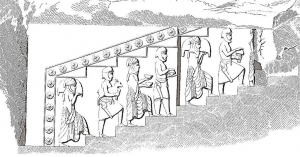
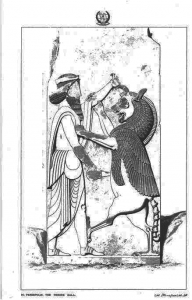
c) The sculpted figures on its base-reliefs are different from those of other buildings.

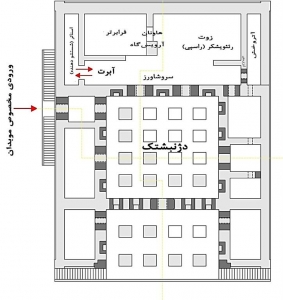
d) It has only one entrance on the west side, which was originally on the south side as mentioned above.

e) And the most challenging point is that there are some shelves in the main hall of this building decorated with engravings all around. According to Professor Shabazi, these shelves were protected by wooden doors.

f) There is a stony water basin (sangaab) and a water channel on the north part of its staircase, which runs down to the south on the west side of the building.

g) The inscriptions found in this building,like a birth certificate mention the five generations of kings who took part in its construction, annexations and subsequent repairs. They all sound very proud of their deed, asking God Ahuramazda to bless,protect and maintain their souls.

h) Finally, in contrast to royal courts, this building is totally isolated without any security routes and pathways. It looks more like a quarantine place than a palace.

Nearly all native and foreign archaeologists and scholars, including Shapour Shahbazi reached the conclusion that this relatively small building of the Persepolis complex known as Tachara, located on western south of Apadana Palace to be Darius’s private palace. The conclusion has most probably been based on the assumption that in classifying the users of Persepolis into distinct separated classes, no doubt, the king and his Royal demeanor and ceremonies would be the first priority.

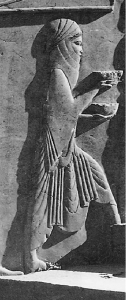
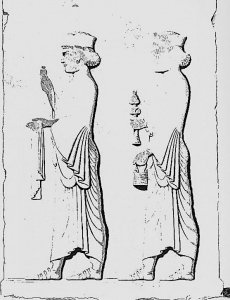
As a Royal private palace, it then would have required a kitchen and it is on this account that the sculpted figures on the base-reliefs of its staircase were interpreted as representing servants working in the Royal kitchen or carrying oblations and the sacrificed animals to the Royal Palace.

Now before dealing further with the unique architectural features of this building and for a better understanding of its most probable real function, I will first examine the inscriptions found in this building, which as mentioned before act like its birth certificate.

Inscriptions

First comes the inscription engraved in three languages, Elamite, Ancient Persian and Babylonian on both sides of the southern threshold of the hall above the head of the king. It reads:

“Darius Shah, the great king, king of kings, king of countries, the son of Vishtaspe Achamenid, built this Tachara.”

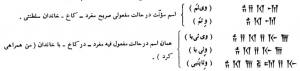
In addition, on the lapis lazuli doorknob found in the same building there is an inscription reading “constructed by Darius.” (see fig.1) This means that Darius’ signature is found on even the relatively insignificant components of this building, pointing to its importance and Darius’prideof his accomplishment. This can also be another seemingly ‘logical’ reason for the assumption that it was his private palace.


Figure 1Source: A Doorknob made of precious stone, Ralph Norman Sharp, The inscriptions in old Persian cuneiform of the Achæmenian emperors

Cornelius de Brown who visited the building in 1904 has reported how he ruined the engravings of the two sides of the west pillar, while trying to remove a part of Daruis’s outfit to take home to Paris. The inscription on the stolen parts now preserved in the treasury of the National Library in Paris,again written in the three above languages reads:

“The Great King Darius, the Son of Vishtaspe Achaemenid.”

There is yet another inscription repeated 18 times on the cornices of its central hall, mentioned above. This too is in three languages and reads:

“The stony frame made for Darius’s vithiya” (see fig.2)


Figure 2. Ralph Norman Sharp,The inscriptions in Old Persian cuneiform of the Achæmenian emperors

The next inscription attributed to the next generation, i.e. Khashayar Shah (Xerses) reads:

“… By the will of Ahuramazda, Daruis who was my father built this palace. May Ahuramazda and other gods protect what my father Darius and I have done.”


Figure 3. Ralph Norman Sharp,The inscriptions in Old Persian cuneiform of the Achæmenian emperors

This inscription is repeated five times in Ancient Persian, Elamite, and Babylonian languages on the southern part of the platform and southern pillars of its balcony.

The inscription of Ardeshir III, in Ancient Persian is seen on the staircase built during his reign. It reads:

“Ahuramazda, the greatest of all gods who created this…, who made me king (Ardeshir), one of the unique kings among many, a unique ruler among many. I am Ardeshir, the great king, the king of kings, the king of countries, the king of this land. I am the son of Ardeshir Shah, Ardeshir Shah was the son of Daruis Shah, Daruis Shah was the son of Ardeshir Shah, Ardeshir Shah was the son of Khashayar Shah, Khashayar Shah was the son of Daruis Shah. Darius Shah was the son of Vishtaspe. Vishtaspe was the son of Arshameh, descended from Achaemenids. Ardeshir Shah says: I have built this stony staircase. May Ahuramazda and the divinity Mehr protect me and this country and whatever I have done.”

The names mentioned in this inscription shows that Ardeshir III, belonging to the fifth generation after Darius the Great was actually the king who repaired the staircase.

There is also another inscription in Sassanian Pahlavi language remaining from Shapur II in which after confessing that the king and all those who have participated in building Pasargade, worship Ahuramazda, it reads:

“… he held a great feast and performed the religious rituals… and then sacrificed an animal for the king of kings Shapur and his soul, and the one who first ordered to build this building.”

A Sassanian king, asking for salvation of the soul of the one who ordered to build this edifice belonging to the dynasty they overthrew! This is a very significant point implying its supreme importance, which should not be overlooked.

In these three inscriptions, three different words are used to designate the building ‘tachara,’ ‘hadish’ and “vi-th’, (‘vithiya’), all apparently having the same meaning as palace (kaakh), but in Persian this wordkhaakhalso implies house, citadel and a tall building, a superb edifice. Most probably as it will be seen later, the use of triple designations for the same edifice is to suggest that it had all the various functions these words imply.

Now considering the relatively large number of inscriptions found in this comparatively small building, remaining from five generations of kings, it is hard to believe the claim that it served as a private palace of only one king. Based on this and the following architectural features, my hypothesis is that this marvelous edifice was a yazeshgaah, a place where religious rites and ceremonies were performed, in short a temple. That can then very well explain the relatively high number of its inscriptions, and why all the kings sound so full of pride for participating in its construction and maintenance.

So, once again before going into more detailed analysis of its unique architecture, let us say a few words about the religious rituals and ceremonies whose performance requires certain objects and procedures which help us to discover who might be those sculpted figures on its base-reliefs interpreted so far as servants working in the royal kitchen.

Relevant Religious Rites and Rituals

1)Rite of Yasna

Literally yasna means worship and prayer. It is also the name of the main liturgical texts (consisting of 72 chapters as mentioned before) and one of the five parts of Avesta. Rite of Yasna consists of reciting yasnas (yazshankhani or yazashana).

Yasna 22-26, are dedicated to the barsam (bareman, barsom, meaning sacred twigs), haoma (a sacred plant) and milk and their corresponding rites performed in veneration of Ahuramazda, sorosh (equivalent to Gabriel or inner voice), amshaspandan (archangels) and fravashi (souls or spirits) of the virtuous. It should be mentioned that barsam is an important part of Zoroastrian liturgical apparatus, prepared from twigs (number varying according to the ceremony) of the haoma plant or pomegranate tied up in bundles.

The ritual is carried out by 7 mobad-s (Zoroastrian priests), whose tasks are:

Zot, is the highest mobad who recites the Yasnas.

Ha’vanan, is the mobad who prepares haoma (scared juice) for the ceremony.

Atrfakhsh attends the fire.

Farabartaris responsible for handing various utensil to the highest priest or Zot.

Abret brings water for the ceremony.

Asnatar is responsible for washing and cleaning the plants and the utensils.

Raovishgar mixes the plants’ juice with milk (usually of goat).

Saroshavarz supervises the whole ceremony.

From the above description, it is clear that water, certain plants, milk and utensils required for grinding and mixing of these plants and extracting their juice are among the necessary means and procedures of the rite (s) performed. The plants need to be thoroughly washed and cleansed and the fresh milk is obtained by milking a goat just right before the rite, at the scene. Thus, making the presence of the stony water basin and water channel next to the building meaningful. The room on the left side then could be the place where the plants were washed and prepared, and those sculpted figures on the base-reliefs are disciples bringing what is necessary. There is one who is carrying (most probably) a goat.

It is not in vain to mention here that a very similar water channel is found in A’zargoshasb Fire temple too, even though A’tashkadeh (Fire Temple) is different from Yazeshgah (Place of Worship) in their functions. Yet, considering that A’zargoshasb was one of the most important fire-temples, then most probably it served as a yazeshgah as well.

The other requisite for all these preparation iservisgaah, a large square stony table on which the barsom is prepared and the juice of plants is extracted and mixed with milk, while the corresponding yasnas are recited. In Tachara there is a similar structure in the middle of the room on the west side (see fig.4)


Figure 4, From “A collection of Traditional Iranian Architectural works” by Geographic Organization.

In this map, the architectural function is clearly seen in relation to the users.

In his book Iranians and Greeks, Plutarch writes: “A short while after the death of Darius II, his successor Ardeshir went to Parsrgade to perform the ritual ceremony of his enthronement performed by mobad-s. There in a place of worship named after the warring female divinity who can be the equivalent of the Roman Minerva, the goddess of wisdom, war and arts, the heir takes of his outfit and puts on what Darius had been wearing. He then eats a basket of figs, and other fruit with a glass of sour milk. In addition, there are other rituals which are hard to believe unless one sees them with one’s own eyes and hears them with one’s own ears.”

Doesn’t this quotation imply that there should have been a ‘temple’ for mobad-s (priests) to perform the enthronement ceremony?

Bas-reliefs

a)Sculpted figures on the bas-reliefs of the southern staircase (fig.5),


Figure. 5 Note that they are alternatively wearing male (Median) and female (Persian) outfits, while both genders have covered their heads.

The figures appear in different outfits, but those repeated on the slope of the staircase, are alternatively wearing similar outfits;those wearing the Median coat and trousers are armed and bearded and those wearing Persian pleated dresses have soft feminine faces (see fig.6). They are women, and young boys, as has always been claimed. These figures are of the same stature as the men, thus implying that they are grown up and not adolescent boys who have not still grown beard. And when the faces are carefully scrutinized, little doubts remains about their femininity.


Figure 6, A girl carrying some utensils to the yazeshgah (From Heidemarie Koch Persepolis)

To call them eunuch is like looking at the world from the point of view of recent Sultans who cruelly made young boys sterile. There is no reference to such an inhuman act in any old Zoroastrian texts. On the contrary, looking after one’s health is an imperative in this culture. One of the names of Urmazd or Ahuramazda (the eighteenth according to Urmazd Yasht of Avesta) is ‘one bestowing health.’

Going back to the same stone-carvings, we can conclude that in contrary to the claim that there is no trace of women in Persepolis, these very figures are the testimony of its falsity. These men and women are all wearing a head covering which is actually a special long shawl wrapped in a specific way as to cover their mouths too. They are carrying mortars and chalices for grinding and extraction of herbal juices, mixing them with milk, zohr water, etc, together with a tray covered by a piece of cloth, most probably for carrying herbs and fruit used for the rite. The men, in addition to small tools, are carrying small goats, whose milk will be used for the rite. One can assume that those whose heads and mouths are covered and are not armed are the only ones who are allowed to enter yazeshgaah. (fig.5)

In addition, if we compare the protome of the Achaemenid Lady(fig.7a) with the two sculpted figures on the pillars with one of them carrying a long belt-like ribbon (known as belt of religion, or koshti in Zoroastrianism)in one hand(fig.7b) and a small flask in the other, we can notice the similarity of their hair-dressing, crown and facial anatomy, with the rather prominent curve of their breasts. They must be court ladies entering the building to attend the ceremony and maybe even taking part in it because, they are carrying, a brazier, a liquid container, small bowels and/or mortar.


Figure 7d. From the book Persepolis by Reza Qiasabadi

Figure 7b. Traditional Iranian Architecture, Geographical Organization

Figure 7a. The Protome of the Achaemenid Lady

Finally, the last evidence for the falsity of the claim that these sculpted figures are kitchen servants is Xenophon’s repeated comments in his Anabasis (mainly dealing with Cyrus’ education): “Persians and Achaemenids did not care much about food and eating.”In addition, it is said in certain ancient texts that Persiansateonly once a day. So, how can people who did not care much about food and eating and were content with having one meal a day, would dedicate a whole staircase to kitchen servants?

b) Bas-reliefsof the Central Hall

There are four bas-reliefs in the central hall. Before analyzing what they signify, it is necessary to say a few words about the basic principles of Zoroastrianism.

Devils and their rivals symbolize Ahriman’s (evil spirit) in people and the task of the virtuous people is to follow the example of Amshaspandan to help the Bounteous Spirit and ultimately Ahuramazda in the struggle to subdue and restrain the Spirit of Destruction (Dorough, lies).

In yasna (chapter 31, paragraph 18) it is said:

“Therefore, you should not listen to the words and teaching of Dorvands (followers of dorouj= Lies (doruj) or devils) who bring about destruction and ruin and you should resist them with arms.”

This is what the four stone-carvings of the central hall of Tachara are in fact illustrating: the struggle of the king, hero, the Ideal Human, symbolizing the bounteous spirit of Amshaspand swith the Spirit of Evil, symbolized by complex demonic creatures. (Figures 8-11, notice the spear (the arm mentioned in the above quotation from Avesta) being pushed into the belly of the creature in all the four images). All the images are taken from A Collection of Traditional Iranian Architecture, printed at Iranian Geographical Organization, 1976.

 Figures. 8 and 9 Struggle with inner demons

Figures. 10 and 11Struggle with inner demons

In short, what the stone-carvings of this hall, which based on the remaining inscriptions, had been a very special place,more or less undoubtedly illustrate is the rite of evolutionary passage from the human to the divine stage.

Now we reach the peak of our analysis; the presence of shelves protected by wooden doors in the central hall, each decorated on top with a repeated inscription in the words of Darius, reminding their high importance to the users.

I would like to claim that this square shaped small hall, yet decorated with a comparatively large number of special bas-reliefs depicting the king (ideal human being), entering into the hall from the west-north part, or his exit from yazeshgaah, while holding the barasm, the scenes of his spiritual struggles with the inner demons and beasts, with a separate royal entrance door, an annexed yazeshgaah, with Persian soldiers guarding it from the front as well as the southern balcony, located in a solitary building (thus making it easily accessible to everyone), is most probably that very famous dejnapshank, with shelves made from monoliths, protected with wooden doors, decorated with inscriptions, repeated 18 times, where the Avesta written with gold ink on 12,000 cow skin was kept.

The claim is based on the following additional evidence:

We read in Pour-Davood’s Gathas:

“Tansar (Tosar), the well-known sage (hirbodanhirbod, highest priest) wrote in a letter written about the king Ardeshir Babakan, to the king of Tabarestan 1700 years ago: “You know Alexander burnt our Holy Book written on 12000 cow-skins in the city of Estakhr.” In addition, Pour-Davood writes:

“Now, it is said in the book of Dinkerd, Zardosht Sepanteman gave 21 chapters of Avesta to Gashtasb and according to another tradition he handed it to Dara, the son of Dara. One of these copies was kept in the treasury in Shapigaan and the other in Dejnapshteh. Avesta had 1000 chapters in total. When the cursed Alexander burnt the Iranian Royal Palace, the Holy Book was burnt with it too. The Greeks took the other copy from Shapigaan and translated it into their own language.”

Pour Davood translated “dejnapshtak” as the ‘citadel of papers’ or the registry office (archive).

Now the most valid evidence is perhaps the inscription remaining from the next dynasty, i.e. Sassanian, making it as significant as those of the builders. According to this inscription, found in the same building, when the great Sassanians reached this place they felt obliged to perform certain religious rites, pray for their ancestors and offer sacrifices for those who built this building. This is particularly important when we remember that even though Sassanians were very religious, but as one can speculate, they could not care about the kings of another dynasty, the founders of this majestic Tachara. This inscription belongs to the third century, i.e. nearly 8 centuries after the construction of Persepolis. The remarkable durability of Tachara, the way it still inspired awe and religiosity leaves little doubt about its holiness and religious function.

Conclusion:

As the guiding paradigms of ordinary people, the royal ritual demeanor of Achaemenid kings, the whole complex of Parsagade together with its bas-reliefs were designed and built in harmony with the way they approached human existence and the Universe. Considered as a stone book, its architectural plan and elements, its bas-reliefs and inscriptions are the phrases, manifesting the lofty sacred ideas and ideals expressed in the imperishable spirit of these forms.

In order to reach a deep understanding of this splendid extraordinarily unique earthly palace of existence, one should walk along it, breathe in its majesty, encounter Time, see the signs, hear the voices, perceive the impression of the resonating echoes, endure the weight of awe and supremacy, envision merit and value, recognize depth, learn from light, try and savour pure reflection to the point of having a mirror-like quality, conceive imperatives and rites, discover the impasses of users, and finally take a distance from them all in order to lend wings to these contemplations to assume a three dimensional volume, turn and dance in and out of it, until reaching a point of standstill when the whole complex begins to vibrate with life, revealing its secrets.

The findings presenting themselves in this way would leave little doubt that Tachara was the Royal Zoroastrian palace of rites and ceremonies (yazeshgaah), and the mysterious citadel (dejnebeshteh)of the Original Royal Avesta written with gold ink on 12000 cow-skins with the essence of its content illustrated and preserved on its walls for all the generations to come.

 
Khoobchehr Keshavarzi, born into a Zoroastrian family, is an architect and researcher with many published articles. 

Footnotes:

(1) In old Persian garde means city, so we have Pars (Persian)-garde which the Greek called it thus Persepolis. Due to some carelessness on the side of scholars and researchers, the Persian word for Persepolis is now written and pronounced as Pasargad.
(2 )For more information, see Khoobchehr Keshavarzi, A New Approach to Stone-reliefs of Persepolis, at Farairan Online www.farairanonline.com/Articles/ArticleDetailEn.aspx?src=159.
Later Ms. Keshavarzi elaborated her visions in that article and wrote a book titled: A New Approach to Pasargade, (Behjat Publishing, 20014) which won the prize of Iranian Society of Architectures in 2015.
(3) The essentials of Zoroaster’s teaching in Gathas is the faith in the divinity of Ahuramazda, and the twin opposing spirits Spenta Mainyu, the Bounteous Spirit and Angarah Mainyu, the Spirit of Destruction. Ahuramazda’s seven Amshaspands(archangels) are guiding lights to salvation and happiness in the same way as they assure Ahuramazda’s presence (good spirit) in the soul of righteous people

New discoveries in Afraz (Bam fault)

Source: Farairan

Translated by Arash Aliasghari

On the eve of the ninth anniversary of Bam earthquake, an expert in the field of world heritage, Dr. Shahriar Adle reported on new discoveries of ancient altars in Afraz (Bam Fault) and the identification of the first layers of Bam citadel (Arg-e-Bam)`s ancient defensive wall.

He told ISNA: During recent years and since the inscription of Arg-e-Bam on the list of world cultural heritage, many measures have been taken in order to preserve this historical complex. This year, in collaboration with the Arg World Heritage Base, several archaeological teams, have done different surveys. Meanwhile, the archaeologists of Arg Base continued their own excavations and they have achieved satisfactory results.

An amateur archaeologist in Bam, succeeded to discover for the first time, a number of petroglyphs related to at least 3 different historical eras depicting hunting scenes and portray animals such as wild goat, ram, …

While looking for a suitable itinerary for Nessa Dam water pipeline, the above mentioned team discovered a number of tombs (Dambi type) belonging to the pre-Islamic era, in different forms similar to pyramids, prisms, semi-spheres covering the surfaces of the tombs. Made of gravel, these tombs covered vast areas in Baluchistan, but in the Bam and Narmashir areas they were still undiscovered until recent.

The discovery of a few altars of Mehr religion and fire and water worshiping

He also added: Another team was working in the Afraz area, that geologists call by the name of “Bam fault”. In this vast region that covers an area of over 2500 acres, the team was able to reach results in their excavations in discovering different kinds of altars (similar to the altars in mosques).

He also mentioned: “we were not aware of the number of these types of foundations which are unique to this region”. He added: “The small altars have been engraved in small chambers made in the slopes of the faults which were carved by water over time, and the others were in the form of two separate altars which were linked by tunnels and dug in a depth of approximately 2 meters on each side of the faults. At least half of the tunnel-like altars in Bam are related to the Mehr religion and there also may be deeper altars available. The double altars were most probably used for water and fire worshiping.

Recognition of the waterways to Darzin

Adle Stated: Another archeological excavation team was working in a region between Bidaram, Darzin and Abaragh in the north-west of Bam. In this region in Abarighak they discovered a vast area which may have been an orchard or something similar. Of course prior to this discovery, another archaeological team which was working in the Bam Citadel also discovered a large stream which directed water from the northern foothills of the Jebale Barez to Darzin. This was an important discovery, since in historical sources, there are references to Darzin as a grand, magnificent and beautiful city, but no explanation has ever been given on how the water reached the city.

He reminded that today only the impressive ruins of Darzin city and its mosque which goes back to the beginning of Islam and the Pre-Mongol era are still remaining and the officials working in Bam and other officials including the governor, the ministries of transport and environment have reached an agreement in their project to reconstruct the vital Kerman-Bam road, to reduce the damages made to the archeological site as much as possible and we hope that in the future by working together, there will not be any other Parking lot constructions on the Abaragh –Bam route and beyond, on the route to Zaahedan so that all these sites can be protected and preserved.

Adle mentioned the activities of another archaeological team in the north-eastern part of the fault, and he reported that in addition to the rereading of the upper part of the wall, they were able to discover precious artifacts in the core of the citadel`s wall.

Defining the age of the core of Bam`s defensive wall

Adle said: Although the Bam citdel`s defensive appears to be made of a single block, in reality, it is composed of different layers which have been added to the primary wall over the course of the years and in different eras of history. And this is how the wall became what it is today. During new researches on the primary core, considerable progresses have been made and since the modern science has reached levels that permits us to use the latest technologies to be able to define the exact age of clay blocks, the archaeological team in Bam has collected the necessary samples for dating the formation of the wall, the palace and old castles of the fault region. These analyses are only possible in a few laboratories around the world and in order to achieve our goals, we actually have to wait for the money exchange problems to be solved by the assistance of regional office of UNESCO in Tehran.

He added that 6000 to 7000 years ago, at Bam citadel, there used to exist a number of installations. The layers of these installations are situated approximately 10 meters beneath the actual surface of Bam citadel region. Since then and until the Qajar era, various layers have been added to the primary core of the wall and this is what makes the absolute dating of each layer so complicated and difficult. We hope that these analysis will provide us with valuable data for the exact dating of the core situated on the upper section of the palace which is believed to be linked to the Achaemenian period.

Adl also stated: The National Cartographic Center (NCC) will resume its flights over the Bam cultural site soon. These flights will provide us with a 1:500 scale map. For the time being we are using 1:20000 scale maps created in the 1960`s in order to reconstruct Bam`s cultural landscape in half a century ago. Thus we hope to get a better view of Bam`s cultural landscape, before the population growth, industrialization of the area and digging of deep veils could change it.

He added: These activities will enable us to create 1:5000 scale maps and to restore a part of artifacts which do not exist anymore. In case of success of the project, we will be able to retrace a suitable and useful image of Bam`s cultural landscape.

Persian Garden


Safavid Mural-Louvre

Khoobchehr Keshavarzi

Translated by Roya Monajem

Abstract:

The great substantial art exhibition held on Persian Gardens at Tehran Museum of Contemporary Arts in 2004 and registration of Persian Gardens on the list of UNESCO World Heritage in 2011, make it opportune to refer to a vital significant point hidden from the eyes of researchers of the subject so far: Persian Garden is the manifestation of a wise-humanist process with its form and geometry naturally following this process. As the result, the garden finds a destiny shared with those who use it. Thus the wiser is the design of the fate and destiny of the garden, the more extensive will be its interaction with the users. On entering a Persian Garden, the users will have all their senses, including their faculty of imagination aroused and inspired with the result that knowingly and unknowingly, consciously and unconsciously, the rhythm of their whole being will harmonize with that of the nature and in this way it is transformed, renewed and refreshed (frashkard)

As a process of an extensive vast complex, Persian Gardens speak of good-mannered persons who created them and through that a signature as transparent and radiant as good mannerism and wisdom appeared under their cultivation which is in fact what grants them such a lofty place. According to the beliefs of constructors, good manner is the result of good thoughts, good words and good deeds; which in itself is a reasonable answer to the two questions: Should the garden be Persian or the approach to the garden? The third question which arises is: how much the name and qualities of the Persian Garden is indebted to the worldview of long-gone people who created them?

First of all, it is necessary to explore the meaning of the name (Persian Garden, Paradise, Ferdos, a symbol of Eden). In recent eras, Persian garden is introduced and defined as an earthly symbol of the heavenly world. What has brought about such a surmise is the word Pardis, Paradise and Ferdos now known as Heaven, Eden. Meanwhile the very word paradaêza (=pairir-daêza) giving rise to all the subsequent heavenly allusions and inspirations is actually lost! In Dehkhoda dictionary under the entry Ferdos it is said: “Ferdos, the Arabic word of the Persian pardis is mentioned twice in Avesta as pairir-daêza consisting of the prefix pairir, meaning surrounding, environment; and daêza, meaning accumulation, piling, enclosing with walls.

Writing about Manouchehr [Pishdadi], the son of Iraj, the son of Afridoun, Ibn Shadi Hamedani (c.590HG) (probably on the basis of Sassanid Khoda’ynameh-s [Epistles of Gods]) says: After the destruction of towns and the land of Iran, all in the city of Ray, by Afrasiayb [Tourani], Manouchehr began to rebuild everything from the scrap because of the scale of demolition, and called it Ma’hjaan (Ma’dga’n), Ma’hma’n (Ma’dma’n) and designated that ruined place, Supreme Ray… Manouchehr then collected various blossoms, flowers and herbs from the mountains and fields and planted them there, ordering to build a wall around that cultivated land.
When the plants all bloomed and spread their scents, he called it bousta’n (flower garden). (2)

“Under the Achaemenids, in the vast land of Iran particularly in Asian Minor, pairir-daêzas or ferdoses were majestic vast gardens of the kings, their khashtarpa’van-s (governors) and courtiers, and enjoyed a great fame. These enclosed places as mentioned by Xenophon in Anabasis or the Expedition of Cyrus and also by Plutarch, had huge trees with water running along them. They raised games for hunt in them. Achaemenid kings encouraged their governors to build such gardens in the territories under their rule. This kind of gardens which were not found in Greece, evidently attracted their attention and they borrowed the Persian name and called them parádeiso. In late Akkadian language, it is called paradise, in Hebrew pardes, in Armenian pârdês, all coming from the Persian word meaning an enclosed place with walls.”

The important point here is that the garden should not be confused with the name defining it, even though there is always a relationship between them. The garden we are speaking about here has most of the things necessary for its emergence, while the garden which actually exists, carries little of its story. This is a very subtle and vital point. When we talk about the wisdom manifested in the garden, we use the magic of words to provoke feeling; while the existing garden should in itself leave an impression by virtue of its complex, which it may sometimes fail to achieve. Herodotus says: No nation can learn foreign rites, ceremonies and traditions as fast as Persians!” The fragile vase of Persian Garden lies in this very point, in the sense that by virtue of this inborn trait or talent, we can ignore and abandon our own ways and insights and instead follow the foot-traces of others. The point is that if we do not tend this fragile vase of Persian garden, it will be replaced by something with no name and history. In other words, we should approach Persian Gardens directly and not merely through Orientalists, because if we discover and follow our own foot-traces here, we will definitely find the garden too.

Like the palm of the hand, Persian Garden is engraved with lines from its past; a past which is found in its every corner, passageway, brook, canopy of trees, bushes, scents and most of all, in people and their relationships. The characteristic behaviour of each tree or bush, their geographic and climatic features and a distinctively holistic approach to them, together with symmetry of the garden which implies physical balance rather than tackling the question of irrigation are what are taken into consideration. In fact, symmetry and balance is one of the most important Iranian beliefs in regard to cosmic order. (The creators of the gardens were wise and intelligent enough to manage the question of irrigation in the best ingenious ways, such as digging qanats (water management technology), invention of ga’vgard (literally meaning a cow going round a circle) carrying out the work of pumping water out of a well or qanat, etc.), Symmetry alludes to a divine secret. In Avesta, yasna 30 (paragraphs 2, 3, 4) it is said: It is the human mind which appraises and evaluates good and evil, beauty and ugliness, abundance and lack, otherwise they do not exist on their own. Zoroaster says that these two primal forces born out of human mind are ‘twins’, with each carrying out its own function alone. Though related, they do not follow each other. They manifest themselves in thoughts, words and deeds, which means that they do not have an independent existence, except in the human mind. These forces are free in their action. Ultimately, Zoroaster says: “Choosing Good is the work of wise people.” Good and evil are among the qualities of matter and their validity depends on the mind. Moderation is the way of the righteous virtuous people.
At the first glance, on entering a Persian garden, the user faces a kind of splendor, based on the worldview of its designer; a kind of splendor immensely praised in his/her sacred scriptures which leads to a heart-filling praise even if it is not uttered. As one continues to walk through the garden and faces all its carefully chosen components, the above state of appreciation and gratitude develops into a higher state resembling to that experienced during what is called a ‘spiritual journey’. In short, through this promenade, one is overwhelmed by a state of humbleness and gratitude which usually happens in a temple.

“We praise all Your good pure creations, You good mannered Ahuramazda who created them in beauty and abundance. We praise those who following you are worthy of praise. And we praise all the beauties of Nature, mountains, seas, Mazda-made fires. We praise all good words.” (Avesta, Yasna 10, 71)
“We praise all waters, we praise all vegetations, we praise the good souls of all the virtuous, righteous people. We name waters and praise them, we name the foliage and flora and praise them, we name and praise the souls of virtuous, righteous people.” (Avesta, Farvardin Yasht, 22, 79)

It is the meaning hidden in all this praises that elevates the Persian Garden to the position of a temple. The same sensual emotional state and the foot-trace of this vegetation song (that is the garden), which is the twin of sacred hymns, is also found in its noble ancient musical pair (Barbad’s musical pieces) such as pieces called Siyavasha’n Garden, Shahriar Garden and Shirin Garden.

According to Arthur Pope: “Iranian Artistic characteristics include, simplicity, fineness, eternal youth and comprehensibility, love of colors, splendor and grandeur.” Maybe he did not know that the meaning of ‘eternal youth’ he has used in his description originates from the old Iranian belief in frashkard (transformation, renewal, regeneration). However, the approval of Pope’s view can be found abundantly in Persian Literature, as for example in this poem by Rudaki:

Practicing the way of heaven, he made an abode / Decorating it with all kinds of signs and symbols
The threshold he made of aloe and sandal wood / The door of silver, the roof of gold

The secret of Persian Garden lies in the fall of the eyes on its components which like the notes of a splendid piece of music follow each other, without the possibility of changing a single note. These components include, an empty-full majestic threshold as an entrance, the axis of the view (imparting the feeling of security and balance to the user at the first glance), limiting what the eyes see with the foliage and flora, and finally, conveying the cosmic order in a way which depends on the designer’s view and approach implied either by the architectural order or the order of moving around.


Golestan Palace, Tehran

In fact, secrets hidden in the past events will not be discovered unless deeply sensed. Persian Garden is the process of interaction of favorable and unfavorable geographic-climatic conditions with Iranian people, or better to say, it is a bed of real ecological structures with the foot-print of a wise rational thinking mind! By enclosing one’s own thoughts (paradaêza of mental waves) in a piece of walled land for particular uses such as recreation, performance of religious ceremonial rites, a place for growing and supplying crops, herbal medicine, fodder, dyes and many other needs, one shows one’s personal conception of Nature.

Giving the name of particular trees to the gardens grants a mysterious quality even to their pronunciation. Defining vast expanses with familiar distant names such as ana’resta’n (garden of pomegranates), moesta’n or ta’kesta’n (garden of grapes), and so on, bestows a mysterious fabulous tone to them. The use of sacred numbers also plays a vital role in their division.

The hidden sensual-emotional basis of Persian Garden embodies special concepts: here creates peace, there evokes imagination and thought, at another corner the feeling of pride is fulfilled, at another the feeling of splendor and mastery, here sacredness and salvation is experienced and… in one word, each corners is filled with its own mystery.

The nights of Persian Gardens have also their own tale and considering the role of the moon and its influence on the earth and its inhabitants including human beings, it occupies an important place in the design of Persian Gardens, with Mahta’bi as an architectural example of it. Literally meaning moonlit, Mahta’bi is a ceiling-less room built on a low platform, with three beautifully constructed and decorated walls, surrounded by flowerbeds with flowers emanating their scents especially at nights. Its geographical location in the plan of the garden was determined according to the geographical direction of the moonlight.


Chehel Sotoun, Esfahan

Iranian designers and gardeners made use of all the qualities of night and with their knowledge of astrology, they calculated the best time for cultivation of various crops. They could even predict droughts (through comets) by looking at the night sky, and contemplate on their plantations and crops accordingly.


Prince Garden-Ma’ha’n, Kerman

All this are excuses for artistic creations in a Persian Garden with trees and flora, some of which mentioned in various texts. In Fars-na’meh (The Epistle of Fars), it is said, fruits of both tropics and cold regions are all found there (i.e. in Fars), walnut, pomegranate, fig, date, na’renj (sour orange) and toranj (begamot), lemon, and other citrus trees are found in every garden. This vast collection of fruits of cold and tropical regions is not found anywhere else.

In Pourda’voud’s Hormozd-nameh (The Epistle of Hormozd), it is said about alfalfa, called Madi plant under Achaemenids, that it can be harvested six times a year and the seeds can last up to thirty years.

Theophrastus says: Persian apple or toranj (begamot) has both good smelling leaves and fruit. It has flowers throughout the year. The ripe and unripe fruit are found hanging next to each other.

Polonius says about the same tree: Any tree separated from its native land should be planted in a smaller place in order to bear fruit, but this tree refuses to grow in any place other than its motherland.

In Ferdos-al-hekama there is a tale about a king who enraged by a man, he sends him to prison. Before that however, the king asks the man, what do you want as your sole food? The man chose toranj.

He made flour out of its fruit proper once dried; and baked bread with it. His vinegar was its sour juice and from its seeds he extracted his cooking oil, from its peels and leaves, he made perfume. That’s how he survived and thrived.
Sa’a’labi Neyshabouri says: Gor is one of the villages of Fars, famous for its red roses having such a divine scent not found in any other places. Rose water of Gor is also divine. Twenty seven thousand bottles of it, together with other things are sent to the Caliphates as tax each ear.

In the ancient book of genesis and cosmology Bondahesh it is said: Each Amshaspand (archangel in Avestan language) is designated with a flower, myrtle and jasmine symbolize Hormozd and iris Morda’d, etc. Each day of the month is also designated with a flower, or a separate flower is attributed to each day of the month and it this way a floral calendar is born. We also have plants with mythological names such as par siyavasha’n (black maidenhair fern), believed to have grown from the blood of Siyavash shed on the earth. (3)

In Ferdosi’s Shahnameh, it is said in this regard:

Soon a plant grew from his blood / Except God nobody knows how
I will now show you that plant / Which you will call a-Siyavasha’n


Fin Garden, Ka’sh’n

Herodotus points out: Iranians are always in search of light and fresh air!
However, we are living in an era, when the beauties of the past have lost their power to the new ugliness. That’s why some parks and gardens give us peace and relief in our struggle against ugliness and disharmony.

It is no exaggeration to say that Persian Garden is a process of a sensual emotional rational exchange of an Iranian human being with his/her native geographic-climatic plants and vegetations, water, earth and light, receiving and embracing all by accepting the responsibility toward self and others. It is not out of place to also mention a few words about the representation of opposite or twin forces in the Persian Garden. Talking about The Prince Garden in the city of Ma’ha’n, Mirfenderski says in a tone of great appreciation: “The space of the garden has taken shape in an air of opposites, like shadow and light, full and empty, open and closed, static and dynamic.”

It is by virtue of these facts that the same phrase: “One was and one was not…” (equivalent of “Once upon a time” in English) marking the beginning of a Persian story, can also begin the story of Persian Garden. It is in this “‘was’ and ‘was not’” that the user searches for a balance between material and spiritual elements and depending on his/her power of imagination which will automatically lead him/her, he/she will intuitively reach a vital imperative, the existence of the Cosmic and Natural Order, bringing about refreshment, renewal, resurrection (frashkard).
To conclude: “You knowledge, the most righteous creation of holy Mazda: If you are ahead of me, wait for me, and if you are behind me, catch up with me!” (Zardosht).


Prince Garden-Ma’ha’n, Kerman

Khoobchehr Keshavarsi is an architect and researcher from a Zoroastrian family.

khoob_tchehr@yahoo.com

Footnotes:
(1) Bahman is the name of Ahuramazada’s first created Amshaspand (archangel), symbolizing good thoughts, words and deeds.
(2) Parviz Azkaee, Zakaria Razi, Tarh No Publishing, Tehran, 2005, quoting Majma-ol-tava’rikh o Al-fesas, p.52
(3) For flowers attributed to Amshaspands, wee, A New Approach to stone-reliefs of Persepolis, by the author, www.farairanonline.com and www.payvand.com

“Love Me, Love Me Not”: Contemporary Art from Azerbaijan and its Neighbours

Source: LMLMN

“Love Me, Love Me Not” is an unprecedented exhibition of contemporary art from Azerbaijan and its neighbours, featuring recent work by 17 artists from Azerbaijan, Iran, Turkey, Russia, and Georgia. Produced and supported by YARAT, a not-for-profit contemporary art organisation based in Baku, and curated by Dina Nasser-Khadivi, the exhibition opened to the public from 1st June until 24th November 2013 at Tesa 100, Arsenale Nord, at The 55th International Art Exhibition – la Biennale di Venezia, and now it is on view from 3 April until 25 May 2014 at the recently-opened Heydar Aliyev Center, in Baku.

Artsists featured are Faig Ahmed (Azerbaijan), Rashad Alakbarov (Azerbaijan), Afruz Amighi (Iran), Kutluǧ Ataman (Turkey), Shoja Azari (Iran), Rashad Babayev (Azerbaijan), Mahmoud Bakhshi (Iran), Ali Banisadr (Iran), Ali Hasanov (Azerbaijan), Orkhan Huseynov (Azerbaijan), Sitara Ibrahimova (Azerbaijan), Aida Mahmudova (Azerbaijan), Taus Makhacheva (Russia), Farhad Moshiri (Iran), Farid Rasulov (Azerbaijan), Slavs and Tatars (‘Eurasia’), Iliko Zautashvili (Georgia).

“Each piece in this exhibition has a role of giving the viewers at least one new perspective on the nations represented in this pavilion, with the mere intent to give a better understanding of the geographical area that is being covered. Art enables dialogue and the Venice Biennale has proven to be the best arena for cultural exchange.” explains curator Dina Nasser-Khadivi.

“Showcasing work by these artists in a single exhibition aims to, ultimately, question how we each perceive history and geography.”

The exhibition offers a diverse range of media and subject matter, with video, installation and painting all on show. Pieces range from those steeped in historical reference, to those with more site-specific responses through to those which are inspired by personal history.

Faig Ahmed takes the motifs found in Azerbaijani carpets as a starting point for his work, reinterpreting these to underline the rapid shift Azerbaijan is experiencing towards modernity. His thread installation Untitled (2012) deconstructs the notions of craft inherent to the traditional process of weaving, extending the usual two-dimensional plane of the finished carpet across a three-dimensional space.


Faig Ahmed-UNTITLED (detail)

Kutlug Ataman’s video installation Mesopotamian Dramaturgies – Column (2009) is inspired by the Trajan Column in Rome and was originally commissioned for the MAXXI (National Museum of XXI Century Arts, Rome). A tower of 42 used TV screens each feature the silent face a villager from Erzincan in Eastern Turkey, Ataman’s place of origin. This key work is both an attempt to show a story without narration as well as a tribute to the history of Anatolian people, who he sees as silenced throughout history.


KUTLUĞ ATAMAN-Column (installation view)-from the Mesopotamian Dramaturgies series, 2009, Video installation made with forty-two used TV monitors

In his most ambitious project to date, Shoja Azari will show a specially commissioned film which recreates the Haft Paykar, the romantic epic of the 12th century, by Nizami of Ganja.Haft Paykar or Seven Beauties is an allegorical romance, which takes self-knowledge as the essential path to human enlightenment as its central theme.


Shoja Azari, THE KING OF BLACK-Hedjleh 2 (still), from The King of Black, 2013, HD colour-video with sound- Length 24 mins-Courtesy of the artist and Leila Heller Gallery-New York

Ali Banisadr will be producing his largest work to date for the exhibition, in the form of a triptych inspired by the pervasive symbolism of fire and light. These elements, prevalent in both Azerbaijan and Iran, relate to the origins of Zoroastrianism as well as the etymology of ‘Azerbaijan’, which derives from the Persian name for ‘Guardians of Fire’. Through effective use of colour and painterly control, Banisadr translates the imagery of his childhood, his extensive understanding of art history, and his sharp observations of everyday life onto canvas, capturing insightful details of humanity with movement, energy, and abstraction. Banisadr’s works are housed in public collections worldwide including the Metropolitan Museum of Art in New York, Museum of Contemporary Art in Los Angeles, the Saatchi Gallery and the British Museum in London.


Ali Banisadr-2013, Oil on linen, Triptych, 243 x 152 cm. each; 243 x 457 cm. overall-courtesy of galerie Thaddeaus Ropac-Paris-Salzburg

Ali Hasanov, from Azerbaijan, uses a contemporary appropriation of everyday materials. His work Masters (2012) features hundreds of “veniki” (brooms made of bundled twig and common in post-Soviet countries) which are bound together to form a sculptural whole.


Ali Hasanov- 2012, Installation with sweeping brooms and ropes, Dimensions variable

Taus Makhacheva, will re-produce a film, recently shown at the Liverpool Biennale about an abandoned silk-road city Gamsutl (2012) through a young male protagonist who “dances” to enact the fragmented qualities of the city, now half forgotten.


Taus Makhacheva,-gamsutl-2012, HD colour video with sound, Length16 mins 1 sec-Courtesy of the artist

Slavs and Tatars’ installation entitled Molla Nasreddin The Antimodernist (2011) is a life-size sculpture as a playground “ride” for adults and children alike and refers to the popular Sufi philosopher of the 13th century. By creating works that can be directly engaged with by the public, the collective addresses notions such as generosity and participation through the disarming use of humour. Molla Nasreddin also refers to the legendary Azerbaijani satirical periodical of the early 20th century, which not only contributed to a crucial understanding of national identity, but offered a momentous example of the powers of the press. In their installation Love Me, Love Me Not, the collaborative pluck the petals off the past to reveal an impossibly thorny stem: entire metropolises are caught like children in the spiteful back and forth of a custody battle, representing the evolution of the region over time – a theme which is at the core of this exhibition.


Slavs & Tatars, Molla Nasreddin The Antimodernist (2011)

By bringing artists from Azerbaijan and its surrounding region together in one exhibition, Love Me, Love Me Not will create new perspectives on the contemporary art of Azerbaijan, as well as that of Iran, Turkey, Russia and Georgia.

Marx After Duchamp, or The Artist’s Two Bodies

Boris Groys

Source: E-Flux Journal
At the turn of the twentieth century, art entered a new era of artistic mass production. Whereas the previous age was an era of artistic mass consumption, in our present time the situation has changed, and there are two primary developments that have led to this change. The first is the emergence of new technical means for producing and distributing images, and the second is a shift in our understanding of art, a change in the rules we use for identifying what is and what is not art.

Let us begin with the second development. Today, we do not identify an artwork primarily as an object produced by the manual work of an individual artist in such a way that the traces of this work remain visible or, at least, identifiable in the body of the artwork itself. During the nineteenth century, painting and sculpture were seen as extensions of the artist’s body, as evoking the presence of this body even following the artist’s death. In this sense, artist’s work was not regarded as “alienated” work—in contrast to the alienated, industrial labor that does not presuppose any traceable connection between the producer’s body and the industrial product. Since at least Duchamp and his use of the readymade, this situation has changed drastically. And the main change lies not so much in the presentation of industrially produced objects as artworks, as in a new possibility that opened for the artist, to not only produce artworks in an alienated, quasi-industrial manner, but also to allow these artworks to maintain an appearance of being industrially produced. And it is here that artists as different as Andy Warhol and Donald Judd can serve as examples of post-Duchampian art. The direct connection between the body of the artist and the body of the artworks was severed. The artworks were no longer considered to maintain the warmth of the artist’s body, even when the artist’s own corpse became cold. On the contrary, the author (artist) was already proclaimed dead during his or her lifetime, and the “organic” character of the artwork was interpreted as an ideological illusion. As a consequence, while we assume the violent dismemberment of a living, organic body to be a crime, the fragmentation of an artwork that is already a corpse—or, even better, an industrially produced object or machine—does not constitute a crime; rather, it is welcome.


Guided tour at Tibor de Nagy Gallery, New York, 1966.

And that is precisely what hundreds of millions of people around the world do every day in the context of contemporary media. As masses of people have become well informed about advanced art production through biennials, triennials, Documentas, and related coverage, they have come to use media in the same way as artists. Contemporary means of communication and social networks such as Facebook, YouTube, and Twitter offer global populations the ability to present their photos, videos, and texts in ways that cannot be distinguished from any post-Conceptualist artwork. And contemporary design offers the same populations a means of shaping and experiencing their apartments or workplaces as artistic installations. At the same time, the digital “content” or “products” that these millions of people present each day has no direct relation to their bodies; it is as “alienated” from them as any other contemporary artwork, and this means that it can be easily fragmented and reused in different contexts. And indeed, sampling by way of “copy and paste” is the most standard, most widespread practice on the internet. And it is here that one finds a direct connection between the quasi-industrial practices of post-Duchampian art and contemporary practices used on the internet—a place where even those who do not know or appreciate contemporary artistic installations, performances, or environments will employ the same forms of sampling on which those art practices are based. (And here we find an analogy to Benjamin’s interpretation of the public’s readiness to accept montage in cinema as having been expressed by a rejection of the same approach in painting).

Now, many have considered this erasure of work in and through contemporary artistic practice to have been a liberation from work in general.
The artist becomes a bearer and protagonist of “ideas,” “concepts,” or “projects,” rather than a subject of hard work, whether alienated or non-alienated work. Accordingly, the digitalized, virtual space of the internet has produced phantom concepts of “immaterial work” and “immaterial workers” that have allegedly opened the way to a “post-Fordist” society of universal creativity free from hard work and exploitation. In addition to this, the Duchampian readymade strategy seems to undermine the rights of intellectual private property—abolishing the privilege of authorship and delivering art and culture to unrestricted public use. Duchamp’s use of readymades can be understood as a revolution in art that is analogous to a communist revolution in politics. Both revolutions aim at the confiscation and collectivization of private property, whether “real” or symbolic. And in this sense one can say that certain contemporary art and internet practices now play the role of (symbolic) communist collectivizations in the midst of a capitalist economy. One finds a situation reminiscent of Romantic art at the beginning of the nineteenth century in Europe, when ideological reactions and political restorations dominated political life. Following the French Revolution and the Napoleonic Wars, Europe arrived at a period of relative stability and peace in which the age of political transformation and ideological conflict seemed to have finally been overcome. The homogeneous political and economic order based on economic growth, technological progress, and political stagnation seemed to announce the end of history, and the Romantic artistic movement that emerged throughout the European continent became one in which utopias were dreamed, revolutionary traumas were remembered, and alternative ways of living were proposed. Today, the art scene has become a place of emancipatory projects, participatory practices, and radical political attitudes, but also a place in which the social catastrophes and disappointments of the revolutionary twentieth century are remembered. And the specific neo-Romantic and neo-communist makeup of contemporary culture is, as is often the case, especially well diagnosed by its enemies. Thus Jaron Lanier’s influential book You Are Not a Gadget speaks about the “digital Maoism” and “hive mind” that dominate contemporary virtual space, ruining the principle of intellectual private property and ultimately lowering the standards and leading to the potential demise of culture as such.(1)
Thus what we have here does not concern the liberation of labor, but rather the liberation from labor—at least from its manual, “oppressive” aspects. But to what degree is such a project realistic? Is liberation from labor even possible? Indeed, contemporary art confronts the traditional Marxist theory of value production with a difficult question: if the “original” value of a product reflects the accumulation of work in this product, then how can a readymade acquire additional value as an artwork—notwithstanding the fact that the artist does not seem to have invested any additional work in it? It is in this sense that the post-Duchampian conception of art beyond labor seems to constitute the most effective counter-example to the Marxist theory of value—as an example of “pure,” “immaterial” creativity that transcends all traditional conceptions of value production as resulting from manual labor. It seems that, in this case, the artist’s decision to offer a certain object as an artwork, and an art institution’s decision to accept this object as an artwork, suffice to produce a valuable art commodity—without involving any manual labor. And the expansion of this seemingly immaterial art practice into the whole economy by means of the internet has produced the illusion that a post-Duchampian liberation from labor through “immaterial” creativity—and not the Marxist liberation of labor—opens the way to a new utopia of creative multitudes. The only necessary precondition for this opening, however, seems to be a critique of institutions that contain and frustrate the creativity of floating multitudes through their politics of selective inclusion and exclusion.

However, here we must deal with a certain confusion with respect to the notion of “the institution.” Especially within the framework of “institutional critique,” art institutions are mostly considered to be power structures defining what is included or excluded from public view. Thus art institutions are analyzed mostly in “idealist,” non-materialist terms, whereas, in materialist terms, art institutions present themselves rather as buildings, spaces, storage facilities, and so forth, requiring an amount of manual work in order to be built, maintained, and used.
So one can say that the rejection of “non-alienated” work has placed the post-Duchampian artist back in the position of using alienated, manual work to transfer certain material objects from the outside of art spaces to the inside, or vice versa. The pure immaterial creativity reveals itself here as pure fiction, as the old-fashioned, non-alienated artistic work is merely substituted by the alienated, manual work of transporting objects. And post-Duchampian art-beyond-labor reveals itself, in fact, as the triumph of alienated “abstract” labor over non-alienated “creative” work. It is this alienated labor of transporting objects combined with the labor invested in the construction and maintenance of art spaces that ultimately produces artistic value under the conditions of post-Duchampian art. The Duchampian revolution leads not to the liberation of the artist from work, but to his or her proletarization via alienated construction and transportation work. In fact, contemporary art institutions no longer need an artist as a traditional producer. Rather, today the artist is more often hired for a certain period of time as a worker to realize this or that institutional project. On the other hand, commercially successful artists such as Jeff Koons and Damien Hirst long ago converted themselves into entrepreneurs.


Jeff Koons’ design for collector Dakis Joannou’s personal yacht.

The economy of the internet demonstrates this economy of post-Duchampian art even for an external spectator. The internet is in fact no more than a modified telephone network, a means of transporting electric signals. As such, it is not “immaterial,” but thoroughly material. If certain communication lines are not laid, if certain gadgets are not produced, or if telephone access is not installed and paid, then there is simply no internet and no virtual space. To use traditional Marxist terms, one can say that the big communication and information technology corporations control the material basis of the internet and the means of producing of virtual reality: its hardware. In this way, the internet provides us with an interesting combination of capitalist hardware and communist software. Hundreds of millions of so-called “content producers” place their content on the internet without receiving any compensation, with the content produced not so much by the intellectual work of generating ideas as by the manual labor of operating the keyboard. And the profits are appropriated by the corporations controlling the material means of virtual production.

The decisive step in the proletarization and exploitation of intellectual and artistic work came, of course, in the emergence of Google. Google’s search engine operates by fragmenting individual texts into a non-differentiated mass of verbal garbage: each individual text traditionally held together by its author’s intention is dissolved, with individual sentences then fished out and recombined with other floating sentences allegedly having the same “topic.” Of course, the unifying power of authorial intention had already been undermined in recent philosophy, most notably by Derridean deconstruction. And indeed, this deconstruction already effectuated a symbolic confiscation and collectivization of individual texts, removing them from authorial control and delivering them into the bottomless garbage pit of anonymous, subjectless “writing.” It was a gesture that initially appeared emancipatory for being somehow synchronized with certain communist, collectivist dreams. Yet while Google now realizes the deconstructionist program of collectivizing writing, it seems to do little else. There is, however, a difference between deconstruction and googling: deconstruction was understood by Derrida in purely “idealistic” terms as an infinite, and thus uncontrollable practice, whereas Google’s search algorithms are not infinite, but finite and material—subjected to corporate appropriation, control, and manipulation. The removal of authorial, intentional, ideological control over writing has not led to its liberation. Rather, in the context of the internet, writing has become subject to a different kind of control through hardware and corporate software, through the material conditions of the production and distribution of writing. In other words, by completely eliminating the possibility of artistic, cultural work as authorial, non-alienated work, the internet completes the process of proletarizing work that began in the nineteenth century.
The artist here becomes an alienated worker no different than any other in contemporary production processes.


Gillian Wearing, Everything in life…, 1992-1993, from the series Signs that say what you want them to say and not signs that say what someone else wants you to say, color coupler prints.

But then a question arises. What happened to the artist’s body when the labor of art production became alienated labor? The answer is simple: the artist’s body itself became a readymade. Foucault has already drawn our attention to the fact that alienated work produces the worker’s body alongside the industrial products; the worker’s body is disciplined and simultaneously exposed to external surveillance, a phenomenon famously characterized by Foucault as “panopticism.”2 As a result, this alienated industrial work cannot be understood solely in terms of its external productivity—it must necessarily take into account the fact that this work also produces the worker’s own body as a reliable gadget, as an “objectified” instrument of alienated, industrialized work. And this can even be seen as the main achievement of modernity, as these modernized bodies now populate contemporary bureaucratic, administrative, and cultural spaces in which seemingly nothing material is produced beyond these bodies themselves. One can now argue that it is precisely this modernized, updated working body that contemporary art uses as a readymade. However, the contemporary artist does not need to enter a factory or administrative office to find such a body. Under the current conditions of alienated artistic work, the artist will find such a body to already be his or her own.

Indeed, in performance art, video, photography, and so forth, the artist’s body increasingly became the focus of contemporary art in recent decades. And one can say that the artist today has become increasingly concerned with the exposure of his or her body as a working body—through the gaze of a spectator or a camera that recreates the panoptic exposure to which working bodies in a factory or office are submitted. An example of the exposure of such a working body can be found in Marina Abramović’s exhibition “The Artist Is Present” at MoMA in New York in 2010. Each day of the exhibition, Abramović sat throughout the working hours of the museum in MoMA’s atrium, maintaining the same pose. In this way, Abramović recreated the situation of an office worker whose primary occupation is to sit at the same place each day to be observed by his or her superiors, regardless of what is done beyond that. And we can say that Abramović’s performance was a perfect illustration of Foucault’s notion that the production of the working body is the main effect of modernized, alienated work. Precisely by not actively performing any tasks throughout the time she was present, Abramović thematized the incredible discipline, endurance, and physical effort required to simply remain present at a workplace from the beginning of the working day to its end. At the same time, Abramović’s body was subjected to the same regime of exposure as all of MoMA’s artworks—hanging on the walls or staying in their places throughout the working hours of the museum. And just as we generally assume that these paintings and sculptures do not change places or disappear when they are not exposed to the visitor’s gaze or when the museum is closed, we tend to imagine that Abramović’s immobilized body will remain forever in the museum, immortalized alongside the museum’s other works. In this sense, “The Artist Is Present” creates an image of a living corpse as the only perspective on immortality that our civilization is capable of offering its citizens.

The effect of immortality is only strengthened by the fact that this performance is a recreation/repetition of a performance Abramović did with Ulay in her younger years, in which they sat opposite each other throughout the working hours of an exhibition space. In “The Artist Is Present,” Ulay’s place opposite Abramović could be taken by any visitor.

This substitution demonstrated how the working body of the artist disconnects—through the alienated, “abstract” character of modern work—from his or her own natural, mortal body. The working body of the artist can be substituted with any other body that is ready and able to perform the same work of self-exposure. Thus, in the main, retrospective part of the exhibition, the earlier performances by Marina and Ulay were repeated/reproduced in two different forms: through video documentation and through the naked bodies of hired actors. Here again the nakedness of these bodies was more important than their particular shape, or even their gender (in one instance, due to practical considerations, Ulay was represented by a woman). There are many who speak about the spectacular nature of contemporary art. But in a certain sense, contemporary art effectuates the reversal of the spectacle found in theater or cinema, among other examples. In the theater, the actor’s body also presents itself as immortal as it passes through various metamorphic processes, transforming itself into the bodies of others as it plays different roles. In contemporary art, the working body of the artist, on the contrary, accumulates different roles (as in the case of Cindy Sherman), or, as with Abramović, different living bodies. The artist’s working body is simultaneously self-identical and interchangeable because it is a body of alienated, abstract labor. In his famous book The King’s Two Bodies: A Study in Mediaeval Political Theology, Ernst Kantorowicz illustrates the historical problem posed by the figure of the king assuming two bodies simultaneously: one natural, mortal body, and another official, institutional, exchangeable, immortal body. Analogously, one can say that when the artist exposes his or her body, it is the second, working body that becomes exposed. And at the moment of this exposure, this working body also reveals the value of labor accumulated in the art institution (according to Kantorowicz, medieval historians have spoken of “corporations”).(3) In general, when visiting a museum, we do not realize the amount of work necessary to keep paintings hanging on walls or statues in their places. But this effort becomes immediately visible when a visitor is confronted with Abramović’s body; the invisible physical effort of keeping the human body in the same position for a long time produces a “thing”—a readymade—that arrests the attention of visitors and allows them to contemplate Abramović’s body for hours.


Marina Abramović and Ulay, Imponderabilia, 1977, performance, 90 min., Galleria Communale d’Arte Moderna Bologna, © Marina Abramović. Courtesy of Sean Kelly Gallery, New York.

One may think that only the working bodies of contemporary celebrities are exposed to the public gaze. However, even the most average, “normal” everyday people now permanently document their own working bodies by means of photography, video, websites, and so forth. And on top of that, contemporary everyday life is exposed not only to institutional surveillance, but also to a constantly expanding sphere of media coverage. Innumerable sitcoms inundating television screens around the world expose us to the working bodies of doctors, peasants, fishermen, presidents, movie stars, factory workers, mafia killers, gravediggers, and even to zombies and vampires. It is precisely this ubiquity and universality of the working body and its representation that makes it especially interesting for art. Even if the primary, natural bodies of our contemporaries are different, and their secondary working bodies are interchangeable. And it is precisely this interchangeability that unites the artist with his or her audience. The artist today shares art with the public just as he or she once shared it with religion or politics. To be an artist has ceased to be an exclusive fate; instead, it has become characteristic of society as a whole on its most intimate, everyday, bodily level. And here the artist finds another opportunity to advance a universalist claim—as an insight into the duplicity and ambiguity of the artist’s own two bodies.

1 See Jaron Lanier, You Are Not a Gadget: A Manifesto (New York: Alfred A. Knopf, 2010).

2 See Michel Foucault, Discipline & Punish: The Birth of the Prison (New York: Vintage, 1995).
3 Ernst H Kantorowicz, The King’s Two Bodies: A Study in Mediaeval Political Theology (Princeton: Princeton University Press, 1997), 3.

Boris Groys (1947, East Berlin) is Professor of Aesthetics, Art History, and Media Theory at the Center for Art and Media Karlsruhe and Global Distinguished Professor at New York University. He is the author of many books, including The Total Art of Stalinism, Ilya Kabakov: The Man Who Flew into Space from His Apartment, Art Power, The Communist Postscript, and, most recently, Going Public.

Related Articles:

Boris Groys, Art and Money
Anton Vidokle, Art Without Artists?
Boris Groys, The Weak Universalism
Boris Groys, Comrades of Time
Boris Groys, Self-Design and Aesthetic Responsibility
Omnia El Shakry, Artistic Sovereignty in the Shadow of Post-Socialism: Egypt’s 20th Annual Youth Salon
Zdenka Badovinac, What Will the Next Revolution Be Like?
Boris Groys, Religion in the Age of Digital Reproduction
Simon Sheikh, Positively White Cube Revisited
Boris Groys, Politics of Installation
Boris Groys, The Obligation to Self-Design

Shirin Neshat to Debut New Work at Rauschenberg Foundation’s Project Space in New York

Shirin Neshat to Debut New Work at Rauschenberg Foundation’s Project Space in New York (January 31- March 1, 2014)

Source: The Robert Rauschenberg Foundation

The Robert Rauschenberg Foundation announced today the selection of Shirin Neshat for its new One-to-One artist initiative that supports contemporary artists as they create artwork in the service of advancing human rights, cultural understanding, and international peacekeeping. The foundation will exhibit new work by Neshat at the Rauschenberg Project Space, located at 455 West 19th Street, from January 31 through March 1, 2014.

Following her recent photographic series The Book of Kings (2012), that captured the spirit of activism across the Middle East during the Arab Spring, the Rauschenberg Foundation commissioned Neshat to create a new body of work. As a reflection on the aftermath of the recent revolution in Egypt, Neshat conceived of a new series of photographs and prepared to travel to Cairo. In advance of the trip, however, her longtime collaborator, photographer Larry Barns, experienced the tragic and unexpected death of his daughter. Barns’s grief, coupled with the profound sense of loss in a country rife with unrest, inspired Neshat to use this new project to investigate the universal experience of pain and mourning on both a personal and national level.

In Egypt, Neshat invited several individuals to share their stories before her camera, culminating in a series titled Our House Is on Fire. Depicting her subjects up close and with a notable directness, Neshat captures the intensity of each individual’s gaze, creating a poignant connection between the subject and viewer. Neshat then overlays the images with a nearly indecipherable veil of text, inscribing calligraphy across the creases and folds of the subjects’ faces, thereby mirroring the way in which national calamity has become embedded in and inseparable from their personal histories. Taken as a whole this body of work compels the viewer to acknowledge the toll of political and social upheaval that results when people deny humanity to those whom they perceive as the “other.”

“This human exchange and sharing of emotions between me, the subjects, and Barns is among the most important and moving experience I have had while making art, and it was a unique moment when the boundary between art and life suddenly seemed entirely blurred. I am extremely grateful to the Rauschenberg Foundation for selecting me for the One-to-One initiative and for supporting the creation of this new series of photographs.”

“Through the One-to-One initiative, the foundation extends Rauschenberg’s legacy of creating artwork that enhances the understanding of the human experience,” said Christy MacLear, Executive Director of the Robert Rauschenberg Foundation, “Shirin’s new work—these exquisite portraits of loss—provides a universal language for an experience that every person will recognize, no matter where we live, no matter what we believe, no matter the differences that seem to divide us.
Our House Is on Fire reminds us of our shared humanity, and we are so pleased to work with Shirin and to support this new body of work.”

Two limited-edition prints from the series will be sold through Artspace, with proceeds going to benefit an organization of Neshat’s choosing focused on strengthening human rights in Egypt.

About Shirin Neshat:

Iranian-born artist and filmmaker Shirin Neshat has had numerous solo exhibitions at galleries and museums worldwide, including the Detroit Institute of Arts; Hamburger Bahnhof, Berlin; Musée d’art contemporain de Montréal; the Serpentine Gallery, London; the Stedelijk Museum, Amsterdam; and the Walker Art Center, Minneapolis. She is the recipient of various awards, such as the Golden Lion at the Venice Biennale (1999), the Hiroshima Freedom Prize (2005), the Dorothy and Lillian Gish Prize (2006), and the Crystal Award at the World Economic Forum, Davos (2014). In 2009, Neshat directed her first feature-length film, Women Without Men, which received the Silver Lion for Best Direction at the Venice International Film Festival. Declared Artist of the Decade in 2010 by The Huffington Post, Neshat is represented by Gladstone Gallery, New York and Brussels.

Under the Gaze of Theory

Boris Groys

Source: E-Flux Journal

From the start of modernity art began to manifest a certain dependence on theory. At that time—and even much later—art’s “need of explanation” (Kommentarbeduerftigkeit), as Arnold Gehlen characterized this hunger for theory was, in its turn, explained by the fact that modern art is “difficult”—inaccessible for the greater public.1 According to this view, theory plays a role of propaganda—or, rather, advertising: the theorist comes after the artwork is produced, and explains this artwork to a surprised and skeptical audience. As we know, many artists have mixed feelings about the theoretical mobilization of their own art. They are grateful to the theorist for promoting and legitimizing their work, but irritated by the fact that their art is presented to the public with a certain theoretical perspective that, as a rule, seems to the artists to be too narrow, dogmatic, even intimidating. Artists are looking for a greater audience, but the number of theoretically-informed spectators is rather small—in fact, even smaller than the audience for contemporary art. Thus, theoretical discourse reveals itself as a counterproductive form of advertisement: it narrows the audience instead of widening it. And this is true now more than ever before. Since the beginning of modernity the general public has made its grudging peace with the art of its time. Today’s public accepts contemporary art even when it does not always have a feeling that it “understands” this art. The need for a theoretical explanation of art thus seems definitively passé.

However, theory was never so central for art as it is now. So the question arises: Why is this the case? I would suggest that today artists need a theory to explain what they are doing—not to others, but to themselves. In this respect they are not alone. Every contemporary subject constantly asks these two questions: What has to be done? And even more importantly: How can I explain to myself what I am already doing? The urgency of these questions results from the acute collapse of tradition that we experience today. Let us again take art as an example. In earlier times, to make art meant to practice—in ever-modified form—what previous generations of artists had done. During modernity to make art meant to protest against what these previous generations did. But in both cases it was more or less clear what that tradition looked like—and, accordingly, what form a protest against this tradition could take. Today, we are confronted with thousands of traditions floating around the globe—and with thousands of different forms of protest against them. Thus, if somebody now wants to become an artist and to make art, it is not immediately clear to him or her what art actually is, and what the artist is supposed to do. In order to start making art, one needs a theory that explains what art is. And such a theory gives an artist the possibility to universalize, globalize their art. A recourse to theory liberates artists from their cultural identities—from the danger that their art would be perceived only as a local curiosity. Theory opens a perspective for art to become universal. That is the main reason for the rise of theory in our globalized world. Here the theory—the theoretical, explanatory discourse—precedes art instead of coming after art.


Rodney Graham, Rheinmetall/Victoria 8, 2003, Installation, 35mm film, color, silent.

However, one question remains unresolved. If we live in a time when every activity has to begin with a theoretical explanation of what this activity is, then one can draw the conclusion that we live after the end of art, because art was traditionally opposed to reason, rationality, logic—covering, it was said, the domain of the irrational, emotional, theoretically unpredictable and unexplainable.

Indeed, from its very start, Western philosophy was extremely critical of art and rejected art outright as nothing other than a machine for the production of fictions and illusions. For Plato, to understand the world—to achieve the truth of the world—one has to follow not one’s imagination, but one’s reason. The sphere of reason was traditionally understood to include logic, mathematics, moral and civil laws, ideas of good and right, systems of state governance—all the methods and techniques that regulate and underlie society. All these ideas could be understood by human reason, but they cannot be represented by any artistic practice because they are invisible. Thus, the philosopher was expected to turn from the external world of phenomena towards the internal reality of his own thinking—to investigate this thinking, to analyze the logic of the thinking process as such. Only in this way would the philosopher reach the condition of reason as the universal mode of thinking that unites all reasonable subjects, including, as Edmund Husserl said, gods, angels, demons, and humans. Therefore, the rejection of art can be understood as the originary gesture that constitutes the philosophical attitude as such. The opposition between philosophy—understood as love of truth—and art (construed as the production of lies and illusions) informs the whole history of Western culture. Additionally, the negative attitude toward art was maintained by the traditional alliance between art and religion. Art functioned as a didactic medium in which the transcendent, ungraspable, irrational authority of religion presented itself to humans: art represented gods and God, made them accessible to the human gaze. Religious art functioned as an object of trust—one believed that temples, statues, icons, religious poems and ritual performance were the spaces of divine presence. When Hegel said in the 1820s that art was a thing of the past, he meant that art had ceased to be a medium of (religious) truth. After the Enlightenment, nobody should or could be deceived by art any longer, for the evidence of reason was finally substituted for seduction through art. Philosophy taught us to distrust religion and art, to trust our own reason instead. The man of the Enlightenment despised art, believing only in himself, in the evidences of his own reason.

However, modern and contemporary critical theory is nothing other than a critique of reason, rationality, and traditional logic. Here I mean not only this or that particular theory, but critical thinking in general as it has developed since the second half of the nineteenth century—following the decline of Hegelian philosophy.

We all know the names of the early and paradigmatic theoreticians. Karl Marx started modern critical discourse by interpreting the autonomy of reason as an illusion produced by the class structure of traditional societies—including bourgeois society. The impersonator of reason was understood by Marx as a member of the dominant class, and was therefore relieved from manual work and the necessity to participate in economic activity. For Marx, philosophers could make themselves immune to worldly seductions only because their basic needs were already satisfied, whereas underprivileged manual laborers were consumed by a struggle for survival that left no chance to practice disinterested philosophical contemplation, to impersonate pure reason.

On the other hand, Nietzsche explained philosophy’s love of reason and truth as a symptom of the philosopher’s underprivileged position in real life. He viewed the will to truth as an effect of the philosopher overcompensating for a lack of vitality and real power by fantasizing about the universal power of reason. For Nietzsche, philosophers are immune to the seduction of art simply because they are too weak, too “decadent” to seduce and be seduced. Nietzsche denies the peaceful, purely contemplative nature of the philosophical attitude. For him, this attitude is merely a cover used by the weak to achieve success in the struggle for power and domination. Behind the apparent absence of vital interests the theoretician discovers a hidden presence of the “decadent,” or “sick” will to power. According to Nietzsche, reason and its alleged instruments are designed only to subjugate other, non-philosophically inclined—that is, passionate, vital—characters. It is this great theme of Nietzschean philosophy that was later developed by Michel Foucault.

Thus, theory starts to see the figure of the meditating philosopher and its own position in the world from a perspective of, as it were, a normal, profane, external gaze. Theory sees the living body of the philosopher through aspects that are not available to direct vision. This is something that the philosopher, like any other subject, necessarily overlooks: we cannot see our own body, its positions in the world and the material processes that take place inside and outside it (physical and chemical, but also economical, biopolitical, sexual, and so on). This means that we cannot truly practice self-reflection in the spirit of the philosophical dictum, “know yourself.” And what is even more important: we cannot have an inner experience of the limitations of our temporal and spatial existence. We are not present at our birth—and we will be not present at our death. That is why all the philosophers who practiced self-reflection came to the conclusion that the spirit, the soul, and reason are immortal. Indeed, in analyzing my own thinking process, I can never find any evidence of its finitude. To discover the limitations of my existence in space and time I need the gaze of the Other. I read my death in the eyes of Others. That is why Lacan says that the eye of the Other is always an evil eye, and Sartre says that “Hell is other people.” Only through the profane gaze of Others may I discover that I do not only think and feel—but also was born, live, and will die.

Descartes famously said “I think, therefore I am.” But an external and critically-theoretically minded spectator would say about Descartes: he thinks because he lives. Here my self-knowledge is radically undermined. Maybe I do know what I think. But I do not know how I live—I don’t even know I’m alive. Because I never experienced myself as dead, I cannot experience myself as being alive. I have to ask others if and how I live—and that means I must also ask what I actually think, because my thinking is now seen as being determined by my life. To live is to be exposed as living (and not as dead) to the gaze of the others. Now it becomes irrelevant what we think, plan, or hope—what becomes relevant is how our bodies are moving in space under the gaze of Others. It is in this way that theory knows me better than I know myself. The proud, enlightened subject of philosophy is dead. I am left with my body—and delivered to the gaze of the Other. Before the Enlightenment, man was subject to the gaze of God. But following that era, we are subject to the gaze of critical theory.


Joos van Craesbeeck, The Temptation of St. Anthony, 1650.

At first glance, the rehabilitation of the profane gaze also entails a rehabilitation of art: in art the human being becomes an image that can be seen and analyzed by the Other. But things are not so simple. Critical theory criticizes not only philosophical contemplation—but any kind of contemplation, including aesthetic contemplation. For critical theory, to think or contemplate is the same as being dead. In the gaze of the Other, if a body does not move it can only be a corpse. Philosophy privileges contemplation. Theory privileges action and practice—and hates passivity. If I cease to move, I fall off theory’s radar—and theory does not like it. Every secular, post-idealistic theory is a call for action. Every critical theory creates a state of urgency—even a state of emergency. Theory tells us: we are merely mortal, material organisms—and we have little time at our disposal. Thus, we cannot waste our time with contemplation. Rather, we must act here and now. Time does not wait and we do not have enough time for further delay. And while it is of course true that every theory offers a certain overview and explanation of the world (or explanation of why the world cannot be explained), these theoretical descriptions and scenarios have only an instrumental and transitory role. The true goal of every theory is to define the field of action we are called to undertake.

This is where theory demonstrates its solidarity with the general mood of our times. In earlier times, recreation meant passive contemplation. In their free time, people went to theatres, cinemas, museums, or stayed home to read books or watch TV. Guy Debord described this as the society of spectacle—a society in which freedom took the form of free time associated with passivity and escape. But today’s society is unlike that spectacular society. In their free time, people work—they travel, play sports, and exercise. They don’t read books, but write for Facebook, Twitter, and other social media. They do not look at art but take photos, make videos, and send them to their relatives and friends. People have become very active indeed. They design their free time by doing many kinds of work. And while this activation of humans correlates with the major forms of media of the era dominated by moving images (whether film or video), one cannot represent the movement of thought or the state of contemplation through these media. One cannot represent this movement even through the traditional arts; Rodin’s famous statue of the Thinker actually presents a guy resting after working out at a gym. The movement of thought is invisible. Thus, it cannot be represented by a contemporary culture oriented to visually transmittable information. So one can say that theory’s unknowable call to action fits very well within the contemporary media environment.

But, of course, theory does not merely call us to take action towards any specific goal. Rather, theory calls for action that would perform—and extend—the condition of theory itself. Indeed, every critical theory is not merely informative but also transformative. The scene of theoretical discourse is one of conversion that exceeds the terms of communication. Communication itself does not change the subjects of the communicative exchange: I have transmitted information to somebody, and someone else has transmitted some information to me. Both participants remain self-identical during and after this exchange. But critical theoretical discourse is not simply an informative discourse, for it does not only transmit certain knowledge. Rather, it asks questions concerning the meaning of knowledge. What does it mean that I have a certain new piece of knowledge? How has this new knowledge transformed me, how it has influenced my general attitude towards the world? How has this knowledge changed my personality, modified my way of life? To answer these questions one has to perform theory—to show how certain knowledge transforms one’s behavior. In this respect, theoretical discourse is similar to religious and philosophical discourses. Religion describes the world, but it is not satisfied with this descriptive role alone. It also calls us to believe this description and to demonstrate this faith, to act on our faith. Philosophy also calls us not only to believe in the power of reason but also to act reasonably, rationally. Now theory not only wants us to believe that we are primarily finite, living bodies, but also demonstrate this belief. Under the regime of theory it is not enough to live: one must also demonstrate that one lives, one should perform one’s being alive. And now I would argue that in our culture it is art that performs this knowledge of being alive.


Detail of Ad Reinhardt’s cartoons from the book How to Look at art.

Indeed, the main goal of art is to show, expose, and exhibit modes of life. Accordingly, art has often played the role of performing knowledge, of showing what it means to live with and through a certain knowledge. It is well known that, as Kandinsky would explain his abstract art by referring to the conversion of mass into energy in Einstein’s theory of relativity, he saw his art as the manifestation of this potential at an individual level. The elaboration of life with and through the techniques of modernization were similarly manifested by Constructivism. The economic determination of human existence thematized by Marxism was reflected in the Russian avant-garde. Surrealism articulated the discovery of the subconscious that accompanied this economic determination. Somewhat later, conceptual art attended to the closer control of human thinking and behavior through the control of language.

Of course, one can ask: Who is the subject of such an artistic performance of knowledge? By now, we have heard of the many deaths of the subject, the author, the speaker, and so forth. But all these obituaries concerned the subject of philosophical reflection and self-reflection—but also the voluntary subject of desire and vital energy. In contrast, the performative subject is constituted by the call to act, to demonstrate oneself as alive. I know myself as addressee of this call, and it tells me: change yourself, show your knowledge, manifest your life, take transformative action, transform the world, and so on. This call is directed toward me. That is how I know that I can, and must, answer it.

And, by the way, the call to act is not made by a divine caller. The theorist is also a human being, and I have no reason to completely trust his or her intention. The Enlightenment taught us, as I have already mentioned, to not trust the gaze of the Other—to suspect Others (priests and so forth) of pursuing their own agenda, hidden behind their appellative discourse. And theory taught us not to trust ourselves, and the evidence of our own reason. In this sense, every performance of a theory is at the same time a performance of the distrust of this theory. We perform the image of life to demonstrate ourselves as living to the others—but also to shield ourselves from the evil eye of the theorist, to hide behind our image. And this, in fact, is precisely what theory wants from us. After all, theory also distrusts itself. As Theodor Adorno said, the whole is false and there is no true life in the false.2


Dennis Oppenheim, Reading Position for Second Degree Burn, 1970. Book, skin, solar energy. Exposure time: 5 hours. Jones Beach, New York.

Having said this, one should also take into consideration the fact that the artist can adopt another perspective: the critical perspective of theory. Artists can, and indeed do, adopt this in many cases; they see themselves not as performers of theoretical knowledge using human action to ask about the meaning of this knowledge, but as messengers and propagandists of this knowledge. These artists do not perform, but rather join the transformative call. Instead of performing theory they call others to do it; instead of becoming active they want to activate others. And they become critical in the sense that theory is exclusive towards anyone who does not answer its call. Here, art takes on an illustrative, didactic, educational role—comparable to the didactic role of the artist in the framework of, let say, Christian faith. In other words, the artist makes secular propaganda (comparable to religious propaganda). I am not critical of this propagandistic turn. It has produced many interesting works in the course of the twentieth century and remains productive now. However, artists who practice this type of propaganda often speak about the ineffectiveness of art—as if everybody can and should be persuaded by art even if he or she is not persuaded by theory itself. Propaganda art is not specifically inefficient—it simply shares the successes and failures of the theory that it propagates.

These two artistic attitudes, the performance of theory and theory as propaganda, are not only different but also conflicting, even incompatible interpretations of theory’s “call.” This incompatibility produced many conflicts, even tragedies, within art on the left—and indeed on the right—during the course of the twentieth century. This incompatibility therefore deserves an attentive discussion for being the main conflict. Critical theory—from its beginnings in the work of Marx and Nietzsche—sees the human being as a finite, material body, devoid of ontological access to the eternal or metaphysical. That means that there is no ontological, metaphysical guarantee of success for any human action—just as there is also no guarantee of failure. Any human action can be at any moment interrupted by death. The event of death is radically heterogeneous in relationship to any teleological construction of history. From the perspective of living theory, death does not have to coincide with fulfillment. The end of the world does not have to necessarily be apocalyptic and reveal the truth of human existence. Rather, we know life as non-teleological, as having no unifying divine or historical plan that we could contemplate and upon which we could rely. Indeed, we know ourselves to be involved in an uncontrollable play of material forces that makes every action contingent. We watch the permanent change of fashions. We watch the irreversible advance of technology that eventually makes any experience obsolete. Thus we are called, continually, to abandon our skills, our knowledge, and our plans for being out of date. Whatever we see, we expect its disappearance sooner rather than later. Whatever we plan to do today, we expect to change tomorrow.


Inscription on the tomb of Marcel Duchamp, as requested by the artist before his death.

In other words, theory confronts us with the paradox of urgency. The basic image that theory offers to us is the image of our own death—an image of our mortality, of radical finitude and lack of time. By offering us this image, theory produces in us the feeling of urgency—a feeling that impels us to answer its call for action now rather than later. But, at the same time, this feeling of urgency and lack of time prevents us from making long-term projects; from basing our actions on long-term planning; from having great personal and historical expectations concerning the results of our actions.

A good example of this performance of urgency can be seen in Lars von Trier’s film Melancholia. Two sisters see their approaching death in form of the planet Melancholia as it draws closer to the earth, about to annihilate it. Planet Melancholia looks on them, and they read their death in the planet’s neutral, objectifying gaze. It is a good metaphor for the gaze of theory—and the two sisters are called by this gaze to react to it. Here we find a typical modern, secular case of extreme urgency—inescapable, yet at the same time purely contingent. The slow approach of Melancholia is a call for action. But what kind of action? One sister tries to escape this image—to save herself and her child. It is a reference to the typical Hollywood apocalyptic movie in which an attempt to escape a world catastrophe always succeeds. But the other sister welcomes the death—and becomes seduced by this image of death to the point of orgasm. Rather than spend the rest of her life warding off death, she performs a welcoming ritual—one that activates and excites her within life. Here we find a good model of two opposing ways to react to the feeling of urgency and lack of time.

Indeed, the same urgency, the same lack of time that pushes us to act suggests that our actions will probably not achieve any goals or produce any results. It is an insight that was well described by Walter Benjamin in his famous parable using Klee’s Angelus Novus: if we look towards the future we see only promises, while if we look towards the past we can see only the ruins of these promises.3 This image was interpreted by Benjamin’s readers as being mostly pessimistic. But it is in fact optimistic—in a certain way, this image reproduces a thematic from a much earlier essay in which Benjamin distinguishes between two types of violence: divine and mythical.4 Mythical violence produces destruction that leads from an old order to new orders. Divine violence only destroys—without establishing any new order. This divine destruction is permanent (similar to Trotsky’s idea of permanent revolution). But today, a reader of Benjamin’s essay on violence inevitably asks how divine violence can be eternally inflicted if it is only destructive? At some point, everything would be destroyed and divine violence itself will become impossible. Indeed, if God has created the world out of nothingness, he can also destroy it completely—leaving no traces.

But the point is precisely this: Benjamin uses the image of Angelus Novus in the context of his materialist concept of history in which divine violence becomes material violence. Thus, it becomes clear why Benjamin does not believe in the possibility of total destruction. Indeed, if God is dead, the material world becomes indestructible. In the secular, purely material world, destruction can be only material destruction, produced by material forces. But any material destruction remains only partially successful. It always leaves ruins, traces, vestiges behind—precisely as described by Benjamin in his parable. In other words, if we cannot totally destroy the world, the world also cannot totally destroy us. Total success is impossible, but so is total failure. The materialist vision of the world opens a zone beyond success and failure, conservation and annihilation, acquisition and loss. Now, this is precisely the zone in which art operates if it wants to perform its knowledge of the materiality of the world—and of life as a material process. And while the art of the historic avant-gardes has also been accused often of being nihilistic and destructive, the destructiveness of avant-garde art was motivated by its belief in the impossibility of total destruction. One can say that the avant-garde, looking towards the future, saw precisely the same image that Benjamin’s Angelus Novus saw when looking towards the past.
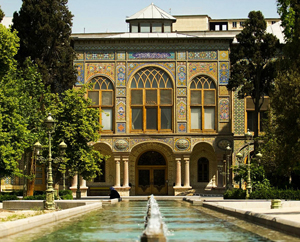
From the outset, modern and contemporary art integrates the possibilities of failure, historical irrelevance, and destruction within its own activities. Thus, art cannot be shocked by what it sees in the rear window of progress. The avant-garde’s Angelus Novus always sees the same thing, whether it looks into the future or into the past. Here life is understood as a non-teleological, purely material process. To practice life means to be aware of the possibility of its interruption at any moment by death—and thus to avoid pursuing any definite goals and objectives because such pursuits can be interrupted by death at any moment. In this sense, life is radically heterogeneous with regard to any concept of History that can be narrated only as disparate instances of success and failure.
For a very long time, man was ontologically situated between God and animals. At that time, it seemed to be more prestigious to be placed nearer to God, and further from the animal. Within modernity and our present time, we tend to situate man between the animal and the machine. In this new order, it would seem that it is better to be an animal than a machine. During the nineteenth and twentieth centuries, but also today, there was a tendency to present life as a deviation from a certain program—as the difference only between a living body and a machine. Increasingly, however, as the machinic paradigm was assimilated, the contemporary human being can be seen as an animal acting as a machine—an industrial machine or a computer. If we accept this Foucauldian perspective, the living human body—human animality—does indeed manifest itself through deviation from the program, through error, through madness, chaos, and unpredictability. That is why contemporary art often tends to thematize deviation and error—everything that breaks away from the norm and disturbs the established social program.

Here it is important to note that the classical avant-garde placed itself more on the side of the machine than on the side of the human animal. Radical avant-gardists, from Malevich and Mondrian to Sol LeWitt and Donald Judd, practiced their art according to machine-like programs in which deviation and variance were contained by the generative laws of their respective projects. However, these programs were internally different from any “real” program because they were neither utilitarian nor instrumentalizing. Our real social, political, and technical programs are oriented towards achieving a certain goal—and they are judged according to their efficiency or ability to achieve this goal. Art programs and machines, however, are not teleologically oriented. They have no definite goal; they simply go on and on. At the same time, these programs include the possibility of being interrupted at any moment without losing their integrity. Here art reacts to the paradox of urgency produced by materialist theory and its call to action. On the one hand, our finiteness, our ontological lack of time compels us to abandon the state of contemplation and passivity and begin to act. And yet, this same lack of time dictates an action that is not directed towards any particular goal—and can be interrupted at any moment. Such an action is conceived from the beginning as having no specific ending—unlike an action that ends when its goal is achieved. Thus artistic action becomes infinitely continuable and/or repeatable. Here the lack of time is transformed into a surplus of time—in fact, an infinite surplus of time.


Richard Artschwager, Live in your head, 2002.

It is characteristic that the operation of the so-called aestheticization of reality is effectuated precisely by this shift from a teleological to a non-teleological interpretation of historical action. For example, it is not accidental that Che Guevara became the aesthetic symbol of revolutionary movement: all revolutionary undertakings by Che Guevara ended in failures. But that is precisely why the attention of the spectator shifts from the goal of revolutionary action to the life of a revolutionary hero failing to achieve his goals. This life then reveals itself as brilliant and fascinating—with no regard for practical results. Such examples can, of course, be multiplied.

In the same sense, one can argue that the performance of theory by art also implies the aestheticization of theory. Surrealism can be interpreted as the aestheticization of psychoanalysis. In his First Manifesto of Surrealism, Andre Breton famously proposed a technique of automatic writing. The idea was to write so fast that neither consciousness nor unconsciousness could catch up with the writing process. Here the psychoanalytical practice of free association is imitated—but detached from its normative goal. Later, after reading Marx, Breton exhorted readers of the Second Manifesto to pull out a revolver and fire randomly into the crowd—again the revolutionary action becomes non-purposeful. Even earlier, Dadaists practiced discourse beyond meaning and coherence—a discourse that could be interrupted at every moment without losing its consistency. The same can be said, in fact, about the speeches of Joseph Beuys: they were excessively long but could be interrupted at any moment because they were not subjected to the goal of making an argument. And the same can be said about many other contemporary artistic practices: they can be interrupted or reactivated at any moment. Failure thus becomes impossible because the criteria of success are absent. Now, many people in the art world deplore the fact that that art is not and cannot be successful in “real life.” Here real life is understood as history—and success as historical success. Earlier I showed that the notion of history does not coincide with the notion of life—in particular with the notion of “real life”—for history is an ideological construction based on a concept of progressive movement toward a certain telos. This teleological model of progressive history has roots in Christian theology. It does not correspond to the post-Christian, post-philosophical, materialist view of the world. Art is emancipatory. Art changes the world and liberates us. But it is does so precisely by liberating us from history—by liberating life from history.

Classical philosophy was emancipatory because it protested against the religious and aristocratic, military rule that suppressed reason—and the individual human being as bearer of reason. The Enlightenment wanted to change the world through the liberation of reason. Today, after Nietzsche, Foucault, Deleuze, and many others, we tend to believe that reason does not liberate, but rather suppresses us. Now we want to change the world to liberate life—which has increasingly become a more fundamental condition of human existence than reason. In fact, life seems to us to be subjected and oppressed by the same institutions that proclaim themselves to be models of rational progress, with the promotion of life as their goal. To liberate ourselves from the power of these institutions means rejecting their universal claims based on older precepts of reason.

Thus, theory calls us to change not merely this or that aspect of the world, but the world as a whole. But here the question arises: Is such a total, revolutionary, and not only gradual, particular, evolutionary change possible? Theory believes that every transformative action can be effectuated because there is no metaphysical, ontological guarantee of the status quo, of a dominating order, of existing realities. But at the same time, there is also no ontological guarantee of a successful total change (no divine providence, power of nature or reason, direction of history, or other determinable outcome). If classical Marxism still proclaimed faith in a guarantee of total change (in the form of productive forces that will explode social structures), or Nietzsche believed in the power of desire that will explode all civilized conventions, today we have difficulty in believing in the collaboration of such infinite powers. Once we rejected the infinity of the spirit, it seems improbable to substitute it with a theology of production or desire. But if we are mortal and finite, how can we successfully change the world? As I have already suggested, the criteria of success and failure are precisely what defines the world in its totality. So if we change—or, even better, abolish—these criteria, we do indeed change the world in its totality. And, as I have tried to show, art can do it—and in fact has already done it.


Peter Hujar, Thek Working on the Tomb Figure, 1967-2010. Pigmented ink print.

But, of course, one can further ask: What is the social relevance of such a non-instrumental, non-teleological, artistic performance of life? I would suggest that it is the production of the social as such. Indeed, we should not think that the social is always already there. Society is an area of equality and similarity: originally, society, or politeia emerged in Athens—as a society of the equal and similar. Ancient Greek societies—which are a model for every modern society—were based on commonalities, such as upbringing, aesthetic taste, language. Their members were effectively interchangeable through the physical and cultural realization of established values. Every member of a Greek society could do what the others could also do in the fields of sport, rhetoric, or war. But traditional societies based on given commonalities no longer exist.

Today we are living not in a society of similarity, but rather in a society of difference. And the society of difference is not a politeia but a market economy. If I live in a society in which everyone is specialized, and has his or her specific cultural identity, then I offer to others what I have and can do—and receive from them what they have or can do. These networks of exchange also function as networks of communication, as a rhizome. Freedom of communication is only a special case for the free market. Now, theory and art that performs theory, produce similarity beyond the differences that are induced by the market economy—and, therefore, theory and art compensate for the absence of traditional commonalities. It is not accidental that the call to human solidarity is almost always accompanied in our time not by an appeal to common origins, common sense and reason, or the commonality of human nature, but to the danger of common death through nuclear war or global warming, for example. We are different in our modes of existence—but similar due to our mortality.

In earlier times, philosophers and artists wanted to be (and understood themselves as being) exceptional human beings capable of creating exceptional ideas and things. But today, theorists and artists do not want to be exceptional—rather, they want to be like everybody else. Their preferred topic is everyday life. They want to be typical, non-specific, non-identifiable, non-recognizable in a crowd. And they want to do what everybody else does: prepare food (Rirkrit Tiravanija) or kick an ice block along the road (Francis Alÿs). Kant already contended that art is not a thing of truth, but of taste, and that it can and should be discussed by everyone. The discussion of art is open to everyone because by definition no one can be a specialist in art—only a dilettante. That means that art is from its beginnings social—and becomes democratic if one abolishes the boundaries of high society (still a model of society for Kant). However, from the time of the avant-garde onwards, art became not only an object of a discussion, free from the criteria of truth, but a universal, non-specific, non-productive, generally accessible activity free from any criteria of success. Advanced contemporary art is basically art production without a product. It is an activity in which everyone can participate, that is all-inclusive and truly egalitarian.

In saying all this, I do not have something like relational aesthetics in mind. I also do not believe that art, if understood in this way, can be truly participatory or democratic. And now I will try to explain why. Our understanding of democracy is based on a conception of the national state. We do not have a framework of universal democracy transcending national borders—and we never had such a democracy in the past. So we cannot say what a truly universal, egalitarian democracy would look like. In addition, democracy is traditionally understood as the rule of a majority, and of course we can imagine democracy as not excluding any minority and operating by consensus—but still this consensus will necessarily include only “normal, reasonable” people. It will never include “mad” people, children, and so forth.

It will also not include animals. It will not include birds. But, as we know, St. Francis also gave sermons to animals and birds. It will also not include stones—and we know from Freud that there is a drive in us that compels us to become stones. It will also not include machines—even if many artists and theorists wanted to become machines. In other words, an artist is somebody who is not merely social, but super-social, to use the term coined by Gabriel Tarde in the framework of his theory of imitation.5 The artist imitates and establishes himself or herself as similar and equal to too many organisms, figures, objects, and phenomena that will never become a part of any democratic process. To use a very precise phrase by Orwell, some artists, are, indeed, more equal than others. While contemporary art is often criticized for being too elitist, not social enough, actually the contrary is the case: art and artists are super-social. And, as Gabriel Tarde rightly remarks: to become truly super-social one has to isolate oneself from the society.

1 Arnold Gehlen Zeit-Bilder. Zur Soziologie und Aesthetik der modernen Malerei, (Frankfurt: Athenaeum, 1960).

2 Theodor Adorno, Minima Moralia: Reflections from Damaged Life, trans. E.N. Jephcott (London: Verso, 1974), 50 and 39 respectively.

3 Walter Benjamin, “On the Concept of History,” in Selected Writings, vol. 4: 1938-40, ed. Howard Eiland and Michael Jennings (Cambridge: Harvard University Press, 2003), 389-400..

4 Benjamin, “Critique of Violence,” in Selected Writings, vol. 1: 1913-26, ed. Marcus Bullock and Michael Jennings (Cambridge: Harvard University Press, 1999), 236-52.

5 Gabriel Tarde, The Laws of Imitation (New York: H.Holt and Co., 1903), 88.