FaraIran Unveils Its 2025 Website: A New Era for Contemporary Iranian Art

FaraIran Unveils Its 2025 Website: A New Era for Contemporary Iranian Art

We are thrilled to announce the launch of the FaraIran 2025 new version website (farairan.com), a reimagined and dynamic platform dedicated to celebrating the vibrant world of Iranian art. Building on our mission to connect Iranian artists with global audiences, the 2025 version introduces exciting new features, enhanced user experience, and a bolder vision to elevate Iranian creativity on the world stage.

What’s New in FaraIran 2025?


  • Redesigned Interface: A sleek, visually stunning design inspired by contemporary Iranian aesthetics, offering seamless navigation for art enthusiasts.
  • Interactive Artist Profiles: Explore in-depth profiles with slideshows, videos, and exclusive interviews with both established and emerging Iranian artists.
  • Expanded News Section: Daily updates on art events, exhibitions, and cultural happenings in Iran and worldwide, now with a dedicated archive for easy access.
  • Artist of the Month Spotlight: A revamped feature showcasing a prominent artist each month with detailed analyses, interviews, and thematic explorations.
  • Bilingual Excellence: Enhanced Persian and English content to engage a diverse global audience, from collectors to cultural institutions.
  • Community Hub: New tools for artists to submit their work directly, fostering a vibrant community of creators and enthusiasts.

FaraIran 2025 is more than a website—it’s a movement to amplify the voices of Iranian artists across visual arts, cinema, theater, music, architecture, photography, and cultural heritage. Whether you’re an art lover, a collector, or a cultural brand, FaraIran offers a unique platform to discover, engage, and connect with the rich tapestry of Iranian creativity.

Join us today at farairan.com to explore the new era of Iranian art and stay updated with the latest artistic events.

Contact

For media inquiries or partnership opportunities, reach out at info@farairan.com

“House of the Sun” shines at Italy’s A’ Design competition

Date: 18 April 2017

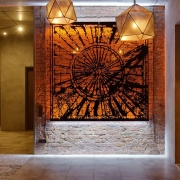
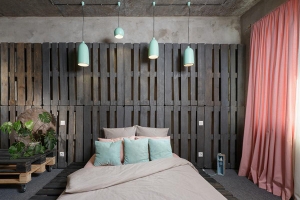
Iranian architects Nima and Sina Keivani won a silver award for their joint design “House of the Sun” at the A’ Design Award and Competition in the Italian city of Milan, the organizers announced Saturday 15 April 2017.

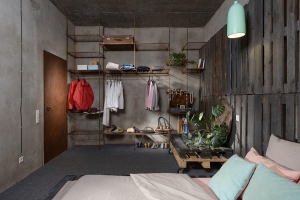
The design, which has been implemented in a building in Kiev, was honored in the Interior Space and Exhibition Design category. Nima and Sina along with designers, architects, artists and design oriented companies from around the world will be honored during a special ceremony on 9 June 2017.

The two Iranian architects started their project in May 2015 in collaboration with the Studio Persian Primavera in Kiev, Ukraine and finished construction in June 2016.

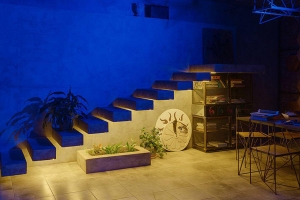
The A’ Design Award and Competition, in describing “House of the Sun”, explained that “one of the most important design ideas is the set of stairs located in the living room.”

“It is a symbolic, yet philosophical element. This element is inspired from historic mehrabs and ziggurats, which are symbols of promotion and approaching closer to the sun. The sun is the symbol of light, and light is the symbol of knowledge and wisdom.”

Award-winning designs will be showcased in an exhibition, which will open at MOOD — the Museum of Outstanding Design — on 6 June 2017.

Source: Tehran Times

**Termination of the “Koocheh Festival” in Solidarity with the People of Bandar Abbas**

Termination of the “Koocheh Festival” in Solidarity with the People of Bandar Abbas

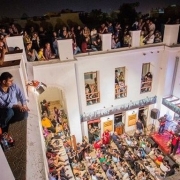
Following the announcement of public mourning and solidarity with the people of Bandar Abbas, the organizers of the Koocheh Festival announced that the festival has come to an end, and the remaining programs will not be held.

“The south is a home with a palm tree in its center, a canary in its corner, an old boat in its nook.

One of its rooms is Ahvaz, another is Bushehr, and its grand, vast, beautiful one is Bandar Abbas.

A home where one eye weeps, no longer having the strength, reed, or breath.

The alley, facing east, facing the port, embraces its knees and, from the peak of joy, falls silent in the depths of sorrow.

We await the days of Iran’s joy.

We ask the people of Bushehr to go all out for the days ahead. For the guests we have in the city, who have counted on staying in Bushehr. People of Bushehr! Without instruments, drums, or cheers, keep the guests’ hearts joyful.

Kudos to the police. You’ve honored us. You’ve stood by the people’s joyful hearts.

Kudos to the opponents. Truly, kudos. You didn’t take the family feud to the streets. You, too, are the beauty of this city of tolerance. The beauty of Bushehr, so beautiful.

Tonight, we gather in the courtyard of Saadat School, read the final story, entrust you to God, and, hopeful for the days crafted by the Most Merciful, the Most Compassionate, we head toward our lives, cherishing Iran’s beauty.

We bid farewell with longing.”

A massive explosion occurred on Saturday (6th Ordibehesht) at the “Shahid Rajai Port” in Bandar Abbas, resulting in 28 deaths, 6 missing persons, and 800 injuries so far. Mohammad Ashouri Taziani, the Governor of Hormozgan, declared three days of public mourning in the province following the explosion and the loss of several compatriots.

The fourth edition of the Koocheh Festival, which included live music concerts and cultural programs in Bushehr, was set to showcase unique regional folk traditions of Iran over five nights for its audience.

Approval of the national document on Iranian-Islamic architecture & urban develo

Date: 28 January 2017

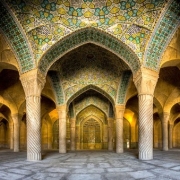
The Supreme Council of the Cultural Revolution has approved a draft of the national document on the Iranian-Islamic architecture and urban development on Tuesday 26 January 2017.

The document, which contains policies regulating and governing urban planning particularly in metropolises, was approved by the council chaired by President Hassan Rouhani with representatives from the Ministry of Transport and Urban Development and the Supreme Council for Architecture and Urban Development in attendance.

Responsible bodies are required to report on their annual progress regarding the law to the Supreme Council of the Cultural Revolution; additionally the state TV and the Ministry of Culture and Islamic Guidance have to strive to promote the Iranian-Islamic architecture among the public by the TV programs they make.

Implementing architectural features of Iranian and Islamic urban planning, promoting interaction between cultural centers, houses, schools and mosques, setting up research hubs and boosting technical and scientific knowledge in this field, reconsidering and reforming the educational system regarding architectural studies with regard to the Iranian-Islamic architecture, conservation and restoration of monuments and relics, management and improvement of cities’ physical environment, and raising public awareness about the significance of Iranian-Islamic architecture are some of the laws approved in the aforementioned document.

Source: Tehran Times

Willy Muller to discuss new urban paradigms in Tehran

Date: 22 January 2017

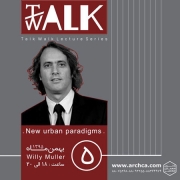
The Barcelona-based renowned Argentine architect Willy Muller is scheduled to deliver a lecture about urban paradigms in Tehran on 3 February 2017.

The lecture program titled “Urban Paradigms: Towards the Extreme Urbanism?” has been organized by the Contemporary Architects Association of Iran.

“During the first decade of the XXI century we have witnessed one of the most singular demographic events of the last centuries: for the first time in history there are more people inhabiting urban environments than the rural ones,” he wrote in the preface to his speech.

As a consequence, on the one side the exponential growth of many metropolitan populations is reaching levels of unprecedented social complexity, and on the other side the geographical environment in which societies are settled is ever more compromised, insecure and threatened,” he added.

He pointed out to Lagos, Manila, Rio de Janeiro, Hong Kong, Mumbai and Tokyo as cities that are starting to manage an unknown type of urban complexity and added, “We are facing limit situations of obsolescence and change of paradigms, where the classical models of success will not be sufficiently useful.”

Muller is the founder of the Willy Muller Architects, a Barcelona-based office dedicated to architecture and urbanism design. The office has been awarded with a series of international prizes for its works and architectural competitions.

It also has representative offices in Rio de Janeiro, Hong Kong, Saint Petersburg and several other cities.

Source: Tehran Times

Iran Architect Receives 2016 Inspireli Award

Date: 3 January 2017

Inspireli Awards, the premier global contest for aspiring architects and designers, has announced the winners of its sixth edition.

The International Union of Architects (UIA), the organizers of the competition, announced competitors from Italy, Japan and Iran as winners of the top three places in its 2016 edition. The competition is one of the most successful talent contests for young and budding architects and designers in the world, says its website uia-architects.org.

The third place was shared by Somayeh Ravanshad, PhD in Architecture from Tehran Azad University, Iran, and Magdalena Trobinger from Italy.

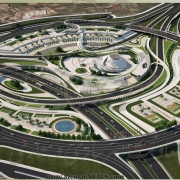
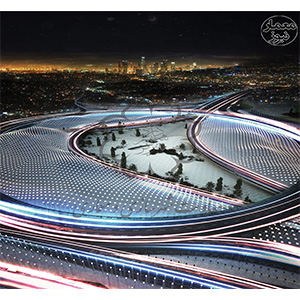
Ravanshad designed ‘Azarbaijan Square,’ the “largest square in the Middle East.” Her design reflects the mountainous structure of Iran’s Azarbaijan region, in particular Tabriz, capital of East Azarbaijan Province. The concept is conveyed with numerous vertical elements rhythmically arranged across the square.

Trobinger is a graduate of University of Innsbruck, Faculty of Architecture in Austria, and presented a deconstructionist design of a building.
The contest was attended by 1,052 competitors from more than 300 universities in 99 countries.

Participants submitted over 2,900 photo designs online and received 25,626 votes in all, and 50 competitors from 37 universities in 25 countries were chosen in the final round.

Jury of 55 Architects
The three winners were selected by a jury of 55 top architects from 6 continents. A competitor from France won the highest public vote.
Giacomo Garziano from University of Florence in Italy bagged the first place with 33 votes. He is the founder of GG-loop, an architecture office, established in 2014 in Amsterdam. His winning project ‘Altamura IT,’ is a visionary refurbishment by GG-loop which turned an old house in Altamura, southern Italy, into a place for the arts, multisensory events and exhibitions.

Daiki Watanabe from Musashino Art University (MAU) in Japan won the second place with 28 votes for his designs of a station, a department and a museum.
Said Belmir, graduate of Faculte d’Architecture La Cambra Horta in Belgium, who has participated in the competition as a French competitor, was announced the winner of the highest number of public votes. His winning design was a showroom, showing the interior and façade of a store belonging to Annemie Verbeke, a famous fashion brand in Belgium.

The UIA is a non-governmental organization, a global federation of national associations of architects that are its members. From the 27 delegations present at its founding assembly in Lausanne, Switzerland, in 1948, the UIA has grown to encompass key professional organizations of architects in 124 countries and now represents close to 1.3 million architects worldwide.

Source: Financial Tribune

600-year-old Varf Chal Ritual

Date: 7 June 2017

Every spring, people in Ab Ask, a village near the northern city of Amol, mark a 600-year-old ceremony called “Varf Chal”, which literally means “snow storing”.

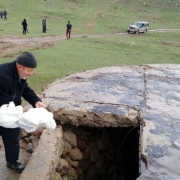
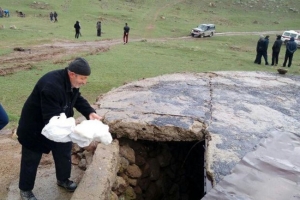
During the event, no man, except elders is allowed to stay in the village. They leave the place to go to Varf Chal to carry pieces of frozen snow left from winter, and put them in a ten-meter-deep pit as they believe the snow could provide fresh water for animals and thirsty passersby after being melted in summer.

On this day women take over everything and choose guards among ourselves to prevent men entering the village. They prepare bread from flour offered and water fetched from nearby water springs from a few days before the ceremony.

The word ‘varf chat’ in Mazandarani dialect means a well dug by the villagers each year in May to fill it with snow, gathered from the mountains.

Ab Ask village is 90km away from Tehran on Haraz Road passing through Rineh, Abgarm and Lar region in the mountain range around Damavand Summit.

Source: Farairan from Tehran Times and Mehr

Exhibition of exquisite rugs, photos and precious scripts at G

Date: 24 May 2017

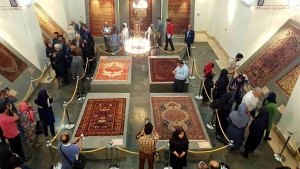
An exhibition of exquisite rugs, precious scripts and patchworks and photos remaining from the Qajar reign is opening today 23 May 2017 at Golestan Palace Complex in Tehran.

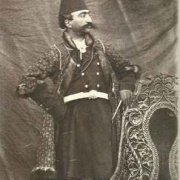
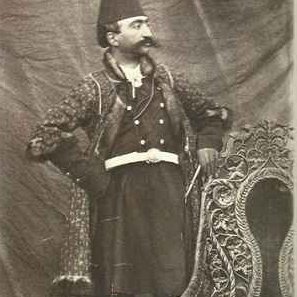
The photos, to be showcased on the occasion of the national Cultural Heritage Week, will be exhibited at the palace Photo House. Among them is the first self-portrait taken by the art-enthusiastic Qajar king, Naser-al-din Shah 130 years ago.

The complex has made available a number of exotic rugs at its anthropology museum for the week. The 17 carpets belong to the Qajar (1785-1925) and Pahlavi (1925-1979) eras, ISNA quoted Nosrati as saying.

About the rugs, Nosrati said the silk and wool carpets were woven in the cities of Arak (Markazi Province), Tabriz (East Azarbaijan) and Sanandaj (Kurdistan Province). “Their makers, however, are not known.”

There are currently 350 rugs at the Golestan Palace treasury which are to be showcased on different occasions.

Nine copies of valuable manuscripts belonging to the complex are also to be displayed for the first time.

Source: Financial Tribune

Tehran exhibit features rarely-seen historical relics

Date: 22 May 2017

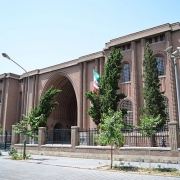
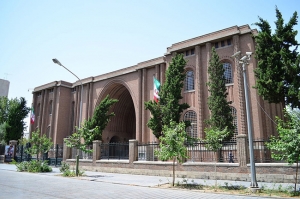
The National Museum of Iran has put on show a rarely-seen collection of its treasure trove in a month-long exhibit that opened to the public on Wednesday 18 May 2017.

Some 80 percent of the total 252 exhibited objects have never been displayed before and the rest are rarely-seen.

The objects date from the Paleolithic era to the end of Qajar period (1789–1925).

The exhibit features prehistoric tools, pottery vessels, metal objects, textile remains, and some rare books and coins amongst others.

The event is devoted to mark the National Cultural Heritage Week, which has already commenced in the country and the International Museum Day that is celebrated on 18 May 2017

Source: Tehran Times

Kalpourgan pottery with 7000 years history

Date: 20 May 2017

Kalpourgan pottery production dates back to 7,000 years and has been handed over through generations from mothers to daughters.

60 entrepreneurship houses have been established province-wide to promote the handicraft industry.

According to Delvari added that due to presence of ferrous oxide in the soil, Kalpourgan pottery becomes red after it is baked in furnace at temperatures ranging from 970°C to 1,200°C for 72 hours.

The designs on Kalpourgan potteries amounting to 30 geometric shapes are inspired by natural elements and imagination of local artisans.

In addition to Germany, Italy, France and Spain, three other countries are customers of Kalpourgan potteries.
Plans are at hand to renovate pottery kilns and develop Kalpourgan Region in the southeastern province of Sistan-Baluchestan.

Kalpourgan pottery is one of superior handicrafts of Iran, which is still made traditionally.

Pottery items produced at Kalpourgan bear great similarity to specimens unearthed during archeological excavations carried out in Sistan-Baluchestan, Kerman, Gilan as well as parts of Japan and India.

The village of Kalpourgan is located 25 kilometers east of Saravan.
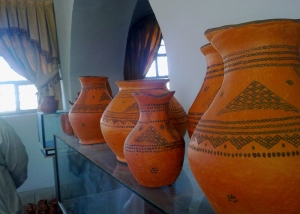
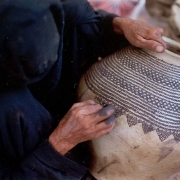
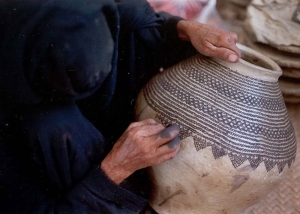
Perhaps the most striking feature of the pottery of Kalpourgan is its manufacturing technique, which is based on ancient methods and styles. This type of pottery is produced by using the coil technique. Its products are unglazed and adorned with dark brown patterns.

The potters of Kalpourgan are all women who contribute to family income. They don’t use the wheel and shape their products by hand.
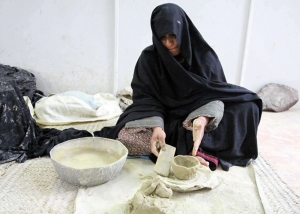
An aqueous mixture of tytok (a type of ferrous oxide) and a stone found on Mt. Birak, near the village, is applied using a match-sized stick of daz (wild date) wood.

The decoration consists entirely of abstract symbols and images passed from generation to generation, which reflect their religious beliefs or environmental features.

A majority of these symbols are similar to those found on potteries belonging to prehistoric and early historic periods.

The raw material used in the manufacture of Kalpourgan pottery consists of a particular type of clay. Villagers bring it in from a region known as Mashkotak, two kilometers northeast of Kalpourgan, and blend it with a slip-like mixture to prepare the clay, which they hand over to nimble-fingered women.

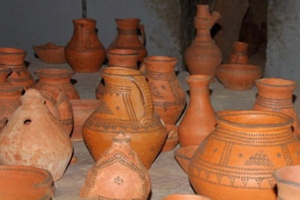
The pottery items produced in Kalpourgan include bowls, jugs, cups, pitchers, cooking vessels, etc. Most of these vessels feature a lid that can also be used as an independent vessel. Cup-shaped lids can also be used to cover large bowls.

Another interesting feature of the pottery of Kalpourgan is their handles. Unlike present-day pottery, these handles are even more resistant than the vessels themselves. Each handle is formed out of a thick coil of mud, which the artisan pastes to the moist body of the vessel and gives it the desired shape by means of different tools.

These handles are much better executed than those of the glazed pottery produced in the middle of the Islamic period.

Kalpourgan pottery is also known for its diversity, which manifests itself in the form of vessels shaped as animal heads, pomegranate-shaped incense burners (used to burn wild rue seeds and locally known as sokaky), vessels shaped as camels, etc.

The thickness of these varies between one and 5.5 centimeters. Their color is gray prior to firing and reddish brown after baking.

The pottery of Kalpourgan may also be subdivided into categories such as toys, water pipes, food and water containers, bowls, vessels, flat trays and jars for keeping dates, which again indicates the diversity of these items and their wide range of use.

In the early 1970s, a workshop was set up at Kalpourgan to coordinate the activities of the region’s potters.

Extending over an area of 3,800 square meters, this workshop has a built-up area of 386 square meters. Its architecture is well-adapted to the desert and is the meeting place for talented women craftsmen of the area.

Today, this workshop has been transformed into the Museum of Kalpourgan Pottery.

Source: Iran Daily