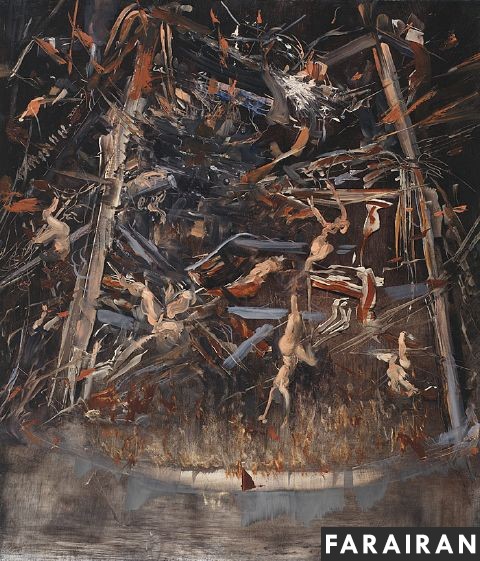
Farairan’ Choice Ali Banisadr
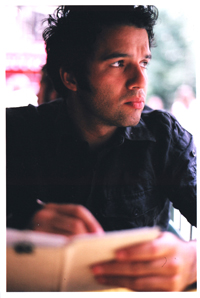
Born 1976, Tehran, Iran
Lives and works in New York City
EDUCATION:
MFA, New York Academy of Art (2007)
BFA, School of Visual Arts, New York (2005)
SOLO EXHIBITIONS:
2012 – “We Haven’t Landed on Earth Yet”, Galerie Thaddaeus Ropac, Salzburg,
Austria
2011 -“It Happened and It Never Did”, Leslie Tonkonow Artworks + Projects, NY
2010 -“Evidence” Galerie Thaddaeus Ropac, Paris (works on paper)
-“Paintings” Galerie Thaddaeus Ropac, Paris
2008 -Leslie Tonkonow Artworks + Projects, New York
GROUP EXHIBITIONS:
2013 – Safar/Voyage, Museum of Anthropology(MoA) at The University of British Columbia, Vancouver, Canada (Curated by Fereshteh Daftari)
2012 – Contemporary Iranian Art in the Permanent Collection, The Metropolitan Museum of Art, New York
-The Sound of Painting , Palazzo Saluzzo Paesana, Turin, Italy (Curated by Margherita Artoni)
-Peekskill Project V, Hudson Valley Center for Contemporary Art, Peekskill, NY (Curated by Livia Straus & Lilly Wei)-Hue and Cry, Sotheby’s (S2 Gallery) New York, NY; (Curated by Vladimir Restoin Roitfeld)
-Dynasty, Hotel Particulier, New York, NY (Curated by Omar-Lopez Chahoud)
-Lucie Fontaine: Estate Vernissage, Marianne Boesky Gallery, New York
-Referencing History, Green Art Gallery, Dubai (Curated by Jane Neal)
2011 -XXSmall, Gemeente Museum, The Hague, Netherlands
-East Ex East, Brand New Gallery, Milan, Italy (Curated by Jane Neal)
-Visions, Monica De Cardenas, Milan, Italy
2010 -Hareng Saur : Ensor and Contemporary Art, Stedelijk Museum voor Actuele Kunst (SMAK), Ghent, Belgium-Contemporary Notes, Assar Gallery, Tehran, Iran (Curated by Vahid Sharifian)
-Ghosts, Luce Gallery, Torino, Italy
2009 -Epic Painting, Samek Art Gallery, Bucknell University, PA
-Raad O Bargh- Kunstraum Deutsche Bank, Salzburg, Austria
-Unveiled: New Art from the Middle East, The Saatchi Gallery, London
-Raad O Bargh – 17 Artists from Iran, Galerie Thaddaeus Ropac, Paris
2008 -Weaving The Common Thread, Queens Museum of Art, Queens, N.Y
-Utopia Dystopia, Leslie Tonkonow Artworks + Projects, New York
-Small is Beautiful (2), Flowers Gallery, New York
-Post Graduate Fellows Exhibition , New York Academy of Art
2007 -Small is Beautiful, Flowers Gallery, New York
-Homecoming, New York Academy of Art, New York
-CAA Exhibition, Hunter College/Time Square Gallery, New York
2006 -Tribeca Ball, Skylight, New York
-Summer Painters, Chateau de Balleroy, France
2005 -In Exile, Visual Arts Gallery, New York
PUBLIC COLLECTIONS:
The British Musuem ,UK
Museum of Contemporary Art, Los Angeles
The Metropolitan Museum of Art, New York
The Olbricht Collection, Germany
Francois Pinault Foundation
The Saatchi Gallery, London
Sammlung Essl , Vienna, Austria
The Wurth Collection, Germany
AWARDS:
-New York Foundation for the Arts Fellowship in Painting (2010)
-Post-Graduate Research Fellowship, New York Academy of Art, New York (2007–08)
-Travel Grant to Normandy, France at the Chateaux Balleroy (2006)
-Prince of Wales / Forbes Foundation (2006)
PRESS:
2012
-Cover of Flash Art International Magazine (July-September 2012)
– G. Roger Denson, “Going Forward in Reverse : The Present Tense(ion) of History
Painting”, The Huffington Post (September, 7, 2012)
-Julie Chae, “Conversation with Ali Banisadr”, The Huffington Post (September, 4, 2012)
– Julie Chae, “Conversation with artist Ali Banisadr”, Arts in a Changing America (September, 2, 2012)
-Nicola Trezzi, “Ali Banisadr”, Flash Art International Magazine (July-September 2012)
-Will Corwin, “Ali Banisadr, Tehran to New York”, Art on Air International Radio (August, 20, 2012)
-Jane Neal, “What Lies Beneath”, Flash Art International Magazine (July-September 2012)
-Shirine Saad, “Impulse to Paint”, Aishti Magazine (April/May 2012)
-Jyoti Kalsi, “Lessons from the Past”, Gulf News (May, 25, 2012)
-Rebecca Ann Proctor, “Historical Relayerings”, Canvas Guide (May 2012)
-Pamela A Lewis, A defiant Beauty: Contemporary Iranian Art from the permanent collection at the Met”, Galo Magazine (March 2012)
-Jonathan Beer, “Conversation with the Unnamed: Ali Banisadr”, Art-Rated (January 2012)
2011
-“Top 100 Artists” (Ranked #1), Flash Art International Magazine (November 2011)
-Margherita Artoni, “Visions”, Flash Art International Magazine (November 2011)
-Marco Tagliafierro, “East Ex East”, Artforum (October 2011)
-Damiano Gulli, “East Ex East”, Flash Art Magazine, Italy (October 2011)
– Christopher French, “Ali Banisadr”, ARTnews (September 2011)
-Media Farzin, “Profile: Clamour and Colour Ali Banisadr”, Canvas Magazine (September 2011)
-Amanda Church, “Ali Banisadr”, Art in America (June 29, 2011)
– Vaziri, Katayoun. “Interview: Ali Banisadr : It Happened and It Never Did”, BBC Persia (TV), Tamasha, (May, 5. 2011)
– Olivia Sand, “Profile: Ali Banisadr”, Asian Art Newspaper (February 2011)
– Augustin Besnier, “Ali Banisadr Evidence”, Paris Art, (January 2011)
2010
– Valerie de Maulmin., “Les arcanes poetiques d’ Ali Banisadr”, Connaissance des Arts, Paris (November, 2010)
-“Prima candelina coi fantasmi: una mostra astratta e figurativa” il Giornale, Italy (September, 15, 2010)
-Chiara Badinella e Fabrizio Affronti, “Ali Banisadr: Un caos controllato in procinto di andare a pezzi” , Flash Art Magazine, Italy 286 (August/September 2010) issue
-Vahid Sharifian, “Interview with Ali Banisadr”, Tandis Magazine, Tehran (May, 2010)
-Alexandra Cheney, “All’s Fare in Art”, Wall Street Journal, (May, 9, 2010)
-Chiara Badinella e Fabrizio Affronti, “Grandi Masteri, Fonte Perenne”, La Casana, (March, 2010) Italy
-Genie Godula, “Ali Banisadr”, France 24 (Video), (February, 12, 2010)
-Sophie De Santis, “Ali Banisadr”, Le Figaro, (February, 23,2010)
-Catherine Rigollet, “Ali Banisadr”, L’agora Des Arts, (March, 2010)
-Nicolas Villodre, “Ali Banisadr”, Paris Art, (March, 2010)
2009
-Tom Jeffreys, “Unveiled New Art From The Middle East,” Spoonfed, (January, 29, 2009)
-Santevecchi Guido, “Arte Shock Per I’ Islam Senza Veli,” Corriere Della Sera, (January, 31, 2009)
-Neal Brown, “Middle Eastern Promise,” The First Post, (February,2, 2009)
-Philippe Dagen, “Le Moyen-Orient détrône la Chine chez Saatchi, collectionneur avisé,”Le Monde, (February,6, 2009)
-“Thunder and Lightning”, Wall Paper (February, 20, 2009)
-Alireza Amirhajibi, “Iranian Raad O Bargh in Paris and London,” Etemad Melli,(February 2009)
-Eric Van Tuijn, “The Middle East Unveiled”, MetropolisM (March 2009)
-Philippe Dagen, “Raad O Bargh”, Le Monde (March, 8, 2009)
-Fiona Gruber, “New Middle Eastern Art”, ABC Radio National, (March, 15, 2009)
-Emily Verla Bovino, “Raad O Bargh”, Frieze Magazine, (April, 2009)
-Morad Montazami, Review, ArtPress, (May 2009)
-“Donner Und Blitz Aus Dem Iran”, Der Standard, Austria (July, 29, 2009)
-Robert Ayers, Modern Painters, (November, 2009)
2008
-Karen Rosenberg, “Ali Banisadr,” The New York Times, (7 November 2008)
-Greg Lindquist, “Ali Banisadr,” The Brooklyn Rail, (December 2008 – January 2009)
-Halasz, Piri. “Detour Through Chelsea,” (An Appropriate Distance) From the Mayor’s Doorstep, No. 81:1 December, 2008
-James Wagner, “Ali Banisadr at Leslie Tonkonow”, Jameswagner.com (December,2008)
PUBLICATIONS:
-Ali Banisadr: Paintings (New York: Leslie Tonkonow Artworks + Projects, 2008)
-Unveiled: New Art from the Middle East (London: The Saatchi Gallery, London, 2009),33–36.
-Raad O Bargh, Text by Vali Mahlouji (Galerie Thaddaeus Ropac, Paris, 2009) 20-23.
-Different Sames: New Perspectives on Contemporary Iranian Art, ed. Hossain Amirsadeghi (London: TransGlobe Publishing Ltd., 2009)
-Epic Painting, Bucknell University/Samek Art Gallery, 2009 (Essay by Dan Mills)
-Ali Banisadr, Text by Fereshteh Daftari, Published by Galerie Thaddaeus Ropac, 2010,52 pages
– Hareng Saur : Ensor and Contemporary Art, distributed by Ludion, S.M.A.K. and MSK Ghent, 2010, 240 pages (Texts by Pierre Alechinsky, Ali Banisadr, Susan Canning, Robert Hoozee, Timothy Hyman, Yang Jiechang, Bart Koubaa, Thomas Kowalski, Enrique Marty, Emilio López-Menchero, Raymond Pettibon, Elly Strik, Koen Theys and Philippe Van Cauteren.)
– Jane Neal , “East Ex East”, Published by Brand New Gallery, Milan, 104 pages (June 2011)
-Nicola Trezzi, “Visions”, Published by Monica De Cardenas, Milan ,55 pages (September, 2011)
Jane Neal, “Referencing History”, Published by Green Art Gallery, Dubai (May 2012)
-Maryam Ekhtiar, Greg Lindquist, “We Haven’t Landed on Earth Yet”, Published by Galerie Thaddaeus Ropac, D.A.P. (June 2012)
VISITING ARTIST / TALKS
2012 -New York Academy of Art , New York
2010 -Rutgers University, Mason Gross School of the Arts, New Brunswick, NJ
-Syracuse University, College of Visual and Performing Arts, Syracuse , NY
2009 -New York Academy of Art, New York, NY
2008 -Queens Museum of Art, Queens, NY
Born in Tehran, Iran in 1976, Ali Banisadr moved to America with his family when 12 years old, already having experienced –if not intellectually for his age, but emotionally – a revolution and a war by then. As a teenager living in San Francisco, Banisadr was part of a well-known group of graffiti artists. After briefly studying psychology, he left the Bay Area to attend art school in New York, receiving a BFA from the School of Visual Arts in 2005 and his MFA from the New York Academy of Art in 2007. He still lives and works in New York.
The visual and narrative content of Banisadr’s works is shaped by his exposure to war, Pop culture, Cinema, Graphic novels, Persian Miniature and European Painting. In an interview with Julie Chae, when she points out to these influences, Banisadr says: It is true that there have been so many influences mentioned about my work. All these influences and others are brought into my work subconsciously so perhaps that is why there are glimpses of this and that in my work but there is always so much more than the ones mentioned.
And in reply to her question whether his paintings are, in the end, decode-able, he says: When I am working on a painting, everything that I am thinking about at the time — be it current events, the books I am reading, personal events, influences, emotions, etc. — all find their way into my work. And in a way, painting is a way of thinking visually, so whatever is happening with me at the time gets reflected in the work. So the title does at the end give some kind of clue about some of the things I was thinking of when I was making the work.
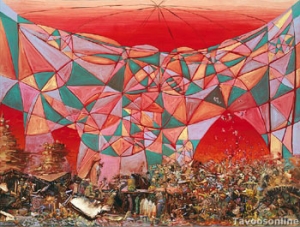
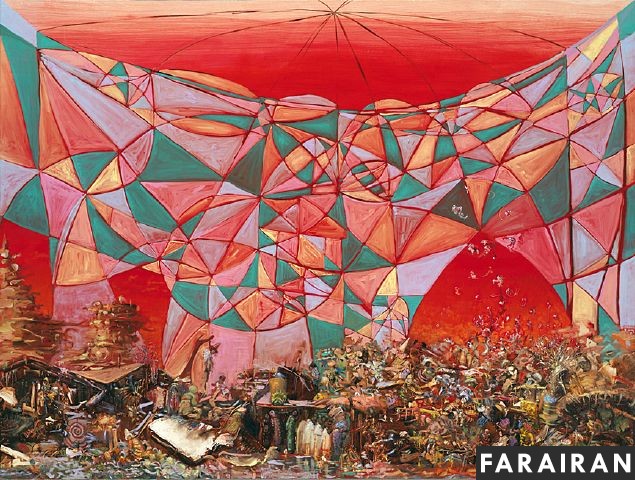
In the Name of, Oil on Linen, 2008
Banisadr’s art has an aural quality, a way of experiencing sound through paint and linen. This goes back to 2006 when he began to make charcoal drawings based on the sounds of explosions, thus bringing auditory elements into the work and letting his subconscious take over. After this, he started to compose his paintings in an auditory way, which felt very organic and visceral. He has taken the time to learn many of the Old Master techniques in handling oil paint, creating illusions such as light and air, and he fuses those brushwork elements with features of Persian Miniatures, particularly the compositional layering of perspectives and stylization of motifs. He creates his own unique versions of “history paintings”; instead of glorifying the current political systems and power structures, however, his art questions myths, history, what really happened and what is really happening.
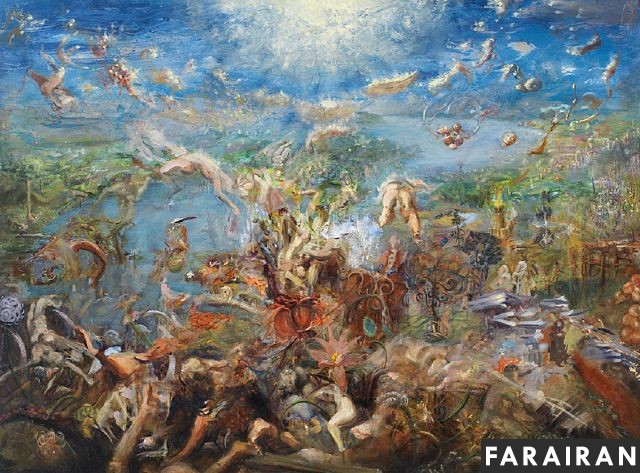
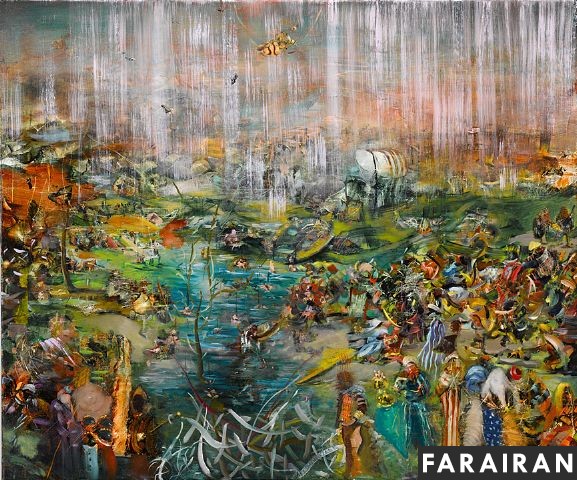
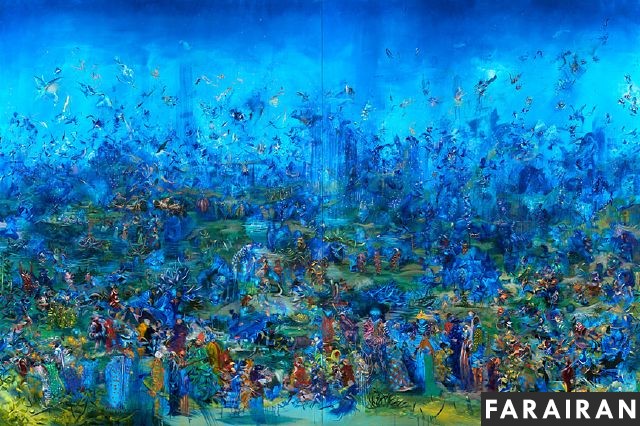
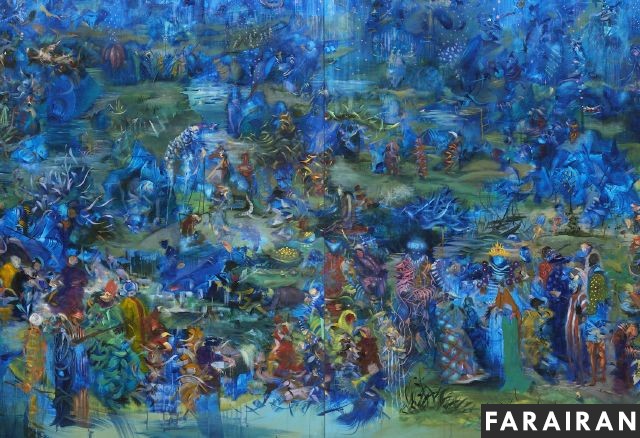
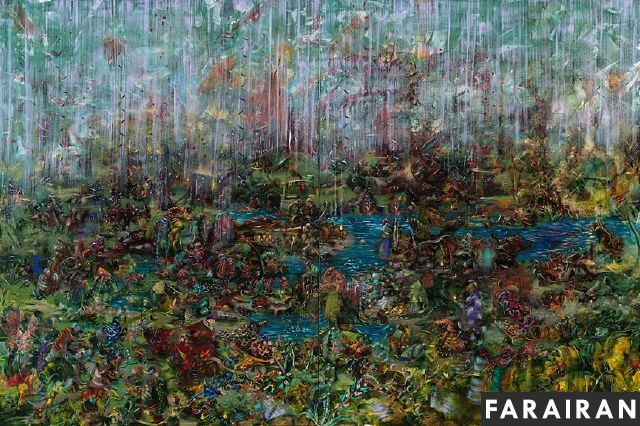
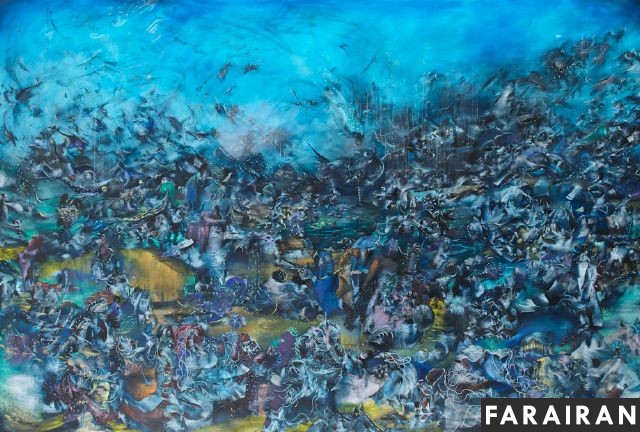
Influenced by Persian miniatures — small, intricately rendered illustrations similar to illuminated manuscripts — Banisadr’s canvas unfurls like an ancient map, a spatially skewed terrain of detailed activity. Throughout, angular shapes suggesting topsy-turvy architecture provoke a disorienting sense of wonder. Out-of-scale figures are formed from indulgent dabs, and exotic fauna and pools evolve from luscious smears and layered washes. Rendered in the gold and blue associated with European religious painting, Banisadr bathes his scene of earthly pleasures in a divine glow, ignited by bombardments in the distance.
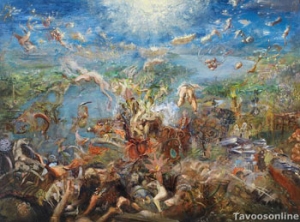
Things Fall Apart, 2007
While addressing universal questions about humankind and life, Banisadr’s art is thoroughly post-Modern, eluding easy categorization and incorporating a myriad of artistic influences from both Western and non-Western history along with renowned Modern artists. His artworks entice you to engage in an act of looking that becomes a pleasurable Borges-ian labyrinth where you think you’re beginning to figure out what is going on just as you realize you probably do not.
Ali Banisadr conceives most of his works with the lack of a center. Scattered, diffuse, dispersed, the characters animating his largescale paintings are continuously undermining the necessity of a focus. For him, seeing and non-seeing are connected both to motion and to the imaginings of the mind. In his imagination, things are always in a state of flux, and so the resulting images are based on fragments from different places, which are combined until they become encyclopedic hybrids. Unlike many of his contemporaries who conform to traditional Western painting conventions, Banisadr refutes the idea that a painting needs a central focus. He wants the entire painting to be the focus; every part should matter. He also wants to capture non-static elements like sound, to turn what he hears emanating from his landscapes into something visual. Often these elements emerge as ghost-like figures. …He has an acute awareness of the role of the invisible.
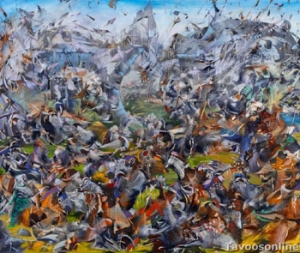
دورویی و دمکراسی، روغن روی پارچه، 1390
بنیصدر بیشتر کارهایش را با نبودِ یک مرکز به نگاره درمیآورد. شخصیتهای پراکنده و پخشوپلا که نقاشیهای اندازهی بزرگش را زنده میکنند پیوسته پایههای ضرورتِ وجودِ کانون را سست میکنند. برای او دیدن و ندیدن هم با جنبش و هم با خیالپردازیهای ذهن پیوند دارد. در خیالپردازی او همه چیز همواره در جریان است و برای همین نگارههای برآمده از آنها بر پایهی پارههایی شکل میگیرند که از جاهای متفاوت میآیند و با هم تا آنجا درهمآمیخته میشوند که دورگههایی دائرهالمعارفی به وجود آوردند. برخلاف بسیاری از همروزگارانش که از قراردادهای سنتی نقاشی باخترزمین پیروی میکنند، بنیصدر انگارهی لزوم کانون در نقاشی را رد میکند. میخواهد کل نقاشی کانون باشد؛ “تمام بخشها باید مهم باشد.” از این گذشته میخواهد عناصر غیرایستا مانند صدا را بگیرد و آنچه را که خود تراوش آن را از مناظرش میشنود به چیزی دیدنی تبدیل کند. اغلب این عناصر در قالب اندامهایی شبحمانند پدیدار میشوند… او هشیاری تیزی نسبت به نقش نادیدنی دارد.
بنیصدر با حالتی فیزیکی احساسی با رنگ برخورد میکند؛ بافتهای گزافهآمیز و رنگمایههای زندهاش از لحاظ دیدنی به تجربهی چشایی، بویایی و به ویژه میدانهای آوایی ضربآهنگی گوشخراش برگردانده میشوند. به گمان او مقایسهاش با بوش بیشتر به آنچه که بوش در زمانهی خودش با آن سروکار داشت بازمیگردد. به گفتهای دیگر میتوانید ارزش جهانی کار بوش را ببینید و پی ببرید که پیام کار به این روزگار هم ربط دارد. بنیصدر دوست دارد کارش به همین سان کار کند.
Banisadr handles paint with a sentient physicality; his extravagant textures and vibrant tones visually translate the experience of taste, smell and especially sonic fields of cacophonous rhythm. He thinks the comparison with Bosch is more about what Bosch was dealing with in his time. In other words, you can see the universal value in Bosch’s work, and you can still find the work’s message relevant today. Banisadr wants his work to function in a similar way.
Ali Banisadr sees the narrative in his work as something developed out of painting. When he starts a dialogue with the painting, the figures begin to create a story of their own — they begin to speak to each other. His figures are archetypes; each represents many different things: a combination of personal history, art history and the history of our century. Banisadr likes when one thing can represent many things at once. Also, the narrative requires that the viewer participate in completing the story. The painting establishes a fifty/fifty relationship, asking viewers to use their own imagination to make sense of it, not unlike a Rorschach test.
Banisadr’s works are influenced by his experiences as a refugee from the Iran-Iraq war, and his approach to abstraction evokes displacement, memory, nostalgia and violence. His fantastical
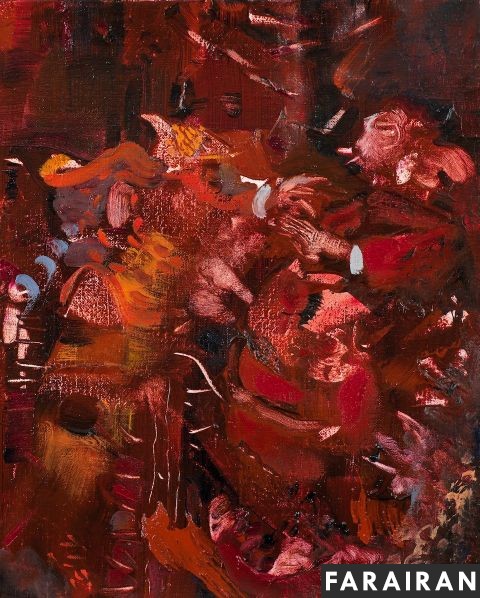
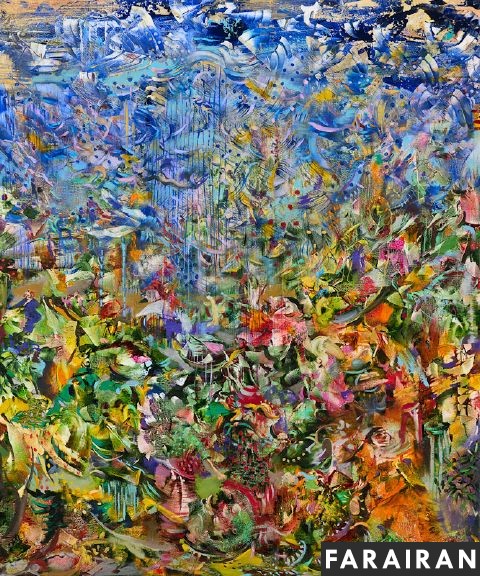
landscapes, rich in aromatic colors, convey a fairytale orientalism that is both majestic and medieval. The use of color comes in a very intuitive way, driven by the mood of the day and the organic preponderance of one color over another. While working on a painting where blue is predominant, he might imagine the next one to be black, and so on. Amid his lush surfaces, splendor gives way to embellished anarchy and carnage as onslaughts of painterly gestures replicate the chaos of an attack. The fractured background, reminiscent of stained glass, is inspired by his recollection of the sound of shattering windows during bombings. This synesthetic connection between auditory memory and visualization is consistent throughout his work.
Ali Banisadr pushes the boundaries of what we understand as painting. His work is not merely poetic; it is, indeed, pure poetry.
The work always requires a 50/50 participation with the viewer as they need to complete their half by filling in the spaces that I have left for them to complete.
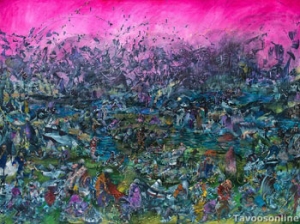
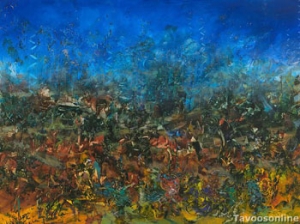
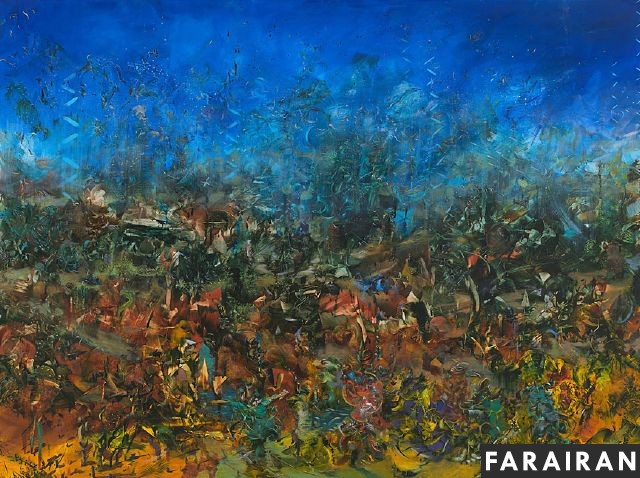
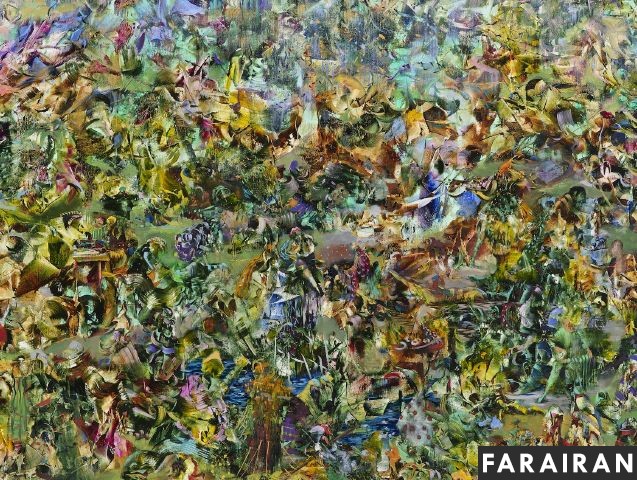
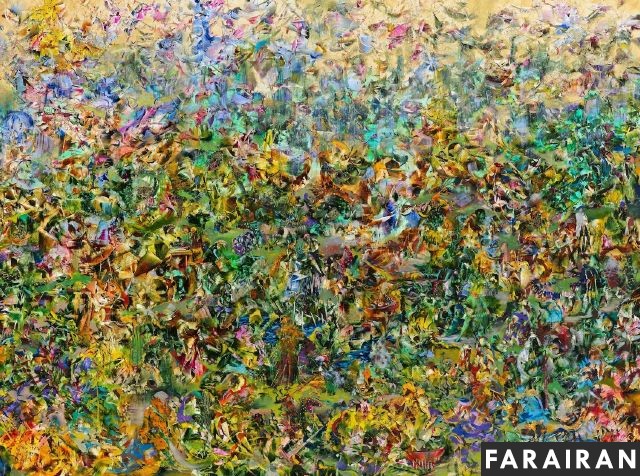
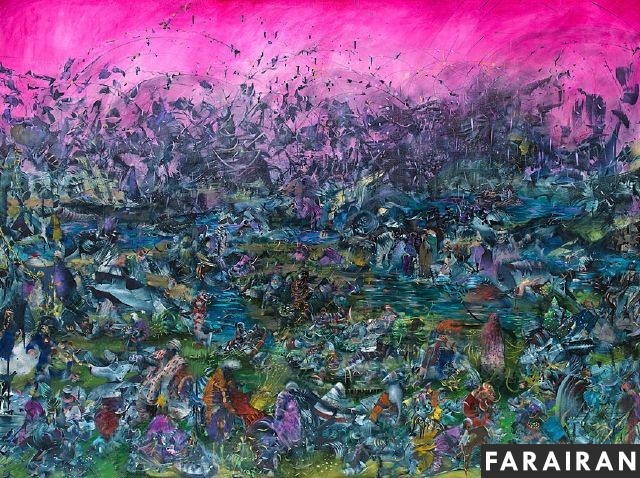
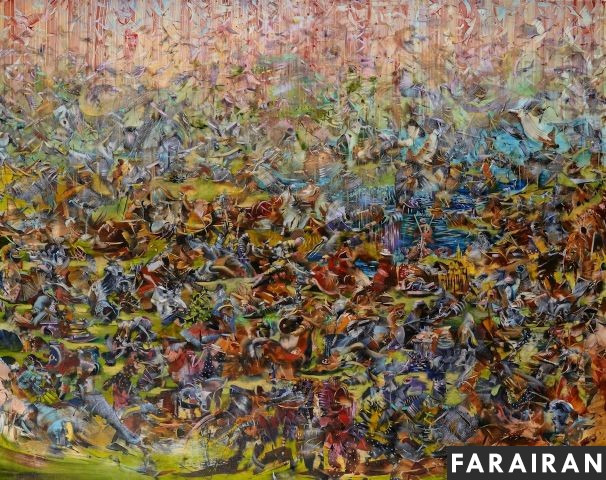
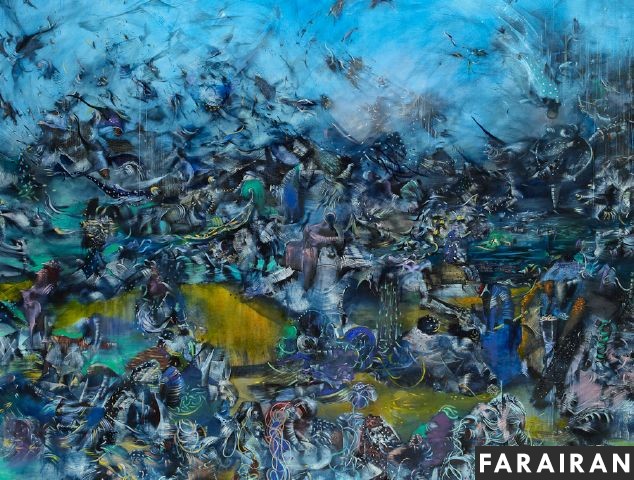
Movement is the key. Using writhing calligraphic marks and squiggles, blobs and veils of paint, Banisadr is devising landscapes that are also mindscapes-trippy, visceral and cerebral-with intimations of war and turmoil but also of pure pleasure. Predominantly bluish-green, the paintings are each separated into “land” and “sky,” often with flecks and spatters of orange, green and yellow blurring the boundary between the two. Some have a gorgeous misty veil of silvery vertical strokes raining down from the top of the canvas, reinforcing the ambience of a verdant Shangri-La. The Marvels of the East (2011) stands out simply for its hot-pink sky across which flecks of black suggest either confetti or barbed wire. The cobalt blue sky of Nowhere (2010) is punctuated by what look like lingering spirals of battle smoke, and its ground appears strewn with debris. Interrogation (2010) has a similar ashy gray atmosphere of pessimism and despair. It is one of his apocalyptic paintings, in which meticulously rendered figures and monumental expanses reminiscent of Hieronymus Bosch are combined with abstract brushwork and gestural compositions. These paintings demonstrate the dichotomy in Banisadr’s work: that of a joyful celebration juxtaposed against a war-torn world.
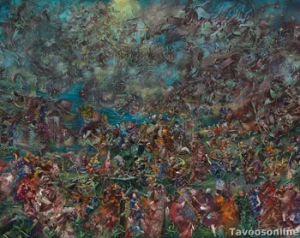
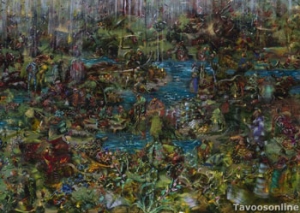
After his first solo exhibition “Unveiled” held at Saatchi Gallery in 2009, his second exhibition “It Happened and It Never Did” suggests a sort of political machination that merges fact and fiction. With their amassing of so many small marks and strokes in a palette variously fiery or verdant, his paintings are riotous and chaotic, creating scenes of what could be either paradise or a battlefield.
“I don’t make things that have names,” he told Jonathan Beer on the Art-Rated blog recently. “I don’t make identifiable things—like here’s a tree or a rock or a car, I just don’t make things that way. The painting doesn’t communicate to me that way, because its paint. As paint, it’s telling me different things and those things are unnamed things.”
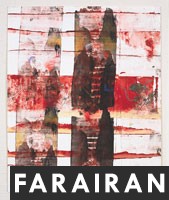
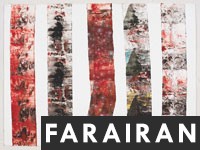
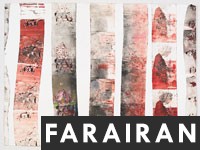
In regard to his monoprints he says, he managed “to create a different kind of space; on each piece of paper there would be about 4-5 different rolls of prints and each had a different set of images. I wanted it to have a feeling as if you were an investigator looking for some kind of clue — that is why the title of the show was called “Evidence.” With the monoprints, I had this idea of making work that mimics a film negative. I wanted it to have a forensic quality to it as if you were looking at these for some kind of evidences.”
Ranked #1 in Flash Art’s Top 100 Artists of 2011Banisadr belongs to a generation of contemporary painters who are rethinking the connection between abstraction and figuration. He creates his own narratives with fragments of abstraction. In the end he rejuvenates the genre of history painting by resorting to abstraction and updates abstraction by infusing it with current events.
“It has taken me 36 years to get to where I am now and, when you are looking up to artists like Goya, Michelangelo, Velazquez and Bosch, for example, you realize that you have a long way to go and may never even reach close to what these artists reached in their time. Painting is a slow process; it takes time to get there, you learn little by little and always want the next painting to be better than the last. For me, success is about this, seeing the slow progress in my work.”
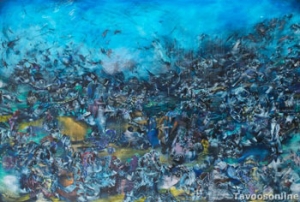
We haven’t Landed Yet, Oil on Linen, 2012
Sources:
Nicola Trezzi, “Ali Banisadr”, Flash Art International Magazine (July/August/September 2012)
Julie Chae, “Conversation with Ali Banisadr”, The Huffington Post (September, 4, 2012)
Shirine Saad, “Impulse to Paint”, Aishti Magazine (April/May 2012)
Fereshteh Daftari, Ali Banisadr Voices of Evil, A Common World Order, Galerie Thaddaeus Ropac
-
- 2007, Things Fall Apart,Oil on Linen, 44 x 50 inches
-
- 2008, Amen,Oil on Linen, 49 x 66 inches
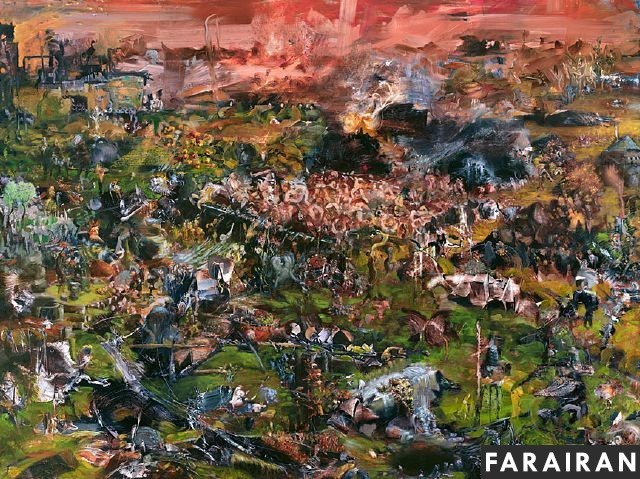
-
- 2008, In the Name of ,Oil on Linen, 54 x 72 inches
-
- 2008, Prisoners of the Sun (T.V.) ,Oil on Linen, 54 x 72 inches
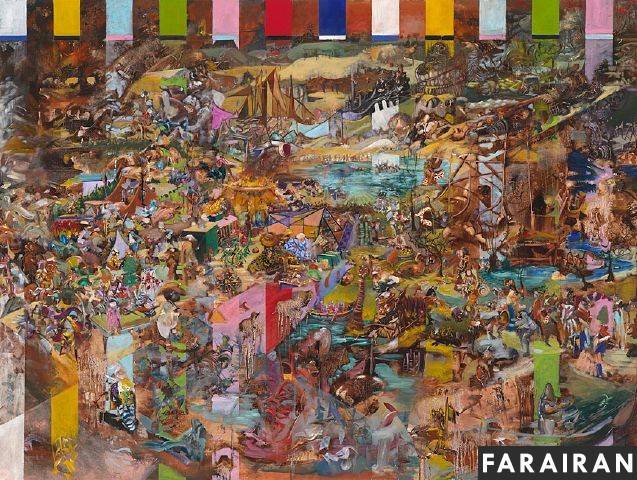
-
- 2008, The Hashashins ,Oil on Linen, 36 x 48 inches
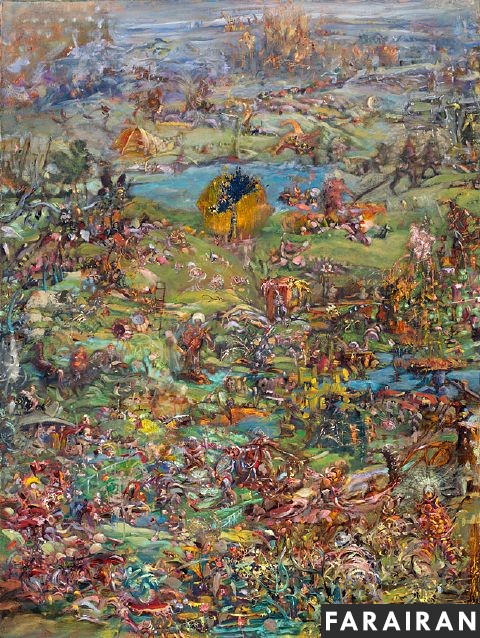
-
- 2009, Fishing for Souls ,Oil on Linen, 30 x 36 inches
-
- 2009, The Charlatans ,Oil on Linen, 54 x 72 inches
-
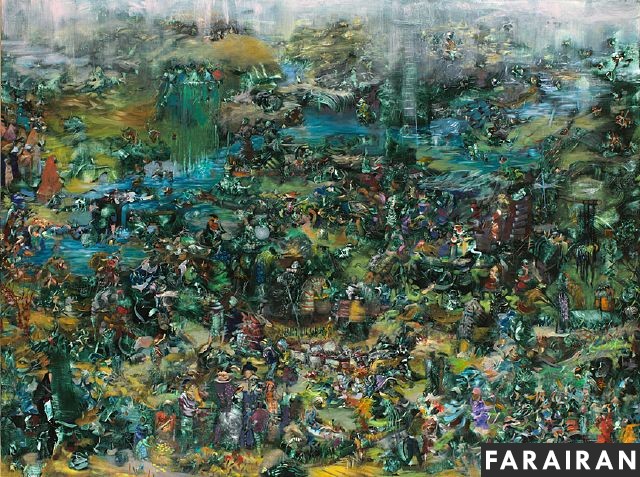
- 2009, The Gatekeepers ,Oil on Linen, 72 x 108 inches
-
- Ali-111109 012
-
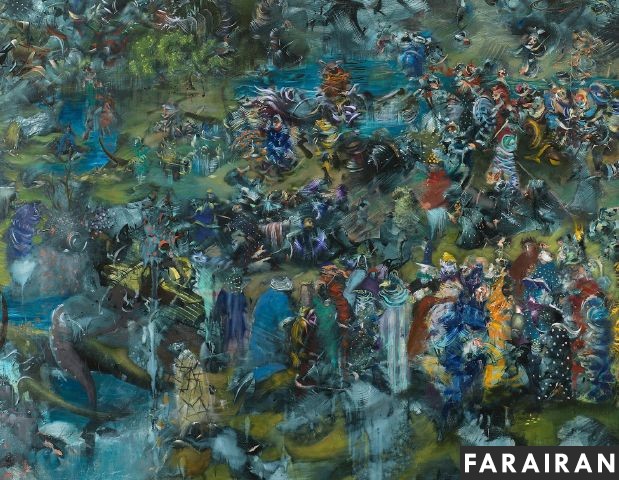
- 2009, The Magians (Detail) ,Oil on Linen, 72×108 inches
-
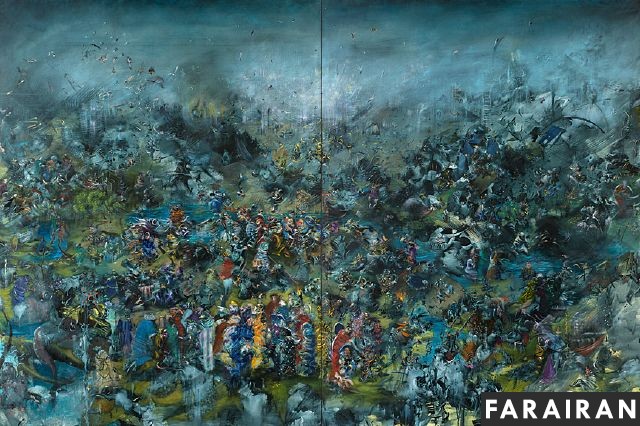
- 2009, The Magians ,Oil on Linen, 72 x 108 inches
-
- Ali-111109 006
-
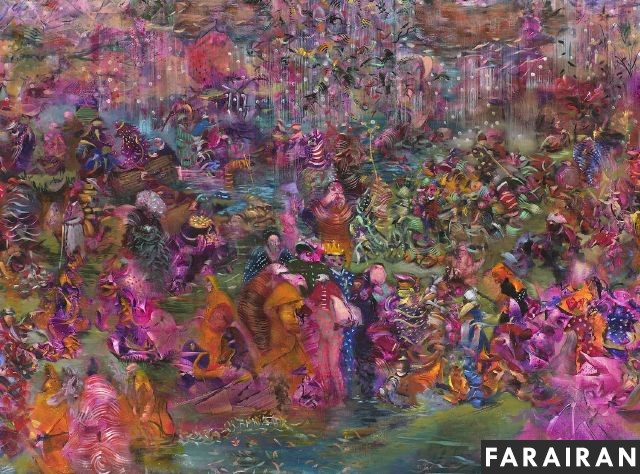
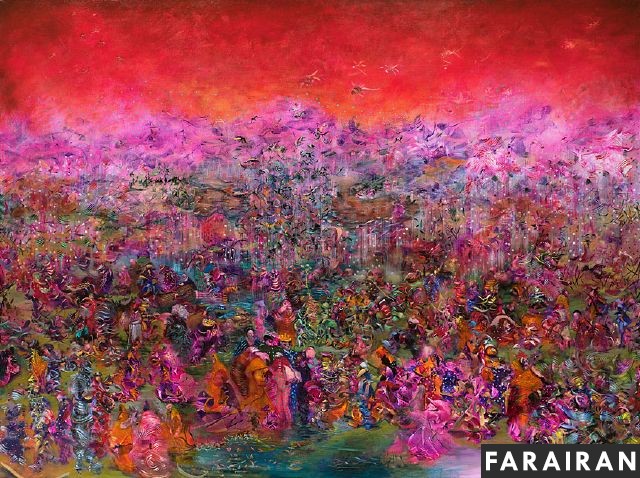
- 2009, The Merchants ,Oil on Linen, 60 x 80 inches
-
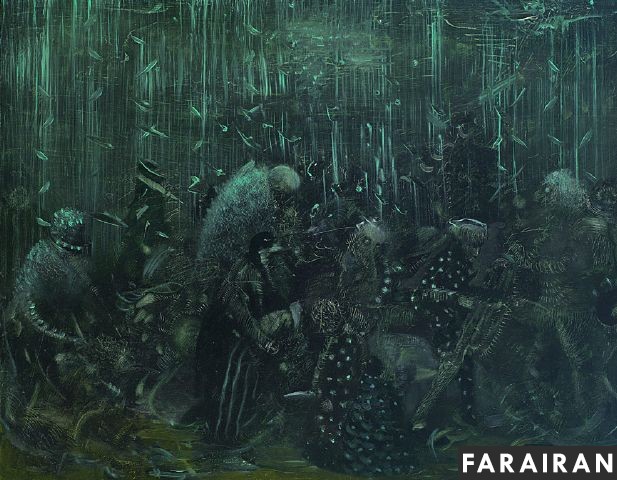
- 2010, Blackwater ,Oil on Panel, 11 x 14 inches
-
- 2010, Follow Follow,Oil on Linen, 8 x 10 inches
-
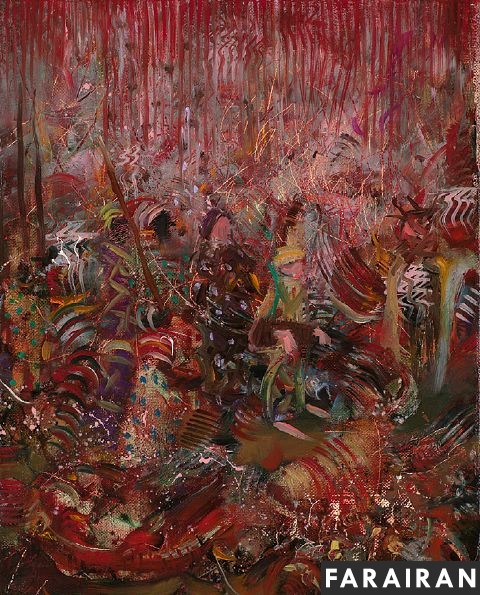
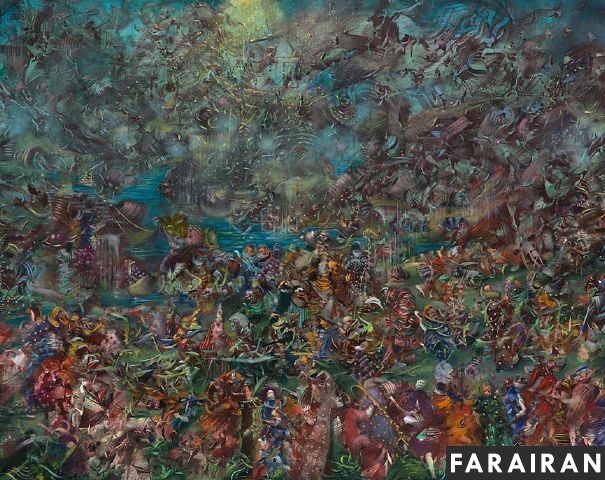
- 2010, Interrogation ,Oil on Linen, 48 x 60 inches
-
- 2010, Nowhere ,Oil on Linen, 66 x 88 inches
-
- 2010, Obstruction,Oil on Linen, 36 x 30 inches
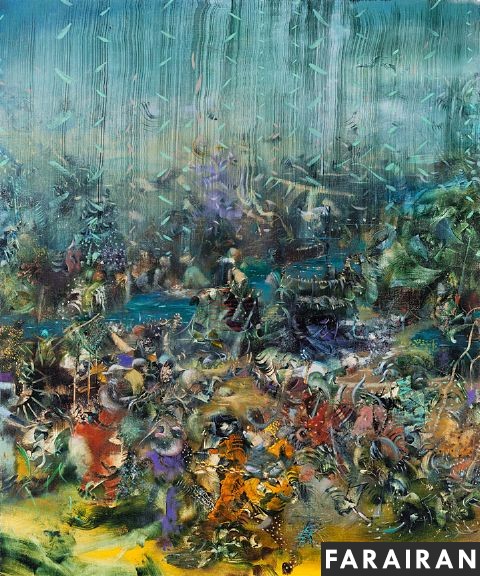
-
- 2010, Telluric Current,Oil on Linen, 54 x 72 inches
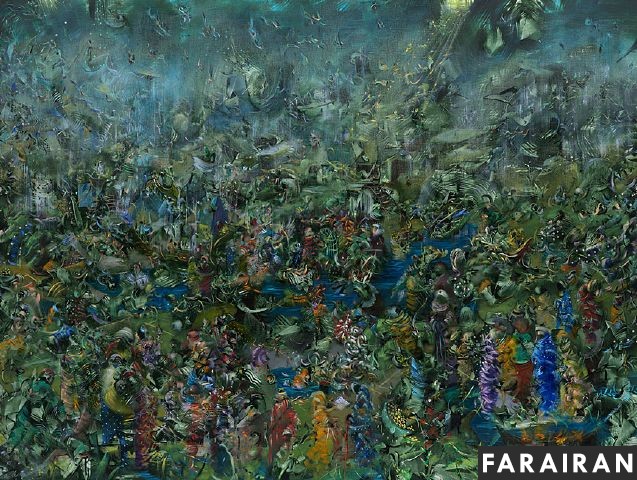
-
- Banisadr-072210 014
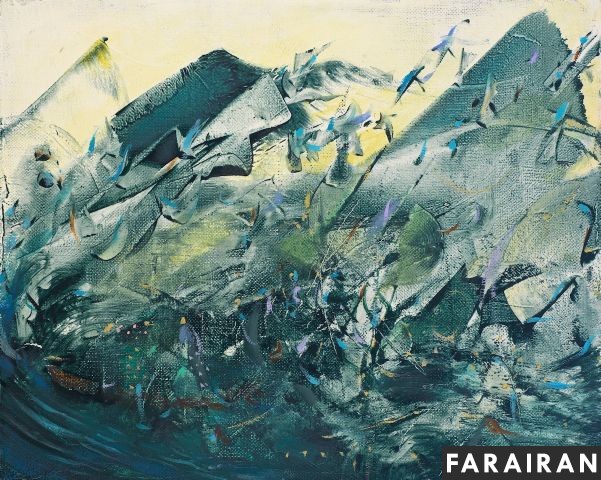
-
- AliBanisdr-112911 012
-
- 2011, Canto 28 ,Oil on Linen, 36 x 30 inches
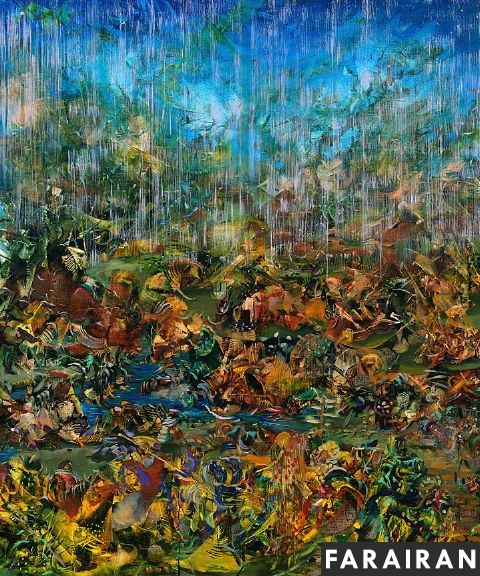
-
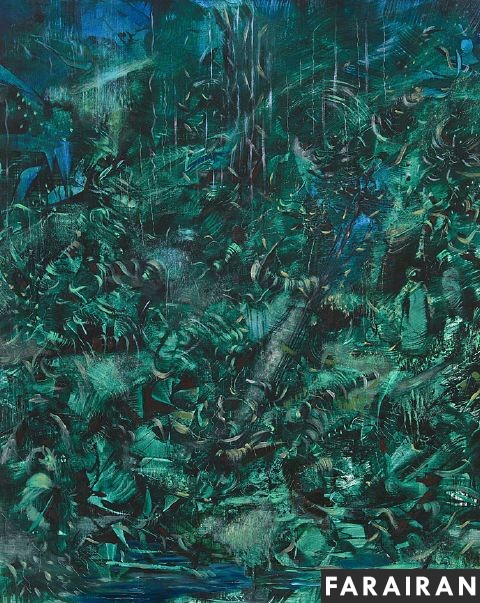
- 2011, In Search of ,Oil on Panel, 20 x 16 inches
-
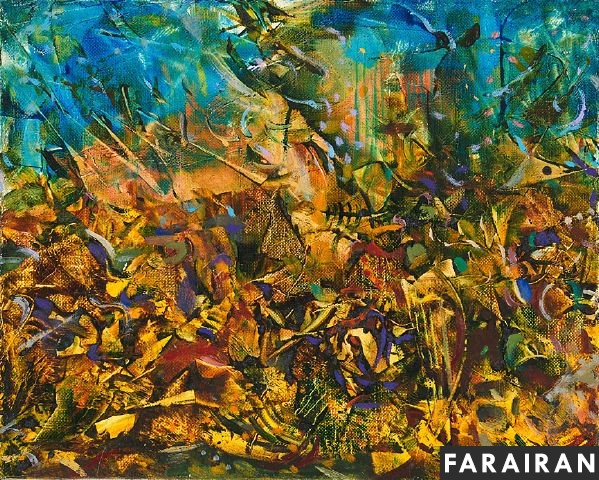
- 2011, It Happened 2 , Oil on Linen, 8 x 10 inches
-
- AliBanisadr-021811 016
-
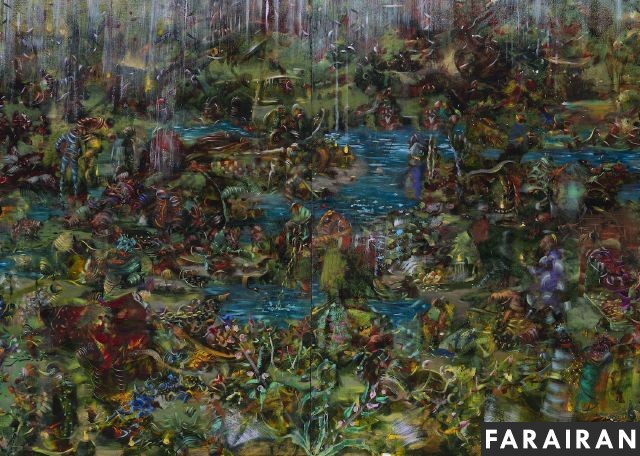
- 2011, It Happened and It Never Did ,Oil on Linen, 72 x 108 inches
-
- AliBanisdr-112911 005
-
- AliBanisdr-112911 001
-
- AliBanisdr-112911 001
-
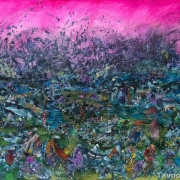
- 2011, The Marvels of the East ,Oil on Linen, 72 x 96 inches
-
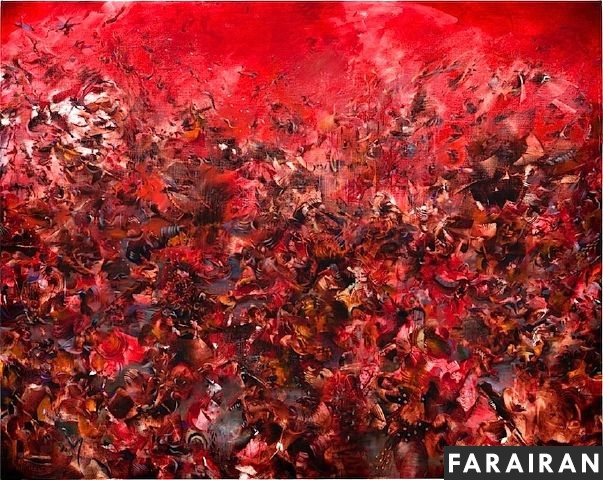
- 2011, Time for Outrage ,OIL ON LINEN, 48×60 INCHES
-
- 2012, Hypocrisy of Democracy, Oil on Linen, 30×36 incehs
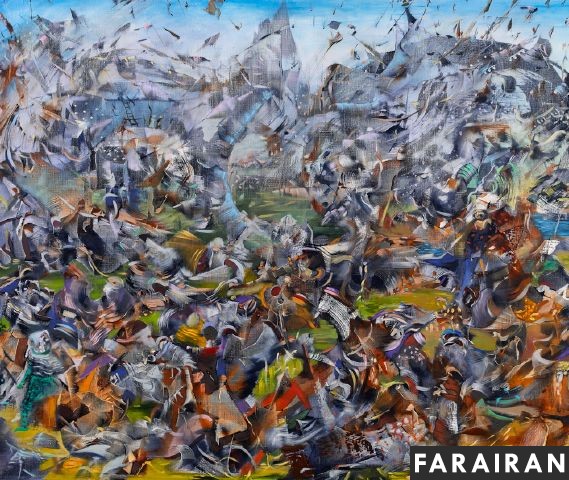
-
- 2012, It’s in the Air (Detail), Oil on Linen, 82×120 inches
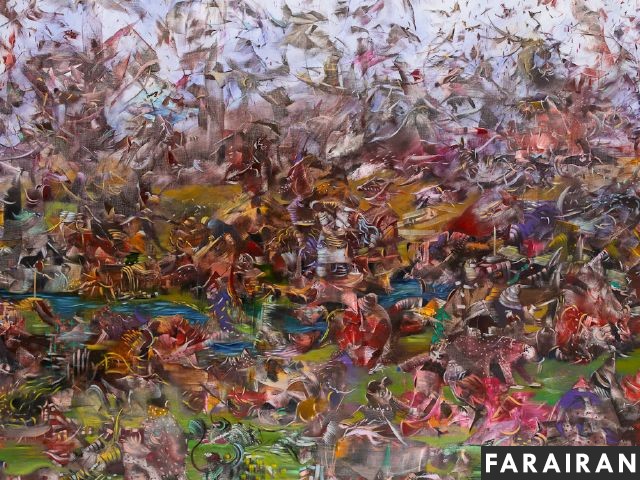
-
- 2012, It’s in the Air, Oil on Linen, 82×120 inches
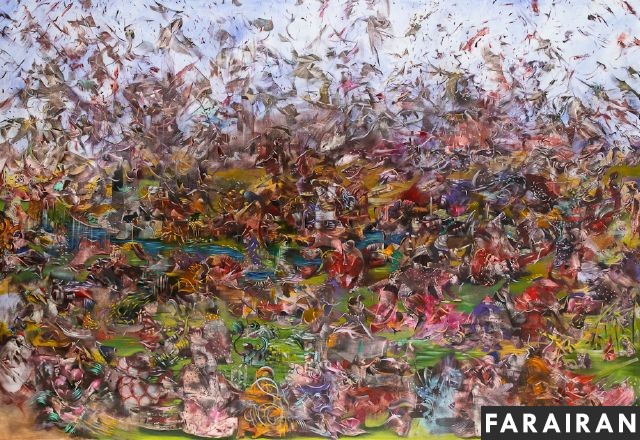
-
- AlexGray-022412 008
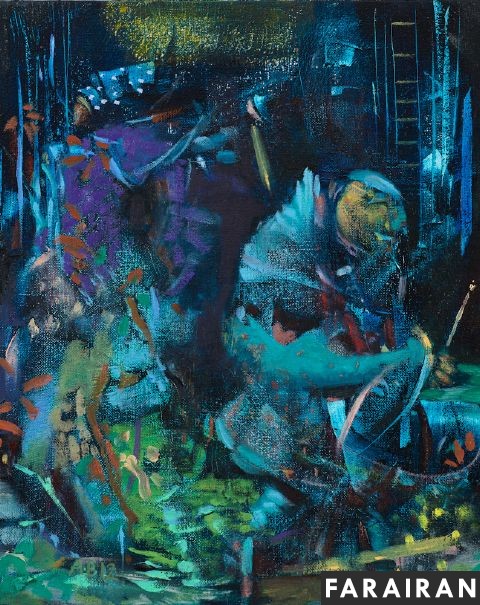
-
- 2012, It’s in the Air, Oil on Linen, 82×120 inches
-
- 2012, We Haven’t Landed on Earth yet (Detail),Oil on Linen, 82×120 inches
-
- AliBanisadr-022812 0002
-
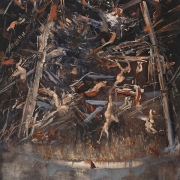
- 2007, Black,Oil on Linen, 24 x 28 inches