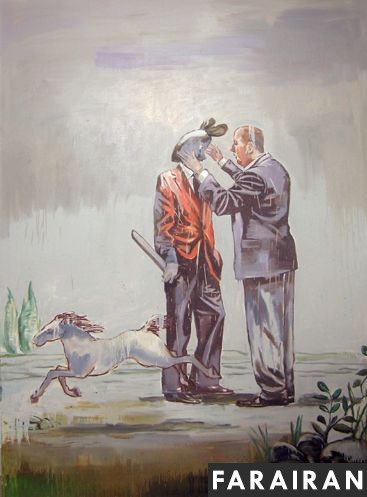
Farairan’ Choice Nicky Nodjoumi
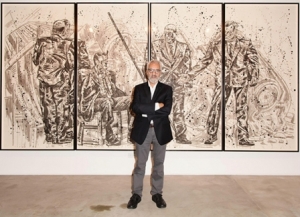
On the occasion of the “Chasing the Butterfly and Other Recent Paintings” exhibition by the celebrated Iranian artist, Nicky Nodjoumi at Teymour Grahne Gallery in TriBeCa, 7 September – 19 October 2013 and the article printed in “New York Times” about his work and artistic life:
“The new Taymour Grahne Gallery in TriBeCa couldn`t wish for a more auspicious kickoff than its excellent inaugural show of new paintings and drawings by Nicky Nodjoumi. Born in Kermanshah, Iran in 1942, Mr. Nodjoumi arrived in New York City in the late 1960`s, when he became involved in protest movements against the Pahlavi regime in his home country. The political thrust of his early work was acute, as is evident in a pair of bruise-dark 1976 pictures in “Iran Modern” at Asia Society. This is emergency art; the sound of alarms still surrounds it.
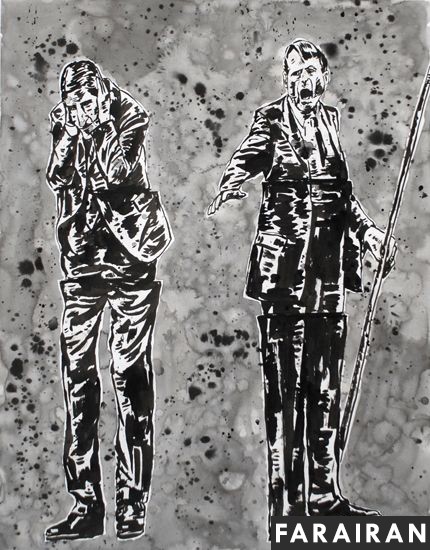
The new paintings at Taymour Grahne are political too, but the tone is different. Visually the work is light, even airy, and filled with absurdist, mocking incident. Men in suits share space with horses, apes and apparitional figures from classical Persian painting. Almost nothing feels grounded or organic: figures are composed of mismatched legs, torsos and heads, and seem unbound by perspective or gravity. Only in a series of magisterial black-and-white ink drawings does the mood tense up. In a 2012 piece called “Invasion”, figures fall as if under attack; a blindfolded man lies flat on the ground. In “The Accident”, from 2013, an interrogation is in progress against a wall of wreckage, and the drawing`s surface is sprayed with ink drops as if with bullet holes.
The artist offers fascinating insights into his working method in several small studies for paintings, made up of elements cut from newspaper clips and collaged in ways that throw off logic of placement and scale but suggest an insistently, if unlocatably, topical content. Mr. Nodjoumi who has lived in New York City many years, is a treasure, and he`s never looked better.”
Holland Cotter,
New York Times, October 18, 2013
If we take mythology as the science of gods and supernatural powers, then it will not be too wild to describe Nodjoumi as the painter of contemporarized mythology, painting surreal narratives of gods and supernatural powers in the figure of captains of politics, industry and finance, mainly based on their photographs newspapers and magazines. In other words, his paintings can be described as absurd allegories of power or allegories of absurdity of power.The source and inspiration of his style going back to when on the proposal of Firouz Shirvanloo, the former director of Niavran Cultural Center, he studied Mani, the Iranian painter-prophet before the advent o Islam.
The result was 270 paintings, which in his own words, changed the course of his artwork. Years later a selection of these Manichaean paintings carried out mainly in the traditional Iranian painting –negargari- was exhibited at Arya Gallery (1993), his sole exhibition in Iran after the revolution, disregarding the retrospective of his works called Reort on revolution held only for a few days at Tehran Museum of Contemporary Arts upon its re-opening after the revolution in 1979, bringing about his forced move back to New York.
After graduating in Fine Arts from Tehran University (1967) and working for Kanoon, Institute for Intellectual Development of Children and young Adults, Nodjoumi went to New York, where he finished a course in Animation from the New York school of Visual Arts (1972) and his master degree in Fine Arts from City College of New York (1974).
He landed in New York at the height of anti-Vietnam war protests and it was there-then when he found his political voice by joining the Confederation of Iranian Students. “The freedom of expression I witnessed in New York had such a profound effect on me that I albeit temporarily, felt that art was not an effective instrument of change.” This active political life, though led to being summoned by Shah’s secret police on his return to Iran in 1975, three months of repeated interrogations and his final deprivation of his dream of teaching at Tehran University, but being allowed to have annual exhibition of his artwork. So when he returns to Iran for his annual show at Shahr gallery in 1978, the revolution was already on the way and surely the politically oriented Nodjoumi joins it with the above-mentioned outcome of forced immigration a year later.
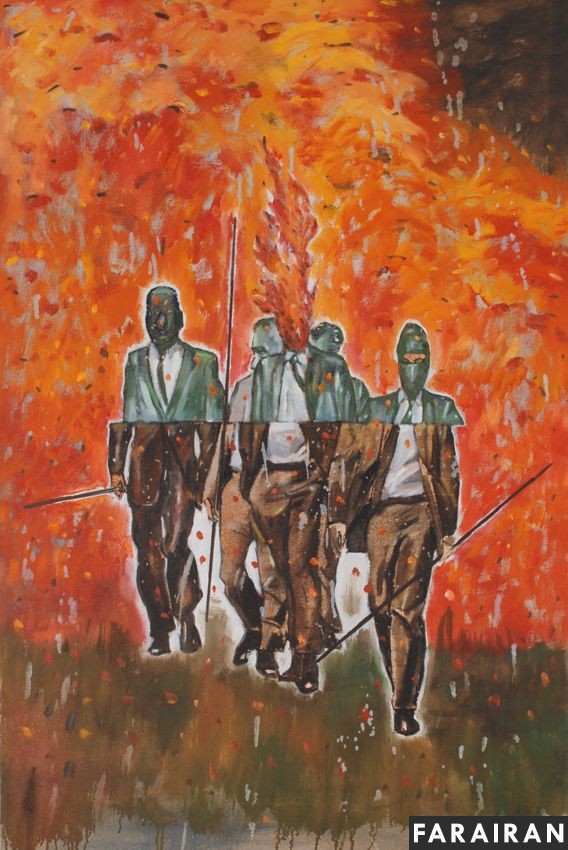
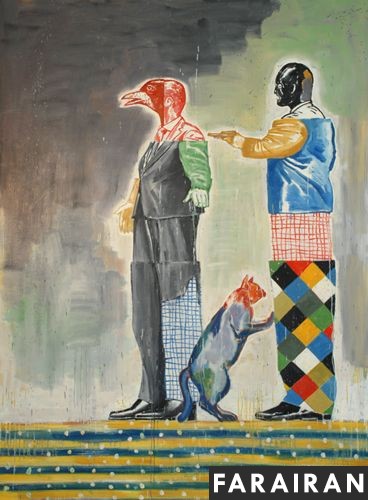
Nodjoumi’s experience in illustration and design gathered while working for Kanoon are evident in his paintings with his figured depicted in sketchy, monochromatic strokes in stark contrast with his otherwise vivid palette. The hierarchical arrangement of his life-size figures gives his paintings the communicative clarity of successful agitprop. He often slices his compositions and figures horizontally, fracturing and refracting he picture planes to create two adjacent, related but distinct realities which are distinguished by a slight misalignment or the use of different colour or pattern. In this way he recreates the collage process to plan his compositions and subtly registers displacement and difference. The technique also dismembers the body, producing amputated limbs and disintegrating bodies, playfully depicted in colorful dots, to imply violence without actually representing it. On the other hand, images of these amputated legs placed asymmetrically over one another evoke the shifting fortunes in an unstable social order; there is nourishment an rebirth.
The subject matter in my paintings mostly deals with power structures and power struggles in intentionally nondescript situations. I challenge the inherent limitations of the multilayered content of my works by crossing cultural and sociopolitical boundaries. Each painting acts as a singular critique of society in general without being specifically political.
Power-possessors are seen conversing in groups, observing what they consider transgressions performed by individual or by the populace at large. Such transgressions involved the most innocuous actions, as a man and a woman holding hands in public. His works articulate outrage at the ignorance and prejudice of those who maintain this pervasive control of individual and group behavior. Beneath the painted ground structure, various figures appear; repetitions of ape heads, upside down feet and legs and chair lying sideways. These chaotic underpinnings stress the repressed animal instincts and unconscious confusion the drive insecure authority figures toward sexual and social repression. It is all about their fear of losing control. Ultimately, the artist speaks out against a totalitarian climate that crushes natural human instincts and desires. As such his work comes across as a call for individual freedom and reason.
My paintings present theatrical stages with scenes played out in which costumed characters, animals and props engage in an ongoing dialogue. Animals appear throughout the works as both gestural metaphors and/or ambiguous aggressors or victims. I use them in a mythological sense as representations of the emotions that are associated with cruelty, innocence and at times despotism. Referring to animals helps me to maintain the unity of thinking and feeling. They collectively, with the other props, add to the spiritual and psychological dimension of my paintings.
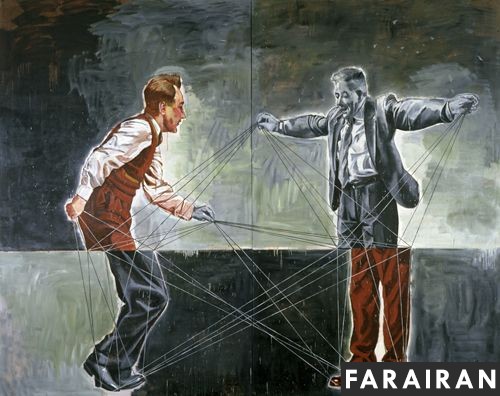
In fact, his men in suits represent universal signifiers for political and corporate functionaries. He makes absurd scenarios for these global power players, sometimes infantilizing them, sometimes presenting them as overgrown boys fighting and playing games, with the use of webs and strings pointing to their invisible puppet masters, if not the gymnastic of political or corporate negotiations. In the same way that scissors and wire cutters allude to torture, forced abortions and other similar ignominies.
Throughout my work, uniforms of Western business suits and Iranian clerical garments portray the authority of a male-dominated world. The discourse of these elements integrates humor that operates to humiliate political leaders and their violence, while pointing out immanent weaknesses of the human condition. I employ lines of divisions in my compositions as well as visible cuts across the figures and their surrounding environments to reflect not only oppression, but a sense of dislocation. Furthermore, I reference eroticism to investigate the prevailing hypocrisy and duplicity in patriarchal societies, especially those of the Middle East.
In the process, this simultaneously seductive and subversive visual vocabulary works to create a cohesive and dramatic narrative. These representations, set against a continuous backdrop of ambiguity, allegory and irony, suggest an extremely delicate balance between the personal and the universal.
Though a resolutely political painter, Nodjoumi steers clear of representing politics. Instead his scenarios dramatizes the invisible relationships, connections and behaviors through which power is expressed, maintained and circulated. He reveals the mechantions of politics for what they truly are, games played by the powerful, often without a clear sense of the real consequences of their actions.
In general as Mary c says: Nodjoumi’s Iranian background combined with American influences allows for unique perspective in his work, an ironic metaphoric world view. His large scale oil paintings employ visual conceptual puzzles to express obliquely outrage at life’s modus unfortunate operandi. He communicates this outrage metaphorically to the viewer, who is challenged to analyze his heretic works to discover clues to their alarming implications. The beauty and perversity of the images add allure to the challenging iconography: They take the edge off the unknowable.
but a sense of dislocation. Furthermore, I reference eroticism to investigate the prevailing hypocrisy and duplicity in patriarchal societies, especially those of the Middle East.
In the process, this simultaneously seductive and subversive visual vocabulary works to create a cohesive and dramatic narrative. These representations, set against a continuous backdrop of ambiguity, allegory and irony, suggest an extremely delicate balance between the personal and the universal.
Nicky Nodjoumi has exhibited internationally and is in several prominent collections worldwide, including the Metropolitan Museum of Art in New York, the British Museum in London, the Salsali Private Museum in Dubai, and the National Museum of Cuba. His work will be featured in the exhibition Iran Modern, opening at the Asia Society in New York in September 2013, in conjunction with his solo exhibition at Taymour Grahne Gallery. The artist lives and works in Brooklyn.
Horne, Sarah. “Politically Charged”, Canvas Magazine, Vol. 5 Issue 3, May / June, 2009, 84-95
Vali, Murtaza. “Nicky Nodjoumi: Educating the Horse”, Bidoun, Spring 2011
Horne, Sarah. “Politically Charged”, Canvas Magazine, Vol. 5 Issue 3, May / June, 2009, 84-95
-
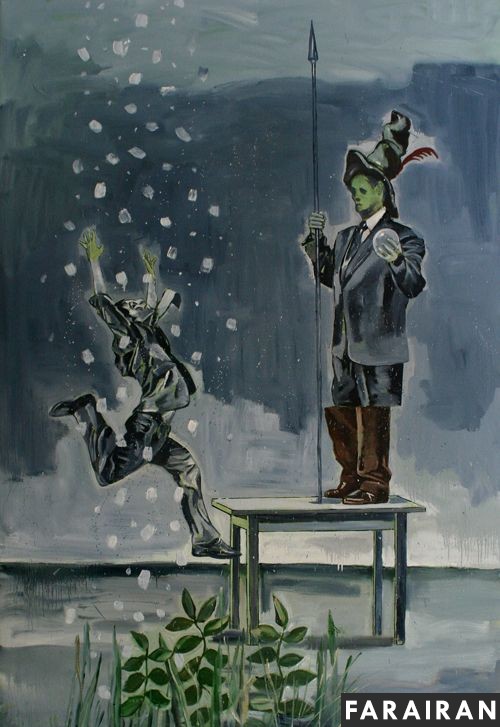
- 2006- The Dancing Man- Oil on canvas- 183×127 cm
-
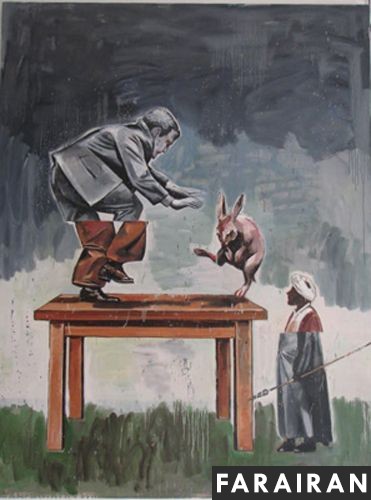
- 2007- Dancing Rabbit- Oil on canvas- 173×132 cm
-
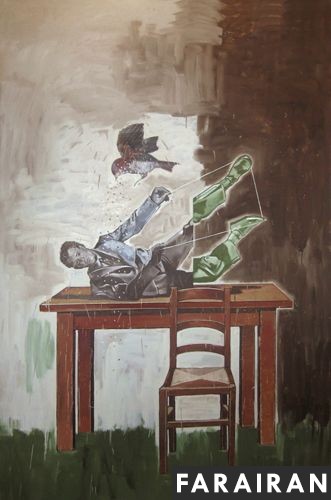
- 2007- Tje Last Dance- (In Memory of Hassan)- Oil on Canvas- 244×152.5 cm
-
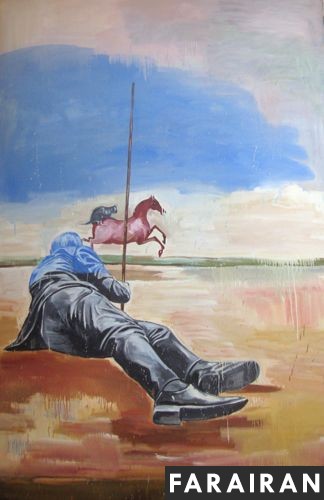
- 2007- Watching the Divine Horse- Oil on canvas- 183×127 cm
-
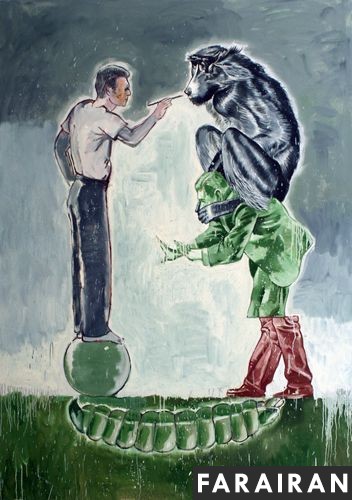
- 2008- At 3 Afternoon- Oil on canvas- 180×127 cm
-
- 2008- Push and pull- Oil on canvas- 244×305 cm
-
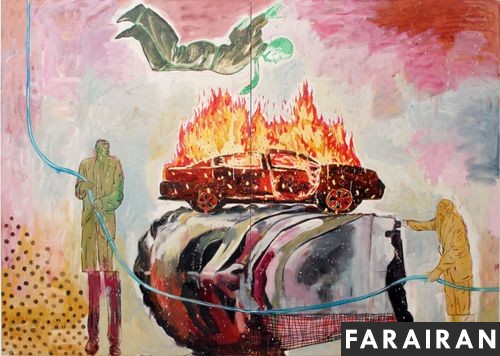
- 2009- Invitation to Change Your Metaphor- Oil on canvas- 183×254 cm
-
- 2009- Mid-Autumn Leak- Oil on Canvas- 91×61 cm
-
- 2010- Front Man- Oil on canvas- 183×132 cm
-
- 2010- Untitled- Ink and gouache on paper- 72x 57 cm
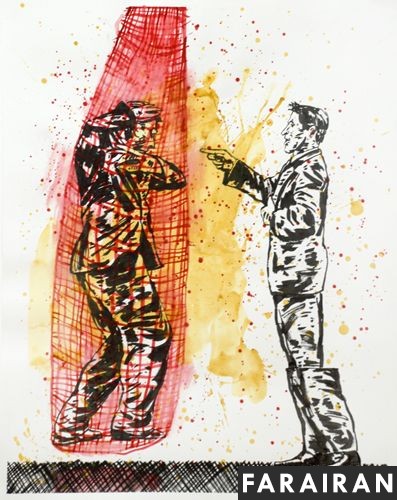
-
- 2010- Untitled- Ink and gouache on paper- 72×57 cm
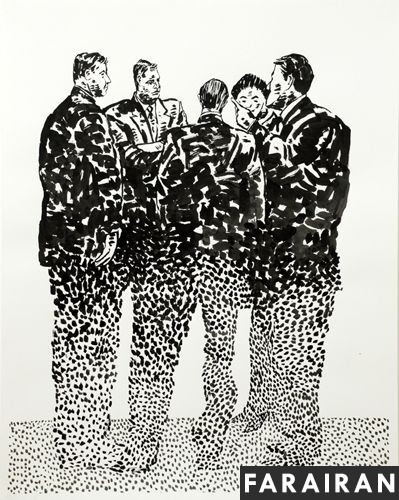
-
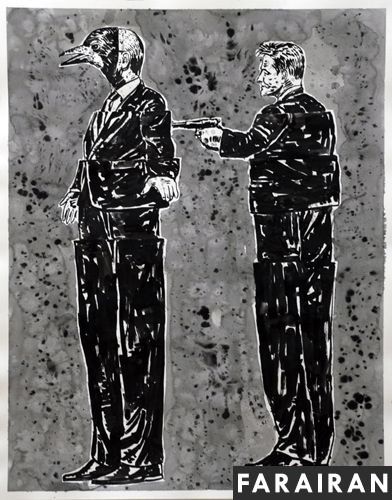
- 2010- Untitled- Ink and wash on paper – 72x57cm
-
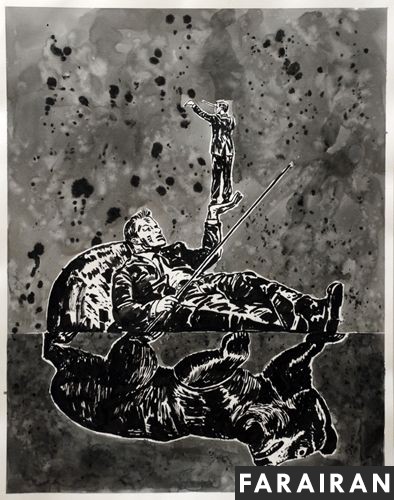
- 2010- Untitled- Ink and Wash on paper- 72×57 cm
-
- 2010- Untitled- ink and wash on paper- 72x57cm
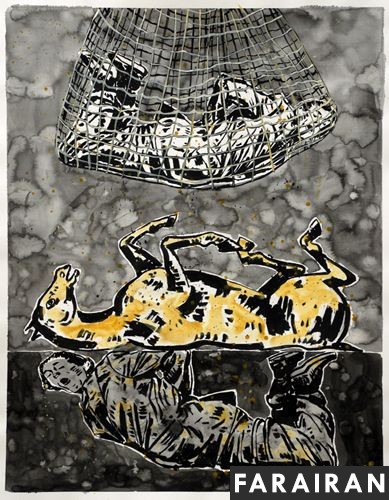
-
- 2010- Untitled- Ink and wash on paper-72×57 cm
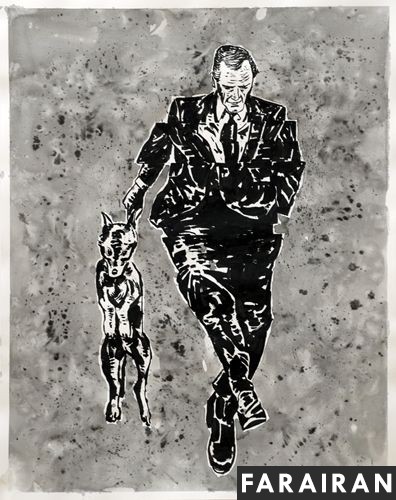
-
- 2010- Untitled- Pencil on paper- 72×57 cm
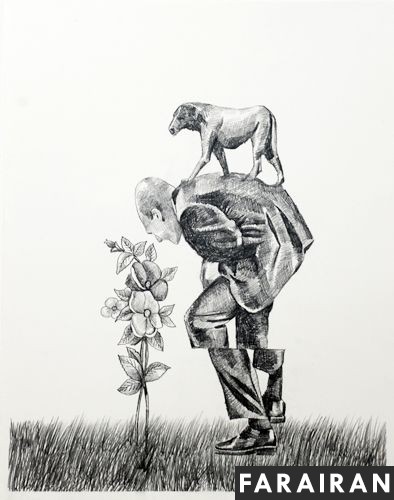
-
- 2010- Untitled- Pencil on paper- 72×57 cm
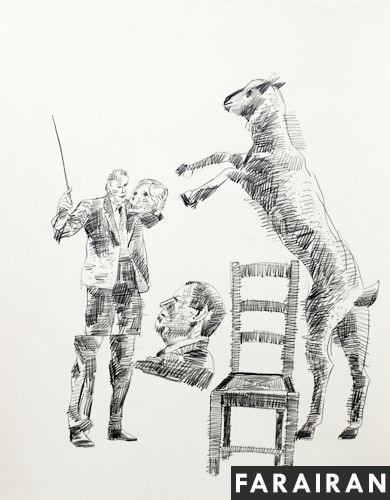
-
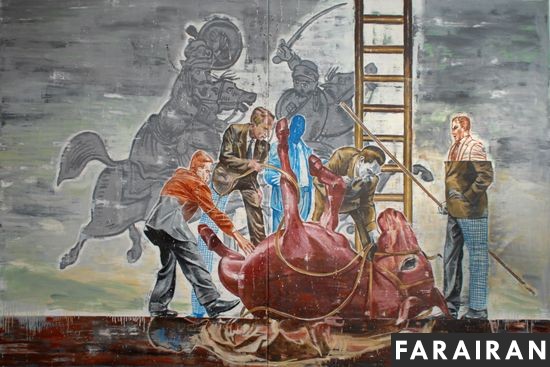
- 2011- Inspector’s Scrutiny, Oil on canvas- 216×330 cm
-
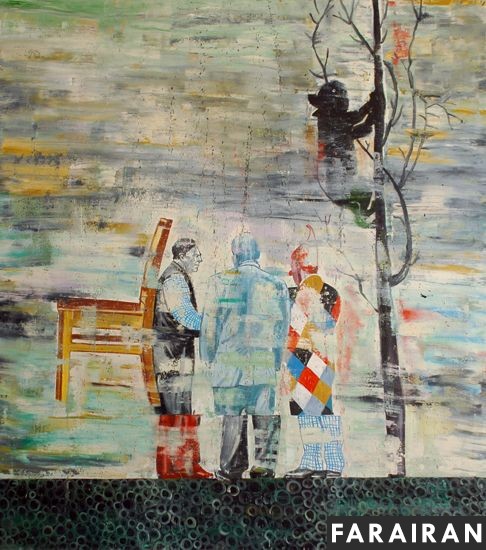
- 2011- Shades of Jubilation, Oil on canvas- 157.5×137.2 cm
-
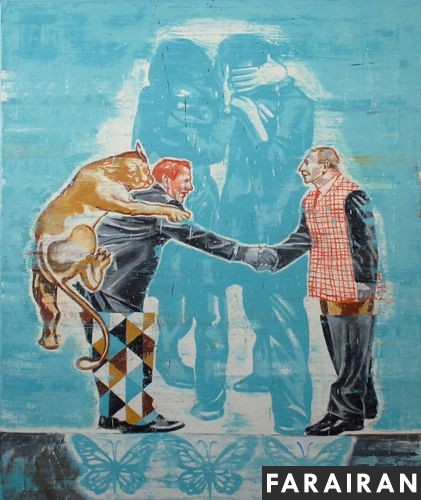
- 2011- Tear Gas and Butterflies- Oil on canvas- 132×112 cm
-
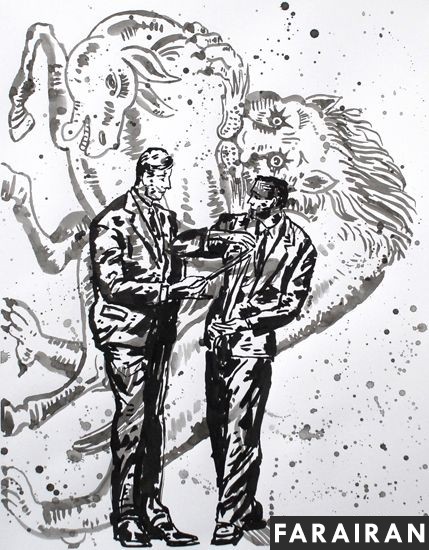
- 2011- Untitled- Ink and wash on paper- 72×57 cm
-
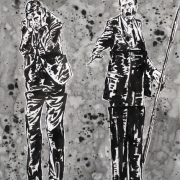
- 2011- Untitled- Ink and wash on paper- 72×57 cm
-
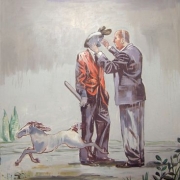
- 2006- Going to the West- Oil on canvas- 183×132 cm