
SPEND, SPEND, SPEND
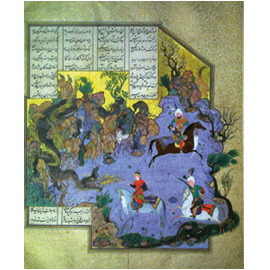
Iillurstrated Page of Shahnameh
source: Canvas,July/Aug. vol.7, issue 4
After a rocky couple of years and several false dawns, the art market seems to be finding its feet again. With records tumbling and a new buzz in the salerooms, James Parry assesses recent auction highlights and finds a celebratory mood.
Earlier this year, one European gallerist groaned, “It’s got to get better, it just has to” when memories of the recession-his market were still painfully raw. A few weeks later, and now it’s smiles all round, with a tangible sense of relief that at long last things seem to be ‘on the move”. Not only that this spring’s round of auctions saw new records set and clearly renewed enthusiasm in sectors of the market that had been struggling.
The Bonham’s Islamic and Indian Art sale in London on 5 April got the season off to a slightly uncertain start with just under 50 per cent of lots sold, but there was one undisputed highlight that turned all heads: a superb life-size painting of the Mughal Emperor Jahangir, dated 1617 and the largest known portrait of its type. The painting was secured by a “Middle Eastern institution” for $2.3 million, at the top end of its estimate. One observer remarked that she was surprised this stunning piece had not fetched more, but given the recent trials and tribulation of the market, this was surely a very positive result.
The following day, 6 April, saw the Sotheby’s Arts of the Islamic World auction, also in London. Auctionistas had been eagerly anticipating this sale, not least because it included a section dedicated to the first of a two-part sale of the collection of Stuart Cary Welch, a former curator at both the Metropolitan Museum of Art and Harvard Art Museum and one of the great American art collectors and connoisseurs of the 20th century. Largely credited with raising the profile of Islamic and Indian art in North America and beyond, Welch died in 2008, having amassed one of the best quality private collections in those fields.
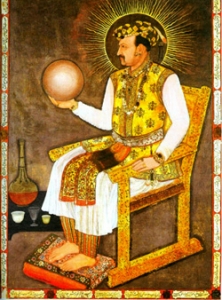
Jahangir, Mughul King
FLYING DRAGON
Pre-sale expectations were therefore high, but few could have forecast the astonishing $12.1 million paid by an anonymous bidder for an illustrated folio from the highly revered Shahnameh (Ferdowsi’s book of Kings) made for Shah Tahmasb of Persian. Described by one London Dealer as “one of the supreme examples of the art of the book”, the folio depicts Fereydun in the Guise of a Dragon Tests His Sons and was made in Tabriz, circa 1525-35. The price smashed the previous record achieved for an Islamic work of art by a huge margin – the record had been held by a 17th-century Kerman ‘vase’ carpet, for which $9.6 million was paid at Christie’s in London in April 2010.
The Fereydun folio – regarded as among the very best folios in one of the finest manuscripts of its type – was wrangled over by seven bidders, both in the saleroom and on the telephone, before the hammer finally came down. Many other lots in the Welch sale also soared way over estimate, a reflection not only of their undisputed quality but also of a renewed sense of confidence among buyers. In total, the collection raised $34.1 million, almost four times its pre-sale estimate. One anonymous dealer, who attended the sale, observed, “this is one of the greatest collections of its type and it would have been a surprise if the pieces hadn’t gone well. But I don’t think any of us really thought they would fly quite like this”.
In the wider Arts of The Islamic World sale, the lots sold reached an impreessive $26.4 million and notably included an outstanding Mamluk armorial candlestick, which went for $7.3 million against an estimate of $4.9 million, and a 12th-13th century carved wooden frieze panel from Spain or Morocco, sold to an anonymous buyer for $1.4 million against an estimate of $490,000.
The head of steam generated by the London salerooms was sustained in Dubai on 19-20 April by Christie’s 10th sale season in the city. No fewer than 42 world auction records were set in the Modern and Contemporary Arab, Iranian and Turkish Art sale, which ran up sales of just under $8 million. A focal point of the auction was a group of six Contemporary Soudi works from Edge of Arabia, which sold for a staggering totalof $1 million against their estimate of $135,000. Abdulnasser Gharem’s seminal The Messafe/Messenger (2010), a three-metre wide wood and copper dome symbolizing the Dome of the Rock in Jerusalem, proved to be the top lot on the day, coming in at $842,500 – a world record for the artist at auction, and dwarfing its presale estimate of $70,000- 100,000. Other notable lost included works by Modern masters Abdul hadi El-Gazzar and Jewad Salim – El Gezzar’s Fishing sold for $746,500 against its estimate of $250,000- 350,000, and an early wood sculpture by Selim achieved $662,000. Both were new records for the artists. Another record was broken when the hammer came down on Ayman Baalbaki’s (Canvas 5.2) Let A Thousand Flowers Bloom, after a fevered bout of eyebrow-raising bidding that saw its price soar to $206,500 against an estimate of $50- 70,000.
Michael Jeha, Managing Director of Christie’s Middle East, admitted that a subtle change of focus appeared to have brought dividends: “We chose a slightly different course… by focusing on stellar Contemporary works as much as on Modern masterpieces”, he explained. “Perhaps the most encouraging sign that this market and the interest in it continues to grow was the many new faces we saw. ‘Indeed, 40 per cent of those packing out the saleroom were new bidders – an encouraging sign for the auction houses and continuing confirmation that the regional collector base is continuing to expand.
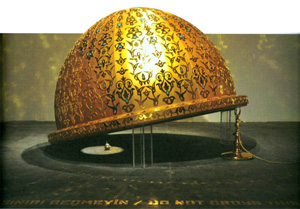
Abdulnasser Gharem/ Message/Messenger
SENSES OF PROPORTION
April also saw Ayyam Auctions hosting the first 2011 instalment of its twice-yearly Dubai Sale. Over $1.3 million was raised from the 68 lots, with the sale having a special emphasis on the private collections of long-time art patrons, former Syrian Prime Minister, His Excellency Abdul Raouf Al-Kasim and His Excellency Nohad Al-Machnouk, member of the Lebanese parliament. Their collections provide the highest bid orks of the evening, with Louay Kayyali,s Motherhood (1973) and Maaloula (1974) fetching $90,000 and $57,000 respectively. Paintings by more contemporary figures such as Safwan Dahoul and Samia Hahaby (canvas 2.1) also soared above their estimates, with two early canvases by Dahoul yielding $57,000 and $66,000 and a recent mixedmedia work by halaby hitting $42,000. Ayyam Auctions followed up this success the following month with the first of two Young Collectors Auctions scheduled for this year. Aimed at providing young collectors with access to reasonably priced, high quality works by established and rising names alike, the sale totaled almost $250,000 and set an interesting benchmar for regional scene-watchers.
The market in Orientalist works has been notoriously unpredictable in recent months, with works by some of the big names failing to reach their reserve on more than one occasion. Many eyes were therefore on the Sotheby’s 18 May sale in London of 19th Century European paintings, which featured an Orientalist section including works by star figures such as Rudolph Ernst and Frederick Bridgman. These cam safely home within their estimates, but particular interest was generated by the success of two works by Girolamo Gianni and Hermann Corrodi, both depicting scenes of Constantinople and each setting a new record at auction for its respective artist – evidence that the Orientalist market continues to evolve and that the myriad niches within it are attracting a stream of canny buyers.
Recent sales at Bonhams in London and New York similarly paint a somewhat erratic market for Middle Eastern art. There was general excitement for Bonhams 1 June sale of Modern and Contemporary Middle Eastern Art and South Asian Art, which included works by star figures such as Parviz Tanavoli (Canvas 4.2), Suad Al-Attar (Canvas 2.5), Farhad Moshiri (Canvas 1.5), Ismail Fattah (canvas 1.3), Shirin Neshat (Canvas 3.5), Paul Guiragossian (Canvas 1.1), Dia Al-Azzawi, and Adam Henein (Canvas 2.2), the majority of which sold for safely within or just above their estimates. Interestingly, the top lot of the evening was a work by the late India artist MF Hussain which sold for $275.984 above its presale estimate of $115,000- 147,863 providing an optimistic tone for the sale of emerging art markets abroad. Across the Atlantic, 9 May saw the sale at Bonhams of Modern and Contemporary Art in New York which included a 1987 acrylic work on paper by iconic Lebanese Guiragossian. Although it sold for less than its pre-sale estimate, at $4279, the inclusion of such a renowned Modern master signals the growing international presence of art from the Middle East.
Furth evidence came in the Artists for the Serpentine Gallery, a sale at Sotheby’s scheduled for 30 June and offering 46 works donated by some of the world’s leading Contemporary artists to benefit the Serpentine Sackler Gallery, the Serpentine Gallery’s new space set to open in 2012 in Kensington Gardens. Among the artists who generously donated their work were Iranian Neshat and Egyptin-German artist Susan Hefuna (Canvas 3.6).
Following the success of the Part l sale and the record-breaking Shahnameh folio, expectations were high for Part ll. Stuart Cary WelchCollection Part ll: The Arts of India, on 31 May at sotheby’s in London did not disappoint, as the sale’s total of $13.9 million was seven times its estimate and brought the combined total of the Stuart Cary Welch Collection to a remarkable $48 million. Whoever said that best way out of a recession was to spend more might have had a point, because with figures like this in the headlines, the art market seems finally to be on the move.


