Farairan’ Choice Farhad Moshiri
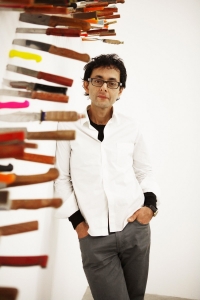
Born 1963, Shiraz, Iran
Graduate of California Institute of the Arts, Valencia, California, 1984
Lives and works in Tehran.
Solo exhibitions:
2008 -Galerie Rodolphe Janssen, Brussels
2007 -Daneyal Mahmood Gallery, Chelsea NY
CANDY STORE, The Third Line Gallery, Dubai
2006 -Threshold of Hap, e x t r a s p a z io, Rome
Albareh Gallery, Bahrain
Operation Supermarket, with Shirin Aliabadi, The Counter Gallery, London
Operation Supermarket, with Shirin Aliabadi, Kolding Design School, Copenhagen
The Third Line Gallery, Dubai
2004 -e x t r a s p a z i o, Rome
Art Space Gallery, curated by Isabelle Van Den Eynde De Rivieren, Dubai
Kashya Hildebrand Gallery, New York
2003Kashya Hildebrand Gallery, Geneva
Leighton House Museum, curated by Rose Issa, London
2002-13 Vanak Street Gallery, Tehran
2001-Heaven,13 Vanak Street Gallery, Tehran
2000-13 Vanak Street Gallery, Tehran1992Seyhoun Gallery, Tehran
Group Shows:
2007-Art without borders, Tehran Gallery, University of Tehran.
Neighbours in Dialogue, Feshane cultural center, Istanbul, curated by Beral Madra
2006-Iran.com, Museum of New Art, Freiburg
Images of the Middle East, Copenhagen
Art without Borders, Armenian Centre for Contemporary Experimental Art, Yerevan
V-Day, Kashya Hildebrand Gallery, New York
Word into Art. Artists of the Modern Middle East, curated by Venetia Porter, British Museum, London
Ethnic Marketing, 13 Vanak Street Gallery, Tehran
2005-After the Revolution, curated by Octavio Zaya, KM Kulturunea Erakustaretoa, San Sebastian. Quasi niente / almost nothing, e x t r a s p a z i o, Rome Welcome, curated by Farhad Moshiri, Kashya Hildebrand Gallery, New York
2004-2005-It’s Hard to Touch the Real, Kunstverein, Munich – Tallinn Kunsthalle, Tallinn – Unge Kunstnerers Samfund UKS (The Association of Young Artists), Oslo – Yeans (artist-run-space), Gothenburg – Bildmuseet Umeå, University College of Fine Arts, Umeå, Sweden
2004-Entfernte Nähe, curated by Rose Issa, House of World Cultures, Berlin Iran under the Skin, curated by Firouz Firouz, CCCB, Barcelona Ethnic Marketing, curated by Martine Anderfuhren e Tirdad Zolghadr, Centre d’Art Contemporain, Geneva Turning Points, curated by Media Farzin, LeRoy Neiman Gallery, Columbia University, New York
2003-Iranian Pool, curated by Maria Chus Martinez, Casa Asia/ARCO, Madrid
Casa Asia, curated by Maria Chus Martinez, Barcelona
Sharjah Biennial, Sharjah, UAE
Rooseum Center for Contemporary Art, Malmo, Sweden
Continuous Stroke of a Breath, curated by Afsaneh Firouz, Harvard University, Boston
Haft, curated by Michket Krifa, l’Espace Landowski, Ville de Boulogne- Billancourt, France
1993-Tehran Biennial, Museum of Contemporary Art, Tehran
1989-Dorothy Goldeen Gallery, Los Angeles
Literature:
2005 Gulf Air Magazine, May 2005
2005 Art AsiaPacific, Spring 2005
2005 Bidoun Magazine, Spring 2005
2005 New York Times, April 8
2005, review by Holland Cotter
2005 Canvas, March/ April 2005
2005 New York Sun, March 25, 2005
2005 Trace, March 2005
2005 Bidoun Magazine, Winter 2005
2004 Berliner Morgenpost, March 20, 2004, Berlin
2004 Der Tagesspiegel, March 19, 2004, Berlin
Farhad Moshiri
Translator:Roya Monajem
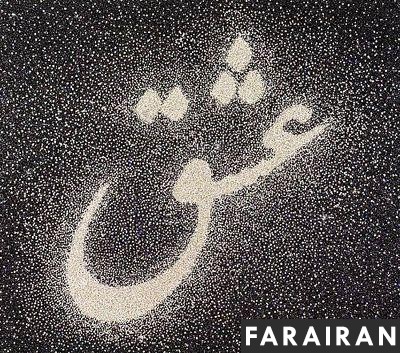
It is years now that Farhad Moshiri, the Iranian painter and installation artist is a known figure on an international scale. General reception of art critics as well as, his successive achievements in international art auctions outside Iran are the main factors which helped him reach such an exceptional fame and esteem. In 2008 his piece “Love” made a record in the price of art works sold in a major art auction, which is something unique and exemplary for a young Iranian artist even though in his home country, his presence has not been felt as much. Yet, success in selling is not the only factor which has turned Moshiri into an exceptional artist; accomplishing a personal language and style at early stage of his artistic career is a prior factor in making his works distinct and special.
Farhad Moshiri was born in 1963 in Shiraz, the city of Hafez, Sadi, Pasargad and Persepolis. His father owned a few cinemas in Shiraz, which roused Farhad’s interest in cinema and art from an early age. Even though he was not a successful student at school, he showed a great love for drawing and painting, which was recognized and encouraged by his art loving father. In fact, it was this passion for drawing which made him go to America after the Revolution (1979) and settle down in a small town near Los Angeles where he finished his preliminary education. He then enrolled in Art Institute of California in 1981, when artists like John Baldassari and Michael Asher taught there. Thus his academic studies coincided with one of the brilliant periods of CalArt. His first exhibition in Los Angeles (1987) was a group video installation called The End followed by another installation at Black Salad Gallery in 1988. Even though at the beginning of his artistic career, he was utilizing images, film and video art, after his third exhibition at Dorothy Goldin Gallery; he turned his attention to painting and mixed media.
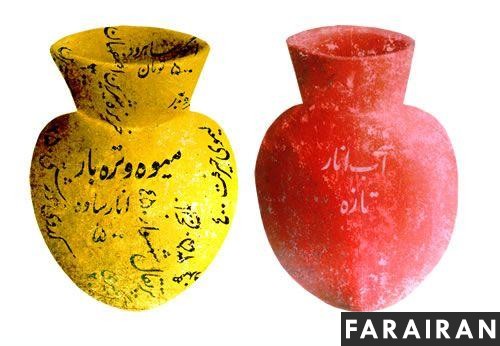
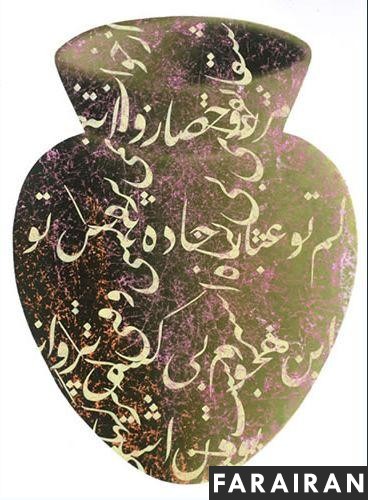
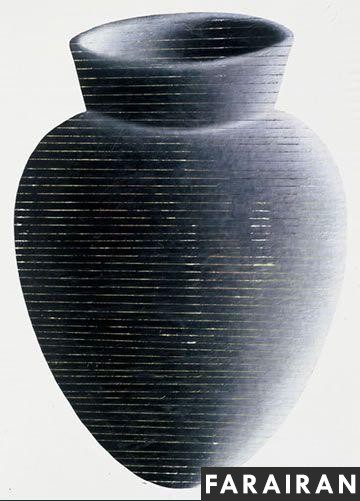
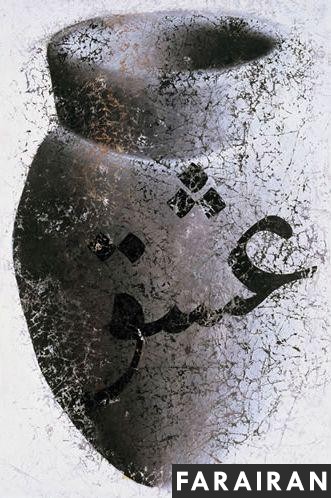
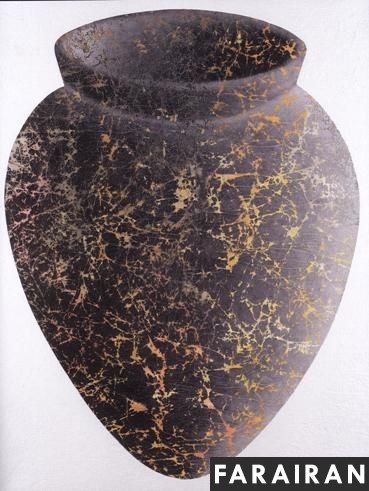
After his return to Iran in 1989, he began working for UNICE producing computer animations and books for children for four years. He then totally devoted his time to painting. Inspired by clay vases and jars he had seen in Shiraz, he produced a series of paintings in 1999, later coming to be known as Jar Paintings. They were minimalist paintings of clay jars on large canvases, with single color backgrounds. He displayed words or simple phrases such as “love”, “past is past” or “only me” in Iranian calligraphy in ink or paint on these jars. They immediately attracted the attention of art virtuosi and critics and soon decorated the walls of art collectors.
Sohrab Mohebbi, art critic, author and artwork specialist regards these works as “subtle hints to Saqqakhaneh School of the 1960s and 1970s.” According to him “Moshiri’s tongue in cheek evocation of Iranian modernism, while giving visual references to calligraphy and khat-naghashi (calligraphy-painting), were playful comments on the relationships between the visual, textual and the oratory.” But Moshiri’s minimalism, this subtle, translucent and alluding approach to an Iranian modern school of painting was in open contrast to this school’s style of exaggeration and detail – and the minimal application of image, colour, calligraphy and embellished compositions can be regarded as a post-modern approach to a period of Iranian painting which at the threshold of 1960 tried to create a kind of pop art. However, according to Mohebbi, these works “had the sound of streets and honk of khavar trucks, the appearance of a misplaced Saqakhaneh idea and touched upon the line between poetry and moetry (sher o ver = rhythmic nonsense). In a way, it could be said that these works were also about the notion of making work about painting/calligraphy or Saqakhaneh school- a predominant brand of Iranian art making. In his works, Moshiri succeeded in creating a situation where the very notion of art historical reflections (for instance in the case of jar paintings) itself is embedded in the work and the viewer is at once encountering the work and a posture of criticality. It is this notion of criticality as a posture or a position among others, such as locality, irony or contradiction that separates Moshiri’s work from most of his contemporaries whose brand of critique dominates the work and the work does not go beyond plastic manifestations of the status quo.”
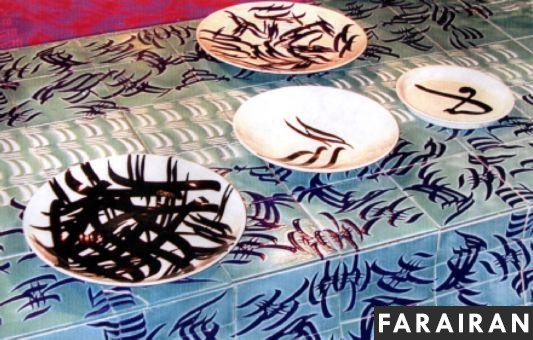
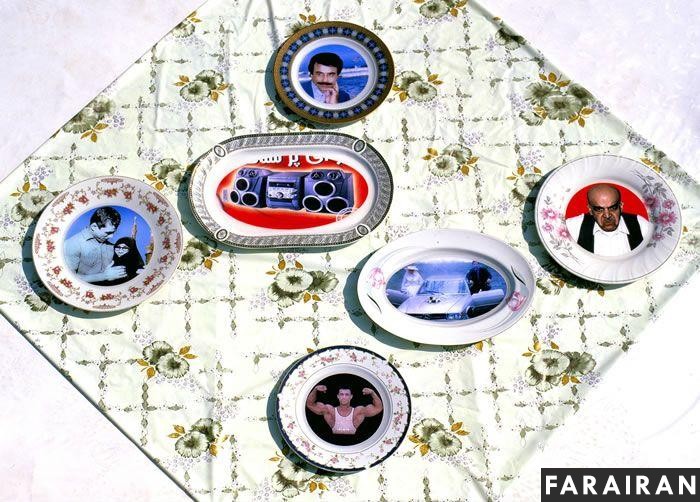
Moshiri exhibited his vase paintings at Fereydoun Ave’s Gallery for the first time in 2001 which was followed by period of his painting exhibitions and installations. His sofreh-s (table-cloths) installation with illustrated plates was an attempt to reach a kind of Iranian Pop Art. In these collections, he used recent Iranian popular icons, photos of artists and famous figures to decorate his plates and dishes in a kitsch-like representation, set on long Iranian sofreh-s laid on grass field or under the canopies of trees. In a period when according to Mohebbi, “some of the artists in the country were preoccupied with cheap exotica and obsolete identity politics with rather conservative use of medium, Moshiri’s palette went beyond paint tubes.”
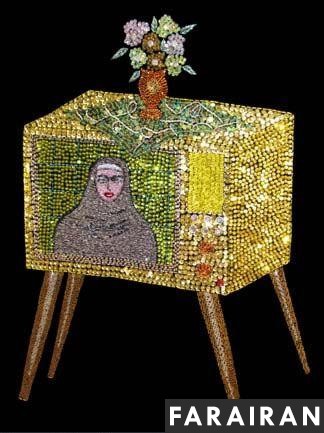
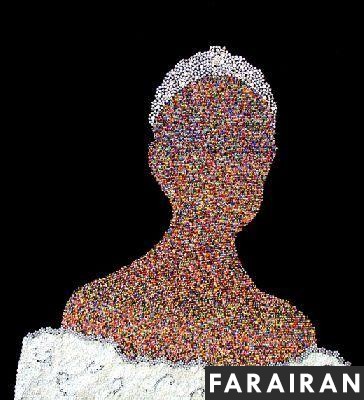
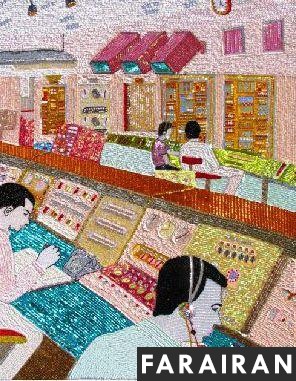
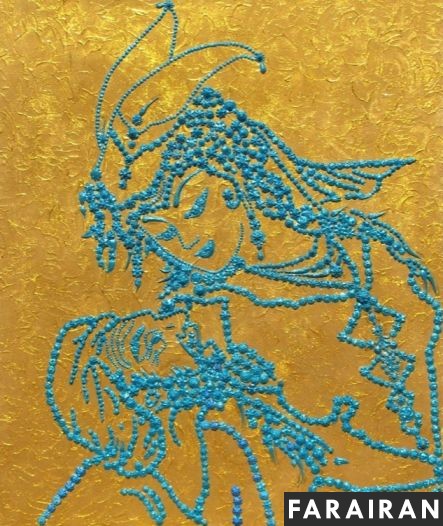
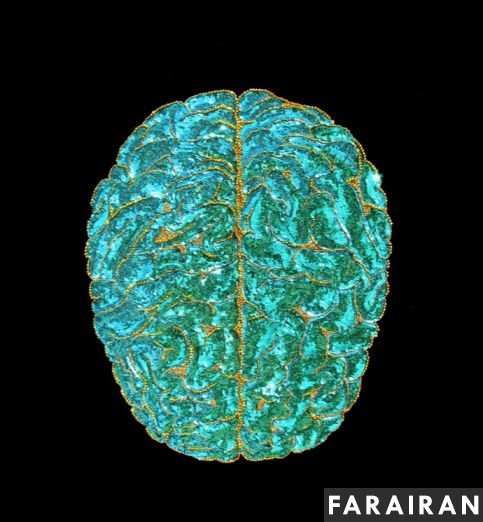
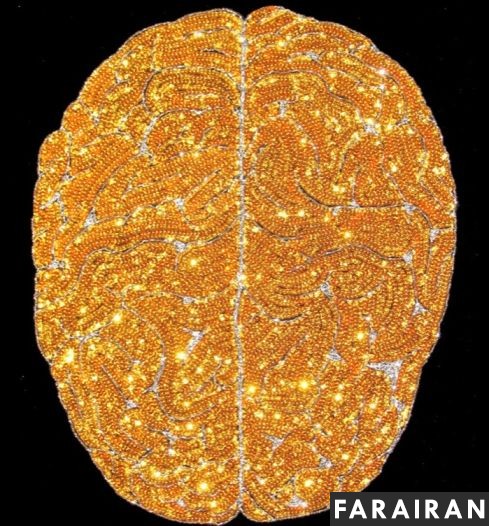
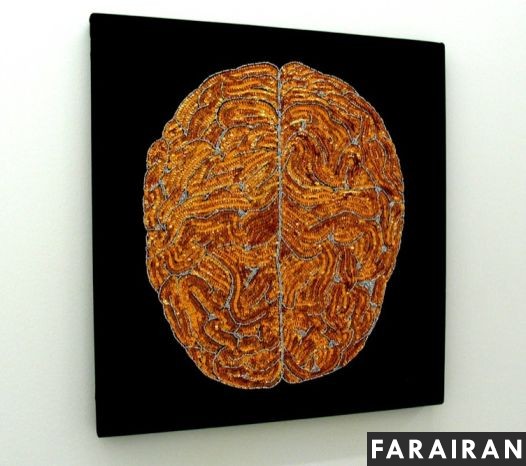
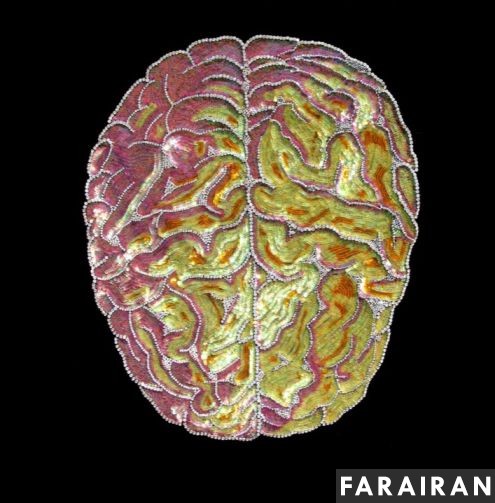
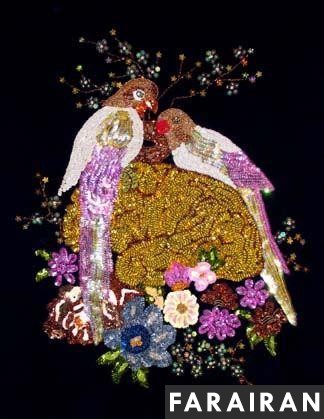
In 2004, Farhad Moshiri experienced a new approach to kitsch. He exhibited his first embroideries (reminiscent of traditional embroideries by Iranian women) in Italy. These works also show the same dominant features of his previous works: a decorative approach, yet a simple minimalist application of popular icons and images mixed with a personal mannerism with images which as described by Negar Azimi in an article (Bidoun, No. 20, spring 2010) “have emerged as though out of the heart of cartoons, fables or fairy tales” and had the same function as universal icons, adopted from both cultures, Eastern (his birth place) and Western (where he studied). An attempt to present the anomalies resulting from the clash of two cultures, if not reconciling them in a new form of Iranian Pop Art. In another period of his artistic activity, Moshiri worked with toy fighters and bombers reminding Lichtenstein’s famous work, Whaam or the original inspiration sources, that is Marvel comic strips.
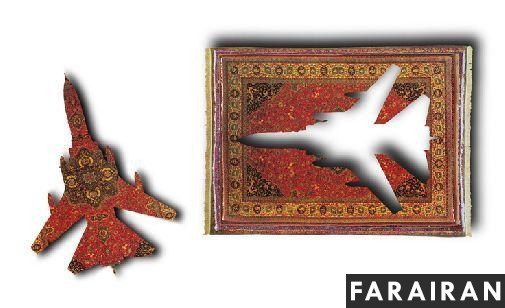
Another example of utilization of universal icons is his Flying Carpet (2007); 32 stacked machine made carpets 275 x 180 x 44cm. and 300 x200 x 44cm, each apparently mechanically mutilated and shaped into a generic fighter jet sending a barrage of contrasting signals. The juxtaposition of domestic soft furnishings with an image of military hardware is suggestive either of foreign interference bringing hardship into the home or else is emblematic of the determination and defiance of the Iranian state in the face of aggressors. In the face of stiff competition from princes, princesses, thieves and genies, the image of the flying carpet is still the most enduring of all of those to emerge from the Tales of the Thousand and One Nights.
Moshiri says about this work:
“I have a fascination with icons and cliches, exemplified herein the Persian carpets, probably our country’s biggest export after oil. They are imbued with a sense of familiarity and open to all sorts of possibilities”
In a text posted at Christie’s site it is said:
Farhad Moshiri’s Flying Carpet is at once provocative, humorous and ambiguous in message. Its monumental size and its fusion of the lyrical with the sardonic make this one of his most impressive works. Persian carpets with their immense cultural and economic importance are iconic and emblematic of Iran and a strong part of the Persian identity. Moshiri uses the motif of the carpet as visual shorthand for Iran and Persian culture in a way strongly reminiscent of Jasper Johns’ use of the Stars and Stripes as representative of America. The Persian carpet carries with it the connotations of the unique and the handmade. By stacking thirty-two carpets of the same size-each of them factory produced- and cutting identical holes into each of, them the shape of which represents a hi-tech product of symbol of modern warfare, Moshiri subverts the expectations of the carpet as an individually crafted rather than a mass-produced artifact. The repetition and stacking of this visible symbol recalls Andy Warhol’s well-known depictions of Campbell’s Soup Cansor Brillo Boxes, whilst in its precision and fetishistic celebration of the material it recalls Minimalist art, notably that of Donald Judd.
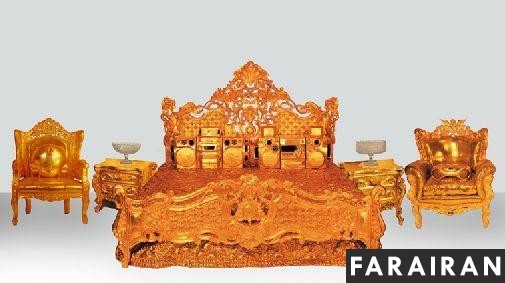
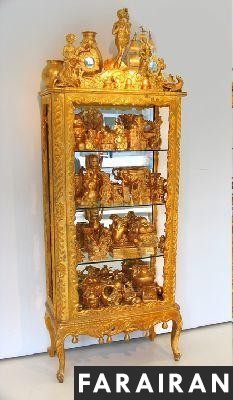
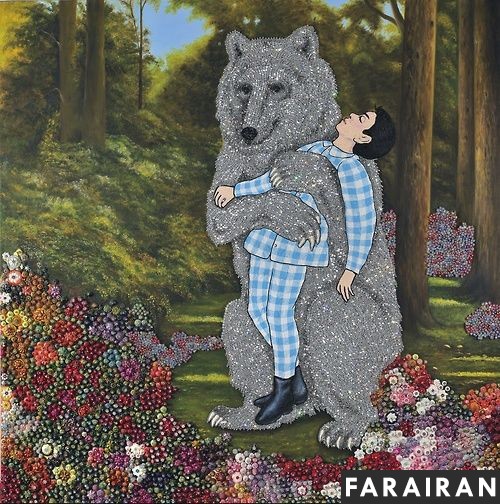
Later in 2008 he exhibited embroideries which were composed of Swarovsky’s crystals In one of these works called “Love” (see above) Moshiri is apparently referring to both meanings of this word, that is, its mystical religious Iranian meaning, and its Christian sense of brotherhood, compassion and the relationship between human beings and god. At the same time his installations of gilded armchairs with boomboxes led to the development of a new approach to the mixing of cultures with an affinity to kitsch in both.
According to Sohrab Mohebbi, the notion of juxtaposition is central in many of Moshiri’s works; “Displacement, as opposed to contradiction, which has become a source of one-liner art productions of many artists who have become mere illustrators of ready-made juxtapositions of Iranian contemporary life. This displacement could be within the institution of painting itself, such as the pottery pieces, where the artist looks at Saqakhaneh for instance, or it could be a gold covered mobl-e estil (stylish furniture) and boombox installation at a white cube space- works such as Cradle of Happiness. Moshiri’s art both uses ethnic marketing strategies and their critique and a touch of ironic self-reflexivity is his icing on the cake. By incorporating the distance in the work itself, which at points might approximate cynicism, Moshiri gives concept a sculptural presence. He would make planes out of carpets, outlines corpses with cakes and writes poetry with detergents.”
Moshiri is at the starting point of a new path. He is now an internationally known artist with a background in the rich culture of the east, who is also familiar with the latest development of western art and culture. Moshiri is in search of his unique personal language to interpret the contemporary world, using familiar artistic methods and techniques; he is ready to take the leap into new horizons.
-
- Oil and Acrylic on canvas
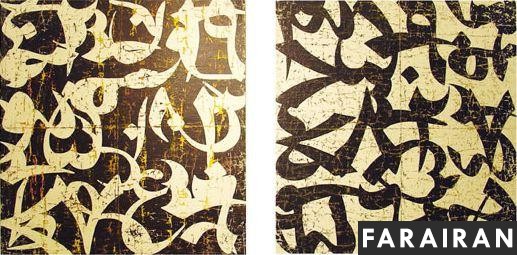
-
- Oil and Acrylic on canvas
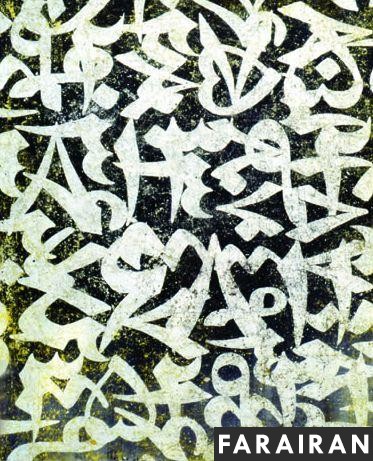
-
- Oil and Acrylic on canvas
-
- love
-
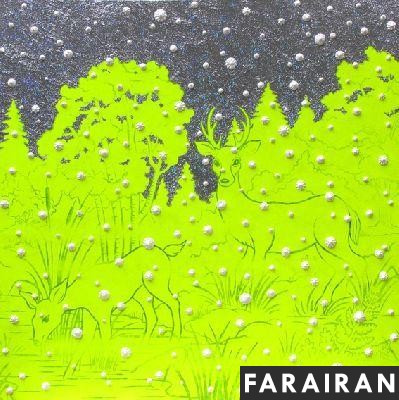
- 2007-Two Deers-acrylic and glitter on canvas-150 x 150 cm
-
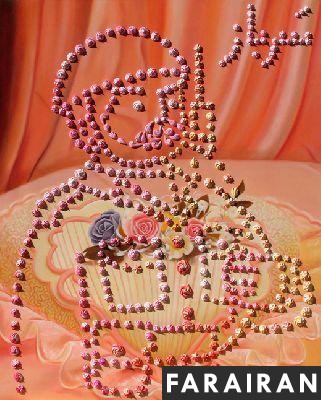
- 2007-Soldier-oil and acrylic on canvas-190 x 150 cm
-
- 2007-flying Carpet-cutted carpets-200 x 300 cm ( x2)
-
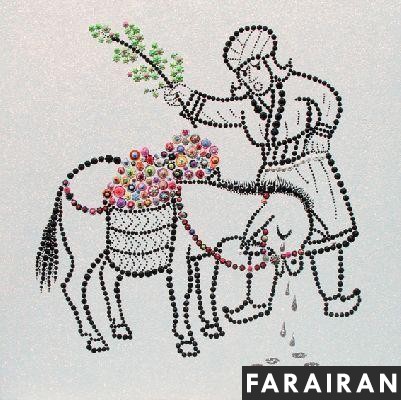
- 2007-Crying Donkey-acrylic and glitter on canvas-170 x 170 cm
-
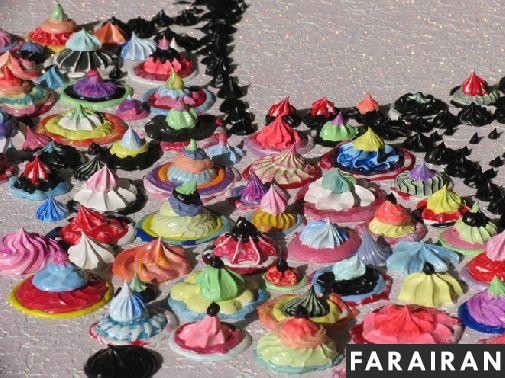
- 2007Crying Donkey (DETAIL)
-
- 2007-Blue Birds-oil and acrylic on canvas-190 x 150 cm
-
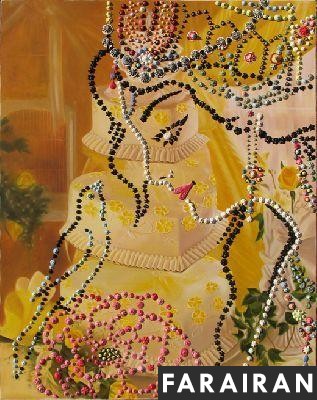
- 2005-The Bride-Embroidery on velvet
-
- 2005-Space Station-embroidery on canvas-140 x 110 cm
-
- 2003-Personne ne se reveille – 184 x 134 cm -Oil and Acrylic on canvas
-
- 2003-Living room Ultra Mega x – King Bed with Stereo Pillows – Life Size
-
- 2003-Amour – 271 x 181 cm – oil and Acrylic on Canvas
-
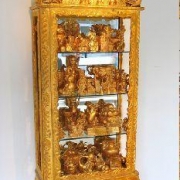
- 2002-Golden Love Super Deluxe-mixed materials in goldleaf-190 x 35 x 140 cm
-
- 2003- Farhad Moshiri- Black + Brick- 173×130 cm- Christie’s 16 April 2013
-
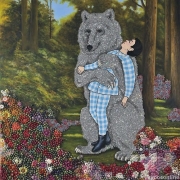
- 2009- Farhad Moshiri- Secret Garden- 197x197x505 cm- Christie’s 16 April 2013
-
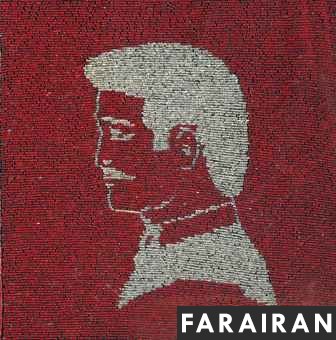
- 2009_silver portrait on red 2- 30×30 cm- Christie’s 17 April 2013
-
- thought for food-embroidery on felt
-
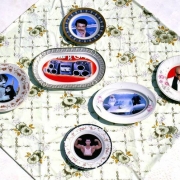
- sofreh – installation project – close-up
-
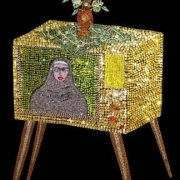
- news-embroidery on felt