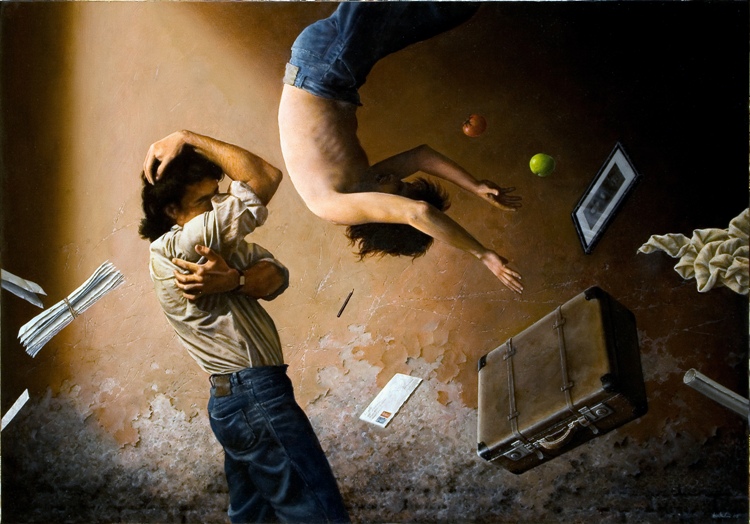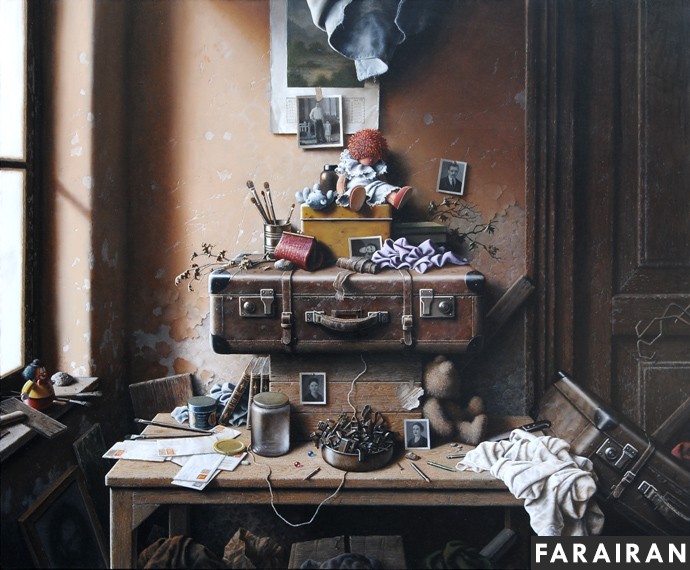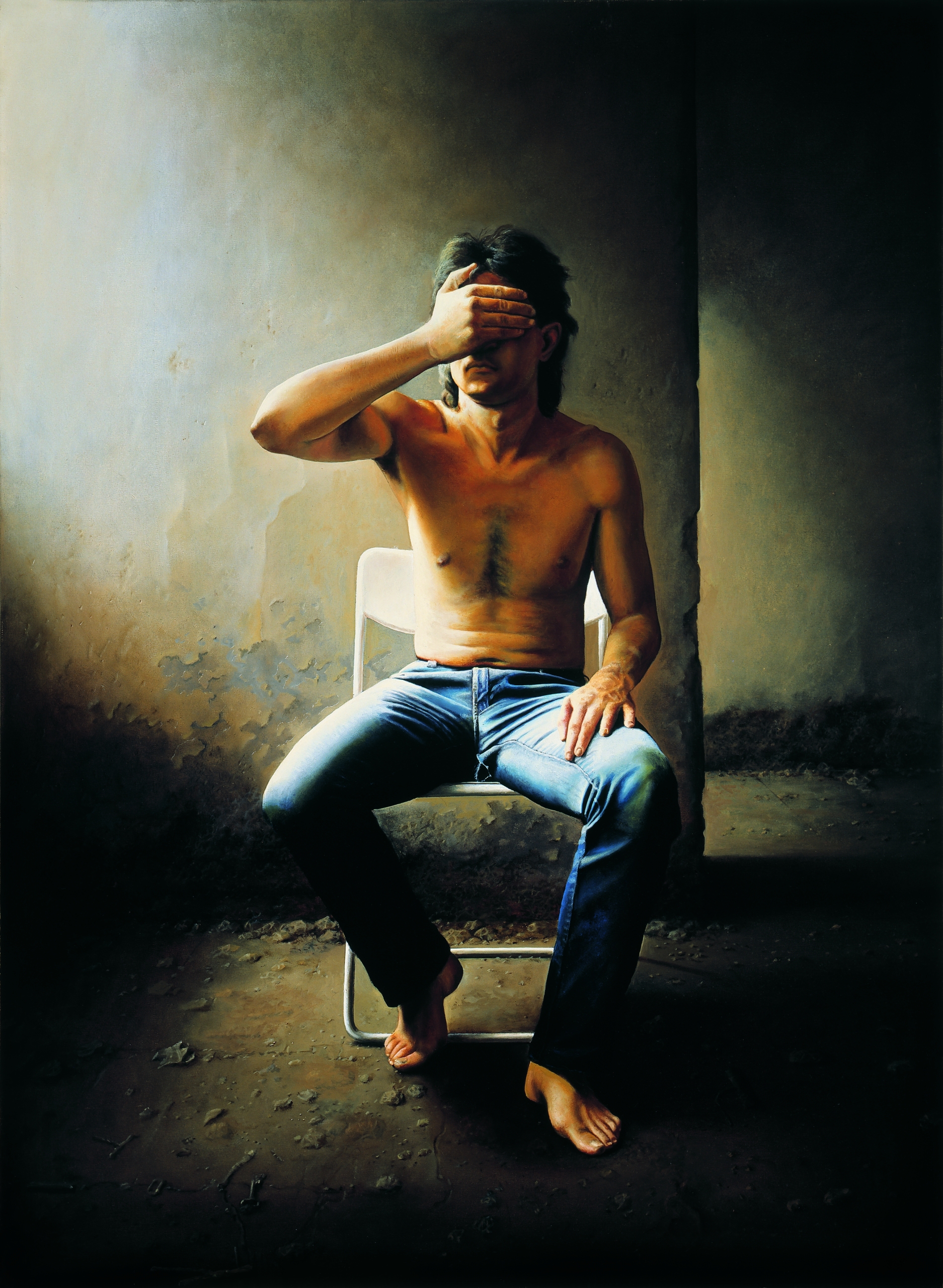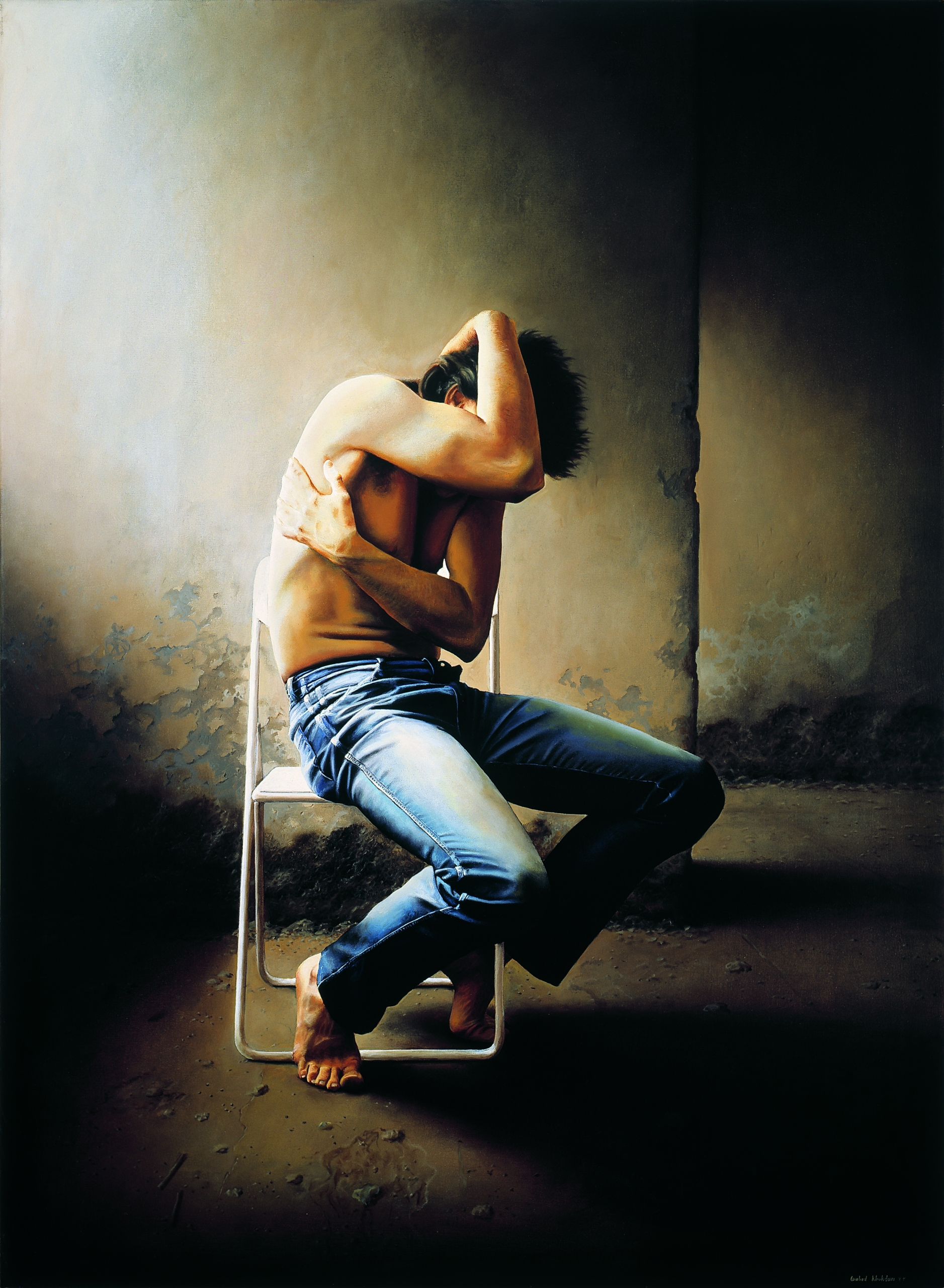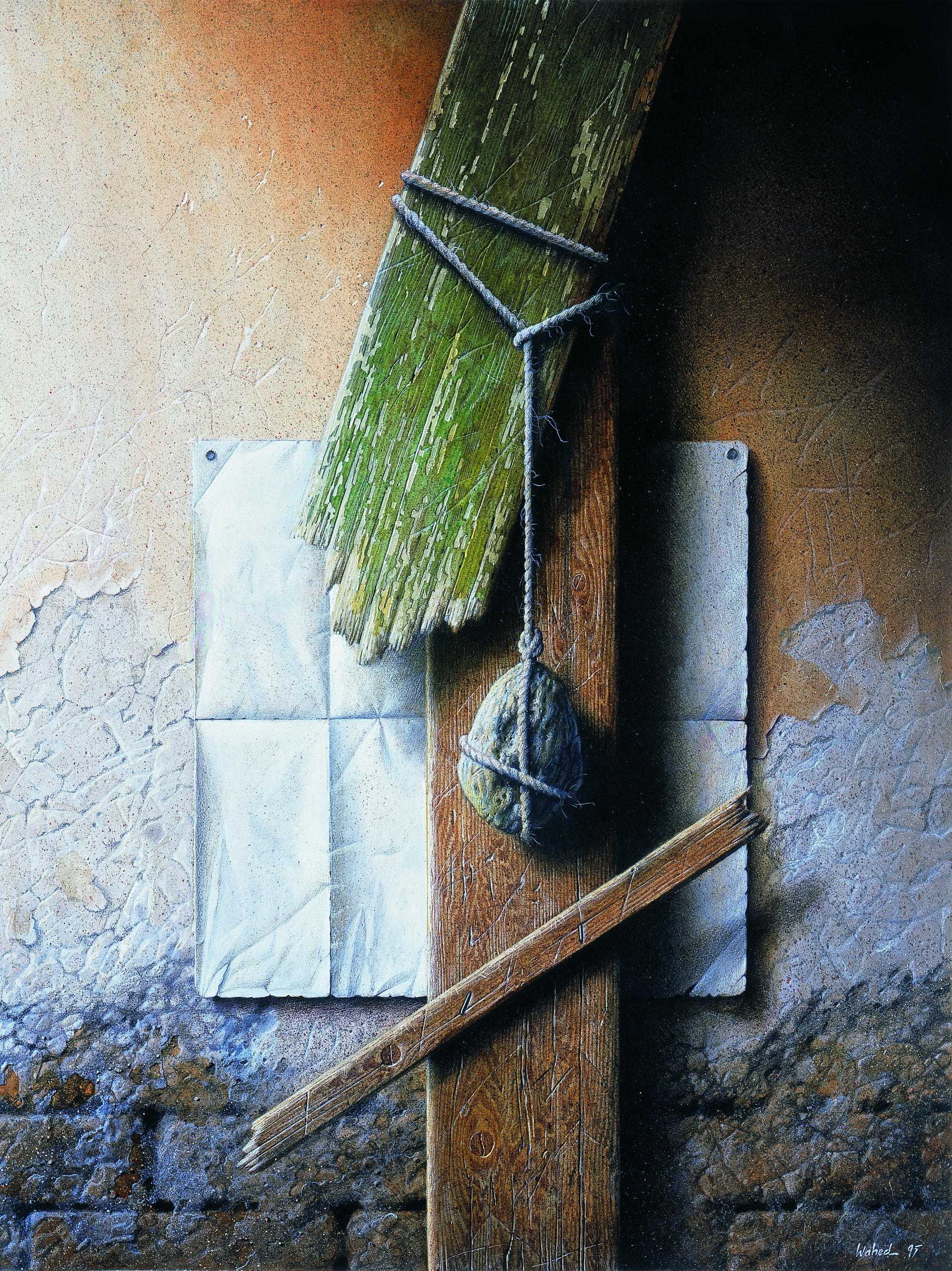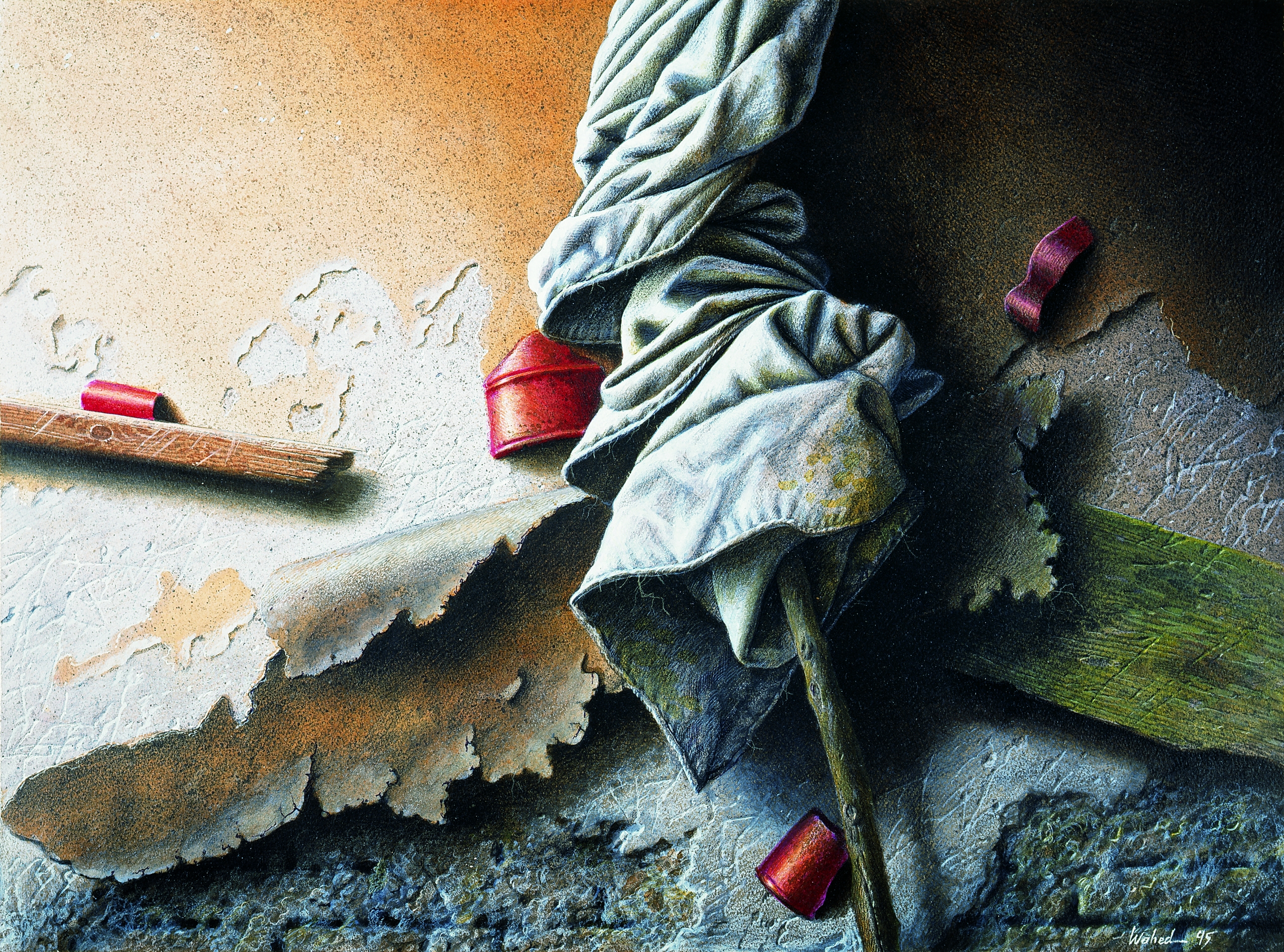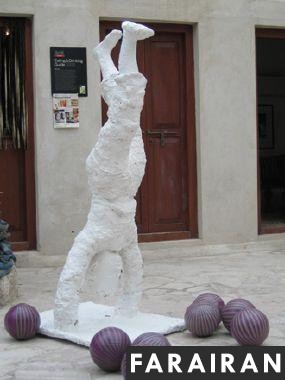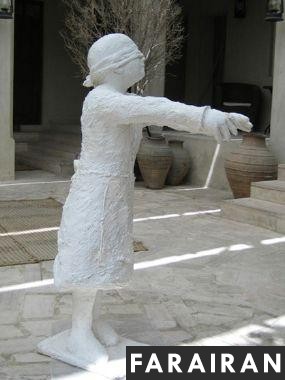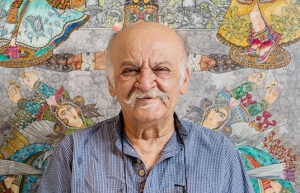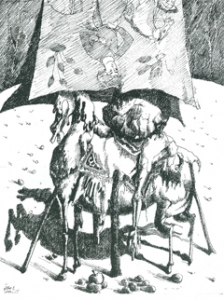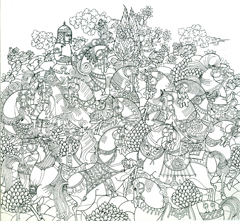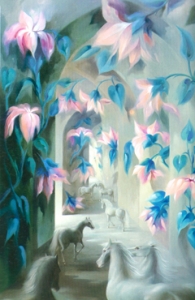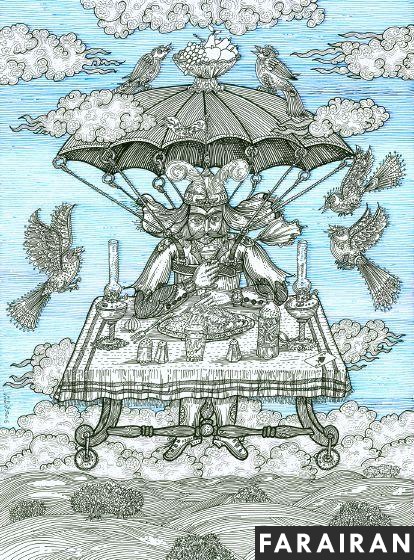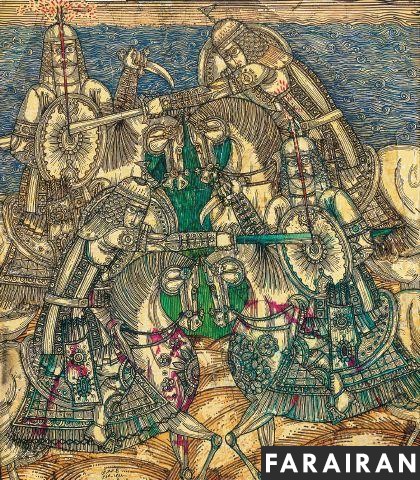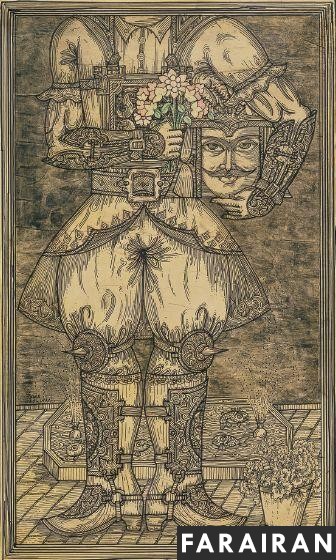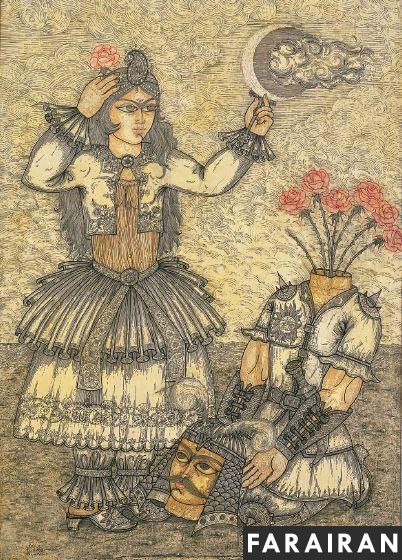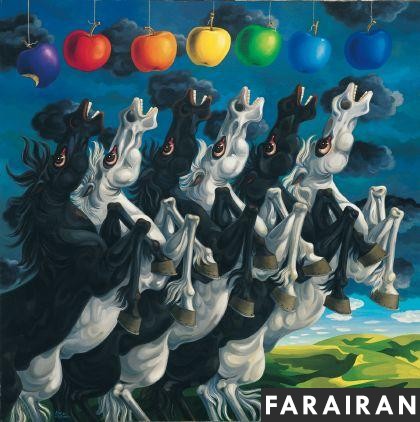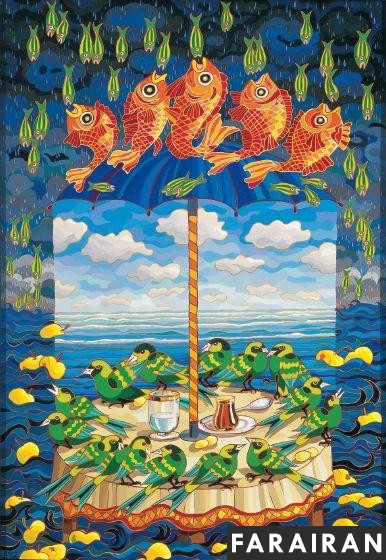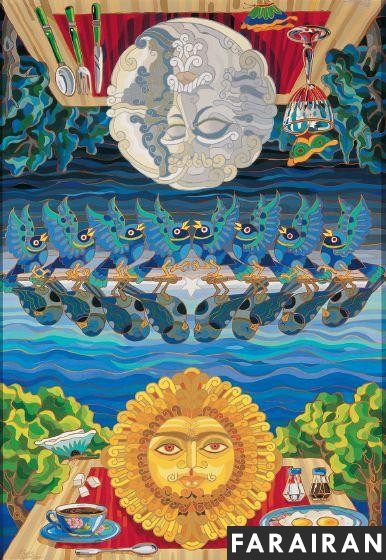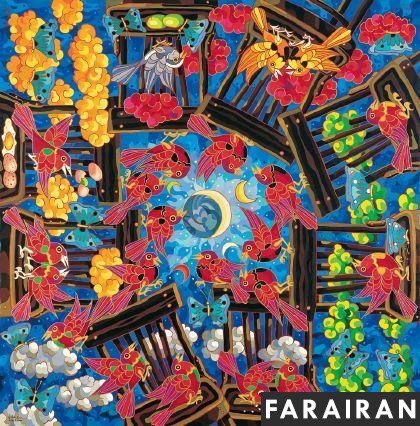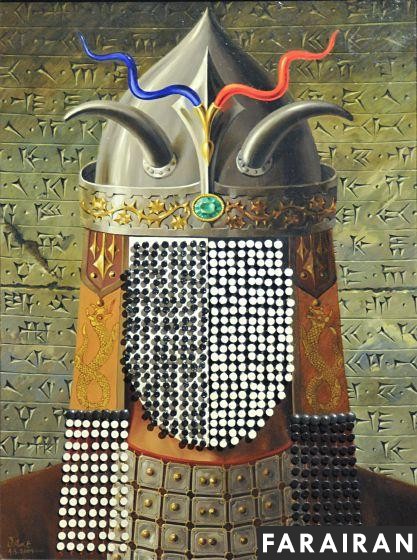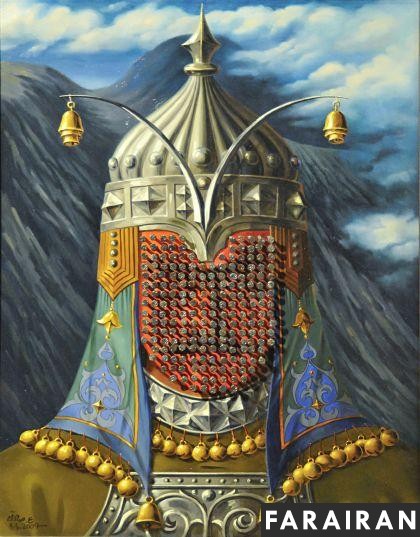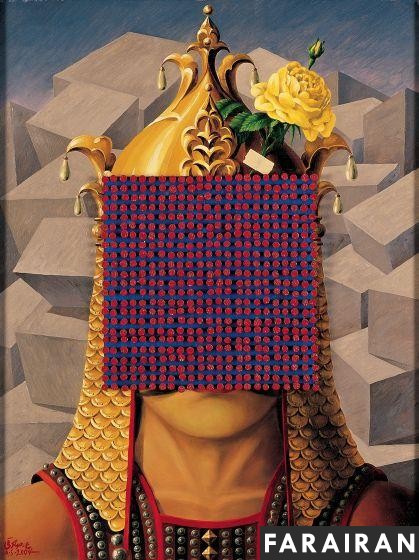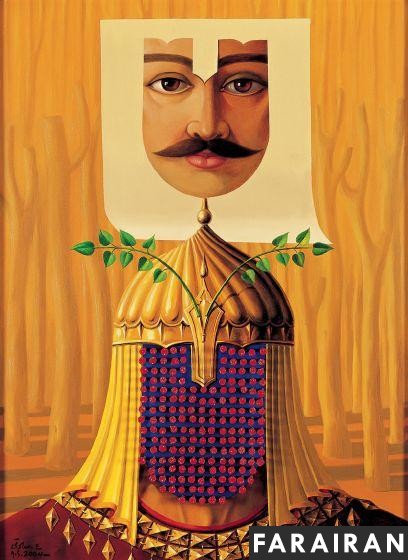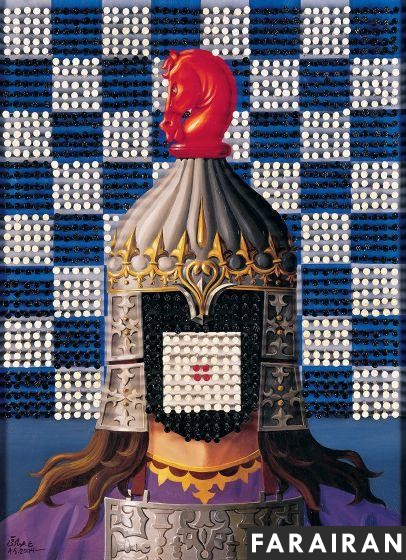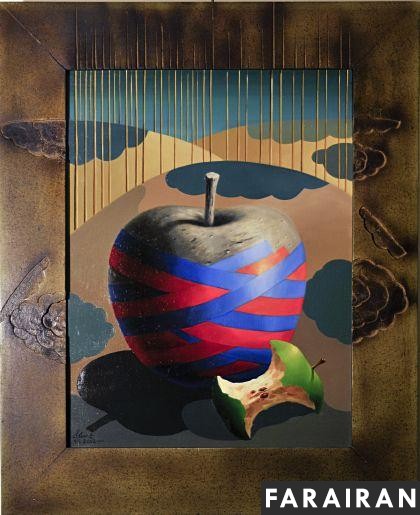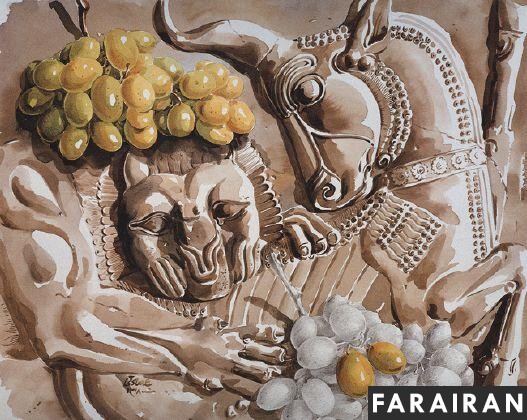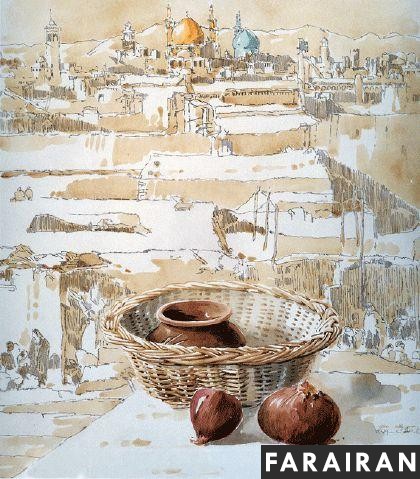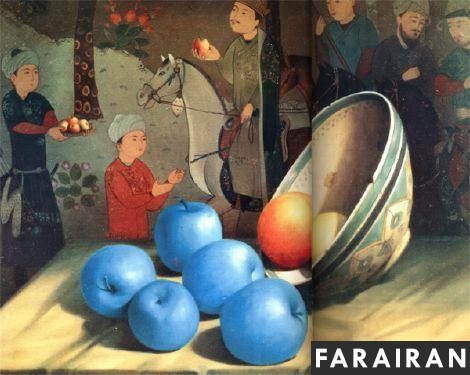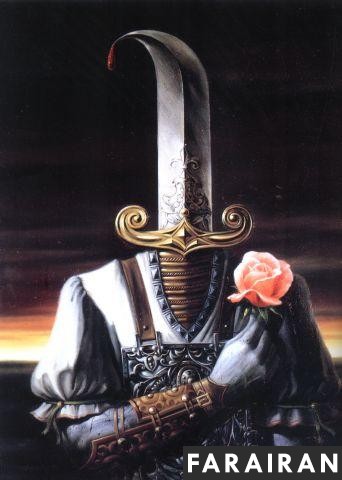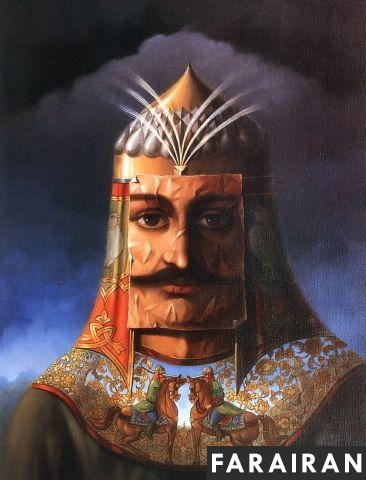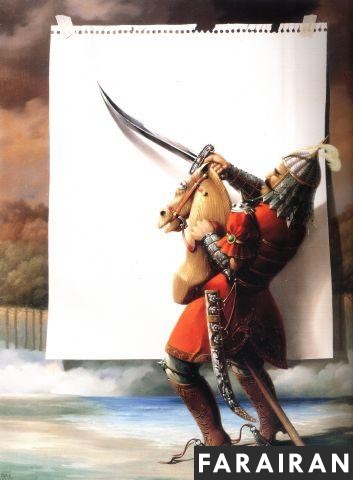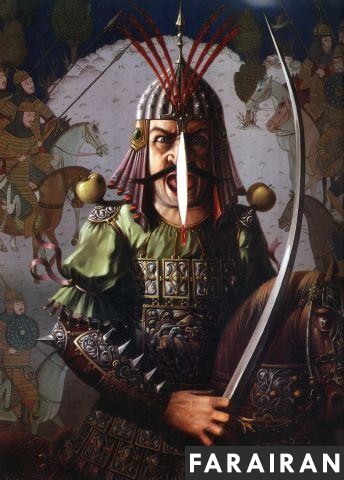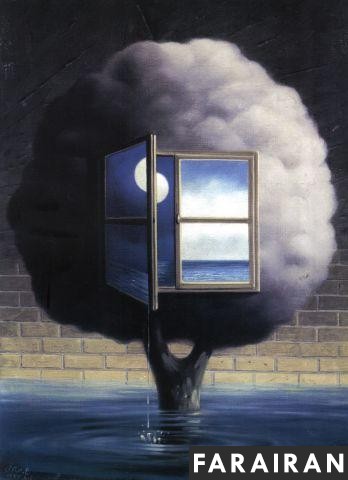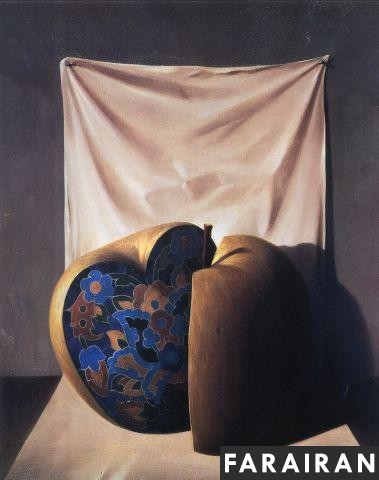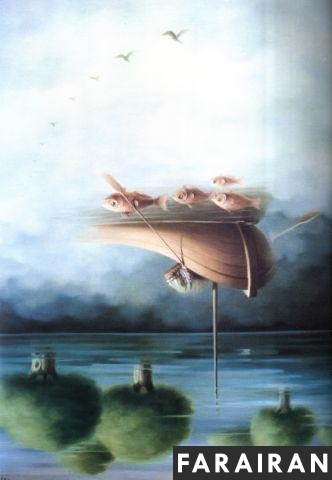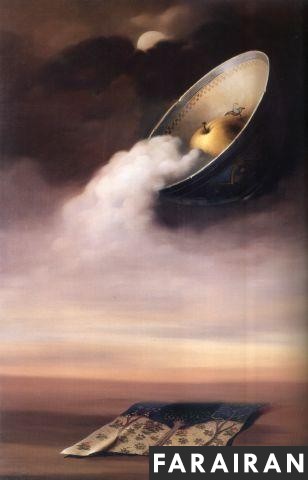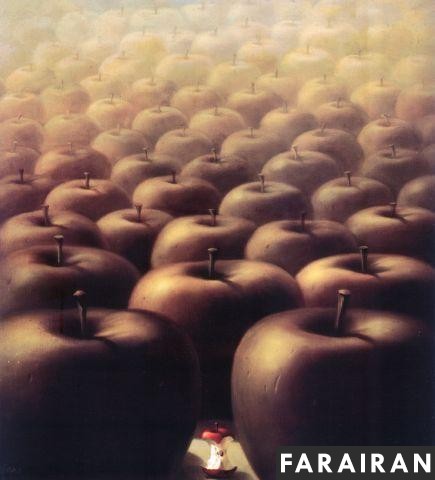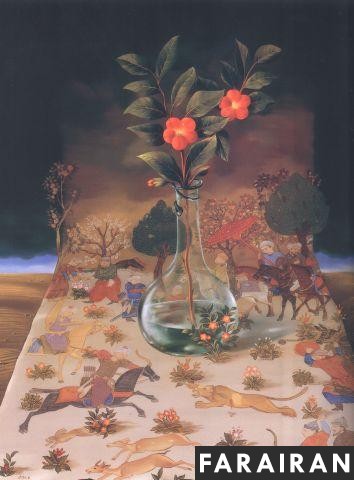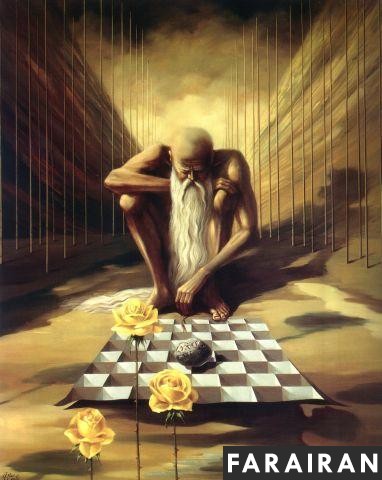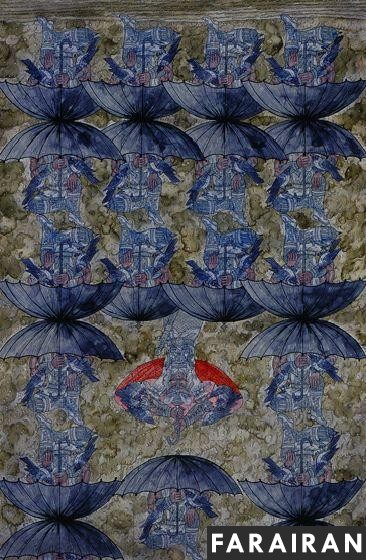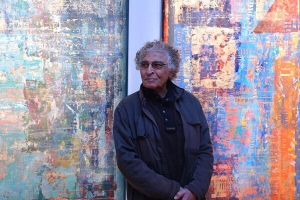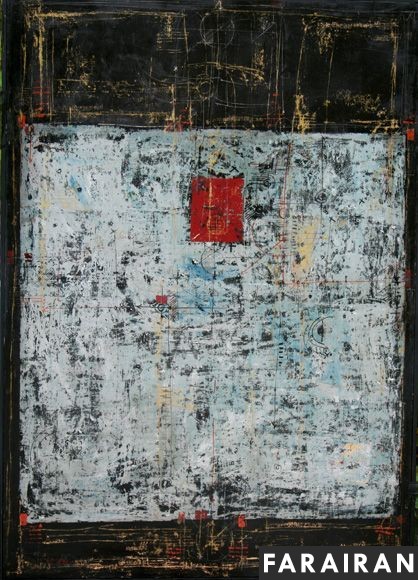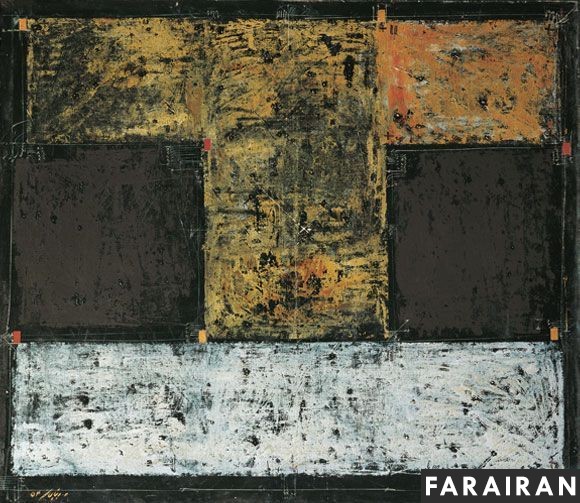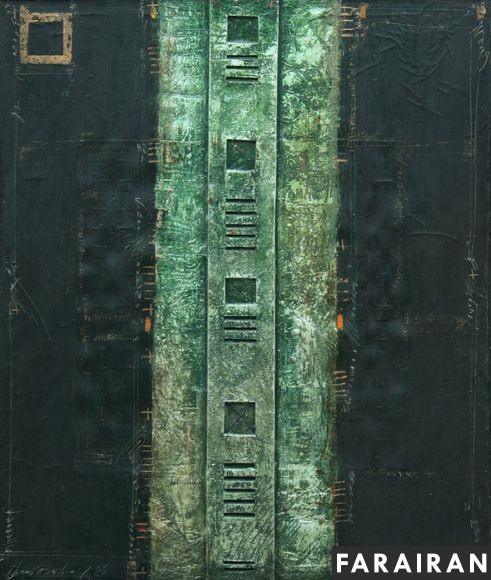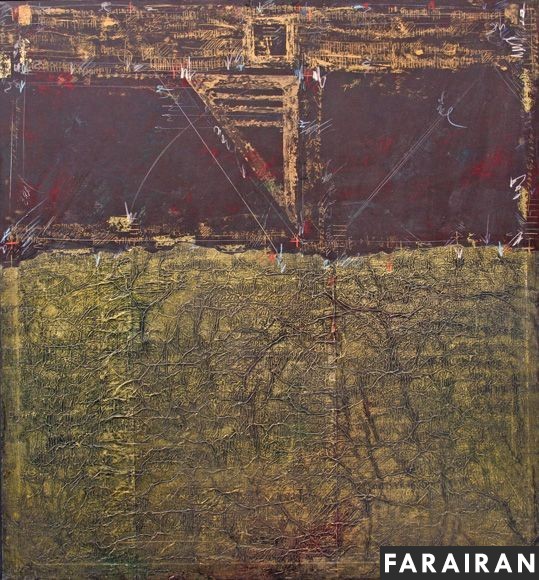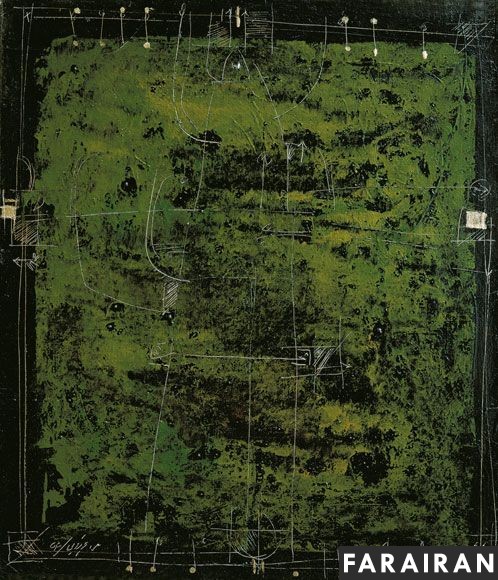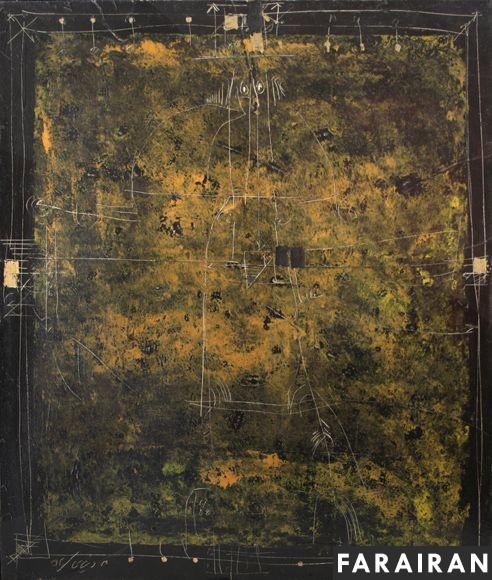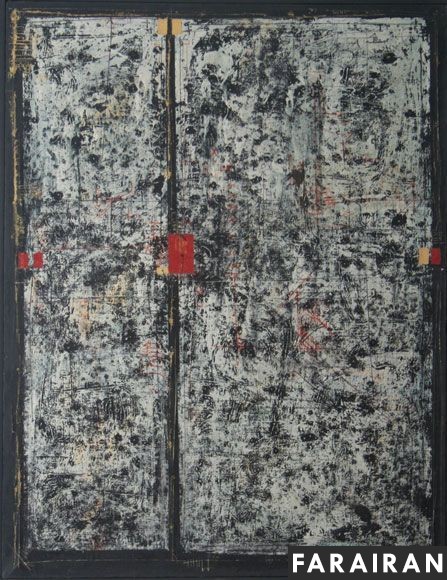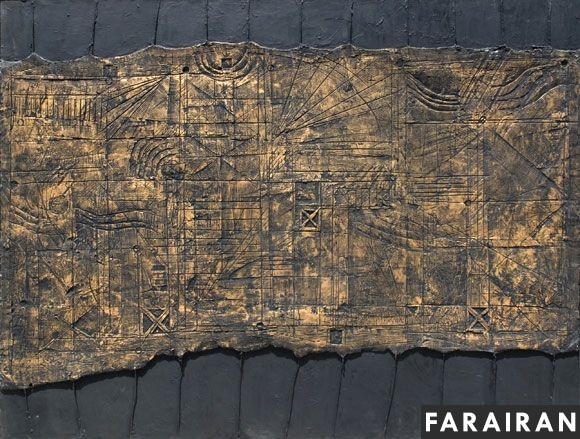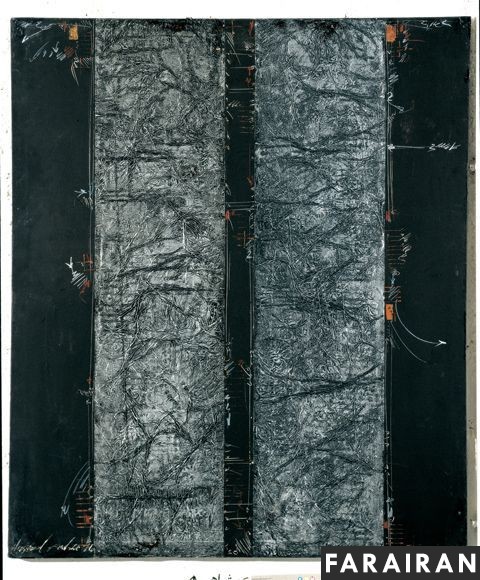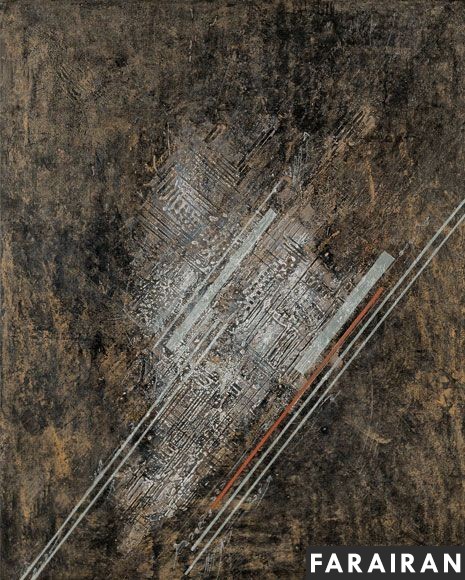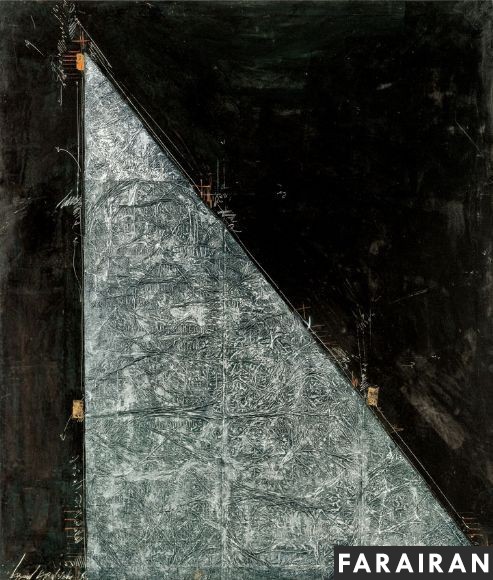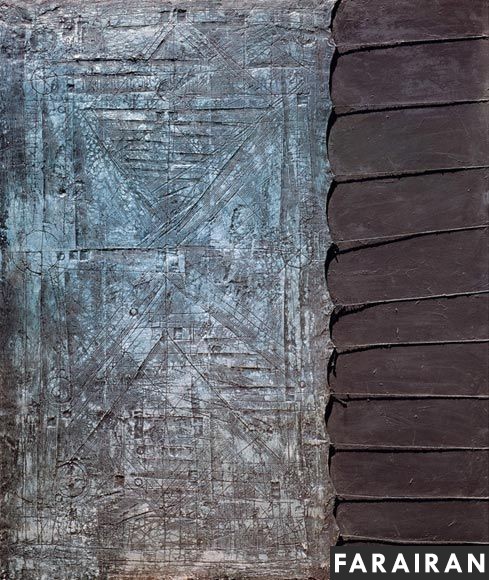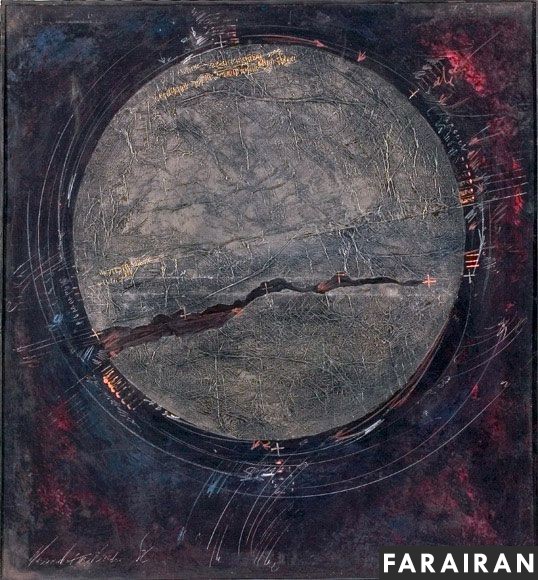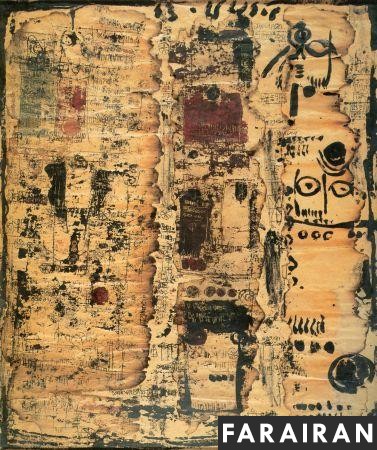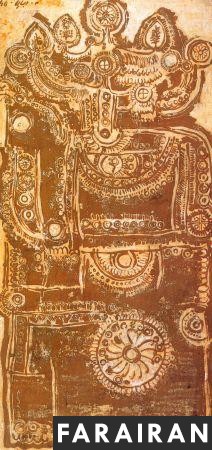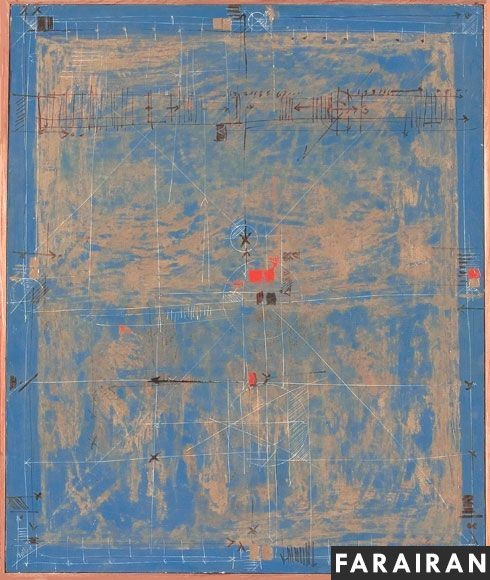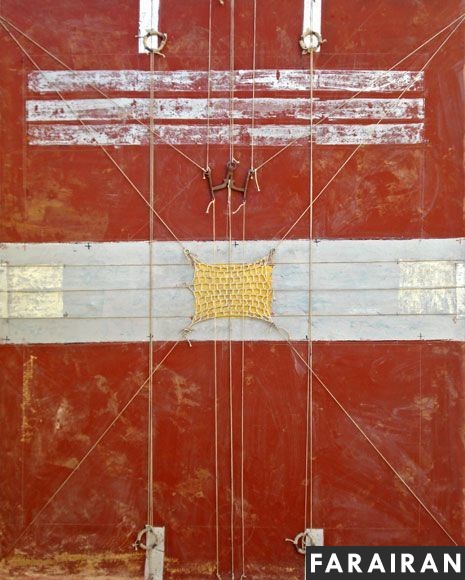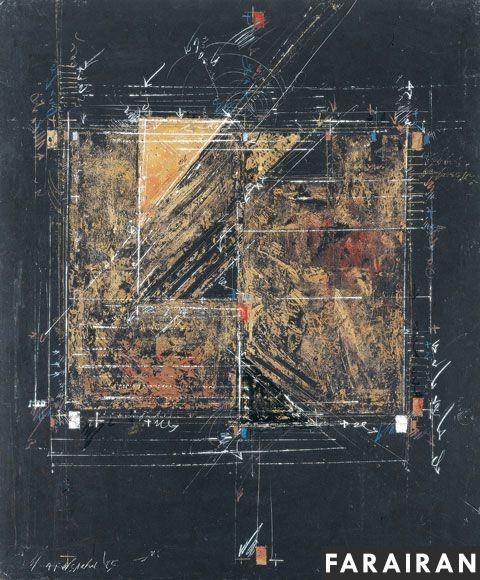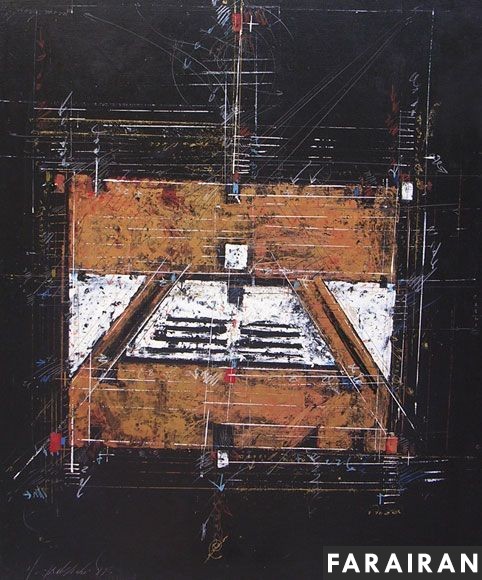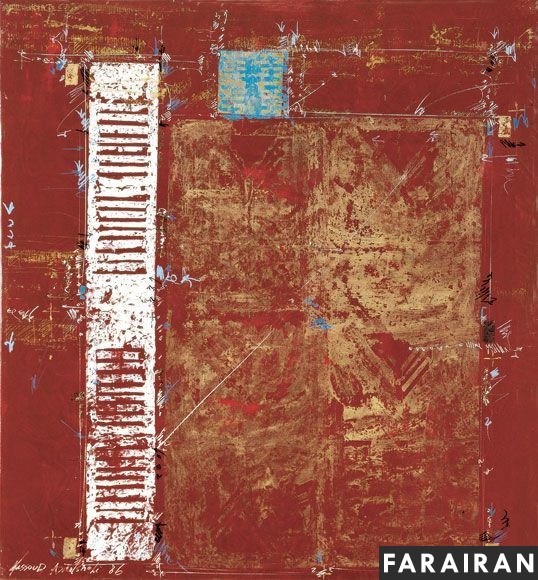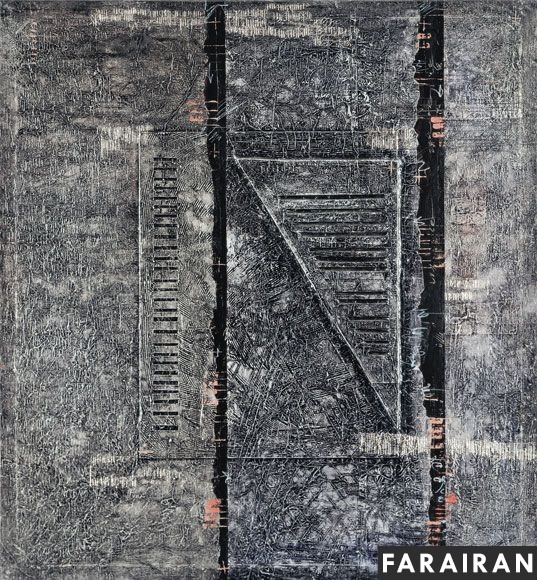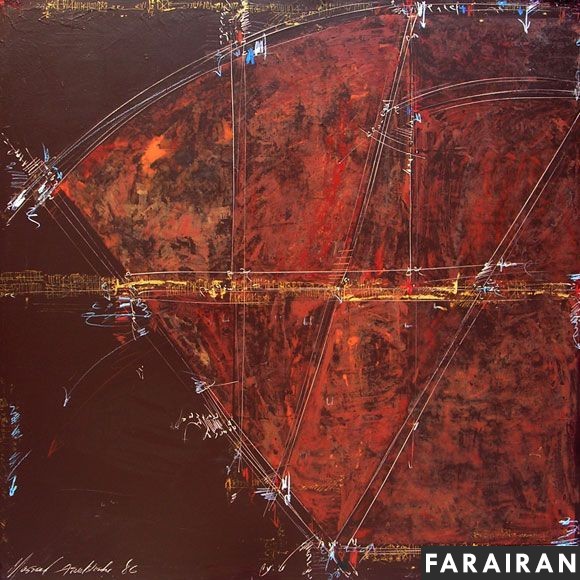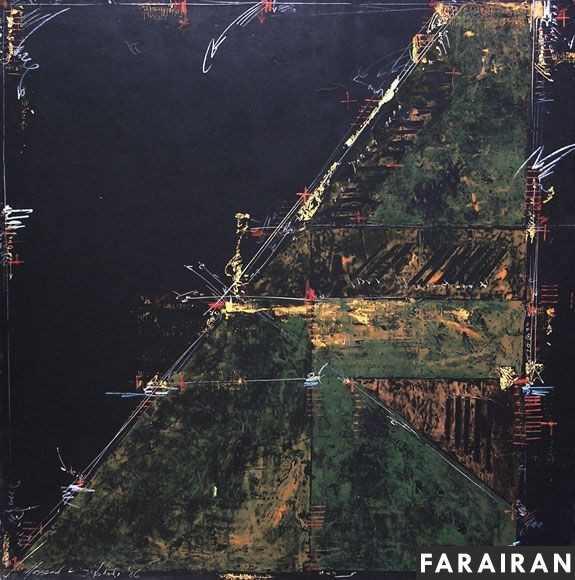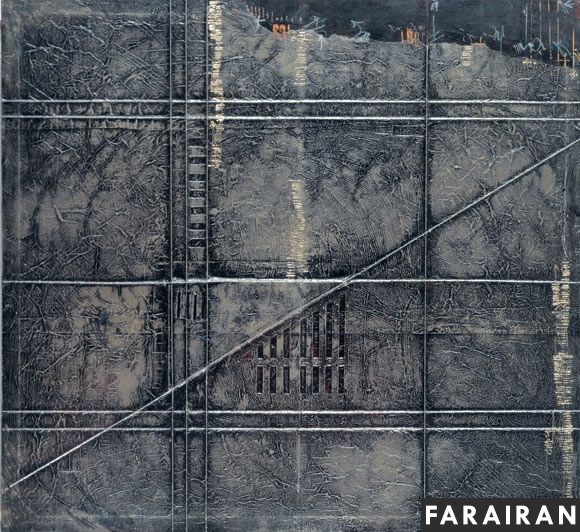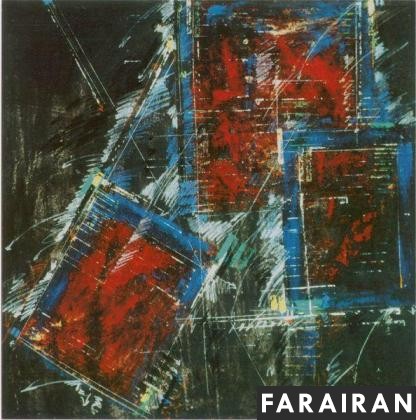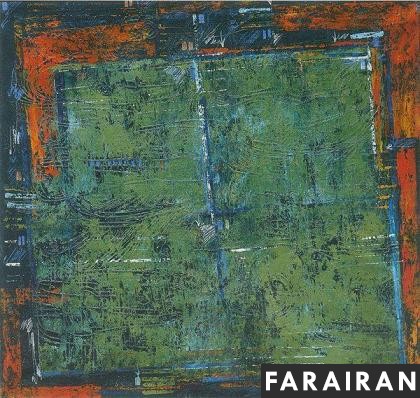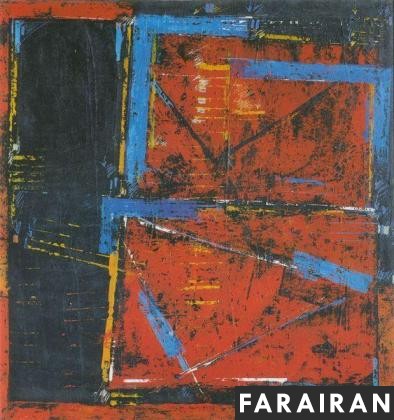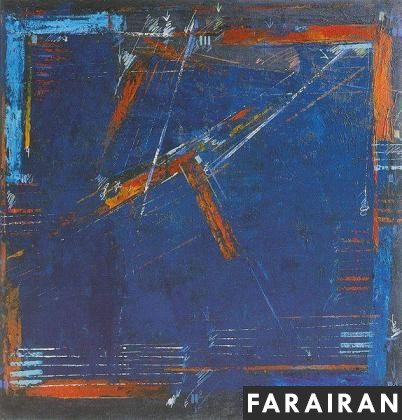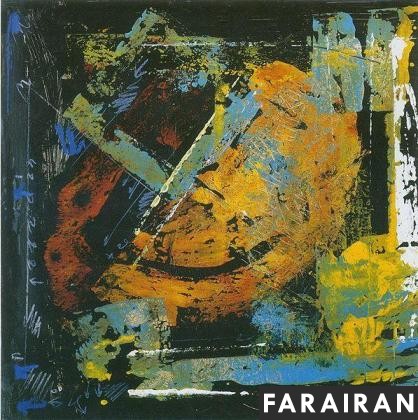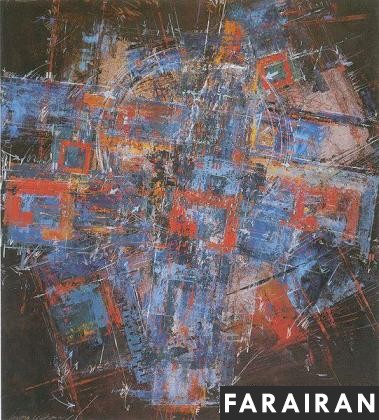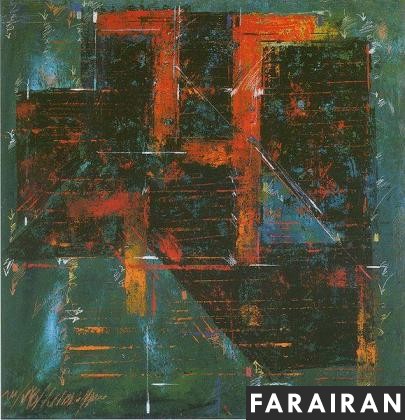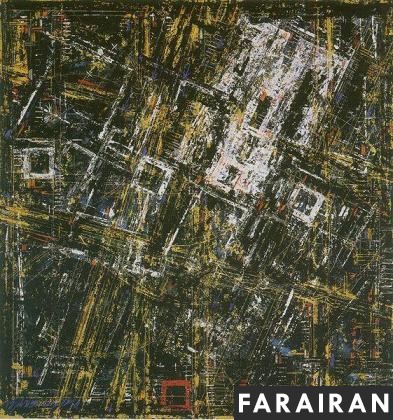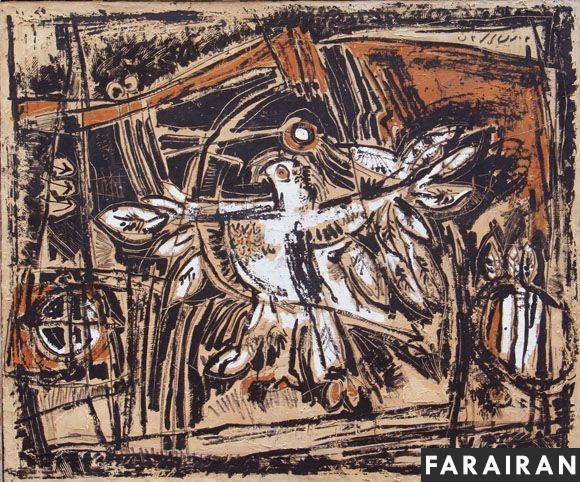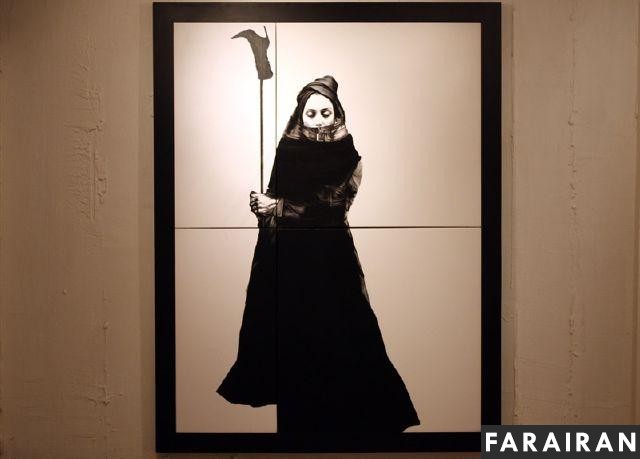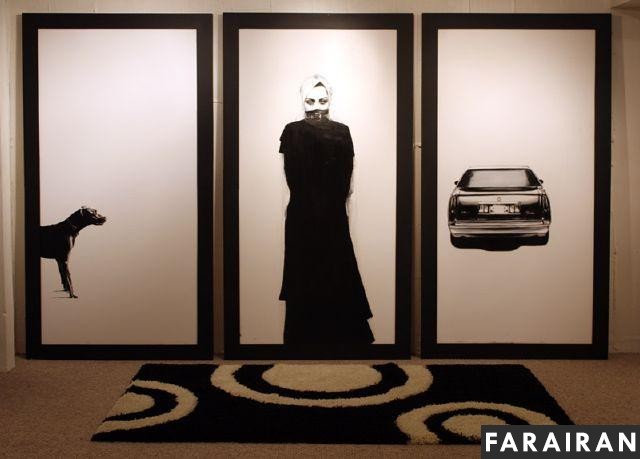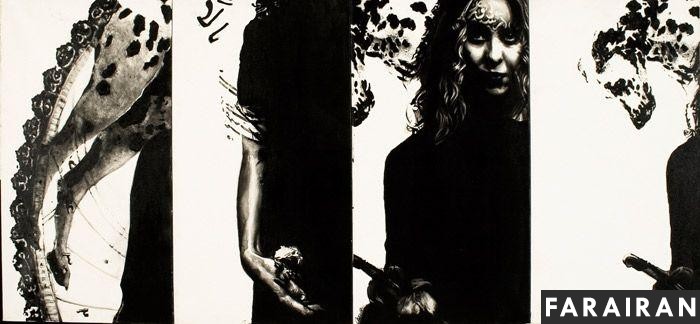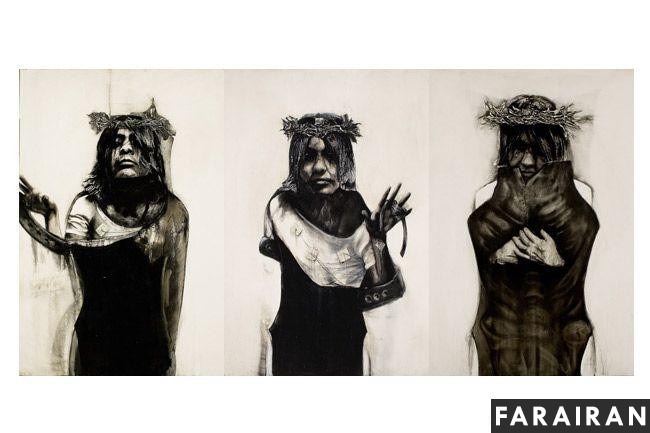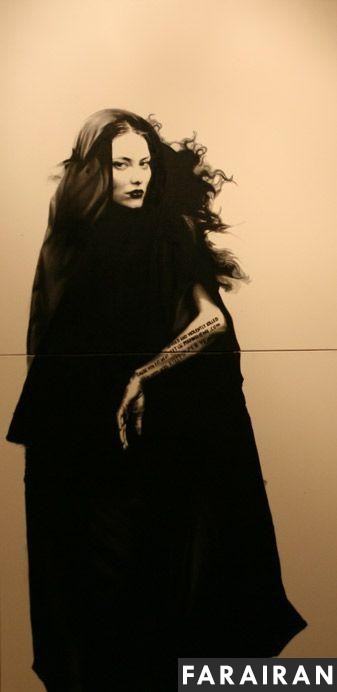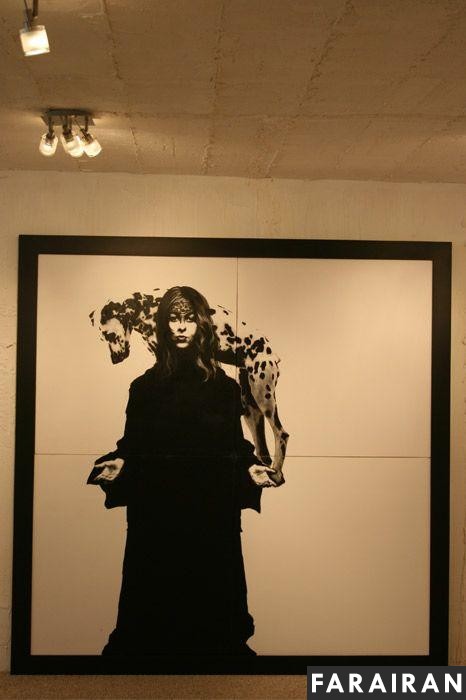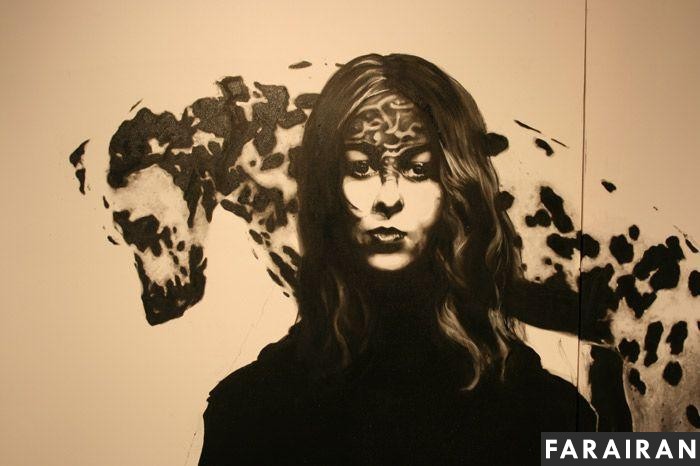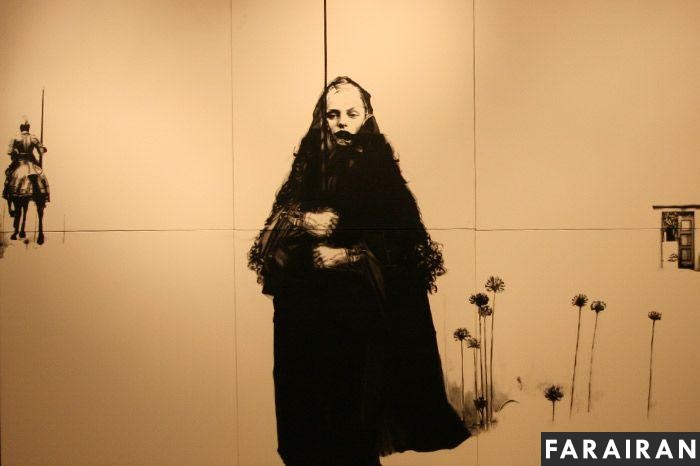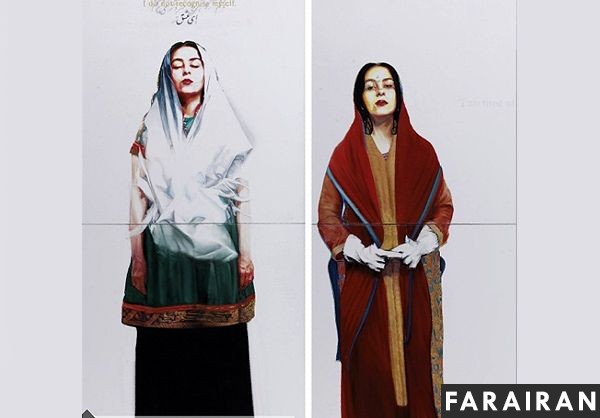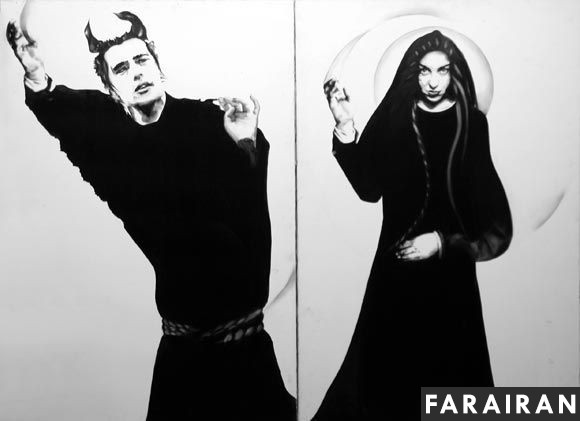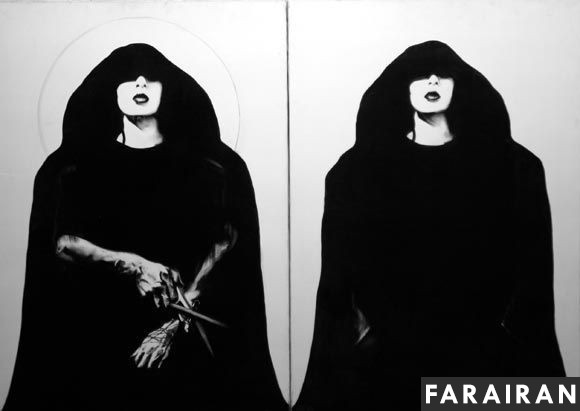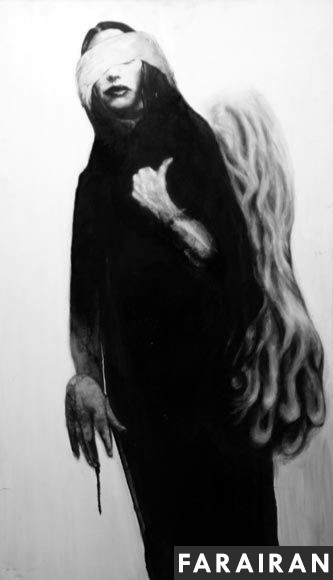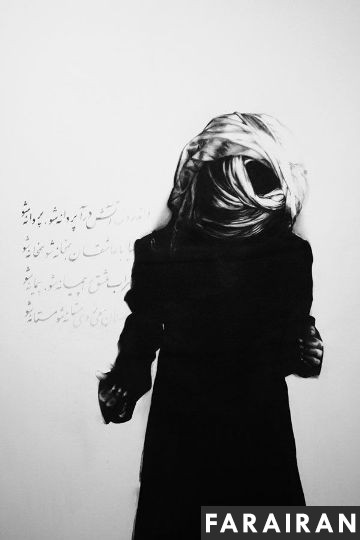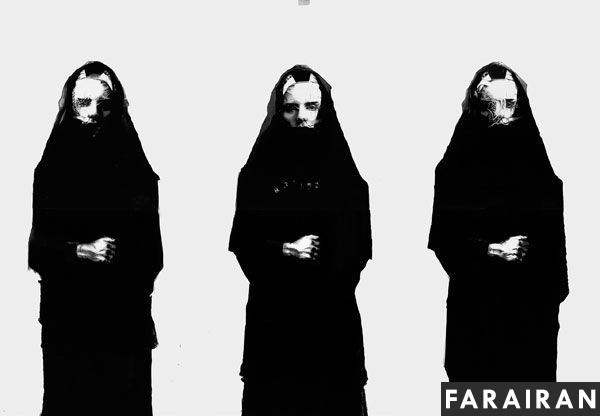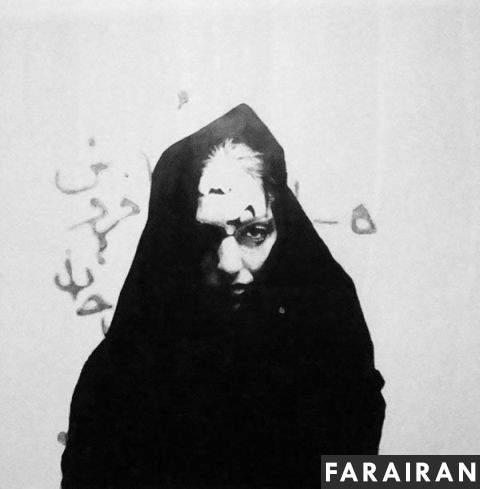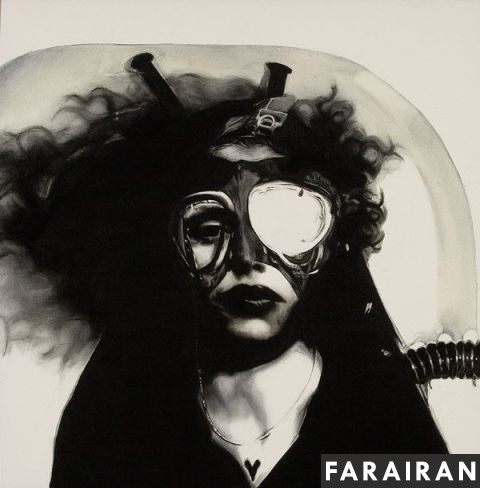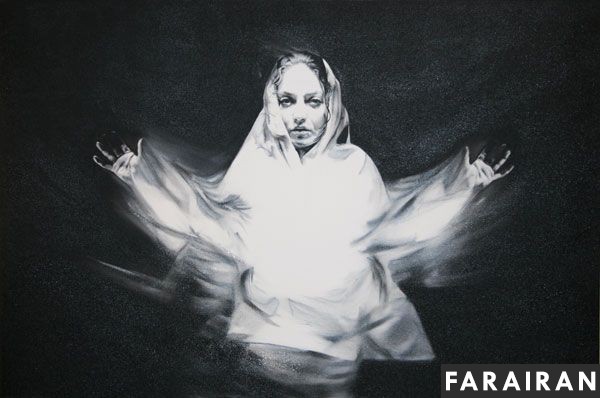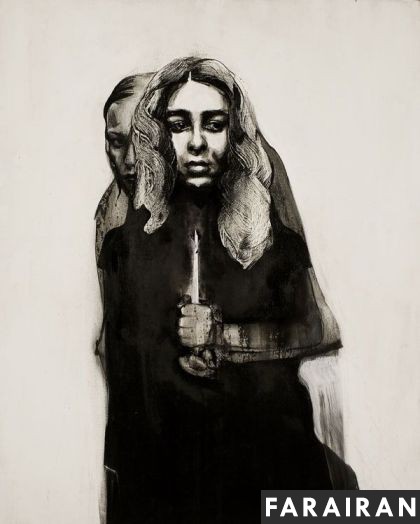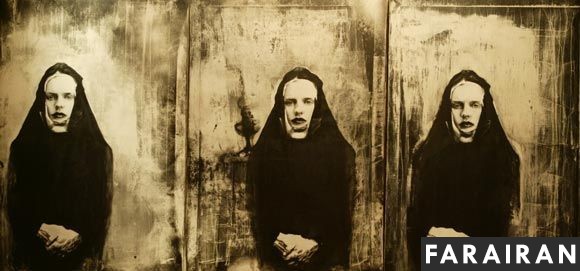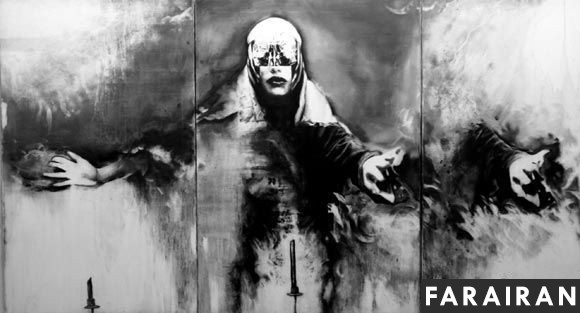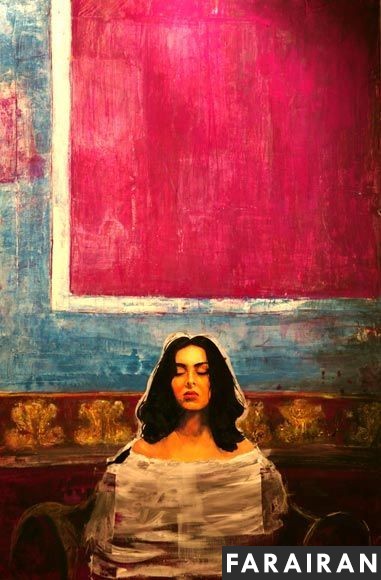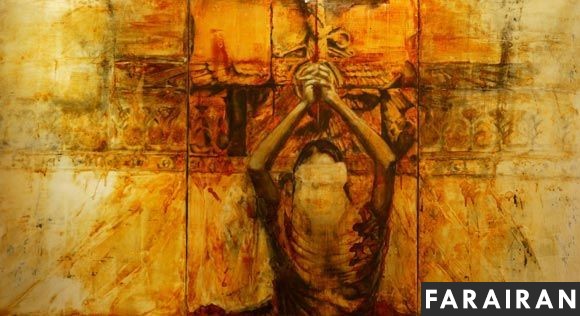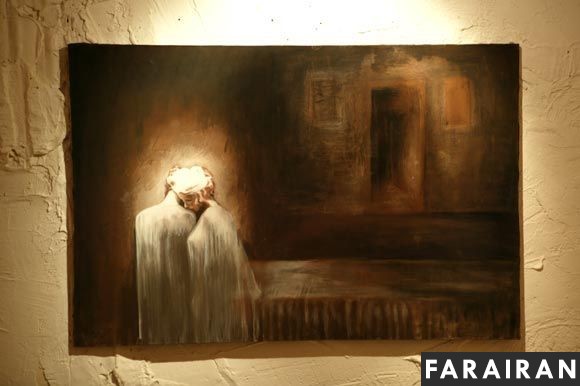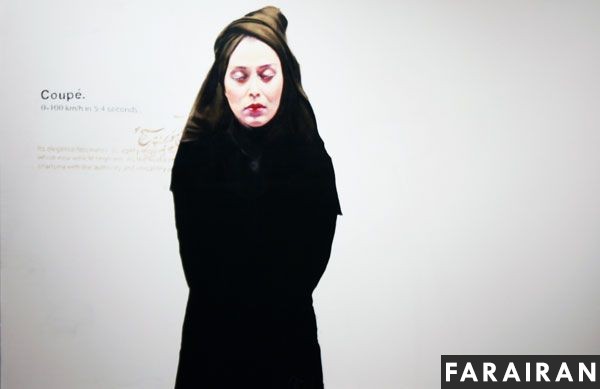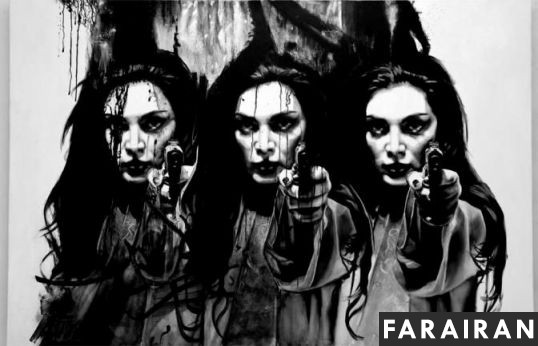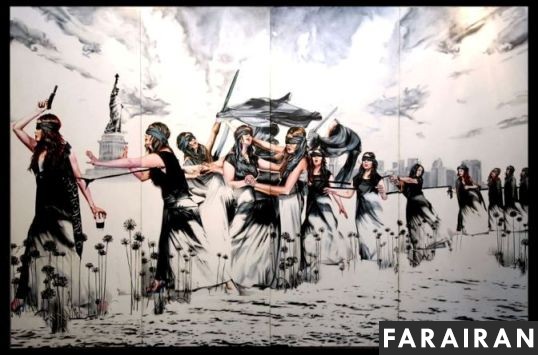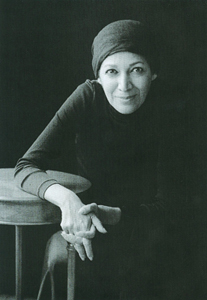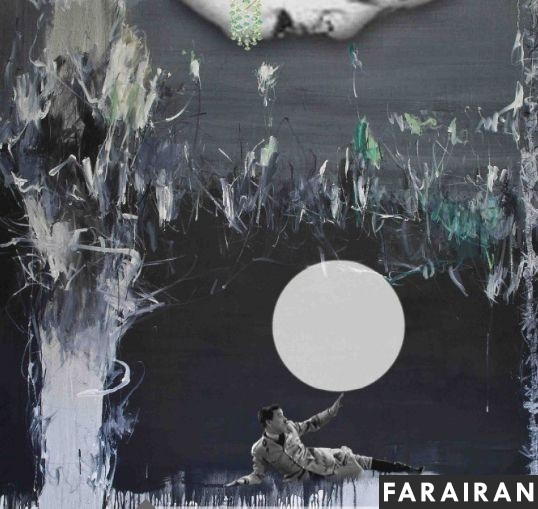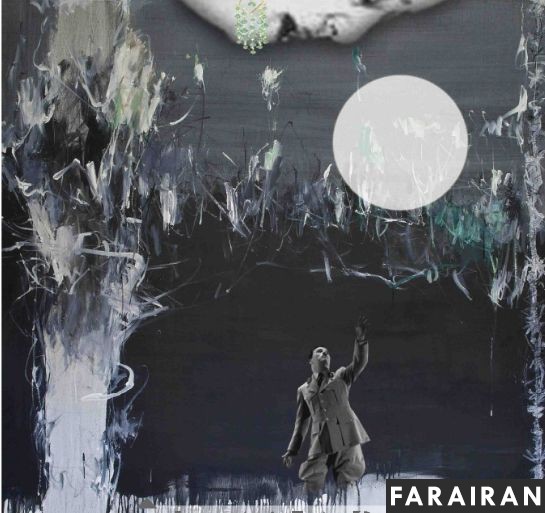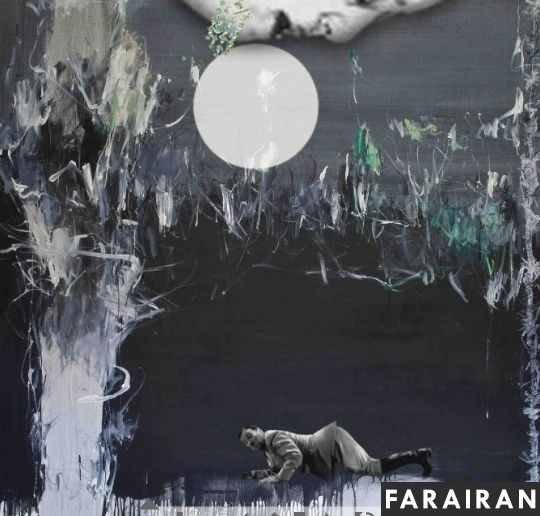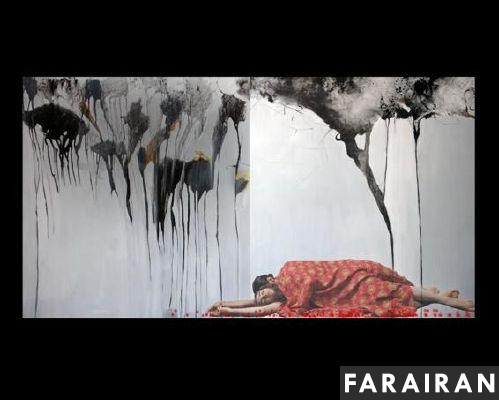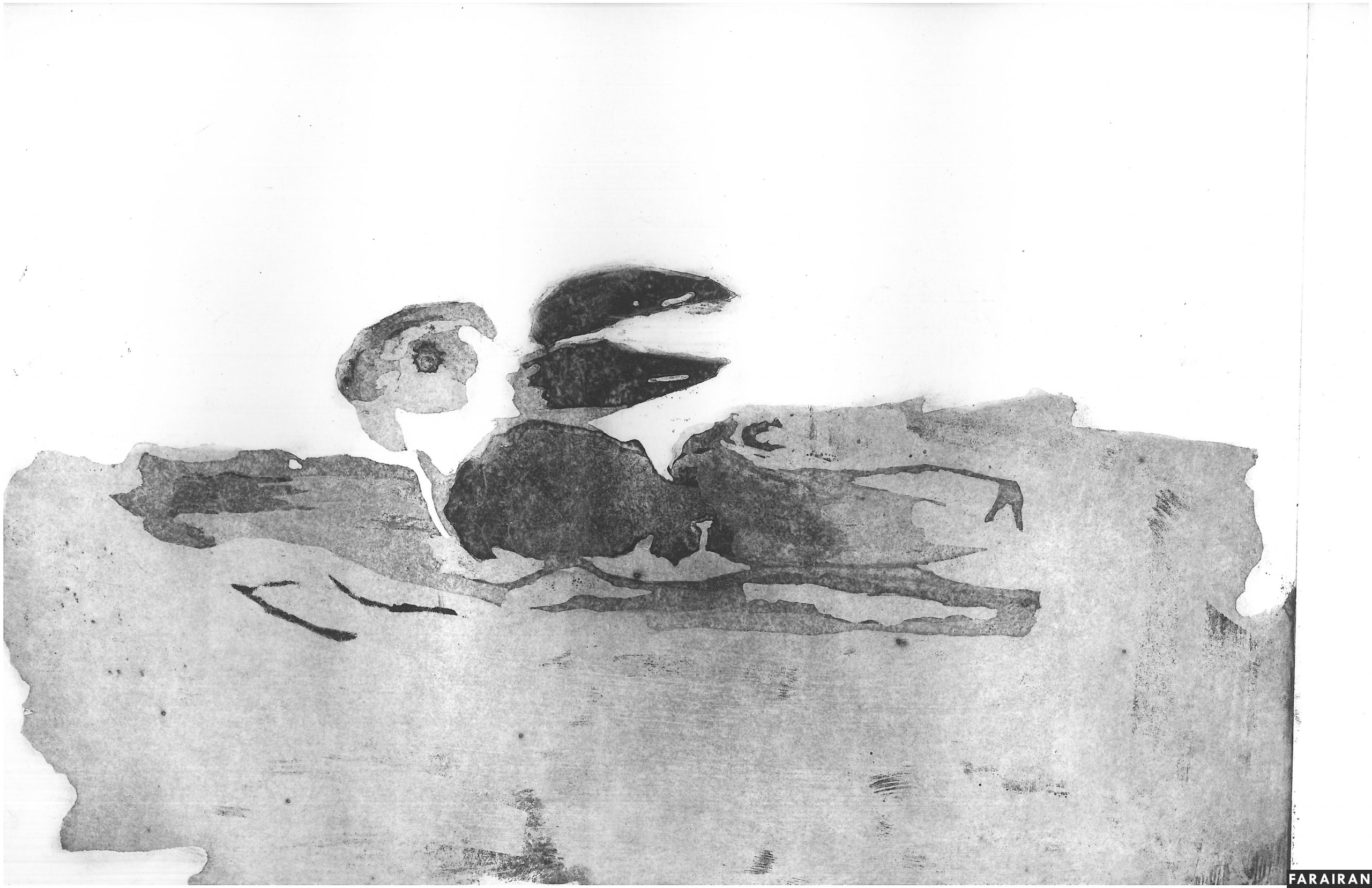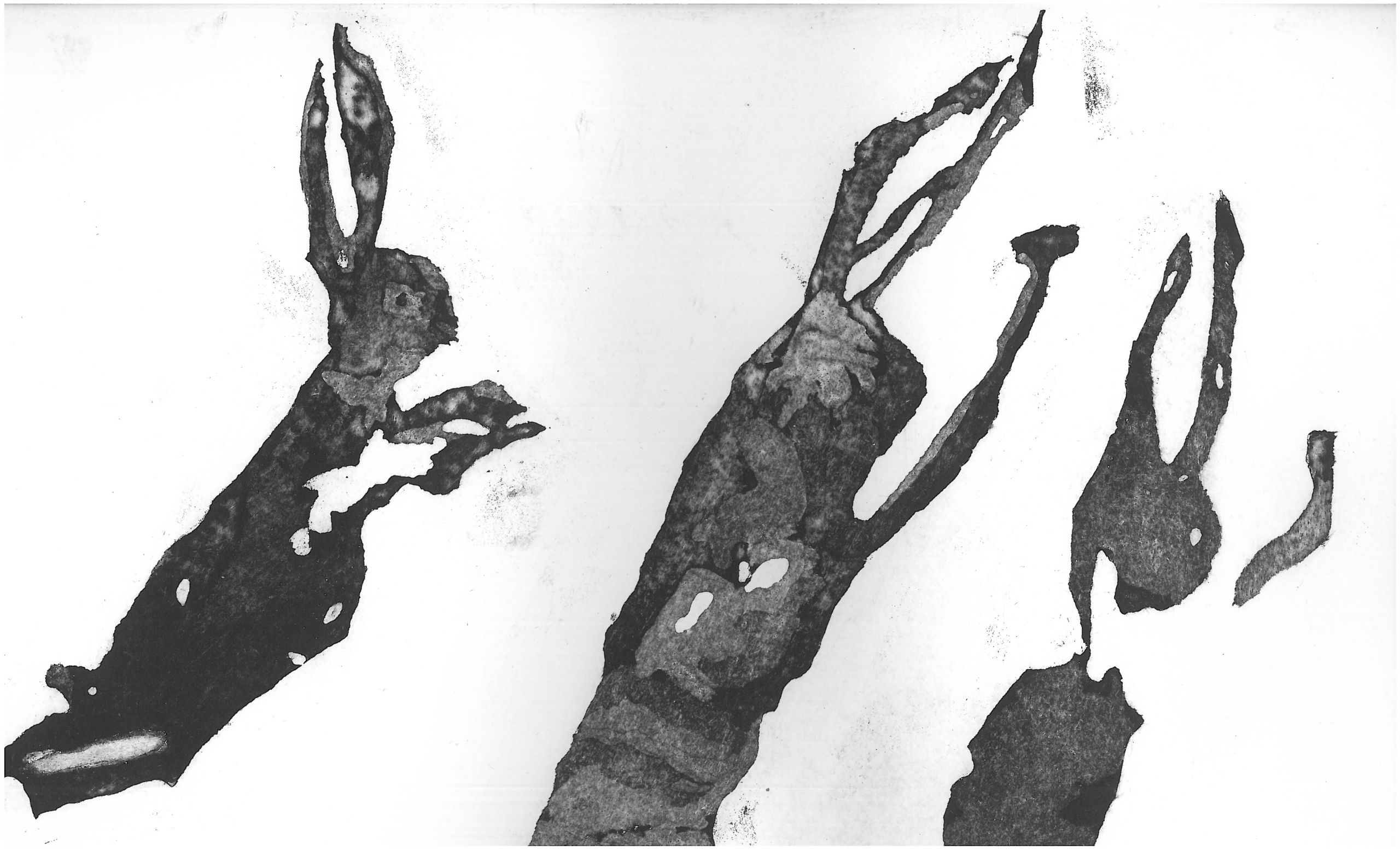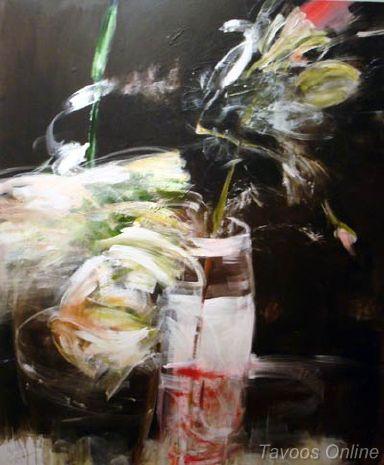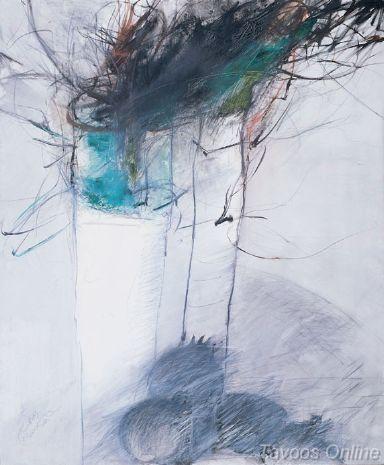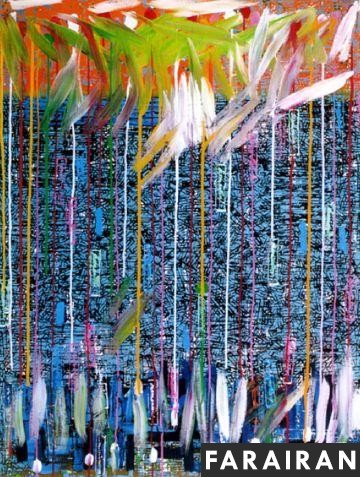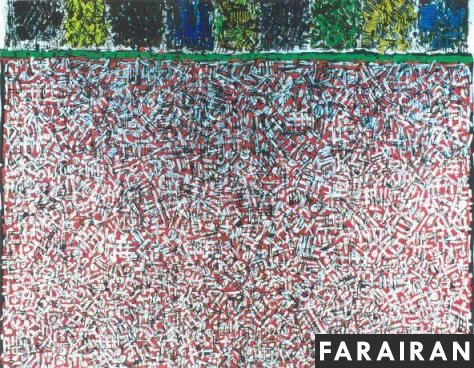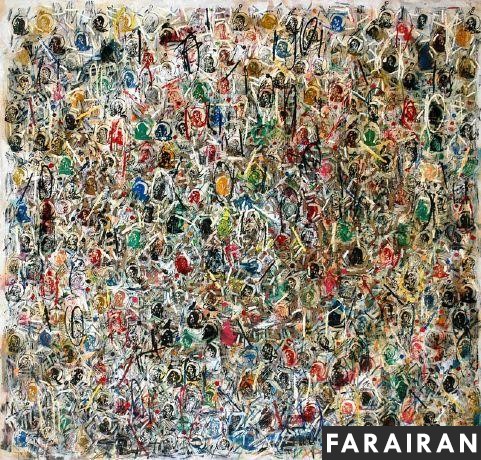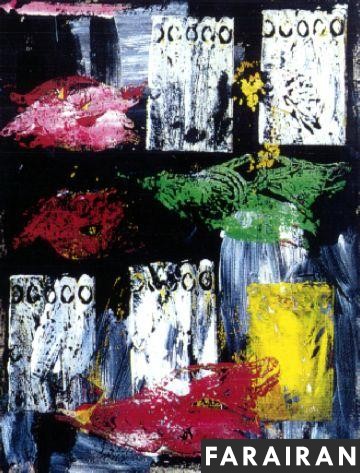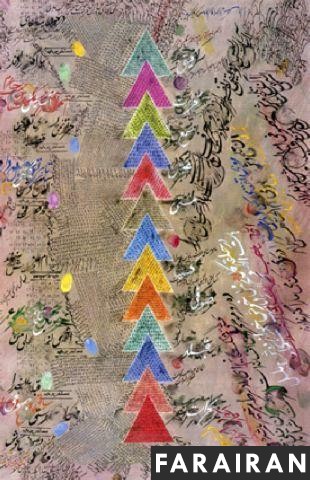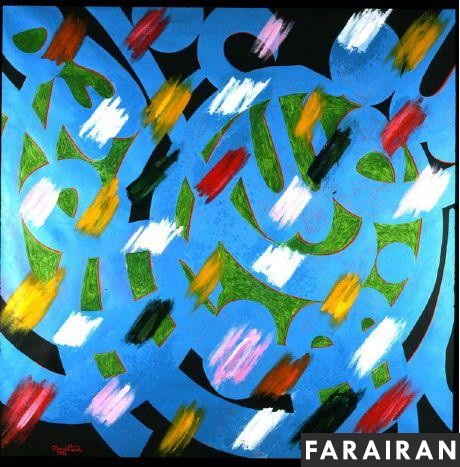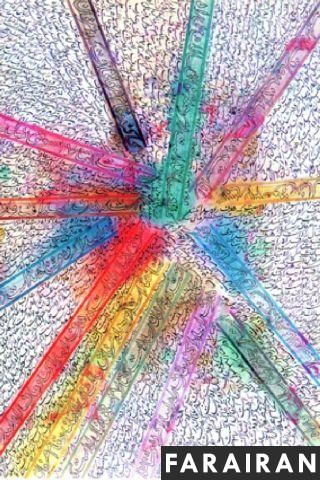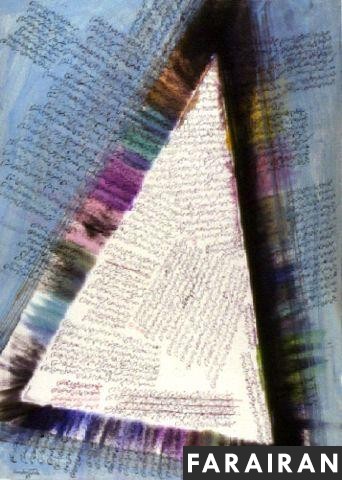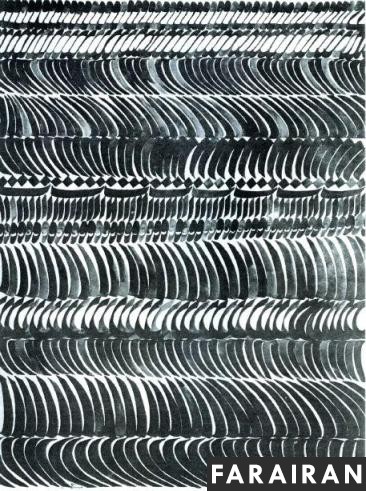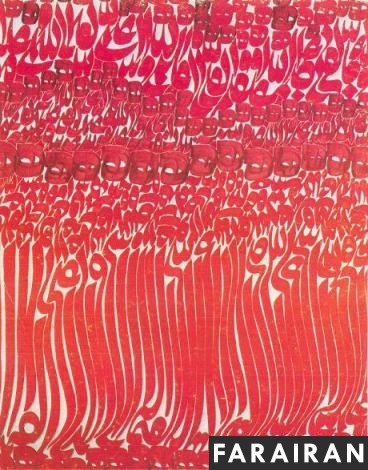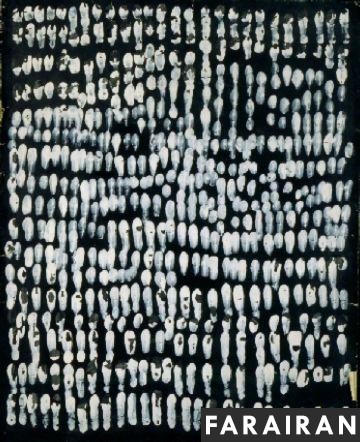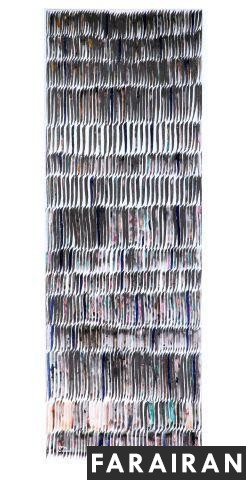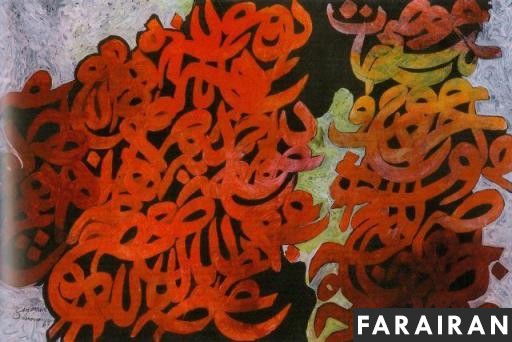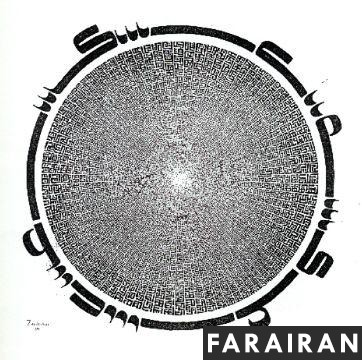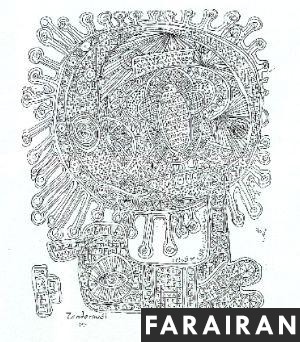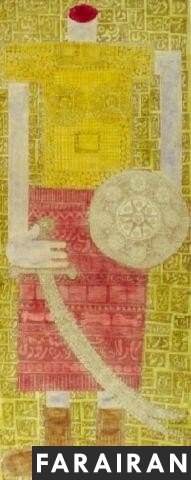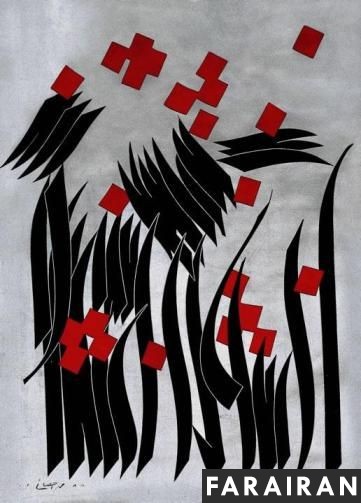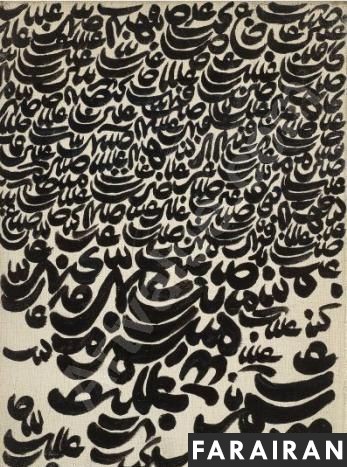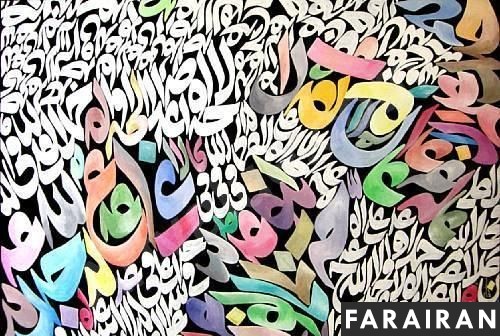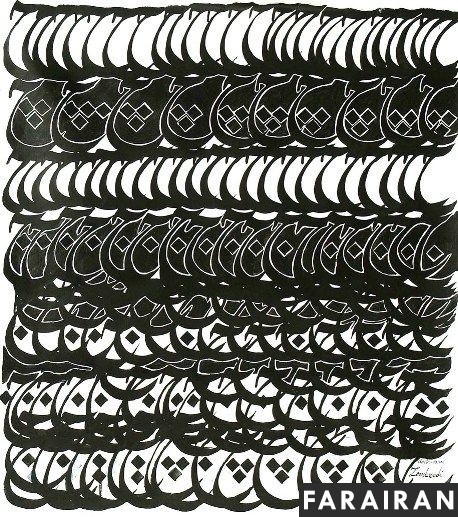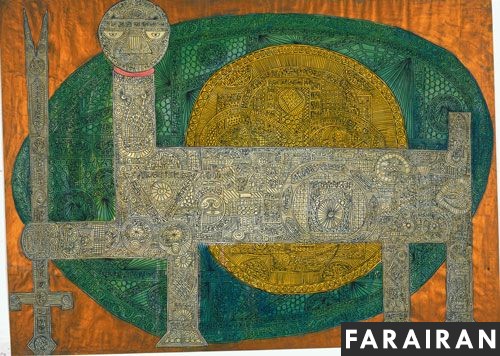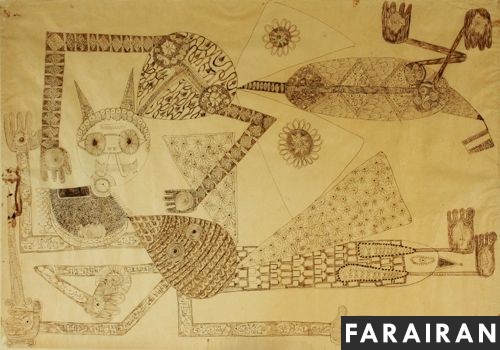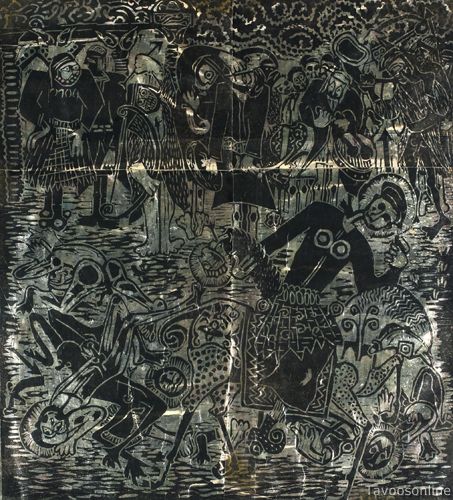
Farairan Choice Vahed Khakdan (Wahed Khakdan)
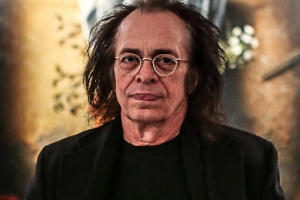
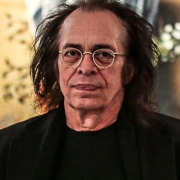
Wahed Khakdan

Born in 1950

Education:
School of Fine Arts 1968-1971
Faculty of Decorative Arts
BA in Interior Architecture 1971-1976

Solo Exhibitions:
1974 Seyhoun Gallery- Tehran1975 Ghandriz Gallery- Tehran
1976 Talar-e Iran Gallery- Tehran
1979 Seyhoun Gallery- Tehran
1981 The Museum of Contemporary Arts Tehran
1985 Burg Vondern- Oberhausen Cultural Center- Germany
1986 Galerie Conen- Oberhausen- Germany
1987 Kultur Zentrum K14- Oberhausen- Germany
1988 Kultur Werkstatt Arka- Essen- Germany
1988 Galerie Im Burgermeisterhaus Werden- Essen- Germany
1989 Stadtische Galerie Schloss – Oberhausen-Germany
1990 Galerie Ardrea Krieger- Dortmond- Germany
1991 Galerie E.P.-Dusseldorf- Germany
1992 Galerie kunstform Weiden- Koln- Germany
1995 Galeria Im Stadtsparkasse- Oberhausen- Germany
1995 Galerie Poly Print- Wuppertal- Germany
1996 Tifra Art Gallery- Maastricht-Holand
1998 VHS- Essen- Germany
1999 Galerie Im Tzu- Oberhausen- Germany
2001 Galerie E.P.- Dusseldorf- Germany
2002 Galerie Sindelgrube- Munchen- Germany
2004 Galerie E.P.- Dusseldorf- Germany
2005 Art Print via Sindelgrube Gallery, Munchen in Vienna- Austria
2007 Galerie Kunstler Inetiative Ruhgebiet- Oberhausen- Germany
2008 Special Pavilion in an exhibition of the artists of “Rein und Ruhe”
Area, Ludwing Galerie Schloss- Oberhausen- Germany
2008 Homa Gallery- Tehran
2009 Seyhoun Gallery- Tehran
2010 Naar Gallery- Tehran
2018 Mah Art Gallery – Tehran
2016 Iranshahr Art Gallery – Book Launch: ” A Day in Heaven”
& a Retrospective of artist’s artworks – Tehran
2012 Mah art Gallery – Tehran

Selected Group Exhibitions:

1974 International Artfair-Tehran with Cooperation of Le Saion d’Automme- Paris
1975 Contemporary Art of Iran- Persepolis Governmental Gallery
1976 Art Basel- Switzerland
1977 Iranian Contemporary Art-Apadana Gorememental Gallery- Tehran
1978 Portrait of Iranian Contemporary Art- seyhoun Gallery- Tehran
1981 The Museum of Contemporary Art- Tehran
1986 Stadtische Galerie Schloss- Oberhausen- Germany
1988 Stadtische Galerie Schloss- Oberhausen- Germany
1989 Kunstverein OB, Ludwig Galene- Oberhausen- Germany
1991 Galerie E.P. Dusseldorf-Germany
1991 Stadtische Galerie Schloss- Oberhausen- Germany
1992 Art Expo-LA.U.S.A
1993 Kunsthaus-Haven- Oberhausen- Germany
1993 Speing Fair International- Birmangham
1993 (Art Prints), Art Expo, New York, USA
1994 (Art Prints), Ambiente International- Frankfurt- Germany
1995 Galerie sabine Lulie- Wuppertal- Germany
1997 Kunstmeile- Oberhausen- Germany
2000 Kunstmeile- Oberhausen- Germany
2001 Ludwig Governmental Galerie Schloss- Oberhausen- Germany
2002 Art House Pavilion- Amdiente International- Frankfurt- Germany (Art Prints)
2003 The Museum of Contemporary Arts- Tehran
2004 Ludwing Governmental galerie Schloss – Oberhausen- Germany
2005 The 4th International Painting Biennial of the Islamic World- SabaMuseum-Tehran
2006 Iranian Art in 60s and 70s- The University of Fine Arts (Negarkhane-ye Tehran)
2007 The 7th Painting Tehran Biennial- Painting in 60s and 70s- Saba Museum- Tehran
2007 Niavaran Cultural centre “Haft-Negaaj”
2008 Royal Mirage- Bonhams- Dubai
2009 Mah-e-mehr Gallery- Tehran
2009 Homa Gallery- Tehran
2009 Bonhams- dubai
2009 Bonhams- Dubai
2009 Christis- Dubai
2009 Ludwig Museum Gallery- Oberhausen- Germany
2020 Aria Art Gallery – Silkscreen Prints – Tehran
2019 White Line Gallery – Tehran
2019 Mah Art Gallery – Summer Group Exhibition – Tehran
2019 Hoor Art Gallery – Silkscreen Prints – Tehran
2018 Mah Art Gallery – Summer Group Exhibition- Tehran
2018 Imam Ali Museum – 2 Centuries of the Art of Drawing in Iran – Tehran
2017 White Line Art Gallery – Tehran
2017 Seyhoun Art Gallery – 50 years Seyhoun Gallery- Tehran
2017 Tehran Museum of Contemporary Art-The Fadjr International Festival of Visual Arts 2017 Shokouh Art Gallery – Tehran
2017 Mah Art Gallery -Drawing Group Exhibition – Tehran
2017 Mah Art Gallery – Summer Group Exhibition -Tehran
2016 White Line Art Gallery- Tehran 2016 Niavaran Cultural Center – Haft Negah -Tehran 2016 Iranshahr Art Gallery -Home -Tehran
2016 Mah Art Gallery – Iranian Contemporary Artists – Summertime – Tehran
2015 San Giorgio Maggiore – Luciano Benetton Collection – Venice – Italy
2015 Iranian Artist Forum – Annual Exhibition / Association of Iranian Painters- Tehran
2015 Homa Art Gallery – Iranian Contemporary Drawing – Tehran
2014 Iranian Artists Forum -Annual Exhibition / Association of Iranian Painters – Tehran 2014 Sam Art Gallery “Pejman Collection” – Tehran
2014 Mah art Gallery – Iranian Contemporary Artists – Summertime – Tehran
2013 Shirin Art Gallery & Homa Art Gallery – Tehran
2013 IBS Project – London “Auction “- London – UK
2013 Mah Art Gallery – Summer Group Exhibition – Tehran
2013 Etemad Art Gallery – in memory of Lucien Frruend – Tehran
2012 Shokouh Art Gallery – Wonderland – Tehran
2012 Niavaran Cultural Center -Haft Negah – Tehran
2012 Ferya Art Gallery Tehran
2012 2nd Tehran Auction – Modern and Contemporary Irainian Art -Tehran
2012 Rira Art Gallery – Dubai
2012 The 8th Iranian National Biennial of Painting – Saba Museum – Tehran
2011 Shirin Art Gallery – Tehran (1st Modern and Contemporary Visual Art’s Auction )
2011 Seyhoun Gallery(Project Seven) – Tehran
2011 Saba Museum of Tehran- Collection of Tehran School of Fine Arts -Tehran
2011 Shirin Art Gallery (Doll) – Tehran 2010 Sin Art Gallery – Tehran
2010 Faravahar Gallery – Iranian Contemporary Artists – Tehran
2010 Preussen Museum – Wesel – Germany
2010 Gallery in Burgermeisterhaus – Werden , Essen -Germany
2010 Ludwig Gallery -schloss Oberhausen (Oberhausen Palace) Germany
2010 Naar Art Gallery – Tehran

Other Artistic Activities:

1981 Puppet design for the “Magic bean” puppet, theater directed by Ardeshir Keshavarz (Teater-e- shahr)
1982 Stage, Costume and Mask design for Greeny, Childrens Friend, Dierected by Reza Jiyan (Teater-e-shahr)
1988 Stage and puppet design for the tele-theater the “CaterpillarStory”, directed by Ardeshir Keshavarz in
Cooperation’s with IRIB, theaters for children and teenagers
1983-2010 Illustrating more than 40 children and teenager books and cooperating with more than 10 publishing companies in Iran, Germany, Switzerland and Austria. Creating more than 80 Art prints, limited edition.
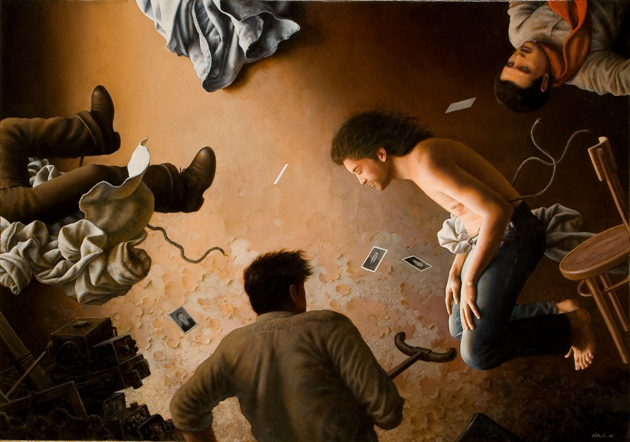
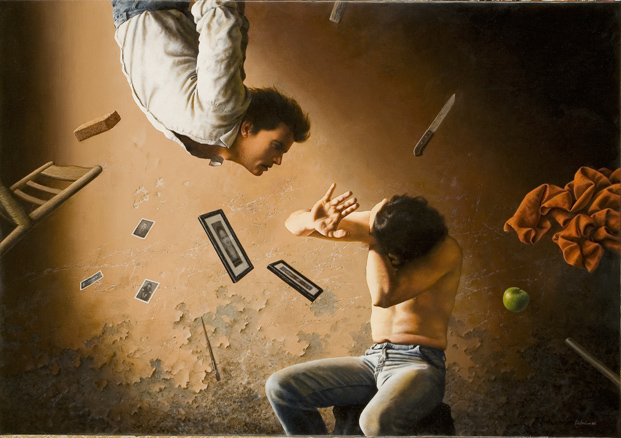
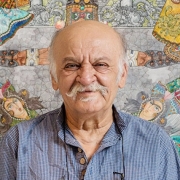
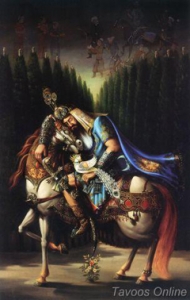
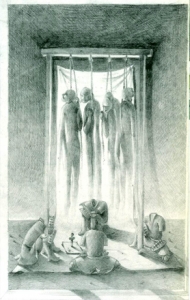
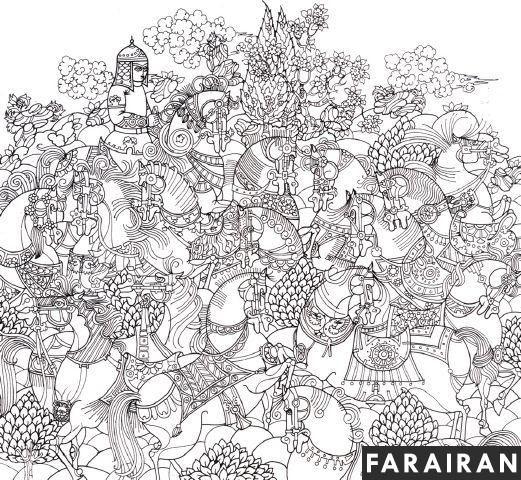
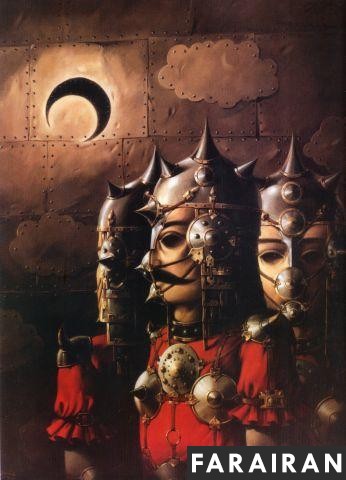
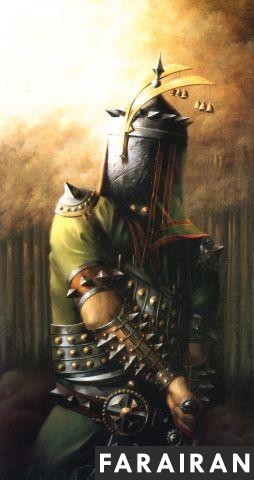
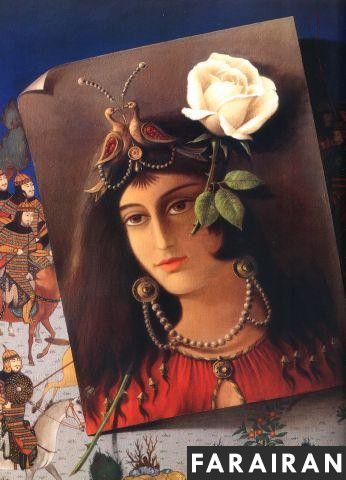
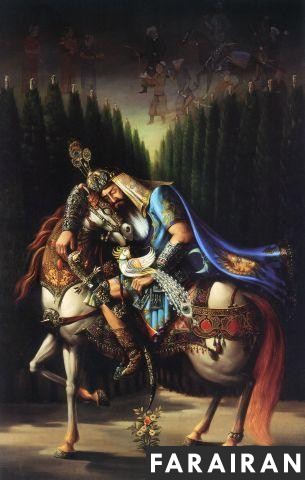
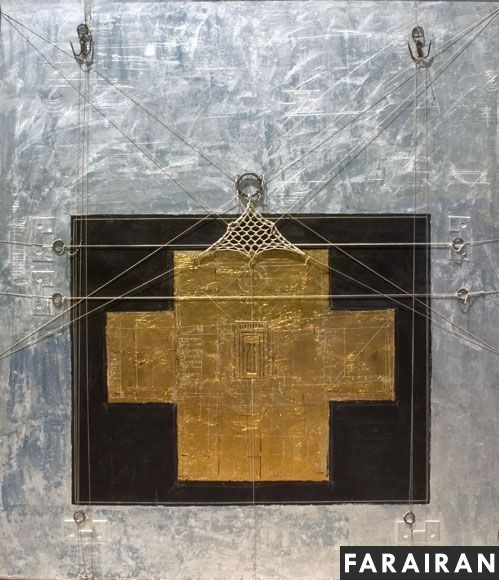
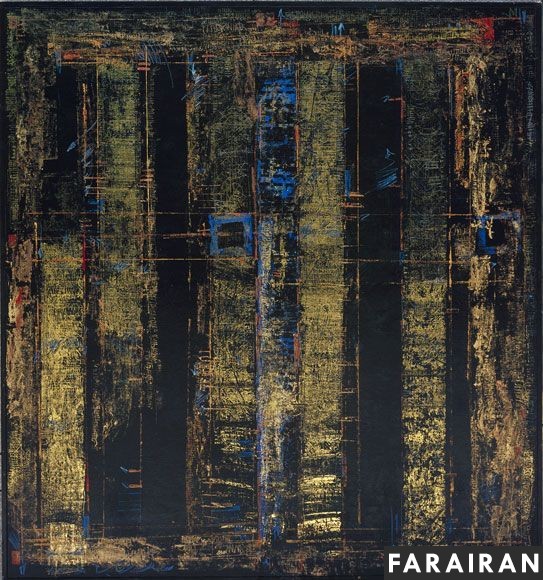
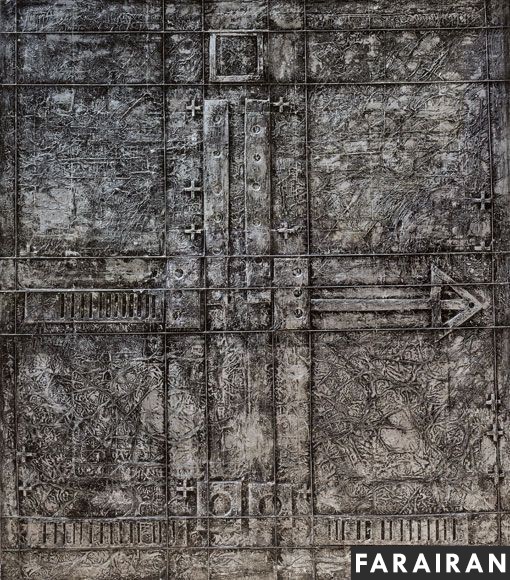
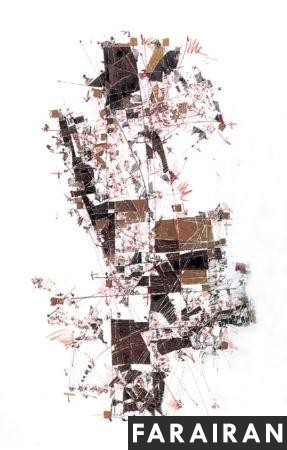
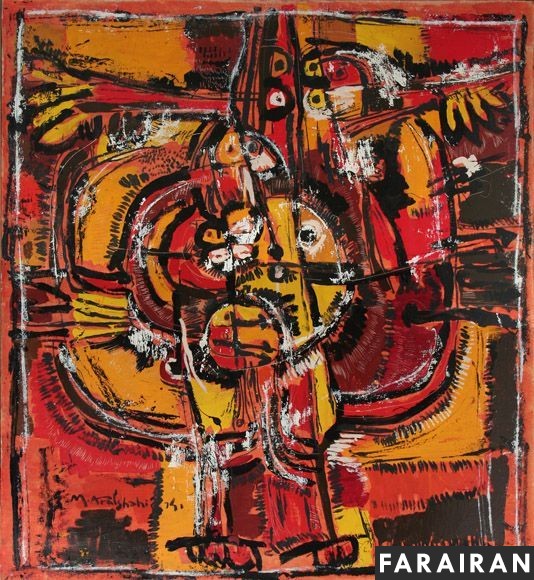
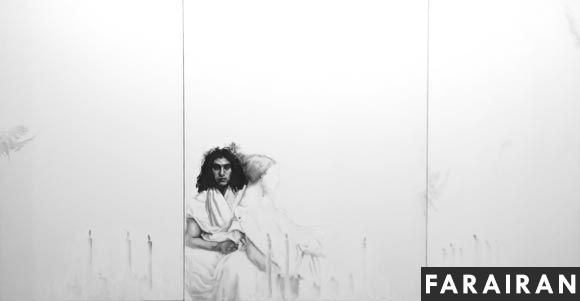
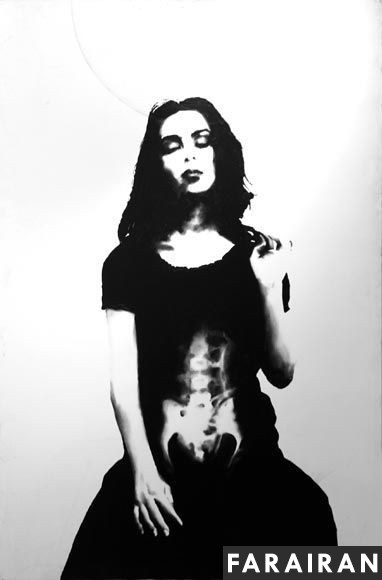
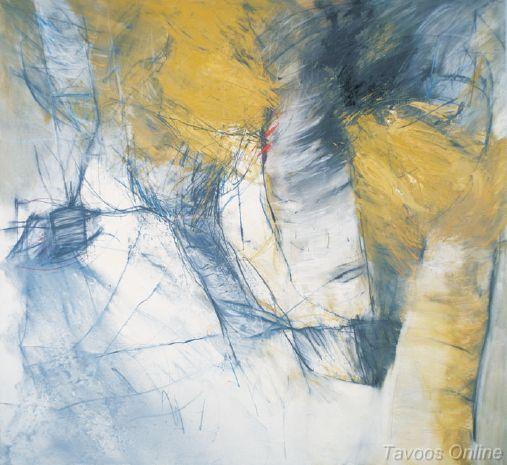
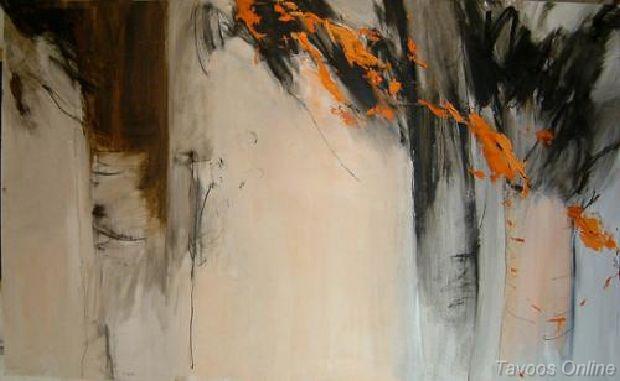
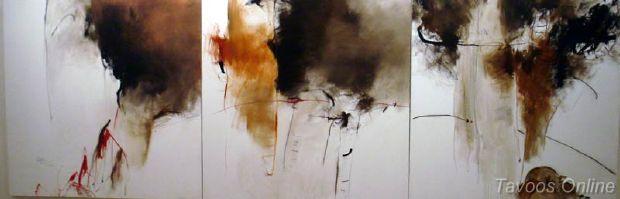
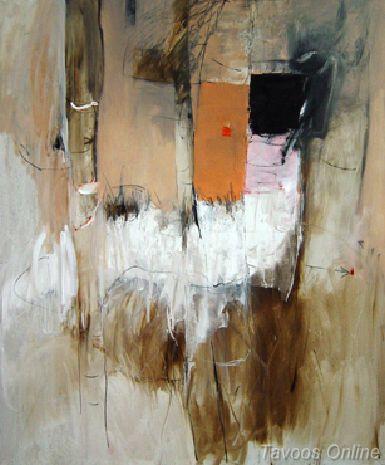
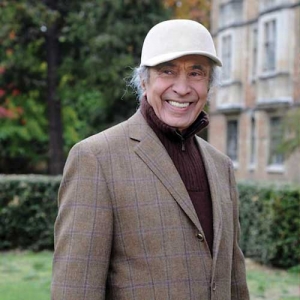
Born in 1950 in Tehran Vahed Khakdan began painting in childhood. “The walls of my kindergarten were always covered with my drawings and everyday the children of our neighborhood, carrying coal and plaster, knocked at our door, calling me outside to begin covering the asphalt pavement with strange animals and figurines… And in high school, I won three drawing medals from the erstwhile Ministry of Culture,” recounts Khakdan in his interview with Shafaq Sa’ad (Farairan Art Quarterly, No.3-4, 2000).

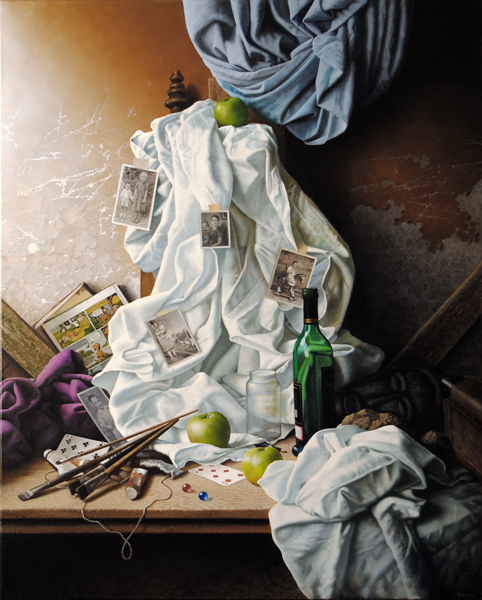
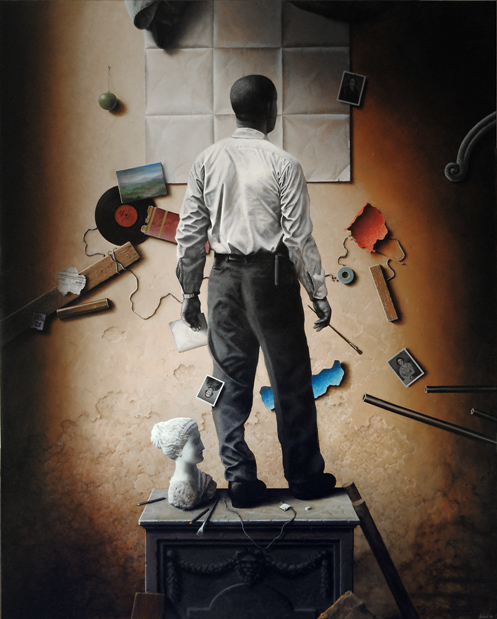
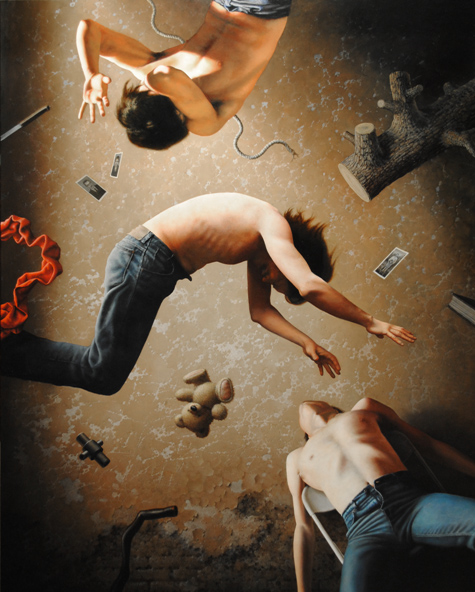
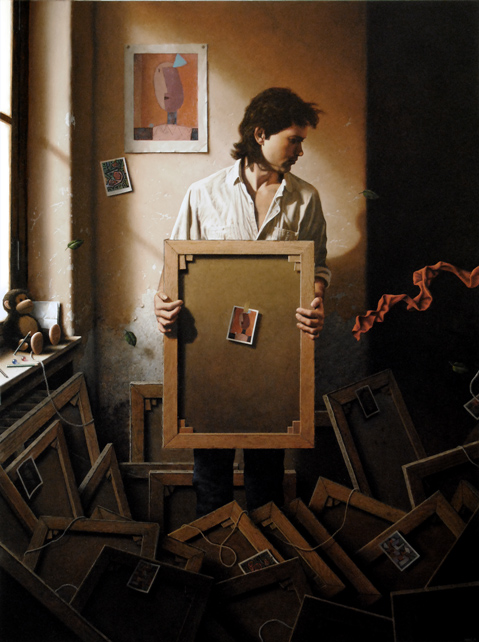
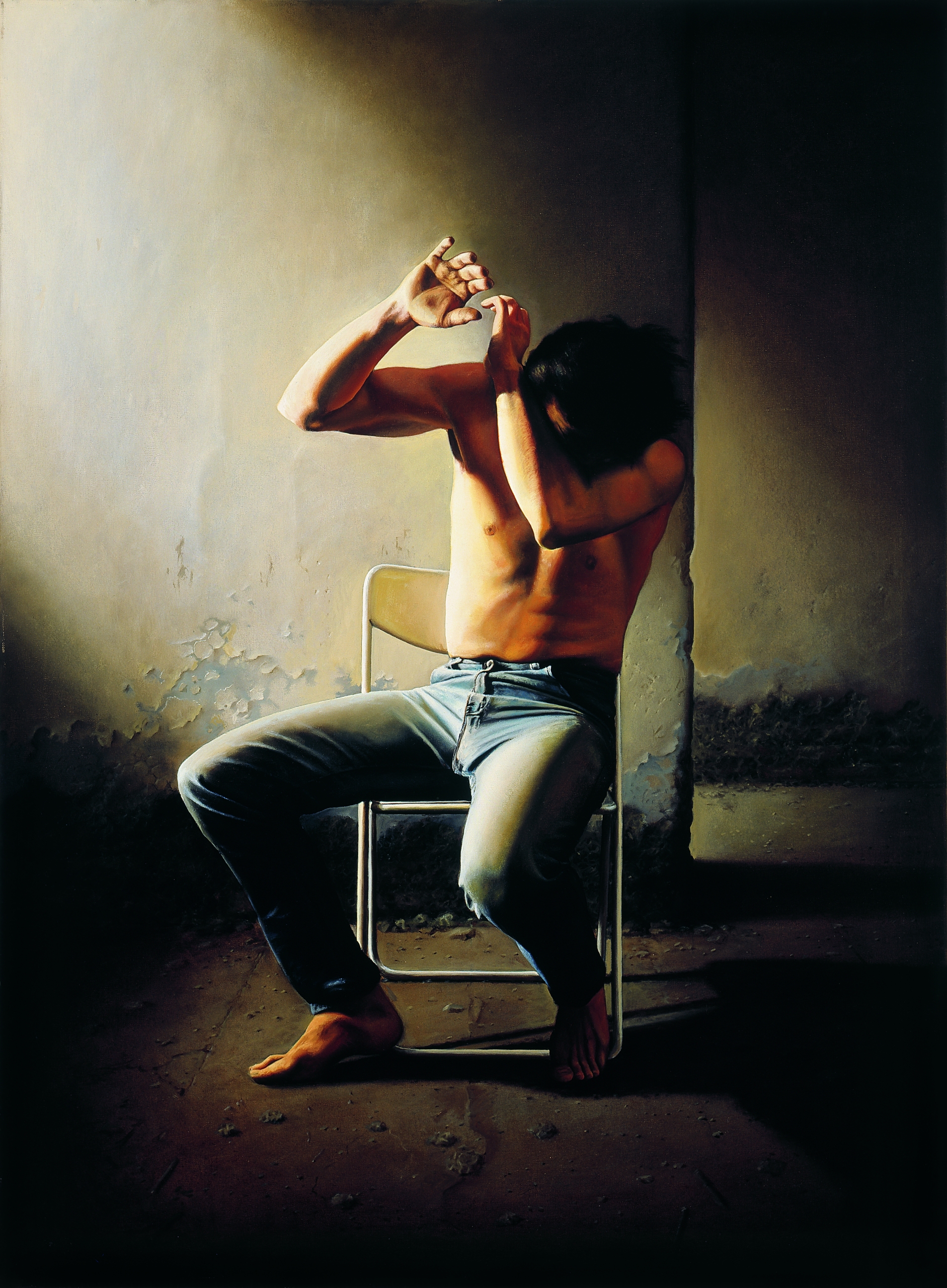
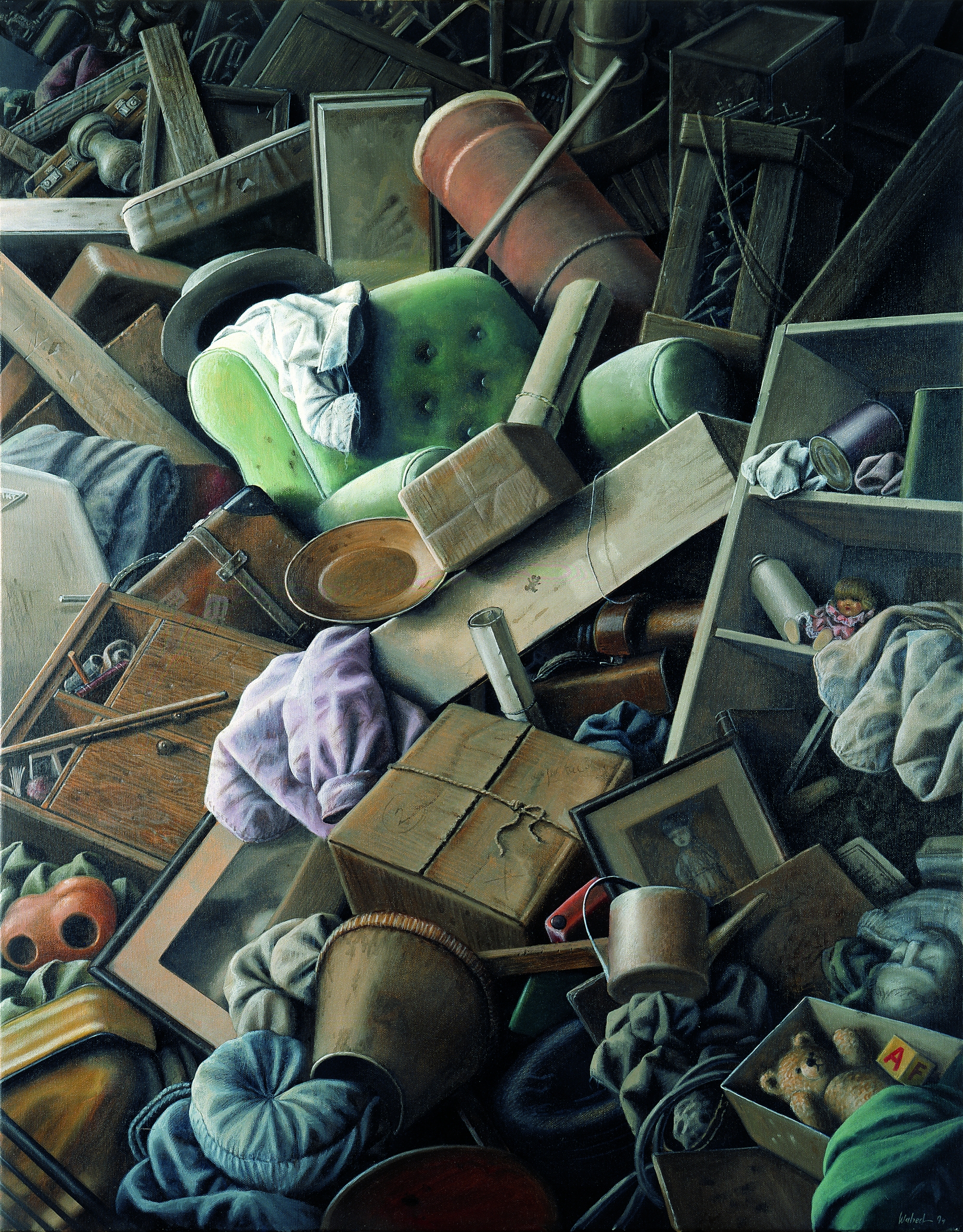
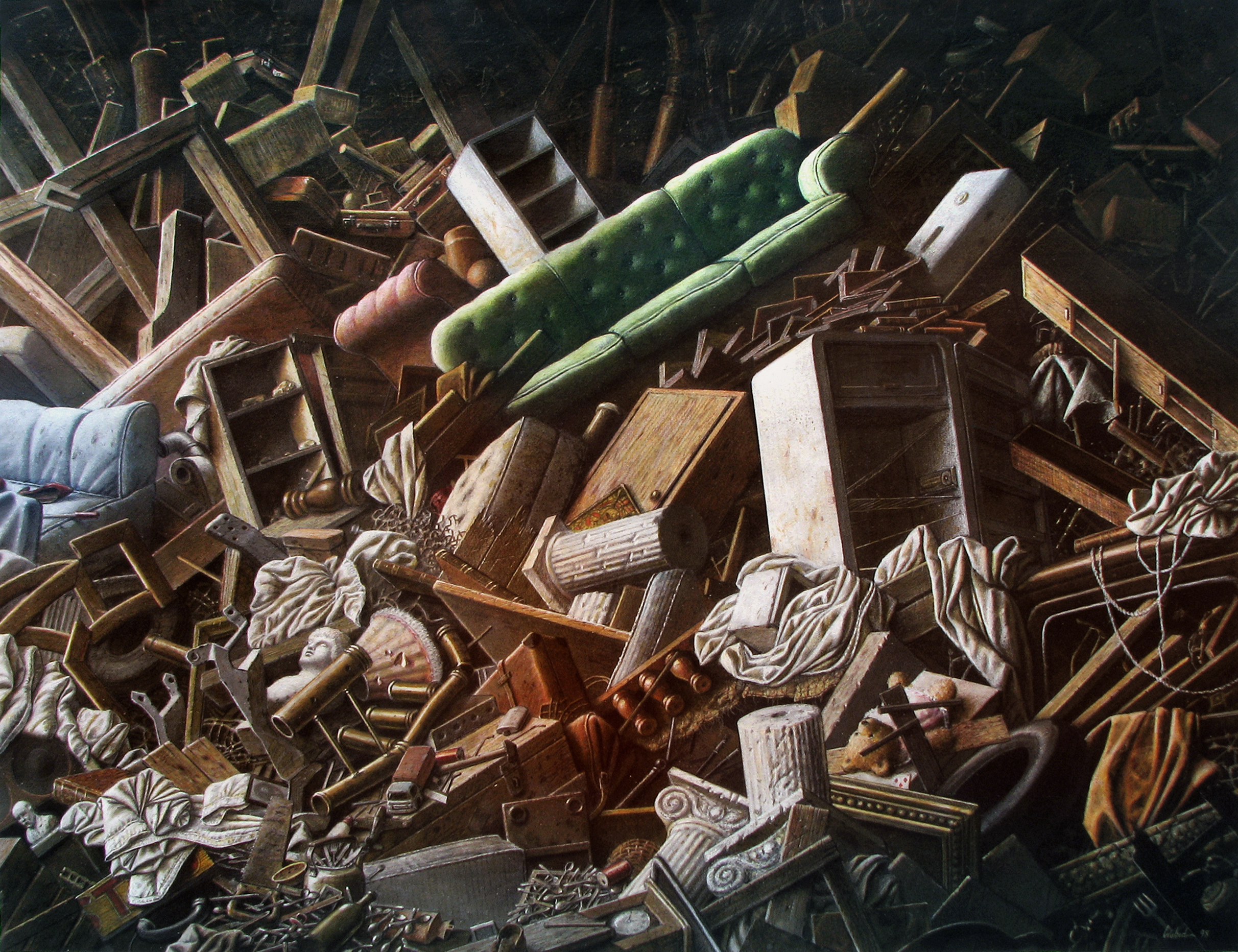
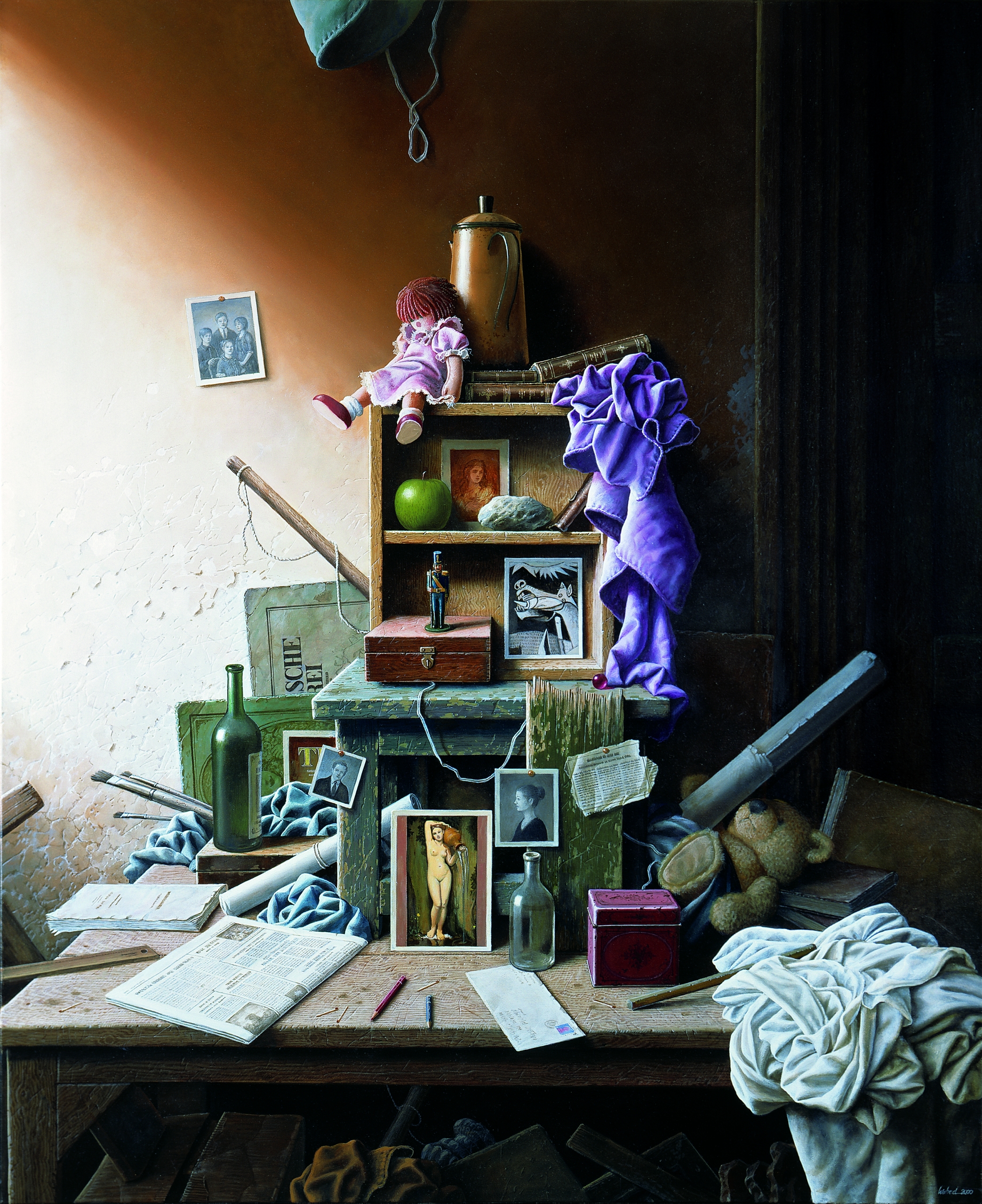
His father was a forerunner of theater and cinema stage design in Iran: “I often accompanied my father when he went to work in movie studios and theaters, watching him create the various scenes he had designed. I also spent a great part of my childhood in my father’s library, which was filled with art books. For this reason, I never lacked materials and, most importantly, my father, who was my first art teacher, taught me many techniques concerning the use of art materials. Traces of my father’s stage design skills are still perceptible in my present-day works, particularly in paintings in which I depict. Generally speaking, theatrical stage design is always visible in my works.”

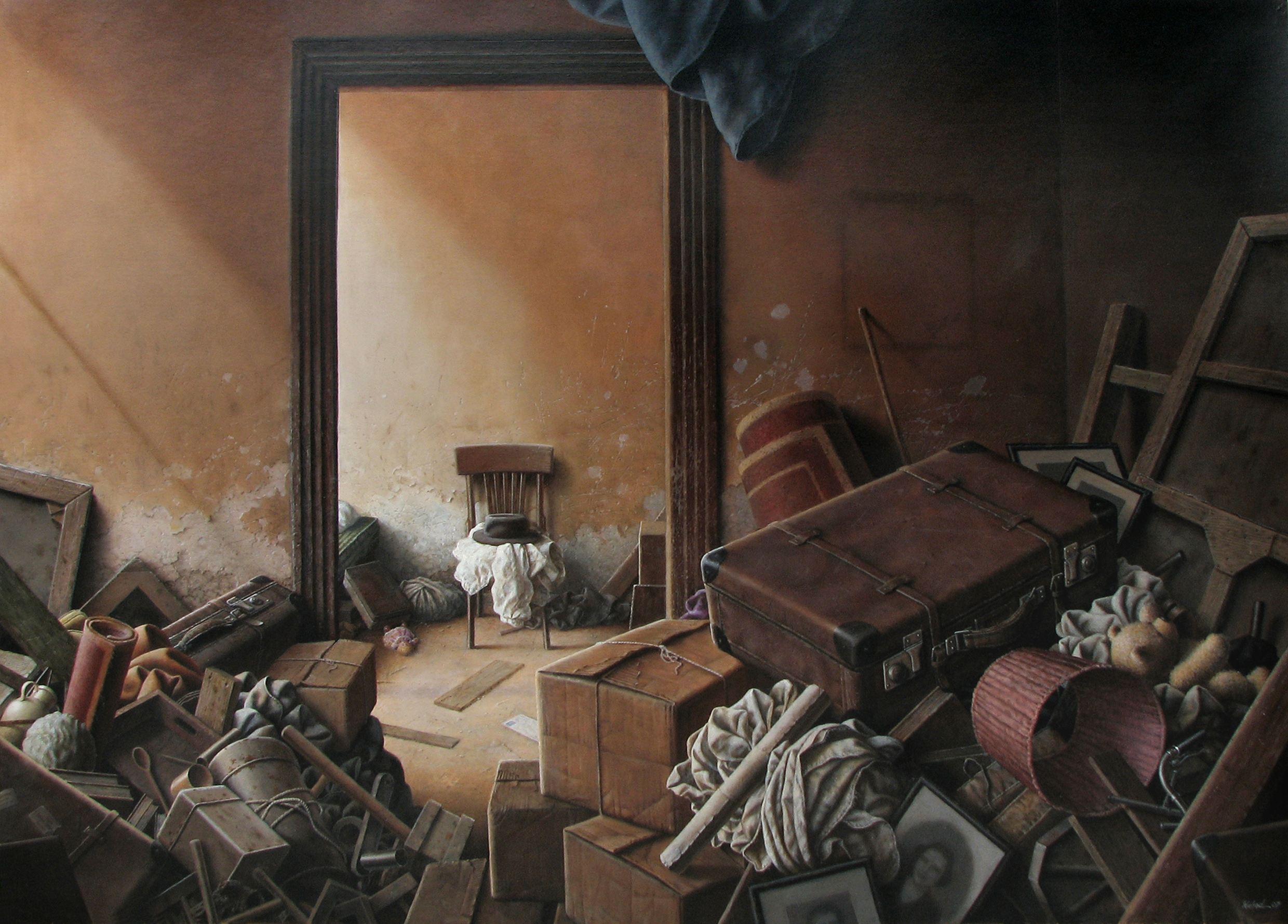
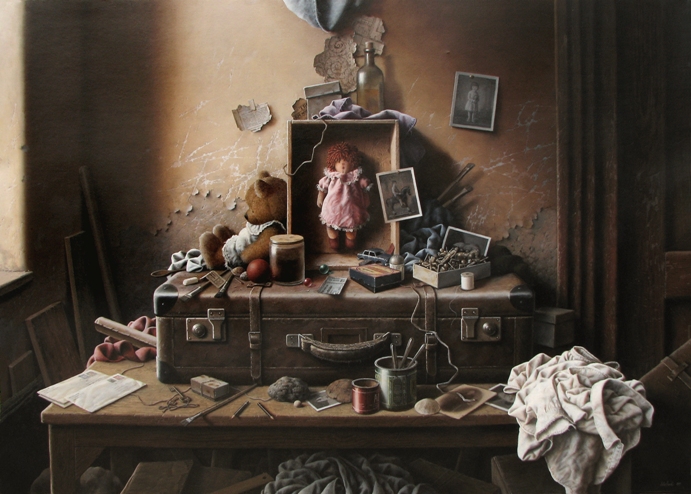
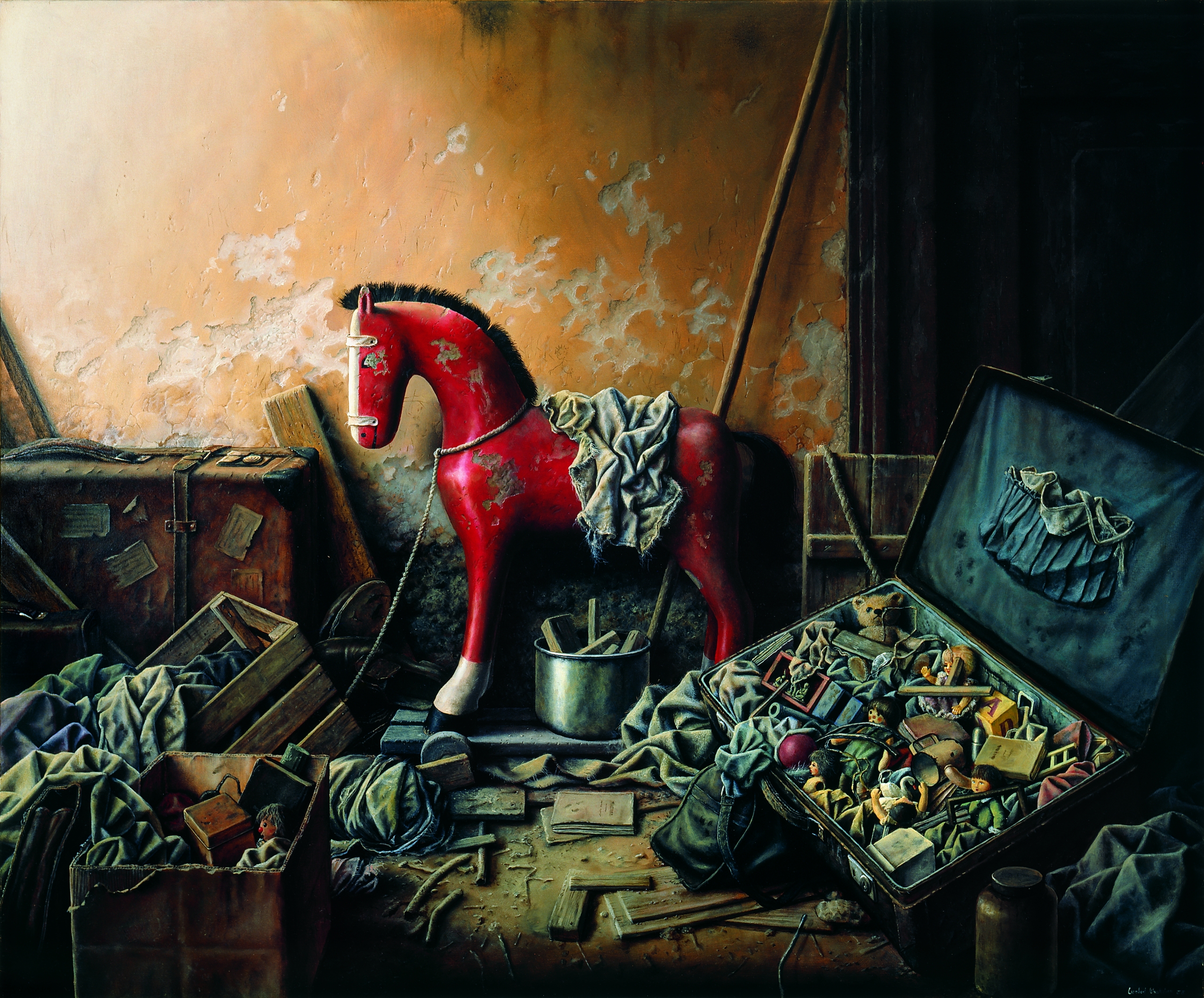
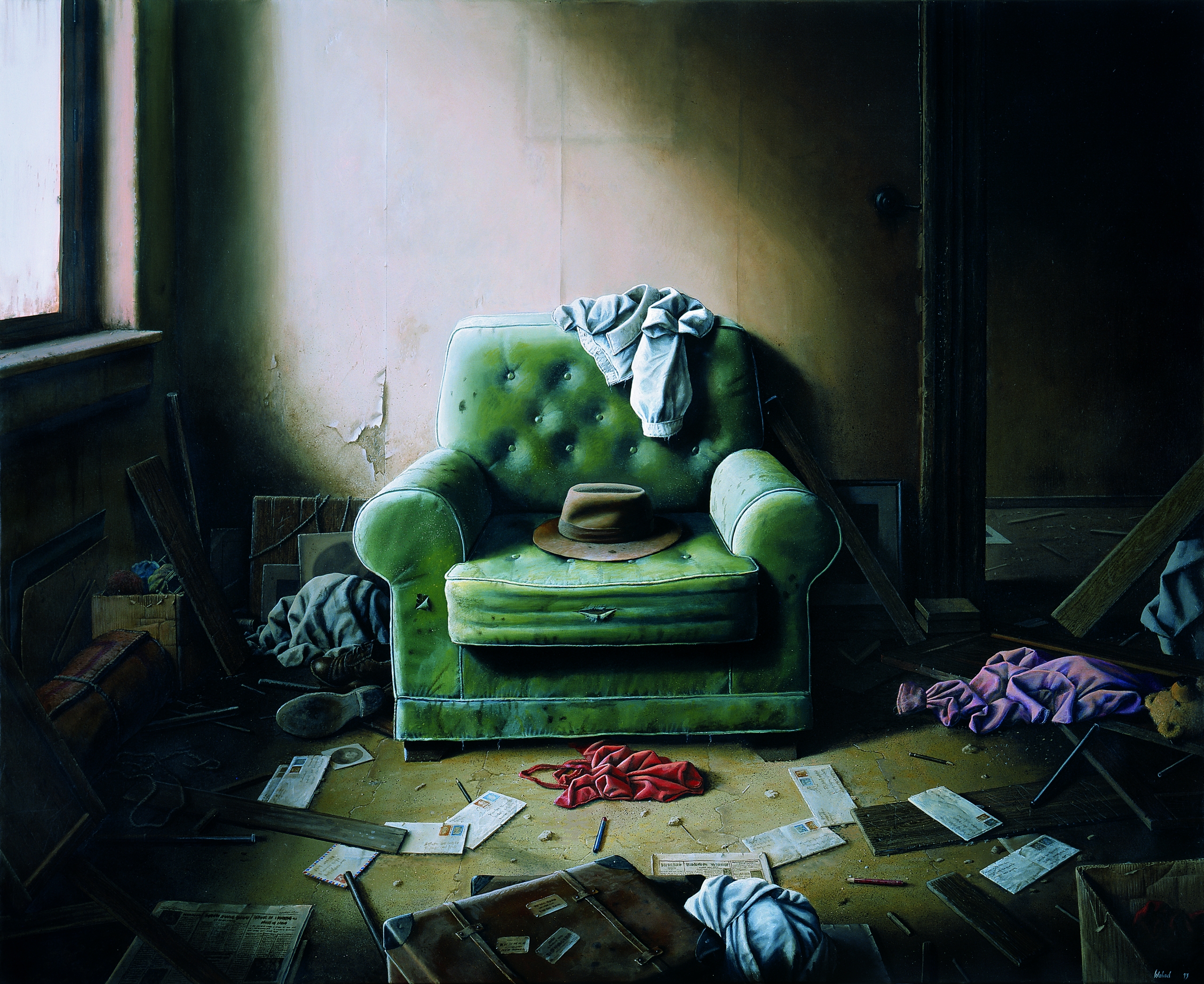
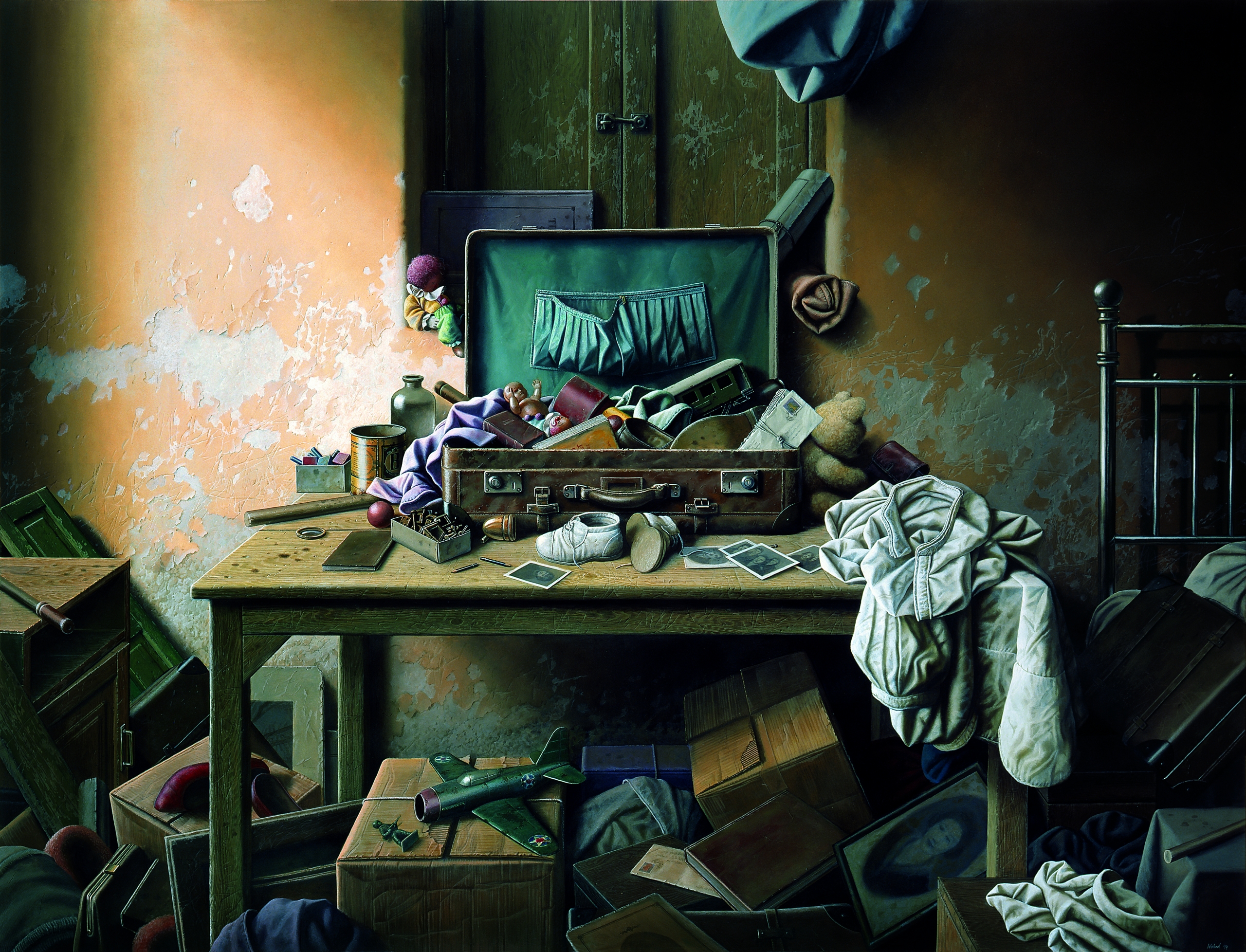
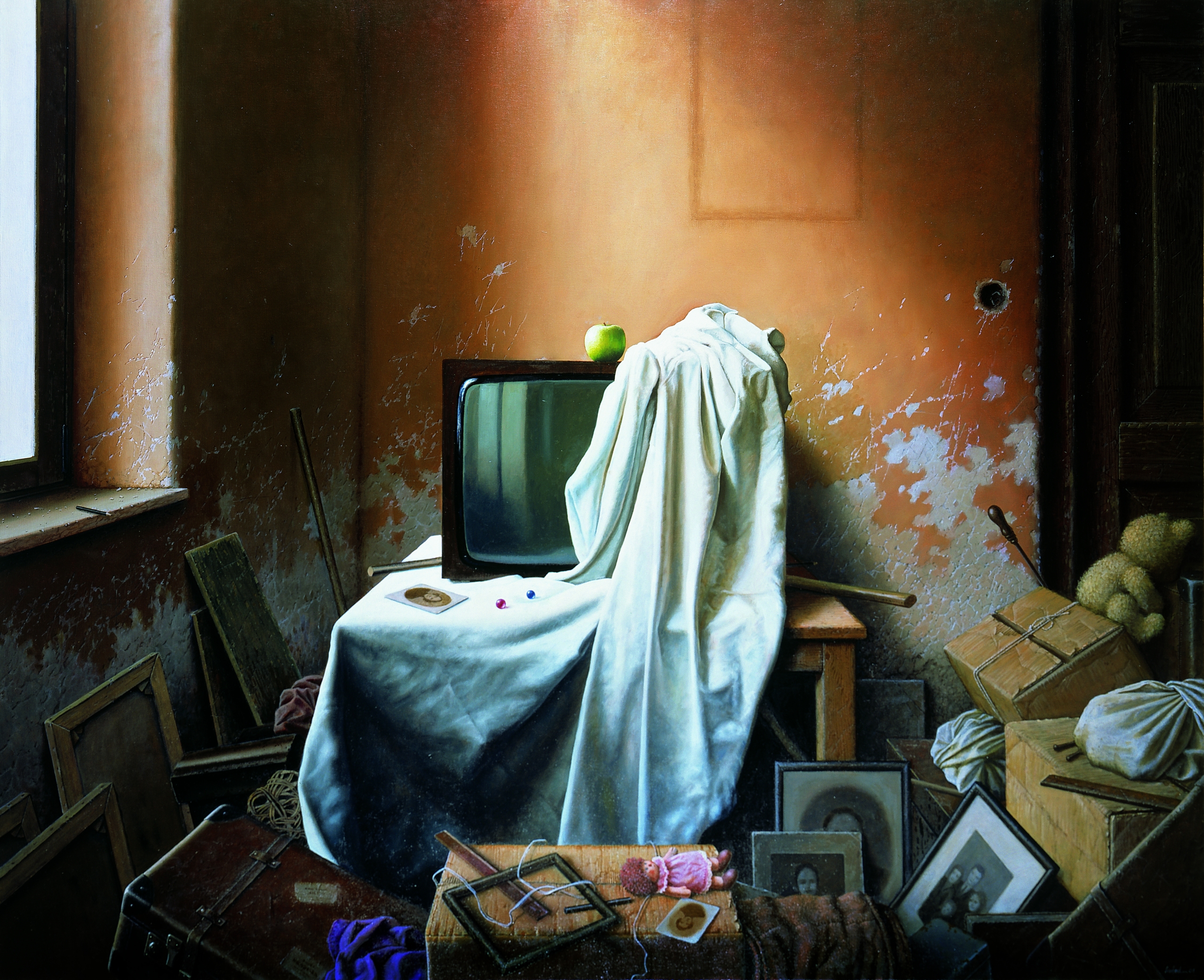
His mother – in love with sculptures – was the person who encouraged him to paint. In his own words: “My mother and father were both keenly interested in art. In addition to books, my father voraciously collected engravings of famous Baroque and Renaissance painters and 19th century and early 20th century realists. My mother was deeply in love with sculpture and she had a small collection of brass and porcelain statues, and she could never part with old familial objects. In our house, there was a room cluttered with old objects, including our grandfathers’ and grandmothers’ suitcases.”

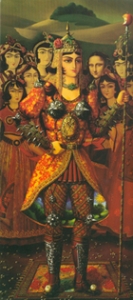
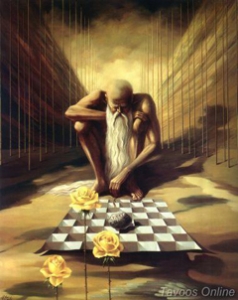
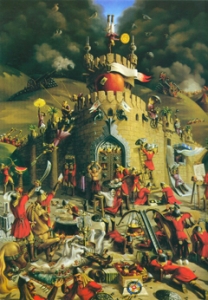
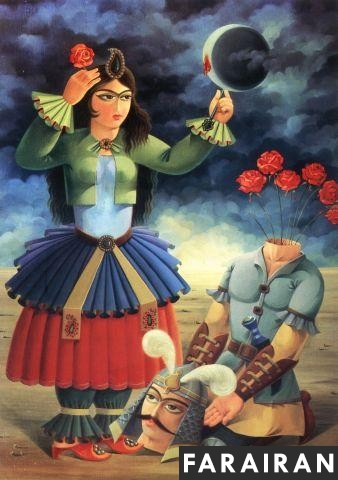
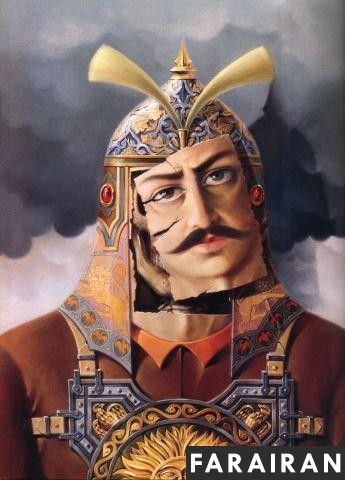
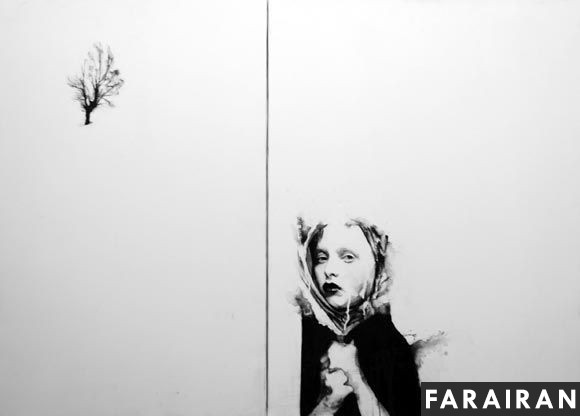
This must be where the cluttered air of old antique shops of a great number of his paintings come from which for Iranians can bring to mind one of the main heroes of Sadeq Hedayat’s Blind Owl – pirmard khenzerpenzeri, or the tattered old man. And it must be the Baroque and Renaissance air of his paintings (not excluding their surrealistic realism) which speaks to Europeans in a familiar language.

After graduation from Fine Arts High School, he studied interior architecture and obtained his bachelor degree in this field. In his own word: “From 1976 to 1983, besides continuous activities in plastic arts, I was busy in other domains, such as interior design, stage and costume design for theater, cinema, television and illustration of children’s books. Among my famous works of this period, I can cite the design of the puppets, costumes and book layout for Ardeshir Keshavarzi’s Magic Bean, the stage, costumes and masks design of Reza Zhian’s Sabzeh, the Children’s Friend, and the stage and puppets design of Ardeshir Keshavarzi’s Story of the Firefly,for television.”
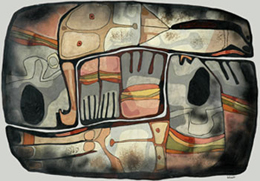
His 2 years military service which gave him a direct experience of the hardship and poverty, the deprived rural people were struggling with became a turning point in Khakdan’s subjectivity. While up to this point he painted in Abstract Expressionist and later Surrealist way, he was henceforth drawn to Realism.

In an interview with Mohammadreza Shahrokhinezhad, Khakdan says: “I have always worked in the Western School of Painting, with all its traditional themes and also its realist method and although I have distanced myself from analytical painting, but it is still Western.… My horror was to turn into those who only imitate them. This is what I did in my first exhibition (1973). Imitating Picasso will not get anywhere. But if one does not discover one’s essence one falls a victim of depression. I was in search of something to follow and continue it lovingly.”

“Yet, at the same time, I felt the absence of a cultural identity of our own in my works, and the integration of these two discordant worlds, which often puts many of our young artists in a mental quandary, absorbed a great deal of my energy.”

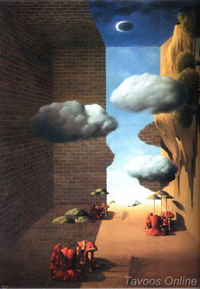
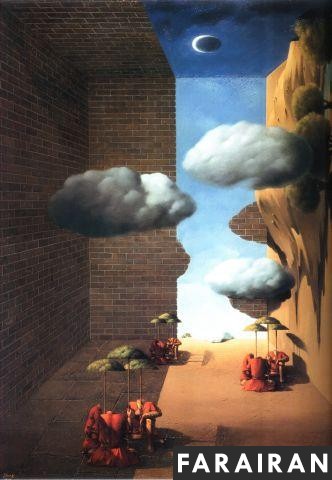
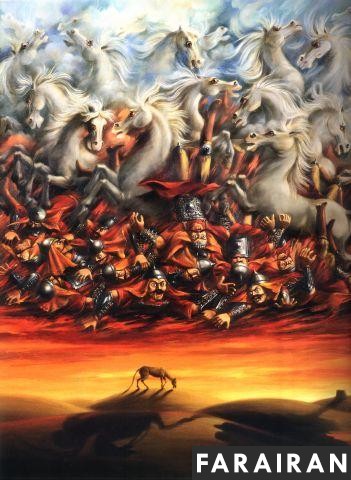
The second turning point in his life was the revolution (1978) followed by war with Iraq which brought about major changes in his way of thinking. Now human beings step on the stage of his paintings as well, workers, deprived classes, loneliness, death, torture, social and cultural antagonisms carefully depicted in brown colors shinning with a light associating Rembrandt and other 18th and 19th centuries European painters while the same ambivalence and equivocal surrealist air still dominated them. Elements of the past like cloud, ambiguous backgrounds, vast planes and lack of time-space too could still be seen in this prolific period of his creativity.
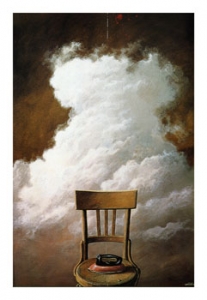
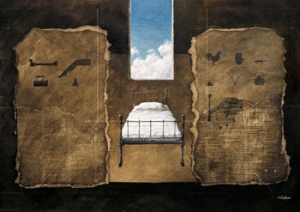
In 1983 he travels to Germany to eventually visit his sister in Canada, but it happens that he stays there. The story is that he paints a small painting for his German neighbor to show his gratitude for her kindnesses and when he gives it to her, she is surprised and thinks Vahed wants money in return. When she is assured that it is a gift, she returns in an hour later telling him that she had shown his painting to the owner of an art gallery who likes to meet him. And this is how Khakdan joins the art scene in Germany.

“My first contact with the artistic scene of Germany at the time was tainted with a great doubt. The most current painting style in those days was that of the Neuen Wilden (The New Wild Ones), which was a kind of expressionism with harsh characteristics that was considered a reply to the dark blind alley reigning over the avant-garde painting of the time.

“I understood nothing of the artworks of that time. It took me a long time to understand them and I didn’t want to imitate them. I could become a part of The New Wild Ones, but there were layers of mysticism in me which was at the same time realistic. That’s why I couldn’t accept them. The mentality of the painters of that time of Germany was different. Artist becomes the founder of a way of thinking, while he/she is the product of an economic, social and political system. No matter how much he/she claims that he does not defend any political systems or is a religious person or an atheist, he/she is still the product of a society. The behavior of an artist is even dependent on ecosystem. Germans ask me where does this light in your paintings come from and I have always told them from Iran. There are many things that leave their impressions on painters and paintings.”

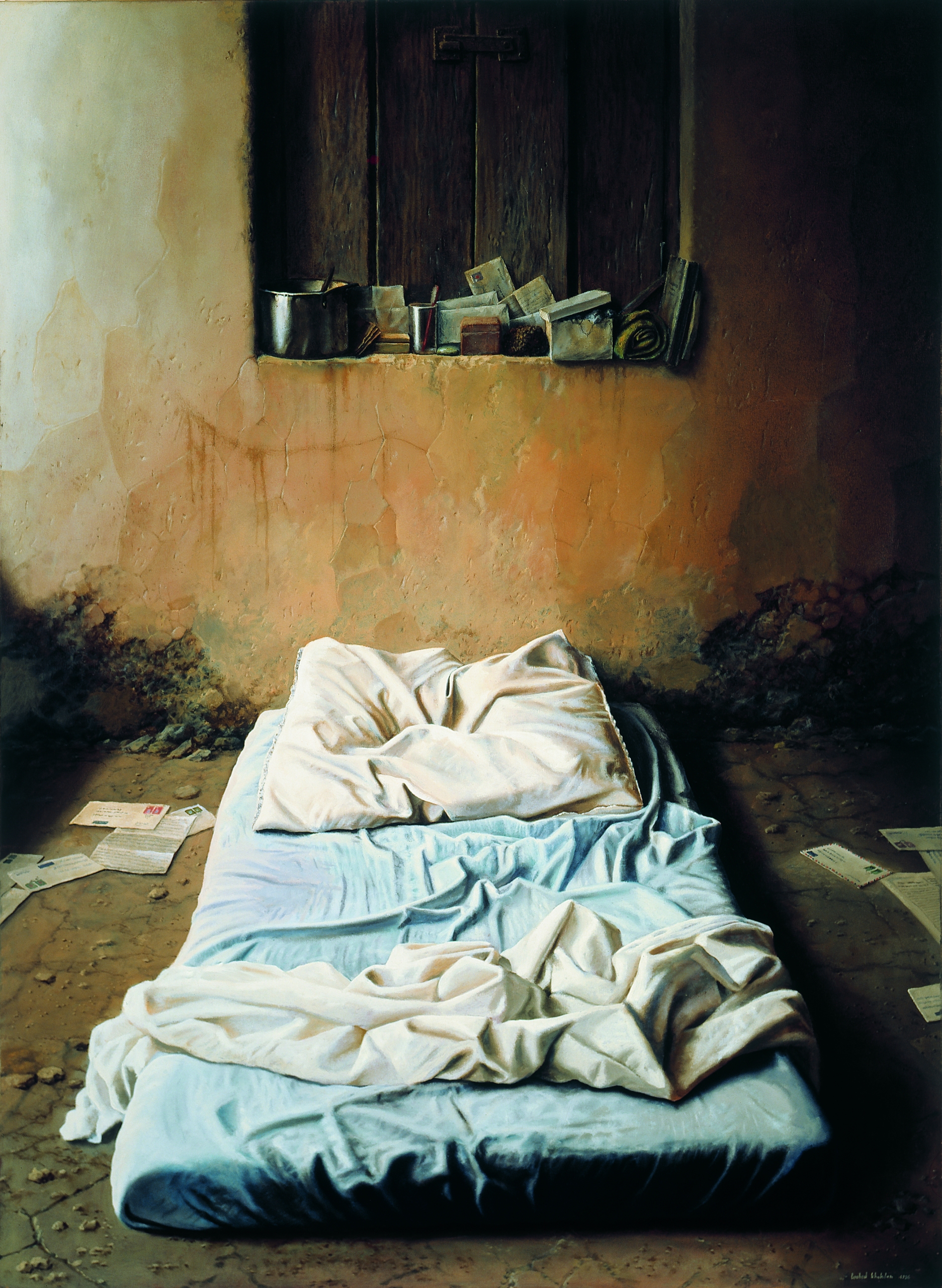
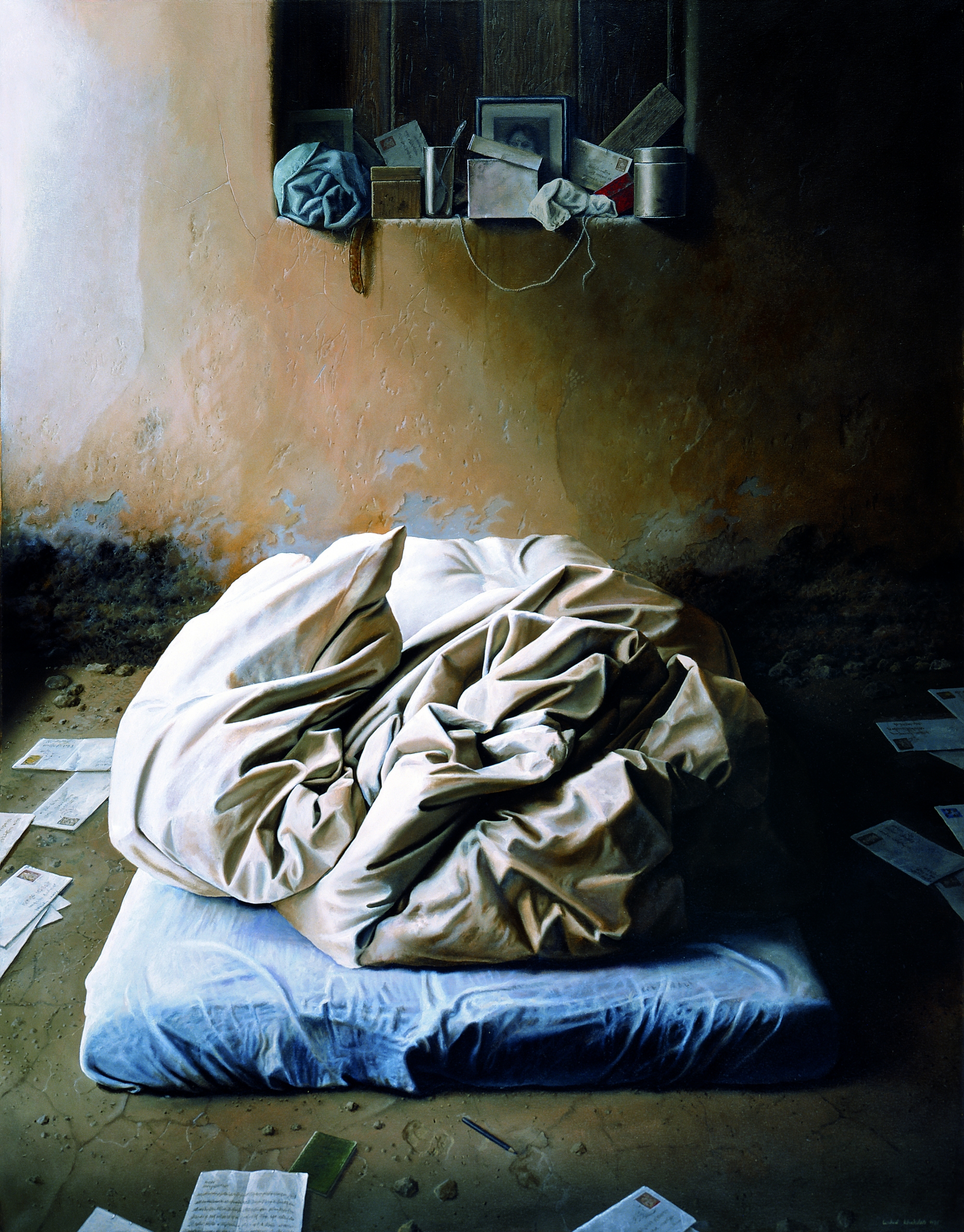
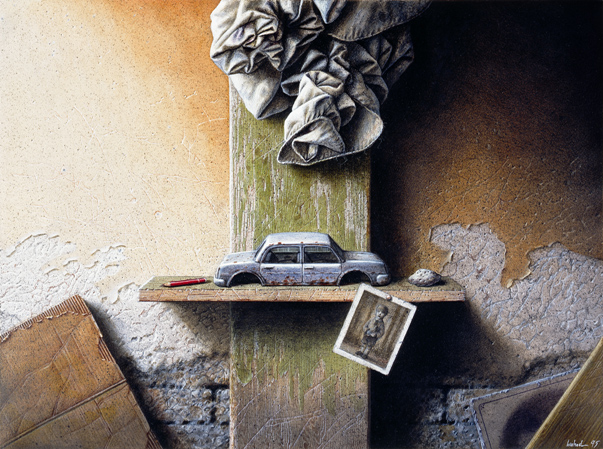
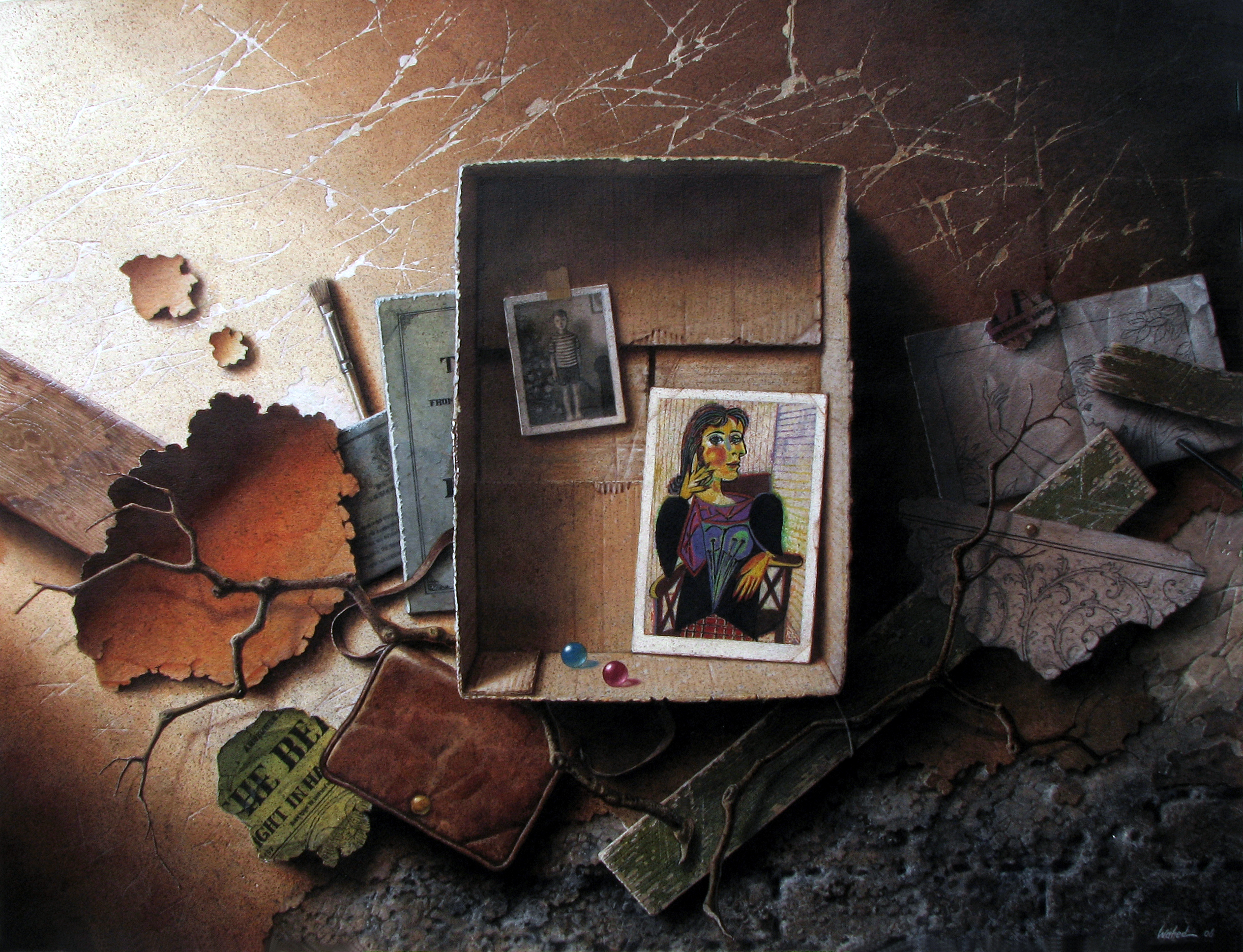
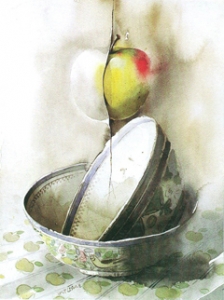
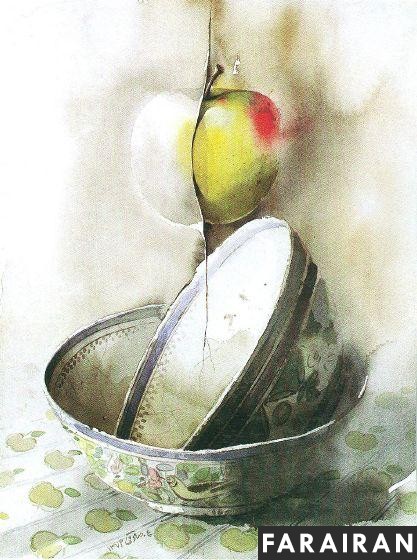
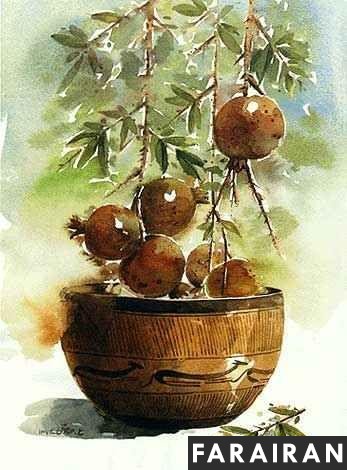
His still life-s attracts interest in Germany; childhood, the evanescence of time, the ephemeral nature of objects and men, abandoned places and objects, and, most importantly, the play with the history of art… are the main characteristics of these still life-s. Some of his works of this time are printed by prestigious German publishers in high quality, numbered, signed and sold. He also gets involved in book-illustration: ”About a year after my settlement in Germany, I came to know a famous German author who wrote books for children. When he saw my works, he proposed to illustrate one of his stories. This was the beginning of my activity in this field and after working with several great German publishers, I became also known as children and young adults book—illustrator and book—cover designer. But this was really like a second profession. I also worked in stage and costume design as I believe that one should use one’s artistic talents and abilities in any art-fields when is one gifted with them.”
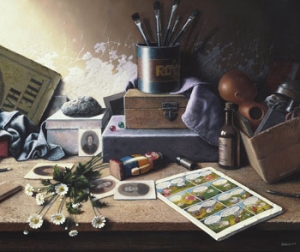
But painting remains Khakdan’s main preoccupation. “In 1993 I was awarded a scholarship to use the Kunsthaus Haven governmental workshop from the city of Oberhausen and worked in that workshop until 1996.

“The upshot of my work in that period was displayed in several individual exhibitions the most important of which was an exhibition in one of the most famous art galleries in Düsseldorf and another was in Maastricht, Netherlands.

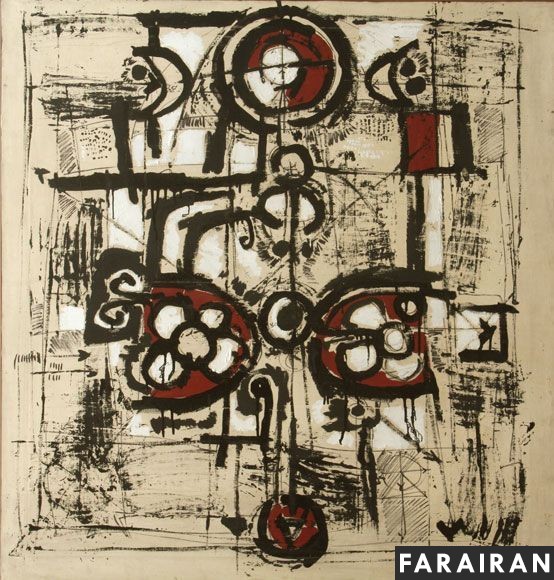
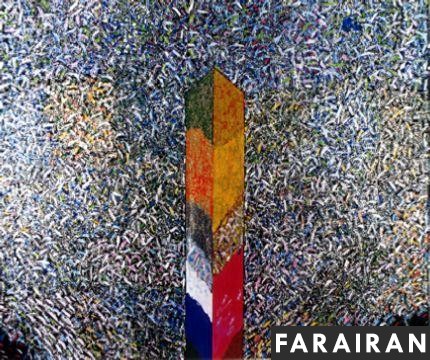
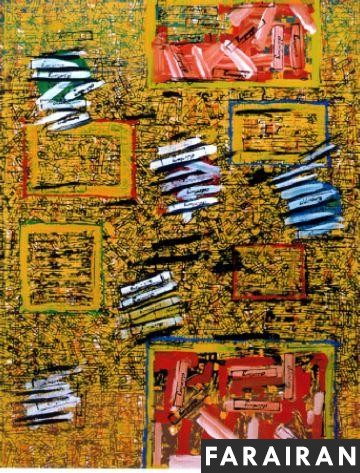
”In my works, I anticipate everything beforehand. There are times when I ascertain the place of all the components, which is usually when a certain atmosphere, person or a painting inspires a new idea and motif in me. Often I begin without having any specific idea in mind; I sit in front of a brown, beige or café au-lait canvas and begin to draw with a thin brush dipped in diluted oil. It usually begins with an exact composition carried out with simple lines. Then I pick up a wider brush and begin to put paint blots on it. By looking at these blots, the outlines of objects come to life and then I begin to work on details. It takes about a month and a half to finish a 120 x 150 cm work.

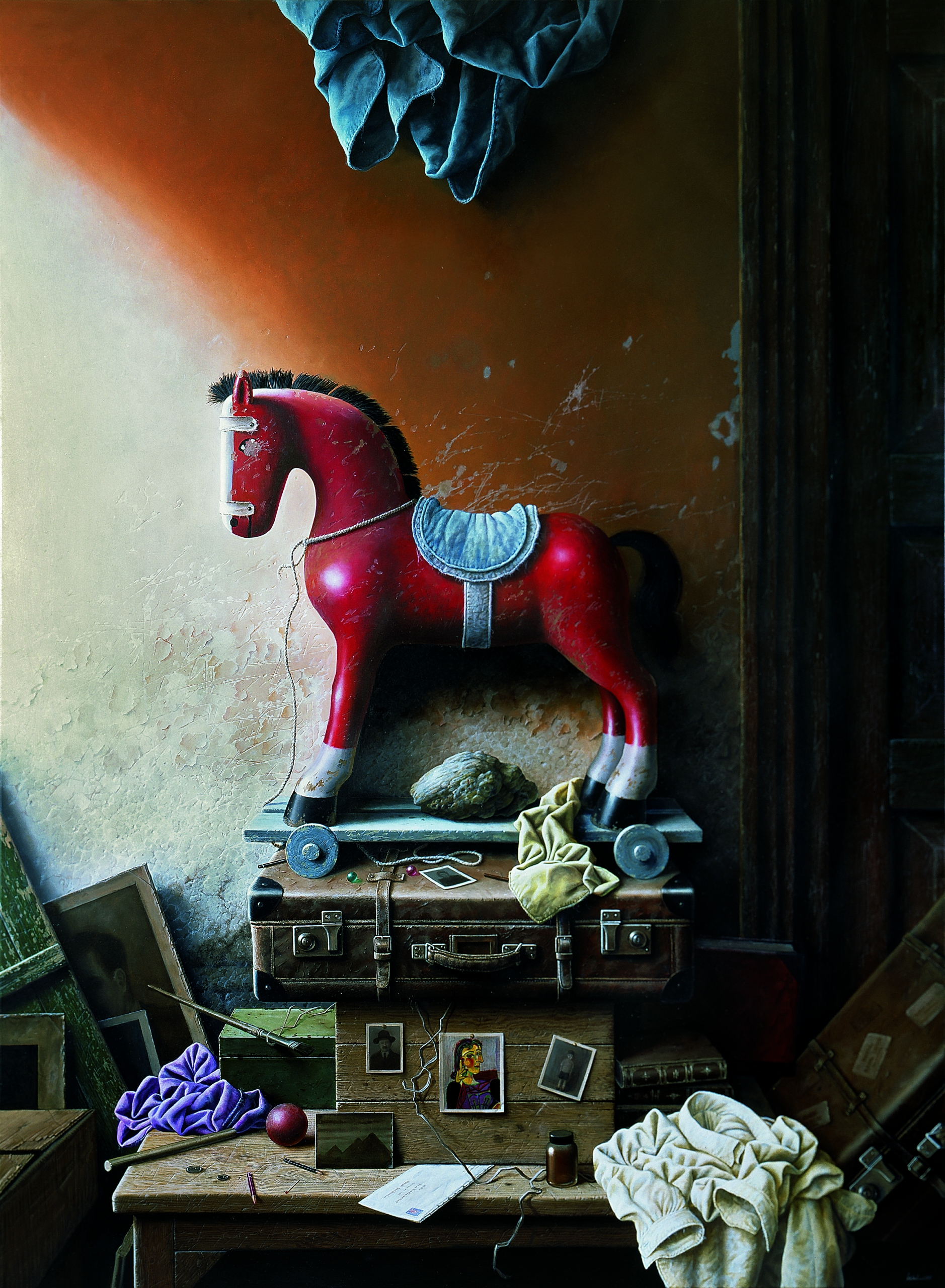
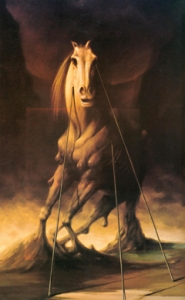
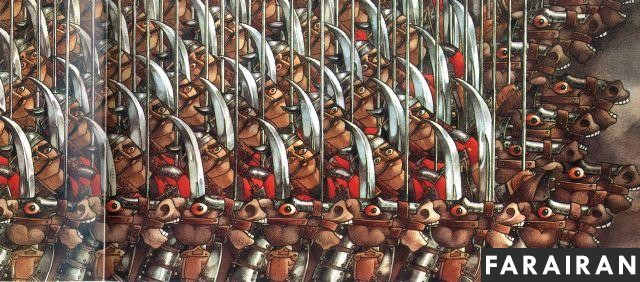
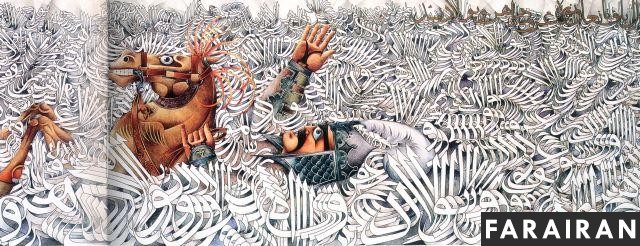
“In fact, nearly 80 percent of what you see in my paintings is mental. I always run a contest with my power of imagination and try to draw objects mentally. When facing obstacles then I use a photograph or the real object. Many objects of my works come from the past. Like the red horse of my early childhood which I often have reproduced.”
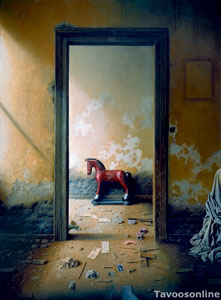
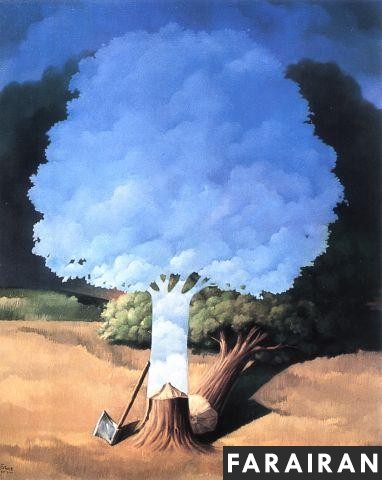
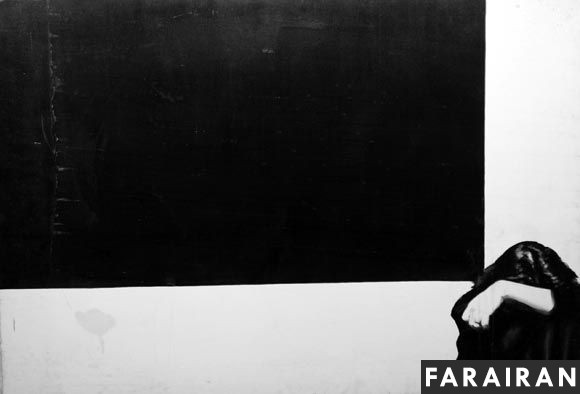
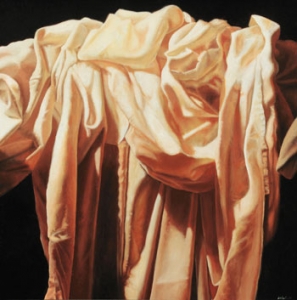
“And I am not afraid of incorporating elements from the works of great painters into my works. On the contrary, I utilize them as the alphabet of my own paintings and as my working instruments. I am certainly inclined to leave my works as ambiguous dilemmas. For this reason, I deliberately conceal temporal and spatial identity in many of my works.

Objects seen in my works have gradually turned into words. A poet composes and writes copiously at the beginning in order to convey his mind to others. This is also true in painting. What I mean is that there is a time when the idea of immigration is conveyed by showing many people standing with hundred suitcases. Other times a single open suitcase can convey the same idea.”

Actually, it is this absence of Time-Space and reaching a kind of painting alphabet by virtue of his deep knowledge of eastern and western cultures since childhood that makes Khakhdan a painter with a universal language.
Sources:

Interview with Shafaq Sa’d, Farairan Art Quarterly, No. 3 & 4, 2000
Interview with Mohammadreza Shahrokhinezhad, www.dlisland.com/4536
Interview with Hassan Murizinezhad and Vahid Sharifian,Tandis, Biweekly Visual Arts Magazine, no. 73, 2006

Farairan’ Choice Reza Aramesh

Born in 1970, AHWAZ, Iran

Works and lives in London, UK

EDUCATION:

Goldsmith College, London. 1997. MA Fine Art.

SOLO EXHIBITIONS AND PROJECTS:

2011 ‘Walking in the Darkness of a Promised Light’, Gallery Isabelle van den Eynde, Dubai, UAE

2009 Live Action 71, curated by The Diogenes Club, Late at Tate Britain, London, UK

‘Between the Eye and the Object falls a Shadow…’, B21 Gallery, Dubai, UAE

2008 Live Action 60, commissioned for Zoo Art Fair and CollectingLiveArt, London, UK

Best of Discoveries, Shcontemporary, Shanghai, China

2007 ‘You Were the Dead, Their’s Was the Future…’, Barbican Art Gallery, London, UK

‘Who is the Third that Walks Beside You?’, Matthew Bown gallery, London, UK

Reza Aramesh, Watermans Centre, London, UK

‘We’ve Lost the Hearts and Minds… E: vent gallery, London, UK

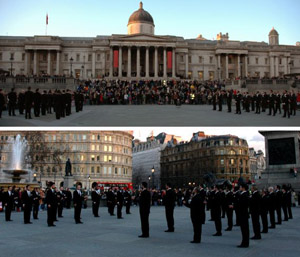
2006 Live Action ‘I am a Believer’, commissioned by ICA, Trafalgar Square, London, UK

2005 Live Action, ‘The Key of Dreams’, Gasworks Gallery, London, UK

Live Action ‘Of this Men Shall Know Nothing’, Thomas Goode Shop, London, UK

2003 ‘The Eternal Spring’, Laurence O’Hana Gallery, London, UK

2002 ‘Picture This..’, Platform Gallery, London, UK

GROUP EXHIBITIONS:

2011 ‘Light’ (part 1), Paradise Row, London, UK

2009 ‘Relaunch’, Sunbury House, London, UK

2008 ‘Los Vinilos’, Zoo Art fair, London, UK

Event Horizon, GSK Contemporary, Royal Academy of Art, London, UK

2007 Space Invasion, an International Offspace Project, various venues, Vienna, Austria

2007 ‘Los Vinilos’, Buenos Aires, Argentina

‘The Politics of Fear’, Albion gallery, London, UK

‘Temporary Measures’, Associate Gallery, London, UK

2006 ‘Making a Scene’, curated by Tal Yahas Haifa Museum of Art, Israel

‘Metropolis Rise: New Art from London’, CQL Design Centre, Shanghai and 798 Art District, Beijing, China

Culture Bound, East Wing Collection VII, Courtauld Institute of Art, Somerset House, London, UK

2005 ‘Defense’, University of California, Sweeney Art Gallery, USA

Contemporary Drawings, curated by Synthesis, Athens, Greece

‘We Have Met The Enemy and He is Us’, curated by Shezad Dawood, Redux Project Space, London, UK

2004 ‘So You’re Afraid of What?’, curated by Centrefold, Redux Project Space, London, UK

‘Copy-art.net’, curated by Irini Papadimitriou, ICA, London, UK

‘Gewalt’, curated by Suhall Malik, Laushy Art, Tel Aviv, Israel

Sir ® Eel: The Suit since ’68: The Politics of Revulsion, curated by Peter Lewis, Redux Project Space, London, UK

2001 ‘What if I Told the Truth?’, curated by Reza Aramesh, Cell Projects, London, UK

‘Trick Peaser’, curated by Luke Oxley, Mandarin Duck, London, UK

‘Teeth and Trousers’, curated by Richard Priestly, Cell Projects, London, UK

‘Forever Yours’, curated by Reza Aramesh, Victoria House, London, UK

‘Heart of Glass’, curated by Esther Windsor, London College of Printing, London, UK

AWARDS AND SCHOLARSHIP:

2007 Nominated for the Paul Hamlyn Award

2006 Nominated for the Paul Hamlyn Award

2006 Artsadmin Bursary

2006 Arts Council of England grant for the ‘I am a Believer’ show hosted by the ICA

2004 London Arts Research and Development grant, Arts Council


Action 97 (2010),Algerian civilians suspected of being terrorists are searched and put on trucks to be taken to the inter- rogation cells, Algiers 1956.

Born in 1970 in Ahwaz, Iran, Aramesh left his homelandwhen 16 and after completing his BA in Chemistry, changed his major and obtained his first class MA in Fine Arts at Goldsmith College, London. At first it was paintings and pieces of texts which attracted his attention, but since 2001 he is engaged in works he calls Actions. Launching shows or events which may or may not have any audience, nevertheless they remain in the form as photographs or videos where he explores his identity as a Middle Eastern man and all those clichés which can play a role in the relationship between East and West.

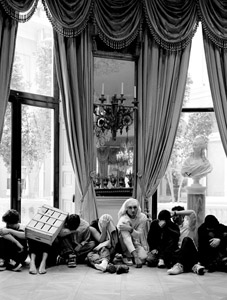
اکشن 42، پیروان فتح از منطقه حماس در شمال غزه به سوی کرانه باختری می‌گریزند. چاپ نقره، ژلاتین، 164 در 124.


Action 105. An Israeli soldier points his gun at a Palestinian youth asked to strip down as he stands at a military checkpoint along the “separation barrier” at the entrance of Bethlehem. March 2006.

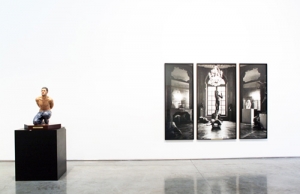
Aramesh, the imagery of the world in turmoil and war has become a focal point for his work. He meticulously recreates details found in images that are sourced from print, television and online media, all reporting on wars and international conflicts. The artist tends to focus on an individual or group of men, and endeavours to bring their character into his photographic or sculptural pieces.
In photography Aramesh finds a medium to connect social-politics of the modern world with his interests in art history, cinematography and literature.

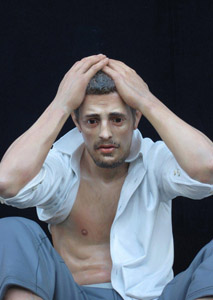
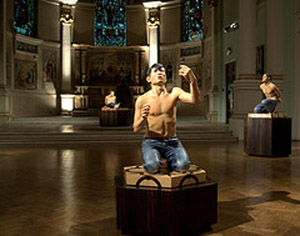
In making his sculptures, Aramesh uses the exacting techniques employed by 17th Century European sculptors; the application of the varnish and paint are executed in the same way as the great ecclesiastical sculptures of the 17th Century. This is essential to understanding his work. Aramesh brings a contemporary dialogue to the traditions of sculpture and the long-standing debates of conflict and faith, and thus hope. He invites the viewer to question whether the victims of war which he portrays can be considered as modern day saints not in the disparaging relationship between East and West, but in terms of the absolute human realities of suffering.

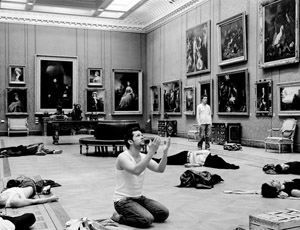
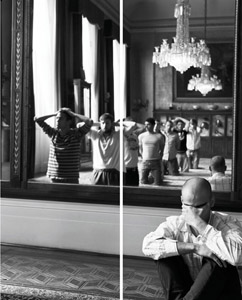
Aramesh’s photographs represent a kind of stillness associating Still Life in painting. His scenarios go on stage, in slick modern apartments, stately British mansions, and art-filled museums. from majestic apartments to aristocratic houses in order to suggest that wealth and financial interests are fundamentally intertwined with war. He says: I think war reportage is presented in such a way as to make you see the horrible at the first glance. In this way, they focus on certain elements and exaggerate. Attention is drawn to horror and you stop reading the picture further. Aramesh wants to show all the layers of reality. “Life as it is lived is what theater and media lose in their search for horror. “The expression of tragedy turns to roar. I am interested in things which are completely left out; the things which are not captured by the camera, but are around it.”

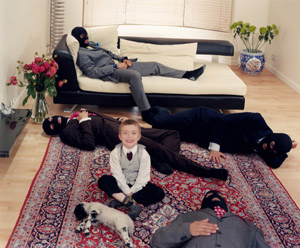
Picture this. You are walking back from work down a pedestrian suburban street, and through the window of a terraced house you glimpse a group of Middle Eastern men lounging around in armchairs, wearing balaclavas. At a time when terrorist activity saturates popular visual culture, this simple tableau contains all the ingredients of tabloid sensationalism – the unexpected and dangerous combined with the neighbourly and familiar, peppered with a pinch of xenophobia. It is with such scenarios that Iranian artist Reza Aramesh adroitly explores his identity as a Middle Eastern man, as well as the complex relationship between East and West, in his recent show ‘Picture This’ (2002). His work, though political, has quite a humourous element running through it; an element that is highly important to him as he feels that humour creates a distance with which to critique culture. It is as though he uses humour as a tool rather than merely a means of making people laugh: humour often serves as a way of breaking down awkward situations, of making people feel at ease, perhaps even when they shouldn’t.

This characteristic intertwining of social conventions and clichés which undoubtedly are also drawn from his personal experiences in living in war-ridden south of Iran during the war with Iraq is an exploration of how he himself is perceived and the various fallacies on which such perceptions are founded. However, such an approach to race and the dominance of the Western canon should not be simply understood as a disparaging review of the West’s attitude towards the East. The intention in his own words is a ‘critique of the Iranian middle-class aspiration to an idealized notion of Western culture’ as well as an investigation into the ‘notion of masculinity within the Islamic cultural context’

Like the Surrealists, Aramesh uses the masquerade to question the identity behind the mask. Drawing on his own experiences of living in both Iran and the UK, the artist explores how he himself is perceived, and the various fallacies on which such perceptions are founded.

In fact, deconstructing identities; scrutinizing and pulling apart the fabric of contemporary culture to reveal the fragility of the very notion of society, ethnicity, and identity: this is the essence of Reza Aramesh. May be the old cliché runs true that what you see is Not what you get.


I am a believer (2005)

It’s interesting with Aramesh that as much as he wants to break down the constructs and structures of society, he avoids them. He states that he consciously avoids anything that could possibly dictate rules or impose bonds unto him, and one can see this obsessive aversion to authority in his work. He states that we can only define our identity within the very split-second that you do so, within moments that definitions changes, shifts according to your situation and beliefs. Such an attitude makes the theme of his I am a believer (2006 at Watermans) which takes the traditional Changing of the Guard ceremony and re-enacts it in Trafalgar Square. He first advertised, in various newspapers and publications, for males (of which roughly 99% were second-generation British) to perform the ceremony. In other words, by turning to the Past and glorifying traditions, and arguing that the I am a believer he is questioning the fact that identity could be fixed. He argues that this regression to the past, this citation of history as a form of psychological appeasement, is detrimental to contemporary society. Constructs, rituals, habits are what make the society and it is specifically these, which Aramesh finds so tiring, and burdensome.


Between the Eye and the Object Falls a Shadow (2008)

The series Between the Eye and the Object Falls a Shadow (2008), a name borrowed from William Burroughs is an attempt to unlearn surrounding media images. He wants to overturn our perception of tragedy and in this way remind us of the reality of atrocities. The ever present coverage of atrocities rendered in words and images can desensitize us as much as bring about a kind of indifference through the knowledge we gain from tragedy. To confront such detrimental effect, he slows down the pace of the image to draw our attention to the essential humanity lost in momentous reading. In this way he breaks down the shape of the tragedy and with that suddenly nudity becomes vulnerability. The curiosity of viewer is left intact, but it seems naïve. Once again human tragedy becomes human. In his own words: Each one of us can be an oppressor and each one of us can be a victim.” That is why the oppressive figure is completely removed from this series and the camera intentionally keeps a distance and focuses on the detained groups of men.


Walking in the darkness of a promised light (2011)

In the series called Walking in the darkness of a promised light (2011, Dubai), Aramesh puts himself centrally, amidst the swirling cross_currents of the global information flow and relentless supply and demand of media imagery from across the world. In this exhibition he presents photographs in the form of triptychs and diptychs in a Goya-like manner and five sculptures that employ traditional 17th century polychromatic, marquetry and wood-carving techniques. Their themes is the continuation of the previous series of conflict, war, martyrdom, sacrifice and most of all and more tangible, human suffering.

In his last show Them Who Dwell On Earth (2011, One Marylebone), the inaugural exhibition by Mottahedan Projects dedicated to developing, nurturing and creating platffoorms for emerging artists of our time, Aramesh displays seven sculptures and six photographs as his first solo exhibition in London.


یکی از پیکره‌های نمایشگاه ساکنین زمین 2011

در آخرین کارهایش، ساکنین زمین (2011، وان مریلبون) که یکی از پروژه‌های متحدان برای رشد خوراک‌رساندن و آفریدن سکوهایی برای هنرمندان در حال پیدایش روزگار ما از سوی محمد متحدان است، آرام هفت پیکره و شش عکس را در این نخستین نمایشگاه انفردی خود در لندن به نمایش می‌گذارد. پیکره‌ها از سبک تمثالهای کاتولیک پیروی می کنندف اما در اینجا به صورت رنج آدمی به نمایش گذاشته می‌شوند و بیشتر انگار دادخواهی می‌کنند تا گذشت الهی را به نمایش بگذارند. سپس با عکسها زمینه بیشتری به آنها داده می‌شود، نگاره‌هایی عظیم و سیاه و سفید که نگاه خیره موضوع تنوعی از داوری یا بدفهمی را به نمایش می‌گذارد و احساس کلی ابهامی ژرف را. پیکره‌هایش برانگیزاننده، پرشورند و رویارویی نزدیک با افرادی که نقش قربانی را بازی می‌کنندف عواطف خود را برای ژرف‌اندیشی و مهر و شفقت به دنیا پیشکش می‌کنند.
امید است تلاشهای رضا آرامش در مقام هنرمندی ایرانی انگلیسی، همراه با دیگر هنرمندانی که دغدغه‌های او را دارند، درک گسترده‌تری میان باختر و خاور از راه رسانه‌ی کارساز و تأثیرگذار هنر به وجود آورد.


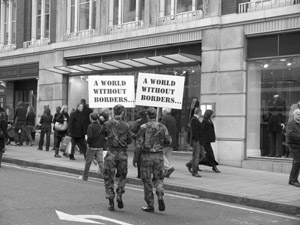
اکشن 58، دنیای بدون مرز

منابع:

کاتالوگ نمایشگاه‌ها و بازبینی‌های نمایشگاه‌هایش از جمله در مجله فریز

بیتا فیاضی

Farairan’ Choice Bita Fayazi

بیتا فیاضی

Born in 1962 in Tehran, studied ceramics and scultupre with masters of these arts

Group exhibitions:

2011 October, Obscure Stream of Life, But I am still having my afternoon Cuppa, Gallery Isabelle Van den Eynde, Dubai
2011- Dubai Art Fair, presented by IVDE (Isabelle Van den Eynde) Gallery based in Dubai UAE
2010- Installation, The Grind Khak Gallery, Tehran
2009-2010, The 1st International Festival of Contemporary Art (FIAC) of Algiers, National Museum of Modern And Contemporary Art 2oo9, Abu Dhabi Art Fair, B21 Gallery, Dubai
2009, Iran Inside Out, Chelsea Art Museum, New York
2009, Ra’d O Bargh (The Lightning), Gallerie Thaddaeus Ropac in Kunstraum Deutsche Bank, Salzburg, Austria 2009, Ra’d O Bargh (The Lightning), Gallerie Thaddaeus Ropac, Paris
2009, There Goes The Neighbourhood, B21 Gallery, Dubai UAE
2009, Dubai Art Fair, B21 Gallery, Dubai UAE
2008, The Messenger, Brugge, Brussles
2008, Naqsh, An Insight Into Gender And Role Models in Iran , Pergamen Museum, Berlin
2008, “Mahak” charity exhibition. Tehran, Iran
2008, “Hope” Charity exhibition, Dubai, UAE
2008, PlayGround, Orients Sans Frontieres, Espace Louis Vuitton, Paris, France
2008, Dubai Art Fair, B21 Gallery, Dubai, UAE
2007, Magical Nights in Dubai, Dubai, UAE
2007, Art Paris, France; Silk Road Gallery, Tehra, Iran
September 2007-January 2008, international art exhibition, Bette et Hommes, Parc de la Villette, Paris, France
2007, Iranian artists Group exhibition, Within and Without, No More Grey Gallery, London, England
Ocotober 2006-January 2007, Diva, iran.com, Museum of Modern Art, Freigburg, Germany
2006, Road-Kill, New Territories, De Hallen, Brugge, Belgium
2005, When still a Child, XVA Gallery, Dubai, UAE
2005, Road Kill, Amazon Series, Rebell Minds Gallery, Berlin, Germany
2005, KiIsmet, 51st International Art Exhibition, Venice Biennale
2004, The Yellow Silence of Nargess, Tehran Museum of Contemporary Art, Gardens of Iran, Ancient Wisdom/New Visions.
2004 The Mannequin, National Gallery of Armenia, Yerevan
2004, Lizards, Isfahan Museum of Contemporary Arts, Contemporary Ceramic exhibition
2003, “Iranian Contemporary Artists” at Pietro Della Valle, the Italian School of Tehran
2002, On/Off (Abortion) Tehran Museum Of Contemporary Arts, 2nd conceptual art exhibition titled “New Art”
2001, Art Addiction Virtual Gallery, The 7th International Female Artist’s Art Annual
2001, Tehran Museum of Contemporary Art, First Conceptual Art Exhibition
2001, Barbican Center, London, UK, Iranian Contemporary Art
2001, “±7 Ceramists”, Iranian National Commission for UNESCO, Tehran
2000, Ekbatana, Nikolaj Contemporary Art Center, Copenhagen, Denmark
2000, “Falling Figures”, Seyhoon gallery, Tehran.
2000, Canadian Women’s Club – Barg Gallery, Tehran
1999, Golestan Gallery, Tehran
1996, Ceramic abstract objects, Golestan Gallery, Tehran
1994, Ceramic abstract formsm, Museum of Contemporary Arts, Tehran
1993, Embassy of the Netherlands, Tehran
1992, Museum of Contemporary Arts, Tehran
1989, Pafar gallery, Tehran.
olo exhibitions:

2011, Title, yet unkown? IVDE Galllery, Dubai
2010, Performance, installation and video projection titled Performance 1388/2010, Aun Gallery, Tehran
1993, Classic Gallery, Isfahan, Wall murals and abstract forms

Group experience:

2004, “ For Bam”, an installation of 7 crying angles, “The Fallen Angles”
2003, The Speed Bag Factory International Artists Residency Programme, Johannesburg, South Africa
2003, “Lucky Charms,” Gallery Golestan, Tehran
2003, “On The Road,” moving installation, Tehran
2002, Forum on “Cultural Practices In The Region”, Beirut , Lebenan
2001. Festival of the Culture and Civilization of Persian Gulf Coastal Communities, Gheshm Island, Iran
2001, Khoj International Artists’ Workshop, New Delhi, India
2000, “Children of the Dark City”, Tehran
1998, “Experiment 98” Conceptual Art & Installation, Tehran
1997, “Road Kill,” Tehran
Memberships:

Member of the jury for the the 8th Tehran Ceramic and Glassware Art Biennial in 2007 at Saba Cultural Centre.
A member of the selection committee and jury for the 7th Tehran Ceramic Arts Biennial in 2001 at the Museum of Contemporary Arts.
Pirvate Collections:

Kismet has been purchased by Luciano Benetton for his private collection.

Awards:

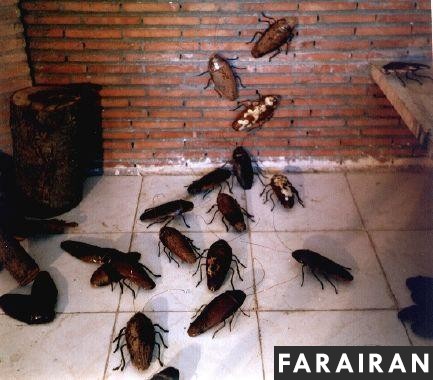
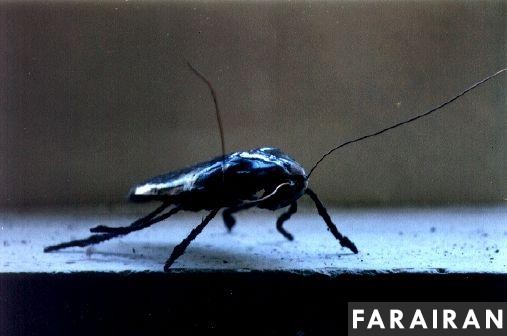
1998, Winner of special exhibition prize: Cockroaches, Museum of Contemporary Arts, Tehran.


Purple Scream

Bita Fayazi
In Search of The Mystery of Life

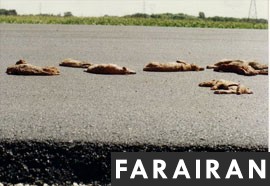
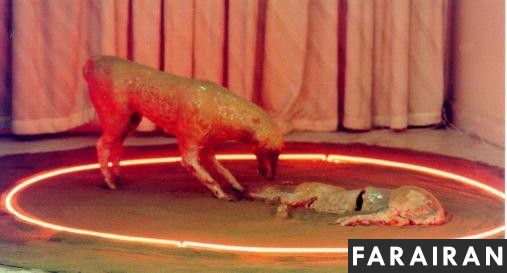
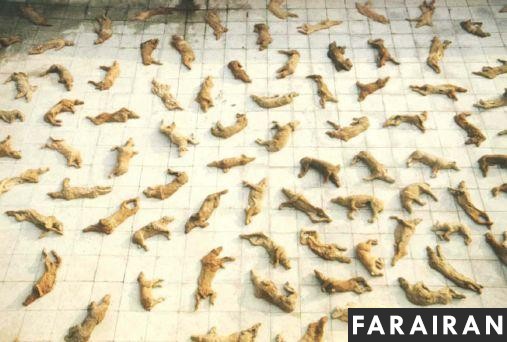
Bita Fayazi, one of the most active multimedia artists, was born in 1962 in Tehran. She studied ceramic art with masters such as Haj Abdollah Mehri, Mehdi Anoushfar, Roya Djavidnia and Ojan Sirousi and held her first solo exhibition, titled Wall murals and abstract forms at Classic Gallery in Esfahan in 1993. Then she turns to sculptures and studies with well known sculptors like late Yuness Fayyaz Sanavi and Ramin Seaa’dat Gharin, when she realizes that “three-dimensional conceptual work is her medium of expression” and the first thing she does is to make 200 crushed ran over clay dogs, arranging them in an installation called The Road Kills, then burying them all in a collective grave on which a high rise is built. The whole process is filmed, and years later she displayed an installation entitled the same in Berlin (2004)

When asked ”What gives her inspiration?” quoting Louise Bourgeois she replies: “Art is not about art. Art is about life. I like the mystery of all that happens around me.” With this intense curiosity, she draws inspiration from all the objects and living things around her.
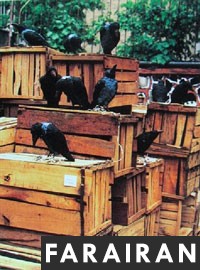
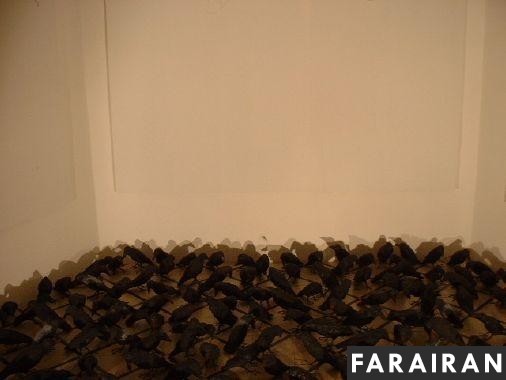
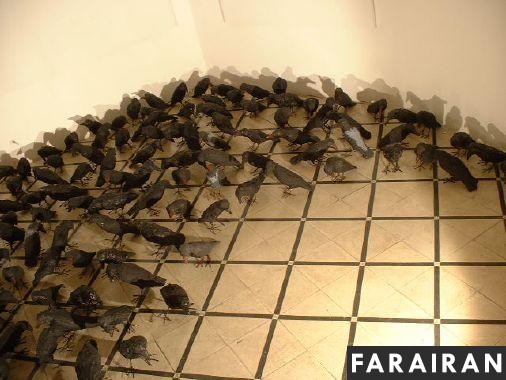
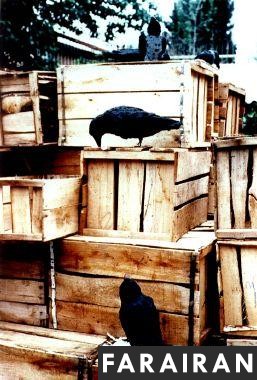
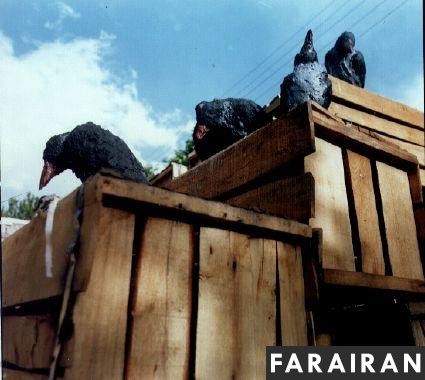
In 1998 together with four other artists, they turn an abandoned old house near Hossynieh Ershad to a work shop and Bita makes a large number of sculpted crows and places them on top of used fruit crates in the house and on the roof of a bus station near it. Maziar Bahari produces a documentary of the whole process of turning the demolishing house into a workshop now called the Experience 98, an exhibition of Ephemeral Art (Art of Demolition). The installation which attracted a great amount of attention shows the effects of demolition on living beings. (Later Bita makes a lot of crows again for The Forum of Cultural Practices in the Region held at Beirut in 2002 and places them in an old house called “Zico” and on the roof of a bus station nearby and is amazed when she hears that there are now crows in Beirut.)

In this way Fayazi plays a significant role in bringing about a new art movement, attracting new audiences. She soon becomes one of the few women artists with a high profile in Iran’s art world and with her works exhibited in the West, she finds an international recognition as well.

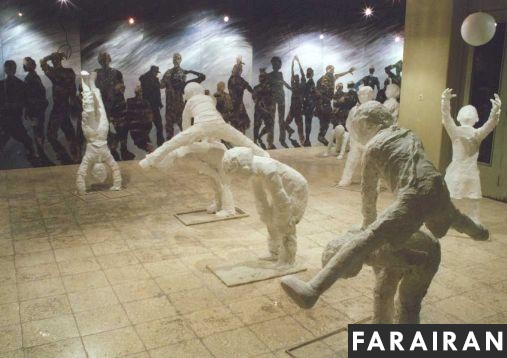
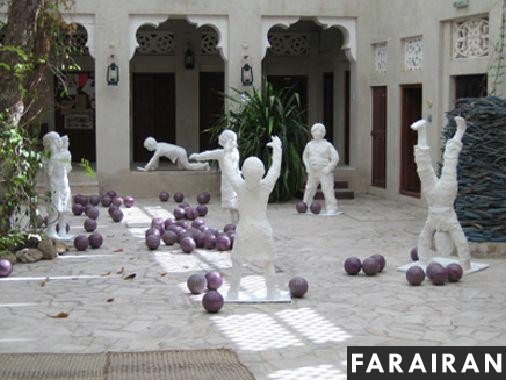
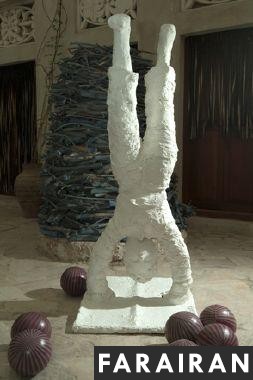
In Children of the Dark City a multimedia installment of sculpture, video, photographs and painting about harmful effects of air pollution on children, she makes 34 plaster life size sculptures of children and tries to show an ideal world in which children are happily playing. This was the first project in the history of Iranian contemporary art supported by governmental and non-governmental institutes.

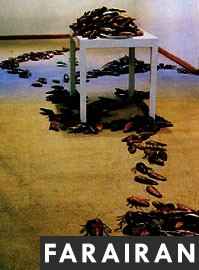
Among her other installations was 2000 glazed bigger than life size ceramic cockroaches inspired by the world these creatures had made in the sewage lines of a neighbor’s house and Archy, the cockroach created by Don Marquis, the American poet and author ‘living’ on his type-writer. ”The reason I devoted so much of my time to that pesky insect is basically my profound interest in the critter and I am fascinated with the fear they instill in the weak of spirit. How can anybody take a view on art if they don’t understand its general context. These creatures have no positive role models in our fairy tales and bed-time stories. We never have this condescending and demeaning attitude towards any other insects.” And her next installment was a large number of life size lizards placed on the floor of the installation space (Johannesburg 2005, Tehran 2004) in such a way as to associate a battle field.

In reality by symbolic application of living beings which nobody likes, Fayazi tries to play up the follies of human beings. The peak of her playfulness is perhaps in On the Road, performed with three other artists. Bita’s sculptures were fastened in the back of two moving vans, touring around Tehran with the intention to find new viewers (school children, drivers, shopkeepers, road sweepers, tramps and…) in addition to art-lovers and elite who frequent art exhibitions. We see more or less a similar experience in her Playground performed for cultural space of Louis Vuitton in an exhibition called Orient Without Frontiers (Paris, 2009). A Citroen with toys pouring out of it with a stuffed camel behind it.

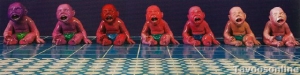
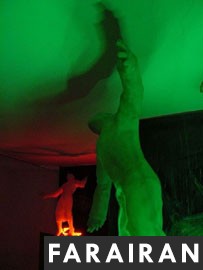
Her two other group experiences in public art are Lucky Charms (Golestan Gallery, 2003) and For Bam (2003) taking place in a warehouse in the center of Tehran about the tragic earthquake in Bam. To sell their artifacts, the artists go around the warehouse like hawkers. Fayazi’s other piece for the event was Fallen Angels, an installation of seven crying angels in a dimly lit space by a purple-blue neon light on top of a wall toward which all the angles were facing.

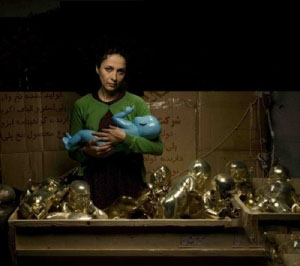
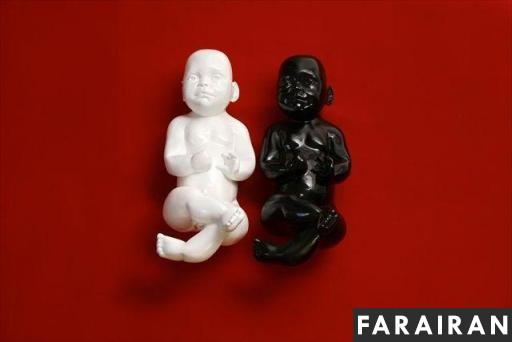
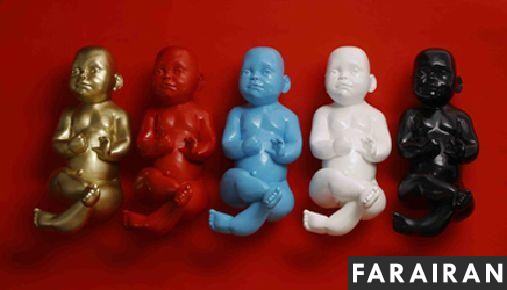
Kismet, exhibited at the 51st Venice Biennial (2005) is an installation of golden babies hanging at different heights from the ceiling, writing the word Kismet (قسمت) in the air and the source, which simultaneously can bring to mind the fate of the mother-creator after giving birth, deprived of substance, in pieces and shattered.

She says she had been making sculptures of babies for seven years, inspired on first seeing a photograph of the burial of a baby shot dead in the war in Bosnia, with the bullet leaving a hole in his chest. The image haunted her with the question: “What if the infant could somehow catch a glimpse of his/her fate?” And maybe even before that, which could have been her mental preoccupation while working on On/Off (Abortion); an installation of 10 transparent fiberglass placed in plexiglas boxes hanging from the ceiling with their umbilical cords tied to the ground, their hearts lit by tiny colored diode lights, flickering on and off to the sound of a recorded heart beat (Tehran Museum of Contemporary Arts, 2002).

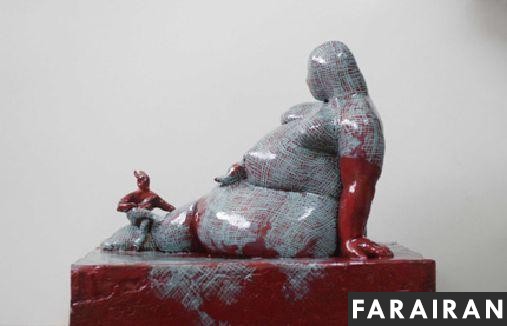
Putting herself in the mental or emotional state of others, Bita who earns to unfold the mystery of life and find an answer to her questions, reaches a moment when she feels she is confident enough to develop her subject further. This is best seen There Goes the Neighborhood. “Initially, I decided to work on a small Iranian family… Then something more suggestive of our culture developed. Iran is not the black-white nation described by the media. The community is pluralistic with many colors, layers and complexities…” The work captures the mentioned plurality very well. “The personalities are those who have impressed me, even though they might not have ever seen me…” She began the work by shaping the personalities in plaster and clay, but ultimately makes them out of fibe glass and polyester with Rokni Haerizadeh clocking them with painting (2009, B Gallery, Dubai).

Fayazi depicts the innate qualities of her personalities in a subtle way with a touch of humor. She believes that she gives up the control over her message once the work leaves her workshop. She leaves the judgment to viewers. “It is to them to define the work. I always consider myself as a dead artist with no record of works done.”

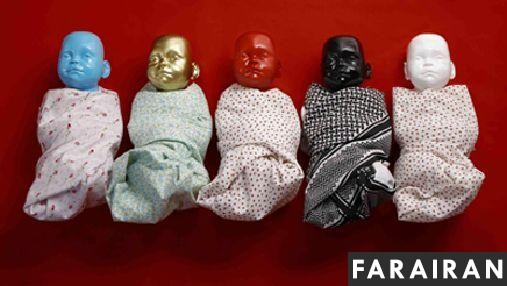
She says her work is genderless. “There is no comparison between gender roles. When a child is born, it does not know whether it is male or female. The genes and principles of the society decide that…” She depicts this belief in depth in her installation, Creche II displayed in a group exhibition titled: Naqsh, An Insight Into Gender And Role Models in Iran , held at Museum of Islamic Art in Berlin’s Pergamon Museum Berlin. The arrangement and coloring of fifteen babies on a spiked metal bed associating rug ornaments from ancient Iranian civilization points to her genderless approach, and the way the society suppresses individuality and determines the fate of our lot since the time of antiquity.

This symbolic dark ironic view on our species future Kismet (fate) is also clearly seen in her installation Barbecue (Aun Gallery, 2010) where a female figure is stuffed, as goats are for example for a lavish feast, a long table is set with the fillings on the serving dishes containing mostly babies and their beheaded begetters.

In City Scape, displayed in a group exhibition at Khak Gallery, Tehran, we see Fayazi once more turning to living beings nobody likes; pairs of scorpions, houseflies, praying mantis, black widows, chameleons, grass hoppers in a den like space invaded by spiders as though showing in practice how love and hate are the two sides of the same coin.

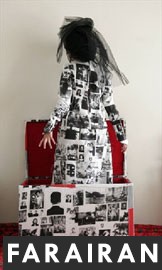
Whether we wear our life? is the motif of Mannequin (2004) who is clocked in a robe covered with silk screen images of events, memories, people and places leaving a deep impression on her, drawing them out of family albums. Wearing trinket rings in one hand and holding a staff with the head of a diva, she walks in silence in the streets and alleyways of Tehran and Yerevan, Armenia. The same Mannequin with the same journal-like dress is seen in Goli’s Dowry (2009 Paris) standing inside the biggest chest of seven wooden chests covered by the same images, if not bringing out the boqcheh-s (a piece of handmade cloth functioning as chest of drawers in old times) of the dowry to examine their contents one by one, while the Goli’s life story is narrated out in Farsi and English from two different speakers; a typical old story of a 12 years old girl wed to a much older man due to poverty.

And this makes up more or less that very past record of Fayazi which repeating her own words, she closes her eyes to and considers herself dead in them in order to continue her experimentations in various art fields, allowing her raw ideas to lead her toward their artistic realization.
Sources: Artist’s resume

Bita Fayazi, in collaboration with Rokni Haerizadeh, There Goes the Neighborhoud, B21 Gallery, Dubai

Tableaux of Daily, an article written by Danish Magazine with the link below:

www.zmga.dk/showmag.php?mid=rghdg&pageid=83

Special issue of National Geographic: Orient Sans Frontieres, Exposition Espace Louis Vuitton, February 9-27 April 2008

Exhibition Reviews:

http://www.iranian.com/Arts/2000/January/soosk.html
http://www.iranian.com/Arts/2001/May/London/fayyazi.html
http://www.guardian.co.uk/arts/story/0,3604,471498,00.html
http://www.artaddiction.se/7fem_fayyazi.htm
http://www.thehotspotonline.com/blahblah/articles/IranArt.htm
http://www.iran-bulletin.org/Art_Review.html
http://www.bbc.co.uk/worldservice/arts/highlights/010427_iranian.shtml
http://www.khojworkshop.org/khoj2001_r3.htm
http://www.britishcouncil.org/visitingarts/v43it3.html


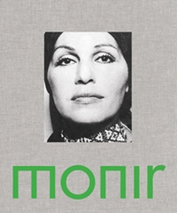
Farairan’ Choice Monir Farmanfarmaian


Edited by Hans Ulrich Obrist, Karen Marta. Text by Nader Ardalan, Media Farzin, Eleanor Sims. Conversation with Hans Ulrich Obrist. Published by Damiani

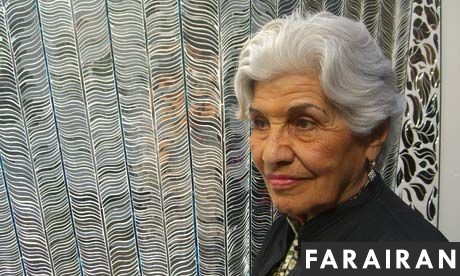
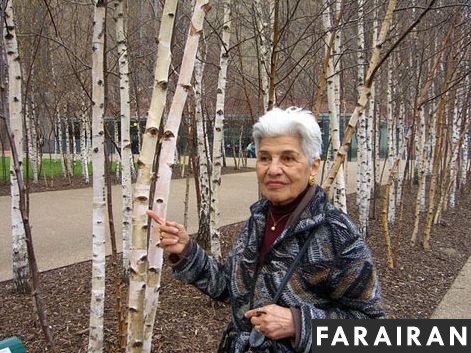
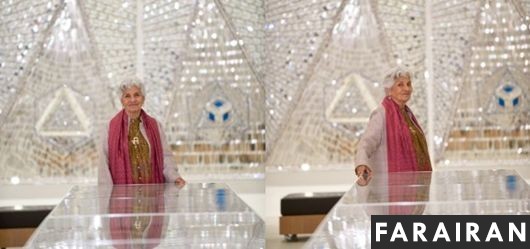
Monir Farmanfarmaian is one of those Iranian women of our time who brings to mind Ferdosi’s great epic Shahnameh and the verse: “That’s the way their women are, the Iranians.”

Born in 1923 in the city of Qazvin, and in one of those old and now nostalgic Persian house-gardens with rooms covered with gorgeous Persian carpets, and colored windows opening to orchards full of nightingales. During the WWII, she audaciously left the occupied Iran, because she had made up her mind to go to Paris to become an artist. The French consulate informed her that moving to occupied Paris was, unfortunately, impossible; as was her alternative plan of waiting out the war in Morocco, which was still under German attack. But Monir was undeterred: she resolved to move to America, and from there to Paris once peace was declared. She secured a place on an American battleship bound from Mumbai to California; from there, she travelled east to New York, arriving in 1945. She never made it to Paris, but she did become an artist.

Instead of Paris, she returned to Iran, entered Tehran University to study art (1944-46), went back to New York to further her studies at Parsons School of Design (1946-49) and Cornell University (1948-51) where she becomes close to many of the emerging contemporary artists of 1950s, like Louise Nevelson, Andy Warhol, Jackson Pollock and, later, Frank Stella, Willem de Konning and…, thus becoming a component product of Zeitgeist. She began her art career as a fashion illustrator for the department store Bonwit Teller, where “Andy would do the drawings and she would do the layouts.” The musician John Cage describes her as the “young beautiful Persian girl” while Monir describes Warhol as an ‘incredibly shy illustrator’ from whom she bought several sketches of shoes and in exchange gave him a small Mirror ball which he always kept on his desk. It is through her friendship with these people that her lifelong interest in modernism is instilled in her – the influence of which sits fascinatingly in her art. “It was amazing to know all these people,” she says. “I loved it. Even though I was just painting flowers and designing fashion, I loved these modern things.”

After a decade of life and studies in New York, she returned to Iran in 1957 which was a return to her rich Iranian inheritance. One day when taking some visiting western friends to Shah Cheraq’s Shrine in Shiraz, she sits in a corner for half an hour dumfounded by its unique majestic interior mirror work, crying like an innocent child by watching the reflection of people’s images – the faithful and beggars – in those tiny pieces of mirrors. This is how her lifelong experimentation with adapting and combining age old techniques of reverse-glass painting, mirror mosaics and Iranian Islamic designs with a modern abstract expressionism and minimalism begins.

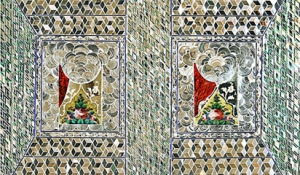
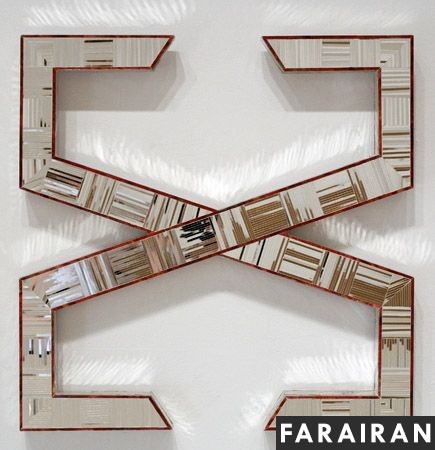
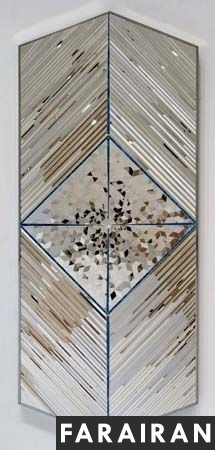
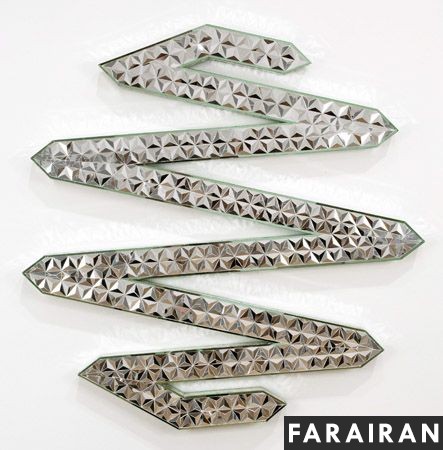
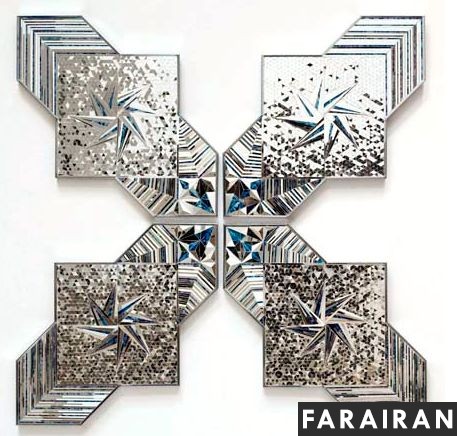
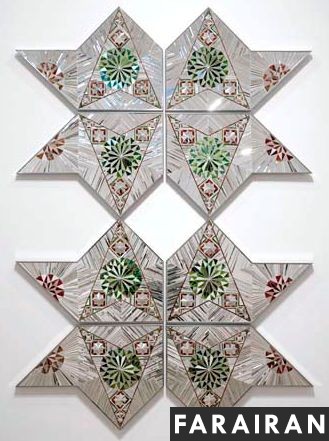
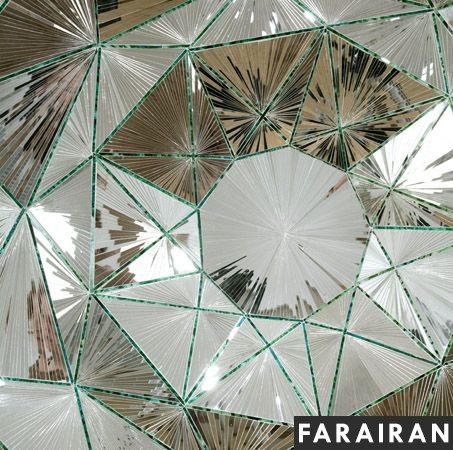
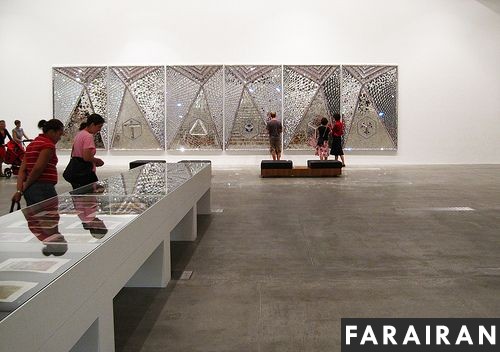
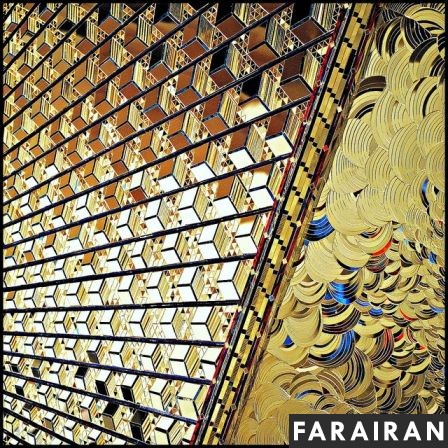
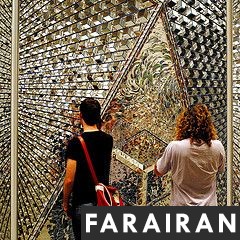
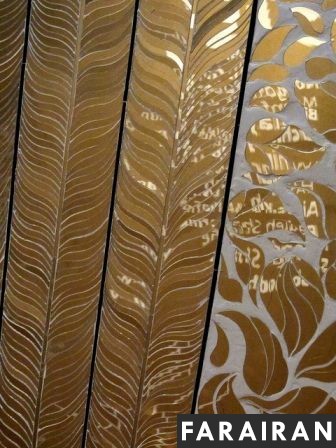
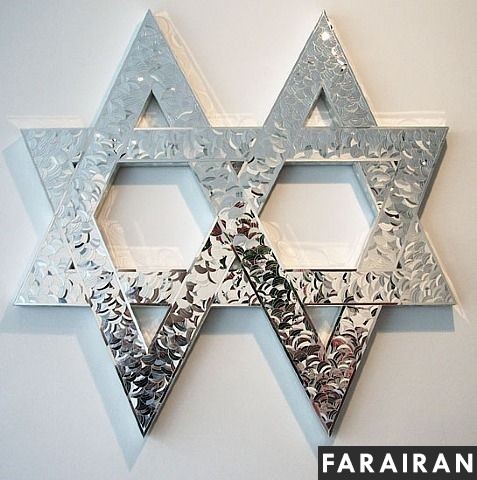
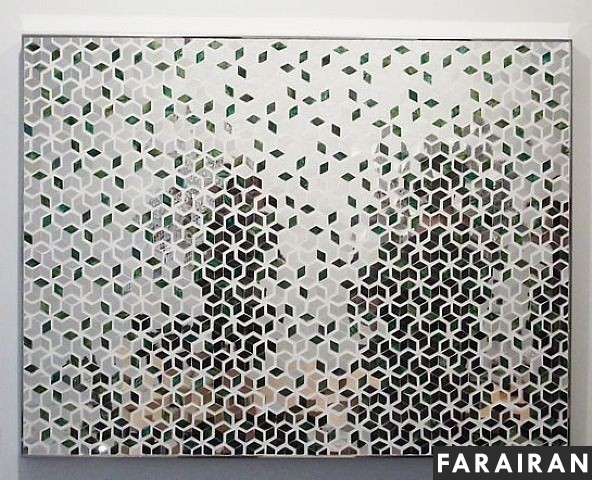
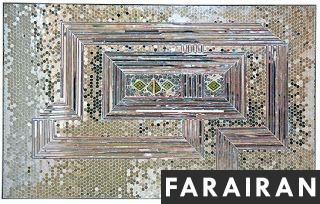
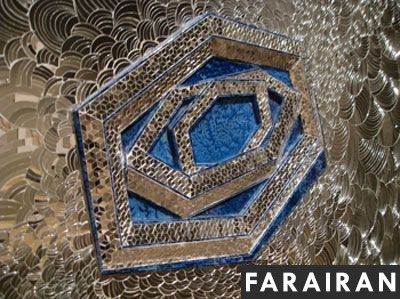
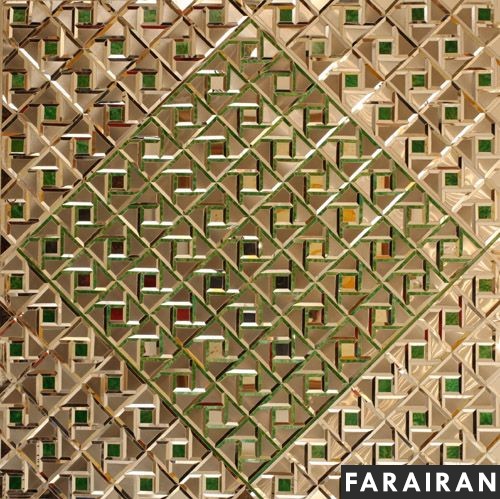
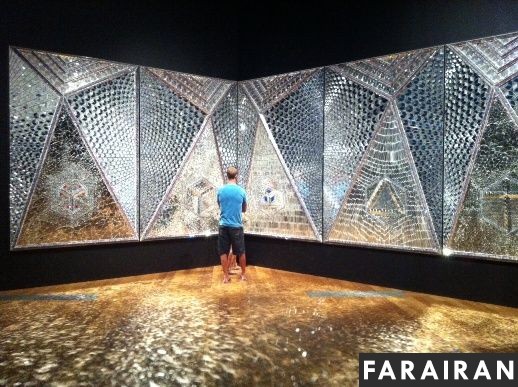
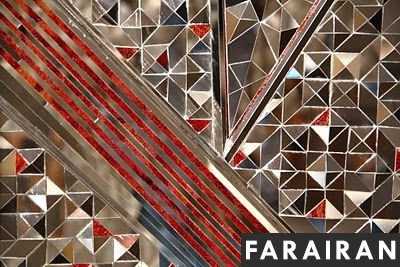
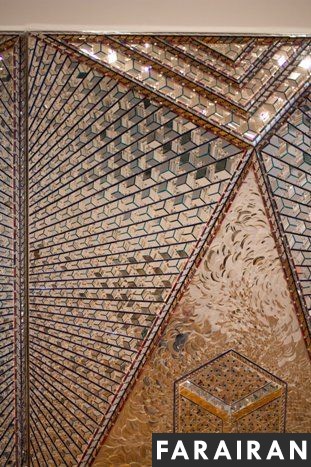
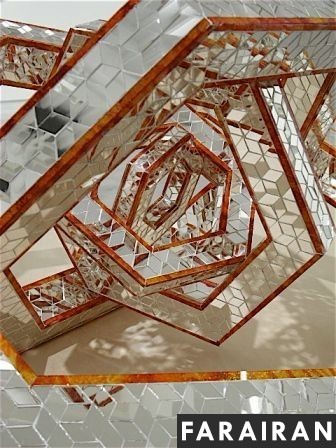
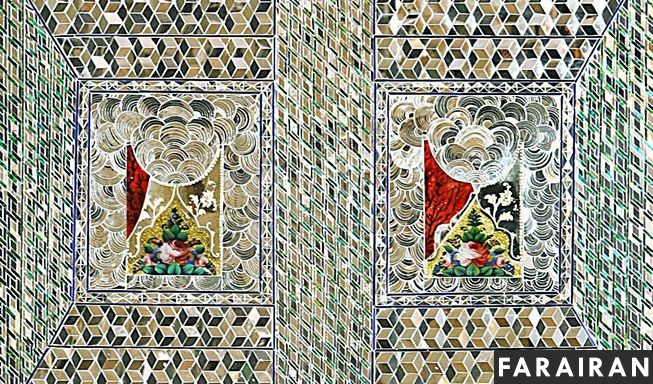
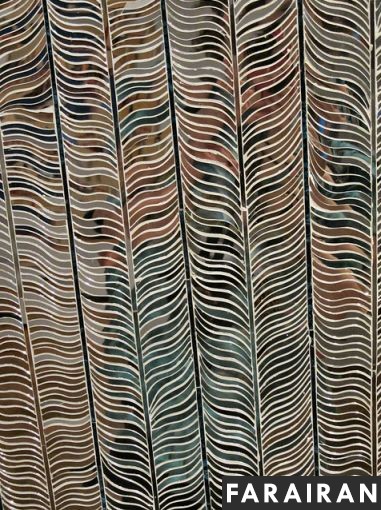
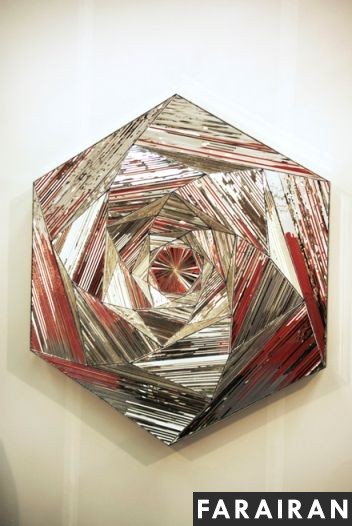
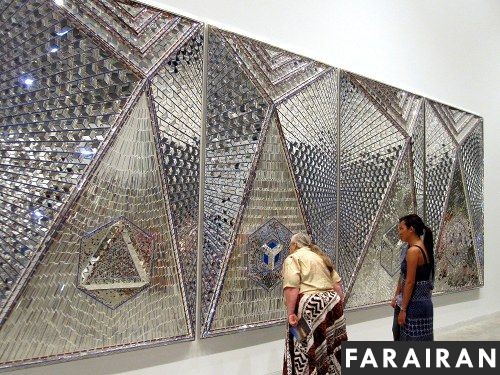
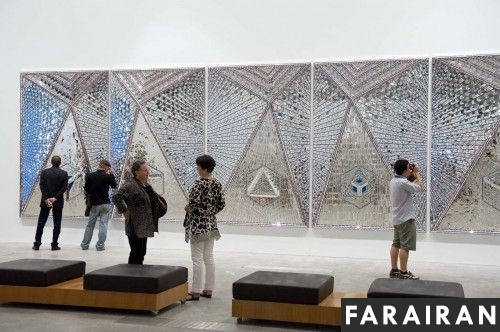
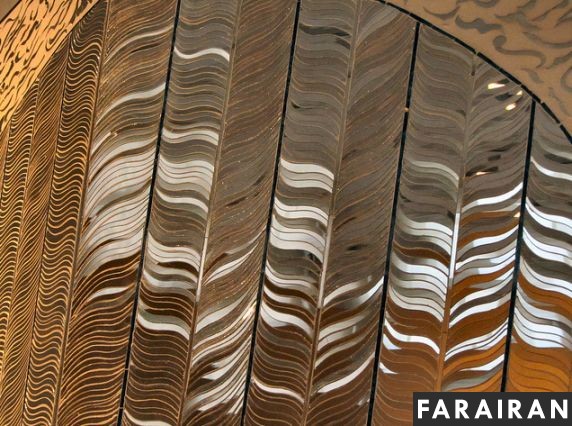
Farmanfarmaian’s art has encompassed many forms, from simple paintings of flowers and birds to unsettling “memory box” installations reminiscent of the oeuvre of Louise Bourgeois. But her largest, and most compelling, body of work combines two techniques from traditional Iranian design: mirror mosaic, and reverse glass painting, both having a flourishing existence in Iran before the advent of Islam (with Mirror Hall of Persepolis and the documentary Iran, Seven Faces of Civilization, as evidences)[1] and continuing to evolve as other art fields after Islam now not only in Royal Castles, but also Holy Shrines. These works are often large in scale and exquisitely beautiful, each sliver of glass catching and refracting the light like the teeming images inside a giant kaleidoscope, celebrating a culture which their creator adores.

Her distinctive aesthetic, thus rooted in a strong passion for her Iranian heritage was developed in the late 1960s and 1970s, with a knapsack of modern art she had brought home from US. It is during this period when Monir Farmanfarmain seriously begins to study the arts, crafts, customs and rituals of nomadic tribes in the Middle Eastern region, and toured ancient cities where she was impressed by their architectural forms and intricate ornamentation. Her work illustrates a commitment to these traditional Persian Oriental techniques and patterns, combining mirror mosaics, geometric patterns and reverse-glass paintings to create works that resonate both with traditional forms and a more modernist aesthetic.

Her reputation peaked in the 1970s, with major exhibitions in Tehran, Paris and New York. Hans Ulrich Obrist, the distinguished contemporary art director, curator, art critic and author becomes determined to see Farmanfarmain because during his trips to Cairo and Emirates at that time whenever he asked young artists: Who is your hero of the last generation? They always answered “Monir.” Obrist’s continued dialogue and friendship with Monir thereby becomes the basis of a monograph he edited about Monir (see above) and also his invitation to her to participate in his project Maps for 21st Century (2010) a series of lectures and discussions with the simple guideline: how artists perceive a map of 21st Century.[2]

Although Monir was brought up in affluence inherited from her grandfather (a merchant along the Silk Road), yet losing two sisters (one due to tuberculosis and the other to appendicitis), initiated her into pain and suffering quite early in life. After the Islamic Revolution of 1978, with the confiscation of her home and her art (some sold and others destroyed), she was forced to flee and take refugee in New York working on commissions, drawings, collages and models.

If in Iran her gender was her main hindrance as an artist (traditional craftsmen found it hard to take orders from a woman), in US it is her nationality which hinders her. In her own words: “After the revolution and the Gulf war, nobody wished to have anything to do with Iran and Iranians. None of the art galleries were willing to even talk to me. And after September 11 – my God. No way. Rather than being a woman, it was difficult just being Iranian.”

After her return to Iran in 2000, she was encouraged to recreate some of her lost works. Reluctant to copy herself, she began warming herself with abstract painting, dropping color on glass and mixing it with mirror work to rediscover the patterns she had begun in 60s when she first immersed herself in this old traditional Iranian branch of art. And like phoenix resurrecting from its own ashes, she was reborn from the kaleidoscopes of her own making.

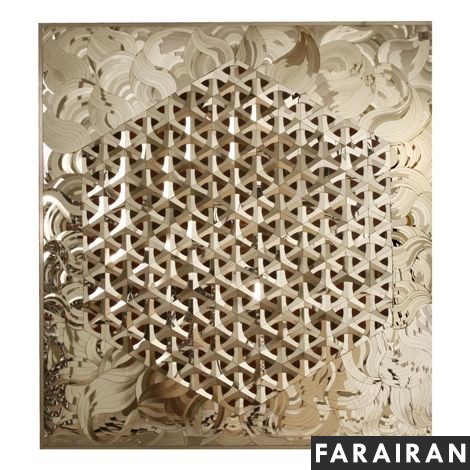
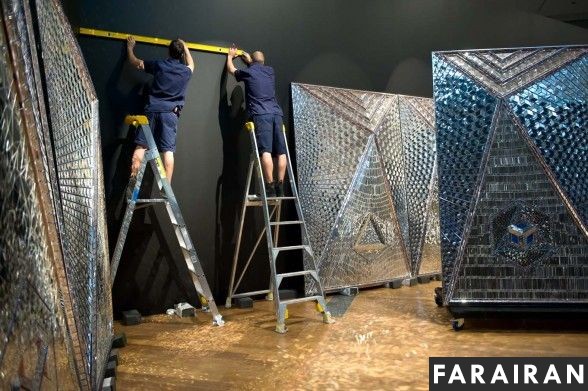
Monir Farmanfarmain is the first contemporary artist using traditional mirror mosaic and reverse glass techniques in her art. Her formula, using wooden and plaster ‘canvases’ allows the pieces to be movable, while traditionally they would have been fixed to the wall. When still young, whenever her father designed Persian carpets at home, Monir would sit beside him, stitching embroidery or drawing and painting flowers. She was still mainly painting flowers when for the first time she decided to use the reverse glass method, which is building up a picture in reverse on the back of glass. When she first tried to add mirrors to the work, she found that the oil paintings of flowers reacted badly with the adhesive she was using, thus she had to drop painting altogether. Now Monir has perfected her technique using different adhesive and glass that cuts to any size, shape and color in her works.

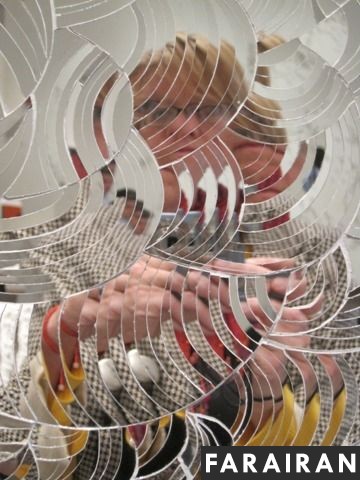
The mirror mosaics reflect many fragments of the world around them, assembling a constructed identity, a life composed of memories, individually disjointed, but beautiful in their overall effect, held in balance by the act of composition. Monir’s compositions, while externally bound and limited, open inwardly to the infinite, underlining the timeless and infinite quality of geometric concepts.

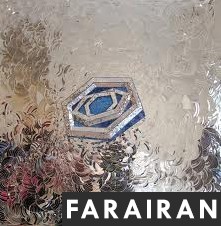
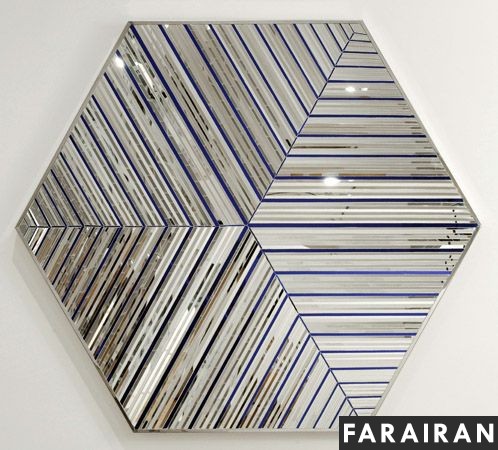
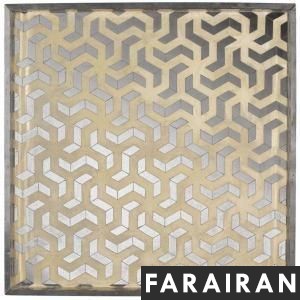
The traditional mirror mosaic designs revolve around geometrical shapes, notably the hexagon, rooted in ancient astronomical science. In her youth when Monir was first drawn to mirror work, she hired a math tutor to teach her the algebra and geometry she needed to construct these intricate and precise pieces. Curator Rose Issa, who also is an old friend of Monir highlights “Monir explores the different interpretations and variations of the flexibility of design that geometry allows.”

In this new period of her artistic creation, she not only continues to explore the variable arrangement of geometric figures, but also to emphasize on the physical movement of the shapes.

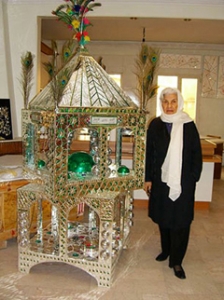
After years of absence from the scene of exhibitions, she held her first solo show in 2006 at Niavaran Artistic Creation Center, Tehran. The following year Monir Farmanfarmaian’s Mirror Mosaics were exhibited at Victoria and Albert Museum (2007). With Hejleh (2007), a mobile shrine used traditionally up in Iran to commemorate someone who has died, one comes to believe that her rebirth now consolidates, as going beyond and transcending the past is an integral part of any re-birth. She makes it in memory of her beloved husband, other family members, poets and other individuals she admired, which sounds like a homage to her personal and national past, the final stage of a metamorphosis, the butterfly is now ready to emerge out of the pupa of her transforming years of exile. No wonder that her next series conveyed the kind of air to be called the Geometry of Hope.


Farmanfarmaian with her work Hejleh

Geometry of Hope curated Rose Issa was held at Leighton House Museum, London in 2008. “I chose to use ‘Hope’ in the title of the exhibition,” explains Rose, “because I am always so happy in Monir’s studio.” The title pays homage to the beauty of Monir’s work, and refers to Sufi poetry where mirrors reflect life, light and hope.

Continuing on the path of surpassing the past, memories are poured out and Recollections (1 & 2) come to life.

Recollection 1, (Third Line Gallery, Dubai 2008), the reverse glass painting fragments that she incorporates among the mirror mosaics are details of flowers. Pen and ink drawings of flowers have been a constant practice throughout Monir’s life and she once spent many happy years creating a beautiful garden out of the bare earth around her (now confiscated) home in Tehran. It is as though with this series she reviews the geometric patterns of her own inner personal circle of life and deals with the outer social circle in Recollection 2.

Like many of her compatriots of her age and the generation after, Monir’s has witnessed the rise and fall of different political regimes in Iran. The Qajar painting fragments in Reflection 2, the dynasty whose fall coincided with Monir’s first birthday (1925) is like marking ‘ the end of a beginning’ and can symbolize the whole social historical past.

Her name appears on the shortlist for Jameel Prize 2011 at Victoria and Albert Museum, London. “I am old, but my mind is much younger. I never took myself seriously. I had no hope that I would be one of [the nominees for the Jameel prize], out of so many artists. But,” she adds with a mischievous cackle, “maybe I do deserve to win it, when I am 87 years old.”

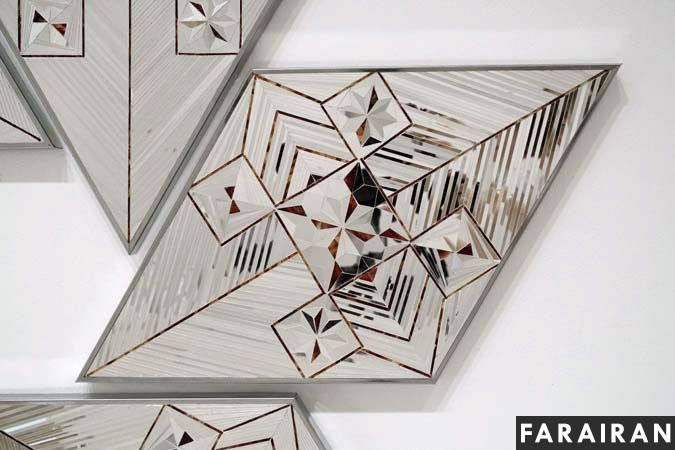
Monir has a command of a visual vocabulary that many would envy. She relies on instinct and intuition rather than theory, and her recent work is the result of a lifetime’s learning and experience. Her pieces are mystical in the play of light and colour from the mirror’s reflection and striking in their mathematical precision, and slick reflective surfaces. They come in a large scale and different shapes, some as a series and incorporate hundreds of tiny geometrical mirrors and reverse glass paintings, some only 1mm thick, carefully cut and positioned to fit. The details never cease to be alluring from 10 metres to 10 centimetres.

In her Bisections of a Circle Series recently shown at the 29th São Paolo Bienale in Brazil (2009), each work is embedded within a circle of 100 cm diameter; however in joining two overlapping circles Farmanfarmaian also references the mathematical concept of the Venn Diagram, which is used to define relationships between two or more concepts containing the possible iterations and intersections of elements. In this manner the geometric forms that are described within the circle – each articulated by a set number of points that touch the outer diameter- are also examples of the infinite possibilities of these works.
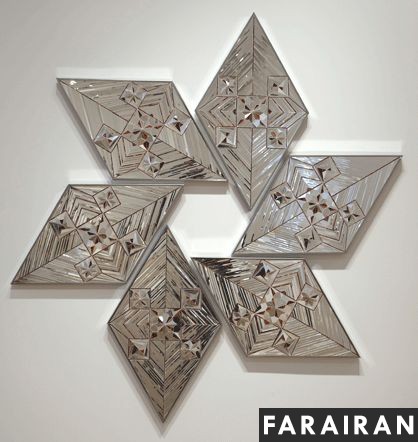
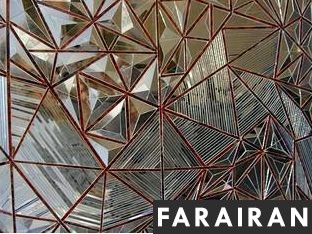
“So far as I am aware, no other artist has made works in five or six pieces that can be arranged in different ways as a collection. For two or three of them, I came up with the designs myself, then went to work on the framing. But most are taken from the geometric designs of old Islamic architecture.


Group 4, Version 4, 2010 – Mirror mosaic, reverses glass painting -100 cm x 100 cm (estimate”
“I take one classic piece of architecture and then design around it with strips or squares, half-circles, hexagons or octagons.

“The first ones were quite simple, and then I begin making them more complex. Then I went in the other direction, simplifying them down as far as I could go.”

Monir, explains that there is no ‘arty’ inspiration for her work, simply a love of geometrical beauty; she draws out a plan for each work and from this, she works with craftsmen (with master Mohammad Navid as her first instructor) to build the final piece. Monir has a lot of input in the construction of each piece which usually changes from the original drawing. “The men who work for me are very good at what they do, but when it comes to being creative, they cannot do it, they are just craftsmen.” To construct her three dimensional panels, Farmanfarmaian employs them to draft her initial designs. Mirrors are then cut to fit the required shape and placed in geometrical patterns and mixed with plaster to produce new compositions which allow the artist to use colored glass too. The resulting works are complex geometrical patterns which refer to a wide range of influences in traditional art, architecture to sciences.

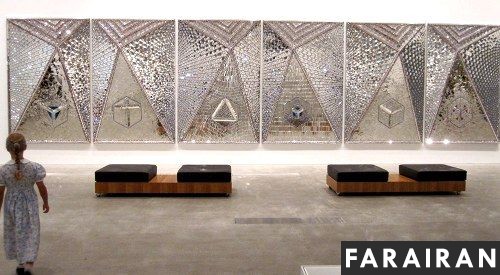
Farmanfarmaian’s work juxtaposes tradition and avant-garde to create colorful and geometric motifs: circles, squares and polygons are skillfully cast within the rigorous mould of classical geometrical design. Aware of her interest in Islamic geometrical patterns, the Queensland Art Gallery commissioned Patterns of infinity also called Lightning for Neda in 2009 for APT6, presented first by Sherman Contemporary Art Foundation. It is a computer touchscreen interactive in which participants can create colorful geometric designs. Children are invited to discover the complexity and beauty of geometric patterns and see how Monir’s installations and mirror mosaics drew inspiration from these time-honored design principles. The artist dedicated this work to the loving memory of her late husband, Dr. Abolbashar Farmanfarmaian.[3]

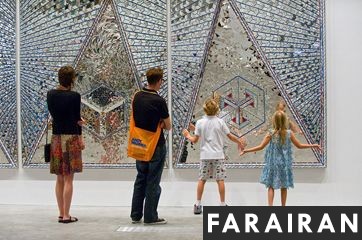
In this monumental work, the six sides of the hexagon provide an underlying structure and are expanded and elaborated on as a repeated motif. Additionally, the hexagon represents the six directions of motion (up, down, front, back, right, left) and the six virtues (generosity, self-discipline, patience, determination, insight, compassion). In each of the panels of Lightning for Neda, Farmanfarmaian has used over 4000 mirror shards to create myriad patterns across a sublime, glittering surface.

This is how much she has advanced as a product of Zeitgeist, to fill up the generation gap and bring shrines and hejlehs not only to museums, but on computer screens.

Flight of the Dolphin , (recently acquired by the Metropolitan Museum of Art, New York) is a geometric and reflective kaleidoscope with shard-like forms of color and light slicing through fragments of mirror, showing her ongoing endeavor to emphasize physical movement on a two dimensional surface.

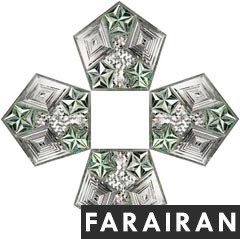
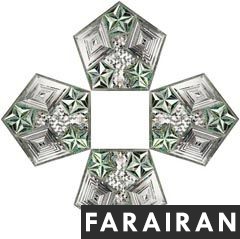
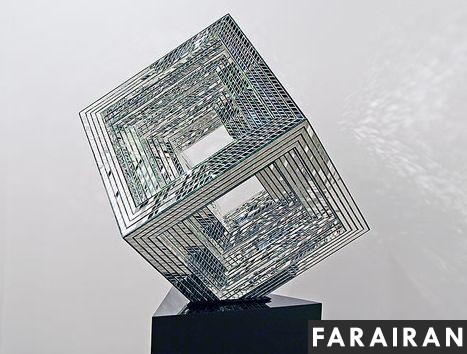
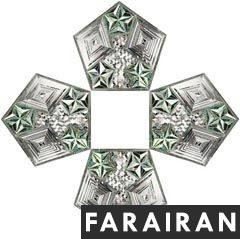
With the detailed intricacies of the cut mirror and her acute sense of modern aesthetics, Farmanfarmaian creates three-dimensional sculptures that challenge the basis of contemporary compositions. In her new work duplicating the selected figure either side by side, or facing each other, yet always connected, Farmanfarmaian creates a series of geometrical formations resulting in a number of kaleidoscopic variations. The negative space created within these formations further manifests other geometric shapes thus creating yet another layer to the work through careful and precise placement. Putting it in her own words: “The negative shapes are very important, so that the combinations can create, say, a four-pointed star in the space inside pentagons.”

Over the past forty years, Farmanfarmaian has explored, reintroduced and restructured the use of mirror mosaics, reverse glass painting and Islamic geometry creating her individualized technique. Inspired by the symbolism of numbers in Islam, where the belief is that at the core of any geometrical expression is the line and single figure based on the Divine Order of nature laws. This has led her to explore the notion of repetition, pattern and form creating elaborate combinations of shapes, color and line. In her latest series, aptly titled the Convertibles, her ornate works elevate this interplay to another level, creating formations that physically can be arranged in multiple variations.

There is no doubt that the evolution of Monir’s powerful and original vision will radiate for years to come, and leave its impact on subsequent generations of artists.


Farairan’ Choice Sadegh Tirafkan

(1965-2013)

Education:

1989 BA Photography, Tehran University

Solo Exhibitions:

2008 Assar Art gallery , Tehran , Iran

2007 Silk Road Gallery, Tehran, Iran

2006 Lee Ka-Sing gallery , Toronto, Canada

2006 Aspace Gallery, Toronto, Canada

2006 Massoud Nader Gallery, New York, U.S.A

2005 Esace photography contreype, Bruxelles, Belgium

2005 VU Photography Centre Quebec, Canada

2005 Assar Art gallery , Tehran , Iran

2004 Lehmann museun Gallery, New York, U.S.A

2003 Gallery VU, Paris, France

2002 Nader Gallery, New York, U.S.A

2002 Parkerson Gallery, Houston, U.S.A

2001 Seyhoun Art Gallery, Tehran, Iran

2000 Seyhoun Art Gallery, Tehran, Iran

1997 Seyhoun Art Gallery, Tehran, Iran

1995 Seyhoun Art Gallery, Tehran, Iran

Selected Group Exhibitions:

2010 Martin Gropius Bau Berlin, Taswir, Berlin, Germany

2009 Chelsea Art Museum, Iran inside out, NY, New York

2009 British Museum, London, England

2008 ‘Whispered Secrets, Murmuring Dreams’, Mall Galleries London

2008 Los Angeles‌ county Museum of Art, Los Angeles, U.S.A

2007 Contemporary Art Platform, In Focus, London, UK

2007 Maison Europeenne de la Photographie, Paris, France

2006 Total Arts gallery, Dubai, U.A.E

2006 Gold Coast City Art Gallery, Australia

2006 Honolulu Academy of Arts, Honolulu, Hawaii

2005 Art after Revolution, San Sebastian, Spain

2005 Arco Art fair Madrid, Spain

2004 LEE Ka-sing Gallery, Toronto, Canada

2004 Musulmanes, Musulmans in Caire, Tehran, Istanbul, Paris and Dakar – La Villette Museum, Paris, France

2004 The Fifth International Month of Photography in Moscow, Russia

2003 Paris Photo Art Fair, VU Gallery, Paris, France

2003 Group show, Unique(s), VU Gallery, Paris,France

2003 Group show , Arta Gallery, The Distillery, Toronto, Canada

2003 Art Brussels 21st contemporary art, VU Gallery,Brussels, Belgium

2002 Paris Photo Art Fair, VU Gallery, France

2002 ‘Memoires de Pierres’ musee municipal des Beaux-Arts de Frejus, France

2002 20 years photography in Iran, 40 Iranian photographers, Museum of Contemporary Art, Tehran, Iran

2001 5th Aleppo Photo Festival, Syria

Conceptual Art Exhibitions:

2005 “ Lighting The Nation Gate” Photo, Video installation, Assar Art gallery Tehran, Iran

2002 Tehran Museum of Contemporary Art,Second exhibition of conceptual Art, Secret of Words, Tehran, Iran

2002 Zagreb museum, Iranian Contemporary Art Exhibition, Zagreb, Croatia

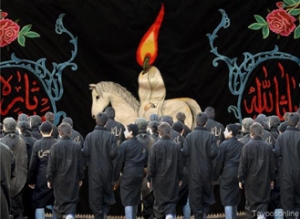
2001 Tehran museum of contemporary Art, First exhibition of conceptual Art, Ashura installation with collaboration with an Iranian contemporary painter, Tehran, Iran

2001 UNESCO center, Ashura installation pictures, video & painting, with collaboration with an Iranian contemporary painter – Beirut , Lebanon, March 2001z

2000 The children of Dark city – installation, video , painting, sculpture, with 3 Iranian artists – about Tehran’s air pollution – Tehran, Iran

Film & Video:

2004 “Sacrifice” Art Video, Tehran, Iran

2004 “Stages” Art Video, Tehran, Iran

2000- 2004 Ashura” Art video, Tehran, Iran

1999 “Untitled” Short video about Tehran’s air pollution, Tehran, Iran

1997 “Persopolis” video installation, Tehran, Iran

Sadeq Tirafkan

In Search of National Masculine Identity

Translated by Roya Monajem

Note: In writing this article, Tirafkan’s interviews with Canvas (Art and Culture from the Middle East & Arab World, Vol.3, 2009), and Asian Art News (Vol.18, 2008), his own comments for his various exhibitions stated in the corresponding catalogues have been the sources of inspiration.

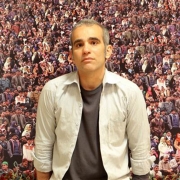
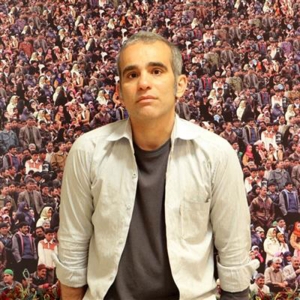
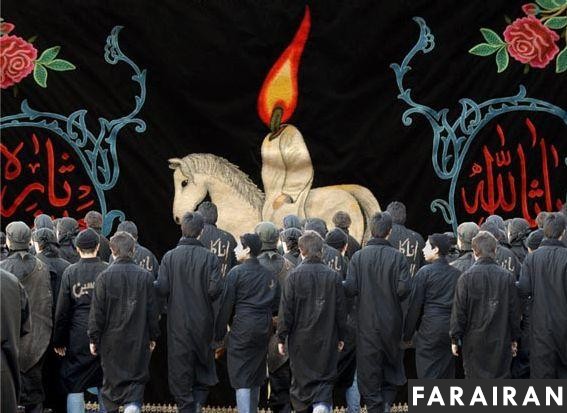
Sadegh Tirafkan was born in Karbala, Iraq to Iranian parents in 1965, and like all Iranian families in Iraq at that time, they were expelled by Saddam Hussein in 1971. So they fled to Iran just before the Islamic revolution. From 15 to 18, Tirafkan became a member of the youth militia, basij and participated in Iran-Iraq war in 1980s. The experience left such a deep impression on him that still reverberates in his work. In an interview with Canvas, while showing his snapshots of those years, he says: “Most of these people are dead now and I have lost touch with the others.” His Ashura ongoing series originates from these years of his direct religious experience, when he also made his mind to pursue an artistic career and subsequently entered Tehran University and was graduated in 1989 with a degree in photography. “I began photography by recording what surrounded me, now I take what is around me into the studio and make it into what I see through the prism of my life and culture. An idea starts as photograph, but it may grow into a collage or video.” His simultaneous deep interest in theater and film, frequently makes his work appear as a combination of a staged theatricality (even when he has not actually staged the photo) with a documentarian’s eye, revealing the influence of Cindy Sherman on him. Like her, Tirafkan uses self-portraiture to fulfill narrative ends, but where Sherman adopts various disguises in her photos, he is nearly always recognisable.

“I like the precision and aesthetic of a staged photo and strive for that without actually staging it.” Other influences include Philip Lorca di Corcia and Vik Muniz. Tirafkan is continually absorbing and learning from all around and, as he says, “I’m always a student.”

To some extent this explains Tirafakan’s spontaneous approach to his projects. He constantly works on simultaneous projects and never begins them as a work in isolation with determined start and end date.

Thematic variations consistently weave in and out of Sadegh Tirafkan’s work – Iranian culture, contemporary culture, ancient culture and his identity as a man and as an Iranian. In his photography and videos, Tirafkan draws from the vast several thousand-year-old history of Iran, from the Zoroastrian religion and the Safavid Dynasty to the present, including satellite television and celebrity culture. He subsequently adds layers of his own personal experience to create a rich tapestry of expertly crafted aesthetics and concepts. Tirafkan is a genial man with salt-and-pepper hair, expressive hands and a quick smile. His boyish looks and energetic demeanour reveal the mature voice of a man who has witnessed a lot in his 44 years.”

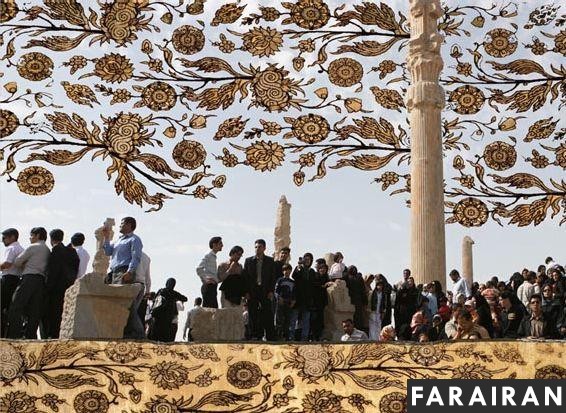
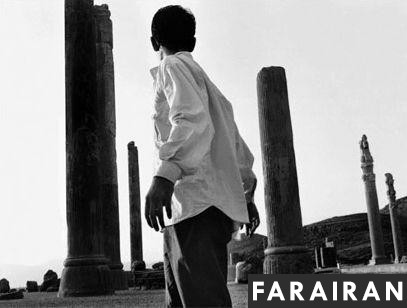
He had his first solo exhibition of portraits at Seyhoun Gallery in Tehran, in 1990. In the November of the same year he was invited to participate in Mois de photographie held in Paris. This marked the beginning of his career outside Iran and became the impetus for his move to New York in 1997, where the interaction with Western artists strengthened his belief in his Iranian-ness, bringing him back to Iran to produce the first conceptual video installation produced in Iran, called Persepolis exhibited at Seyhoun Gallery in 1998.

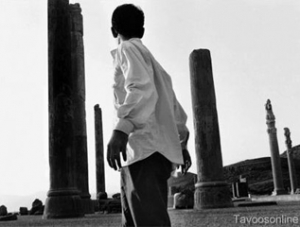
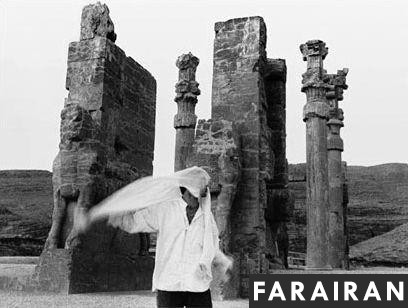
In an interview with Janet Rady from Asian Art News, in reply to her question, why he used Persepolis as a backdrop for images of himself, he exclaims: “… The question of identity of self and of nationality has always fascinated me. The glory and grandeur of any civilization is reflected in the monuments left behind and by picturing myself, I wanted to better understand what it was that the monument exuded both on a personal level and on a national one.”

1998 – Perspolis – Black and white print

While in Iran, he becomes more interested in Pre-Islamic and Islamic cultures, including art, philosophy and literature, giving rise to his series of Choghazanbil (an ancient ziggurat in southwest Iran 1995-1998) and Ashura (the mourning ceremony of martyrdom of the third Shiite Imam Hussein (1989-2004) and Persepolis 2 series in 2002 in which he introduced other people from different historical settings into the frame.


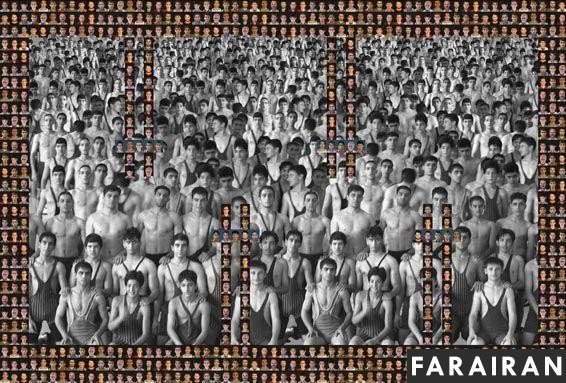
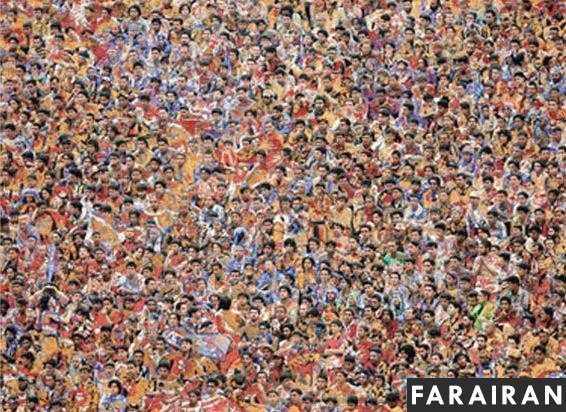
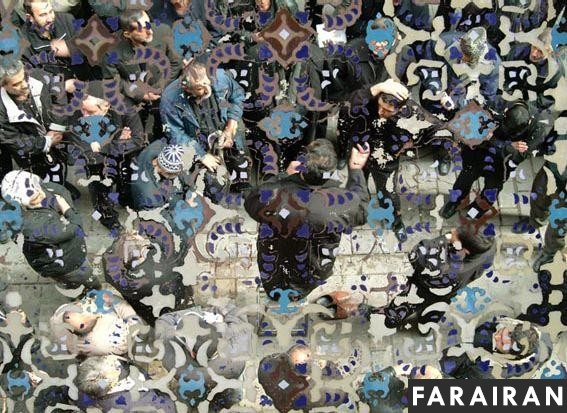
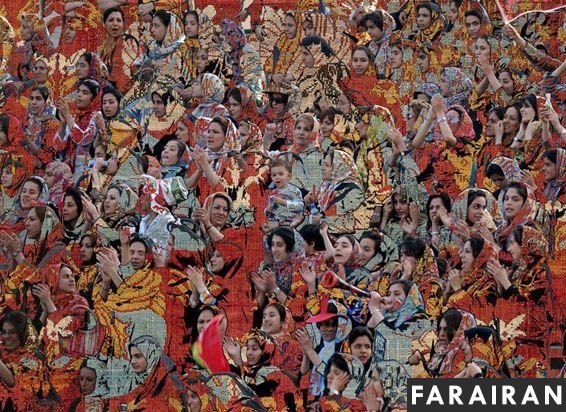
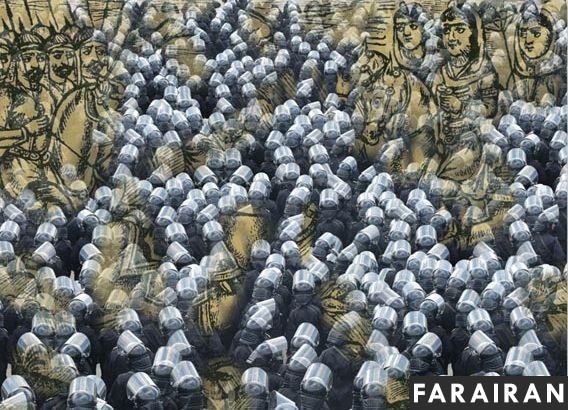
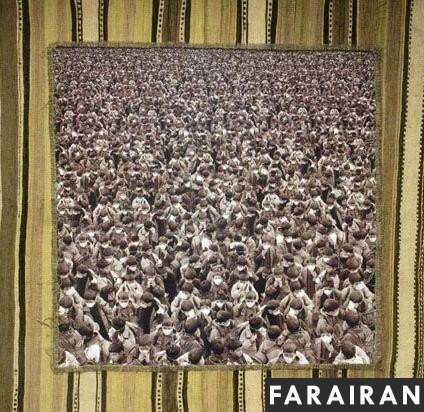
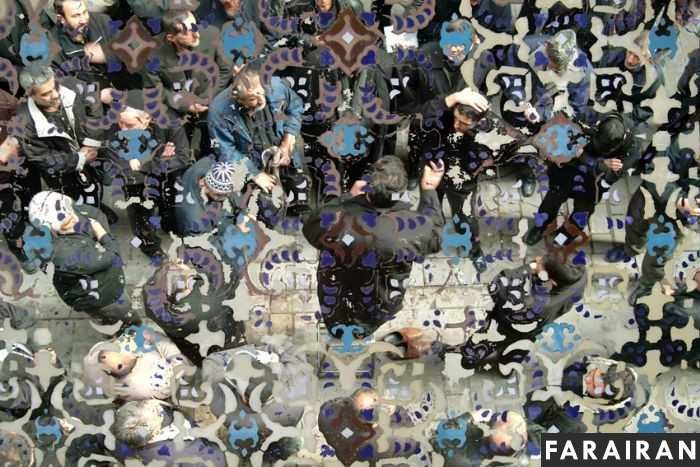
2008 – Multitude – 74 x110 cm- Digital photo collage

Beginning to shoot with a Hasselblad camera, which captures incredibly rich and detailed images, Tirafkan switched to a portable digital format in 2002. That’s why the Ashura series, consists of snapshots which are sometimes the final work of art and at other times, they serve as a preparatory image that the artist then manipulates on a computer. Within the theme of Ashura, Tirafkan has many subcategories, including fashion, generation and gender. The fashion component resulted in the Men in Black series. The first part of Ashura was exhibited at Tehran Museum of Contemporary Arts in 2001. A part of Men in Black first appeared in a book published in 2005, and later exhibited at Waterhouse & Dodd Fine Art in 2008. Altogether according to his own estimate only five percent of the series has been seen by the public, something he hopes to change by publishing a book of all the images in the future.

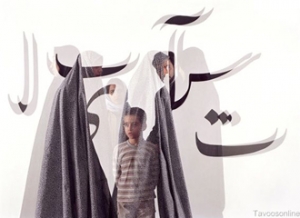
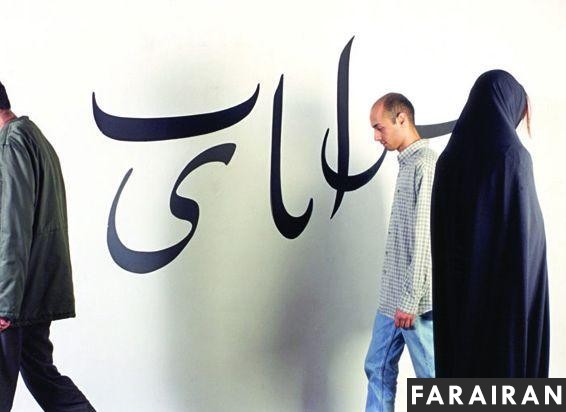
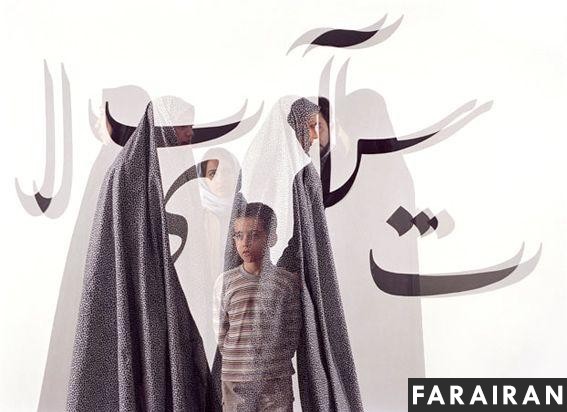
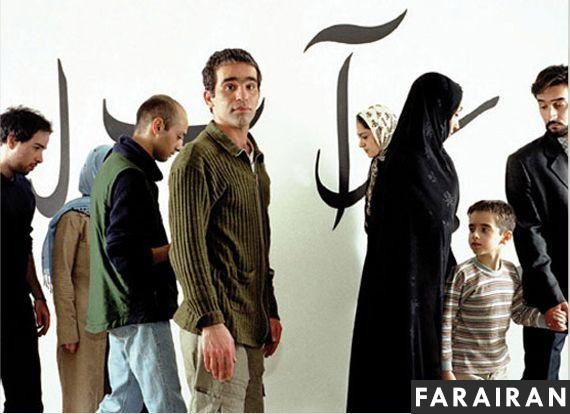
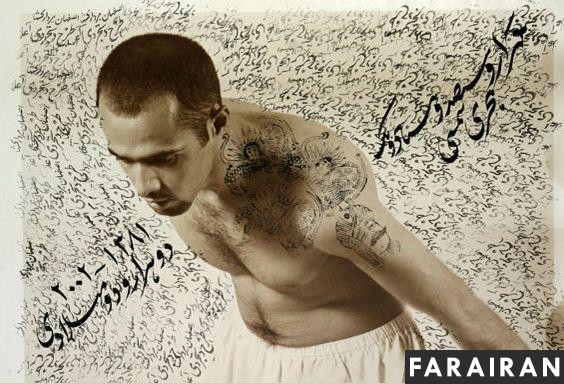
In 2002 he turns to calligraphy which he considers as “the highest written form of communication for all mankind,” and his Secrets of Words is born, featured in Whispered Secrets, Murmuring Dreams, a group exhibition held in London in 2008. “We all have our sad stories, which we instantly recognize in the glimpse of another. So, the single letters in my work act as a metaphor for these glimpses and set out to show that through our feeling-experiences, we all share something in common.”


2002 – Secret of words – 63×90 cm – C print
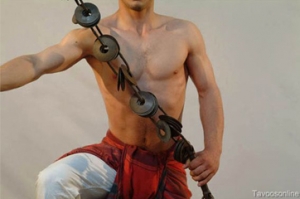
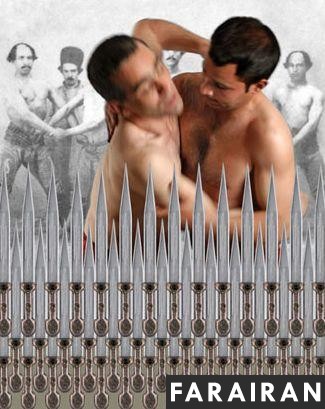
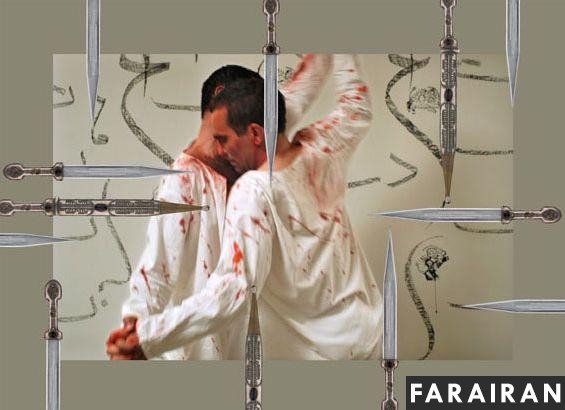
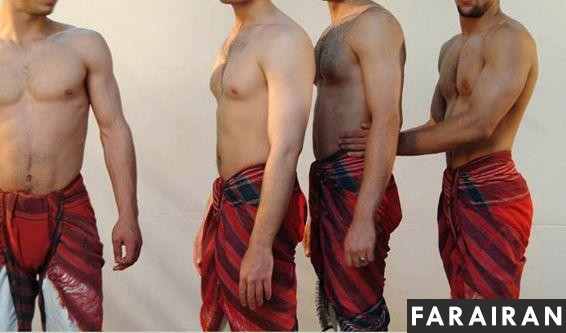
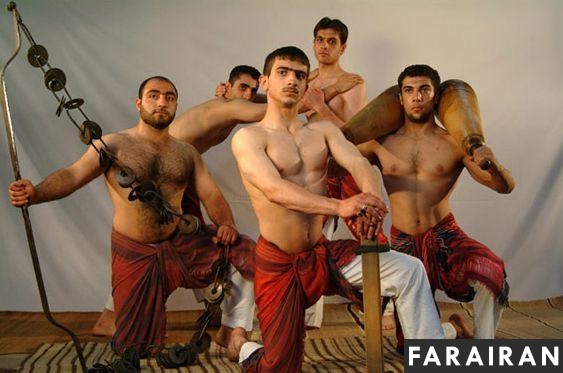
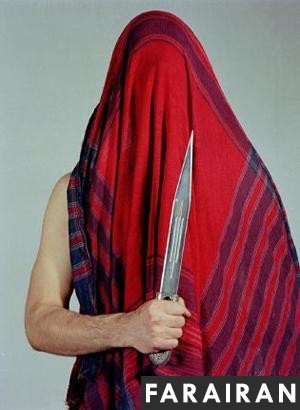
In addition to Iranian history and self-identity, masculinity and manhood has been a major subject matter of Tirafkan’s works, dealt with first in Iranian Men (2000) which was later published in Belgium in 2006. A self-portrait photo triptych resembling a sequential comic strip, masking his identity under a red lo-ng, a traditional Iranian sash (originally made of gold and silk threads) used in sporting combats that is known as the warrior wearing symbol of masculinity and according to Tirafkan “of humanity of real man not just in Iran, but in universal society today. In fact, the subject of masculinity is continued in my current series The Loss of Identity.”

“I tried to convey the humanistic message embedded in these ancient symbols of manhood in my culture – lest they are forgotten.

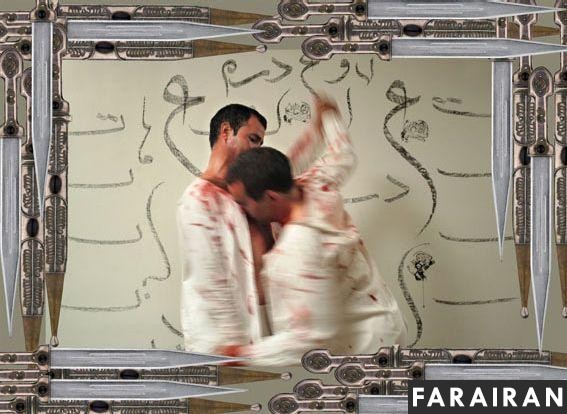
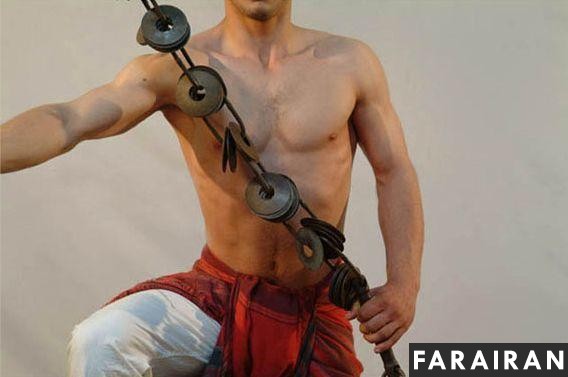
In Zoorkhaneh (2003-4)which is Islamized Mithraic temples where ever since then men made their body as well as their mind, and has been the cradle of many orders of knighthood and other masculine cults, Tirafkan tries to show that although ‘the same environment and looks are kept, but not the same spirit and attitude.”


2003-04 – Zoorkhaneh (Traditional Iranian sport club) – 60×90 cm – C.print
No wonder that his other simultaneous project, Sacrifice (2003) video is set in a zoorkhaneh, where the red lo-ng wearing wrestlers tumble about center stage.

But just underneath the surface, crimes of passion clash with hidden affairs and madness dances with rage. This is where Tirafkan challenges the taboos of traditional Iranian culture. Inspired by the stories of Abraham nearly killing his favorite son to prove his devotion to God, Rostam, the most well-known ancient Iranian knight unknowingly killing his sole son to prove his devotion to his king and country and Imam Hussein as the classical Shiite emblem of self-sacrifice for one’s faith and ideology, Tirafkan describes this series as “my artistic interpretation of the emotional impact these stories have had on me since childhood.” Later he develops the same theme further in Devotion.
For Tirafkan symbols “have their own values and meaning in every culture,’ while “basic human instincts have common meanings for people all over the world.” To him “pomegranate is the most symbolic fruit in middle east,” covering a wide scope of meanings from love to infinite world and in Temptation dedicated to his favorite filmmaker Sergei Parajanov, he “leaves the audience to interpret it in their own way.”

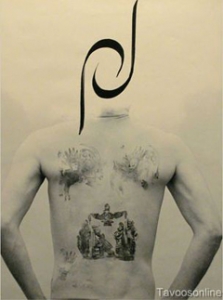
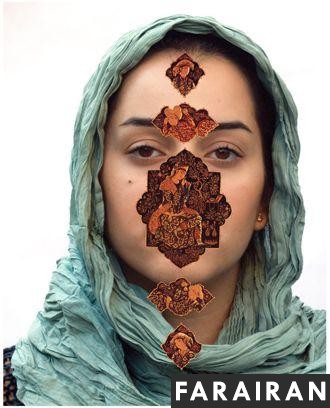
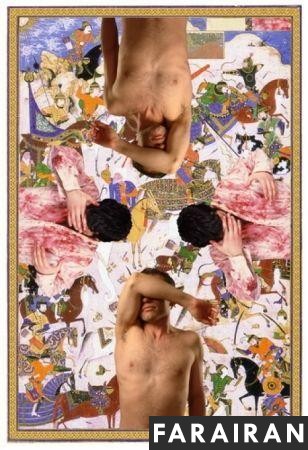
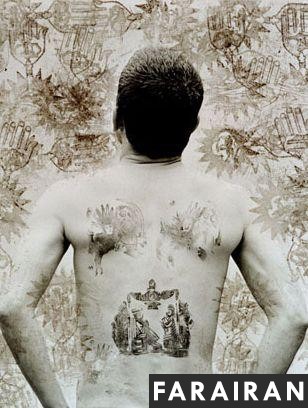
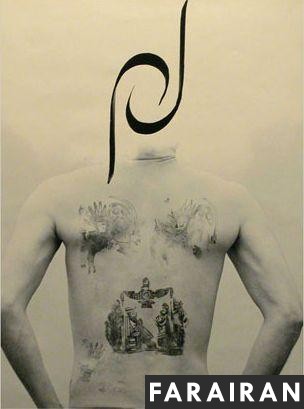
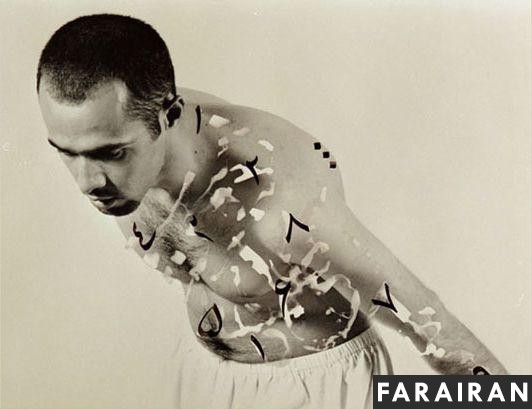
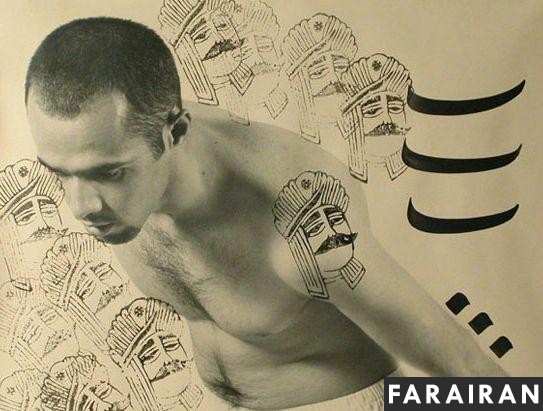
In Body Signs, Body Curves and Loss of Our Identity, Tirafkan approaches culture as a physical stamp that cannot be removed or altered, thus making a great part of one’s identity. The imagery in these series was inspired by ancient Iranian tattooing practiced among pre-Achaemenid kings, as well as by wooden block print stamps used to decorate cloth. But for Tirafkan, “the blocks have been used here to stamp the human form. Flesh is the canvas branded by culture.”


2001-02 – Body Curves – 60×46 cm- Mixed of stamps and hand written calligraphy on silver print

From another perspective, this series can be viewed as the artist’s lamentation for former glories of Iranian culture now being replaced by contemporary Iranian youth with “the present commercial pervasive satellite broadcasts and the Internet.” As Tirafkan so aptly states, “The first thing war kills is culture. Governments cut budgets for culture but have the means for the satellites that beam garbage directly into peoples’ homes.” The role of cultural heritage in contemporary life is another ongoing subject, Tirafkan deal with in Multitude and Devotion exhibited at Assar Gallery in Tehran in 2008. Both series deal with the leitmotifs of identity and culture.

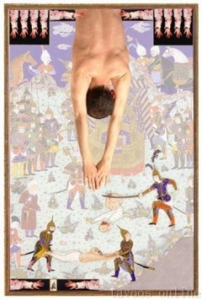
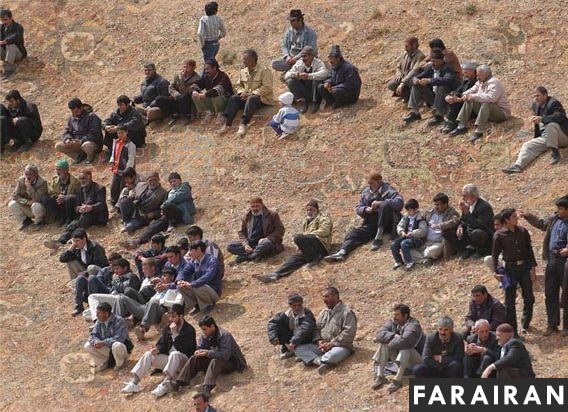
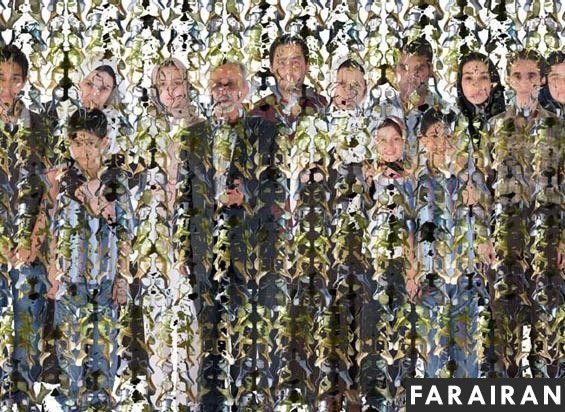
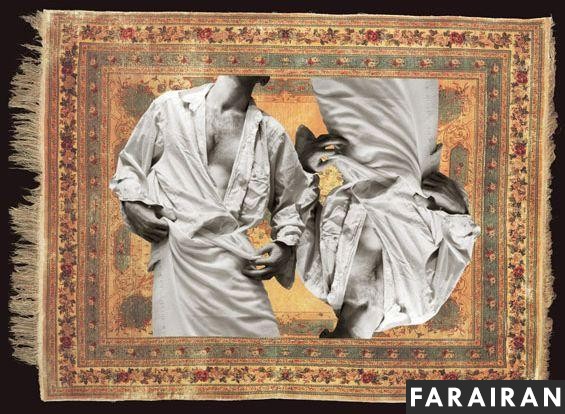
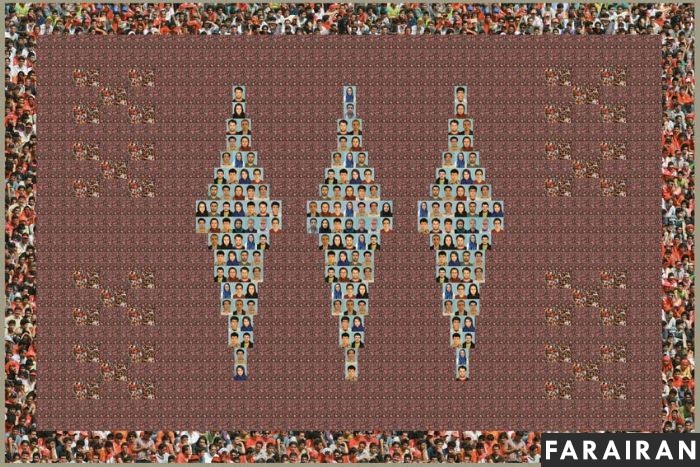
Multitude looks to a person’s public life and the crowded streets of Tehran one must negotiate when leaving one’s home, taking the initial documentary snapshots of multigenerational group of men sitting on a hillside and transforming them into a work of art by manipulating the hillside into a rich and complex surface of dirt and an earth-toned Safavid carpet. Devotion which is more reserved and contemplative, comprises a series of a sequence of photos of men and women applied to the four walls of the gallery; in the centre is a glowing yellow-and-green glass a ziggurat-like construction referring to Iran’s Zoroastrian past. This sober work is more understated than his previous projects and also incorporates elements of installation art, which is new for the artist, who hopes to develop this project and exhibit it elsewhere.

Whispers of the East (2006-7) deals with the question of democracy and how US has little sensitivity for culture, religion and life style in the region, but is only concerned about military actions. With his interpretation of a classic Persian carpet, Tirafkan seeks to preserve the traditions.


2006-07-Whispers of the East 3

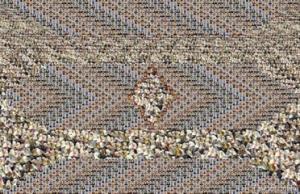
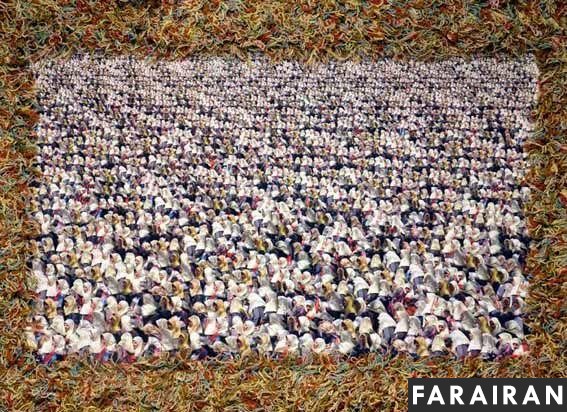
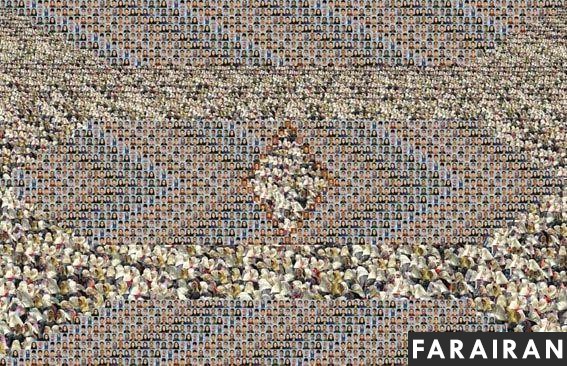
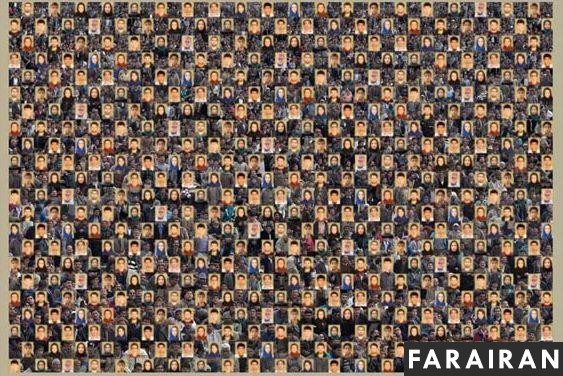
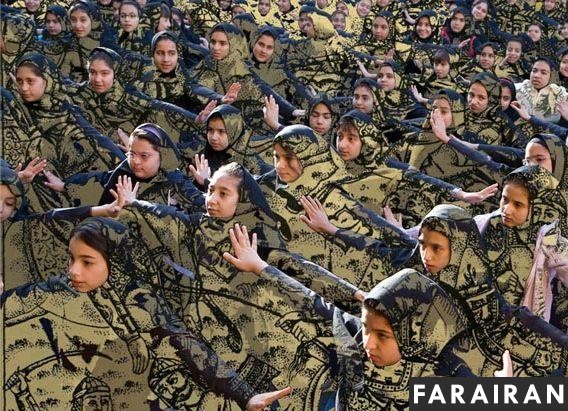
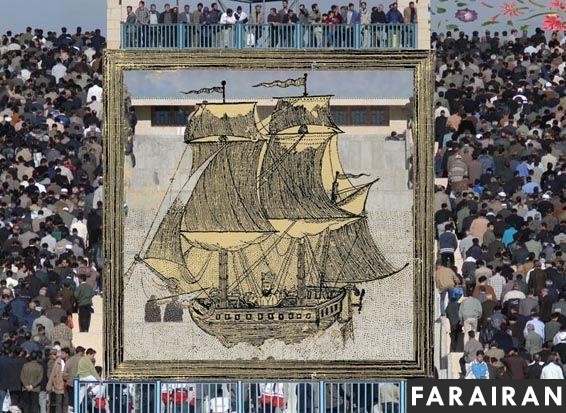
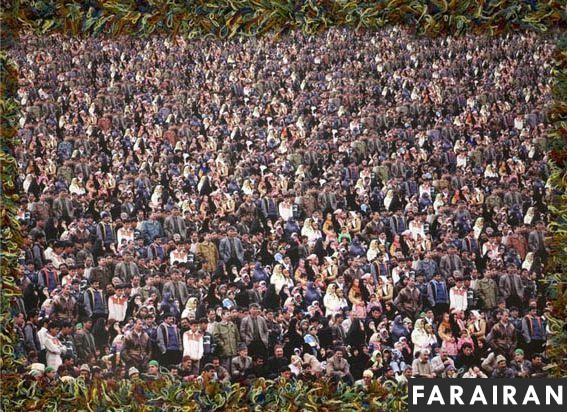
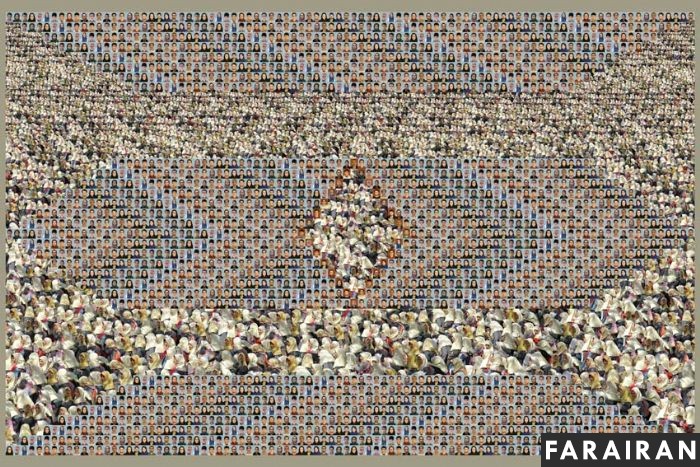
His most recent project, Human Tapestry is a commemoration of the traditional art and unknown artists of his homeland to tie traditional beliefs and ancient patterns to modern people and contemporary aesthetics. “From 2006 I have been focusing on population and its unbalanced distribution around the world within my works. I don’t only look at topic from a political aspect, but also and most importantly from an artistic eye – an eye which originates from a thousand year old culture, rich with history and civilization. I have been trying to combine current events with layered and hidden historical art, using new technology in order to ease communication between people living in today’s world and my work.”


2009-2010 – Human Tapestry- 97×151 cm – Digital photo collage

As his body of work elucidates, Tirafkan is very proud of his identity as an Iranian man. He conveys this pride through meticulous art in which every detail is weighed and measured in order to create work that is to the best of his ability. He sees this as the ultimate Iranian cultural trait. “Iranian art reflects a heightened sense of perfectionism. Look at Persepolis, Iranian miniatures and Safavid art!”

Tirafkan’s richly layered art is the work of an incredibly complex man who has been to hell and back and whose work is fearless and poignant.

Perhaps his art is a poetic way to exorcise demons of the past and present.

My goal is to demonstrate that all people regardless of gender, culture and religion are indeed looking for inner peace and sanctity.

Sadegh Tirafkan passed away on the morning of May 9, 2013 after a long battle with brain cancer.


Farairan’ Choice Ali-Akbar Sadeghi

Image processed by CodeCarvings Piczard ### FREE Community Edition ### on 2018-01-29 12:55:19Z | http://piczard.com | http://codecarvings.com

Born in Tehran in 1937, Ali Akbar Sadeghi entered the college of fine arts of ‌Tehran University in 1958. While still at high school, he studied watercolor painting with Avak Hyrapetian. Later in 1959, Sadeghi created a characteristically Iranian style of stained glass art. During his college years he engaged in such various fields as poster painting, advertisement graphics, packaging and book cover designs.

Upon graduation, Sadeghi produced a few animations for the center of intellectual development of children and young adults and illustrated a few books for the same institute. He soon became quite distinguished in the field of animation, book illustration, watercolor, and oil painting. His animations include: The Seven Cities (1971, 18 minutes), Flower Storm (1972, 9 minutes), Boasting (1973, 11 minutes), Coalition (1973, 12 minutes), The Rook (1974, 10 minutes), Malek Khorshid (1975, 22 minutes), and Zal and Simorgh the Bird (1977, 25 minutes) with cooperation of Alireza Kavian-Ra’d.

Teaching art students in Oman, teaching animation in the University of Decorative Arts, teaching book illustration at the College of Fine Arts of Tehran University, supervising more than 20 students studying animation and illustration at both undergraduate and postgraduate levels, honorary member of Society of Iranian Painters, a member of the Society of Children Books Illustration, commemorated as the distinguished Iranian children books illustrator in 2006, also as a pioneer animation director and the first Iranian director in folklore animation films and..

Awards:

1978 Grand Prix, Noma Concours, for Children’s Picture Book Illustrationfor “Contemplation is the Best Worship”, “Hero of Heroes” and “Voyages of Sindbad, the Sailor”
1980 Grand Prix, Best Designed Books from All Over the World, Leipzig, for “Contemplation is the Best Worship”
1985 Grand Prix, First Biennale of Iran Graphic Design Exhibition for Book Illustration
1989 Honorable Mention, Intellectual Development of Children and Young Adults, for “Victory
Awards for Flower Storm:

1972 Gold medal from Tehran 7th international film festival of children and young adults
1973 Honorable Mention, Tampere International Short Film Festival, Finland
1974 The Soviet Painters Association Award
1974 The Grand Prix of Lebanon Educational Film Festival
1975 Bronze Medal, Columbus Film Festival
1975 Bronze Medal, Columbus Film Festival for the idea and motif in production of Flower Storm
1975 Honorable Mention, International Animation Film Festival, New York
1975 Bronze Medal, International Animation Film Festival, New York
Awards for Boasting:
1974 C.I.D.A.L.C, Gandhi Peace Prize at 24th international Filmfestpiele Berlin
1974 Bronze Medal, C.I.D.A.L.C. Annual International Committee, Paris
1974 Honorary Diploma for the best short film, Tehran International Festival of Films for Children and, Young Adults
1974 Honorary Diploma, Krakow 12th International Film Festival
1975 Bronze Medal, Krakow 12th International Film Festival
1975 Gold Medal, Virgin Islands International Film Festival
1975 Silver Medal, Chicago International Film Festival
1975 Honorable Mention, Los Angeles International Festival of Children’s Film
1975 Honorable Mention, New York 4th International Film Festival
1975 Honorable Mention, San Francisco 4th International Festival of Children’s Films
Awards for The Rook:
1974 Honorary Diploma for the best short film, Tehran 9th International Festival of Art Film for children and young adults
1974 Honorary Diploma, Krakow 12th International Film Festival
1974 Bronze Medal, Krakow 12th International Film Festival
1975 Gold Medal, Virgin Islands International Film Festival
It is noteworthy that 38 countries participation in this festival and there were 2000 film entries.
1975 Silver Medal, Chicago 11th International Film Festival
1975 Honorable Mention, Los Angles International Animation Film Festival
Honorable Mention, San Francisco 4th International Festival of Children’s films
1975 “Rook” was selected as an outstanding film of the year for presentation at London Film Festival
Awards for Malek Khorshid:
1977 Honorary Diploma, the Festival International de court Metrage pour la Jeunesse – Paris
Books Illustrated:
The Hero of Heroes (1970, also published in Japanese in Japan)
Abdolrazzaq the Hero (1972)
Gordafarid (1973)
Contemplation is the best worship: Aphorisms of the Prophet Mohammad (1974)
The Bronzesmiths (1974)
The Rain, The Sun , and The Story of Tiles (1974)
Be the Child of Your Times: Aphorisms of Imam Ali (1975)
Let us play Chess (1975)
The Prophets’ Mother (1975)
The Voyages of Sindbad The Sailor (1976)
They Are Alive, The Life of Zeinab, Imam Ali’s Daughter (1977)
Shine, Lady Sun! (1977)
Let Us Live Together (1977)
A Visit to the Province of Chahar Mahal and Bakhtiari (1977)
Keep Your Spirit Alborz: The Mystical Sayings of Khajeh Abdollah Ansari (1978)
Victory (1985)
The Chapter Entitled Chaharshanbeh Suri: An Iranian Traditional Ceremony” in Asian Games (Published in English in Japan), and the film posters forThe Rook, Boasting, and Malek Khorshid.

Awards for Book Illustrations:

1978 Grand Prix, Noma Concours, for Children’s Picture Book Illustration for “Contemplation is the Best Worship”, “Hero of Heroes” and “Voyages of Sindbad, the Sailor”
1980 Grand Prix, Best Designed Books from All Over the World, Leipzig, for “Contemplation is the Best Worship”
1985 Grand Prix, First Biennale of Iran Graphic Design Exhibition for Book Illustration
1989 Honorable Mention, Intellectual Development of Children and Young Adults, for Victory
In 1977 Sadeghi stopped making films altogether and devoted himself entirely to painting in the style of Surrealism, also resumed watercolor painting after many years. He says in this regard: When I feel relieved of tensions and constraints which drive me to surrealist painting, and at times of mental serenity and peace I turn to watercolor paintings.

In 1989 Sadeghi added an exhibition room to his studio called Sabz Art Gallery, in order to offer a space for contemporary Iranian artists to show their works.

Exhibitions:

Commemoration of Parviz Fanizadeh, Niavaran Cultural Center, Tehran
Commemoration of Asghar Mohammadi, Niavaran Cultural Center, Tehran
1988 Museum of Contemporary Arts, Tehran
1988 La Chaux-de-Fonds Art Gallery, Switzerland
1989 Iranian Watercolor Painters, Museum of Contemporary Arts, Tehran
1989 Watercolor Paintings Sabz Art Gallery, Tehran
1989 Opening of Sabz Gallery
1990 Commemoration of Firooz Shirvanlu, Noqreh Publishing, Tehran
1990 Commemoration of Firooz Shirvanlu, Seyhoun Art Gallery, Tehran
1990 For the Victims of the Earthquake, Museum of Contemporary Arts, Tehran
1991 Painting & Miniatures, Exports Development Center, Tehran
1991 Watercolors, Sabz Art Gallery, Tehran (solo),
1992 Watercolors, Iran the Land of Love, Part 1, Sabz Art Gallery, Tehran
1992 Watercolors, Iran the Land of Love, Part 2, Sabz Art Gallery, Tehran
1992 Sketches of oil paintings, Sabz Art Gallery, Tehran
1992 Watercolors, Sabz Art Gallery, Tehran (solo)
1993 Painting & Miniatures, Export Development Organization of Iran
1992 Images of Iran’s Contemporary Arts, Museum of Contemporary Arts, Tehran
1992 Painting exhibition in support of the people of Bosnia and Herzegovina, Niavaran Cultural Center, Tehran
1993 Painting Biennial, Tehran
1993 “Watercolor exhibition, Iran the Land of Love,” Sabz Art Gallery, Tehran,
1995 Painting Biennial, Tehran
1996 “Watercolor exhibition, Kerman, Memorial of Presence,” Sabz Art Gallery, Tehran (solo),
1996 “Watercolor and oil painting exhibition in Salau Palace,” Bern, Switzerland,
2001 Painting exhibition, Los Angeles
2003 Watercolor exhibition, Los Angeles
2008 Painting Exhibition, Dubai
2011 Painting Exhibition, Aran Gallery, Tehran
Sadeqi has participated in more than 70 group exhibitions inside and outside the country

Publications:
Whispers, Ali Akbar Sadeghi’s Watercolors, Negar Publication
Iran, The Land of Love, Sadeghi’s Watercolor Paintings, Gooya Publishing
Alphabet, A Philosophical Analysis of 50 Works of A.Sadeghi, by Nader Ebrahimi, Farhangan Publication
Memories, Watercolors Album No. 1, Gooya Publishing
Memories, Watercolors Album No. 2, Gooya Publishing
Memories, Watercolors Album No. 3, Gooya Publishing
Kerman, Memorial of Presence, Watercolors, 1997, Kerman Studies Center
Membership of Juries:
1974 Painting Exhibition of Tamasha Magazine for children and teenagers
1975 Iran’s Representative in the Week of Animation Film Makers, Zagreb, Yugoslavia
1976 Iran’s Representative in the Seminar of Animations Film Makers, Alma Ata, Kazakhstan
1989 The First Exhibition of Illustrators of children’s book, Tehran
1991 The Seventh International Festival of Film for children and teenagers, Tehran
1991 Honorary Diploma from the First Painting Biennial, Tehran
1992 The First Exhibition of Flowers and Nature in the works of Iranian painters, Tehran
1993 Member of Selection Board, Painting Biennial, Tehran
1995 Member of Selection Board, Painting Biennial, Tehran
1996 International Festival of Paris Children’s Film, Aubervilliers
Tributes

1991 Tribute at the 25th Anniversary of the Foundation of the Institute for The Intellectual Development of Children and Young Adults for his outstanding artistic achievements in the field of book illustration and film making, his participation as a jury member in more than 40 TV animation festivals, one minute films and cinema animation festivals, participation as a jury and selecting member for native and international book festivals, participation as a jury member in tens native biennials, honorary guest at Iranian short films festival in Washington and production of more than 15 reliefs for Saderat Bank and so on. He has been commemorated in more than 70 film and book festivals

1996 Golden key of the Aubervilliers, at International Festival of Paris Children’s Films, Aubervilliers
2000 Commemoration for illustration of religious books
2006 Commemoration on the international day of animation
2008 Selected as an everlasting figure
2008 Commemoration at Art Academia
2010 Commemoration at animation festival, South Korea

The following is an extract from: Alikabar Sadeghi, Selected works (1977-1997), Iranian Art Publishing, 1992, Tehran

Turning Toward New Horizons
Javad Mojabi

Since the beginning of modern painting movement in Iran, going back to forties (Iranian twenties), the major academic advices, that is taking advantage of tradition has had a tremendous impact on the main Iranian painting genres for subsequent decades. The question however is: How can cultural inheritance be utilized, remain Iranian and at the same time accomplish an international esteem?

Undoubtedly, innovation in any domain revolves around the existing tradition, but not in a convergent direction, like a spring that spirals toward its center and, by enveloping the shell of tradition and apparently repeating it, is reduced into a more compressed state. The innovator begins with tradition, realizing its real dimensions, he/she goes beyond it and with a divergent turn from its center opens up to other horizons. In this way by utilizing the overall human accomplishment, he/she finds a dynamic share in the development of native art and adds to the universal art treasury.

In his particular interpretation of tradition, Sadeghi first deals with the characteristic Iranian world, and subsequently with the roots of human universe. In contemplating upon these worlds, he sometimes makes time and space to fade away in his works, invoking the entire humanity to an infinite world, to an eternity in which the world is observed at the stage when apple, tree, horse and the first human beings were created, as though, after centuries of efforts, human beings have already reached its apocalypse.

The Planet of Imagination

If we accept the premise that art is the interaction between imagination and reality, in the sense that the artist’s imagination draws vigor from the outer reality and affects it in return, with art being born out of this continual exchange, then this interpretation fits Sadeghi better than any other painter, because he has made real use of imagination in his works. This imagination is not of the fantastic, unbridled or sickly nightmarish type. Rather, in the language of Iranian sage artists, it is a kind of attitude, a worldly outlook of existence. Our past artists and men of letters believed that the imaginary world can provide an interpretation of existence superior to that resulting from the means of experience or reason.

Sadeghi has built an imaginary planet with a strange geography, chimerical peoples, a real history and surreal adventures. His colorful imaginary planet bears similarities to our world. At times its link with it is filial. At others it is so remote that identifying it with the mother planet becomes difficult.

The planet of Sadeghi’s paintings is made, not out of reality, but of the substance of imagination. His active imagination transforms the surrounding realities into the form and color of an imaginary space; although the boundary between reality and fantasy has long become so blurred that separating them seems so naïve and credulous.

He begins his work with the pictorial heritage of his own culture that is Iranian painting, which is the outcome of his ancestors’ imagination in the face of the real world. Past Asian painters, particularly Iranians, contemplated the materiality of the real world at large but did not reproduce it as such. Instead, they depicted their subjective mental reactions to the surrounding world and people in an intuitive way, in esoteric signs. The aim was to depict one’s mystical understanding of the world rather than to faithfully reproduce it.

Iranian artists recognized the microcosm and the macrocosm in the mirror of mysticism, poetry and myths: in the realm of imagination. They believed that the meaning of the universe is nothing but a transcendent imagination. Imagination, therefore, is an effective means of understanding existence. Material experiences and reason cannot lead one to the universal truth as effectively as active imagination.

After graduating from the Faculty of Fine Arts, Ali-Akbar Sadeghi touched upon various experiments in painting, stained glass and graphic design, which resulted in his acquiring brilliant technical skills in various fields of plastic arts. But his cooperation with the Children and Young Adults Intellectual Development Center as book illustrator and film producer was the beginning of a new period in his artistic career which he has ever since pursued at an accelerated pace and with stupendous diversity.

In his illustrations of the Hero of Heroes (1970) and other books, mostly published during 1970s, and in his five or six animation films, which range from the Seven Cities to Zal and Simurgh the Bird, he utilizes the apparent mold and space of miniature paintings, thus aligning himself with many contemporary painters who revived or renovated miniature painting in order to preserve traditions and adopt an indigenous iconography.

In this period, Sadeghi simplifies the forms and spaces of miniatures and applies this ultimate stylization to his colors as well as to his lines and forms. But what distinguishes Sadegi from his peers is his next step in exploring the world of miniatures. Beyond the apparent face of miniature forms, he reaches the essence of Iranian painting, and this essential discovery saves him from imitating, copying and playing with forms. He is instinctively aware of the intuitive perception ancient artists had of existence. He senses that miniature painting is the fantasy of this world, and not an exact reproduction. So, imagination is the foundation and not formal appearances. Thus one may discard the appearance of miniature forms and pay attention to its spirit which amount to understanding the imaginary space and apprehending the “symbolic world.” One can imagine the world differently and still function in a genuine way like ancient artists, and benefit from their knowledge about existence. The outer appearance disappears. A door opens. Sadeghi finds a way into the immensity of imagination, where the world can be recreated in fantasy and paint that transcendent reality in a mystic space. This immensity, this essential universe, is filled with poetry and mysticism. One can soar in it on the wings of myths and fables. Here, dreams and nightmares transcend actual reality. Symbols, mysteries and allegories rule in this eternal universe, which is the universe of reflections and enlightenments, of wonderful human fantasies, or artistic creation.

In the world of modern painting, when passing through new experiences, some avant-garde artists alter both foundations of their work, i.e. form and content in a harmonious way. That is, when they chose ‘subjectivity’ and instead of presenting an exact representation of Nature, reproduce their own subjective world, they change both their subject matter as well as their way of dealing with it, just as Picasso and Joan Miro changed both their vision of painting and their style of materializing it. But Sadeghi – like Dali and Magritte – cautiously retains one foundation unchanged, and that is the classical way of depicting his subjective world to which he has grown accustomed and which he has mastered, while altering the other foundation, which is the context of his world of paintings. Thus, in order to maintain his relationship with his innumerable audience he does not take the risk to alter both form and content simultaneously and while renewing his subjective world, he does not cut the string of his bonds with tradition and current visual habits.

The Inhabitants of the Imagined Planet

In visual terms, Sadegi’s oil paintings can be divided into several categories. He has created numerous paintings with specific elements, for example apples, trees, clouds, horses, horse-riders, knights, women, masks, water, boats …

He toys with a single theme or concept for a period of time, each time picturing its dimensions and qualities differently. At one time he paints the subject – an apple or a boat – in relation with other objects within a pictorial ensemble, at another he sets it by itself alone at the center of his canvas, as though he were picking every detail of his elaborate paintings one by one, exposing them to revealing light and dissecting their innards. Apples occupy a prominent place in his works, appearing each time in a different color and with a different meaning. Here it signifies life. There it symbolizes love. Elsewhere it is a metaphor of natural moderation, when it is a hermetic world the painter is enthusiastically tempted to crack open.

This treatment can be pursued at length in each of the painter’s various themes, in which he has indulged in all sorts of plays, be it a boat, water, fog, woman and… But these are to be seen rather than described, and what is said here is merely a reference to the mental function of the painter and how like an inexhaustible experimenter, he takes his ‘subject’ to the other side of tolerance to test it with pictorial experiences, each time creating an amazing world out of a simple element.

Conceptual Painting and Interpretations

The contemporary plastic world shies away from interpretation, because interpretation limits it to its apparent image. But conceptual paintings, which belong to the Eastern universe of fantasy and imagination, just as its mystical poems and tales, allow for interpretation and each viewer, according to his/her thoughts, finds a particular meaning or various interpretations in them, even if these meanings and interpretations are not compatible or the same as those the artist elaborated in some hidden place of his mind

In the rock-land desert, a herd of horses is circling within an invisible enclosure. A few are drowsy and unaware, while most are excited and frightened, because a cube of inflamed space is about to fall; a steely mass out of which six deadly spears are protruding. The herd is aware of the mortal menace and its horror of this inescapable fate is natural. Among the rocks lies an apple; a memory of a lost peace, a sign of a lovely innocence or a departed freshness.

The onslaught of that dreadful steel mass upon the circle of the existence of a herd of horses, which symbolizes beauty, dignity and dynamism, represents the eternal combat between the forces of Ahura-Mazad (God) against Ahriman’s (Devil’s) invasions, a theme often repeated in the Manichean space of Sadeghi’s works. In this Manichean space, evil is dominant, besieging beauty and the good, so often evil disguises itself as good or has engulfed good in its depth. Yet, hope is not lost in the turmoil, even if it is as small as an apple in a rocky desert. Such is the miracle of being a human being creating a spiritual garden against the material wilderness out of an apple.

His horsemen are often warriors from historic dynasties, legends or symbols of various powers in different eras. In terms of composition, the hero is depicted at the center of the painting and everything else in the margins and background takes shape as the result of this central image. This arrangement is repeated in many of Sadegi’s works, as for example in his Female Warrior where the subject is centrally located surrounded by tables, women and khatuns of Nasseri era, with an uninvited guest “Joconde”.

In Sadeghi’s Manichean universe, evil ultimately annihilates itself, as in the case of the four warriors who, out of ignorance or cruelty, draw sword against one another, each one mutilating the other and being mutilated by another. The similarity of their faces, attitudes and weapons, imply that these four knights are in fact one and the same, in a dual state preoccupied with opposing forces and bewildered at his own ordeal. These slayers and slain may even be innocent. Their crime is ignorance or a blind, hopeless enmity. Each is a paradoxical combination of the victim and the executioner. They have opted for evil. They have attempted to kill one another, and therefore themselves. It is as though Sadeghi is repeating this divine message: “To kill one man is like killing all mankind”.

A Life at a Glance

Sadeghi’s works can be categorized in several ways. One is to consider his oil paintings and watercolors separately, because of their clear differences. In Sadeghi’s own words, his watercolors are the outcome of his “recreation breaks” at home, after taking a rest from his oil paintings elaborated the whole day in the studio of his mind.

Whereas, in his oil paintings, he is attached to the world of meanings and a thematic view of existence, proceeding on the path of imaginary creation by precise construction and execution, in his watercolors, he often frees himself of restraints of concepts, nightmares, the surreal world and freely and hastily depicts the objects around him. Still life, panoramas constitute his materials. He simply, swiftly, not feeling indebted to imagination, he goes on making realistic representations of surrounding objects and forms: flowers, plants, fruit, lamps, bowls, buildings and natural views.

Perhaps his watercolors are his response to a deep need unconsciously driving him toward a different kind of painting. Accustomed to the ornate and masterful manner of creating paintings overfilled with imaginary figures, and respectful of conceptual painting, he is spontaneously and unconsciously drawn to a style which is in direct contrast to his works: no more imagination and imaginary painting, but direct representation of objects.

A. Structural Particularities

Accomplished Technique

Sadeghi masterfully applies painting techniques in the most appropriate way. He is able to construct and execute whatever he wishes and this technical skill and mastery is the fruit of forty five years of continuous work in various fields of visual arts, half of which make up the foundation to accomplish his creations in the past two decades. This technical skill often astonishes the painter’s audience, which is somehow intentional. He has paintings which can be viewed from two different angles. In fact, they are two paintings in one. They can be viewed from top or bottom, or left and right. In some of his paintings, this device has structurally perfected the work, although this is not always the case, occasionally giving way to unnecessary sophistication. This artistic tour de force reaches perfection in his Green Umbrellas.

Complete Sketches

Wherever the opportunity arises, the artist records his pictorial notes in notebooks, to which he later refers when painting. These sketches usually begin with a line. Then comes another line. The sketch takes shape piecemeal until it is carefully completed. The sketches of one of these notebooks were once published alongside their painted counterparts. The sketches and corresponding paintings were not very different and only certain fine details had been deleted or added. Sadeghi’s professional discipline is exemplary and one of the reasons for his voluminous output is this very outer discipline and inner order which he observes in his work.

Palette

Sadeghi’s coloring technique is extraordinarily varied and has an amazing power. He rarely uses original, pure paints. He mixes and combines. A single color theme often dominates his paintings, and this is the most arduous achievement in view of the extreme colorfulness of his works. The presence of blue, azure, gold, silver, orange is conspicuous in most of his works, although, just as in the case of his teacher, Nature, one cannot say which one he prefers. His colors are brilliant, vivid, pulsating, fluid, youthful. His seas are as varied as his apples and involve the same colors and shades.

B. Contextual Particularities

Manichean contradiction

It was pointed out that Sadeghi’s mind is involved in an incessant opposition whereby he sees the world and existence at the mercy of good and evil forces. The context of his paintings, as a whole and in their details, is based on this antagonism. At times this duality is obvious, as in the opposition of day and night, desert and sea, or flower and stone: at other times it is hidden and metaphorical, as body in the hand of passage of time, bondage yearning for freedom, germination wrestling with erosion.

Although evil overcomes, giving a bitter taste to his works, as the one where the desert yearns for the sea while the sea is an image on a wrapped scroll hanging from nowhere, yet, in this Manichean world filled with evil, a liberating light of hope ever glimmers and the painter does not consider the domination of any of these forces to be absolute, and this is the result of his doubt in the judgment of expedient Reason and at last he finds Love to be the salvation.

Humoristic mind

Sadeghi’s faces the surrounding reality with humor and, unbelieving in history and its current clichés, takes refuge in a superior reality where the logic of dreams, inversion, displacement, ambiguity and grotesque space rules.

Legend, Lyricism and Epic

Sadeghi’s looks upon history but does not believe in it. He is a history-watcher rather than a historiographer, just as he is a legend observer and not a legend painter. He sees the world as a legend fabricated by others. Finding the reality in such cloak, he gets involved with it. In this involvement, he makes no judgment. He only records. He leaves the judgment to the viewer. He likes people and is familiar with their folklore. He looks upon the era’s superstitions and rituals, their customs and beliefs. He records them without judging, for he does not see himself separate from people.

Sometimes he looks at the world lovingly, as a dream of crystal and tears. Look at the house with a fountain of mist pouring on the lush green valley through its window. This is a materialized paradise of lyrical peace untainted with sadness. Or look at the painting in which a building is visible amidst the grass, fog and cloud, with columns and arcades of the substance and color of air, perceptible but inaccessible, just as a well turned poem. Sometimes the epic recorder is saddened at the fate of heroes who, like Don Quixote, have set foot in the world at the wrong time. Occasionally fairies appear in his paintings beside or against monsters and devils.

He dose not flee into the past. For him, time is eternal and the past and the future happen coincidently with the ephemeral present. The simultaneity of non-contemporary eras gives him the opportunity to reflect unhindered with conventional divisions of time, alongside ordinary men-who are unbounded by temporal, spatial and racial constrains and to ultimately deplore their fate with deep love.

Sadeghi’s is the narrator of contemporary man’s complicated and contradictory world. Such complexity extends from the heart of the atom to the periphery of the galaxy, with human being left alone in this wondrous world. The artist sadly paints human solitude amid the crowd, but does not surrender to this loneliness and isolation. At the end of this smoky horizon, he thinks about a sunny future in which every human being empathizes with every other human being. Unlike Man of the Age of Reason, he is not solely infatuated with rationality and science. Rather, just as his ancestors, he still seeks the wisdom of life in art and despairingly hopes that art would teach him all that the science fails to bestow to human beings and the world.

Sadeghi’s last exhibition was held at Aran Gallery last week (from 22 April 2011) showing a new stage in his inexhaustible artistic activity. In fact, what is said above does not include the last two decades of his life and works which hopefully will be dealt in the near future.


Farairan’ Choice Massoud A’rabshahi

Birth: 1935, Tehran

Education:
Graduated from the Academy of Decorative Arts, Tehran
Selected Exhibitions:

1962: Iran-India Cultural Society, Tehran
Third Tehran Biennial
1964: Fourth Tehran Biennial
Group exhibition, Iran Hall, Tehran
1965: Individual exhibition of bas-reliefs, Tehran University
Paris Biennial
1967: Individual exhibition in Solstice gallery, Paris
“Sacred Arts,” Modern Arts Museum of Paris
Fifth Tehran Biennial
1968: “Iran’s Contemporary Artists,” USA
Individual exhibition, Seyhoun gallery, Tehran
1971: Individual exhibition, Negar gallery, Tehran
1972: Individual exhibition, Litho gallery, Tehran
1973: Group exhibition, Grand Palais, Paris
Group exhibition, Guilot gallery, Paris
International Exhibition, Monaco
Individual exhibition, Seyhoun gallery, Tehran
1974: International Exhibition, Tehran
1975: “Blue” group exhibition, Takht-e Jamshid gallery, Tehran
“Volume and Environment” group exhibition, Iran-America Cultural Society, Tehran
“Fifty Years of Iranian Art,” Iran-America Cultural Society, Tehran
1976: Basel Art Fair, Switzerland
“Volume and Environment II” group exhibition, Saman gallery, Tehran
1977: Individual exhibition, Saman gallery, Tehran
“Wash Art” group exhibition, Washington
“Saqqa-khaneh School” group exhibition, Tehran Museum of Contemporary Art
1978: Basel Art Fair, Switzerland
1984: Paris International Art Festival
1985: Individual exhibition, Leila Taghinia gallery, New York
1986: Art Expo, Los Angeles
1987: Art Deca, Los Angeles
1990: Individual exhibition, International gallery, Los Angeles
1991: Art Expo, Los Angeles
1992: Art Deca, Los Angeles
1993: Individual exhibition, Seyhoun gallery, Tehran
1994: Individual exhibition, Golestan gallery, Tehran
1995: Individual exhibition, Seyhoun gallery, Tehran
Individual exhibition, Keyhan gallery, Tehran
1996: Individual exhibition, Architectural Center, Costa Mesa (USA)
“Retrospective,” Barg gallery, Tehran
1998: “Contemporary Iranian Drawing” group exhibition, Barg gallery
“Tradition as Reflected in Contemporary Iranian Art,” Tehran Museum of Contemporary Art
1999: Individual exhibition, Golestan gallery, Tehran
Tehran Contemporary Drawing Exhibition, Barg gallery, Tehran
Tehran Contemporary Drawing Exhibition, Tehran Museum of Contemporary Art
Group exhibition, Ravaq Yahya gallery, Tunisia
2000: “Art of 20; One Century of Contemporary Iranian Painting,” Tehran Museum of Contemporary Art
Individual exhibition, Golestan gallery, Tehran
Group Exhibition, Rome Museum of National, Folk and Popular Art
Group exhibition, Bob Ravah, Morocco
2001: “Contemporary Iranian Art,” Barbican Centre, London
“New Art from Iran,” Meridian International Center, Washington
“Pioneers of Contemporary Iranian Art,” Tehran Museum of Contemporary Art
2001: Tehran Museum of Contemporary Art, a Retrospective
2003: Arian Gallery, Tehran
2003: Tehran Museum of Contemporary Art, A Spiritual Vision, Tehran
2006: The British Museum, Word into Art
2006: Mah Art Gallery, Tehran
2007: Mah Art Gallery, Tehran
Works in Museums:
Tehran Museum of Contemporary Art
Fine Arts Museum, Sa‘dabad Complex, Tehran
Kerman Museum of Contemporary Art
Awards:
1964: Fourth Tehran Biennial, First Prize for Iranian Fine Arts
1973: International Exhibition of Monaco, First Prize
1974: Mother’s Day Competition, First Prize
Farah-abad Park Sculpture Competition, First Prize

Publications:
Avesta from the Viewpoint of Modern Art (illustrated by Mass‘ud ‘Arabshahi), Firooz Shirvanloo (ed.), Niavaran Cultural Center, Tehran, 1978
Relief in Architecture, Tehran, 1980
Selected Commissions:
1969: Relief, Red Cross Conference Hall, Arg-e Bam Square, Tehran
1970: Relief, Ministry of Mines and Industries, Tehran
1972: Relief, Chamber of Industries, Tehran
Bronze sculpture, Farah-abad Park, Tehran
1974: Relief, entrance to Behshahr Industrial Group Conference Hall, Behshahr
Relief, Behshahr Industrial Group Conference Hall, Behshahr
1975: Relief, Ministry of Agriculture, Tehran
1977: Relief, private residence, Tehran
1985: Aluminum sculpture for the California Insurance Company, Sacramento
Relief, for the California Insurance Company, Santa Rosa
1987: Relief, private residence, Los Angeles
1989: Relief, private residence, Encino
1990: Relief, private residence, Santa Monica
1993: Relief, private residence, Hollywood
1996: Relief, Soil Mechanics Laboratory Conference Hall, Tehran
1997: Relief, Modarress expressway, Tehran
1998: Relief, entrance to the Conference Hall of the Islamic Countries Summit building, Tehran
2001: Relief, façade of the Iranian Bar Association Central Office, Tehran
Auctions:
Christie’s: 2002, 2007,2008,2009,2010
Sotheby’s: 2007, 2008
Bonham’s: 2009, 2010

Note: What you read below is a selection of articles prepared for Farairan Art Quarterly, No.10 which unfortunately was never printed.

Massoud A’rabshahi
From the Burnished Red of Bronze and the Dusty Brown of Earth to the Continuity of Ancient Icons
Manijeh Mir-Emadi

Mass‘ud Arabshahi, painter, sculptor and muralist, was born in 1935 in Tehran. He began his studies in art at the Tehran Vocational School for Boys, followed by the Tehran College of Decorative Arts, where he majored in painting and sculpture. He eventually graduated from the same college with a Master’s degree in interior design.
‘Arabshahi held his first exhibition at the Iran-India Cultural Society in 1962. He took part in the Third Tehran Biennial in the same year, and was awarded a prize at the Fourth Tehran Biennial in 1964. He achieved international recognition with the first prize of the Monaco International Exhibition in 1973.
Extensive research on the various historic periods of Asian art has been a major influence on Arabshahi’s artwork, as can be seen in his illustrations for Avesta from the Viewpoint of Modern Art (Niavaran Cultural Center, 1978).
His most notable accomplishments are the large-scale bas-relief murals which he has designed and executed in buildings both in Iran and abroad. Among these are the 500-meter designs for Tehran’s Arg Square Conference Hall, the 117-meter design for the Iranian Chamber of Industries, and the 60-meter entrance to the Conference Hall of the Islamic Countries Summit building in Tehran.

The Essence of a Culture in the Global Convergence of Cultures
Javad Mojabi
Arabshahi is born a painter. He can be regarded as an instinctive painter from the view that despite the ups and downs of his country and his own life, he never turned his back on painting (or his clay and relief work), and never entertained a moment of doubt; whether at a time when art was admired and respected, or during the days when it was condemned and denounced. He continued to make steady progress, working passionately and unselfconsciously, his work the sole aim of his life. A mental worker in love with and concentrated on his work and its continuity, who strives to depict the minute details of a world of his own creation, occasionally perceived and admired by others, after being isolated for two decades. But in both cases he is occupied with an unavoidable and uninterrupted creative endeavor, giving no thought to its advantages or drawbacks. His quick intuition has led him to continue and complete his personal efforts, and not give in to the conditions prevailing outside his studio. He never thought to take advantage of the tastes of gallery owners, curators, private collectors or public officials; he was never hampered by the thought that constant innovation has no audience, and that he should create according to the circumstances of the day. Yet the main function of his instinct, what has raised him to his peerless status, is that his particular nature is that of a painter, and nothing else.

Hearing Color, Seeing Sound and Then Silence
Mohammad Shamkhani
The artist’s most significant researches and activities until mid 1970s can be divided into three general categories: 1) His collections of designs, paintings, bas-reliefs and metal engravings (1961-1969), 2) his collection of sculptures, paintings and designs (1971-1976), 3) A collection of works, using materials and means such as ropes, metallic rings bestowing a third dimension to the works and later the same distance between thread lines and background turn into volume and his bas-reliefs. From 1986 he reaches a transitory stage thoroughly abstract in nature and outside the domain of tangible and sensual experiences. His experiences now continue without being under any direct influence and his compositions turn into the guiding light of his efforts and experimentations. He leaves the country for Paris and stays there for a year and a half, always referring to it in a peculiar way. It is in the same year 1983 when he acquires a vast supreme knowledge of Western Modern Art leading to solidification of the foundation of his paintings and purification of his personal language. His eight years long stay in America becomes the meeting point of his eastern experiences with western modern art. Being away from his birthplace brought him- in his own words – this great fruit which is enrichment of the silence and isolation chosen consciously by him from the beginning.”[1]

Signs and Symbols in the Art of ‘Arabshahi
Ruyin Pakbaz

Forty years of Mass‘ud Arabshahi’s creative activity signify the quest of a modernist in the realm of ancient cultures, particularly Iranian art. He began by exploring the artistic heritage of the Middle East, and was later attracted to the symbolic images of the ancient world, and now brings the mysterious spirit of past eras to the dynamic world of today. Signs and symbols play such a significant role in each period of Arabshahi’s work that his evolution as an artist can be studied through these symbolic elements.
The various motifs employed by Arabshahi are more often abstract, and it is only occasionally that ancient figurative elements find their way into a work. (It should be mentioned however, that for a short period between 1974 and 1975, he turned from his previous approach to depict mythical creatures in an expressionist manner.)
Arabshahi’s motifs fall into three major categories. The first comprises ancient symbols such as the lotus, the wheel, the shining sun, the tree of life, pseudo-cuneiform script, etc. The second consists of circles, squares, curves, spirals and grids. The third are symbols such as arrows, mathematical signs, architectural symbols, numbers and parabolic lines.
Apparently Arabshahi first employed these symbols simply as decorative elements, independent of their symbolic referents. Later works however, indicate a more deliberate and thoughtful application of motifs from the second group, resulting from careful studies of Iranian and Islamic art history. The most perceptible elements at this stage are circular and angular shapes, the cross, and balanced lines in curved, horizontal and vertical states.
By incorporating these elements into his art, Arabshahi has not only created a geometric aspect for his work, he has also moved closer to the modern vision. This is particularly true for his works created after 1976, in which he has focused on the concept of “space” (whether modern architectural or cosmic). It is at this stage that the elements of the third group gain prominence. Arrows, scales, numbers, parabolic lines, crosshatching and scribbles may appear in the work of another artist, but the presence of these symbols in Arabshahi’s art are a means to a different end: to summon the mysterious spirit of bygone eras to the dynamic world of today.

A Creative Return to Iran’s Ancient Art
Firooz Shirvanloo
Arabshahi is an artist who has made use of traditional elements in his art from the very beginning; what sets him apart from his contemporaries however is his choice of ancient Iranian elements and decorative motifs. Arabshahi has mistakenly been referred to as a member of the “Saqqa-khaneh” school, if it can be named a school at all. Such negligence, a clear sign of indifference and lack of true comprehension of art, is one of the reasons behind today’s disheveled cultural state… Utilizing elements of Islamic art and decorative motifs are among the main characteristics of the Saqqa-khaneh school. But while Arabshahi has made use of the decorative elements of Islamic art in certain periods of his work, he has not included any of its basic features. Arabshahi can be considered a seeker of Iranian forms and motifs. It is not clear how much the underlying idea bringing these forms and patterns into existence and the content of these forms have inspired him. What is known is that his passionate interest in them is so serious and unrelenting that it will either lead to a transformative synthesis in new Iranian art, or his complete abandonment of the experiment.
Arabshahi’s creative efforts have no doubt undergone a variety of transformations. The variations arouse a certain curiosity about the technique of the work and emotional concentration. The most outstanding feature of his work is a sense of peace and serenity, flexibility and flowing motion, emanating from the forms as well as the colors. During certain periods of his career, these features give way to cruelty and outcry,
ancient and Zurvanian idols, once depicted in muted tones and on a small scale, are suddenly transformed into colossal beings, which violently decry the evils of the age. This manner of unconscious symbolism has become a characteristic of the artists of the new age. They seek to use primitive symbols in order to depict the transformation of today’s material achievements into idols in their own right, just as powerful as the divine idols of the distant past.
Divine and celestial aspects of ancient Iranian art have enabled Arabshahi to create vast murals and three-dimensional works. These works benefit from a heavenly equilibrium, and can be considered among his best. In more recent works, Arabshahi has drawn upon the three-dimensional elements which conveyed movement and radiance in previous pieces. This is an experience that once again ushers in a sense of violence, further discussion of which demands the advancement of the experiment.

A Journey through Myths & Time
Sylvia Haimoff White
Mass‘ud is a master of infusion. He skillfully blends his search for meaning and direction in today’s world with art forms of the ancient and mysterious Middle East. His paintings throb with the resonance of a past laden with symbols, but his is the work of a contemporary artist reflecting his own time. By using powerful symbolism and complex visual imagery, the artist manages to weave both past and present into his intricate and finely detailed work. There is a sculptural architectural quality to his paintings that gives them great solidity. The richness of his paintings reveals his mastery of relationships between image and architecture, symbol and object. The artist’s work is full of contrasts and delightful contradictions. His image strives to disclose a variety of secrets and ambiguities as the pull of the past works in tandem with a strong contemporary influence. His web-like detail, as finely wrought as cloisonné, adorns warren-like imagery suggestive of caves and caverns, edifices and portals. He uses the actual language of a long forgotten past, cuneiform writing, to attest to the very real presence of history.

From An Echo to a Chorus
Khosrow Hassanzadeh

The geometric forms and the symmetrical compositions of his works should never be confused with decorative embellishments and handicrafts. Many have been misled into thinking an Iranian work can be created by crossing a few lines and blots of color with indigenous elements. The repetition and distortion of decorative motifs taken from ancient carvings and religious icons grace the world of three and four-cornered shapes. These shapes bear testimony to the infinite nature of the universe, which, despite its astronomical numbers, is ordered into a geometric structure and singular unity. Recurring motifs, pleasant harmonies, geometric forms and lines, and colors unique to the artist, are all signs of the musical quality of his artwork. Lines, signs and symbols begin from faint echoes and gather force to become a choral overture. Arabshahi’s paintings are enchanting music which does not need to be heard. Colors play an important role in this orchestral composition. They are not intended to deceive the viewer, but are a manifestation of the hidden meaning and mysteries of the forever unattainable secrets of the East. Shades of blue-gray on a black background, burnished silvers and golds, hints of amber and the hues of the desert spread on his canvases—what could they be speaking of, if not these hidden hopes?
The multitude of lines and spinning forms in Arabshahi’s artwork are on one hand a reference to the mystical aspirations of the East, what brings the dervish to a whirling ecstasy, propelling the viewer’s eye into constantly following these spinning and springing forms; on the other hand, they appear to be maps belonging to explorers in unknown lands, joyfully marking new discoveries on the margins of a new excavation. The handmade notations are not arbitrary; they are the vision of an artist who transforms letters and numbers into visual elements, distributing them throughout the canvas.
Handwritten notes that are intended to be indecipherable, like magical spells rolled into small paper charms, a custom among the simple people of this land. These beautiful gold- and silver-worked canvases invite us to glimpse the layout of a metaphysical terrain, whose inhabitants dance mischievously amidst the gentle, ephemeral circles and squares, set in earthy colors drawn from the desert bluffs. We are beckoned to witness the fluid spinning, the sudden halt, and the prostration before the infinite divinity of Eastern aspirations.

The Abstract Expression of an Eastern Myth
Reza Gowharzad

University experiments in line and motif led him to research the ancient designs. From the early 1960s, his research and artwork proceeded side by side: a study of the ancient relics of Kashan’s Tappeh Sialk, Hassanlu, Hessar, Shush, Tappeh Marlik, and others, in his chosen medium of clay. At the same time, he began his investigation on the jewelry, pottery and inscriptions of Elamite art, the inscriptions, scripts, metalwork and engravings of Sumerian and Assyrian art, the relief work of Achaemenid and Sasanian eras, and eventually, the art of the Islamic period. The Lorestan bronzes, relics of a glorious epoch of ancient Iranian civilization, incited Arabshahi’s curiosity about the flexibility of this extraordinary metal, and its potential to depict the world of creations. He thus achieved a deep spiritual understanding of the hidden layers of these works.
Arabshahi’s deep and ordered knowledge of ancient Iranian, Sumerian, Assyrian and Egyptian art give him a tactile understanding of traditional iconography, using this as a basis for his work, and reintroducing ancient motifs into the arena of modern art…
This guiding vision has informed Arabshahi’s art and philosophy, causing him to gravitate towards the center of Iranian cultural life. A journey to Europe, a stay in Paris (1983) where he spent most of his time in museums, the experience of modern European society, and its contrast with the Eastern way of life—these experiences provided the key to a new combination of lines and geometric forms. Prior to this visit, his passion for images from astronomy, outer space, planetary orbits and their orderly movements knew no bounds. His encounter with a new culture brought a fascination with beliefs that celebrate the planets and the galaxies, their inherent order and their influence upon our lives. Wishing to understand the unknown and draw nearer to the central force of this prolific source, he fervently explored three-dimensional geometry in his paintings, seeking to present this ideological viewpoint in the movements of lines and patterns. He accurately and skillfully translated geometric proportions into the language of abstract painting; his indisputable knowledge of the principles of dimension, volume, line, color and the contrasts resulting from their proximity allowed him to imbue his abstract works with “the essence of ancient art.” His modern art flows from the wellspring of eternal symbols and the spiritual and mystical values of Iran. The contrast of light and darkness, the basis of Mithraist and Zurvanian religious beliefs, are directly perceived in Arabshahi’s work. The approach an Iranian artist takes towards the core of existence, the manner in which he transcends Mithraist beliefs and rituals to arrive at his mature Eastern philosophy; in contrast with the approach of a Western artist in his search for the core of existence and the uniqueness of man—these are the beliefs which turned Arabshahi towards introspection and reflection. He adopted the abstract vocabulary of modern Western art to challenge and resist their cultural phenomena, especially the effects of materialistic forces in the violent and fast-paced age of Western technology…. He recounted Eastern philosophy and mysticism through his mastery of modern art and its techniques, in a manner that was characteristic of new Western painting. .. Arabshahi has full knowledge of Eastern views, and is therefore in no need of a return to the East; his paintings are a journey to the depths of his inner vision, which is rooted in his homeland. Indeed, Arabshahi has found the missing link which completes the chain stretching from centuries of Iranian art to the new art of the world, and he knows this link well. His works powerfully assert this knowledge.”

…Arabshahi is one so totally absorbed in the world of painting paying no attention to anything other than the world of his own paintings. Though among others, he is absent, immersed in his own world of paintings. He will not hear you if you speak, unless it pertains to his inner world. This immersion in this own world has led to fertile discoveries, giving Arabshahi the ability to bring the millennia of art history into the workshop of his mind and hands, condensing it, giving it a contemporary turn, and using the symbols to deliver an immortal message. These images transmit a riddle as an eternal human inheritance in the form of a personal code on behalf of a contemporary Iranian painter to the past and future.[2]

Murals and bas-reliefs are another milieu he uses for his creative expression. One of Arabshahi’s unique experiences is his creative production of relief-work upon the walls of buildings. His bas-reliefs, while being technically advanced, are also admirable with regards to forms, colors and the relevance of their medium.
Bas-reliefs influenced by the historic art of this great land have grown old with the passing of time, yet they have managed to retain their flaming vividness and loyalty to nature. They have been utilized in various ways to recreate an original and aesthetically organized space in Iranian architecture. He considers reliefwork to be an abstract projection of aspects of life upon the wall of a building. His researches provide the material for his mental creations, and they are physically embodied in metal, clay, plaster and concrete. His reliefs alter the atmosphere of a building in an unbelievable way. A building, whose inherent nature is static and inert, is thus transformed; “design and material” convey the artist’s fluid imagination and bestow an eternal spirit upon the building. And should an artist not depend upon his own creativity and originality, should he be unable to form the true image of a three-dimensional mass in his mind’s eye, he will remain an artisan whose skill lies in cutting and pasting clay or metal designs. Reflection and creativity are the central axis of Arabshahi’s art in bas-relief structures. His bas-reliefs are the realization of authenticity in design and motif, the answer to a thousand questions, sparked by the encounter between his thoughts and the artworks he has seen. Arabshahi’s reliefs are a powerful fusion of design and motif, patiently interpreting ancient art in a modern language. The authenticity of the work he has installed upon buildings signifies the preservation of designs and motifs which had been destroyed or forgotten with the passing of time.
His bas-reliefs are the contemporary symbols of the art of man, particularly that of the East. Yet, they will be able to convey the authentic essence of this country only when Arabshahi truly believes his mind to be a foundation for the development and continuance of the solid chain of Iranian art.
On the other hand, the colors of earth and the colors of hills, turquoise and dark greens, silver and gold, all covered by a floating layer, contribute to the attraction and subtlety of the patterns in his murals. The colors have a long history, rooted in the meadows, red hills and arid deserts of bronze sands which left an impression on Arabshahi early on in his life. They lead him to new combinations and interactions with constituent elements of painting, so that their harmony and structures recall the legend of Eastern color values. Shades of black, dark green and lapis lazuli which comprise the world of Arabshahi’s art have been drawn from the rainbow of color left by the blacksmith’s hammer upon metal, it’s purples and greens, the fading of that metal with time, yet containing all the richness of ancient colors. Arabshahi’s sharp intelligence identifies the colors woven in the fabric of Iranian life, bringing them to the surface of his murals, and giving his art a freshness, a vitality, and a connection with the past. These familiar dark greens, legendary deep blues and desert tones have not been arbitrarily combined. They have been restored and appreciated by a wise and sensitive individual.[3]
One of these mural bas-reliefs, decorating Haqani Highway in Tehran, disappeared in 2007. It is said it was transferred to the demolished pieces and wastage store-room of the Parliament. His other work Light and Vegetation designed 30 years ago for the building of the Parliament, suffered the same inauspicious fate. In an interview with Etemad Melli on the subject he said, triptych out of six, 9 m in length and 4m height has been transferred to the treasury of Saba Institute and its other triptych has been torn and demolished and even if the remaining triplytch is restored, it will not have much value as they are parts of a single work.”[4]

Since 2007, Arabshahi’s works had a remarkable presence in well-known international art auctions and sold at high prices, even if not breaking any records as the works of certain young Iranian artists did.
“My concern is much greater than what I have shown. For example, when I think about Mullana Rumi, I see his poetry makes a very small part of what he had in mind. This can be perceived in the poems of this great man. In the void of his works.”
Arabshahi always confesses that his work is just to open a small window to a vast marvelous sea. To a limitless past which has not been explored and reviewed as it should have been. Wisdom and foundation are among his constant mottos.[5]

Mass‘ud Arabshahi’s work is joyful, a celebration of life. He revels in the multidirectional pull of the present as it exerts its influences upon him while he finds creative satisfaction in evoking the symbolic, mysterious past.[6]

[1] Mohammad Shamkhani, Hearing Color, Seeing Sound and Then Silence,

[2] Javad Mojabi, ibid.

[3] Reza Gowharzad, ibid.

[4] Interview with Etemad Melli Newspaper, No. 413, 25/4/86 (2007), p.12.

[5] Mohammad Shamkhani, ibid.

[6] Sylvia Haimoff White, Ibid


Farairan’ Choice Afshin Pirhashemi

Born in 1974 in Tehran (Iran)
Lives and works in Tehran (Iran)
Education:
2005-2007 BA Azad University, Tehran (Iran)
Selected Solo Exhibitions:
2009 Silk Road Gallery, ARCO Madrid, Spain
2005 Seyhoun Art Gallery, Tehran, Iran
2005 Barg Gallery, Tehran
2004 Fatima Art Gallery, Tehran, Iran
1990 Bamdad Gallery
Selected group exhibitions:
2009 In & Out, Milan, Italy
2006 “East of Imagination”, Tehran Museum of Contemporary Art, Tehran, Iran
2005 2nd Beijing International Art Biennale, Beijing, China
2004 6th Iranian Painting Biennale, Museum of Contemporary Art, Tehran, Iran
2003 A Spiritual Vision, Tehran Museum of Contemporary Art, Tehran, Iran
Awards:
2004 Tehran 6th International Art Biennial, Juror’s Choice prize and award for the best work
2005 2nd Beijing International Art Biennial, the prize for Excellent Work
2003 Voss Corporation for the best work at Tehran International painting Biennial
2002 Peace Conference, award for the best work
First place, National students art competitions
Art Auctions:
2009 Christie’s Dubai
2010 Christie’s Dubai
2010 Bonhams

I don’t see myself in you
In you I see another

Translated by Roya Monajem

Afshin Pirhashemi, the young ingenious experimentalist painter was born in 1974 in Tehran. He began painting in childhood and held his first exhibition when sixteen at Bamdad Gallery, Tehran, while simultaneously participating in a group exhibition at Seyhoon Gallery. His works do not find their way to any biennials inside the country until 2004 when he wins the juror’s award as well as the visitors’ prize for the best work, and in the following year, he wins the prize for ‘excellent work’ in the second Beijing international art biennial.
To this day Afshin Pirshami has held 15 solo exhibitions and participated in more than 50 group exhibitions inside and outside the country.

Refusing to cut his long hair he was forced to change high schools until he finally convinces his father whose library he preferred to school, to yield to his son’s wish to study arts, thereby obtaining his bachelor of arts in 2007 from Azad University, Tehran. Before that he received a grant from the Italian Ambassador to study at Rome Art Academy for two months.

His love for Mathematics and its unknown X can in itself explain why his paintings are polyptych, like mathematical equations ( X+Y=Z, for example), why women, this seemingly ‘unknown’ of the human history make his protagonists, also the name of one of his well-known collections, and why he worked solely in black and white, and even until the present time everything is apparently in black and white in his mind and he can express himself best in these two colors, which can be regarded as two absolutes, only meaningful in mathematics.

He learns painting basically by copying the works of well-known figures of the art-history, as he believes in this way one can intuitively grasp their lifelong work-experience as well. He ran a private art gallery, for several years in Tehran and in this way not only he acquaints himself with other artists and their artworks, but also learns the trade of art-business. He believes, “it is the artist who dictates the market prices by producing good works.”

Pirhashemi is a figurative painter, a kind of figurative, and now characteristic, style associating Iranian Miniatures and Japanese painting on one hand, and Pop and Kitsch on the other. Although there is no prominent trace of his native conventional elements and clichés in his works, nevertheless they somehow reveal their Iranian origin, which Pirhashemi attributes to impressions he received by assiduously reading books on Iranian literature and history he found in abundance in his father’s library.

In an interview with Canvas he says: My canvas is like a film, like a movie. I am creating this person and she is like an actress, so she can take on all these scenarios, depending on my movie and my mood.” (1)

The main model of his paintings is his wife, originating from a childhood belief that the model of a painter should either by his wife, his love or Jesus Christ. (2) He came to know his wife Fatima in his first exhibition (1996) and married her two years later. “I get my energy from women’s secrets, the lives they never want to disclose. I don’t judge them but I just feel that women have elements which give me energy,” explains Pirhashemi. (3)

The conspicuous presence of women in his works makes him to be known as a feminist painter, while in relation to his BMW series with one of them sold at a high price at Bonhams, Pirhashemi says: This is in fact an antifeminist series. I felt feminists don’t do their job properly, I mean they rather spoil it. No doubt my feminist approach in this series was unconscious at the beginning, and only later became conscious. The BMW series is quite patriarchal and men will like them more. I totally destroyed the identity inferred from my previous works… this series is a protest to those who think they are helping women, and instead spoil the work. (4)

Pirhashemi’s paintings deals with complexities of contemporary life in Iran through a unique carefully controlled combination of realistic photo-paintings of Iranian figures and gothic imagination. In addition to his father’s high respect for the opposite sex, Botticelli’s women intensified his admiration for feminine form and psyche. Arrangement of figures on a plain white background not only furthers trompe l’oeil, but also grants a sense of monumentality and timelessness to them. The lack of extraneous detail, combined with keenly observed features on the figures concentrates attention solely on the protagonists and the relationships between them.

His success in Tehran’s sixth painting biennial followed by Beijing biennial opened his way to major art auctions. While the hammer on his works and thus his fame began to sound continuously louder, he has nevertheless been perseveringly working in his studio in Tehran, experiencing depressed gloomy states. “This fame has changed a lot of people around me, although I haven’t changed,” he tells Canvas. “They have changed, particularly after April 2010 Dubai Christie’s auction when the proverbial straw that broke the camel’s back was the sale of his Rapture triptych for $554500.” (5)


2003- 100×620 cm – Oil on canvas- Winner of the Second Bijing international Art Biennale China 2005

Despite his significant accomplishments outside the country, Pirhashemi lives and works in Iran: “I can’t work outside Iran, there is no source of inspiration whatsoever elsewhere. If I’d left, it would feel as though I ceased to be an artist because it is the controversy that drives me. It is with such approach that he paints Jesus, Rasputin, Rumi, only because they are controversial figures within a religious context… “(6) The news of his achievements is published in local newspapers, but not his paintings due to their themes.

He regards the black and white period of his work representing the dark stage of his life and with a change in his outlook and introduction of colors to his works; he does not wish to go back to painting in black and white which now gives him strange emotions and an unfamiliar feeling.

His last solo exhibition which can be considered as an attempt to create a relationship between mystical texts and painting was held in 2009 in Homa Gallery, Tehran with the opening verse by Shams, Rumi’s Master, I do not see myself in you/In you I see another, decorating the exhibition catalogue. In an interview with Etemad Meli Newspaper, in reply to the question that his paintings are mystical, he says: “It was Mohammad Shamkhani who first pointed to the mystical feature of my work in 1998… since then whenever there was a spiritual art exhibition; my work went on the wall.” (6) In the same interview he refers to a video-art produced by two young film-makers, Keyvan Alimohammadi and Omid Bonakdar on Pirhashemi’s paintings, together with a selection of Shams’ statements in early 80s and he uses their selection in the catalogue of the same exhibition, held after four years of absence on the national art scene, even though he performed two or three controversial projects each year as for example breaking sale records in art auctions.

His recent measure to launch Pirhashemi prize (Pprize, a sum of $10,000) for an annual national art competition initiated five years ago by Homa Gallery under the title “Selected New Generation” is an admirable gesture in supporting young visual artists

Pirhashemi’s characteristic approach, his continuous experimentation and his achievements while still going through the last years of his 30s promises an even more brilliant future for him.

Foote notes:

1. Interview with Canvas, Looking at you/Looking at me, Sept-Oct, 2010
2. Interview with Etemad Melli Newspaper, They think I am a Sufi, 23 Khordad 1388 (2009)
3. Canvas, ibid
4. Interview with Farhikhtegan, 20 Mehr 1388 (2009)
5. Canvas, ibid
6. Etemad Melli, ibid.


Farairan’ Choice Farideh Lashayi

Poetry in Representation of Nature
Translation by: Roya Monajem
Fadrideh Lashai is a multimedia artist, a perfect artist. It is forty years now that she paints and having held 25 solo exhibitions and participating in more than 80 group exhibition she is one of the most active Iranian female visual artists known. Even before exhibiting her paintings she worked in crystal manufacturing workshops in Germany and Austria as designer for years, having an experience of nearly half century in this field. A lover of literature in general and having studied German literature, she has translated several plays by the famous German playwright Berthold Brecht (1968-2008); an activity she had to abandon after choosing painting as her career. She is a writer too and her last novel Shal Bamu, published a few years ago became a best-seller and attracted the attention of Iranian literary circles. She is one of the founders and an active member of Neda group consisting of 12 Iranian female painters. It is a few years now that she has appealed to video art and multimedia installations. Her presence in international art auctions together with her brilliant valuable works and her successes on a global scale has turned her into one of the most well-known pioneers of visual arts not only in the Persian Gulf region and the Middle East, but also in Europe and America.

Although she began to exhibit her works in Iran late, yet according to an interview she held in Warsaw, Poland, she began painting when six years old, that is before actually starting the primary school. She was born in Rasht in 1944 and may be it is her life next to forests of Gilan, which made nature her primary source of inspiration. After graduation from high school, she went to Germany to study at Munich Fine Art Academy. It was then that the manager of one of the large crystal manufacturing factories in one of the cities in the south of Austria invited her to work as designer there. She received her bachelor degree in German literature from Frankfort University and another bachelor degree from Academy of decorative fine arts of Vienna. Ever since then, glass work and design has remained with Farideh Lashai; a love she pursued after her return to Tehran too.

Her translations of Brecht’s have been published since 1968 in Tehran. Her first painting exhibition included her works from the period while she was still studying decorative arts in Vienna and working as glass designer. Her designs are still found in the catalogue of famous Rosenthal crystals under the name of Farideh Lashai’s glass-wares.

Upon returning to Iran, she picked up painting as her career during the last years of 1960s and devoted her life to it. In this relation she says: I paint everyday, as though it is my main duty and commitment. Since the very beginning, she pursued her own individual style, a combination of her oriental subjectivity, her love for nature expressed in the framework of abstract art. The fruit of her forty years of relentless efforts include participation in more than 80 group events and 25 solo exhibitions of her paintings, sculpture and recently new art and installations of video and painting. All these years, she has followed her own style and has achieved her own solid visual language. Her works are so illustrious and her style is so unique and characteristic that her works can be easily distinguished by this very personal stamp, elements and motives.

Lashai founded Neda group together with a few other female painters during the closing years of 1990 with the aim to bestow a collective form to their individual activities. Their common concern was to reach a kind of painting style combining native peculiarities and oriental language with the rules and artistic framework established in the world. Their main preoccupation was and the question of identity, the same concern in Farideh Lashayi’s works.

Traces of various artistic traditions from the past and present are found in Lashayi’s works. She can be regarded a naturalist painter, even though in her works nature does not have an objective realistic aspect, but possesses a complicated personal subjective quality. In the framework and abstract composition of her works, the presence of nature is clearly discernable, but in an intangible way. It appears sometimes as an interwoven mass, a network of colors, and sometimes as in a shapeless or geometrical form of color. Her works are abstract figures of trees, flowers, bushes and vegetations, from the green bed of earth to trees with their branches crosshatching the sky and the horizon. She chooses the same old tradition of painting nature as the basis, but grants it a modern contemporary coloring and spirit. She stylizes the richness of natural colors and designs to a few lines and colorful touches. Her nature is devoid of time-space dimension. Although inspired by the nature of her birthplace without any doubt, but it is now a subjective imaginary nature. Her nature turns into such a complicated subjective relation of lines and colors that conveys only a general space of an ideal nature. She catches and depicts freshness, succulence, revelry and beauty of nature on her canvases without an objective presence of real natural elements and involves us in a natural space. Her abstract landscapes, despite bringing nature to mind, are a complex of all elements and motives from colorful compositions to occasional introduction of calligraphy on transparent planes and geometry and graphic.

In the past few years Lashayi’s main preoccupation has been video art making her presence on the international scale more pronounced. This collection includes:

Keep your Interior Empty of Food/That you May Behold Therein the Light of Knowledge
Dear, Dear! How Queer Everything is Today
Gone Down the Rabbit Hole
I Come from the Land of Ideology
Prelude to Rabbit in Wonderland
Rabbit in wonderland
Leyli and Majnun
Le Temp Perdu (the time lost)
In Lashayi’s work, what attracts the attention most of all is a lyrical air. Her works are odes filled with sensation and poetry in praise of nature, but in the language of painting, a kind of lyricism originating from the oriental spirit and geographical history of her birth place; a kind of lyricism covering the whole of her canvases, oozing from the association of her colors and impressionability of her designs, bringing Chinese and Japanese paintings to mind. Her paintings are like haikos about nature, as poetical and as minimal.

FARIDEH LASHAYI
1944, Rasht – 2013, Tehran

EDUCATION:
B.A. in German Literature, University of Frankfurt, Germany
B.A. in Glass Design, Academy of Decorative Arts, Vienna, Austria
RECENT SELECTED SOLO EXHIBITIONS:
2010 Rabbit in Wonderland, Gallery Isabelle van den Eynde , Dubai, UAE
2009 Rafia Galery, Damascus, Syria
Albareh Gallery, Manama, Bahrain
200 7 X VA Gallery, Dubai, UAE
2001 Cultural Center, Barcelona, Spain
1998 Espace Galant, Avignon, France
Chapelle de l’Hôtel de Ville, Vesoul, France
Hunar Gallery, Dubai, UAE
Goletsan Gallery, Tehran, Iran
RECENT SELECTED GROUP EXHIBITIONS:
2010 Hope ! curated by Ashok Adiceam, Palais des Arts, Dinard, France
2009 Facts and Illusions, Henry Moore Gallery, Royal College of Art, London, UK
Iran Inside Out, Chelsea Art Museum, cura ted by Sam Bardaouil, NYC, USA
Across the Persian Gulf, Hong Kong International Art Fair, curated by Dr. Charles Merewhether, Hong Kong
Movers and Shakers in Iranian Contemporary Art, LTMH, curated by Dr. Laila Diba, NYC, USA
Conference of the Birds Exhibition, Berardi & Sagharchi Projects, London, UK
2007 Dar Al Fonoun, Kuwait City, Kuwait
Warsaw Museum, Warsaw, Poland
2005 Ludwig Museum, Koblenz, Germany
2004 Persian Gardens,Tehran Museum of Contemporary Art, Tehran, Iran
2003 Liu-Haisu Art Museum, Shanghai
Yan-Huang Art Museum, Beijing, China
Kokkola Museum, Kokkola, Finland
Femmes en Iran, Evry City Hall, France and European parliament, Brussels, Belgium
2007 Dar Al Fonoun, Kuwait City, Kuwait
Warsaw Museum, Warsaw, Poland
2005 Ludwig Museum, Koblenz, Germany
2004 Persian Gardens,Tehran Museum of Contemporary Art, Tehran, Iran
2003 Liu-Haisu Art Museum, Shanghai
Yan-Huang Art Museum, Beijing, China
Kokkola Museum, Kokkola, Finland
Femmes en Iran, Evry City Hall, France and European parliament, Brussels, Belgium
Caisa Cultural Center, Helsinki, Finland
2002 Iranian Contemporary, Christie’s King Street, London, UK
Villa del Cardinale, Naples, Italy
Fabien Fryns Fine Arts, Marbella, Spain
Palazzo Reale di Napoli, Naples, Italy
Cultural Center, Berlin, Germany
2001-2003 Traveling exhibition “A Breeze from the Gardens of Persia, New Art from Iran”, Meridian International Center, Washington DC, New York, Belleville, Los Angeles, Atlanta, Texas Florida, USA
2001 Amber Gallery, East-West Foundation, Leiden, the Netherlands
2000 Museum of Fine Arts, Caracas, Venezuela
Rome Expo, Rome, Italy
International Drawing, Biennial, Tehran, Iran
COLLECTIONS:
National Museum of Fine Arts, Valetta, Malta
Tehran Museum of Contemporary Art, Tehran, Iran
Deutsche Bank, Dusseldorf, Frankfurt, Germany
Credit Suisse, Dubai, UAE
Abu Dhabi Authority for Culture & Heritage, Abu Dhabi, UAE
The Farjam Collection, Dubai, UAE


Farairan’ Choice Charles Hossein Zenderoudi

Born 1937, Tehran, Iran

Art Graduate, Tehran University, Tehran, Iran

Art Graduate, Paris, France

Co-founder of “Saqa-khaneh” style in Iran

Selected individual Exhibitions since 1970:

1970, 71, 73, 75, 77, 79, 80: Stadler Gallery, Paris, France / 1972: Mus’ee des Beaux Arts, La Chaux-de-Fonds, Switzerland / 1975: Carini Gallery, Milan, Italy / Zarvan Gallery, Tehran, Iran / 1976, 78: Zand Gallery, Tehran, Iran / 1977: Haden-Zand Gallery, Washington DC, USA

L’Atelier Gallery, Rabat, Morocco / Centre Culturel, Casablanca, Morocco / 1978: Th’erese Roussel Gallery, Perpignan, France / 1979: Numaga Gallery, Auvernier, Switzerland / 1983, 84, 85: Taghinia-Milani Gallery, New York, USA / 1986: Patricia Carrega Gallery, Washington DC, USA / 1987: Museum of Valetta, Malta / 1988: Bossuet Museum,Meaux, France / 1989: I.N.S.E.A.D., Fontainebleau, France / Centre Culturel La Voute, Royan, France / 1992: Noor Foundation, New York, USA / 1993: Leighton House Museum, London, UK / 1994: Bernay Museum, Bernay, France / 1995: Abbatiale Be’ne’dictine, Bernay, France / 1996: Equinoxe, La Me\diatheque, Chateauroux, France / 1997: Scryption Museum, Tilburg, Pays Bas / 1998: Montclair, New Jersey, USA / 2000: Sharjah Museum, Emirates / 2001: The Point Gallery, New York, USA / 2002: Tehran Museum of Contemporary Art, Tehran

Works in Museums:

Centre Georges Pompidou, Paris, France / Contemporary Art National Center (CNAC), Paris, France / Museum of Modern Art (MoMA), New York, USA / Voor Volkenkunde Museum, Rotterdam, Netherlands / Tehran Museum of Contemporary Arts, Iran

Aesthetic Research Center, Turin, Italy / Fine Arts Museum, La Chaux-de- Fond, Switzerland Statens Museum, Copenhagen, Denmark / Museum of Modern Art, Alborg, Denmark / Modern Art Museum, Amman, Jordan / Malmo Cultural Center, Sweden / British Museum, London, UK

Prizes:

1959: Iran-America Society, Tehran, Iran / 1960: First prize of the Second Tehran Biennial, Iran / 1961: Laureate of the Paris Biennial, France / 1962: Laureate of the Venice Biennial, Italy / 1963: Honor homage of the Sao Paulo Biennial, Brazil / 1964: Prize of the Cagnes-sur-Mer exhibition, France / 1970: Crown of honor from the International Aesthetic Research Center, Turin, Italy / 1971: Mentioned as “one of the ten important living artists” by the Selection des Critiques, published by the French revue Connaissance des Arts, France

Charles Hossein Zenderoudi
Translator : Roya Monajem
It is now nearly half a century that Hossein Zenderoudi, the Iranian artist residing in France, considered as one of the ten living important contemporary artists by editorial board of the French journal Connaissance des Art (1971) and one of the most esteemed founders of Saqakhaneh School, represents Iran’s visual arts on an international scale. His periodic exhibitions around the world, his continuous presence at the international art auctions and his influence on contemporary Iranian art, stresses his significance and esteem more than ever. His illustrations for the text of Qoran and Hafez’s poetry, his paintings preserved in various museums throughout the world, his murals in Morocco, Saudi Arabia and Paris all point to his fame and esteem. He is one of the few successful Iranian artists abroad who has accomplished his personal unique style; a superb style arising from juxtaposition and simultaneous use of freedom of Western modern art and the power of decorative and visual elements of the Oriental and Iranian traditions.

Zenderoudi was born in 1937 in Tehran. After his preliminary studies in mid 1950s, he entered the Fine Art College of Tehran University to study painting. In the course of his familiarization with native traditional cultural motifs and elements, the idea crossed his mind to begin an art movement inspired by Iranian philosophy and wisdom, traditional and folk arts in combination with abstract art – going through its peak in Europe then – with the help of his friends and a few other artists. His intention was to reach a new artistic language and expression which despite its novelty would embrace national, native and traditional identity of his birth-place. His high aspiration was the result of his interest in his native traditions. He traveled all over Iran, paying great attention to buildings, architecture, the structure of domes and caravansaries, bazaars and Saqakhaneh-s (water serving places), visiting local geomancers, fortune-tellers and those who write amulets and prayers. He learnt abjad numerals. He paid attention to Iranian-Islamic believes and customs and got familiar with religious stories, ethnic believes, the structure of icons, inlaid on copper, wedding ceremonies, astrolabe, raml (an instrument of geomancy), Mithraism… He read ancient texts, studied Islamic mysticism, religious poems, mourning tablets, sympathizing with visual artistic traditions of Ashura.

In short his interest in Iranian-Islamic traditions, his acquaintance with calligraphy and his affiliation and sympathy for traditions were what helped him to reach his own personal unique style. In a talk with Rouin Pakbaz (1), he says: It was around 1955 or 1956 while I was still studying at the Fine Art College, when I came across a shirt in the National Museum, covered with prayers and numbers… I was shocked in a strange way. I realized I can use these religious elements… The other thing which attracted my interest was astrolabe and raml. I liked raml, also the writings on amulets and religious icons.

One of his works won the best award in Tehran’s second biennial (1960) and brought him a scholarship. He left Iran for Paris in 1961 and chose painting as his career. He has been living in Paris and New York from that time on.

In 1961, some of his works were sent to an exhibition held in Paris. They were carried out on thin papers, painted in natural colors using revolving images of Iranian domes of mosques, Farsi and Arabic letters and other motifs found in native folk visual traditions which attracted attention abroad. The early years of 1960s also coincides with the emergence and increasing popularity of Saqakhaneh painting movement in Iran with Zenderoudi’s juxtaposed style playing a significant role – as mentioned above – in this movement, bringing him fame and recognition. In this relation he has said: In Paris Beaux Art I followed classicisms too, while in international biennials I participated with scrolls filled with numbers and encoded letters. I used natural colors and worked with fountain pen. This was a kind of innovation. All my efforts throughout these years were directed to use Iranian folk art not known in Europe to create works capable of competing with the art of foreign artists. I don’t like to consider these works in the genre of Saqakhaneh. The distinctive feature of my works is their depth and their spiritual dimension. They are devoid of any negating spirit. They talk about spirituality. In fact Saqakhaneh style appears only in a small number of my paintings. I use other styles too. A kind of philosophy lies behind my works. It is not mere aesthetics using visual elements and motifs… In my early works, I took traditions and turned them into a kind of absolute art. Tradition in itself and as mere tradition has never interested me… My intention was not to take a part of an old handwriting and work on it, or renew it… or do calligraphy or write… Sentences or numbers were for me colors to play with. I did not intend to produce beautiful calligraphies. Old calligraphers were great artists, nevertheless what I sought was to bring about a revolution. I did not simply imitate tradition, but enlarged traditional images, granting them volume or making them more prominent so to speak.”(2)

In fact Zenderoudi’s approach to traditions and traditional images was not a superficial one. He wished to approach the depth of tradition, give birth to something new from its heart and reach an international language.

The idea of combining folk native traditional Iranian arts on the basis and in the framework of Western school of painting was a conscious effort for him right from the beginning. Juxtaposition and the emergence of this new approach could not take place unconsciously or by mere improvisation. During his academic studies, he necessarily was acquainted with contemporary movements in the world, not only in arts, but also other areas. For example, it was his acquaintance with Picasso’s works, the way they were inspired by African masks and images and the nature of their transformation in Picasso’s hand which impressed his mind. He too wanted to explore the exquisiteness, fluidity and the undiscovered world of the beauty hidden in his native traditional arts, their mutual relationships and to express them in his compositions.

The fact that Saqakhaneh school, at least in Zendehroudi’s works is the accomplishment of a kind of Iranian Pop Art which coincided with the appearance of Pop Art Movement among American artists, may lead one to the conclusion that he was under the influence of this movement, but in a talk with Omid Rohani he says: (3) “…My early works appeared long before the Pop Art movement. When I went to Paris in 1961, Paris School was fashionable, i.e. it was the dominant art movement in Europe at that time. Pop Art emerged later.” And he adds later in this talk: “What was important for me in using prayers, amulets, texts and calligraphy was both their visual impression and their meanings. Usually, in those writings or the text of calligraphies, there is either a mystical, divine spirit or they express some meaning. It was this sense and meaning which was important for me… That’s why I do not use any text, but largely mystical texts. In general the composition of these paintings follows the sense and meaning of the sentences.”

The period of Zenderoudi’s attempt to combine Western art and his Eastern traditions can be divided into 7-8 phases. In a phase of his works, where numbers, letters and talismans appear in a composition of graphical geometrical designs, circles and triangles, or in the form of a religious tablet, what is important is the juxtaposition and composition of these religious motifs and symbols attracting the attention to a concentrated center, like the round structure of domes, or a sacred or spiritual focus. Then there arrives another period when he works with stamps or finger prints. He put finger prints on the surface of the work and in the place of composition. Then he appealed to the structure of stamps and their designs filling the surface of the work with their prints now. The next phase was when he worked with calligraphies and horizontal, vertical or diagonal configurations of repeated letters creating balanced rhythms like what is seen in Iranian brick architecture filled the compositions. There was also a phase when only a part of the surface of the work was filled with stamp prints and texts while the rest was filled more freely with various dispersed designs or vivid warm colors.

Zenderoudi’s attention to a kind of sacred art as well as the decorative, mystical spiritual aspect of his work led Phillipe Lebaud, the editor of Club de Livre to invite him to illustrate Koran in a serigraphic way. The book was published in 1972 and won UNESCO’s annual award for the most beautiful book published in the world. His illustrations for Hafez’s poetry published under the name The Dance of Life was published in 1988. In his talk with Rouin Pakbaz he said: I wanted to create a religious atmosphere in harmony with Qoranic verses.” And in relation to his illustrations for Hafez’s poetry he pointed: There too I tried to produce an image expressing the spirit of the poem or in other words to reflect its lyrical spirituality. I tried the air to resemble Hafez’s poems, a kind of plastic art, expressing the same plasticity as Hafez’s lyrical compositions.”

In his talk with Omid Rohani, in relation to the same topic he said: “In illustrating Qoran I could not rely on any past bankrolls or experiences. There were no sources to refer to. We had only the art of writing the Qoran in the form of handwritten books preserved in museums and private collections which represented the development and transformation of calligraphy… Nevertheless, I had already created a kind of religious air in my works and there I had to depend solely on this personal bankroll… The religious, mystical and sacred air of my works could serve in the illustration of the Qoranic air. But this was not enough. So I appealed to original sources of book writing and various fields of Islamic arts and to combine them. I began to do a research and studied pre- and post-Islamic arts. I had to reconstruct everything… I had to create an atmosphere which could manifest the spirit of Qoran. I knew illustration of Qoran was not allowed. The air had to be mystical, religious, divine and sacred. I strengthened my personal faith and beliefs. I studied Mysticism. I had to discover what the source and root of Qoran was. I had to read Qoran. I had to discover the sense and meaning, the scared spirit hidden in the depth of Qoran.

In a period of his artistic career, Zenderoudi was drawn to performing arts and using color, powder, glue, clay and egg, performed a Happening accompanied with music in a museum in Paris which accidentally was not confined to it, but went beyond the walls of the museum and filmed. It was a perfect installation.

His interest in figurative art led him to paint a number of portraits and also Iran’s landscapes. One of his fields of study is a visual search in Iran’s landscapes which is rather a search to find or create a metaphysical air. His intention was to create strange scenes with a kind of science fiction air and a fanciful mentality in the viewer. Here he worked with warm gravure, a technique which he himself has invented.

The period of his experimentation with colors can be divided into a few phases too. In the early phase: “Only black and white were important. I preferred to work in these two colors only, but in folk arts, color is the determining factor. We know how well this aspect of color was used in tazieh-s – passion plays. Red has a negative effect and is used for garments and identification of felons. White and green have a positive effect and are used for the cloak of saints. In Spanish bull fighting stadiums bulls get aggressive and attack when facing a red fabric. Green has a pacifying effect… I first studied the science of colors and then reached a method of how to make use of them in my works. The use of color in my paintings had and has a philosophical origin.”(4)

In an analytical article on Zenderoudi’s works, Leili Chenderoff writes: A glance at Iranian Mysticism offers a key to reach a better understanding of Zenderoudi’s works. Although unity and multiplicity seem opposite, in fact they are realities complementing each other in a paradoxical way, the same realities inspiring Iranian Mysticism in the past few centuries. For a mystic, the material world is the world of multiplicity where the soul should use for its elevation, attaining unity of being with God. Beyond Zenderoudi’s various styles, beyond the vast scope of his techniques and his brilliant artistry, beyond his precise repetitions and his remarkable inventions, one can feel Molana Rumi’s soul and mentality: “There is a unified world which is a domain where all opposites reconcile to elevate the soul.” Attempt to find the meaning of life, the nature of life, to attain self-knowledge, to see the beauty of the universe makes the essence of any spiritual search and Zenderoudi tries to bring such a search on the canvas, visualize it and make contact with his inner insights. For him, abstraction is the tool for visualization of the invisible. Following Islamic tradition, he looks at the expressive abstract forms as a living heart of some sacred expression.” (5)

Zenderoudi’s works have become more stylized and minimalist since 1990. A crowded representation of religious, native, folk motifs, elements and images filling the whole surface of his works gradually gave their place to simpler, less crowded and more mature compositions and juxtapositions. His attention is now more focused on reaching the essence of abstraction, uses less decorative motifs and images and thus there is less emphasis on the decorative aspect.

Now going through his eighth decade of his life, Hossein Zenderoudi is still as active, searching, experiencing and fresh as before. He is still painting energetically and his dynamic mind is accompanying him in the path of elevation of his art. His recent paintings possess a simpler air, the compositions are more mature, he uses less decorative elements and broken lines, his colors are more expressive, and he pays more attention to simple geometric compositions somehow representing his mental maturity, inner peace and tranquility, mastery in technique. He loves his birthplace as ever and visits it every now and then, sharing his experiences and knowledge with art-lovers.

Footnotes

1, 2 – A talk with Rouin Pakbaz, Farairan art quarterly, no.7, which was supposed to be published in 2001.3, 4 – A talk with Omid Rohani, see the previous footnote.5 – ibid.